
89% of UK adult internet users use social media, and 48.6% use it to research brands and products. That makes social media marketing important because it influences commercial decisions, not just because it gives businesses a large audience.
The counterintuitive point is that social media is both crowded and selective. People can be reached at scale, but organic participation is becoming harder to earn, and passive exposure rarely produces a reliable sales pipeline on its own. The businesses that benefit most treat social as a structured system for discovery, trust, conversation, conversion and reputation management.
For start-ups, SMEs and established brands across Scotland and the wider UK, the question isn't whether social media matters. It's whether the business has connected visibility to a measurable commercial action, then built the editorial discipline to sustain it.
The Strategic Reality of Social Media Marketing
Social media has become part of the UK's everyday media environment. 89% of adult internet users use at least one social media platform, rising to 97% among 16 to 34-year-olds, according to Ofcom's UK media-use research. That reach makes social relevant to almost every organisation, from a Scottish hospitality business seeking bookings to a technology company trying to reach senior buyers.
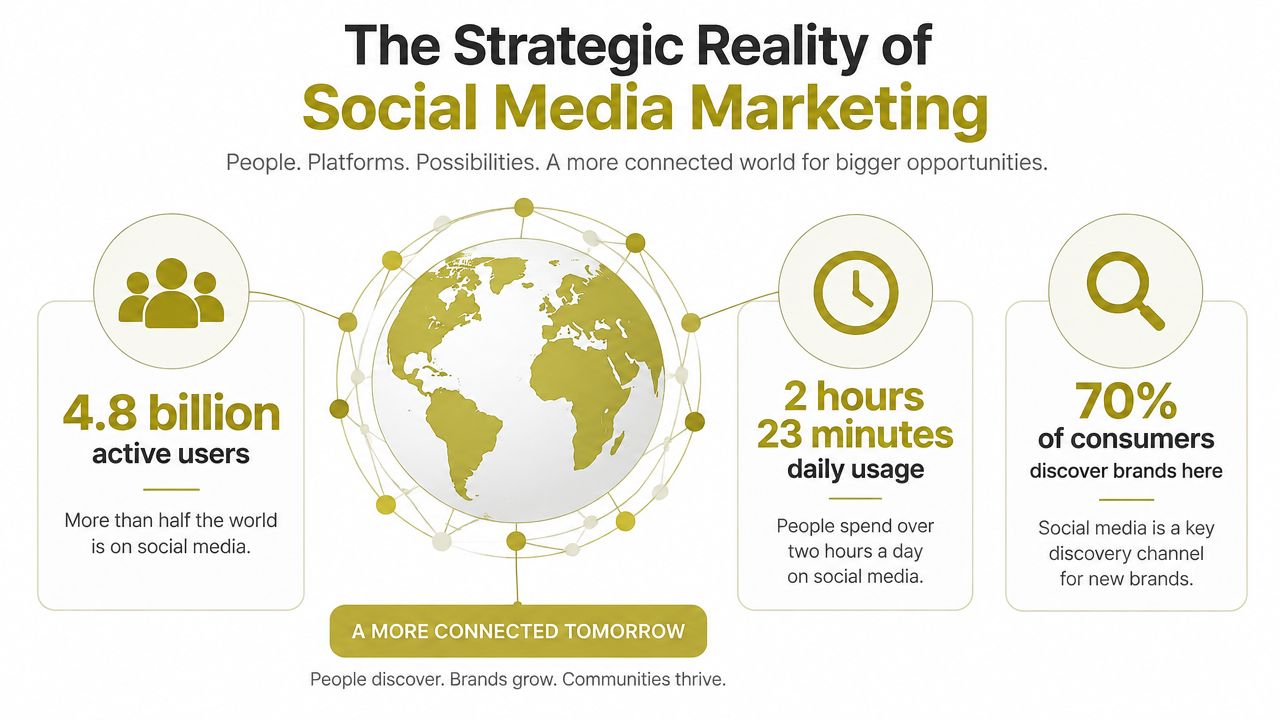
The more commercially significant finding is that 48.6% of adult internet users use social media to find information about brands and products, as reported in Digital 2025 for the United Kingdom. A social profile can therefore function like a public research file. Prospective customers assess the organisation's expertise, tone, responsiveness and credibility before they ever complete a form or contact a sales team.
That changes the strategic brief. Posting attractive images may support recognition, but it doesn't explain why a prospect should choose one business over another. A useful social presence answers real questions, demonstrates standards and makes the next step obvious.
Reach is only the starting point
UK social media reach is substantial. DataReportal's January 2025 figures record 54.8 million social media user identities in the UK, equivalent to 79.0% of the total population, while 80.8% of internet users used at least one social platform. These figures explain why social belongs in core marketing planning rather than sitting at the edge of the communications mix.
Yet a large audience doesn't guarantee useful attention. Ofcom's research also records a fall in the proportion of adult social media users who actively posted, shared or commented, from 61% in 2024 to 49%, meaning that businesses must work harder to create interaction and should not confuse reach with intent.
A senior strategy begins with a commercial question: what should a person do after encountering this content? The answer might be researching a service, joining a mailing list, requesting a proposal, booking an appointment or contacting the organisation about a concern. That is the difference between social activity and social marketing.
For a practical foundation, a clear communications strategy should define the audience, message, channel role, proof points and desired response. Without that framework, businesses often produce a stream of disconnected posts that may look busy while leaving the market unclear about what the organisation actually offers.
Core Business Value Drivers
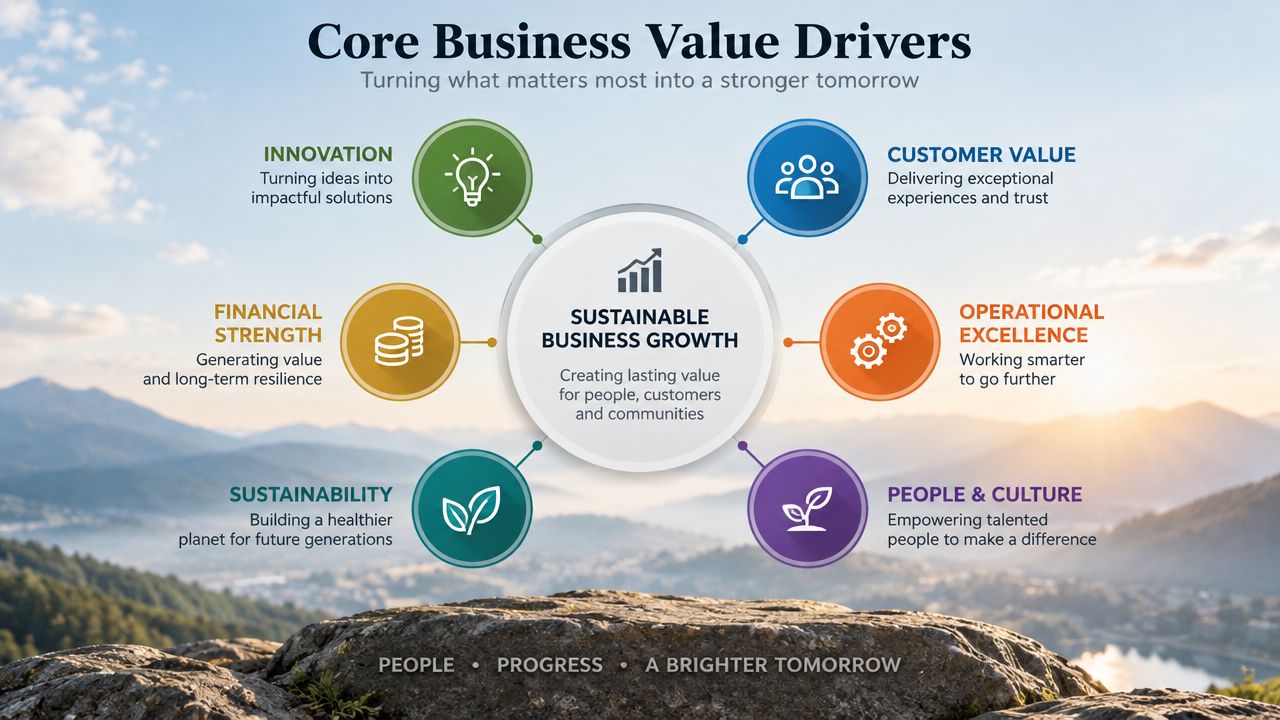
Social media creates business value through several linked mechanisms, but they shouldn't be treated as interchangeable. Awareness introduces the organisation, engagement builds familiarity and confidence, acquisition turns attention into an enquiry, and retention protects the relationship after purchase.
Awareness earns consideration
A consistent presence gives a business repeated opportunities to establish what it does and whom it serves. That doesn't mean publishing for the sake of frequency. It means presenting recognisable themes, distinctive points of view and credible evidence across the places where relevant audiences spend time.
UK audiences use an average of 4.8 different social platforms each week, according to Kantar's UK social media research. A prospect may encounter a company through a LinkedIn explanation, later see a video on Instagram and then check its website before making contact. Consistency across those encounters matters more than producing identical content everywhere.
Engagement reveals intent
Engagement is useful when it signals a question, objection or emerging need. A thoughtful comment from a prospective buyer, a direct message requesting detail or a save of an explanatory post carries more strategic meaning than a high volume of low-context reactions.
Two-way communication also gives organisations an early view of reputation. Customers explain where service is confusing, what language resonates and which claims need substantiation. A business that responds with clarity can turn a public question into evidence of competence.
Practical rule: Treat comments and messages as market intelligence, not merely as a task for the publishing calendar.
Acquisition needs a bridge
Social content can create demand, but the business still needs a credible route from interest to action. That route might lead to a focused landing page, a consultation form, a tracked telephone number, an event registration or a product page. The content should make the transition feel logical, rather than forcing every visitor through a generic homepage.
Paid social is particularly useful when an organisation has a defined audience, a strong proposition and enough conversion data to improve targeting. UK-focused research reports that paid social delivers around £2.50 for every £1 spent, with average ROI around 250%, although results vary by sector, creative quality and targeting precision, as explained by ProfileTree's UK social advertising research. That figure should inform testing, not serve as a promise.
Retention protects reputation
Customer service on social channels is visible to more than the person asking the question. A prompt, accurate response can reassure other customers who have the same concern, while silence can suggest indifference or disorganisation.
This is especially important for tourism, hospitality, public-facing services and regulated sectors. Clear escalation rules, approved response principles and sensible access to senior decision-makers help teams distinguish an ordinary service issue from a developing reputational risk.
Carlos Alba Media's specialist nature reflects this need for both editorial judgement and commercial discipline. Everyone who works for Carlos Alba Media is a former national news journalist or has agency experience of working with international brands. That background helps consultants identify the human question inside a commercial message, test whether a claim will withstand scrutiny and shape responses that protect trust rather than fill a content slot.
Choosing the Right Platforms for Your Audience
Platform selection should follow audience behaviour and business purpose, not fashion. A B2B consultancy, a whisky experience, a software start-up and a lifestyle retailer may all use social media, but they shouldn't use the same editorial format or measurement model.
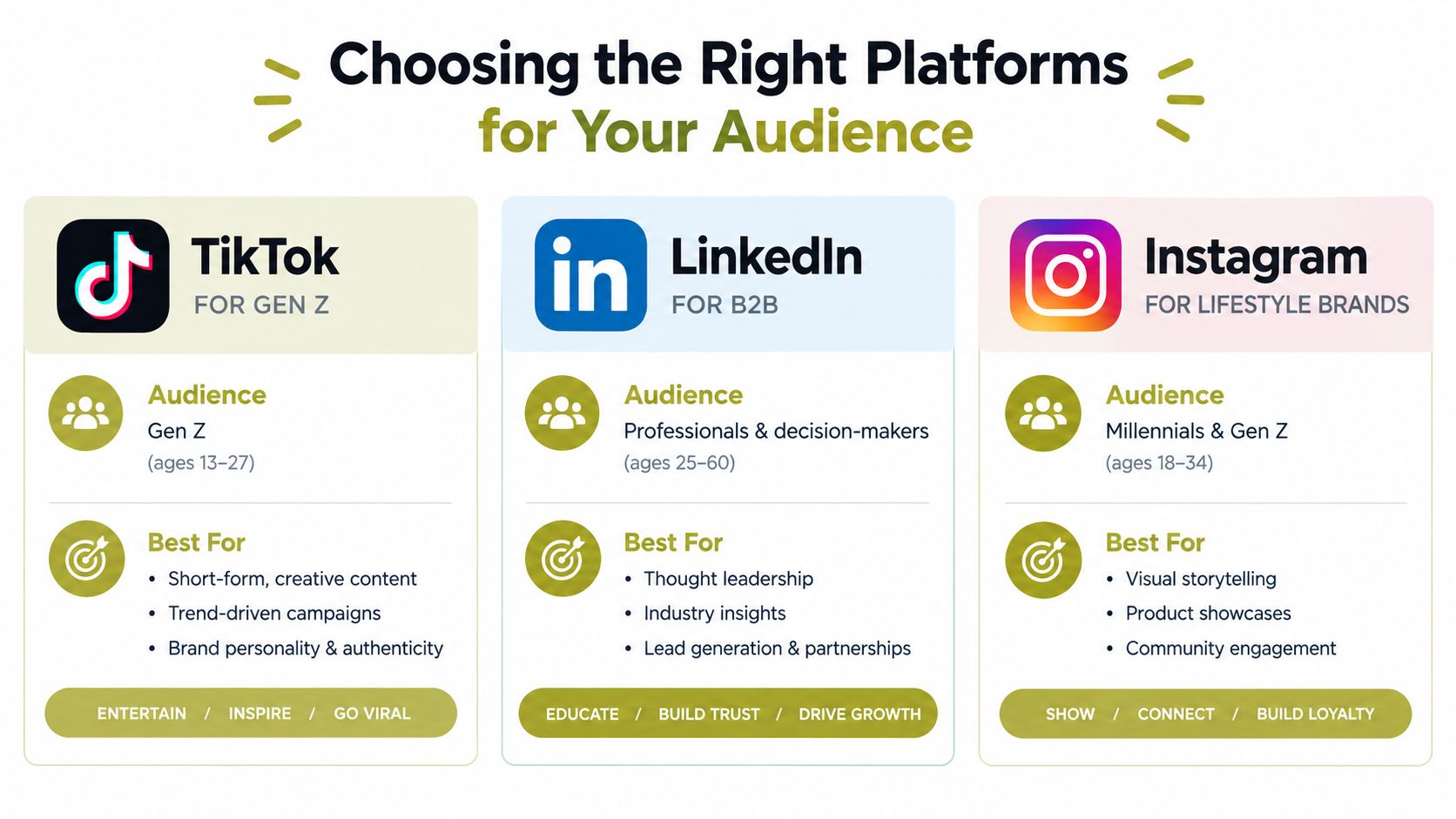
Kantar's finding that people use an average of 4.8 platforms each week supports a coordinated approach, but it doesn't justify copying every post across every network. Each channel should have a job.
| Platform type | Strongest use | Editorial requirement |
|---|---|---|
| B2B expertise, recruitment and stakeholder confidence | Explain decisions, evidence and implications | |
| Lifestyle, hospitality, visual identity and community | Show the experience, people and details | |
| TikTok | Discovery through short-form video and personality | Use a clear hook and native, human delivery |
| Facebook and Messenger | Broad adult reach, local communities and customer contact | Combine useful information with responsive moderation |
| YouTube | Explainers, demonstrations and searchable video | Answer a specific question thoroughly |
YouTube reaches 94% of UK adults, Facebook and Messenger reach 93%, and WhatsApp reaches 90%, according to UK social media marketing research from ProfileTree. These broad-reach channels may suit organisations that need to communicate with customers across age groups, while specialist channels can support narrower objectives.
The choice should also reflect the organisation's production capacity. A company with strong subject-matter experts may create useful LinkedIn analysis and filmed explainers. A hospitality brand with access to distinctive locations may find visual storytelling more natural. A regulated organisation may need a careful approval process before it commits to fast-moving formats.
The practical test is simple:
- Audience fit: Can you identify the people you need to reach on the platform?
- Content fit: Can your team produce material that belongs there?
- Commercial fit: Can you connect activity to a meaningful action?
- Operational fit: Can you monitor questions, complaints and emerging risks?
A smaller number of well-managed channels will usually outperform a broad but neglected presence. Distribution should be coordinated, while creative execution remains platform-specific.
Integrating Social Media with Broader Marketing
Social media performs best when it carries a clear narrative into several parts of the marketing system. A press announcement can become a concise executive post, a customer question can shape an SEO article, and a strong piece of owned content can give paid campaigns a more credible destination.
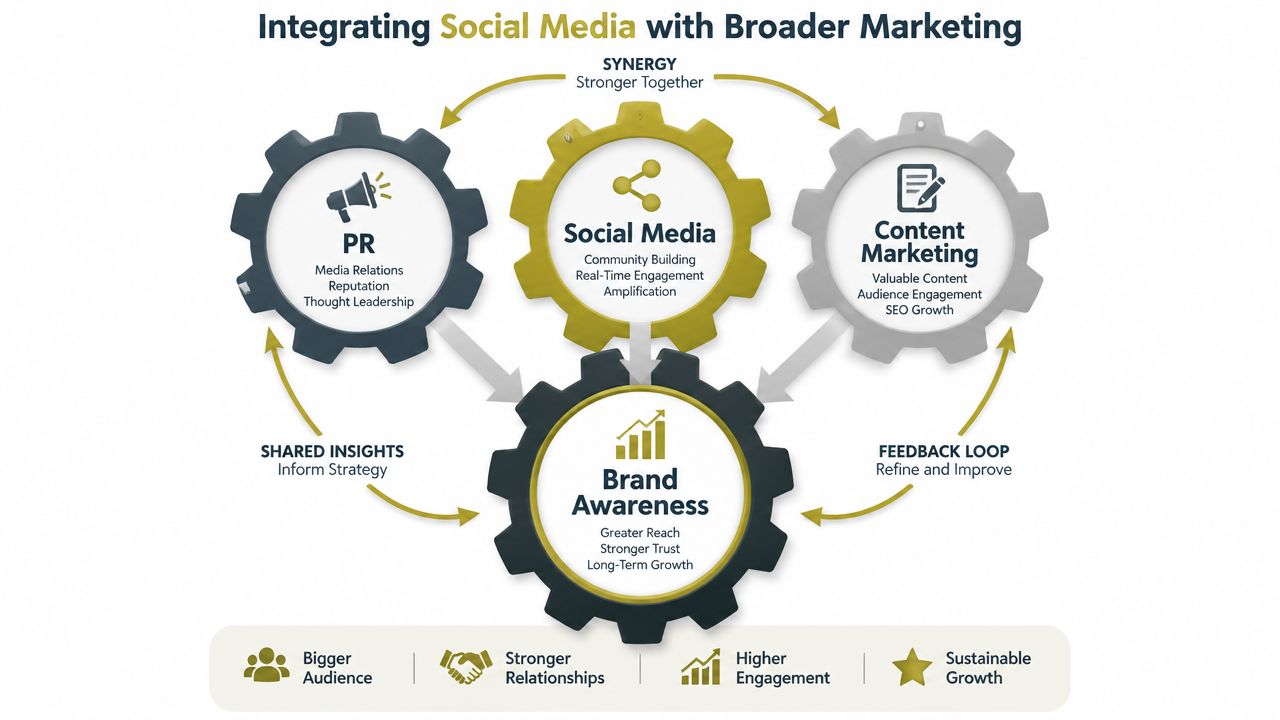
Former national newsroom experience is valuable here because strong campaigns depend on editorial judgement. Journalists ask what is new, why it matters, who is affected and what evidence supports the claim. Those questions prevent social content from becoming a collection of empty announcements.
One story, different treatments
A campaign should have a central proposition, but not a single repeated execution. The website can hold the full explanation. LinkedIn can focus on the business implication. Instagram can show the people or experience behind it. A media pitch can identify the public-interest angle, while paid social can reach a carefully defined audience with a direct response.
This approach also helps teams make better use of earned coverage. A published interview or broadcast appearance becomes a trust asset when the organisation shares it with context, identifies the relevant point and directs interested readers to a useful next step. Merely posting a logo and a headline wastes much of the credibility the coverage created.
A PR and social media programme should therefore align messages, timing and responsibilities. It should also state who handles replies when a campaign attracts criticism, who approves factual corrections and which issues require escalation.
Social gives campaigns feedback
Traditional media and PR can create visibility, but social channels reveal how audiences interpret the message. Comments, questions and private messages expose confusion that website analytics may not explain. They also provide language that can improve future headlines, landing pages and sales conversations.
The strongest integration is cyclical. Research informs the story, PR earns attention, social distributes and tests the narrative, content answers deeper questions, and the resulting audience behaviour informs the next campaign. That system produces a more coherent public presence than isolated teams publishing without shared objectives.
Measuring Success and Proving ROI
Likes and follower counts can describe activity, but they rarely prove commercial value. Measurement should begin with the business outcome, then work backwards to the actions that indicate progress.
A lead-generation campaign might track form completions, tracked phone calls, downloads, newsletter sign-ups and event registrations. A reputation programme might monitor the quality and tone of conversations, the speed of response and the reach of authoritative explanations. A retention programme could focus on resolved service issues and returning customers.
Build the measurement chain
Use a straightforward sequence:
- Define the outcome. Choose an enquiry, booking, sale, registration or reputation objective.
- Map micro-conversions. Record the smaller actions that show movement towards that outcome.
- Instrument every route. Use UTM parameters, platform tracking and GA4 conversion events.
- Connect the data. Match campaign, landing page and sales records where privacy and consent rules allow.
- Review quality, not only volume. A smaller number of relevant enquiries may be more valuable than a larger number of poorly matched leads.
UK research specifically recommends mapping micro-conversions in GA4 with conversion events and UTM parameters, because these mechanisms show how social activity contributes to the customer journey, not only what happens inside the platform. The same research reports paid social at around £2.50 returned for every £1 spent, with average ROI around 250%, but those outcomes depend on targeting, creative, landing-page relevance and accurate instrumentation, as set out in UK paid social effectiveness research.
Separate attention from action
Reach can indicate distribution. Video views can indicate exposure. Comments may indicate relevance. None of those metrics automatically represents revenue.
A useful dashboard places platform data beside website and commercial data. Track the campaign name, audience, spend, landing page, conversion event, qualified lead status and eventual outcome. Review the path for assisted conversions as well as last-click results, because social may introduce a prospect who converts later through search, email or a direct visit.
For a deeper framework, proving social media ROI is useful when senior stakeholders need a clear link between activity, cost and business return. Carlos Alba Media also provides guidance on measuring social media engagement, including the distinction between visible interaction and meaningful audience response.
The discipline is managerial as much as technical. If a campaign generates attention but no qualified action, change the proposition, audience, creative or destination. Don't just publish more content and hope the gap closes.
Common Pitfalls and Strategic Solutions
The most common mistake is treating social media as a publishing schedule. A full calendar can still contain weak ideas, unclear calls to action and no route into the sales or service process.
Another failure is using one creative treatment everywhere. A long technical explanation may suit LinkedIn, while a short demonstration may suit TikTok. Copying the same asset across channels ignores audience expectations and wastes the distinctive strengths of each platform.
Analytics also gets neglected. Teams celebrate reach while failing to label campaigns, track enquiries or review lead quality. That leaves senior decision-makers unable to distinguish useful visibility from expensive noise.
Customer service creates a similar blind spot. If a business invites conversation but doesn't respond clearly, it turns an opportunity to build trust into public evidence of poor attention. Regulated and high-risk organisations need response protocols before a difficult issue arrives, not after it begins to spread.
The remedy is a concise operating system:
- Set a commercial objective: Define what social should help the organisation achieve.
- Assign channel roles: Give each platform a clear audience and purpose.
- Create editorial standards: Check claims, tone, accessibility and approval requirements.
- Track the journey: Use UTMs, conversion events and meaningful lead records.
- Review and refine: Stop formats that attract attention without useful action.
The specialist value of a senior consultancy lies in making those decisions early. Former journalists know how to find the material that deserves attention, while agency practitioners understand how to adapt it for audiences, channels and commercial goals. Social media becomes an asset when those disciplines work together.
Carlos Alba Media provides social media strategy, brand storytelling, PR, digital content and reputation support for start-ups, SMEs and established organisations across Scotland, the wider UK and internationally. If your social activity is generating visibility but not enough qualified enquiries or trust, visit Carlos Alba Media to discuss a practical strategy built around your audience, channels and measurable business outcomes.
[…] broader explanation of channel planning sits within why social media marketing is important, but community management begins where the audience talks back. It needs a named owner who can […]