
Community management is the ongoing, two-way work of building and protecting relationships across digital channels. In the UK, that means serving a mainstream audience of 54.8 million social-media user identities, representing 79.0% of the population, including 47.9 million adults, or 87.0% of people aged 18 and over.
A founder can schedule polished posts all week and still miss the conversation that matters. A customer complaint gathers attention on X, a sceptical Reddit thread challenges a product claim, and a journalist wants a response before the end of the working day. The problem isn't a lack of content. It's the absence of a clear owner who can listen, judge risk, respond accurately and move the issue to the right person.
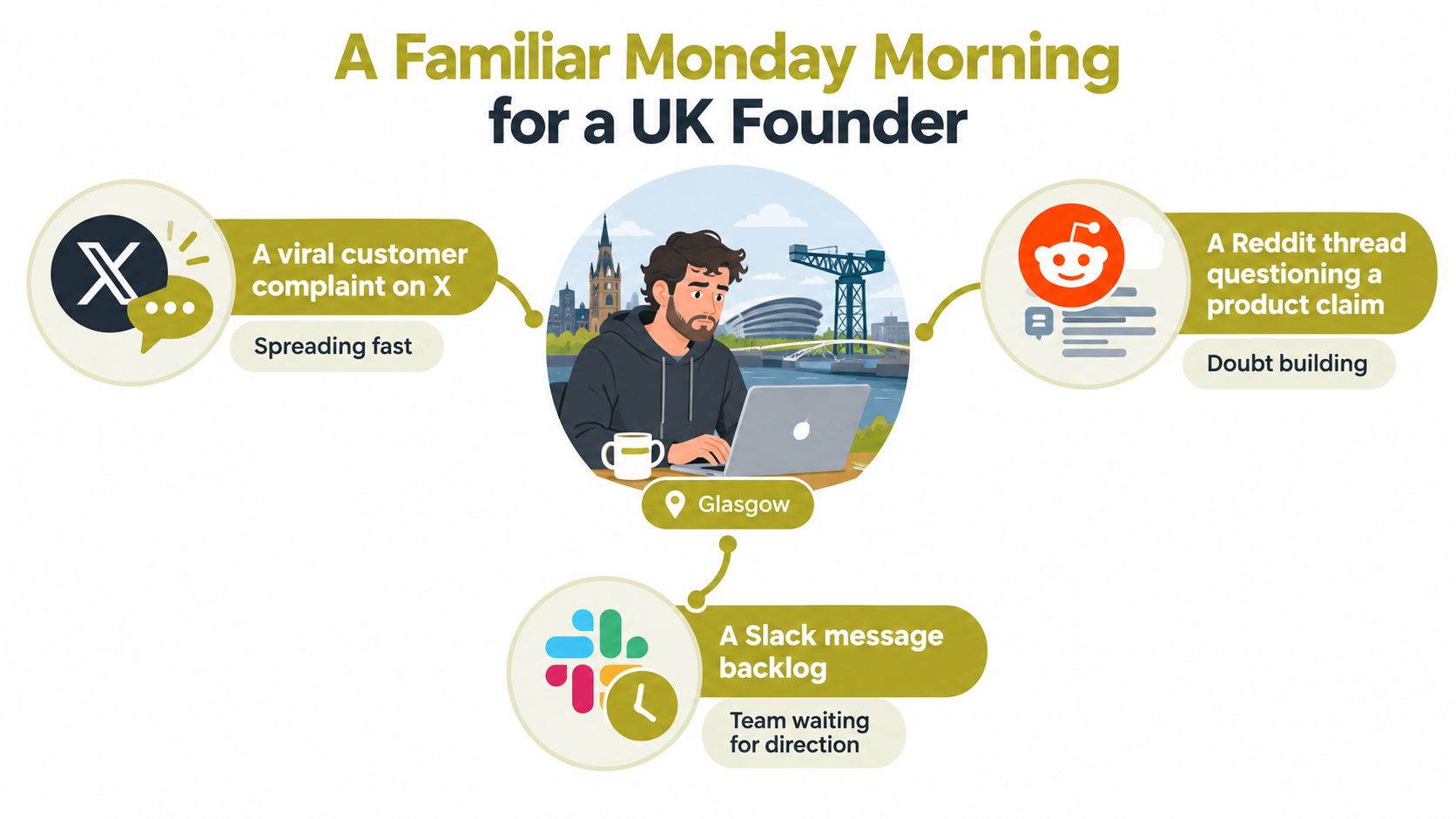
A Familiar Monday Morning for a UK Founder
At 8.15am, a Glasgow-based founder opens Slack and sees three messages marked urgent. A customer complaint on X is spreading quickly. Someone has posted a Reddit thread questioning whether the company's product claim is accurate. A journalist has emailed requesting comment by 5pm.
The marketing calendar offers no help. It contains next week's product announcement and a batch of pre-approved lifestyle posts. Nobody has agreed who should answer the complaint, whether the Reddit discussion requires a technical response, or when the journalist should be briefed. The founder now has to make customer-service, public-relations and risk decisions before the first meeting.
That situation captures what community management is more accurately than a job description built around posting frequency. It's the structured practice of building, supporting and maintaining relationships between an organisation and the people who interact with it, across social networks, forums, messaging channels and other digital spaces.
The work includes:
- Listening: Finding recurring questions, complaints, misconceptions and emerging needs.
- Responding: Giving useful answers in the channel and tone members expect.
- Moderating: Applying rules consistently and reducing harmful or disruptive content.
- Escalating: Moving legal, safeguarding, technical and reputational risks to qualified owners.
- Learning: Feeding conversations back into product, service, policy and communications decisions.
- Protecting trust: Making sure the organisation behaves consistently when attention turns negative.
The UK audience is broad rather than niche. The gender split among social-media identities was almost even, with 49.9% female and 50.1% male identities in January 2025, according to DataReportal's UK digital overview. For a start-up, tourism operator or regulated business, public conversations can involve customers, residents, employees, journalists, partners and critics at the same time.
The governance difference
Community management becomes governance work when a brand hosts or participates in a space where other people interact. Ofcom describes content moderation as activity that removes or reduces the visibility of potentially harmful content. That definition matters because moderation is not just about deleting comments a team dislikes. It requires rules, reporting routes, severity levels, records and a fair way to make decisions.
A practical community manager therefore needs more than a friendly writing style. They need a moderation playbook, response standards, escalation contacts and enough judgement to distinguish an ordinary complaint from a potential safety, legal or crisis issue.
Practical rule: If nobody knows who owns a difficult conversation, the organisation doesn't have a community process. It has a collection of personal reactions.
Community management supports growth because it helps people find answers, understand the organisation and recommend it to others. It supports reputation because the public can see whether the organisation responds transparently under pressure. It supports customer experience because repeated conversations reveal where products, services and policies create friction.
For a UK SME, the working definition is simple enough to use in a board meeting: community management is accountable stewardship of conversations, relationships and risk across digital spaces. Posting can support that work, but posting alone isn't the work.
Community Management vs Social Media Management vs Community Building
These disciplines overlap, but they solve different problems. Community management cares for relationships inside active spaces. Social media management plans, creates and distributes brand content. Community building develops a network around a shared interest, often over a longer period and across several channels.
| Discipline | Primary purpose | Time horizon | Core activities | Core KPIs | Typical owner |
|---|---|---|---|---|---|
| Community management | Maintain trust and useful interaction | Continuous | Replying, listening, moderating, escalating | Resolution quality, retention, response time | Community manager, customer experience or PR lead |
| Social media management | Publish and distribute brand content | Campaign and editorial cycles | Planning, copy, creative, scheduling, reporting | Reach, impressions, traffic, content response | Social media manager or marketing team |
| Community building | Grow a connected member base | Long term | Events, advocacy, member programmes, partnerships | Participation, referrals, repeat contribution | Community lead, partnerships or brand team |
The distinction affects staffing. If an SME gives one person all three responsibilities without priorities, scheduled content will usually win because it's easier to plan and report. Conversations then go unanswered, moderation becomes inconsistent and nobody maintains the evidence needed for a crisis review.
A founder deciding what to commission should ask three questions. Do we need better content distribution? Do we need daily care of an existing audience? Or do we need to create a member network around a shared purpose? The answer determines the role, workflow and measures.
A broader explanation of channel planning sits within why social media marketing is important, but community management begins where the audience talks back. It needs a named owner who can combine responsiveness with judgement, rather than treating every interaction as another publishing task.
Responsibilities and KPIs That Actually Matter
A capable community manager is accountable for five connected areas. Member support means answering questions and resolving friction. Moderation and governance means applying rules, recording decisions and escalating risk. Content collaboration means turning recurring questions into useful posts, guides or product updates.
Insight gathering turns conversation into business intelligence. Crisis readiness ensures the team can recognise a pattern before it becomes a public incident. Those responsibilities need measures that show whether people are receiving value, not just whether the brand is attracting noise.
The Community and Engagement Survey for 2025/26 offers a useful warning. 46% of people in England aged 16 and over took part in civic participation, consultation or activism, yet only 26% agreed they could influence decisions affecting their local area. Participation volume and meaningful influence aren't the same outcome.
| Metric group | Example KPIs | What it tells you | Watch out for |
|---|---|---|---|
| Trust and quality | Response quality, resolution time, repeat participation | Whether members receive useful and credible help | Fast replies that don't solve the problem |
| Relationship health | Member retention, referral rate, returning contributors | Whether the community creates ongoing value | Rewarding only the loudest participants |
| Governance | Report volume, repeat violations, appeals, escalation completion | Whether rules are understood and applied consistently | Deleting difficult criticism without a record |
| Reach and activity | Followers, impressions, post count, comment volume | How far activity travels | Mistaking visibility for trust or influence |
A small business rarely needs a thirty-row dashboard. Three or four honest measures are more useful: resolution time, response quality, repeat participation and a business outcome linked to the community's purpose. For a tourism brand, that might mean clearer visitor information and fewer avoidable complaints. For a regulated firm, it might mean documented answers and better escalation discipline.
Use how to measure social media engagement as a starting point for selecting useful measures, then remove anything the team won't review and act on. A metric earns its place when it changes a decision.
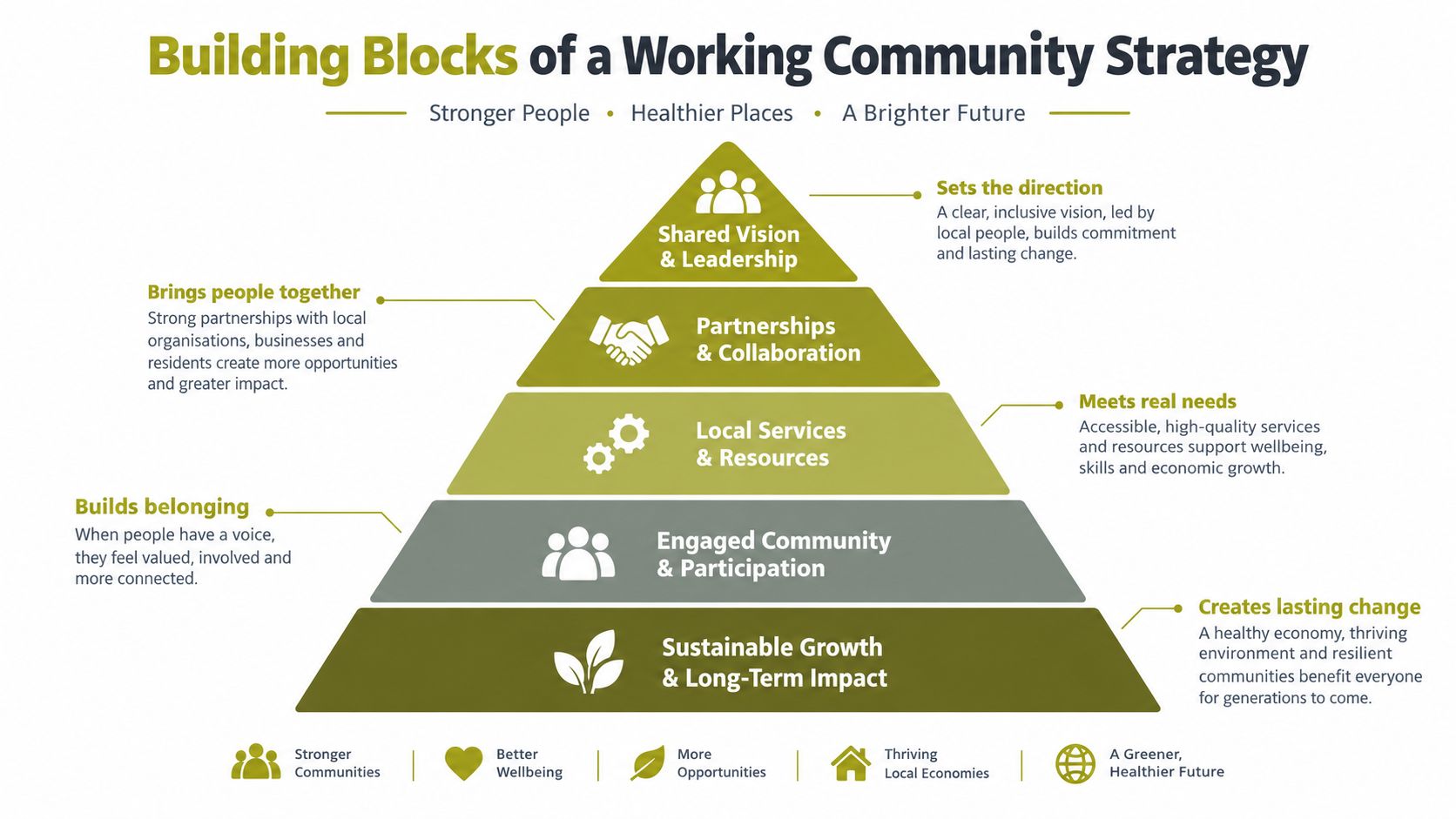
Building Blocks of a Working Community Strategy
A working strategy starts with a member promise. State who the space serves, what people can expect and what the organisation will contribute. “A place to ask questions” is clearer than “a vibrant community”, because it guides moderation, content and staffing.
The second decision is audience and platform mix. UK usage differs materially by channel. Ofcom's 2025 findings recorded YouTube reaching 94% of UK adults, with 51 minutes of average daily use, while Facebook and Messenger reached 93%, with 43 minutes of daily use. Instagram reached 78% of UK adults, around 38.5 million people, and Reddit's UK audience grew 28% year on year to reach 60% of UK internet users, as summarised by UK social media screen-time and reach data.
That doesn't mean a brand should appear everywhere. Choose channels where the audience already asks questions and where the organisation can maintain a credible presence. YouTube may suit demonstrations, Facebook or Messenger may suit customer support, Instagram may suit visual participation, and Reddit may require specialist discussion monitoring.
The operating layer
A one-page playbook should contain:
- Purpose and audience: The member promise and the people it serves.
- Rules: Acceptable behaviour, prohibited content and how decisions are explained.
- Response standards: Who replies, in what tone, and how urgent issues are handled.
- Escalation routes: Named contacts for technical, legal, safeguarding and media concerns.
- Conversation plan: Recurring questions, useful formats and planned listening moments.
- Feedback loop: How insights reach product, service, leadership and communications teams.
- Review cadence: When rules, examples and measures are reassessed.
The best playbooks are usable during a busy Monday, not impressive in a strategy folder. Teams looking to strengthen the operational side can review community engagement systems that work for planning ideas, then adapt the approach to their own audience and risk profile.
Newsroom discipline improves the system. Use a named voice, verify claims before publishing, distinguish confirmed information from uncertainty and correct mistakes visibly. Communities punish vague answers because members have to fill the gaps themselves. A useful strategy makes accuracy and accountability part of the everyday workflow.
Tools, Workflow and Choosing the Right Stack
Start with workflow, not software. A small team needs one place to see relevant conversations, one owner for each channel, one escalation record and one lightweight dashboard. A complex stack won't compensate for unclear responsibility.

Four tool categories cover most SME requirements:
- Listening and monitoring: Social listening, platform alerts, review monitoring and keyword tracking help the team find questions and emerging issues.
- Engagement and scheduling: A primary publishing tool and shared inbox prevent replies from becoming trapped in personal accounts.
- Moderation and governance: Filters, reporting queues, escalation logs and shared decision records create an audit trail.
- Measurement: A simple dashboard should connect directly to the KPIs selected for the community's purpose.
A practical handover says who checks the inbox, who answers technical questions, who approves sensitive statements and who contacts the PR or legal lead. It also records what happened, not just what was published. That record becomes valuable when a complaint repeats or a journalist asks how the organisation reached a decision.
Before choosing software, teams can compare top social media tools against their actual workflow. The right choice reduces the time between hearing and responding. The wrong choice adds another dashboard nobody opens.
AI can help with sorting, summarising and drafting routine responses, but it shouldn't make unreviewed decisions about allegations, safety, sanctions or sensitive customer information. The Reuters Institute reported that 56% of UK journalists surveyed in 2025 used artificial intelligence professionally at least once a week, a useful indication that automation and editorial judgement now work together in newsroom-style environments, as detailed in its 2025 journalism insights.
Carlos Alba Media is one option for SMEs that need community engagement alongside PR, digital marketing and crisis communications, with teams in London and Glasgow providing senior-level counsel without a large-agency structure.
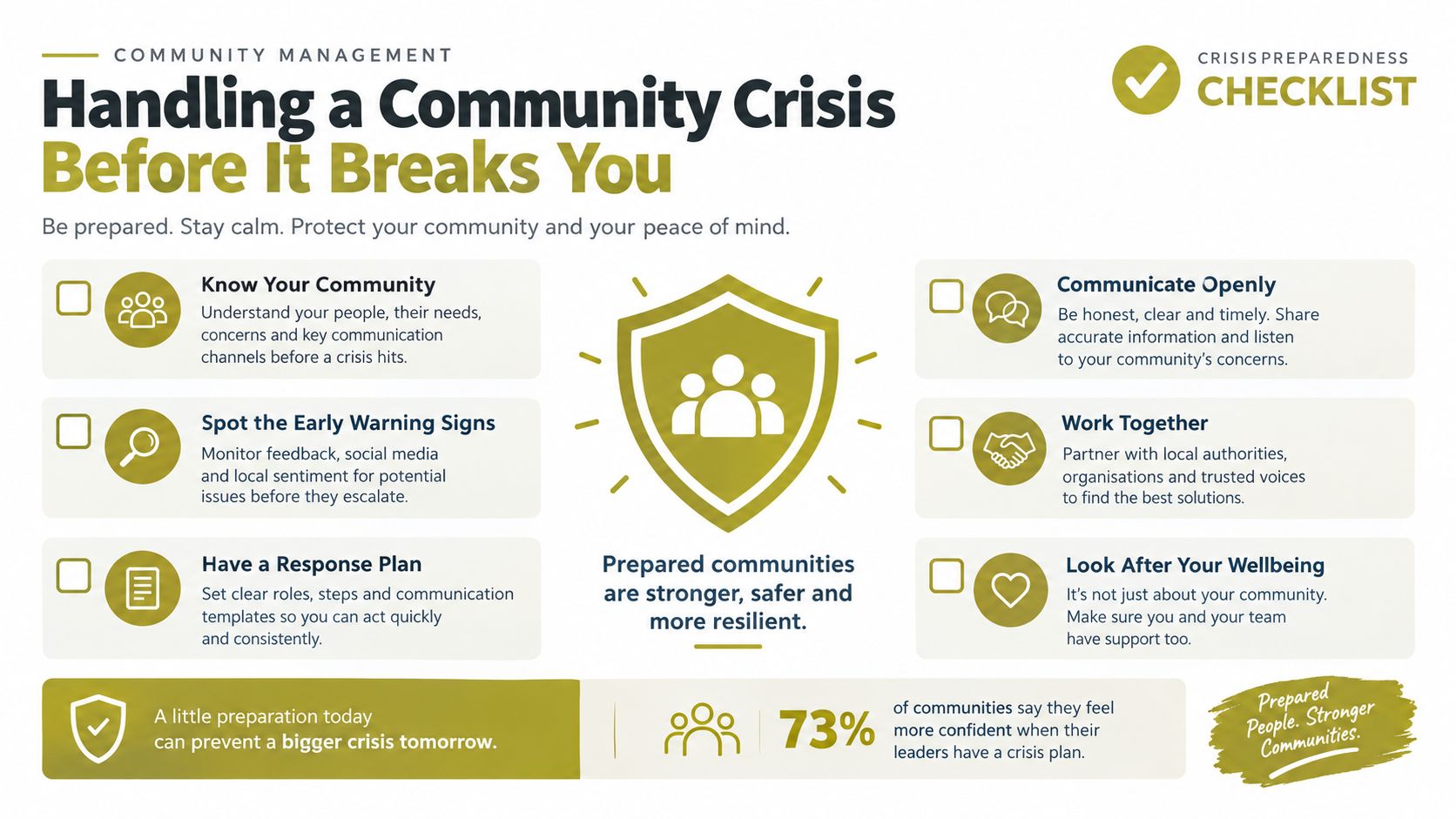
Handling a Community Crisis Before It Breaks You
A crisis rarely begins as a crisis. It may start with one complaint, then attract supporters, expose an old issue and reach a journalist. The community manager's job is to recognise the change in scale and switch from ordinary engagement to controlled incident management.
Three escalation levels
Level one, an individual complaint. The community owner should acknowledge the issue, verify the facts and move personal details into a private channel where appropriate. The public response should explain what can be checked and when the person will hear back.
Level two, a coordinated negative thread. A senior communications or customer-service owner should join the response. The team needs a single factual position, an internal record of claims and a decision on whether technical, legal or safeguarding advice is required.
Level three, mainstream or trade-press attention. The community manager should stop improvising and route all public statements through the designated communications lead. A holding response should confirm awareness, state what is being investigated and avoid promising an outcome that hasn't been established.
The Digital News Report 2025 found that 58% of respondents were concerned about distinguishing truth from falsehood in online news, while UK news trust had declined by 16 points since 2015. In that environment, a confident but unverified reply can do more damage than a careful holding statement.
Deletion should be reserved for content that breaches published rules, creates a safety risk or exposes personal information. Criticism and inaccurate claims usually need a documented response, correction or escalation rather than silent removal. Moderators also need protected handovers, access to support and permission to step away from abusive exchanges.
A quarterly rehearsal should test:
- Ownership: Who makes the final decision?
- Facts: Where will the team verify the claim?
- Channels: Which public and private responses are required?
- Escalation: When do legal, safeguarding or crisis specialists join?
- Records: Where are decisions, edits and outcomes documented?
- Review: What will change after the incident?
Teams dealing with criticism can also use how to respond to criticism as a practical reference. The strongest response is prepared before the first post attracts attention.
SME-Focused Examples and What to Steal From Them
A tourism and hospitality SME may receive repeated questions about parking, accessibility, weather disruption and seasonal availability. A community manager can turn those questions into a living visitor guide, answer individual concerns publicly where useful and flag repeated confusion to the operations team. The newsroom-style decision is to separate confirmed visitor information from assumptions, especially when conditions change.
A regulated services firm faces a different pressure. A complaint thread may reveal that customers don't understand a policy or can't find a required explanation. The right response isn't defensive wording. The manager records the concern, brings in the policy owner, publishes a clear explanation and reports whether the change reduced confusion.
A Scottish technology start-up may use a private product community to gather feature insight and support prospects during evaluation. The community manager has to distinguish a genuine product request from a promise the company can't responsibly make. Sales can learn from the discussion, but the space mustn't become an unmoderated claims channel.
The transferable patterns are straightforward:
- Answer the recurring question once, clearly and accessibly.
- Turn credible criticism into an input for improvement.
- Keep commercial enthusiasm separate from verified product capability.
- Give specialist members a route to influence without allowing one voice to dominate.
Teams with newsroom and agency experience approach these situations by asking what is known, what is contested, who is affected and what evidence supports the next response. The Reuters Institute's 2023 survey found that approximately 40% of surveyed UK journalists worked in senior editorial or reporting roles, including editors, reporters and senior reporters, as reported in its UK journalism employment findings.
Carlos Alba Media's specialist team combines former national news journalists and professionals with agency experience working with international brands. That background is relevant when a community issue needs publication-ready judgement, not just a quick reply.
The mistakes to avoid are predictable: launching a channel without a response owner, deleting criticism without recording why, promising an investigation that nobody completes, and reporting comment volume as proof of trust.
A 90-Day Plan to Make Community Management Work
Use the first phase to define the operating agreement. Over the opening weeks, write the member promise, identify priority audiences, select channels and approve rules. One owner, one output: the marketing or communications lead owns a one-page community brief. The review point is whether a new team member could understand the purpose and boundaries without a meeting.
The second phase turns the brief into practice. Set up listening alerts, a shared inbox, moderation examples, escalation contacts and a small dashboard. One owner, one output: the community lead produces a working playbook and tests it against recent conversations. The review point is whether the team can locate, classify and route an issue without relying on memory.
The final phase tests resilience. Run a controlled crisis rehearsal, review member feedback and remove measures that don't inform decisions. One owner, one output: the senior communications owner signs off the revised playbook. The review point is whether the organisation can respond consistently when the issue crosses customer service, PR, legal or safeguarding boundaries.
Community management turns an audience into an organisational asset only when people receive useful answers, fair treatment and evidence that their participation matters. Treat it as governance-grade work, use tools to support judgement rather than replace it, and bring in experienced communications support when the risk exceeds the team's capacity.
Carlos Alba Media helps UK start-ups, SMEs and established organisations manage two-way engagement alongside PR, digital marketing and crisis communications. Visit Carlos Alba Media to discuss a practical community programme built around your channels, risks and commercial priorities.