
Let's be honest, treating PR & social media as separate jobs is a recipe for wasted effort. In today's market, these two roles are two sides of the same coin. A brilliant social media post can spark a national news story, just as a powerful piece of media coverage can fuel your online conversations for weeks.
Why PR and Social Media Belong Together
Think of it this way. Imagine you have a PR team that only talks to journalists and a social media team that only posts online. One lands a huge story in a national paper, but the other team doesn't know about it until a week later. It’s a massive missed opportunity. The story should have been all over your social channels the moment it broke.
This is the fundamental problem with running these functions in silos. You get disjointed messages and a brand that feels inconsistent. The magic happens when they work together, creating a powerful echo chamber where every story, whether it starts on social media or in the press, amplifies the other.
A truly great story has to work for two very different audiences: the sceptical news editor and the endlessly scrolling social media user. This requires a rare blend of skills—knowing what makes a story newsworthy and, at the same time, what makes it shareable. Without that connection, your best ideas will never reach their full potential.
From Siloed Efforts to an Integrated Strategy
The old-school approach of keeping marketing departments in separate boxes just doesn't cut it anymore. It leads to confused messaging and money down the drain. A modern, effective strategy demands that PR and social media operate as one unified force.
Let’s look at how this shift in thinking changes the game.
| Marketing Function | The Old Siloed Approach | The Modern Integrated Approach |
|---|---|---|
| Story Pitching | A press release is sent to journalists, and that's the end of it. | A story is pitched to media while a coordinated social media campaign is ready to launch the moment it goes live. |
| Content Creation | Social media posts are created independently, often missing key brand messages. | Content is built around core PR narratives, ensuring every post, tweet, and video reinforces the main story. |
| Audience Engagement | Comments are handled by a junior social media manager with no PR context. | Community management is informed by PR strategy, turning online conversations into valuable insights and even new story angles. |
| Campaign Measurement | PR measures column inches; social media measures likes and shares. | Success is measured holistically, tracking how media hits drive web traffic, social engagement, and sales leads. |
Seeing them laid out like this makes it obvious. The integrated approach isn't just better; it’s the only one that makes sense for building a resilient, trusted brand today.
At Carlos Alba Media, our approach is built on this very principle. Everyone who works for us is either a former national news journalist or has extensive agency experience working with international brands. This specialist expertise means we are trained to spot and shape narratives that achieve this dual impact, creating an echo chamber where a social media spark can become a significant media story.
This deep expertise in storytelling is what separates an average campaign from a truly impactful one. It's about knowing precisely how to craft a message that will pass the scrutiny of a seasoned editor while also capturing the imagination of a scrolling social media user.
By bringing PR & social media together, you create a self-sustaining cycle of success:
- Amplified Reach: Great press coverage gives you credible content to share, driving new followers and engagement.
- Enhanced Credibility: A story validated by a trusted journalist automatically lends weight and authority to your social media presence.
- Deeper Engagement: Your social media channels become a real-time focus group, giving you direct feedback to shape future PR angles.
- Consistent Messaging: Your brand’s voice and story remain clear and powerful everywhere, from a national newspaper to a single Instagram post.
Ultimately, integrating these two functions means every pound you invest in marketing works harder. You’re not just sending out messages; you’re building a solid, unified structure for your brand’s reputation that will pay dividends for years to come.
Building Your Strategic PR and Social Media Foundation
If you want to build a brand with real staying power, you can't just throw things at the wall and see what sticks. You need a proper plan. For any founder or business owner getting serious about integrating pr & social media, the most effective blueprint is the PESO model.
Think of the PESO model as the architectural drawings for your brand's reputation. It makes sure every blog post, every media pitch, and every social media update all contribute to the same strong, coherent structure. It organises your efforts into four distinct but connected areas: Paid, Earned, Shared, and Owned.
Getting your head around how these four pieces work together is the first step towards a strategy that actually moves the needle.
The Four Pillars of the PESO Model
Let’s stick with the house-building idea to keep things simple. Each part of the PESO model has a crucial job in building a brand that can weather any storm.
Owned Media (The Foundation): This is everything you have complete control over. It’s your website, your blog, and your email newsletters. This is the solid ground you build everything else on—the one place where your message is totally unfiltered.
Earned Media (The Walls and Structure): This is classic PR territory: getting other credible sources to talk about you. Think newspaper articles, online features, podcast interviews, and TV spots. This media gives you third-party validation that you simply can't buy.
Shared Media (The Roof and Community Space): This is social media. It's where you share your content, chat with your community, and join in with wider conversations. It acts as a roof, protecting your brand and creating a space for people to gather and interact.
Paid Media (The Interior Design and Utilities): This is your advertising spend. It covers social media ads, search engine marketing, and sponsored content. You use it to amplify everything else you’re doing, reach new audiences, and add the finishing touches that make your brand memorable.
When these elements are kept separate, your brand message becomes fragmented and weak. An integrated strategy, on the other hand, ensures all your channels are singing from the same hymn sheet.
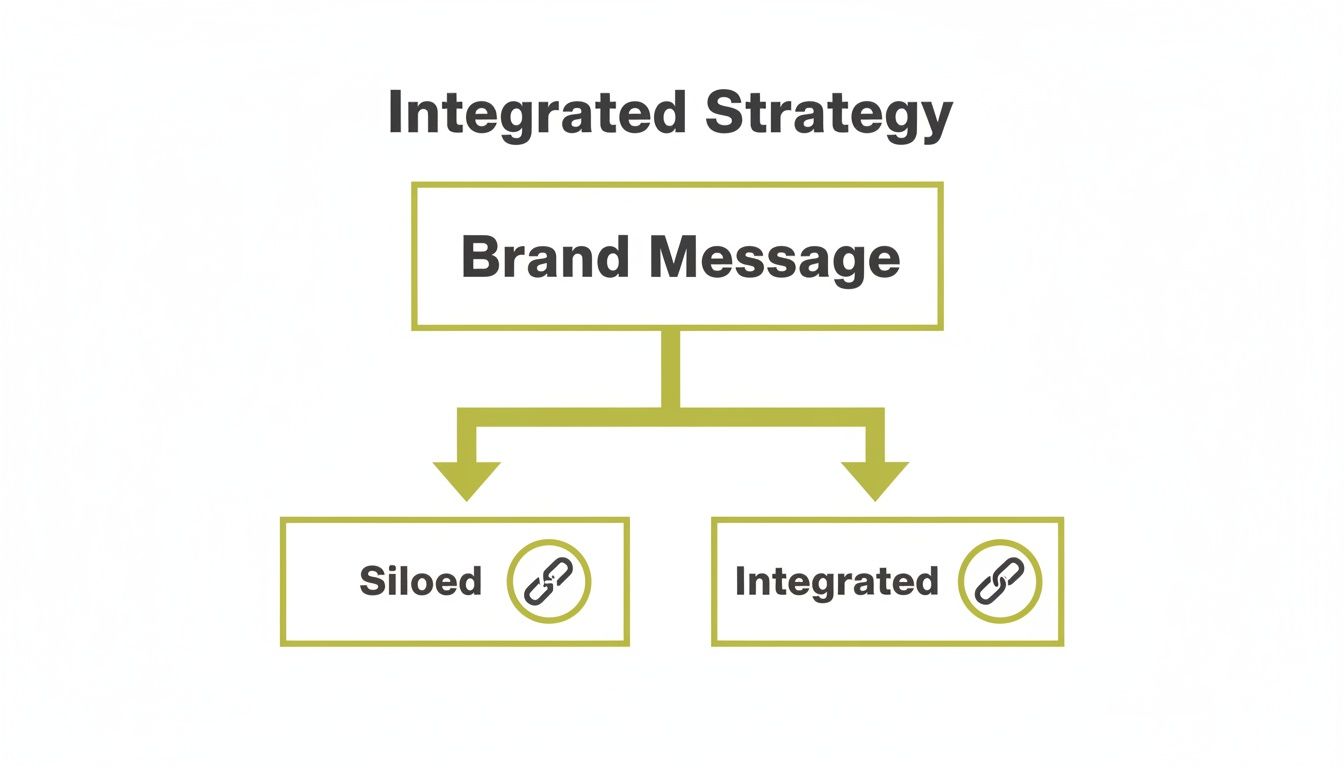
This flowchart shows the difference. A disjointed approach leads to confusion, while a unified one creates a powerful, consistent brand story that cuts through the noise.
Making the Model Work for You
A common mistake we see is businesses focusing on just one or two of these areas. What good is a brilliant blog post (Owned) if no one ever reads it? Likewise, a fantastic piece of press coverage (Earned) quickly loses steam if you don't promote it on your social channels (Shared).
The real magic happens when they all work in concert. For example, you could write an in-depth guide for your blog (Owned), then pitch it to journalists for media coverage (Earned). Next, you promote that positive press with targeted ads (Paid), and finally, use the article to spark conversations on LinkedIn and X (Shared).
This cycle turns individual marketing tasks into a powerful, self-sustaining engine for growth. If you're keen to really get this right, you can explore our expert guide on effective social media engagement strategies to master the 'Shared' part of the model.
At Carlos Alba Media, this integrated thinking is in our DNA. Every member of our team is either a former national news journalist or has managed global brands at the agency level. This specialist mix of skills means we don't just see one part of the puzzle; we see the entire board.
We know how to build a story that a top-tier journalist will actually run with—because we used to be those journalists. And we know how to turn that media win into a social media campaign that drives real business results. This perspective is what separates a standard pr & social media service from a strategic partner who is genuinely invested in your growth. It’s how we make sure your foundation is solid, your walls are strong, and your brand's home is built to last.
Crafting Stories That Win on Every Channel
How do you create a story that a BBC journalist and your LinkedIn audience will both actually care about? It’s the million-dollar question in modern pr & social media. The secret isn't about having dozens of different ideas; it's about having one powerful story that you can expertly adapt to shine on every platform.
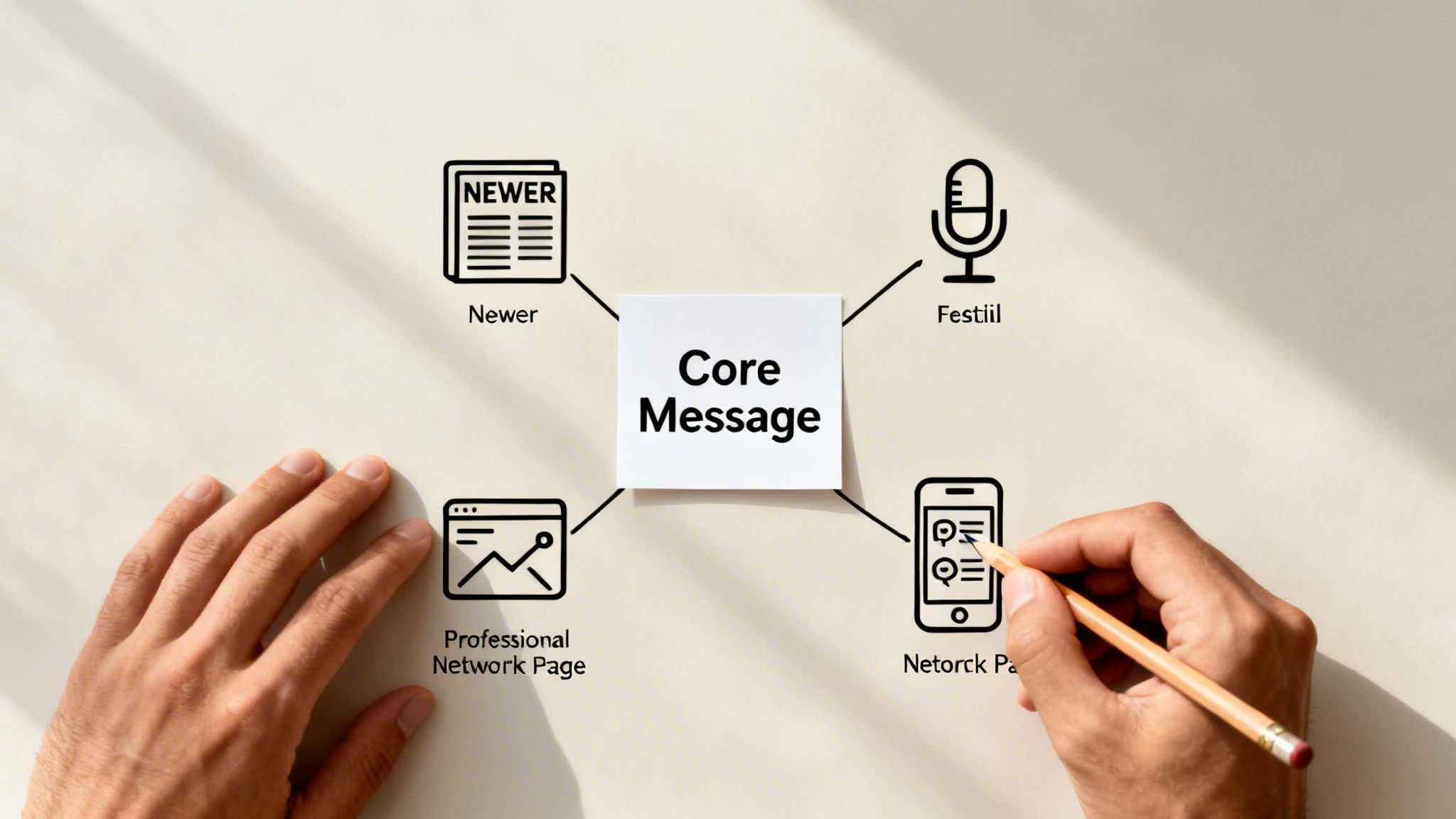
It all begins with a core message that has real substance. This isn’t marketing fluff. It’s a story with genuine value—a fresh perspective, a human angle, or a significant announcement. The real skill is not to just blast the exact same content everywhere, but to tailor its presentation for each channel you’re using.
This is what separates the campaigns that make a quick splash from those that build real, lasting authority. A story isn't a one-size-fits-all product. You have to shape and polish it to meet the expectations of each specific audience.
The Art of the Omni-Channel Narrative
Our unique strength at Carlos Alba Media comes from our background. We’re a team of former national news journalists and senior agency pros who have worked with global brands. That means we’re instinctively trained to spot and shape stories that are genuinely newsworthy.
We know what gets an editor to open an email and, more importantly, what makes them decide to run a story. This insight is the engine behind our entire integrated strategy.
Think of your core message as a powerful musical theme. For the press (Earned), you arrange it as a sharp, formal symphony—the press release. For your blog (Owned), it becomes an extended, detailed concerto. On social media (Shared), you break it down into a series of catchy, memorable pop hooks.
When you approach it this way, your message resonates so much more deeply, no matter where people find it. You’re not just repeating yourself; you're reinforcing your story from every conceivable angle, building an inescapable sense of relevance and authority.
From One Story to Total Market Presence
Let's put this into practice. Imagine your tech start-up has just closed a major round of funding. The old, siloed approach might be to send out a dry press release and post a simple "We got funded!" message on social media. An integrated, omni-channel strategy is infinitely more powerful.
Here’s how you can amplify that single announcement across every channel:
- Owned Media: First, you publish a detailed announcement on your company blog. This post goes beyond the basic facts. It tells the story of the journey, thanks the team, and lays out your vision for the future. This becomes the central 'source of truth' for everything that follows.
- Earned Media: Using that blog post as a foundation, you craft a sharp, targeted press release. It isn't just blasted out; it’s pitched directly to specific journalists who cover your industry, complete with an offer for an exclusive interview with the founder. This journalistic approach is what secures high-value media coverage.
- Shared Media: The moment the story breaks in the press, your social channels light up. You share links to the articles, create a celebratory behind-the-scenes video for Instagram Stories, and have the founder post a thoughtful reflection on LinkedIn, tagging the investors. This turns a simple announcement into a vibrant conversation.
- Paid Media: To guarantee maximum impact, you can put a small budget behind promoting the best press articles to a highly targeted audience of potential customers and future investors. This uses the credibility of earned media to drive valuable traffic and leads.
This is how one piece of news becomes a dominant market narrative. If you're looking to refine that initial message, you can learn more about how to develop your core message with our guide on what is brand storytelling. For practical help in crafting these narratives, you might also find storytelling templates for social media useful.
This strategic amplification is fast becoming the standard in the UK. The market for digital and social media PR services is projected to surge from USD 6.26 billion in 2025 to USD 8.65 billion by 2030. With nearly 90.17% of the UK population online, agencies are rightly pivoting to digital-first strategies to connect with key audiences. This growth simply highlights why a joined-up approach to pr & social media is no longer optional.
Measuring The Metrics That Actually Matter
It’s easy to get caught up in the numbers game of pr & social media. Chasing likes, amassing followers, and racking up shares can feel productive, but these are often just vanity metrics. They look great on a report, but do they actually tell you if your efforts are helping your business grow?
To really prove the value of your strategy, you need to look past the surface and focus on the Key Performance Indicators (KPIs) that connect directly to your bottom line. These are the figures that demonstrate a clear return on investment (ROI) and give you the insight to make genuinely smart decisions.

Beyond Vanity Metrics: The KPIs That Drive Growth
Moving beyond surface-level stats is all about connecting your PR and social media work to tangible business outcomes. Instead of simply counting likes, you start tracking the actions that lead to revenue, a stronger reputation, and genuine market recognition.
So, what are the metrics that truly count?
Referral Traffic: How many people are clicking through to your website from a news article or a social media post? This is a direct measure of how well your earned and shared media are funnelling potential customers right to your digital doorstep.
Qualified Leads: Are your integrated campaigns actually sparking sales conversations? You can track this by looking at contact form submissions, demo requests, or downloads of valuable content that you can trace back to a specific PR placement or social media activity.
Brand Sentiment: Forget just counting mentions—what are people actually saying about you online? Sentiment analysis tools can tell you if the chatter is positive, negative, or neutral. A clear shift towards positive sentiment is a huge win for any campaign.
Share of Voice (SoV): How much of the conversation in your industry do you own compared to your competitors? SoV gives you a benchmark for your authority and visibility, showing you where you stand in the market.
To tie it all together, it's crucial to understand how to measure social media ROI properly. This is how you translate all that engagement into hard financial results and prove the commercial impact of your work.
Setting Goals for Each Part of the PESO Model
A great measurement framework needs specific, meaningful goals for every part of your strategy. The PESO model is the perfect blueprint for this, helping you assign the right KPIs to each media type.
Owned Media Goals
- Metric: Organic search traffic, time on page, and conversion rate from your blog.
- Why It Matters: This shows your content isn't just attracting eyeballs; it's holding attention and compelling people to take the next step.
Earned Media Goals
- Metric: The Domain Authority of publications you’re featured in, referral traffic from that coverage, and the number of high-quality backlinks you gain.
- Why It Matters: This proves your PR efforts are landing you in credible places that boost your SEO and drive the right kind of audience to your site.
Shared Media Goals
- Metric: Engagement rate (beyond just likes), click-through rate to your website, and leads generated from social campaigns.
- Why It Matters: This keeps the focus on how your social channels are contributing to business goals, not just generating noise.
Paid Media Goals
- Metric: Cost Per Click (CPC), Cost Per Acquisition (CPA), and Return on Ad Spend (ROAS).
- Why It Matters: These are the non-negotiable financial metrics. They tell you, in no uncertain terms, whether your advertising budget is actually turning a profit.
At Carlos Alba Media, our senior-level counsel is designed to cut through the noise. Our background as former national news journalists and professionals with agency experience on international brands means we focus on the metrics that matter to your board, not just your marketing team. We provide undeniable proof of impact without the complex reports and high overheads of a large agency.
This kind of focused approach is exactly what the industry is calling for. In the UK, PR leaders are looking towards 2026 with cautious optimism, as roughly 70% predict stronger trading despite economic headwinds. Across the board, measurement and ROI are top priorities, especially as new tools make it easier to prove value. With 85% of business leaders seeing digital as a key driver of UK growth, our work in positioning clients through strategic pr & social media has never been more vital. Find out more about how PR firms are planning for what lies ahead.
Managing Your Reputation in a Digital Crisis
It can happen in a flash. A single disgruntled tweet or a negative story gets traction, and suddenly, what was a normal Tuesday morning has turned into a full-blown reputational crisis. In our always-on world, you don’t have days to react; you have hours, sometimes minutes.
Your reputation is the foundation your business is built on. You can't just hope for the best when it’s under attack. Protecting it demands a cool head and, more importantly, a plan that has your PR & social media teams working as one from the very first moment.
When things go wrong, speed and coordination are everything. If your social media managers are issuing apologies while your PR team is silent, you’re creating chaos. This sort of disjointed response just looks incompetent and pours petrol on the fire. You need a single, unified voice to show you’re in control and start the difficult work of rebuilding trust.
The First Hour: Why It’s Golden
That first 60 minutes after bad news breaks is what we call the ‘golden hour’. This is your window. It’s when the public forms its first impression, and it’s your best—and sometimes only—chance to frame the narrative. A slow, clumsy response can inflict permanent damage. A swift, honest, and empathetic one can often stop a drama from escalating into a catastrophe.
This is not a job for a junior staff member. It’s a moment that calls for genuine, senior-level experience. This is where our specialist nature at Carlos Alba Media really comes into its own. Every single person on our team is either a former national news journalist or has agency experience working with international brands. We’ve been in those high-pressure newsrooms, on the other side of the desk. We know the 24/7 news cycle because we’ve lived it.
That journalistic instinct means we’re wired to act decisively when the pressure is on. We also partner with top-tier media lawyers, giving you the senior-level crisis management needed to navigate these situations with confidence.
In a crisis, silence is often read as guilt, and mixed messages look like incompetence. The first thing you must do is acknowledge the situation, even if you don't have all the answers yet. It shows you’re taking it seriously and you respect your audience enough to be upfront.
Essential Steps in Crisis Management
A solid crisis plan isn't about creating a massive, complicated document. It’s about having a few critical elements prepared and ready to go. If you’re waiting for the storm to hit before you figure this out, you’re already too late.
Here are the practical steps every business should have in place.
1. Prepare Holding Statements
This is a short, pre-approved message you can release immediately. It simply says you’re aware of the situation and are looking into it. Crucially, it buys you time to gather the facts without leaving a communications vacuum.
2. Establish a 'Dark Site'
A "dark site" is a hidden, pre-built webpage ready to be published at a moment's notice. It becomes the official hub for all information—updates, company statements, and contact details—creating a single source of truth for the media and the public.
3. Define Your Response Team
Who’s in charge? Your crisis response team needs to be small, senior, and empowered to make decisions fast. This usually means a key leader, your legal counsel, and your PR and social media lead.
4. Monitor Everything
You need to have eyes and ears everywhere. Set up real-time monitoring for your brand across social media, news sites, and forums. You have to understand how the story is evolving and what people are saying to tailor your response effectively.
Ultimately, the best defence is a good offence. A strong, proactive reputation, built day-in and day-out through consistent and strategic communication, creates a reservoir of goodwill. This is what will help you weather the inevitable storms.
For a deeper look into this specialism, you can learn more about our approach to communications crisis management.
Right, we've covered the theory. Now it's time to put it all into practice with a clear, straightforward action plan.
An integrated PR & social media strategy isn't some luxury reserved for huge corporations. For SMEs and founders, it’s a vital engine for growth where every bit of effort and investment needs to deliver. This five-step roadmap pulls together everything we've discussed so you can get started right away.
Think of it this way: each step builds on the last. You'll go from having a collection of separate tasks to running a focused campaign that builds trust, gets you noticed, and helps you win business.
Step 1: Audit Your Current Presence
Before you start building, you need a realistic picture of where you stand today. Take an honest look at your current footprint online and in the media. No sugar-coating.
- Owned Media: How's your website and blog looking? Is your message sharp and clear? Can people actually find your content through search engines?
- Earned Media: What press coverage have you had, if any? Was it positive? More importantly, was it in places where your ideal customers hang out?
- Shared Media: Dig into your social media channels. What’s your engagement rate really like? Who are you talking to? Which platforms are genuinely delivering for you?
- Paid Media: Review your past ad campaigns. What was the return on that spend? Did your ads reach the right people, or just anyone?
Step 2: Define Your Core Brand Story
Once you have a clear-eyed view of your starting point, it's time to nail down your core brand story. This is the central idea that will sit at the heart of every single piece of content you produce.
Your story needs to answer your "why," explain what makes you different, and articulate the real value you bring to your customers. It's so much more than a tagline; it's the foundation for every communication you send out into the world.
At Carlos Alba Media, our unique value proposition is simple: we provide senior-level counsel without the big-agency overheads. As a team of former national news journalists and professionals with agency experience on international brands, our specialist nature allows us to blend newsroom insight with modern brand-building to deliver measurable growth.
Step 3: Map Your Story to the PESO Model
Now, take that core story and think about how you'll tell it across the different PESO channels. This is where the strategy really comes to life.
- Owned: What detailed blog posts, guides, or case studies can you create to tell the full story?
- Earned: Which specific angles or hooks from your story would make a compelling pitch for a journalist?
- Shared: How can you break the story down into bite-sized, engaging posts, videos, or graphics for social media?
- Paid: Are there parts of your story—or better yet, pieces of positive press coverage—that are worth putting a small budget behind to reach a wider, targeted audience?
Step 4: Build Your Content Calendar
Your content calendar is your game plan. It’s a simple tool that maps out what you're going to post, where, and when. Having this in place stops the last-minute panic for content and ensures your message stays consistent. This is a non-negotiable step for orchestrating your PR & social media efforts.
Step 5: Set Up Your Measurement Dashboard
Finally, decide what success actually looks like. Using the KPIs we talked about earlier, create a simple dashboard to keep an eye on the metrics that truly matter. This forces you to focus on results, not just being busy.
In a competitive UK market projected to be worth £4.3 billion by 2026, a scattergun approach just won't cut it. With over 6,160 PR businesses operating across the UK, standing out demands a smart mix of media savvy and social media know-how—the exact kind of integrated plan we've laid out here. You can explore more data about the growing demand for blended PR expertise in the UK market.
Your Questions Answered: PR & Social Media
Getting to grips with integrated PR & social media often brings up a few key questions. As a founder or business owner, you need straight answers. Let's get into some of the most common ones we hear.
How Much Should I Budget for an Integrated Strategy?
This is the big one, isn't it? Honestly, there's no single magic number. The right budget is tied directly to what you want to achieve, how competitive your market is, and the speed at which you need to grow.
Instead of seeing it as a cost, think of it as an investment in your reputation. A focused, local campaign might start from a few thousand pounds a month. A more ambitious national strategy will naturally require a bigger commitment. The most important thing is to define your goal first, then build a budget that gives you a realistic shot at hitting it.
At Carlos Alba Media, our model is built on providing senior-level expertise without the traditional big-agency costs. Your investment goes straight into the work, executed by seasoned pros—former national news journalists and experts with international brand experience—not into paying for a swanky office or layers of management. We’re focused on one thing: delivering tangible value, no matter the size of your budget.
How Long Until I See Results?
While a smart paid social campaign can start sending people to your website almost immediately, building a rock-solid reputation through earned media is a different game. It’s like planting a tree. You won’t get a forest overnight, but consistent, strategic work lays the foundation for something that lasts.
You should start seeing early signs of traction within the first 3-6 months. This could look like a bump in website traffic, more meaningful conversations on social media, or your first few press mentions. The truly transformative results—becoming that go-to name in your field—tend to build and solidify over a period of 12 months or more.
Can’t I Just Do This Myself?
Of course you can. Many founders start out running their own PR & social media, and it’s a great way to learn. The real question, though, is whether it’s the best use of your incredibly valuable time. Working with professionals is about leveraging their efficiency, relationships, and strategic foresight.
The team here at Carlos Alba Media is made up of former national news journalists and senior agency figures who have worked with global brands. That specialist background gives us three distinct advantages:
- Speed: We instinctively know what makes a story newsworthy and can act on it fast.
- Contacts: Our black books are filled with journalists we’ve known and worked with for years across the UK.
- Strategy: We see the bigger picture, knowing how to turn one great piece of coverage into a powerful, multi-channel campaign that actually grows your business.
Ultimately, bringing in an expert team is about getting you seen, trusted, and chosen much faster than you could on your own.
Ready to build a reputation that drives real growth? Carlos Alba Media provides the senior-level insight and hands-on execution you need to make an impact. Visit us to get started.