

You're in a familiar spot if your customer data lives in different places, your email tool can't see store activity, and your paid social still speaks to people who already bought yesterday. A shopper browses on mobile, leaves, sees a retargeting ad later, pops into a store, then gets an irrelevant follow-up email that ignores the visit. That's not a small annoyance, it's the cost of disconnected marketing.
What is omnichannel marketing? In plain UK terms, it's the discipline of making every customer touchpoint feel like one connected journey, whether that starts on search, social, email, a website, a phone call, or in store. In the UK retail market, the case for this approach is clear, because the British Retail Consortium reported that online sales accounted for 27.1% of total UK retail sales in 2020, while the Office for National Statistics said 73% of adults had bought goods or services online in the previous 12 months in 2021. Those figures show why brands can't afford separate channel campaigns anymore, because customers move fluidly between digital and physical touchpoints. The point of omnichannel is consistency, context, and continuity, not just visibility.
The Customer Journey That Exposes Broken Marketing
A customer in Leeds can browse trainers on their phone at lunch, add them to cart on desktop that evening, click a social ad the next day, then visit your shop at the weekend to check fit and stock. If your systems aren't connected, that same customer can still get an email promoting the exact product they already handled in-store, or a generic discount that ignores the journey entirely. That's when your marketing starts feeling careless, even if each channel team thinks it's doing a good job.
The friction is usually invisible inside the business. Paid media, email, ecommerce, and retail teams often optimise their own slices of the journey, then wonder why conversion stalls or repeat purchases drop away. The customer doesn't care which team owns the channel, they only notice that your brand keeps forgetting what happened five minutes ago.
A useful way to think about this is simple. If the journey restarts every time the customer changes device or channel, you've got multichannel marketing. If the brand remembers the person, the context, and the last useful action, you're moving into omnichannel.
For mapping those transitions properly, a practical starting point is customer journey mapping. It helps teams spot the handoff points where good intent gets lost, especially when online browsing, store visits, and follow-up communications are managed separately.
Practical rule: if the customer has to repeat themselves, your journey design is already broken.
The commercial damage isn't only about annoyance. Disconnected journeys weaken trust, lower the chance of return visits, and make attribution muddy, so teams end up funding the wrong channels with confidence. Omnichannel exists to remove that friction, so the journey feels joined up from first click to final purchase and beyond.
Omnichannel vs Multichannel Marketing Explained
The easiest way to separate the two is to look at how data moves. In multichannel marketing, you run campaigns across several channels, but each channel can still behave like its own island. In omnichannel marketing, those islands are connected by a shared customer view, so the message, offer, and timing can adapt as the customer moves.
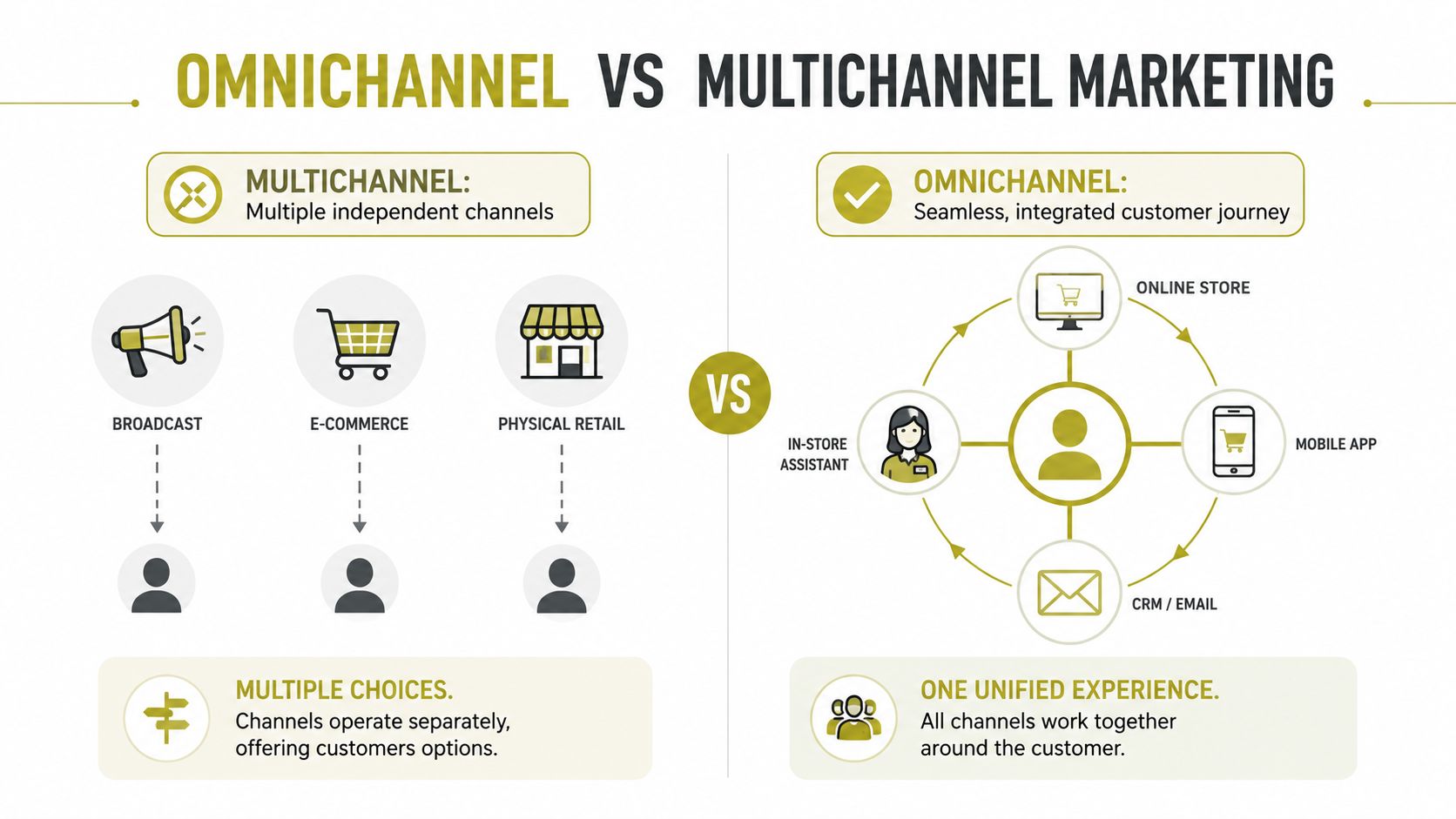
A practical comparison looks like this.
| Dimension | Multichannel | Omnichannel |
|---|---|---|
| Data architecture | Separate systems and partial overlap | A unified customer identity layer |
| Messaging | Often consistent in tone, but not in context | Consistent and context-aware across touchpoints |
| Attribution | Usually channel-led | Person-level cross-channel attribution |
| Experience | The customer may need to restart | The customer moves through one continuous journey |
| Commercial focus | Channel performance | Journey performance |
The difference matters because omnichannel analytics has to reconcile web, app, email, social, call-centre, and offline events into a single customer view, using deterministic identifiers and/or probabilistic matching so performance can be measured at person level rather than channel level. That's what makes cross-channel conversion rate, time-to-purchase, and CLV by channel mix useful, and it's why simple channel CTRs don't tell the full story as outlined in omnichannel analytics guidance.
A multichannel setup gives people options. Omnichannel makes those options feel connected.
In UK practice, the buyer's experience is usually the cleanest test. If a shopper can move from ad to website to store to email without losing context, the brand is orchestrating a journey. If each step behaves like a fresh conversation, the business is still running separate campaigns and hoping they add up.
For a broader view of customer-experience consistency, Tagada customer experience insights are a useful reference point when teams are trying to connect the CX discussion to operational reality.
The Core Components of an Omnichannel Strategy
A UK shopper might browse on mobile at lunch, click an email on the commute home, ring support after work, then walk into a store expecting the staff to know what happened before. If the business treats each of those moments as separate, the customer feels the split immediately. The ultimate test of omnichannel is whether the system keeps identity, context, and promise intact across every step.
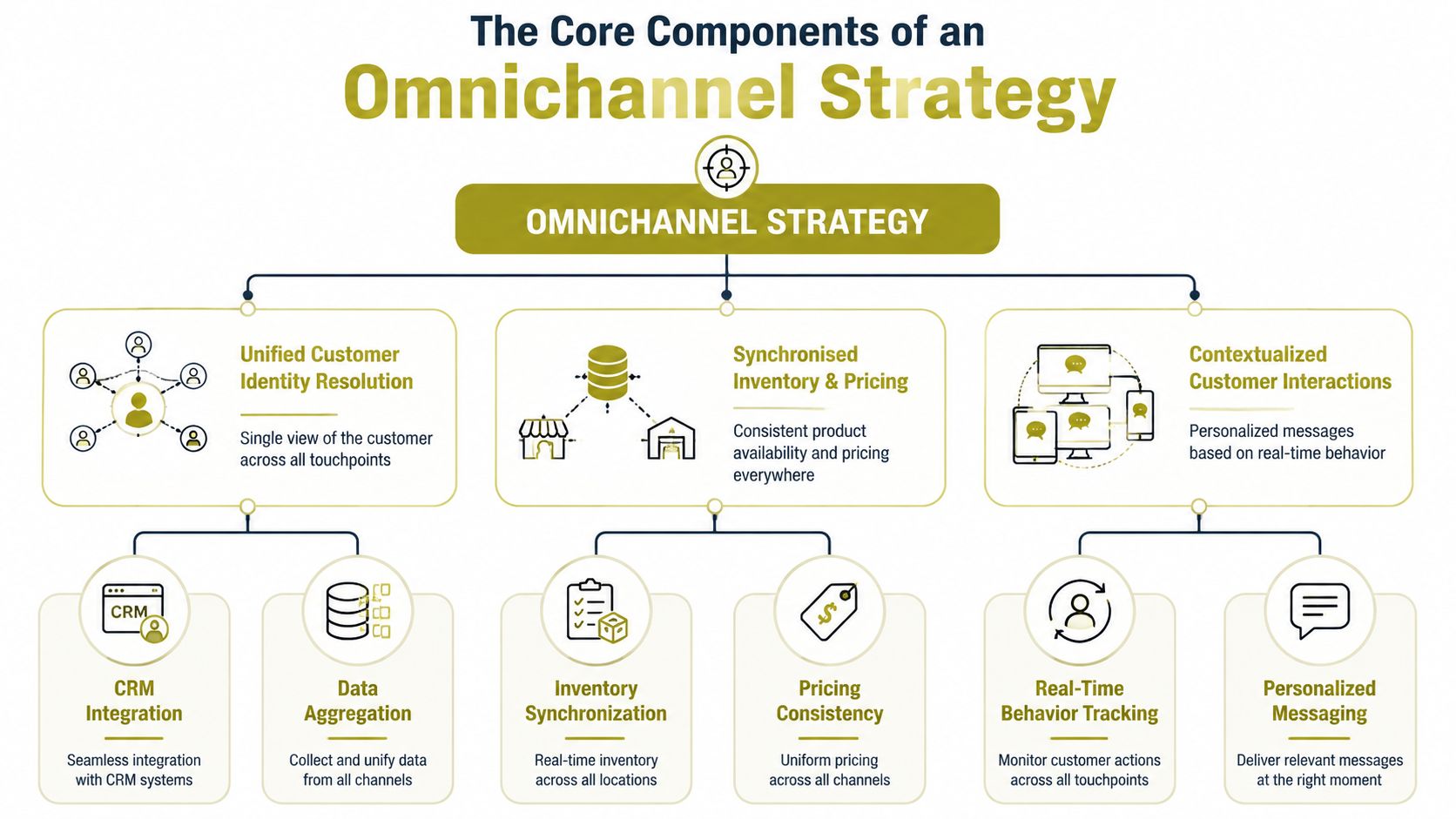
The technical line between a real omnichannel setup and a branded multichannel one is identity. If your web visits, email clicks, app activity, support contacts, and offline purchases can't be tied back to one customer view, you're not orchestrating a journey, you're collecting fragments. That is why unified customer identity resolution sits at the centre of any credible stack.
Identity resolution comes first
The hard work is matching the same person across systems without over-linking or under-linking records. Independent guidance says best-in-class identity resolution match rates are typically expected to exceed 75%, with more than 65% already considered strong, because weak matching breaks attribution and makes segment-level optimisation unreliable as set out in retail strategy guidance. For UK SMEs, the practical lesson is simple, do not chase a shiny stack before the data relationships are in place.
A useful stack joins CRM, ecommerce, support, and store events in a way that survives day-to-day operations. That means a unified customer identifier, synchronised customer records, and event freshness that is good enough for the team to act on. If the system cannot tell who bought, who browsed, and who called last week, personalisation quickly turns into guesswork.
Inventory and pricing have to stay aligned
A customer promise only works if the business can keep it. Retail strategy guidance calls for a single inventory pool visible across all channels in real time, a unified customer identifier, and consistent pricing and promotions across channels as set out in retail strategy guidance. Without that alignment, the customer sees a different offer online, an unavailable item in store, or a price mismatch that erodes trust.
The operational reality is less glamorous than the marketing story, but it is where many SME rollouts break.
Interactions need shared context
The customer experience layer is what people feel, but it only works when the systems underneath are disciplined. McKinsey's explanation of omnichannel stresses that the experience should stay cohesive and consistent across store, app, and website, while also warning against channel silos McKinsey's explanation of omnichannel. In practice, customer service, marketing, and sales need to read from the same playbook, or the customer ends up repeating the same story to three different teams.
If identity is weak, every other layer gets noisier.
For resource-constrained teams, the sensible order is often CRM and inventory synchronisation before elaborate journey design. You do not need enterprise theatre, you need a working chain of evidence from click to checkout to repeat purchase.
Measuring Omnichannel Value Beyond Vanity Metrics
The measurement trap is simple. Teams celebrate impressions, opens, and channel CTRs, then can't explain why revenue or retention didn't improve. Those metrics still have a place, but they don't prove that channels are working together, which is the whole point of omnichannel.
Senior teams need a better scorecard. McKinsey's value-led view is useful here, because it frames the core question as where the value pools are and what fact base clarifies decisions McKinsey on omnichannel value. That's the right lens for UK businesses operating across retail, ecommerce, service, and earned media, where one touchpoint often influences another.
Use journey metrics, not channel trophies
The most useful metrics are cross-channel conversion rate, time-to-purchase, and CLV by channel mix. They tell you whether the combination of touchpoints is shortening decisions or creating more expensive journeys. A paid social click that looks cheap can be poor value if it pushes low-intent visitors into a slow, fragmented purchase path.
For measurement frameworks that keep ROI tied to actual business outcomes, MarTech Do's marketing ROI framework is a practical companion reference. The important point is to define the conversion event, the source of truth, and the sequence of interactions before you start comparing campaigns.
Build attribution around people, not channels
If the first email gets the lead, the retargeting ad nudges consideration, and the store visit closes the sale, last-click attribution lies by omission. A better model tracks the person across touchpoints, then asks which combinations materially changed the outcome. That requires identity resolution, clean event logging, and enough patience to compare journeys rather than isolated clicks.
For teams still building their data foundations, a focused first-party data strategy gives you the inputs needed for this kind of measurement. Without reliable first-party signals, the attribution story gets vague fast.
Rule of thumb: if you can't connect the journey, don't pretend you can judge it.
That's why omnichannel value should be presented as operational learning, not just marketing reporting. The ultimate win is understanding which channel combinations reduce friction, which ones create repeat contact, and which ones improve lifetime value without inflating costs elsewhere.
Real Omnichannel Examples from UK Start-Ups and SMEs
A Scottish hospitality brand I've seen work with booking data got the basics right only after it stopped treating email as a separate campaign lane. Once booking history, website behaviour, and social retargeting were connected, the business could stop sending generic offers to people who had already converted and start shaping follow-up around likely repeat stays. The mistake before that was simple, the CRM held useful data, but the campaign tool wasn't reading it in the right context.
A Glasgow retailer faced a different problem. Its online store showed products that weren't properly synced with stock in branch, so customers kept turning up for items that staff couldn't hand over. The fix was less glamorous than a big rebrand, but far more useful, because once inventory visibility and click-and-collect information lined up, the experience finally matched the promise.
The most interesting UK SME cases often happen when owned, earned, and paid media are planned together rather than handed off between teams. A tech start-up can publish thought-leadership content, secure relevant press coverage, and retarget readers through paid social, but the journey only works if the landing pages, follow-up emails, and sales conversations all reflect the same story. Otherwise, the brand sounds ambitious in one place and forgetful in another.
Carlos Alba Media is built for this kind of connected work, with a model that blends newsroom insight with senior-level PR and digital marketing expertise rather than a junior, generalist agency setup. It was founded and is run by multi award-winning former national newspaper editor Carlos Alba, and everyone who works there is either a former national news journalist or has agency experience with international brands, which matters when the job is to align coverage, content, and conversion without wasted motion.
The common thread across the better examples is not technology for its own sake. It's discipline, clear ownership, and the willingness to remove channels that don't carry context forward.
Your Omnichannel Implementation Checklist
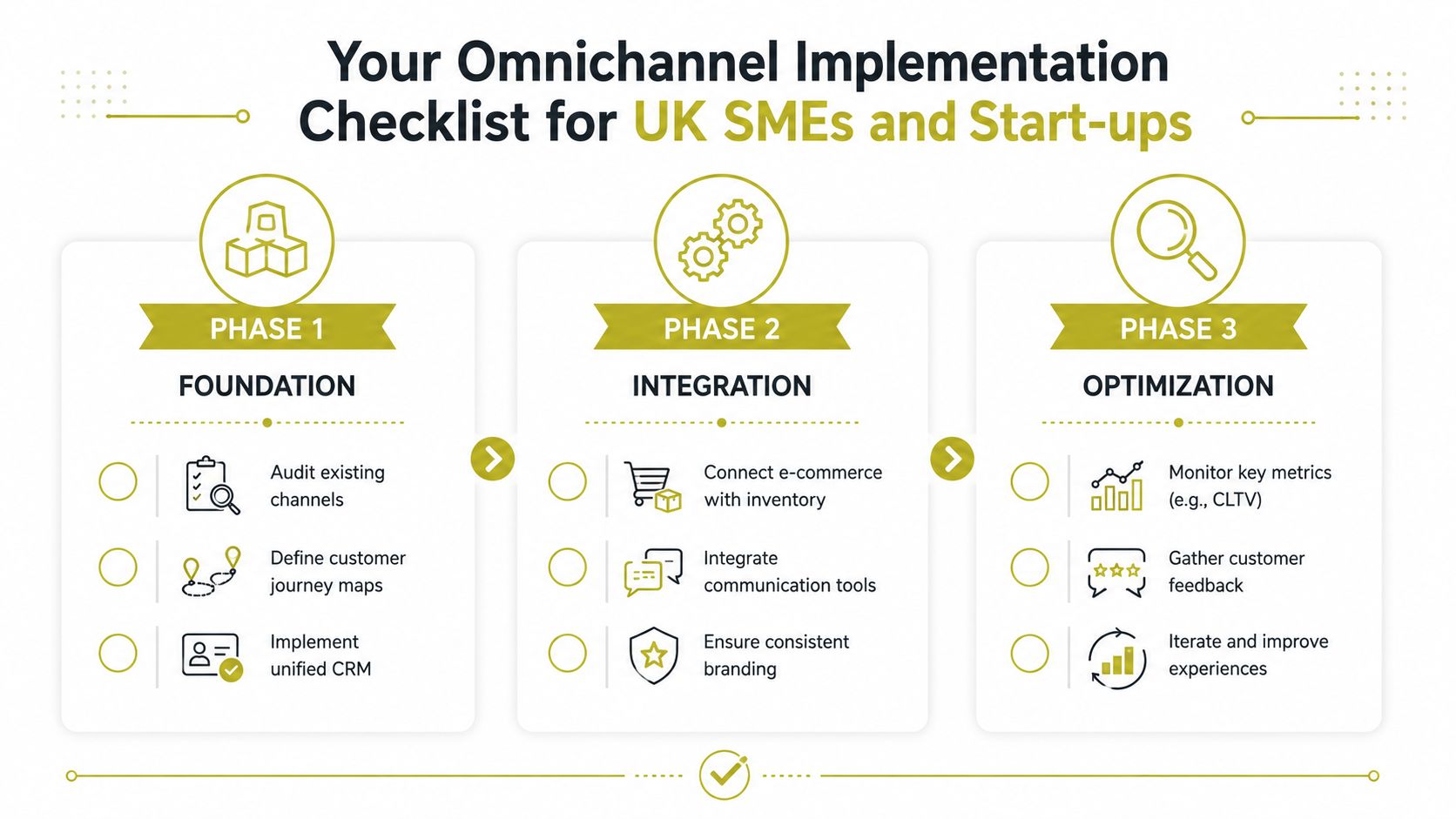
The fastest route to omnichannel is usually a phased one. UK SMEs rarely have the budget or headcount to rebuild everything at once, so the sensible move is to stabilise identity, then connect systems, then improve journeys based on what the data says. Anything else tends to create a busy-looking stack with weak commercial impact.
Foundation
Start by auditing every customer-facing channel, then write down where data currently lives and who owns it. You need a shared customer view, even if it's basic, before you layer on campaign automation. That means deciding which fields are reliable, which identifiers are missing, and how online and offline events will eventually meet in one CRM.
Use this phase to map the customer journey and clean up the handoffs. The simplest wins often come from tightening forms, standardising naming conventions, and linking ecommerce activity to service or store records. If the data is messy now, every later campaign will inherit that mess.
Integration
Once the core records are stable, connect your ecommerce platform with stock information, email, CRM, and any customer service tool that matters. A campaign can't be omnichannel if the person on the receiving end gets contradictory messages from different systems. Consistent branding matters too, but consistency without shared data is just neat packaging.
Many SMEs feel tempted to overbuild. Resist that. A working integration between a few high-value systems beats a sprawling setup no one can maintain.
Optimisation
Only after the foundation and integration layers are working should you tighten the measurement model. Focus on CLTV, conversion paths, and how customers move between channels before you chase more advanced automation. Then test journey changes, compare performance by segment, and remove steps that create avoidable friction.
If you want a practical planning reference for this stage, Carlos Alba Media's omnichannel strategy guidance fits well alongside the operational work. It's most useful when you've already decided which customer journeys matter and need a sharper rollout plan.
Build the system first, then optimise the story it tells.
The checklist isn't glamorous, but it's the difference between a connected journey and an expensive set of disconnected tools.
Common Omnichannel Pitfalls and How to Avoid Them
The most common mistake is buying channel tech before sorting out identity and data quality. UK SME teams get excited about automation, but if the systems still disagree about who the customer is, the campaign logic breaks as soon as it meets reality. The warning sign is usually obvious, duplicate records, conflicting offers, and reporting that looks precise but does not match what customers experience.
Another failure point is measuring at channel level and calling it omnichannel. If a paid ad gets credit because it was last in the sequence, while email, store staff, and search did the heavy lifting earlier, the team ends up funding the loudest touchpoint rather than the most useful one. The fix is to reframe the reporting discussion around journeys, not individual channels, so attribution reflects how people really buy.
There is also a commercial trap that catches a lot of SMEs. A setup can be technically clever and still be commercially weak if it takes too long to maintain or depends on too many manual workarounds. That usually shows up when the marketing team has to patch together customer lists by hand or service staff cannot see the context they need to help properly.
The safest course is to ask one question before every rollout, what minimum integration is enough to improve conversion, retention, and reputation in practice? That question keeps the work honest. It stops teams from chasing architecture that looks impressive in a slide deck but does not change the buying experience.
A system that forces customers to restate their needs is a sign of failed integration.
For UK SMEs, that is the standard. Not perfection, just enough connected intelligence to remove friction and make the next interaction smarter than the last.
If you want a connected customer journey that works in the UK market, Carlos Alba Media can help you shape the PR, content, and digital pieces around a clear omnichannel plan. Visit Carlos Alba Media to talk through your customer journey, your data gaps, and the channels that need to start working together.