
A customer sees your Instagram post for a weekend package, taps through to your site, browses two rooms, gets distracted, then returns later on a laptop. The page loads as if they've never been there. An hour after that, your email platform sends a generic newsletter that has nothing to do with the rooms they viewed. The next day they ring your business, and the staff member on the phone has no idea what they've already looked at online.
That feels small when you're inside the business. To the customer, it feels sloppy.
Most SMEs don't have an awareness problem. They have a continuity problem. People can find them, but the experience breaks as the buyer moves from social to website to email to phone to store. That break is where trust leaks out, and where a better organised competitor often wins.
An effective omnichannel strategy fixes that. Not by putting you on every platform, and not by asking you to buy an enterprise stack you'll never fully use. It works by connecting the channels you already rely on so the brand feels coherent wherever the customer shows up.
The Modern Customer Journey Demands More
A customer doesn't think in channels. They don't wake up and say, “I'm now entering the social media phase of my purchase journey.” They see one business and expect that business to recognise them, respond consistently, and make the next step easy.
That expectation isn't niche behaviour. UK research found that 84% of shoppers used more than one channel when buying, and 63% said they were more likely to buy from a retailer that offered a consistent experience across channels, according to UK omnichannel shopping research.
For an SME owner, that has a practical consequence. If your paid social, website, email, sales calls and in-person experience don't connect, customers don't experience “marketing channels”. They experience friction.
What fragmented journeys look like in real life
A tourism business runs strong destination content on social, but the booking page looks like a different brand.
A hotel sends beautiful pre-stay emails, but the reception team can't see the booking notes.
A retailer offers click-and-collect, but the stock status online isn't reliable enough for customers to trust it.
None of those problems are dramatic on their own. Together, they make the brand feel disjointed.
Modern buyers judge continuity as much as creativity. A polished ad can't rescue a broken handoff.
The fix starts with seeing the journey as one connected system, not a set of separate campaigns. That's why businesses that take customer journey mapping seriously usually make better channel decisions. They stop asking, “What should we post next?” and start asking, “What does the customer need at this exact point, and what should happen after that?”
For smaller firms, this matters because bigger competitors don't always win on attention. They often win on operational smoothness. If you can remove avoidable friction across just a few high-value touchpoints, you can compete far more effectively than your budget might suggest.
Beyond Multichannel What Omnichannel Truly Means
Plenty of businesses are already multichannel. They have a website, an Instagram account, email campaigns, maybe a shop or sales team, and perhaps a booking platform or marketplace listing. That sounds advanced, but it isn't the same as being omnichannel.
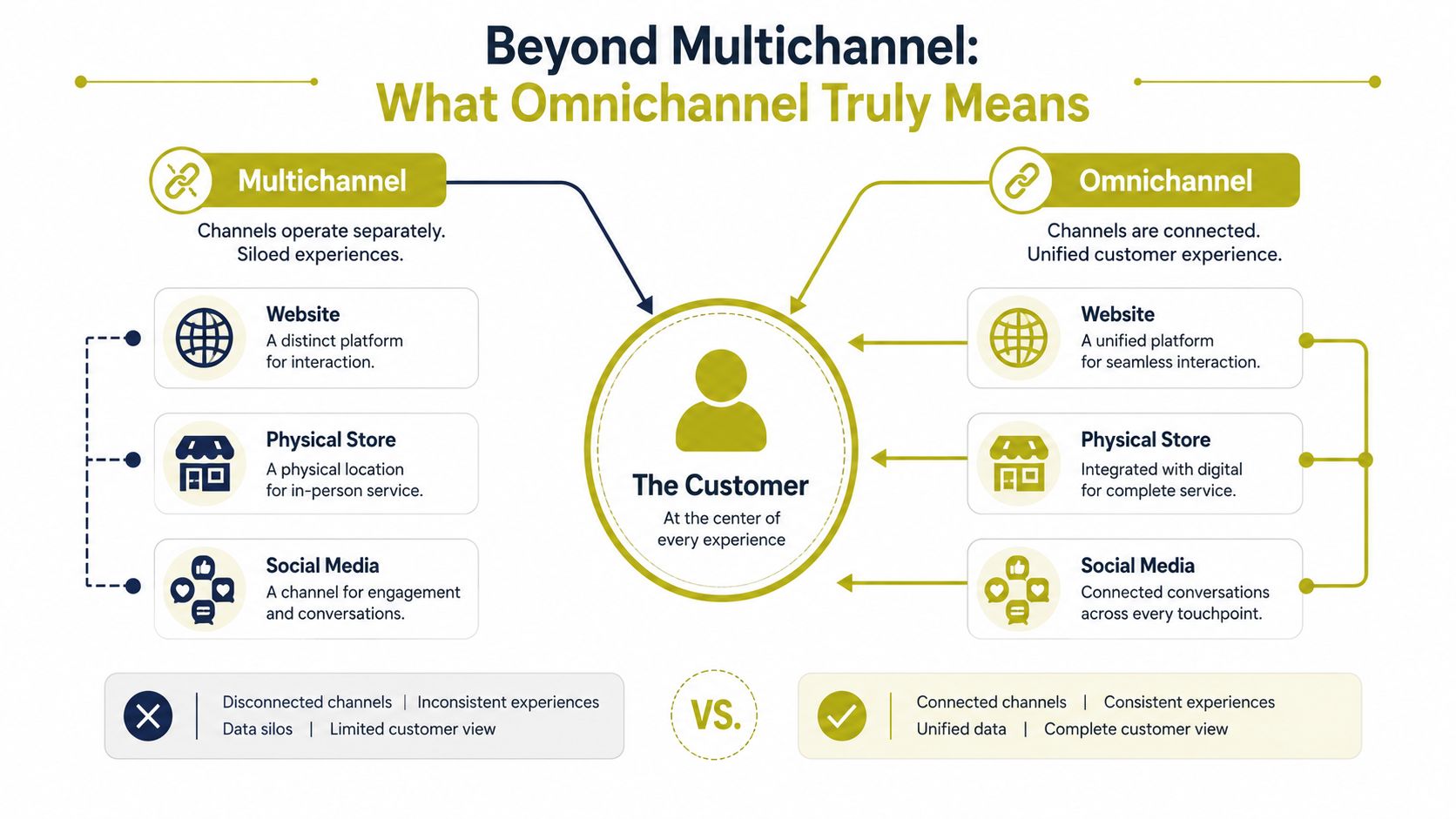
Multichannel is presence. Omnichannel is continuity
Multichannel means you're active in several places.
Omnichannel means those places work together around the same customer.
A simple way to think about it is this:
- Multichannel is making separate announcements from different rooftops.
- Omnichannel is having one conversation that continues wherever the customer moves.
If someone clicks a paid ad, browses products, abandons a basket, opens an email, then visits your shop, an omnichannel setup helps each interaction inform the next one. The message, timing and service context stay aligned. The customer doesn't need to repeat themselves, and your team doesn't need to guess.
What this changes inside a business
The shift is partly technical, but it starts as a mindset issue. Businesses often organise themselves by team, platform or budget line. Customers don't care about any of those internal boundaries.
That's why weak omnichannel efforts usually fail in predictable ways:
- The social team optimises for engagement, but the website doesn't reflect what was promoted.
- Email automation runs on its own schedule, not on real customer behaviour.
- Sales or front-line staff work from partial information, so follow-up feels generic.
- Operations sit outside the plan, which means fulfilment and service undermine the promise marketing made.
A proper omnichannel strategy forces the business to adapt to the customer journey rather than forcing the customer to adapt to the business.
Practical rule: If a customer has to start over every time they switch channel, you don't have omnichannel. You have channel clutter.
For owners who want a straightforward external explanation of the concept, CartBoss's omnichannel strategy insights offer a useful companion read. The value in that framing is simple. Omnichannel isn't about being everywhere. It's about deciding where continuity matters most, then building it deliberately.
That distinction saves SMEs from a common mistake. They add more channels before they've connected the ones they already have.
The Core Components of an Omnichannel Engine
Most smaller businesses make omnichannel harder than it needs to be because they think of it as a giant technology project. In practice, it's an operating model with four connected parts. If one part is weak, the whole thing wobbles.
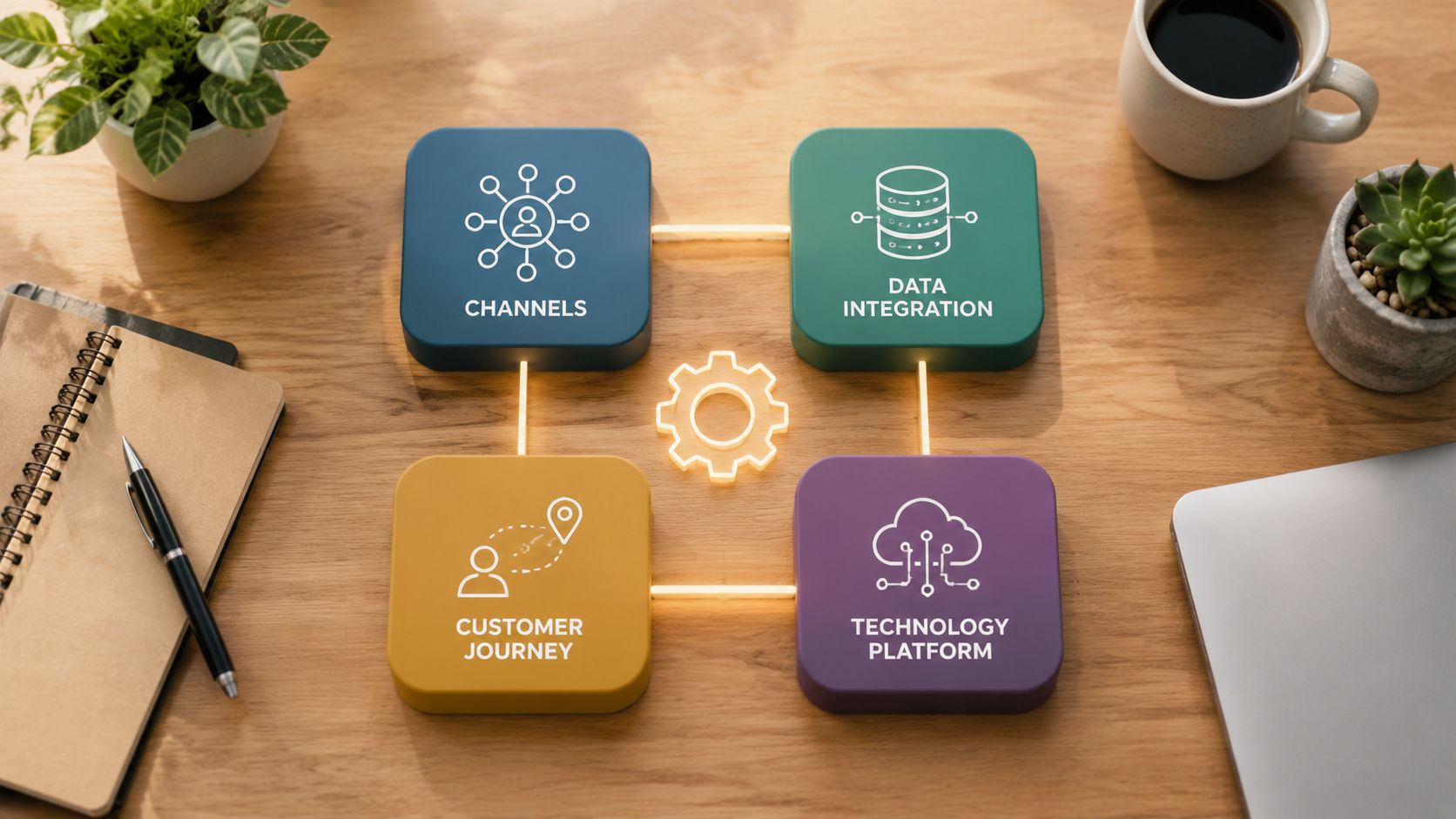
Choose channels by journey stage
Being everywhere is expensive and usually unnecessary. The better question is where customers discover you, evaluate you, buy from you, and come back for support.
For one SME, that might be search, website, email and phone. For another, it could be Instagram, booking engine, WhatsApp and in-person service. The right mix depends on buyer behaviour, sales cycle length and operational capacity.
This is also where specialist work such as AY Rank's e-commerce SEO services can fit into the picture. Search often plays an early-stage discovery role in the omnichannel journey, but it only adds strategic value when the traffic lands on pages that connect properly to the next touchpoint.
Unified data is the spine
Without a shared customer record, channels can't work together in any meaningful way. They just fire messages independently.
That problem is more serious in the UK market because customer journeys are naturally fragmented. 95% of UK adults were internet users, and 88% of those users accessed the internet daily or almost daily, according to UK omnichannel analytics data. People move between devices, sessions and contexts constantly. If you don't unify those interactions, your reporting will over-credit the last visible click and understate the channels that assisted the sale.
A useful way to think about this is the “golden record”. One place where contact details, consent, purchase history, content engagement, service interactions and key preferences are brought together cleanly enough to act on. That doesn't require a giant enterprise platform from day one, but it does require discipline. A messy CRM is worse than a simple one used properly.
For businesses building that foundation, a customer data platform approach helps clarify the difference between storing data and making it usable.
Journey mapping shows where friction lives
Most channel plans are built around the business calendar. Better omnichannel plans are built around the customer's moments of uncertainty.
Map one journey in detail. Start with the trigger. Follow the consideration steps. Note the handoffs. Include the dead time between actions. Then track what happens after purchase.
This is where patterns emerge:
- Discovery friction when the ad promise and landing page don't match
- Decision friction when pricing, stock or booking information is inconsistent
- Conversion friction when forms are too long or checkout lacks reassurance
- Service friction when support teams can't see prior interactions
Journey mapping turns vague complaints into fixable problems.
The stack should serve the strategy
Technology matters, but buying tools too early is a costly habit. The stack should support the journey you're trying to improve, not dictate it.
A practical SME stack often includes:
| Component | What it does | What to avoid |
|---|---|---|
| CRM | Holds customer records and interaction history | Choosing a system your team won't update |
| Analytics | Shows path, source and behaviour patterns | Relying only on last-click reports |
| Email or automation platform | Handles triggered and segmented messaging | Sending every contact the same sequence |
| Booking, ecommerce or POS system | Captures transactions and status | Keeping sales data isolated from marketing |
The strongest setups are rarely the flashiest. They're the ones your team can operate every day.
A Practical Omnichannel Roadmap for SMEs
Most SMEs don't need a transformation programme. They need a sequence.
That means making a few high-value decisions in the right order, proving commercial value, then expanding. That approach is more realistic for smaller firms, especially because many are still early in their digital maturity. Only 14.8% of UK businesses had adopted at least one AI technology in 2025, up from 9.2% in 2024, according to UK AI adoption data and omnichannel rollout context. For most businesses, a phased rollout beats a grand redesign.
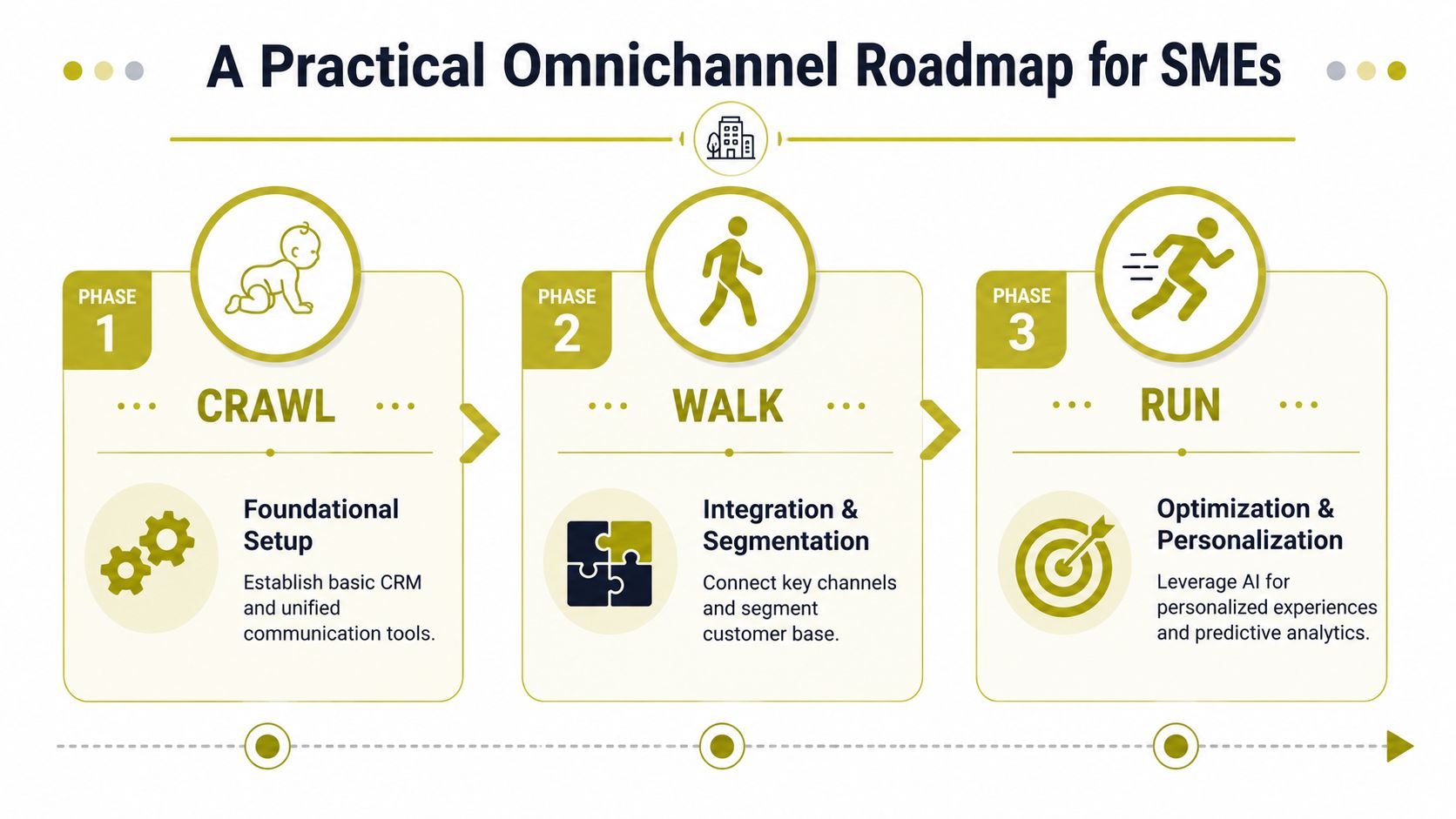
Crawl with two or three channels
Start with the channels that already influence revenue. Don't start with the channels that feel fashionable.
For many SMEs, that first combination is:
- Website plus email for lead capture and follow-up
- Website plus phone for service-led sales
- Website plus in-store or POS for local retail or hospitality
- Social plus booking engine for experience-led businesses
The goal at this stage is simple. Make sure the customer can move from interest to action without being dropped into a completely separate experience.
A useful discipline here is to nominate one primary journey. For example, “social post to room booking”, “Google search to enquiry form”, or “email click to repeat purchase”. If you can't describe the journey clearly, you can't connect it properly.
Walk by building one reliable customer view
Once the first channels are connected, sort out your data hygiene. This isn't glamorous work, but it's where a lot of the eventual return comes from.
Use one CRM. Define who owns it. Decide what fields matter. Make sure customer service, sales and marketing all work from the same record where practical.
Don't automate confusion. Fix naming, tagging and ownership before you add more triggers, journeys or tools.
This is also the point where segmentation becomes useful. Not advanced personalisation. Just sensible distinctions between first-time buyers, repeat customers, warm leads, past guests, lapsed contacts or high-intent enquiries.
A short explainer on the broader thinking can help here:
Run by optimising and expanding carefully
Only add more channels once the first journey performs reliably and the team can maintain it.
At this stage, focus on questions like:
- Which touchpoints assist conversion most often
- Which follow-up messages move people forward
- Where handoffs still break
- Which audience segment justifies more personalisation
For a hospitality business, that might mean linking pre-arrival emails to front-desk notes. For a retailer, it could mean joining inventory visibility with remarketing. For a B2B service firm, it often means connecting web leads, consultation bookings and sales follow-up into one traceable path.
What doesn't work is the “big bang” version. New CRM, new automation platform, new ad channels, new reporting dashboard, all at once. That usually creates internal confusion, patchy adoption and expensive underuse.
The better route is slower, but far more commercial. Build one connected journey. Prove it. Extend it.
Omnichannel in Action for UK Sectors
Theory is useful up to a point. It becomes easier when you can see how the pattern applies in the kind of business you run.
Tourism and destination marketing
A visitor in England sees paid social creative promoting a Scottish short break. They click through to a destination guide with itinerary ideas, save a page, then return later via search to compare accommodation options. After booking, they receive pre-arrival emails with local recommendations and practical travel information.
That's an omnichannel journey when each step feels like part of the same decision, not separate campaigns produced by separate teams.
For tourism brands, the mistake is often over-investing in inspiration and under-investing in continuity. The handoff from dreaming to planning to booking has to feel natural. Content, search visibility, booking UX and follow-up communication all need to support the same promise.
Hospitality and experience-led venues
Think about a premium visitor attraction or hospitality venue. A customer books online, receives confirmation and timed reminders, arrives on site, and the staff already know the booking details and any relevant upsell or preference information. After the visit, they receive a personalized follow-up tied to what they experienced.
That kind of journey doesn't require gimmicks. It requires coordination.
The strongest hospitality omnichannel setups usually connect four things well:
- Booking data so the business knows who is arriving
- On-site experience so staff can deliver with context
- Post-visit follow-up so the relationship doesn't stop at the till
- Service recovery so issues raised in one channel don't need repeating elsewhere
Regulated sectors such as legal or financial services
In regulated sectors, omnichannel isn't about flashy personalisation. It's about trust, traceability and clarity.
A prospect may discover a firm through search, read thought leadership, submit a secure enquiry, receive a follow-up email, attend a call, then move into a client portal or face-to-face meeting. The experience needs to remain consistent, but it also needs proper controls around consent, record-keeping and communication standards.
In regulated markets, a good omnichannel strategy reduces confusion. It doesn't create more messaging. It creates one clear line of communication across approved touchpoints.
For these firms, the win is often operational rather than theatrical. Fewer duplicated questions. Better documented interactions. Smoother movement from marketing to client service.
Measuring Success and Proving Your ROI
If you measure omnichannel work with clicks alone, you'll undervalue it.
A good omnichannel strategy often improves the spaces between channels. Better handoffs, fewer drop-offs, stronger repeat behaviour, cleaner conversion paths. Those gains don't always show up in isolated platform metrics, which is why SMEs need a small set of business-facing indicators.
High-performing UK retailers tie omnichannel execution to commercial outcomes by tracking metrics such as conversion by channel, average order value, and two-or-more-channel penetration, according to retail guidance on omnichannel KPI tracking.
What to track instead of vanity metrics
Don't ignore campaign metrics, but don't stop there. Track what reveals whether the connected journey is making the business stronger.
| KPI Category | Metric | What It Measures |
|---|---|---|
| Customer value | Customer lifetime value | Whether connected experiences increase long-term revenue per customer |
| Customer loyalty | Retention rate by cohort | Whether specific groups come back after a first purchase or visit |
| Journey performance | Conversion by path | Which combinations of channels lead to action |
| Journey efficiency | Time-to-purchase | How long customers take to move from first touch to sale |
| Channel contribution | Assisted conversions | Which channels influence the sale even if they don't close it |
| Commercial quality | Average order value | Whether better continuity leads to stronger basket or booking value |
| Omnichannel adoption | Two-or-more-channel penetration | How many customers interact across more than one touchpoint |
| Service quality | Resolution continuity | Whether support interactions carry over cleanly across channels |
How SMEs should read the numbers
The test isn't whether every line goes up at once. The test is whether the journey gets more efficient and more valuable over time.
If email engagement is flat but repeat purchase improves, that can still be a win. If paid social looks expensive on a last-click basis but repeatedly starts journeys that later convert through search or direct traffic, it may be doing more than the platform report suggests.
For teams that need a clearer view of engagement quality, this guide to measuring social media engagement properly is a useful complement to broader omnichannel reporting.
The practical habit is to review metrics by journey, not just by channel. That's how you spot whether the system is working.
Common Pitfalls and Your Omnichannel Checklist
Most omnichannel failures are not caused by lack of ambition. They're caused by disconnected execution.
A business invests in content, ads and automation, but customer data remains fragmented. Or the buying journey works reasonably well, but returns, support and aftercare are clumsy. Or a new platform gets bought before anyone has agreed the operating model.
One of the most overlooked weak points is what happens after purchase. UK consumers returned an estimated £27.3 billion of online purchases in 2024, according to UK returns data and omnichannel post-purchase analysis. For any retail, ecommerce or hybrid business, ignoring returns and service handoffs is not a side issue. It can undo the value created earlier in the journey.
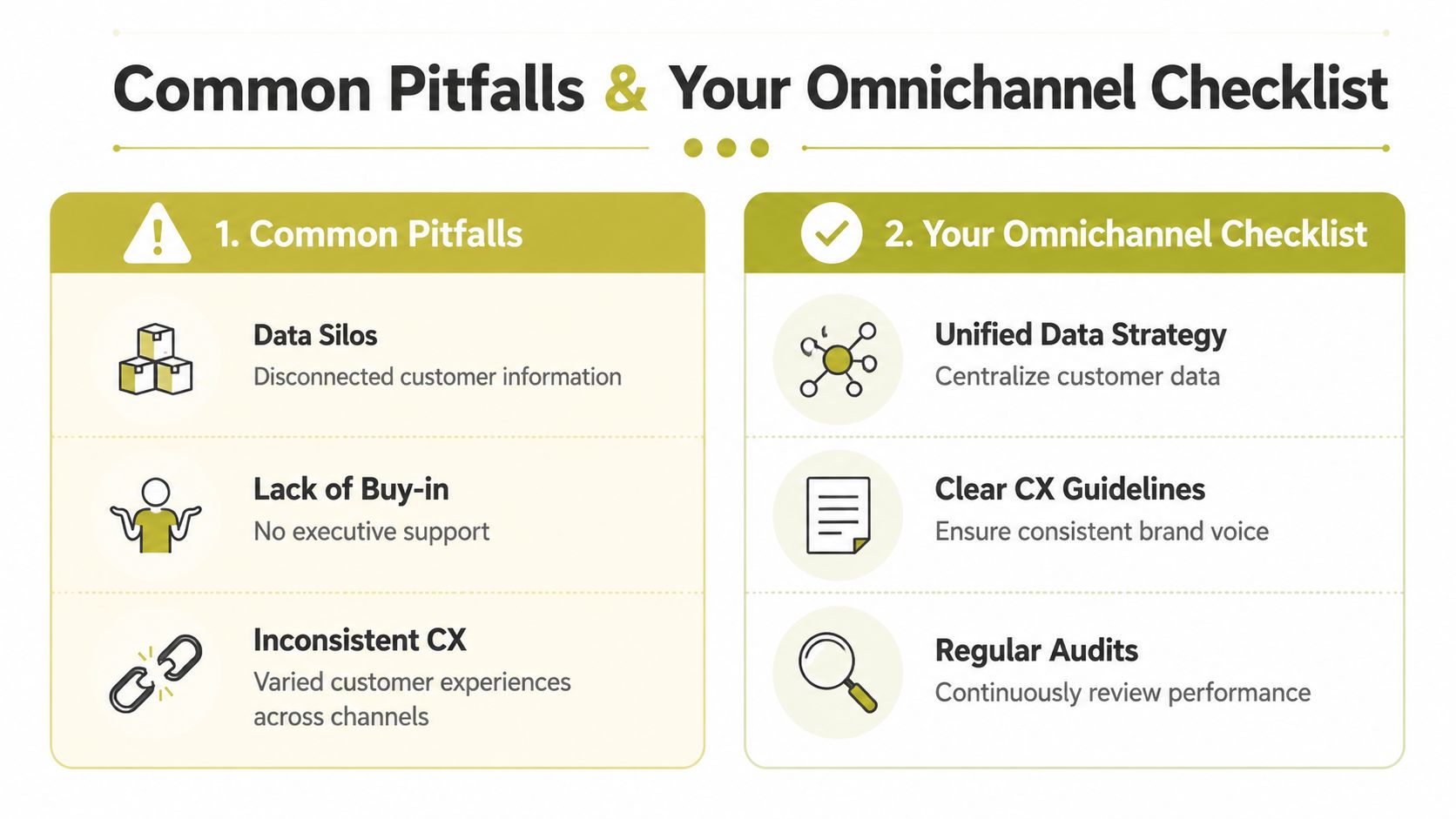
The mistakes that keep recurring
- Data stays in silos. Marketing, sales and service all hold partial records, so nobody sees the full customer picture.
- Brand standards drift. The tone on social, website, email and phone doesn't match, so the business feels inconsistent.
- Pre-purchase gets all the attention. Checkout is polished, but fulfilment, exchanges, complaints and returns are awkward.
- Tech comes before process. Teams buy tools first and work out ownership later.
- Too many channels arrive too early. Complexity grows faster than capability.
A checklist worth using
Use this as a practical test before you expand any further:
- Pick one priority journey and define the start point, handoffs and desired outcome.
- Limit your first rollout to the channels that already influence revenue.
- Create one usable customer record that sales, marketing and service can trust.
- Set basic rules for tone, offer and response handling so the brand feels the same everywhere.
- Include post-purchase steps such as delivery updates, support, returns or rebooking.
- Review performance by journey rather than treating each channel in isolation.
- Add complexity only after adoption is stable inside the team.
A lot of businesses chase omnichannel as if it's a software category. It isn't. It's a coordination discipline. Smaller firms can do it very well because they often move faster, have fewer layers, and can redesign customer journeys without a committee.
Get the basics connected, and the business starts to feel bigger than it is.
If you want senior help building an omnichannel strategy that fits your budget, Carlos Alba Media brings together former national news journalists and agency specialists who've worked with international brands. The team helps SMEs and growth businesses create joined-up customer journeys across PR, digital, content, SEO, web and social, with practical execution that's designed to be seen, trusted and chosen.