
Your email platform knows who clicked. Your ecommerce system knows who bought. Your CRM knows who asked for a callback. Your support inbox knows who complained last Tuesday. The problem is that none of those tools knows the full story.
That's where many UK SMEs get stuck. They aren't short of data. They're short of joined-up customer understanding. The result is familiar: repeat customers get treated like new leads, warm prospects receive irrelevant offers, and staff waste time exporting spreadsheets just to answer basic questions about who did what.
A lot of martech promises to fix that. Much of it adds another layer of cost and complexity. A customer data platform is only useful if it helps you make better decisions, target people more accurately, and stay in control of compliance. If it doesn't do those things, it's just another dashboard.
Is Your Customer Data Working for You or Against You
A common SME setup looks tidy on the surface. There's a website with forms, an email platform, a CRM, maybe Shopify or WooCommerce, and a few sales notes sitting in someone's inbox. Then a campaign goes live and the cracks show. Existing customers get prospecting messages. Support teams can't see marketing history. Paid ads chase people who already converted.
That isn't a reporting problem. It's a customer data problem.

A customer data platform sits in the middle of that mess and tries to turn scattered activity into a usable customer view. For UK businesses, that matters more now because the category is moving into the mainstream. One projection values the global customer data platform market at USD 9.72 billion in 2025 and forecasts USD 37.11 billion by 2030 (Fortune Business Insights on customer data platform market growth). That doesn't prove every business needs one. It does show this is no longer niche software for enterprise brands with oversized tech stacks.
The real test is operational
The useful question isn't “should we modernise our stack?” It's simpler. Is your data helping you serve and sell better, or is it creating friction?
If your team has to do any of the following regularly, your data is probably working against you:
- Export lists by hand: Someone pulls contacts from one system, cleans them in Excel, then uploads them into another.
- Guess customer intent: Sales calls a lead without knowing what pages they viewed or which email they clicked.
- Duplicate work across teams: Marketing, sales, and service each maintain their own version of the customer record.
- Miss obvious follow-ups: A buyer downloads a brochure, visits your pricing page twice, then hears nothing.
Practical rule: If your team can't answer “what happened before this customer contacted us?” without opening three systems, your setup is already costing you.
For SMEs, this isn't only about campaign performance. It affects retention, customer experience, and decision-making. It also affects strategy work like customer journey mapping for growing businesses, because journey maps break down quickly when the underlying data is fragmented or inconsistent.
What a Customer Data Platform Really Does
The cleanest way to think about a customer data platform is this: it acts as a central brain for customer intelligence. It doesn't replace every other tool. It gives those tools a better understanding of the person they're dealing with.
A good CDP usually does four jobs. Not in theory. In daily practice.
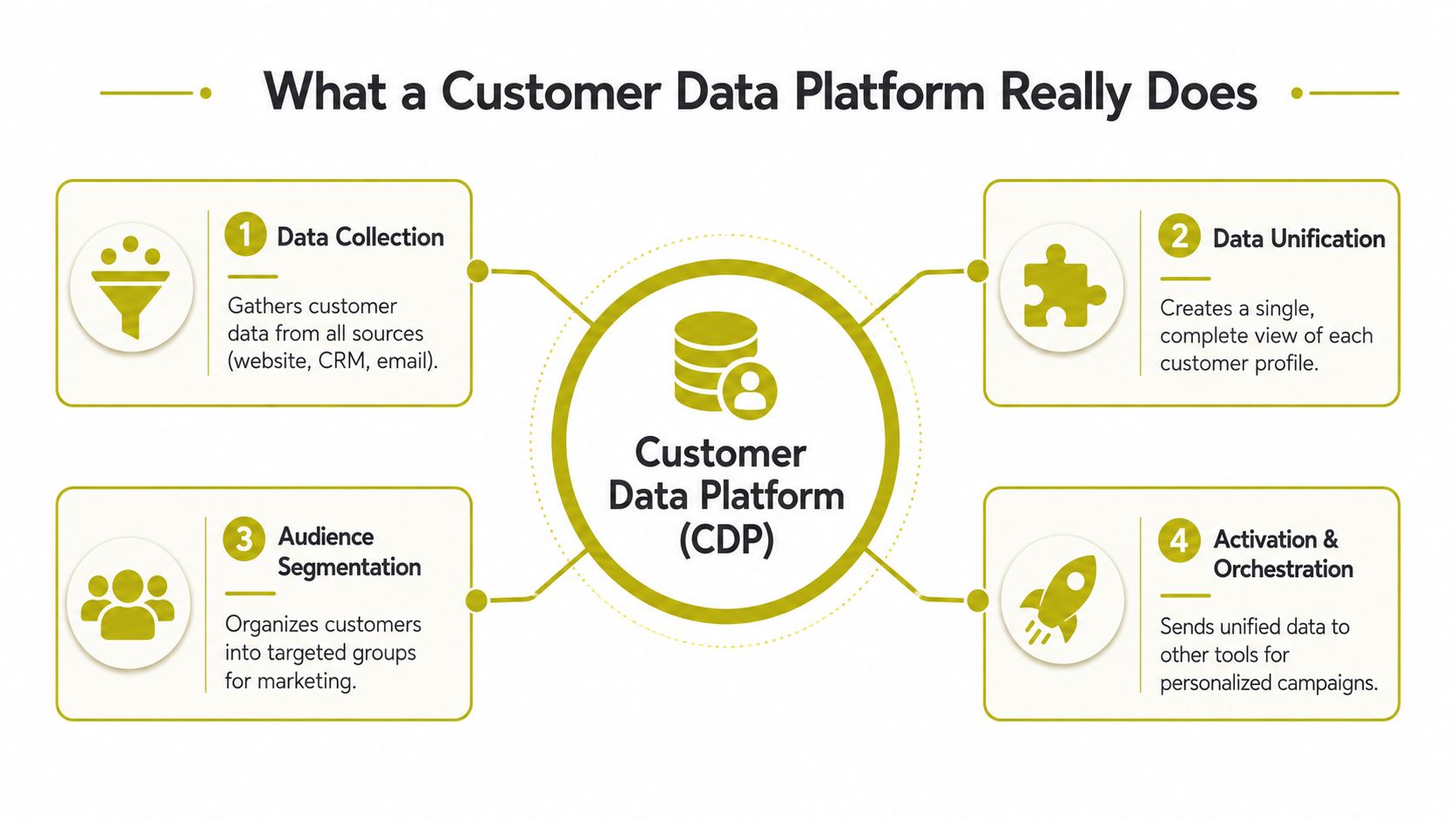
It collects data from multiple places
A CDP pulls in customer information from sources such as your website, ecommerce platform, email system, CRM, app, and support tools. That can include page views, purchases, form fills, support tickets, and campaign engagement.
The point isn't to hoard every possible signal. The point is to gather the signals that matter to a real business decision. For an SME, that often means purchase history, lead source, email engagement, product interest, and service interactions.
It unifies that data into one profile
Collection alone doesn't solve anything. The hard part is matching records that refer to the same person.
A customer may browse on mobile, later open an email on desktop, then place an order using a slightly different email address. A CDP tries to connect those interactions into a persistent customer profile. That's what people mean by a “single customer view”.
It segments audiences based on behaviour and value
Once records are unified, you can build segments that are actually useful.
Not broad groups like “newsletter subscribers”. Better groups, such as:
- Cart abandoners who also opened the last campaign
- Past buyers of one product category who haven't returned
- Leads who requested a quote but never booked a call
- Customers with repeated support issues before renewal
That's the difference between generic broadcasting and relevant communication.
It activates those audiences in other systems
A CDP isn't meant to be a storage cupboard. It should push audiences and profile data into the channels where you act. That could be your email platform, paid social, ad accounts, CRM workflows, or on-site personalisation tools.
A CDP earns its keep when your team spends less time stitching data together and more time acting on it.
What it does not do
Buyers often find themselves mistaken. A CDP does not automatically fix bad tracking, poor naming conventions, weak consent controls, or a confused offer strategy.
It also doesn't guarantee better marketing. If your targeting is vague, your copy is weak, or your sales process leaks leads, unified data won't rescue that. It will only show the problem more clearly.
That's why plain-language explanation matters. Teams with strong editorial discipline tend to make better implementation decisions because they reduce technical fog and focus on what the business is trying to improve.
CDP vs CRM vs DMP Clearing the Confusion
Most SME owners already have a CRM and wonder whether a CDP is the same thing with smarter branding. It isn't. There is overlap, but each platform serves a different job.
A CRM is mainly about managing direct relationships. Your sales team logs calls, tracks opportunities, records notes, and manages follow-ups. Tools like HubSpot, Salesforce, and Pipedrive are built around known contacts and pipeline activity.
A DMP is different again. It's historically been used for audience targeting in advertising, often with anonymous or third-party data. If you need a clearer primer on that older advertising layer, this guide to understanding data management platforms is useful background.
A CDP sits between those worlds. It unifies data from multiple first-party sources into a persistent profile that marketing, sales, and service teams can use.
CDP vs CRM vs DMP Key Differences
| Platform | Primary Purpose | Data Focus | Typical User |
|---|---|---|---|
| CDP | Unify customer data and make it usable across channels | First-party customer data from multiple systems, sometimes including both known and previously anonymous interactions once identified | Marketing, digital, CRM, analytics, sometimes service teams |
| CRM | Manage sales relationships and direct customer interactions | Known leads, prospects, customers, account activity, notes, deal stages | Sales teams, account managers, customer service |
| DMP | Build advertising audiences for targeting | Largely anonymous audience data used for ad planning and targeting | Paid media and advertising teams |
Where SMEs usually go wrong
They buy a CDP when the actual issue is CRM discipline. If your team doesn't log interactions properly, doesn't maintain fields consistently, or hasn't agreed lead stages, a CDP won't create order from that chaos.
They also assume their CRM already does everything a CDP does. Some CRMs can store a lot of data, but storage isn't the same as unification and activation. A CRM record may tell you someone is a lead from Manchester. It often won't reconcile web activity, email behaviour, support history, and transaction patterns into one usable profile without extra work.
When the tools complement each other
A sensible setup often looks like this:
- CRM manages relationship workflow
- CDP unifies behavioural and transactional data
- Campaign tools deliver messages
- Analytics tools measure what happened
If you're comparing platforms, don't ask “Which one is best?” Ask “Which problem is this platform actually designed to solve?”
That question strips out a lot of vendor noise. It also stops SMEs paying twice for similar capabilities while still leaving major gaps untouched.
Real-World CDP Use Cases and Benefits for SMEs
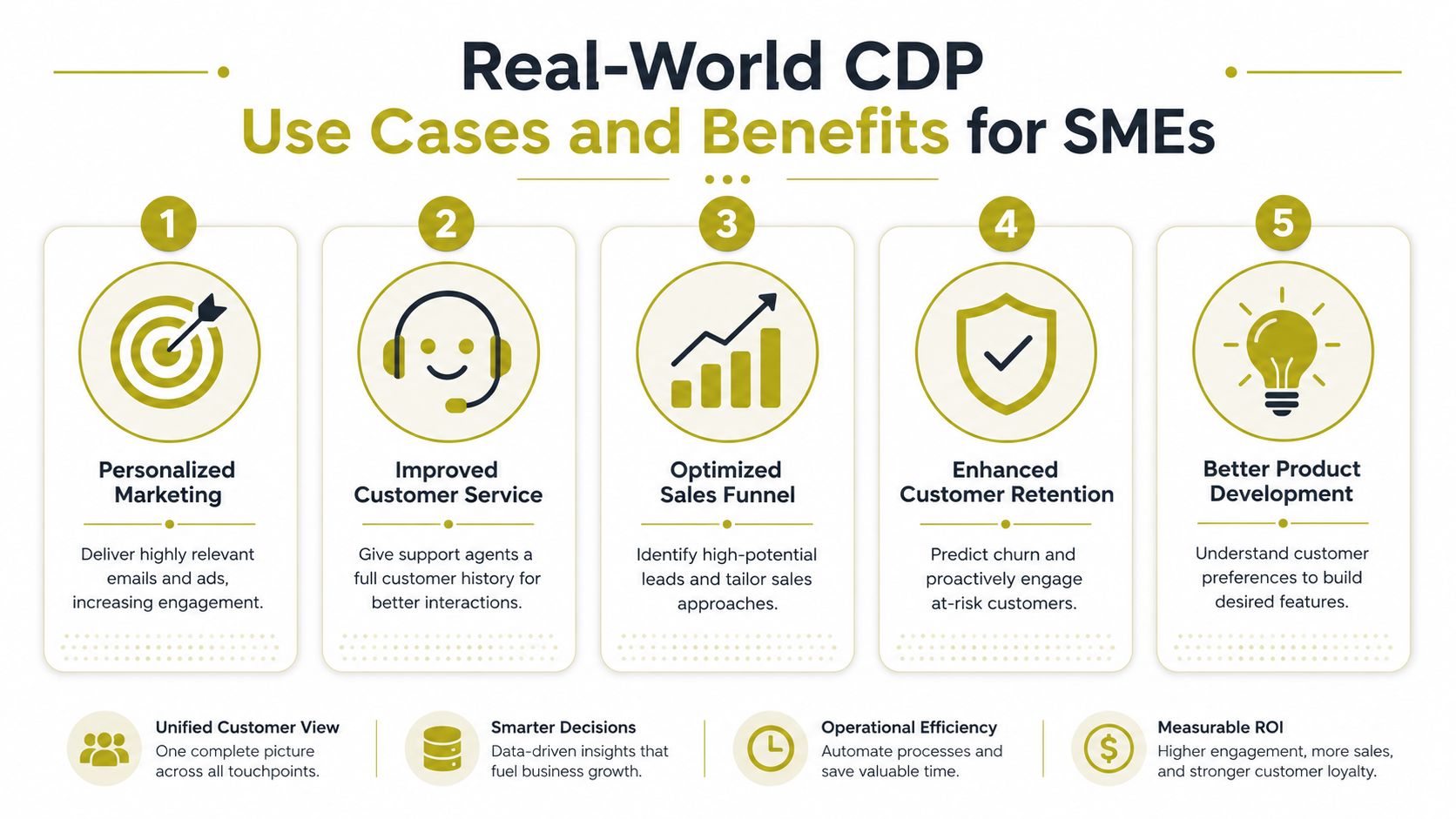
The value of a customer data platform shows up in ordinary commercial moments, not in vendor diagrams. It's useful when it helps a business stop wasting spend, send sharper messages, and give staff context they didn't have before.
One of the biggest frustrations for UK buyers is that CDP content often explains the mechanics but ducks the hard commercial question. Adobe's own explainer reflects that gap: a frequently under-answered UK question is not what a CDP does, but how to prove ROI, especially where GDPR and data minimisation are active operational issues (Adobe on what a customer data platform is).
Reducing wasted paid media
An SME retailer runs Meta and Google campaigns. Without a unified profile, ad platforms keep targeting people who already bought, asked for support, or moved into a loyalty segment.
With a CDP, the team can suppress recent purchasers, build better retargeting audiences, and stop spending money on the wrong people. That doesn't make ad creative irrelevant. It means your media budget starts with cleaner audience logic.
Sending email that feels informed
Plenty of SMEs say they personalise email when all they do is insert a first name.
A CDP makes more meaningful email segmentation possible. A customer who browsed one service line, downloaded a guide, then contacted support about pricing should not receive the same sequence as someone who bought six months ago and hasn't returned. If you're already refining lifecycle messaging, it pairs naturally with a stronger UK email marketing service strategy.
Here's a simple visual summary before going further.
Giving customer service the full picture
Support teams often work half-blind. They can see the ticket in front of them but not the campaign the customer responded to, the order issue that happened before, or the fact that sales promised a callback.
A CDP can feed richer context into service tools. That helps staff respond with relevance instead of asking customers to repeat themselves. For a small team, that kind of context saves time and protects trust.
Spotting high-intent leads earlier
For service businesses, one of the best use cases is combining lead source, site behaviour, and enquiry history. Not every form submission deserves the same follow-up.
Useful CDP logic might flag people who:
- Visited pricing or case study pages repeatedly
- Opened multiple nurture emails
- Returned after an offline event or referral
- Engaged with content tied to a high-margin service
That gives sales a better queue. Not a bigger one. A better one.
What works and what doesn't
What works is narrow, commercial use. Start with one audience problem you can improve.
What doesn't work is trying to “transform the customer experience” across every channel from day one. SMEs usually get more value by fixing one stubborn issue first, then expanding once the data model and workflow hold up.
Choosing the Right CDP and Your Implementation Roadmap
The wrong way to buy a customer data platform is to start with feature grids. The right way is to start with a business problem that's costing time, revenue, or customer trust.
If you can't name that problem in one sentence, you're not ready to buy.
What to check before you shortlist vendors
A practical SME shortlist should focus less on brochure language and more on operational fit.
- Integration reality: Can it connect cleanly to the systems you already use, such as your CRM, ecommerce platform, email tool, and analytics setup?
- Identity logic: How does it handle duplicate records, multiple identifiers, and incomplete customer information?
- Usability for your team: Will marketers and CRM managers use it, or will everything depend on a developer or external consultant?
- Consent handling: Can the platform respect consent state across channels instead of treating privacy as an afterthought?
- Support quality: What happens after onboarding? Many platforms sell capability and leave SMEs to figure out process design alone.
- Security posture: Because a CDP centralises personal data, it's sensible to review wider SaaS risk and ask technical questions. This overview of affordable SaaS pentesting is a helpful starting point for understanding how businesses pressure-test hosted platforms.
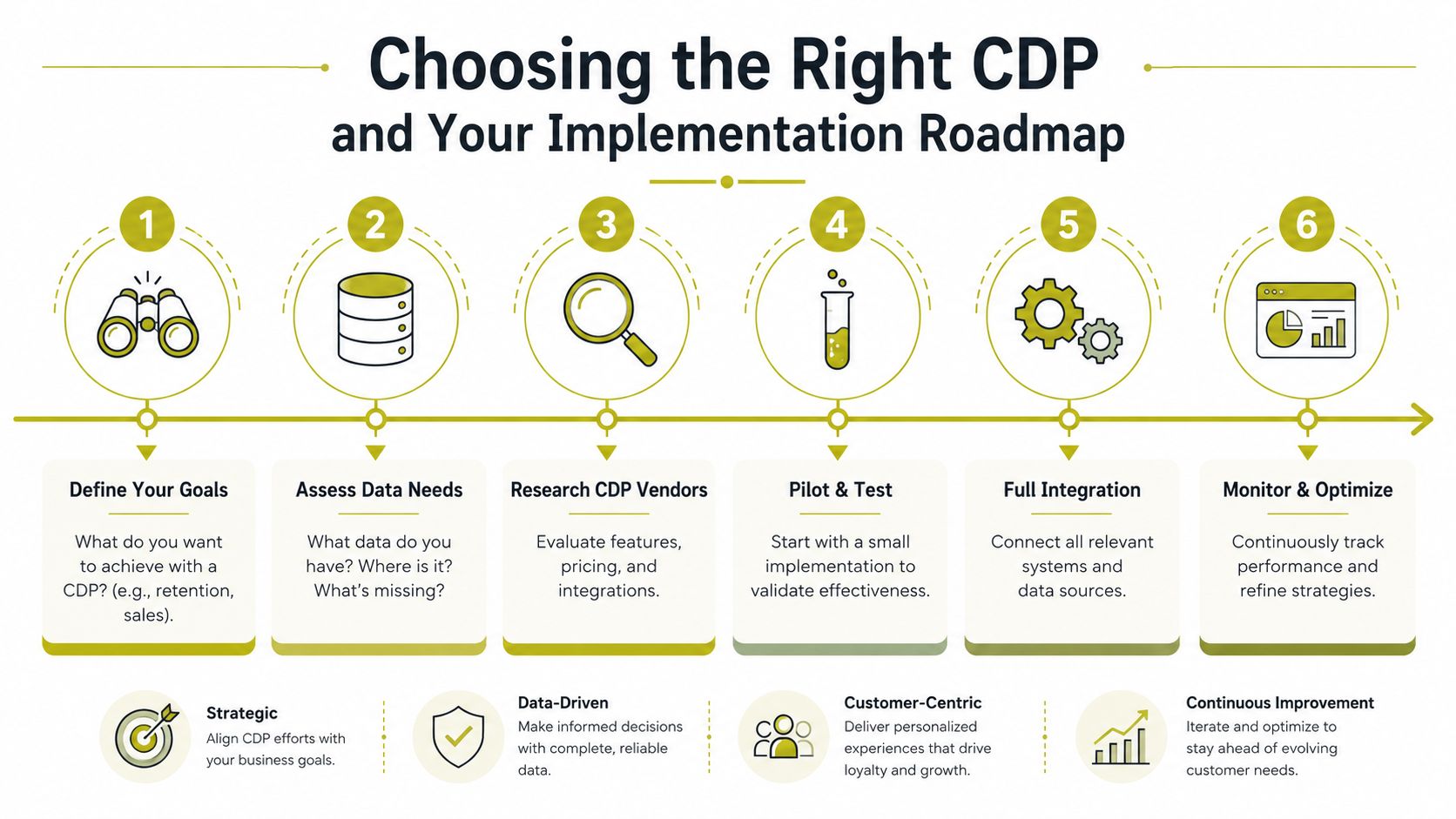
A phased roadmap that lowers risk
Most failed implementations don't fail because the software is impossible. They fail because the scope is inflated and the data underneath is weak.
Define one measurable goal
Pick a single use case. Recover abandoned baskets. Improve lead follow-up. Suppress existing customers from acquisition ads. Keep it tight.Audit your current data sources
List every source that affects the chosen use case. Include where the data sits, who owns it, and whether the fields are reliable.Clean the basics first
Standardise key fields, remove obvious duplication, and fix tracking gaps. Don't pour broken data into a new platform and expect clarity.Run a pilot
Use one channel, one audience, and one workflow. Prove the platform can unify records and trigger the action you need.Measure operational impact
Did the pilot save time, improve targeting, or reduce manual list building? Those signs matter before you expand.Scale gradually
Add channels and use cases once governance, ownership, and reporting are stable.
Decision test: If a vendor pushes you towards a full-stack rollout before you've validated one use case, that's a warning sign.
The trade-off buyers should expect
A CDP can simplify campaign execution later, but implementation creates work first. Teams need to define fields, ownership, and consent rules. SMEs that accept that upfront work usually make better purchases than those chasing a plug-and-play miracle.
Measuring ROI and Managing UK Data Privacy
A customer data platform should be judged the same way as any other business investment. Did it improve a result you care about, and did it do so without creating compliance headaches you can't control?
Those two questions belong together. In the UK, a CDP can strengthen marketing performance and increase data risk at the same time if governance is sloppy.
A useful benchmark exists, but it should be treated carefully rather than blindly. One industry summary reports that companies using CDPs are 2.5x more likely to outperform competitors in revenue growth and see an average return of USD 2.70 for every USD 1 spent (CDP industry statistics and ROI summary). That's encouraging. It isn't a substitute for your own measurement.
What to measure after launch
Forget vanity dashboards. Track the metrics that connect directly to the use case you chose.
- Conversion quality: Are more of the right people moving from enquiry to sale, or from browse to purchase?
- Audience waste: Are you reducing spend on existing customers, poor-fit leads, or duplicate targeting?
- Retention signals: Are known customers engaging more consistently after better segmentation?
- Operational efficiency: Is the team spending less time exporting, matching, and cleaning data by hand?
- Campaign relevance: Are personalised journeys performing better than generic sends in your own environment?
What UK privacy law changes in practice
Under UK GDPR and the Data Protection Act 2018, a CDP isn't just a bigger database. It's a system that can combine online and offline identifiers into a persistent profile. That creates clear operational duties around lawful basis, purpose limitation, provenance, and consent state.
The legal risk often comes from profile unification across sources, not just from storing the data. If someone gave consent for one purpose, that doesn't automatically mean every downstream activation use is valid. Your platform and your process need to reflect that.
Governance controls that matter
A privacy-aware CDP setup should include:
- Record-level provenance: You need to know where a data point came from.
- Consent-state synchronisation: Suppression and preference changes must flow across tools.
- Data minimisation: If a field isn't needed for the use case, don't ingest it.
- Access controls: Not every staff member should see every attribute.
- Clear identity handling: Merging records incorrectly can create both marketing and compliance problems.
A visual approach to secure identity solutions can also help non-technical teams understand why identity resolution and access governance sit at the centre of CDP risk.

Better customer data doesn't remove the need for judgement. It increases the importance of it.
A CDP should also fit the wider discipline of messaging, governance, and stakeholder alignment. If data decisions are disconnected from the way your organisation communicates internally and externally, the system quickly becomes inconsistent. That's why broader strategic thinking, including work such as building a communications strategy, matters more than many martech buyers expect.
Your Next Steps and Questions for Vendors
You don't need a perfect martech stack. You need a cleaner, safer way to use customer data for decisions that matter.
That starts with scepticism. Ask whether a customer data platform solves a live business issue or just sounds modern in a board meeting. If your current systems already support your segmentation, suppression, and follow-up well enough, a CDP may be unnecessary. If they don't, you need evidence that a platform will improve that specific gap.
The compliance side is just as serious. In the UK, the ICO reported 16,827 personal data breach incidents in 2023/24 (ICO data security incident trends). A CDP centralises personal data, so governance, minimisation, and access control can't be left until after procurement.
Take these questions into every vendor conversation:
- What exact problem does your platform solve in our stack?
- Which of our current tools would it complement, and which would it duplicate?
- How do you handle consent, suppression, and purpose limitation across channels?
- What data fields are required for our first use case?
- How do you manage identity resolution when records conflict or only partly match?
- What does a sensible pilot look like for a business of our size?
- Who inside our team will need to own governance after launch?
- What reporting will prove this is working within the first review cycle?
A good vendor answers plainly. A weak one reaches for jargon.
If you want senior, practical guidance on customer data strategy, content, PR and digital growth, Carlos Alba Media brings the kind of scrutiny most agencies don't. The team is made up of former national news journalists and agency specialists who've worked with international brands, so advice is direct, commercially grounded, and built to stand up to tough questioning. If that's the level of thinking you want around your marketing and customer data decisions, they're worth speaking to.