
UK businesses that don't build strong first-party data pools risk losing up to 40% of their audience targeting capability as cookie-based tracking disappears, according to Known Media's analysis of the UK shift to owned data. For an SME, that's not an abstract platform change. It hits lead quality, remarketing, reporting, and how confidently you can spend on growth.
A lot of advice on this topic is written for enterprise teams with data engineers, sprawling martech stacks, and budgets that can absorb mistakes. Most UK SMEs don't work like that. They need a first party data strategy that fits the tools already in place, respects GDPR, and produces something useful quickly.
That's the practical lens that matters. At Carlos Alba Media, the specialist nature of the team shapes that approach. Everyone who works for Carlos Alba Media is a former national news journalist or has agency experience of working with international brands. The result is direct advice, clear judgement, and a bias towards what's workable rather than what sounds fashionable.
The End of an Era and the Dawn of Your Data
Third-party data used to let marketers rent attention. That period is ending. Privacy regulation, browser restrictions, and tougher scrutiny around consent have changed the economics of digital marketing in the UK.
If your acquisition model still depends on cookies filling in the gaps, the risk isn't theoretical. It shows up in missing attribution, weaker audience matching, and campaigns that look efficient in-platform but underperform in the business.
Why owned data now matters more than reach
A strong first party data strategy starts with one mindset shift. Stop asking, “How do we track more people?” Start asking, “How do we build direct, consented relationships we can use?”
That changes where teams focus:
- From rented audiences to owned channels: Website sign-ups, email subscriptions, CRM records, and customer accounts become core assets.
- From volume to usable quality: A smaller consented list with clear intent often beats a larger pool of vague third-party signals.
- From loose reporting to operational clarity: Every data point should support a decision, a segment, or a campaign action.
Practical rule: If you can't explain what a piece of customer data will help you do next, don't prioritise collecting it.
A clearer standard for SMEs
Many founders still hear “data strategy” and picture a giant transformation programme. That's usually the wrong starting point. The better move is tighter. Audit what you already own, clean it, connect it, and use it.
That's also where experienced editorial thinking helps. Carlos Alba Media is explicitly founded and run by Carlos Alba, a multi-award-winning former national newspaper editor, with leadership rooted in senior national news journalism experience, as outlined on the agency's who we are page. That newsroom discipline matters because good data strategy needs the same habits as good reporting. Cut noise. Verify what matters. Build a reliable picture before acting on it.
For SMEs, this is the dawn of something better than cookie dependency. It's a chance to build a marketing system around trust, direct access, and cleaner decision-making.
What Is First-Party Data and Why It Matters Now
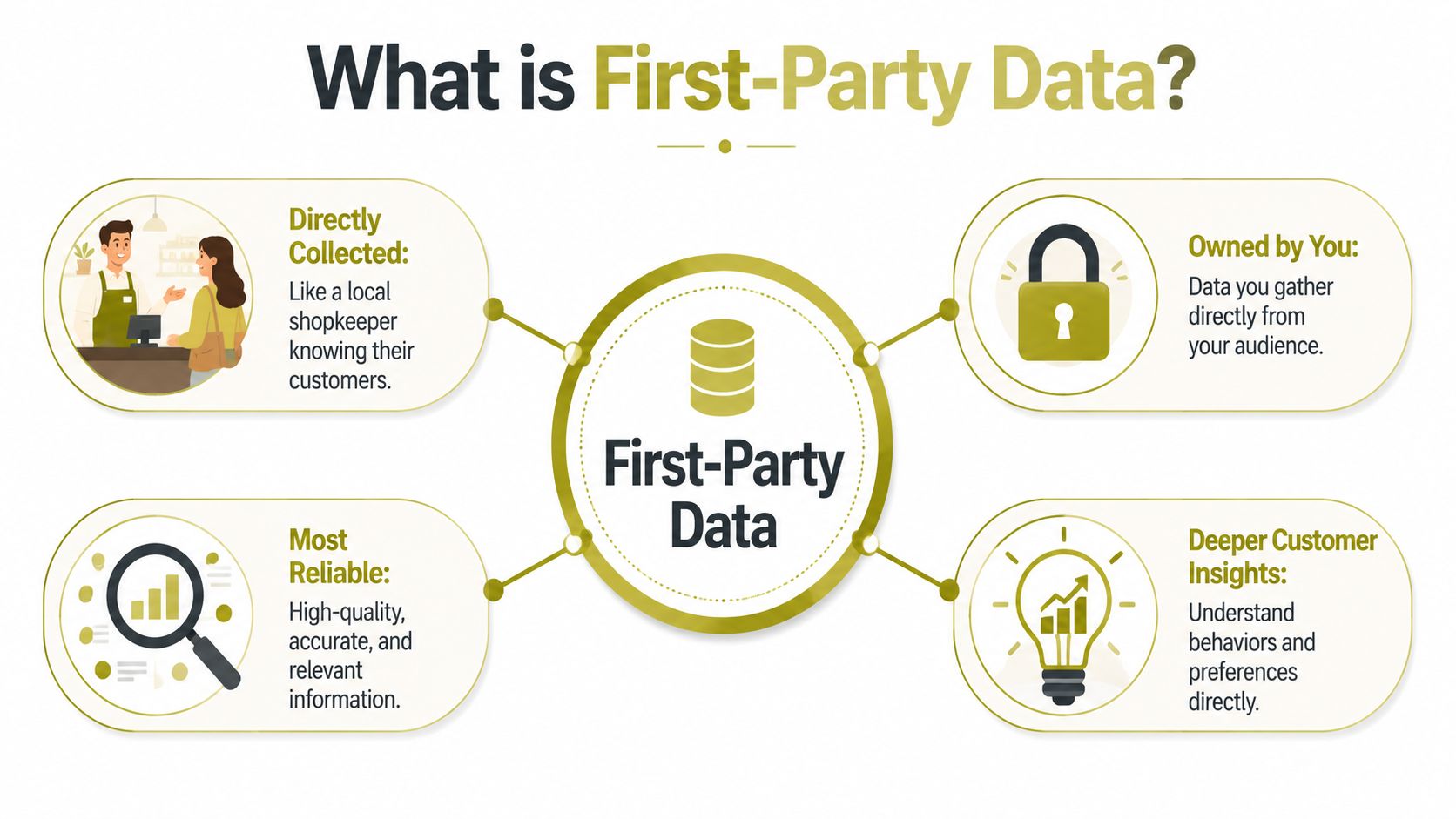
First-party data is information your business collects directly from people who choose to interact with you. For a UK SME, that usually means enquiry forms, newsletter sign-ups, purchase history, account activity, CRM notes, and email engagement, all tied to a real relationship and clear permission.
That direct link matters more now because the old shortcuts are weakening. Third-party cookies are less dependable, platform data is harder to trust at face value, and UK privacy rules have raised the standard on consent and transparency. Smaller businesses feel that shift quickly because they cannot afford wasted spend, messy records, or audiences they do not really own.
What counts as first-party data
In practice, the useful sources are often the ones already sitting inside tools you pay for today:
- Website interactions: Contact forms, downloads, registrations, and enquiry flows.
- Email engagement: Opens, clicks, preferences, and subscription choices.
- CRM records: Sales conversations, lead status, sector tags, and customer history.
- Customer actions: Purchases, repeat visits, support requests, and account updates.
For a simple explainer on the basics, Pipeline On's first-party data guide is a useful reference.
For SMEs, the key point is not collecting more data. It is collecting the right data in a way your team can use next week. A five-person business with a clean contact form, sensible CRM fields, and a consistent email preference process is in a better position than a larger company sitting on disconnected exports.
Why it matters now in the UK
In the UK, this is partly a marketing issue and partly an operational one. GDPR and ICO guidance mean consent, transparency, and purpose limitation are not box-ticking exercises. If someone signs up for your newsletter, downloads a guide, or requests a quote, you need to be clear about what they are agreeing to and how their information will be used.
That changes how smart SMEs should build their systems. Forms need plain language. Preference options need to be understandable. CRM fields need a purpose. If a data point does not help with segmentation, follow-up, service, or reporting, it usually does not deserve a place in the process.
The practical advantage is straightforward. First-party data is usually more accurate because it comes from actions people took with your business, not from inferred behaviour assembled elsewhere. It is also easier to connect to revenue because you can trace it back to actual enquiries, purchases, repeat orders, or customer retention.
The businesses that get this right ask for the minimum useful information, explain the benefit clearly, and keep that promise after sign-up.
What first-party data is not
First-party data is not every spreadsheet in the company. It is not a pile of old lead lists with unclear consent status. It is not useful just because it exists.
Useful first-party data is current, permissioned, and tied to action. If someone downloads a sector guide, sales or email follow-up should reflect that interest. If a customer updates their preferences, future messaging should change. If support tickets show a recurring issue, retention activity should respond to it.
That is where a low-infrastructure strategy works well for SMEs. Start with the data you already collect, make sure the consent trail is clear, and connect each field to a decision. Done properly, first-party data becomes less about storage and more about better timing, better targeting, and fewer wasted campaigns.
The Quantifiable Benefits of Owning Your Data
Owning your data pays off when it improves decisions, not when it sits in a dashboard. The strongest business case for a first party data strategy is that it can sharpen acquisition, improve efficiency, and make marketing less wasteful.
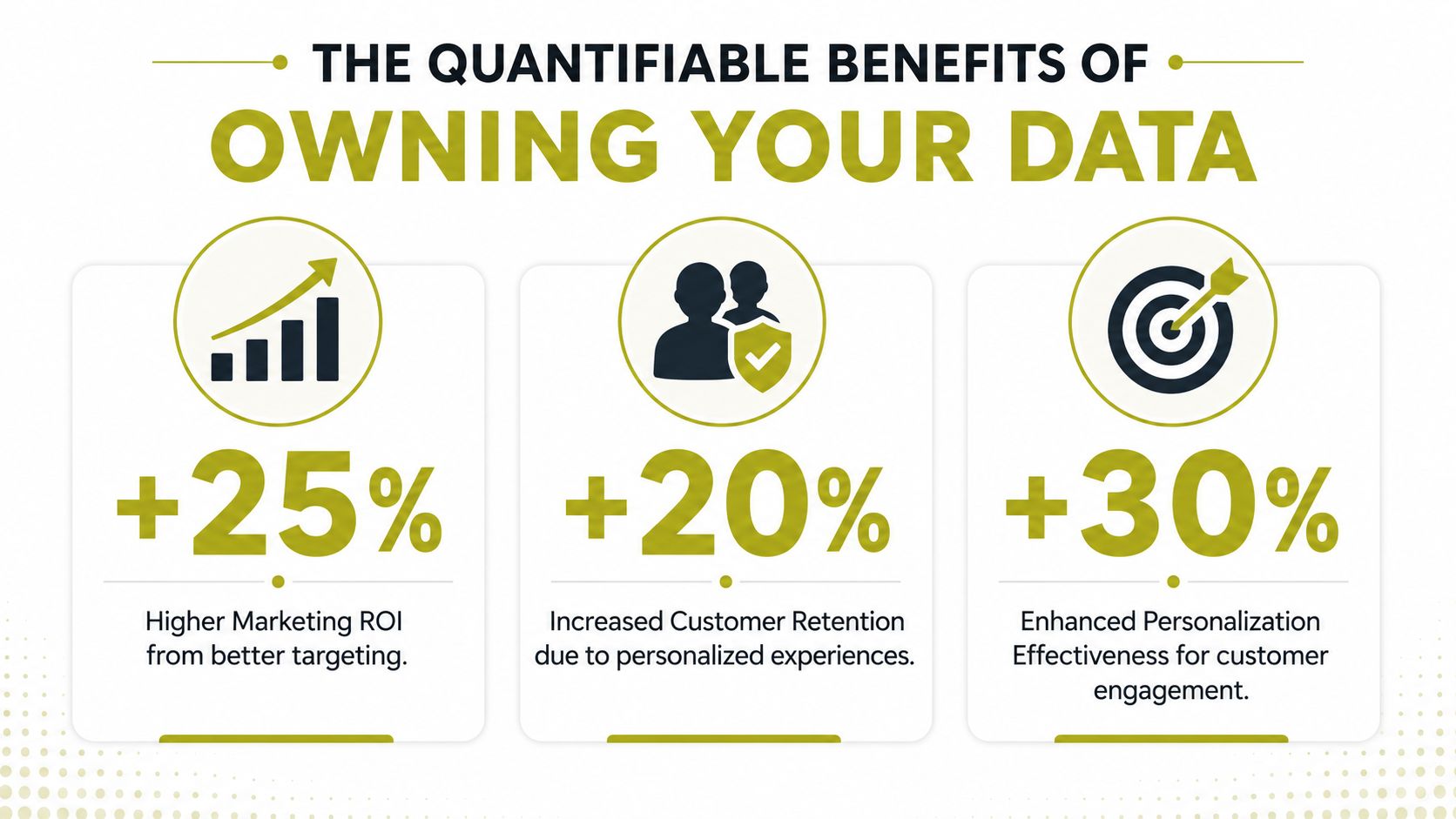
For UK businesses, the measurable upside is already clear. Structured first-party data strategies can achieve 8x ROI, reduce customer acquisition costs by over 25%, and drive up to 2.9x revenue growth compared with competitors relying on third-party sources, according to Avaus benchmarks on first-party data performance.
Where those gains show up first
The benefits usually appear in three places before anywhere else.
| Area | What improves | Why it improves |
|---|---|---|
| Email marketing | Relevance and response | Messages are based on known behaviours and preferences |
| Paid media | Audience quality | Customer lists and consented signals give platforms better input |
| Sales follow-up | Timing and prioritisation | Teams can act on actual engagement, not broad assumptions |
A common example is email. If your CRM knows a lead downloaded a sector-specific guide and your email platform reflects that action, the follow-up can be narrow, timely, and credible. Generic nurture sequences rarely perform as well because they ignore intent.
Paid social and search also become more disciplined. Customer data doesn't make weak creative or weak offers disappear, but it does give campaign platforms better signals than fading third-party tracking ever could.
A short explainer worth watching on the commercial case sits below.
The less visible advantage
There's another benefit that rarely gets enough attention. Owning your data improves internal confidence.
- Marketing teams spot waste faster: Poor segments, stale audiences, and duplicate contacts become visible.
- Sales teams trust handovers more: Lead context improves when records aren't fragmented.
- Leadership gets cleaner reporting: Decisions rely less on platform claims and more on business data.
Better data doesn't just improve targeting. It improves the quality of the conversation inside the business.
That matters for SMEs because every spend decision carries more weight. A first party data strategy isn't a compliance exercise dressed up as growth work. Done properly, it becomes a more dependable operating model for marketing.
A Practical Roadmap for Your Data Strategy
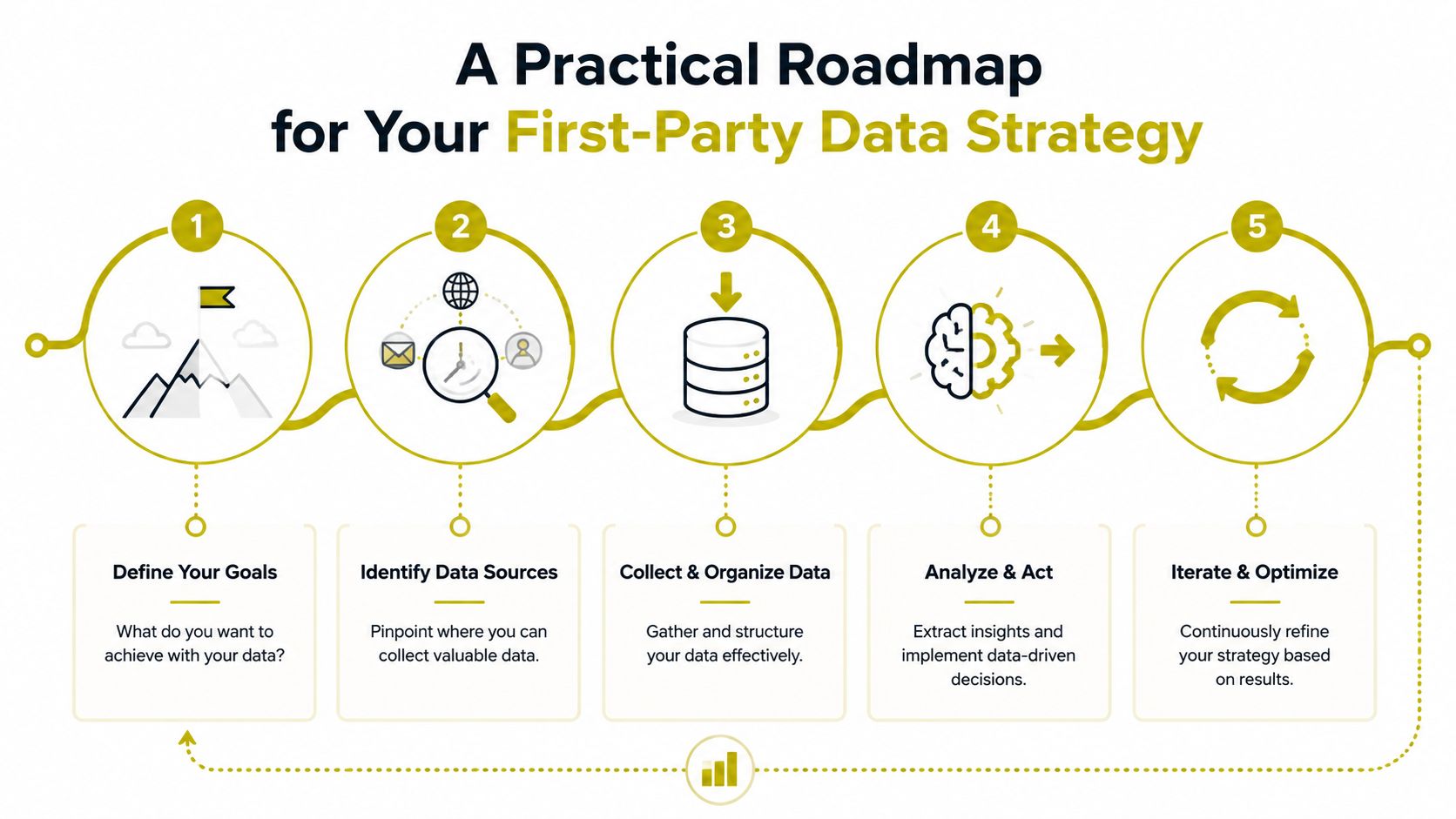
Most SMEs don't need a grand transformation. They need a sequence of sensible actions. The right first party data strategy usually starts with assets you already have, then builds structure around collection, consent, and activation.
Start with what already exists
Before adding tools, audit your current data. Most SMEs have more than they think. The problem is that it lives in separate systems and follows inconsistent naming.
Check your CRM, email platform, website forms, analytics setup, and any sales pipeline notes. Look for duplicate contacts, empty fields, old tags, and fields nobody uses. This stage is dull, but it changes everything that follows.
A practical audit should answer:
- Which sources are live: Website, email, CRM, ecommerce, bookings, or support.
- What data is useful: Email address, sector, enquiry type, purchase category, consent status.
- What can be retired: Legacy fields, broken automations, and unhelpful lists.
Build collection around value exchange
Once the audit is done, tighten the points where people become known contacts. For most SMEs, that means newsletter sign-ups, enquiry forms, downloadable guides, webinars, loyalty mechanics, or account creation.
The mistake is asking for too much too early. The better model is simple consent and a clear reason to share data. If you're improving list-building, guidance on how to grow your email list revenue can help sharpen the offer behind your sign-up flow.
A useful collection point does three things well:
Explains the value
Tell people what they'll get. Sector updates, practical insights, early access, or customized resources all work when they're specific.Sets expectations
State frequency and message type clearly. This reduces low-quality sign-ups.Captures data you can use
Ask for the minimum needed to personalise or route follow-up.
Move from legitimate interest to consent where needed
A major gap in UK SME practice sits here. There's still heavy reliance on legitimate interest for basic analytics and ongoing marketing activity, even as scrutiny tightens. A critical UK-specific point is that 74% of UK publishers and SMEs still rely on legitimate interest for basic analytics despite GDPR tightening, and the stronger approach is to treat consent over legitimate interest as a trust-building mechanism that increases audience value, as discussed in InPublishing's examination of first-party data strategy.
That means reviewing cookie banners, preference centres, and opt-in wording with more care than many businesses currently do.
Don't treat consent as legal friction. Treat it as the moment you begin a more valuable relationship.
A good preference centre should let people choose what they hear about, how often, and through which channel. That improves compliance and also improves list quality.
Unify enough to act
You don't need perfect unification to get value. You need enough connection between systems to recognise the same person across channels. For most SMEs, the email address becomes the shared identifier that links website forms, CRM records, and email engagement.
Segmentation begins to become practical. If you need a clearer framework for turning raw records into useful audiences, this guide to segmentation strategy is a strong next read.
A simple segmentation model might include:
- Source of relationship: Lead magnet, direct enquiry, customer, partner.
- Stage of intent: New lead, active opportunity, existing client, dormant contact.
- Topic interest: Product line, service area, location, sector, or content theme.
Activate, then refine
Once the basics are connected, use the data. Send more relevant email sequences. Build paid audiences from consented customer lists. Prioritise sales follow-up based on engagement. Adjust content around what people respond to.
Then review what happened. Which sign-up paths created useful leads? Which segments moved? Which automations produced noise? Strategy improves when teams close that loop regularly, not when they wait for a giant annual review.
Choosing Your Tech Stack Without Big Agency Overheads
The biggest misconception in this space is that serious data work requires a full enterprise stack. For most UK SMEs, that's wrong. Expensive software won't rescue weak inputs, poor consent handling, or disconnected teams.
The better route is low-infrastructure by design. Use what you already have, make it cleaner, and only add tools when there's a clear operational gap.

What most SMEs actually need
The baseline stack is often enough:
- CRM: HubSpot, ActiveCampaign, or a similar system that holds contact history.
- Email platform: Usually the same tool, or one integrated closely enough to sync segments.
- Analytics: Google Analytics 4 for behavioural signals and conversion events.
- Forms and landing pages: Built to capture clear consent and route leads correctly.
This isn't just theory. 68% of UK SMEs lack dedicated data teams and rely on integrated CRM-email-analytics stacks like HubSpot or ActiveCampaign, while a low-infrastructure method based on cleaning and activating existing data is faster and more cost-effective than starting from scratch, according to ProfileTree's guidance on collecting first-party data.
What works and what doesn't
A simple comparison makes the trade-offs clearer.
| Approach | What works | What usually fails |
|---|---|---|
| Existing integrated stack | Faster setup, easier adoption, lower complexity | Can stay messy if nobody owns naming and governance |
| Enterprise CDP too early | Impressive demos | Slow rollout, underused features, avoidable cost |
| Manual spreadsheet patching | Useful as a temporary fix | Breaks as volume and channels grow |
A Customer Data Platform can be right later. It's just not the automatic first step. If you're weighing that path, this overview of a customer data platform helps frame when the investment starts to make sense.
The technical upgrade worth considering earlier
One technical area deserves attention sooner than many SMEs expect. Server-side tracking.
For UK SMEs, server-side tracking through GA4 Measurement Protocol, using a UK or EU-resident server container, can improve Google Ads Enhanced Conversion match rates by 30–50% when hashed customer data such as email or phone is forwarded with conversion events. The same source links that setup to CPA reductions of over 25%, particularly where browser-based tracking loss is a problem, as explained in Lever Digital's guide to first-party data and server-side tracking.
That doesn't mean every small business should rush into a complex implementation tomorrow. It does mean client-side-only tracking is becoming less dependable, and teams running paid acquisition should review whether their measurement setup still reflects reality.
The useful principle is simple. Buy infrastructure after you've proved the use case, not before.
Measuring Success and Optimising for Growth
A first party data strategy only matters if it changes outcomes you care about. That means measuring business impact, not just database growth.
More contacts on a list can be useful. More consented contacts who convert, buy again, or move through the funnel faster is what matters.
The metrics that deserve attention
For most SMEs, measurement should connect to commercial goals first:
- Lead quality: Are the contacts collected through owned channels becoming real opportunities?
- Conversion rate: Do segmented messages and better audience signals improve action?
- Retention and repeat engagement: Are known contacts coming back, responding, and buying again?
- Marketing efficiency: Are teams wasting less spend and less time?
Good measurement also needs a feedback loop. If one lead source produces low-quality sign-ups, change the value exchange. If one segment never engages, revisit the logic behind it. If email clicks rise but enquiries don't, examine the landing page and handoff.
Build a simple optimisation cycle
A useful operating rhythm looks like this:
Review collection points
Check which forms, guides, or offers are producing useful consented records.Assess audience performance
Compare segment response across email, paid campaigns, and sales follow-up.Refine the model
Remove weak fields, merge redundant segments, and update automation rules.Feed insights back into planning
Let behavioural patterns inform future messaging, content, and campaign timing.
The strongest data strategies aren't the most elaborate. They're the ones a team can review, understand, and improve every month.
As the data becomes more dependable, more advanced methods become possible. Predictive scoring, churn signals, and next-best-action models all become more useful when the underlying records are clean and permissioned. For a deeper look at where that leads, this guide to predictive analytics marketing is worth exploring.
The point isn't to create a reporting machine. It's to give leadership and delivery teams evidence they can act on.
Your Next Steps in a Data-First World
Third party signals are less dependable, and for UK SMEs that changes the economics of marketing. The businesses that will hold up best are the ones with a clean, consented view of their own customers and prospects.
That is good news for smaller teams. A sensible first party data strategy does not start with a major platform migration or a six-month transformation plan. It starts with practical control. Review what you already collect, remove fields nobody uses, fix weak consent language, and connect the tools you rely on today well enough to support useful segmentation and follow-up.
In the UK, that work also has to stand up to GDPR and ICO scrutiny. That usually means keeping records of consent, being clear about purpose, and avoiding the habit of collecting data first and deciding how to use it later. For most SMEs, the strongest approach is simple, documented, and repeatable.
The next step is to choose one priority and implement it properly. For one business that might be cleaning enquiry forms and CRM fields. For another, it might be building a basic welcome journey for new leads who have given clear permission to hear from you. Progress comes from systems a small team can maintain.
How Carlos Alba Media Can Help
Carlos Alba Media helps UK SMEs build first party data systems that fit real budgets, limited internal resource, and existing tools. The work is grounded in practical marketing delivery, not enterprise theory, and shaped for businesses that need commercially sound advice they can implement without adding big-agency overheads.
The agency operates with teams in London at 2-7 Clerkenwell Green, EC1R ODE and Glasgow at 106 Ormonde Avenue, G44 3SL, delivering senior-level counsel across the UK, as outlined on the Carlos Alba Media website. If your business needs a first party data strategy that turns scattered customer data into a cleaner, consent-led growth system, Carlos Alba Media can help.