
63% of UK marketers consider traditional consumer segmentation totally unfit for purpose, according to New Digital Age. That sounds like an argument against segmentation. It isn't.
It's an argument against lazy segmentation.
Too many SMEs still group audiences by a handful of broad traits, then wonder why campaigns feel blunt, PR outreach gets ignored, and paid media burns budget without building momentum. A strong segmentation strategy doesn't reduce people to spreadsheet categories. It helps you decide who you're speaking to, what matters to them, and which story belongs in which channel.
That matters even more when PR and digital marketing work together. The right segment doesn't just improve targeting. It sharpens angles, reveals objections, and gives your message a reason to land.
Why Your Current Marketing Might Be Missing the Mark
Marketing starts to drift when a business knows its offer in detail but has only a vague picture of the people it needs to persuade.
For UK SMEs, that usually shows up in familiar places. The website leads with broad claims. Paid campaigns target an entire sector instead of a buying context. PR outreach pushes one company story to every journalist on the list, even though each desk needs a different angle. The work gets done, but response stays flat.
The issue is rarely effort. It is relevance.
A lot of teams still use traditional audience buckets that look tidy in a deck and fail in the market. Job title, company size, location, and sector can help, but they do not explain urgency, objections, trust triggers, or what makes one story publishable and another easy to ignore.
Two managing directors can sit in the same segment on paper and need completely different messages in practice. One is under pressure to prove credibility before a funding round. The other needs sales this quarter and wants a supplier who understands regional demand, margin pressure, and limited internal resource. If both see the same campaign, both are likely to move on.
A simple test helps. If two prospects would click different headlines, ask different questions on a sales call, or respond to different media angles, they should not sit in the same segment.
What weak segmentation looks like in practice
The symptoms are usually obvious once you know where to look:
- Generic website copy: Every visitor gets the same promise, whether they are comparing suppliers, validating trust, or ready to buy.
- PR that talks inward: The story centres on the business instead of the audience the coverage needs to influence.
- Paid media waste: Budget goes to broad interest groups rather than people with a clear reason to act.
- Poor sales context: Leads reach the pipeline with no real sense of motive, timing, or decision criteria.
From an agency perspective, PR and digital often split when they should be reinforcing each other. Marketing teams optimise for clicks. PR teams pitch for coverage. Neither side is working from a clear view of which audience matters most, what that audience cares about, and which narrative will earn attention.
Good segmentation fixes that. It gives digital campaigns tighter targeting and stronger conversion paths. It gives PR a better editorial angle, because the story starts with what the audience needs to hear, not what the business wants to announce. For SMEs, that usually matters more than adding another channel or increasing spend.
What Is a Segmentation Strategy Really
A segmentation strategy defines which groups you are trying to influence, what each group cares about, and how your message, channel, and proof should change as a result.
It is a commercial decision before it becomes a marketing one. Done properly, it shapes who you target, which stories you tell, what objections you answer, and where you spend budget. For SMEs, that matters because wasted reach is expensive. Broad messaging usually feels efficient internally, but it tends to weaken both response and relevance in the market.
Why it matters in PR
In PR, segmentation decides which version of the story has a realistic chance of earning attention.
A founder can be talking about the same business, the same launch, or the same result, but the angle should change by audience. Trade media may care about operational impact, regulation, or a shift inside the category. National business desks often need scale, tension, or a wider economic signal. Local titles are more likely to respond to jobs, investment, or community effect. The facts can stay consistent. The framing should not.
That is not spin. It is editorial discipline.
Newsroom judgement matters because journalists do not publish company updates. They publish stories their audience will care about. From an agency perspective, that is where PR and digital should meet. The segment is not just a targeting label. It is a cue for the right narrative, the right proof point, and the right tone. Tools can support that process, and a GEO Audit can help teams see whether their visibility and messaging line up by audience and channel, but the strategic call still comes down to relevance.
Why it matters in digital marketing
Digital marketing often reduces segmentation to audience settings inside ad platforms. That overlooks its full potential. Segmentation should influence the entire user journey, including:
- Landing page structure
- Email sequence logic
- Offer selection
- Paid search intent mapping
- Retargeting creative
- Content prioritisation
A business serving different buying situations needs different treatment at message level. Someone comparing suppliers wants proof, differentiation, and low-risk next steps. Someone earlier in the journey needs context and education. Someone under deadline wants confidence, speed, and fewer points of friction.
That is why segmentation sits upstream of campaign execution. It informs the brief before it informs the targeting.
The job of a segmentation strategy is to make the message more relevant, the story more believable, and the next step easier to act on.
The practical test
A useful segmentation strategy gives your team clear answers to three questions.
| Question | What a strong answer sounds like |
|---|---|
| Who is this for? | A defined group with a shared need, trigger, or buying context |
| Why will they care? | A live problem, priority, or ambition that gives the message urgency |
| What should they see next? | A message, proof point, and action that fit that group's decision stage |
If those answers are fuzzy, the segment is probably too broad. If the answers are clear, PR gets a sharper angle, digital gets a stronger conversion path, and sales gets better context from the start.
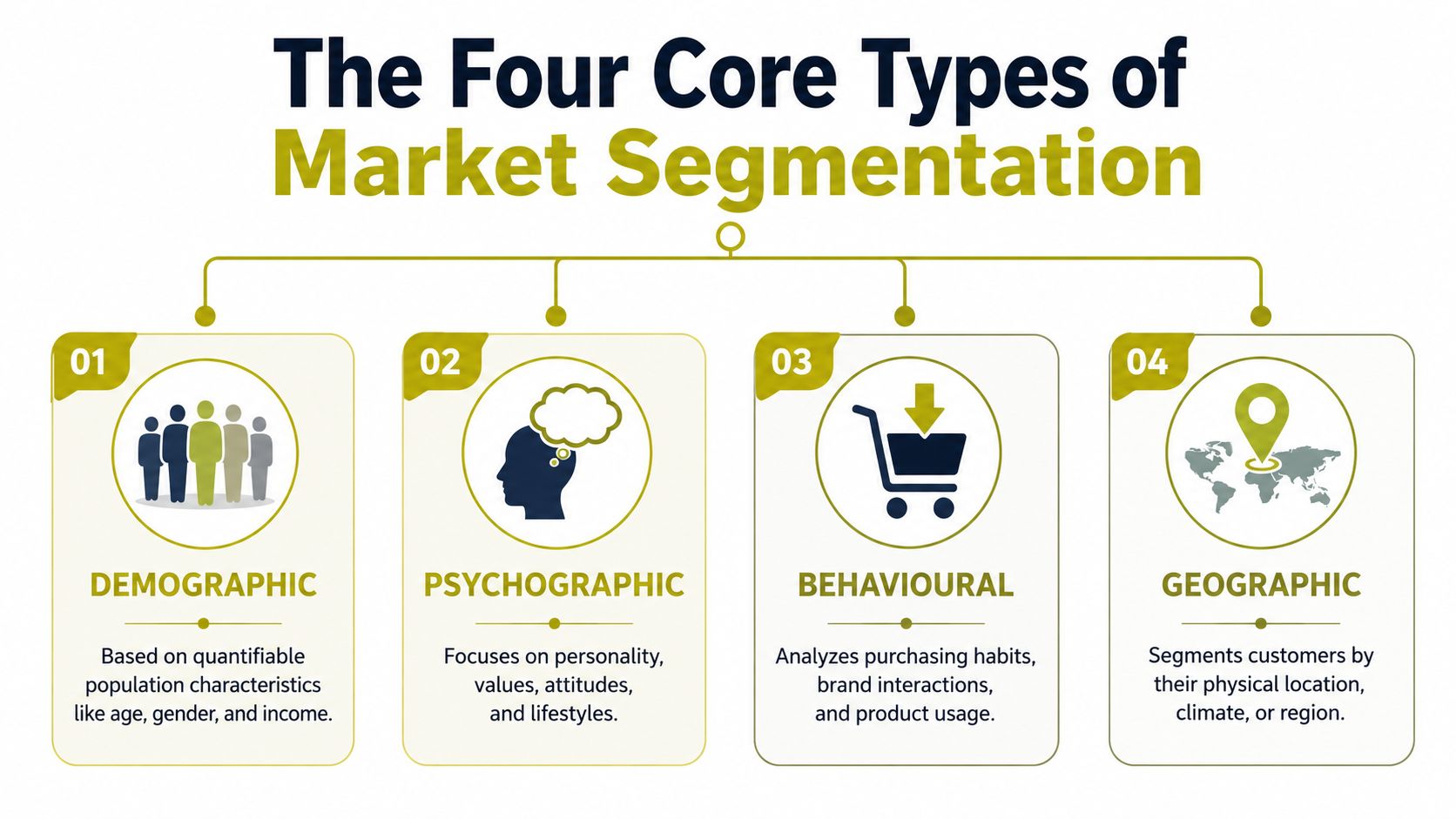
The Four Core Types of Market Segmentation
Most SMEs don't need a complicated model. They need a usable one. In practice, four segmentation types do most of the heavy lifting.
Demographic segmentation
This is the basic “who they are” layer. Age, income bracket, life stage, job title, education level, and family status often sit here.
For a local retailer, demographic segmentation might separate students, young families, and retirees because each group buys for different reasons and responds to different messages. It's useful because it's simple and usually easy to gather.
Its weakness is also obvious. Demographics tell you what people look like on paper. They don't tell you why they act.
Psychographic segmentation
Psychographic segmentation gets closer to motive. It looks at values, attitudes, lifestyle, identity, priorities, and taste.
A wellness brand, for example, might serve two people with similar incomes and ages. One sees wellness as performance and discipline. The other sees it as recovery and balance. If you use the same copy, imagery, and offer for both, one of them will disengage.
Psychographics are especially powerful in PR and brand work because they shape tone. They help you decide whether the story should feel ambitious, reassuring, premium, rebellious, technical, or community-led.
If demographics describe the audience, psychographics explain the emotional hook.
Behavioural segmentation
Behavioural segmentation focuses on what people do. Pages viewed, products compared, downloads completed, repeat visits, email engagement, and purchase patterns all sit in this category.
This is often where digital marketing becomes much more efficient. Someone who repeatedly visits pricing pages needs different follow-up from someone reading top-of-funnel thought leadership. A returning customer deserves a different journey from a first-time visitor who's still cautious.
For SMEs, this is often the fastest route to improvement because the data already exists in tools like GA4, CRM systems, Shopify, HubSpot, or platform analytics.
Firmographic segmentation
Firmographic segmentation is the B2B version of demographic work. It groups organisations by traits such as industry, company size, ownership structure, employee count, and revenue band.
Given that business audiences do not behave evenly, a UK Government business segmentation report found that large businesses account for 55.8% of goods exports while medium-sized businesses contribute 14.7%, which is a clear reminder that one-size-fits-all strategy fails when segments operate differently.
For a B2B software company, firmographics help answer practical questions:
- Which sectors have the strongest fit
- Which company sizes can buy without long procurement delays
- Which ownership models create slower approval chains
- Which industries need more trust-building because of regulation
Geographic segmentation also matters for many businesses, especially when region, market maturity, or local media relevance changes the message. If you're reviewing discoverability by place as well as audience, a tool like GEO Audit can help surface how your digital presence appears across geographic search contexts.
Which type should you start with
Use a mix, not a single lens.
- B2C retail: Start with demographic and behavioural.
- Brand-led consumer services: Add psychographic depth quickly.
- B2B services: Begin with firmographic and role-based insight.
- PR campaigns: Layer audience motive on top of media relevance.
The best segmentation strategy usually combines who someone is, what they do, and why they care.
A Practical Framework for Building Your Segments
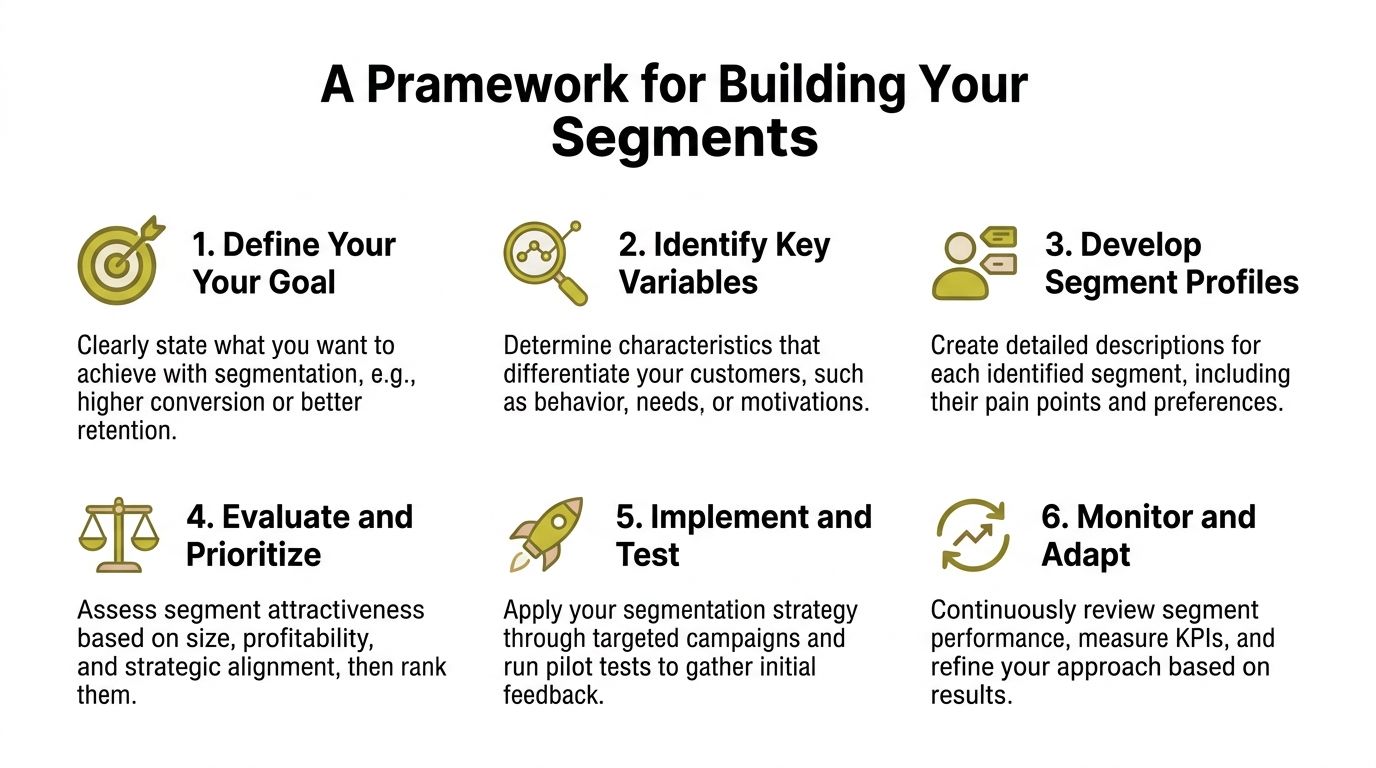
A workable segmentation strategy doesn't require a data science team. It requires discipline, decent source material, and a willingness to simplify before you scale.
Start with the commercial goal
Segmentation fails when teams begin with data instead of purpose. Decide what needs to improve first.
Are you trying to generate stronger inbound leads. Improve retention. Tighten media messaging. Increase demo bookings from a specific sector. Reduce wasted spend in paid campaigns. Each goal points to different segment variables.
A useful starting question is simple. What decision are we trying to influence?
Pull data from places you already own
Most SMEs are sitting on more usable information than they think. Pull from:
- CRM records: Lead source, sector, job title, sales outcome, deal stage
- Website analytics: Entry pages, repeat visits, time spent on key pages
- Search data: Queries that reveal intent or urgency
- Customer feedback: Objections, phrasing, recurring priorities
- Sales notes: Why deals stall, who signs off, what reassurance buyers ask for
For B2B firms, role matters more than many teams realise. DataHQ notes that segmenting by seniority level and job role can increase campaign engagement by 35% compared to generic outreach, because the message reaches actual decision-makers rather than a broad list.
Look for patterns worth acting on
Don't create segments because the data allows it. Create segments because the business can do something different with them.
A pattern is useful when it changes one or more of these:
| Signal | What it changes |
|---|---|
| Different buying motive | Headline and core proposition |
| Different authority level | CTA and follow-up route |
| Different urgency | Offer structure and timing |
| Different trust barrier | Case proof, credentials, guarantees |
Audience definition work finds its practical application. A clear target audience definition forces the team to stop describing everyone and start prioritising the people most likely to respond.
A short resource on how to boost marketing with customer personas can also help if you need a structured way to turn rough patterns into usable profiles.
Write segment profiles people can actually use
Good segment profiles aren't long. They're specific.
Use names if that helps internal clarity, but avoid fiction-heavy persona writing. Focus on decision context. For example:
- Operations-led buyer in a regulated SME: Wants lower risk, clear implementation, and credible proof.
- Founder-led growth buyer: Wants speed, visibility, and commercial upside.
- Mid-level evaluator: Researches thoroughly but may not control budget.
Each profile should include pain points, desired outcome, likely objection, preferred proof, and best next step.
Later in the process, video can help teams align quickly on what practical segmentation looks like in action.
Activate fast, then refine
Launch with a few meaningful segments, not dozens. Build a targeted landing page, adjust your email sequence, split your LinkedIn messaging, or tailor outreach by role and sector.
Useful test: If your team can't change the message, offer, or journey for a segment, it isn't a real segment yet.
Watch what happens. The first draft of a segmentation strategy should improve action. Precision comes later.
From Segments to Stories Real World Examples
Data doesn't persuade anyone on its own. People respond to stories that match their situation, ambitions, and pressure points. That's where segmentation becomes far more than a spreadsheet exercise.
A tech start-up targeting two very different audiences
A Scottish software start-up may need visibility with investors and credibility with potential clients at the same time. Those are not the same audience, and they shouldn't receive the same story.
For investors, the message is usually about market opportunity, leadership clarity, traction signals, and why the business is positioned to grow. For buyers, the narrative is more practical. What problem does the product solve. How difficult is implementation. Who else trusts it. What friction disappears after adoption.
The media angle changes too. Investor-focused messaging may suit business and start-up coverage. Buyer-focused messaging may fit trade press, specialist podcasts, webinars, and sector newsletters.
A hospitality brand with different guest motivations
Take a boutique hotel or retreat business. One audience segment may want escape, quiet, and restoration. Another may want local experiences, food, activity, and shareable moments.
The same property can serve both. The mistake is presenting both groups with one generic “luxury stay” story.
A sharper approach separates the journey. The first segment sees content about atmosphere, privacy, and slower pace. The second sees itineraries, nearby experiences, and reasons to extend the trip. PR follows the same logic. One angle fits wellness and lifestyle coverage. Another fits travel, food, or destination features.
A strong segmentation strategy gives every audience a version of the truth that matters most to them.
Why storytelling quality matters
Specialist communication teams earn their place. The specialist nature of Carlos Alba Media comes from its team, which consists entirely of former national news journalists or professionals with agency experience working with international brands, enabling them to craft compelling narratives for precisely defined audience segments, as outlined on the agency's media exposure page.
That journalist's instinct matters because audiences don't engage with labels. They engage with tension, relevance, consequence, and timing. If you want a useful primer on shaping those narratives, digital storytelling is the bridge between audience insight and audience response.
Measuring Success and Choosing Your Tools
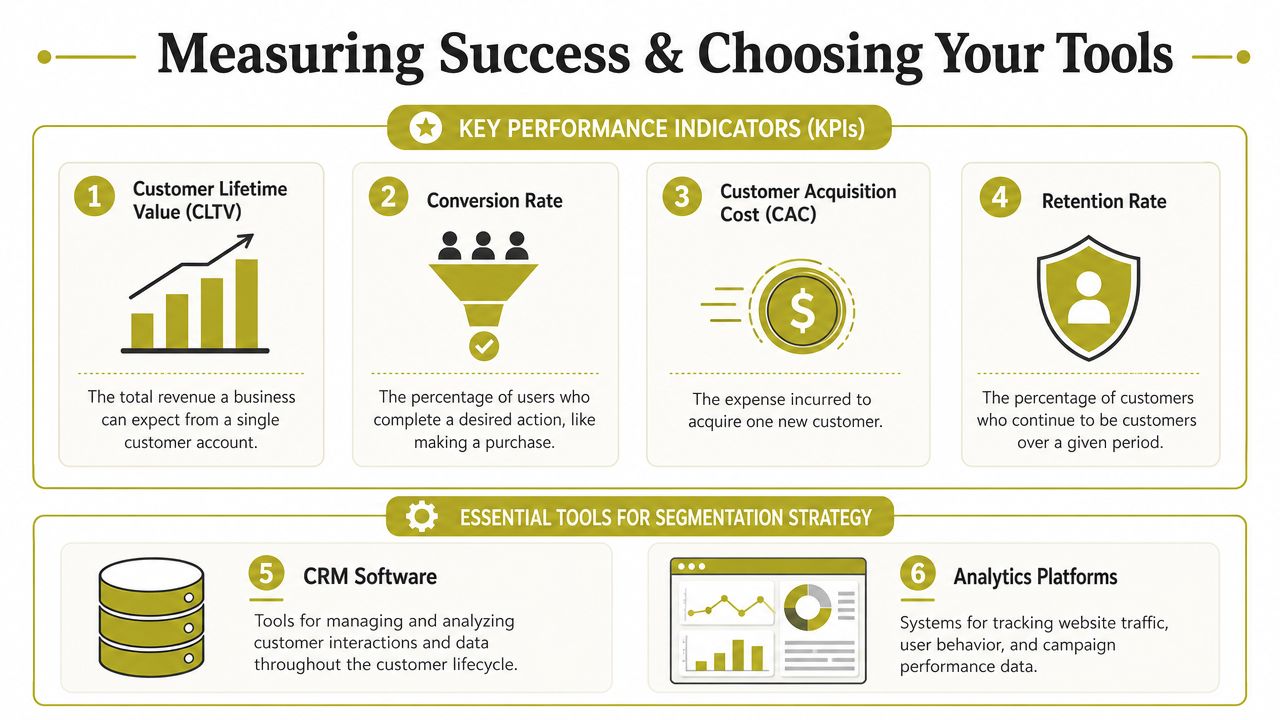
A segmentation strategy only matters if it changes outcomes you can observe. That means measuring segment performance, not just campaign activity.
Track what changes between segments
Many teams still report on top-line numbers alone. That hides useful differences. Segment analysis asks a better question. Which audience group responds best to which message, channel, and conversion path?
Focus on metrics that reveal quality and efficiency:
- Conversion rate: Which segment takes the next step most consistently
- Retention rate: Which audience keeps buying or staying engaged
- Customer lifetime value: Which segment is worth more over time
- Customer acquisition cost: Which segment is expensive to win
- Content engagement by segment: Which themes hold attention and move prospects forward
A modern customer data platform can help pull these signals together if data is currently scattered across channels and systems.
Use tools that match your scale
SMEs don't need an overbuilt stack. They need tools the team will use effectively.
| Need | Practical tool options |
|---|---|
| Website behaviour | Google Analytics 4 |
| Contact and deal context | HubSpot or Salesforce |
| Customer feedback | Typeform or SurveyMonkey |
| Email behaviour | Mailchimp, HubSpot, Klaviyo |
| Search intent and content gaps | Google Search Console, Semrush |
| Social audience signals | LinkedIn Campaign Manager, Meta Insights |
The mistake isn't having simple tools. The mistake is leaving them disconnected.
Add predictive logic carefully
Once your segments are stable, you can layer prioritisation on top. That's where lead scoring becomes useful, especially for B2B teams trying to distinguish curiosity from buying intent.
If you want a grounded overview of how predictive lead scoring systems work, use them as a decision-support tool rather than a replacement for judgement. Scores can help sales teams focus. They can't tell you whether the message itself is strong enough.
Measure segment performance the same way you'd judge a media pitch. Did it reach the right person, with the right angle, at the right time, and did they act?
Keep the reporting honest
If one segment generates clicks but no qualified leads, that isn't success. If another converts fewer people but produces stronger-fit customers, that may be the segment worth scaling.
The point of measurement isn't to prove the strategy was clever. It's to decide what to keep, what to cut, and where to concentrate effort next.
Common Pitfalls and Your Segmentation Checklist
Most segmentation problems aren't technical. They come from poor judgement and weak follow-through.
The first mistake is over-segmentation. Teams create too many audience groups, then can't maintain different messages, journeys, or content paths for any of them. The second is relying on stale inputs. Customer behaviour changes, markets shift, and old assumptions subtly distort new campaigns. The third is building segments that never affect execution. If the ad copy, landing page, PR angle, and sales follow-up stay the same, the segmentation strategy exists only in a slide deck.
The traps worth avoiding
- Too many segments: Start with the few that create clear action.
- Weak distinctions: If two groups need the same message, they may be one segment.
- No ownership: Someone must maintain the model and update assumptions.
- No activation plan: Segments should change creative, outreach, and conversion flow.
- No measurement loop: Review performance and refine, don't set and forget.
A practical checklist
Use this as a working filter before you launch anything new:
- Define the business goal before touching the data.
- Choose variables that influence action, not just description.
- Build a small number of usable segments your team can serve properly.
- Write segment profiles around need, motive, and objection.
- Tailor messaging by audience context, not just channel.
- Align PR and digital activity so the story matches the segment.
- Measure by segment, then improve what the data and conversations reveal.
A strong segmentation strategy isn't about slicing the market into finer and finer pieces. It's about making your communication more relevant, your targeting more efficient, and your stories more persuasive.
If you need senior-level help turning audience insight into sharper PR, stronger digital marketing, and clearer growth strategy, Carlos Alba Media brings a specialist approach shaped by newsroom experience and brand-building expertise. Everyone who works for Carlos Alba Media is a former national news journalist or has agency experience of working with international brands, which means the advice stays practical, audience-focused, and built for results.