
A founder once showed me a perfectly serviceable website, a tidy brochure and a month of social posts, then asked why none of it was cutting through. The answer was blunt. He had information, but he didn't yet have a story.
Beyond Buzzwords to Business Impact
Most SMEs don't struggle because they've got nothing to say. They struggle because they say it the way everyone else does. “Trusted service.” “Customer focused.” “Strategic solutions.” Those phrases fill websites across every sector in Britain, and they rarely give a buyer, journalist or investor a reason to care.
Digital storytelling is what turns that flat messaging into something people can follow, remember and act on. It gives shape to the facts. It puts a human stake into the message. It answers the question every audience asks: why does this matter to me?
What businesses get wrong
A lot of owners hear the phrase and assume it means slick video, trendy editing or a flood of social content. That's the shallow version. In practice, digital storytelling is closer to newsroom work than many marketers admit. You need an angle. You need relevance. You need a clear line from opening hook to final takeaway.
That discipline matters more now because this isn't a fringe tactic any more. The global digital storytelling market was valued at USD 10.0 billion in 2024 and is projected to reach USD 30.0 billion by 2032, expanding at a 15% CAGR, according to Future Data Stats on the digital storytelling market. That tells you something simple. Businesses aren't investing in story because it sounds nice. They're investing because it has become a serious part of modern communication.
Editorial test: If the opening line wouldn't hold a reader for five seconds, the format won't save it.
Why a newsroom mindset helps
National newsrooms train people to spot what matters fast. They teach reporters and editors to strip out waffle, sharpen a headline, find the human consequence and build momentum from one paragraph to the next. That's exactly the mindset strong digital storytelling needs.
Carlos Alba Media's specialist nature comes from that background. It is run by Carlos Alba, who worked as a journalist for 20 years, including 10 years at The Sunday Times, where he served as Scotland Editor, as noted in his Page Turner Awards profile. Everyone who works for Carlos Alba Media is a former national news journalist or has agency experience of working with international brands. That mix matters because good storytelling for business sits between editorial judgment and commercial sense.
The business case in plain English
If you run a startup or SME, you don't need a lecture on creativity. You need to know whether this helps you win attention in a crowded market. It does, when it's done properly.
Digital storytelling helps a company do three hard things better:
- Explain complexity: Turn technical, regulated or specialist information into something people can follow.
- Earn attention: Give journalists, buyers and stakeholders a narrative worth engaging with.
- Create distinction: Stop sounding like every rival who leads with features, claims and generic promises.
That's the point. Digital storytelling isn't decorative. It's the difference between publishing content and being understood.
What Digital Storytelling Really Is
A newsroom learns this fast. Facts alone rarely hold attention. What holds it is a clear line of consequence. What happened, why it matters, who it affects, and what comes next.
That same discipline sits at the heart of digital storytelling for business.
Digital storytelling is the structured use of narrative and digital formats to help an audience understand something, remember it, and act on it. The format can be video, audio, written content, still images, animation or an interactive page. The job stays the same. Build a story people can follow without making them work for it.
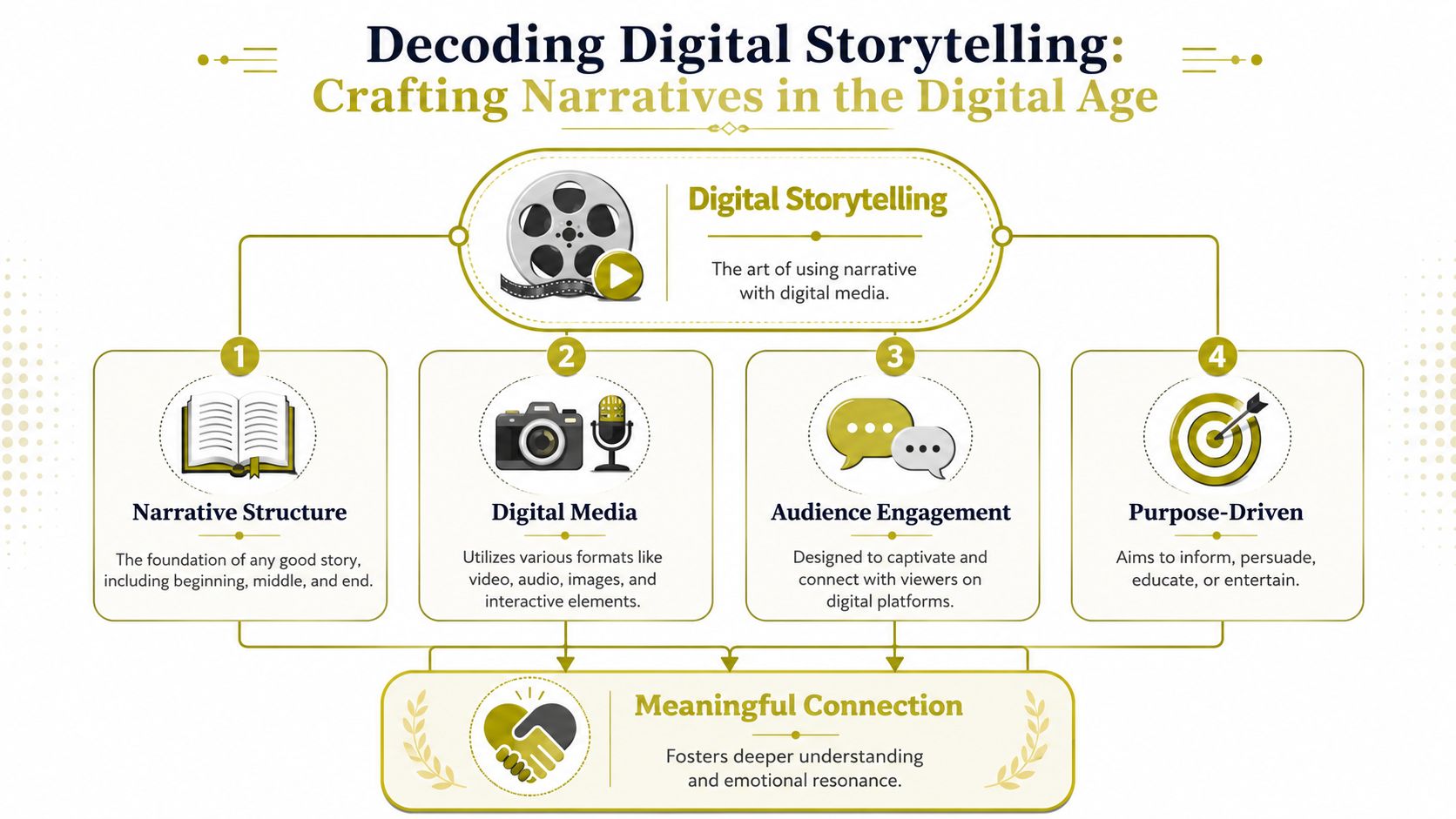
For SMEs, this matters because buyers rarely make decisions on information volume alone. They respond to relevance, sequence and stakes. Former national news journalists are trained to find that thread quickly. In a newsroom, you do not get to hide a weak angle behind glossy production. The same rule applies here.
The parts that make a story work
A useful editorial framework comes from Shorthand's introduction to digital storytelling platforms, which breaks strong storytelling into seven working parts:
- A clear point of view. The audience should know who is speaking and why that perspective matters.
- A question or tension. Something has to pull the reader or viewer forward.
- Emotional weight. That does not mean melodrama. It means the outcome matters to a real person, customer or community.
- A recognisable voice. Real language carries more authority than polished corporate phrasing.
- Sound used with restraint. Audio should support attention, not fight for it.
- Economy. Good stories cut hard. Extra detail often weakens the point.
- Pacing. Order and timing shape whether people stay with you.
This is the primary goal. Turn information into a narrative with direction.
What that looks like in practice
A weak version says a business has launched a service with several benefits. A stronger version explains the problem customers kept hitting, shows the cost of leaving it unsolved, and then introduces the service as the answer. The second approach gives the audience a reason to care before asking them to care about the company.
That is how journalists build a story, and it is why this approach works so well in marketing and PR.
Consistency matters too. If your website sounds formal, LinkedIn sounds promotional and sales material sounds generic, the story breaks apart. Clear tone of voice guidelines for your brand help keep every channel aligned before anyone starts drafting copy or filming content.
The audience does not need every fact you know. They need the facts that move the story forward.
Digital storytelling also does not require a large budget to be effective. Simple execution often beats expensive clutter. A short customer story, a founder-led video, a before-and-after case study, or a visual explainer can all work if the narrative is sharp and the message is properly edited.
If you want a practical outside resource on creating and sharing digital stories, that guide is useful because it treats story creation as a structured publishing task rather than a vague burst of inspiration.
Why Your SME Needs a Story The Strategic Benefits
The commercial case for storytelling gets stronger the moment you stop treating it as branding fluff and start treating it as message delivery.
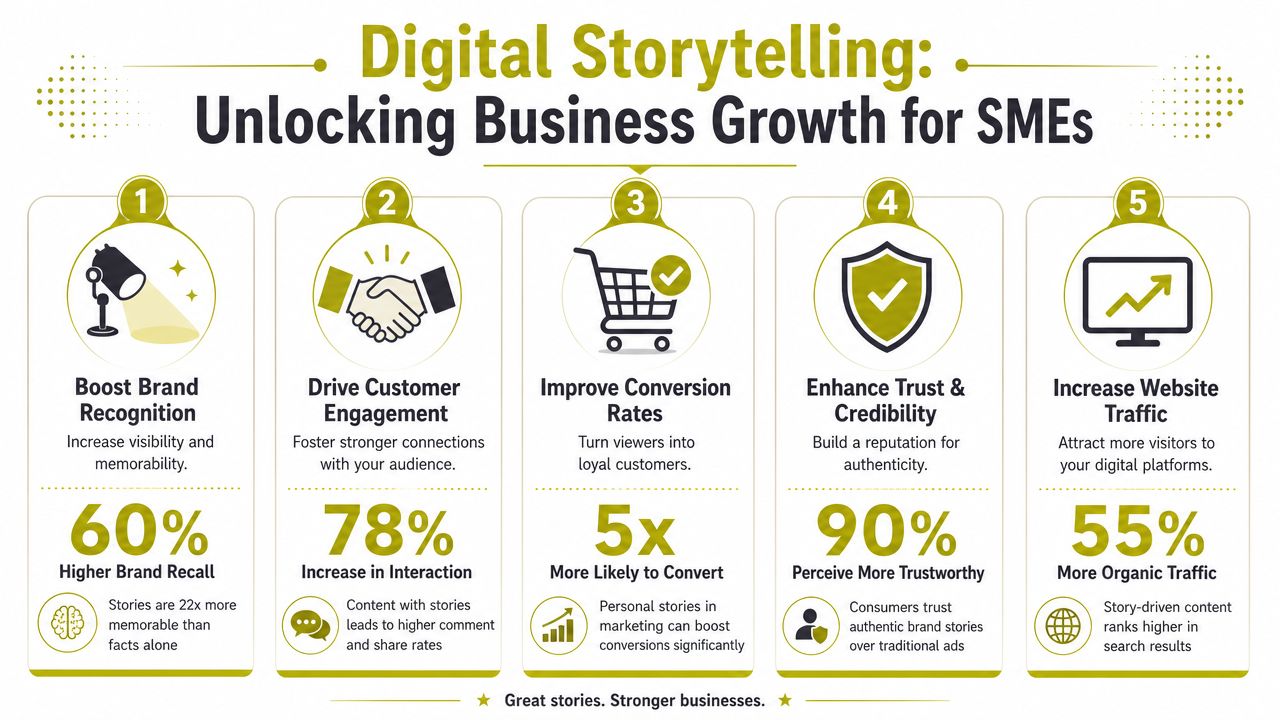
When information is presented as bare statistics, retention sits at roughly 5 to 10%. Pair the same information with a narrative structure and retention rises to about 67%, according to Marketing LTB's storytelling statistics roundup. In the same source, storytelling mechanisms improve conversion rates by about 30%.
For an SME, those two figures cut straight to the point. If customers remember more, your sales conversations get easier. If the message lands with more force, more people move.
Retention changes how buyers judge you
Most small firms are too close to their own expertise. They know the service so well that they explain it in chunks of process, capability and technical detail. Buyers don't absorb that easily. They absorb sequence, relevance and consequence.
That matters in sectors where the offer is hard to visualise. Professional services, property, tourism, technology, specialist manufacturing, regulated services. The audience rarely needs more information. They need a clear line through the information.
A story gives you that line. It helps a founder explain why the business started, what problem it solves, what changed for the customer and why the outcome matters now.
Conversion improves when the story is built around the audience
Many SMEs still write from the inside out. They lead with company history, service menus and abstract claims. Better storytelling works from the outside in. It starts with the audience's pressure, frustration, ambition or risk.
That's why audience clarity matters before you write a script or brief a designer. If you haven't done the hard thinking on who you need to persuade, the content drifts. A proper target audience definition sharpens story choices fast, from headline language to case-study angle.
Here's a useful visual explanation of why that strategic layer matters in content and brand building:
The payoff goes beyond marketing
Strong storytelling helps with more than lead generation.
- PR becomes easier: Journalists respond to tension, relevance and consequence. A story gives them all three.
- Sales teams get cleaner language: Narrative sharpens how a business talks about value.
- Stakeholders understand faster: Investors, partners and regulators need clarity, not content overload.
- Brands become more memorable: People remember movement and meaning better than disconnected claims.
For service businesses in particular, CodeDesign.ai's marketing playbook is a useful companion read because it shows how positioning, audience definition and offer clarity work together. Digital storytelling sits neatly inside that same commercial logic.
A buyer rarely repeats your full service description to a colleague. They do repeat a clear story about the problem you solve.
Formats and Channels Where Stories Come to Life
In a newsroom, the same facts could become a front-page splash, a 90-second package, a live blog or a long read. The angle stayed the same. The format changed what the audience felt, understood and remembered.
Business storytelling works the same way. A founder interview on LinkedIn creates a different response from a customer case study on your website. A short video can carry energy and personality fast. A scrollytelling page can handle complexity, proof and context in a way social posts cannot.
That is why channel choice is an editorial decision, not just a distribution one.
Start with a format you can execute well
SMEs do not need a studio mindset. They need a format they can produce consistently and to a decent standard.
A simple still-image film with a tight script often does the job better than an over-ambitious video shoot. In practice, short pieces built around a clear voiceover, a handful of strong visuals and one central message are often enough to tell a founder story, explain a customer problem or give a place-based brand some character. I have seen businesses get more traction from a well-cut two-minute story than from a glossy video that said very little.
The trade-off is clear. Simpler formats lower production risk, but they also demand sharper writing. There is nowhere to hide weak structure.
Match the format to the job
Different formats do different work. Some are built for attention. Some help a buyer understand. Some create trust over time.
| Digital Storytelling Format Comparison | Best For | Average Cost | Key Skill Required |
|---|---|---|---|
| Short-form video | Social reach, product launches, founder visibility | Low to medium | Scriptwriting and editing |
| Scrollytelling web page | Complex narratives, campaigns, annual stories, place branding | Medium to high | Narrative structure and web production |
| Audio podcast | Authority, interviews, thought leadership | Low to medium | Interviewing and audio editing |
| Email narrative series | Lead nurturing, onboarding, donor or client journeys | Low | Copywriting |
| Photo essay or still-image film | Human stories, heritage, internal communications | Low to medium | Visual sequencing |
| Case-study article | B2B trust, SEO, sales enablement | Low | Reporting and structure |
Treat the cost column as a planning guide, not a quote. A case-study article can be inexpensive if someone on your team can interview well and write cleanly. The same piece gets expensive fast if the raw material is weak and an agency has to find the story from scratch.
What each channel is good at
- LinkedIn: Strong for founder perspective, sector commentary and concise client stories.
- Instagram and TikTok: Best where the story has movement, place, people or visible transformation.
- Your website: The right home for the full version of the story, especially when the audience needs proof, detail and search visibility.
- Email: Useful for stories told in stages, where each message moves the narrative on rather than repeating the pitch.
- Podcast platforms: Good for authority-building when the speaker has genuine insight and can hold attention.
For many SMEs, the smartest model is simple. Put the deepest version of the story on your own site. Use social and email to pull people towards it. That is where storytelling starts to support content marketing and SEO for long-form business growth, because the piece is doing two jobs at once. It holds attention like an editorial feature and it gives search engines enough substance to rank.
Former journalists tend to be useful here for one reason. We are trained to ask which format best serves the story, not which channel is fashionable this quarter. That discipline saves time, cuts waste and usually leads to better results.
From Idea to Impact A 5-Step Storytelling Workflow
Good digital storytelling looks creative from the outside. Behind the scenes, it works best as a disciplined editorial process. That's how newsrooms operate. A strong angle is identified early, the material is cut to fit the audience, and nothing survives just because someone spent time producing it.
That same logic works for SMEs.
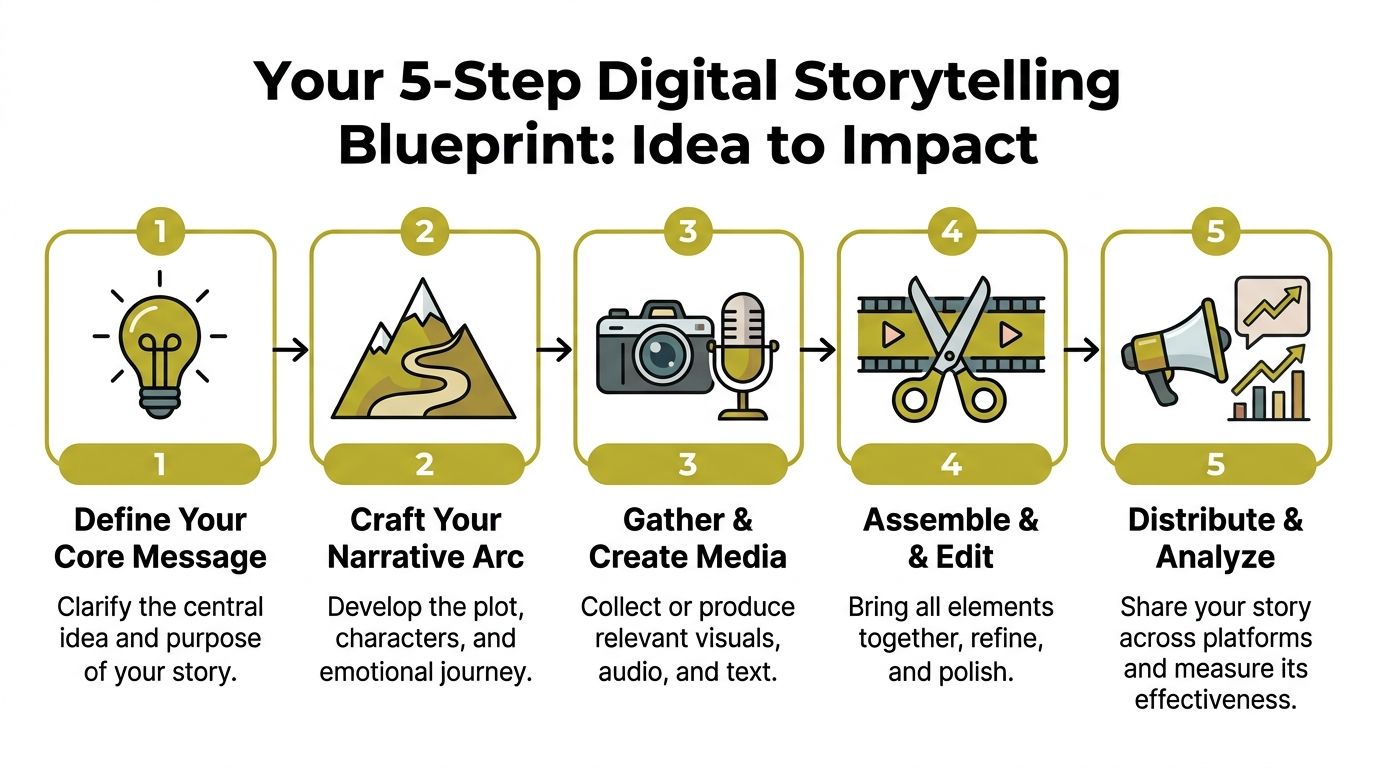
Step 1 Define the goal and the audience
Start with the business outcome. Do you need media interest, sales enquiries, stakeholder trust, investor attention, internal alignment or crisis clarity? Those are different jobs, and they produce different stories.
Then define the audience in ordinary language. Not “decision-makers”. Which decision-makers? A procurement lead. A local journalist. A tourism customer planning a weekend break. A regulator. A parent choosing a school.
If that part stays vague, everything downstream weakens.
Step 2 Find the narrative core
Every strong story needs a central tension. In journalism, it's often the line that makes the editor say, “That's the story.” In business, it might be the customer obstacle, the founder turning point, the market gap or the pressure that forced a change.
Ask a few blunt questions:
- What changed
- Why now
- Who is affected
- What obstacle had to be overcome
- What question keeps the audience reading
That last point matters. The dramatic question doesn't need to be theatrical. It just needs to create forward pull. Will this work? Can this be fixed? Why did this happen? What happened next?
Newsroom habit: Cut any detail that doesn't strengthen the angle, raise the stakes or move the sequence on.
Step 3 Choose the right format
Don't force every story into video because video feels modern. If the material relies on reflection, nuance or detailed explanation, a written piece or narrated still-image story may be stronger. If pace and personality matter, short video may win.
A practical rule is to choose the format that lets the audience absorb the message with the least friction. That might be one channel. It might be a layered package: website feature first, then social clips and an email summary.
Step 4 Build the assets
Now the craft becomes tangible. At this point, many firms either get organised or get lost.
You'll usually need some combination of:
- A script or narrative outline: The spine of the piece.
- Visual assets: Photography, brand graphics, archive images, screen captures, filmed footage.
- Audio: Voiceover, interview clips, music, ambient sound.
- Edit plan: What appears first, what gets cut, where the pace changes.
For beginners, a short script paired with stills is often more effective than trying to shoot too much footage badly. Crisp audio matters more than many people realise. If the sound is poor, audiences abandon the piece fast.
Step 5 Publish, distribute and review
Publishing isn't the finish line. It's the start of the test.
Once the story is live, ask practical questions. Did the audience watch, read or share it? Did sales teams use it? Did journalists respond? Did it improve how people described the business back to you? Those qualitative signs often reveal more than vanity metrics.
The strongest teams also review where the story lost energy. Was the opening too slow? Was the ending too soft? Did the call to action feel disconnected from the narrative? That's how the next version gets sharper.
Real-World Examples Stories That Drive Results
A good digital story earns its keep. It gives the audience a reason to care, then gives the business a result worth measuring.
Place and experience brands
Tourism and visitor economy work makes that plain fast. Brands such as The Johnnie Walker Experience and VisitScotland are not selling a bottle, a ticket or a destination page. They are selling the feeling before the visit, the meaning attached to the place, and the memory people expect to carry home.
That changes the brief. A feature list will not create anticipation. A well-reported narrative can.
From a newsroom perspective, these brands work when the material has a clear angle. Why this place? Why now? What will someone experience that they cannot get elsewhere? Answer those questions well and the content stops reading like promotion and starts working like a story people might remember, share and act on.
Founder-led SMEs
Founder-led firms often sit on the strongest story in the business and bury it under service pages.
The useful material is rarely polished. It is the original frustration, the gap in the market, the bad industry habit the founder decided to fix, or the moment a customer problem exposed a better way to do the job. In editorial terms, that is the tension. In commercial terms, it is what helps a buyer understand why this company exists and why it may be a safer choice than a bigger, blander rival.
Handled well, one founder story can do several jobs. It can sharpen the website, give PR teams a credible human angle, help sales conversations feel less generic, and give staff a clearer way to describe the business. The trade-off is that it has to be honest. Audiences can spot a manufactured origin story very quickly.
Regulated or specialist firms
Specialist and regulated businesses face a different problem. They often know far more than their audience, so their content becomes accurate, careful and forgettable.
Strong digital storytelling does not remove the detail. It organises it. The narrative gives the reader a way in, then the evidence does its work at the right moment. That is how a complex offer becomes easier to trust without becoming simplistic.
I have seen this repeatedly with technical subjects. The firms that hold attention are not always the ones with the most information. They are the ones that present a clear problem, show the consequence of getting it wrong, and explain the solution in plain English. That is a journalistic discipline as much as a marketing one.
Common Pitfalls and How to Avoid Them
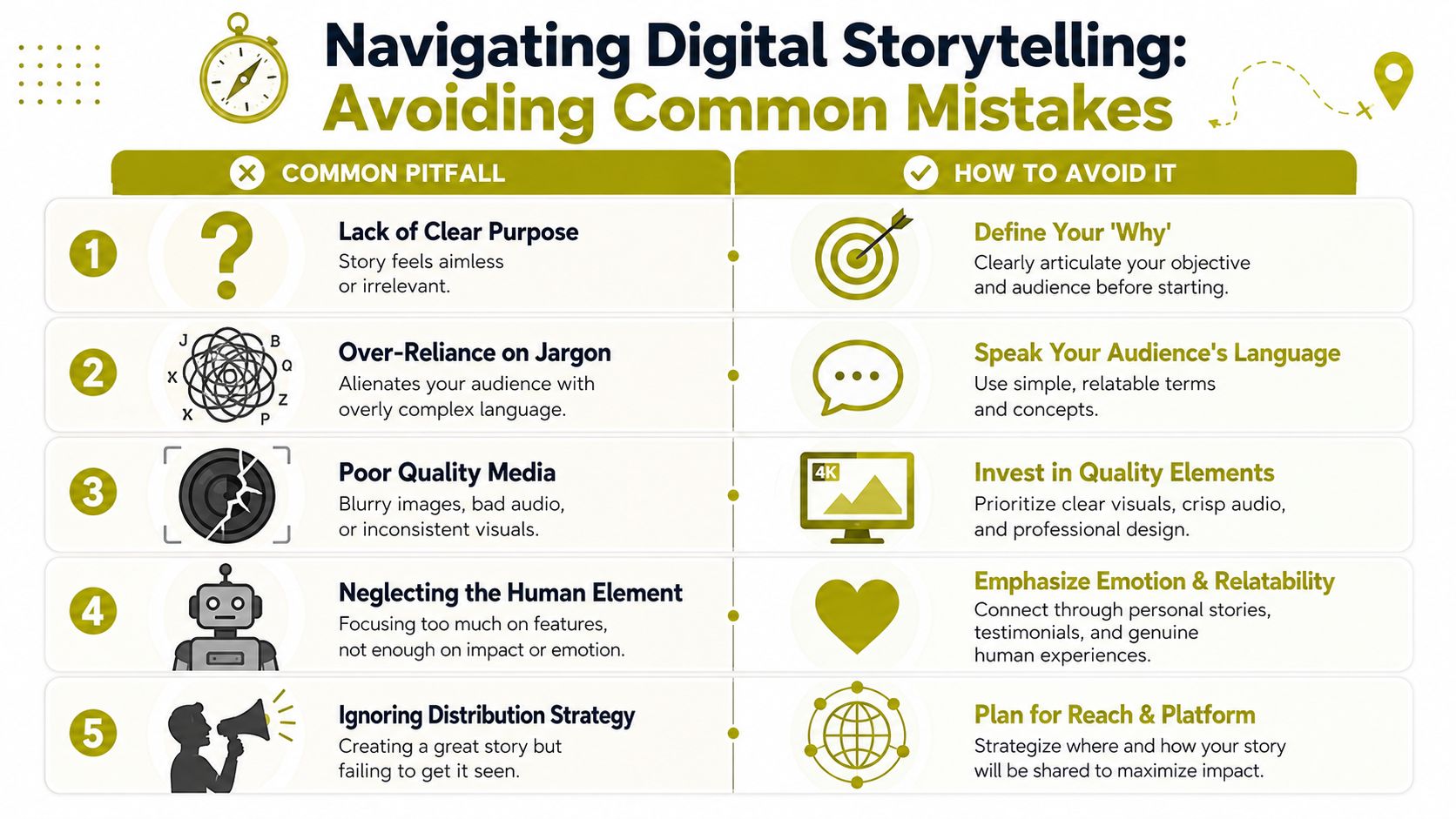
The biggest mistake in digital storytelling is assuming that adding media turns information into narrative. It doesn't. A slide deck with music is still a slide deck if nothing drives the audience forward.
The data dump problem
A lot of business content collapses because it tries to include every proof point, service detail and internal message in one piece. The audience gets buried. In hybrid working environments, that gets worse because teams often pass around disconnected information without shaping it for the people receiving it.
The fix is ruthless editing. Keep asking what the audience needs first, not what the business wants to mention.
Style over substance
Scrollytelling, animation and slick editing can be powerful. They can also become camouflage for weak thinking. If the story has no dramatic question, no clear point of view and no consequence, the format won't rescue it.
A practical test is to strip the idea back to a plain paragraph. If it still has force, production can enhance it. If it falls flat, go back to the angle.
Accessibility isn't optional
A common but overlooked pitfall is failing to make digital stories accessible. A 2023 analysis from Digital.gov on storytelling in a hybrid world stresses that compliance with standards such as captioning is a critical legal and ethical requirement often missing from creativity-led guides.
That means thinking about captions, readable text, usable structure and whether the story works for people who can't or don't consume it in the ideal format.
If a story only works for a fully sighted, fully hearing, fully attentive audience on the perfect device, it isn't finished.
The overlooked research value
There's another angle most business guides miss. Digital storytelling can function as a participatory research method, not just a marketing output. A Frontiers study on co-created digital storytelling with stroke survivors showed how participants became active co-producers of knowledge rather than passive subjects.
That matters for organisations working with underserved communities, public-facing programmes or sensitive stakeholder groups. Sometimes the most valuable story process isn't broadcasting a message. It's uncovering one with the people affected.
If your business has expertise, credibility and a genuine point of difference but still struggles to be seen, understood or remembered, Carlos Alba Media can help shape that into a story people follow. The agency is led by a multi award-winning former national newspaper editor, and everyone who works there is a former national news journalist or has agency experience of working with international brands. That gives clients something rare: senior editorial judgment applied to PR and digital marketing without the usual big-agency fog.