
Most advice on content marketing and SEO gets the order wrong. It tells SMEs to publish more, chase keywords, then hope Google connects the dots. That's backwards. If your content has no strategic search intent, it's a brochure. If your SEO has no editorial value, it's scaffolding with no building.
The better model is simpler. Content is the substance. SEO is the distribution logic. One without the other wastes money.
That matters even more in the UK SME market, where 73% of small and medium-sized enterprises now integrate SEO as a core component of their content marketing strategy, according to the 2025 Chartered Institute of Marketing report). The businesses still treating content and SEO as separate line items are the ones wondering why their blog attracts no leads, or why their technical SEO work hasn't moved revenue.
At Carlos Alba Media, that gap is obvious because of the team's specialist background. Everyone who works for Carlos Alba Media is a former national news journalist or has agency experience of working with international brands. That newsroom discipline changes the standard playbook. The key opportunity isn't just digital optimisation. It's building authority through a joined-up system where search, editorial judgment, and earned media reinforce each other.
Why Your Content Marketing and SEO Are Failing
Most failing strategies have the same flaw. The business hired a writer to “do content” and a consultant to “do SEO”, then left them in separate lanes. One produced articles nobody could find. The other produced keyword maps nobody wanted to read.
That split is fatal.
Two teams, one missed brief
A good article without search intent is like a strong press release left in a drawer. A tightly optimised page with no original insight is worse. It may rank briefly, but it won't convert serious buyers because it reads like it was built for a machine.
Practical rule: Stop asking whether you need content or SEO. You need content built for search and search shaped by editorial judgment.
SMEs usually see the symptoms before they see the cause:
- Low-value traffic: Visitors arrive, skim, and leave because the page answers the wrong question.
- Thin authority: Your site has isolated posts instead of a body of work that proves expertise.
- Weak reporting: You're counting impressions and rankings, but not tying them to commercial intent.
- No editorial discipline: Topics are chosen because someone had an idea in a meeting, not because customers are searching for them.
If you need a better way to diagnose those gaps, a structured client SEO report template helps teams review content, rankings, technical issues, and commercial priorities in one place rather than in separate reports.
The engine and the map
Content is the engine. SEO is the map. An engine without direction burns fuel. A map without an engine goes nowhere. Good growth comes from combining both into one operating system.
That's why the usual SME approach underperforms. They publish sporadically, optimise superficially, and measure the wrong outcomes. Then they blame the channel.
The stronger approach is unified from the start. The topic, search intent, structure, internal links, distribution plan, and earned media angle all need to be decided together. That's how editorial teams work under pressure, and it's why a newsroom mindset beats a siloed marketing one.
A Unified Strategy The Newsroom Model
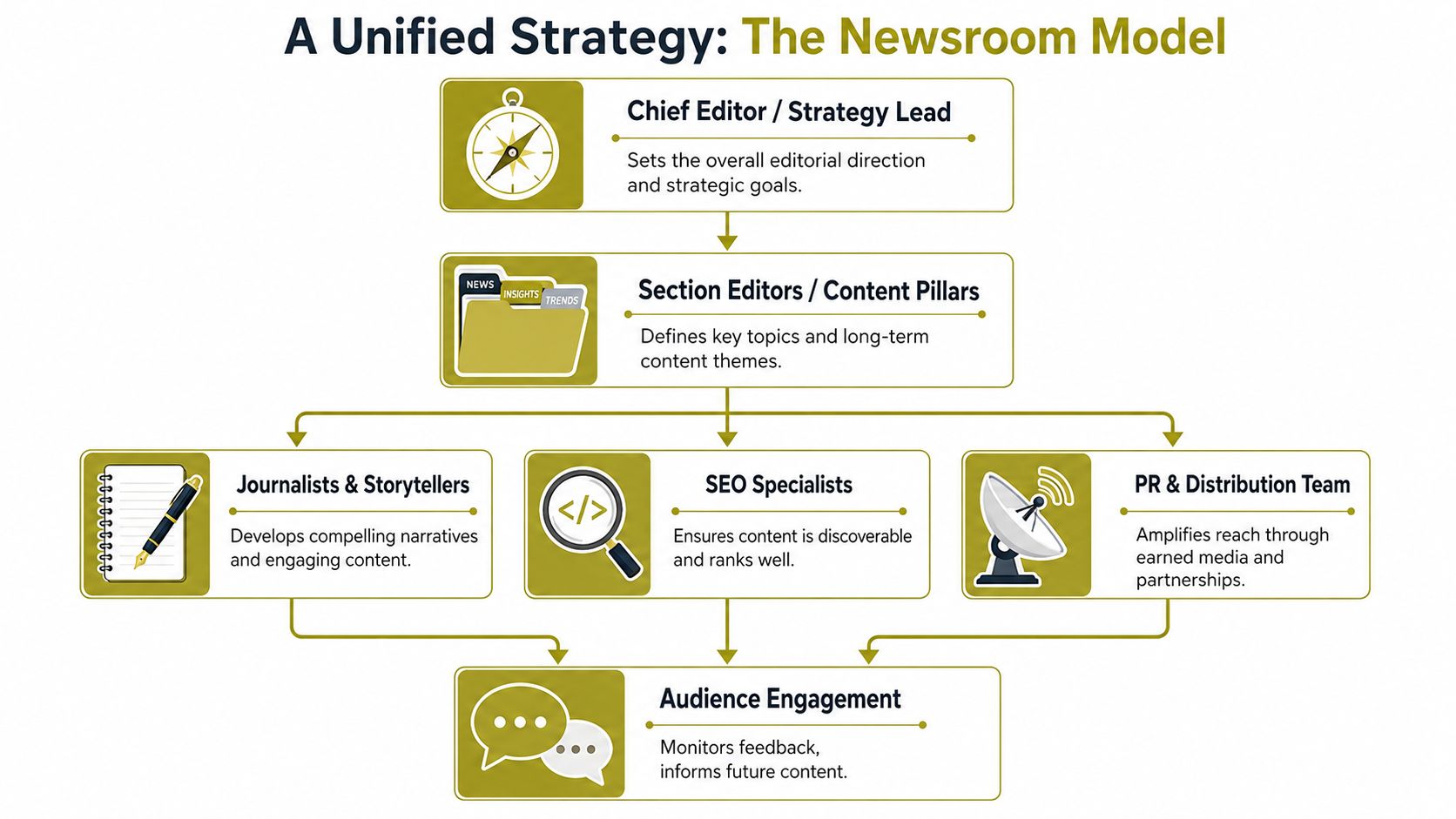
The cleanest way to organise content marketing and SEO is to think like a publication covering a major story. A newspaper doesn't publish one article and call the subject finished. It runs the front-page feature, then follow-ups, analysis, reaction, profiles, explainers, and commentary. Your business topic should work the same way.
Build a cover story first
Your pillar page is the cover story. It's the definitive page on a core commercial topic. If you sell HR software, that might be your main guide on employee onboarding. If you run a legal practice, it might be your central page on a specific service area. If you're a tourism brand, it could be the authoritative page around a destination, audience segment, or premium experience.
That page should do three jobs:
| Role | What it means |
|---|---|
| Set scope | Define the topic in full, not as a thin landing page |
| Hold authority | Become the page all supporting content strengthens |
| Convert demand | Give readers a clear next step when they're ready |
The supporting articles are your cluster content. These are the sidebars, explainers, and reaction pieces that answer narrower questions and link back to the pillar.
Why this structure wins
This isn't theory. UK-based content marketing strategies incorporating topic clusters with internal linking depths of 3–5 levels increase domain authority scores by 18.4% compared to single-page strategies, directly correlating with a 27% reduction in customer acquisition costs for SMEs, according to the 2025 Digital Analytics Consortium study.
A cluster model works because it reflects how buyers research. They don't land on one page, become convinced, and buy. They read laterally. They compare. They look for proof that you know the field, not just the headline term.
A strong site feels edited, not assembled.
For most SMEs, that means abandoning the habit of publishing disconnected blog posts and moving to a planned editorial architecture. If you want a sharper editorial standard for authority-led writing, this guide on how to write a thought leadership article is worth reviewing.
A practical newsroom workflow
Think in roles, even if your team is small:
- Strategy lead chooses the commercial themes.
- Editor defines the pillar and commissions cluster topics.
- Writer builds useful, specific content.
- SEO specialist shapes internal links, metadata, and search intent.
- PR lead identifies which pieces can attract mentions, interviews, or commentary opportunities.
That's the newsroom model in commercial form. It's disciplined, scalable, and far more effective than random acts of publishing.
Keyword Planning Like an Investigative Journalist
Keyword planning is often treated like spreadsheet work. That's a mistake. The best keyword research behaves more like reporting. You're not hunting terms. You're uncovering what people want to know, what they fear getting wrong, and what language they use when the stakes are real.
Stop chasing volume alone
A high-volume term can be useless if the intent is vague. A narrower phrase can be far more valuable if it captures a buyer who's comparing options, checking risks, or trying to solve a specific problem.
Investigative journalists don't start with the loudest claim. They start with the best question. Your keyword planning should do the same.
Ask:
- What does the customer type before they call us?
- What wording do they use when they don't yet know the technical term?
- Where is confusion costing them time or money?
- Which objections appear in sales calls, inboxes, or discovery meetings?
Build an evidence file
Use tools, yes. But don't let the tools do the thinking for you. Search data should inform judgement, not replace it.
A solid keyword brief usually pulls from several places:
- Search Console and analytics: They show what you already surface for, even if weakly.
- Sales and account teams: They know the objections, misperceptions, and buying triggers.
- Competitor pages: Not to copy them, but to spot what they dodge, flatten, or explain badly.
- Forums, reviews, and comment threads: These reveal the phrases customers use when they aren't speaking in polished marketing language.
The right keyword often hides inside a real customer complaint.
Work like a reporter, not a scraper
Journalistic keyword planning leads to better content because it looks for angle, conflict, and consequence. If every competitor has written “what is X”, write the piece that answers “when X goes wrong”, “how to choose X”, or “what buyers overlook about X”.
That's also where specialist teams have an edge. Everyone who works for Carlos Alba Media is a former national news journalist or has agency experience of working with international brands. That background matters because good researchers know how to interrogate a surface narrative and find the stronger line underneath it.
The result is content that doesn't just align with search. It earns attention because it has a point of view.
Technical On-Page SEO for Storytellers
Plenty of SMEs still treat technical on-page SEO as a specialist chore that sits somewhere between development and compliance. That's the wrong lens. On-page SEO is editorial structure translated into code and page design. It helps search engines read your story, and it helps people trust it fast.

Your headline, standfirst, and sections
A title tag is your headline. If it's vague, crowded, or generic, your page starts weak. Your meta description is the standfirst. It should tell a busy reader why this result deserves the click. Your H1 and H2s are the section structure. If they're muddled, both users and Google have to work harder than they should.
That's not just a technical issue. It's an editing issue.
Use a simple standard:
- Title tag: Clear topic, strong phrasing, obvious relevance.
- Meta description: One tight summary with a real reason to click.
- Headers: Break the page where the reader's questions naturally change.
- Internal links: Move readers to the next useful page, not just any page.
If your team needs a sharper review process, this SEO audit checklist is a useful baseline for checking page structure, crawl clarity, and on-page essentials.
Schema is not optional
Schema markup sounds technical because it is technical. It's still not optional. It tells search engines what your content is, which matters when you want visibility beyond the standard blue link.
In the UK, integrating schema markup, specifically Article and FAQ types, into content marketing campaigns directly increases organic click-through rates by 14.7% on average, according to the 2024 BrightEdge Intelligence Report.
That should get any SME's attention. Better click-through means your ranking has a better chance of turning into traffic, and traffic has a better chance of turning into leads.
Good technical SEO doesn't decorate content. It clarifies it.
Technical quality supports editorial credibility
The strongest pages feel easy because someone has made smart decisions underneath them. Clean hierarchy. Sensible linking. Fast loading. Structured information. Clear markup.
When storytellers ignore technical SEO, they reduce the reach of their own work. When technical teams ignore storytelling, they optimise a shell. The pages that perform combine both. They read well, scan well, and signal relevance clearly.
Supercharge Reach with Earned Media and PR
Most content marketing and SEO advice falls short here. It treats authority as something you build only on your own website. That's incomplete. Search authority is also shaped by who mentions you, where you appear, and whether your expertise travels beyond your domain.
That's why earned media matters.
The PR gap hurting SME growth
A large share of UK marketers say SEO matters, but far fewer connect it properly to PR. While 64% of UK marketers prioritise SEO, only 18% effectively use earned media to boost keyword relevance, according to the CIPR report on the PR-SEO integration gap for UK SMEs.
That gap is expensive because earned media does work digital-only teams can't easily replicate. It creates brand searches. It generates authoritative mentions. It gives sales teams proof. It strengthens trust before a prospect lands on your site.
If you still think earned media sits outside search strategy, revisit the basics of what earned media is. For SMEs, it's often the missing authority layer.
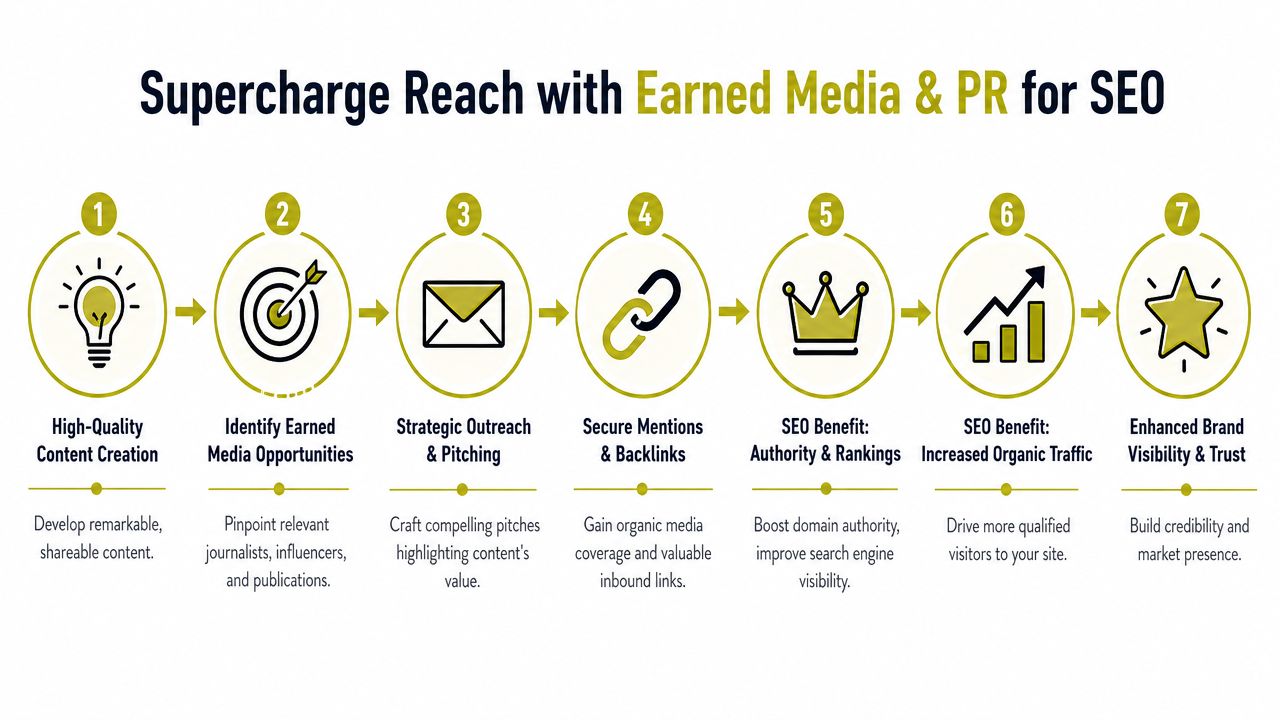
The media-to-search funnel
Here's how it works.
You publish a genuinely useful piece. A journalist, sector title, podcast host, or trade editor picks up the insight, quotes your spokesperson, or links to the source. That mention reaches a wider audience. Some search your brand name. Others search the topic and associate your business with it. Search engines also read the signals around that coverage.
That creates a compounding effect:
| Step | Outcome |
|---|---|
| Earned mention | Third-party credibility |
| Brand search lift | More people actively look for you |
| Authority signals | Search engines connect your brand to the topic |
| Better conversion environment | Prospects arrive with higher trust |
If nobody credible talks about your expertise beyond your own site, your digital authority remains thinner than it should be.
Why newsroom experience matters here
Specialist teams set themselves apart. Everyone who works for Carlos Alba Media is a former national news journalist or has agency experience of working with international brands. That matters because people with newsroom instincts know what makes a story pitchable, what evidence an editor will trust, and how to turn an idea into coverage rather than another ignored outreach email.
Most agencies separate PR from SEO because that's how they're organised internally. SMEs shouldn't accept that model. A press hit should support search. A strong search asset should be built with outreach potential in mind. One feeds the other.
Measuring What Matters and Building a Workflow
Most SMEs don't have a content problem. They have a measurement problem. They celebrate traffic spikes, cling to rank screenshots, and still can't answer the question that matters. Did this work create qualified demand?
Ditch vanity metrics
Traffic on its own tells you very little. A page can pull visitors and still fail commercially. The stronger metrics sit closer to business outcomes.
Track:
- Qualified enquiries: Did the content attract the right sort of lead?
- Sales conversation quality: Are prospects arriving better informed?
- Conversion path: Which pages assist contact forms, calls, or booked meetings?
- Customer acquisition efficiency: Does the content reduce wasted spend elsewhere?
If you can't connect content performance to pipeline quality, your reporting is decorative.
A workable SME workflow
You don't need a massive team. You need a repeatable editorial routine.
- Choose one commercial theme each cycle. Tie it to a service, product, or market priority.
- Gather audience evidence. Pull questions from sales calls, client emails, search data, and support queries.
- Write a proper brief. Include audience, angle, target query, internal links, proof points, and distribution plan.
- Publish with structure. Strong headline, useful headers, clear CTA, and supporting links.
- Promote beyond your own channels. Share with partners, journalists, trade bodies, and warm contacts where relevant.
- Review outcome, not vanity. Look at lead quality, assisted conversions, and whether the page deserves an update.
Use lived expertise, not generic filler
Too many brands flatten their own advantage. A 2025 study found that 62.18% of UK SMEs and start-ups that utilise content teams with prior agency experience incorporate personal stories or anecdotes from direct industry expertise into their content, and that correlates with a 34% increase in customer engagement, according to the UK Department for Digital, Culture, Media and Sport study).
That fits what experienced editors already know. Readers trust specifics. They trust examples rooted in reality. They trust writers who understand the pressure, not just the terminology.
One recent client example showed this clearly. A specialist firm had decent service pages but little authority around the core issues buyers were researching. The fix wasn't publishing more random content. It was building a focused article series around recurring customer concerns, adding stronger internal links, and aligning each piece with a clear outreach angle. The visible result wasn't a vanity traffic boast. It was better sales enquiries because prospects arrived understanding the offer and trusting the expertise.
From Content to Credibility Your Next Steps
The point of content marketing and SEO isn't to game an algorithm. It's to build a credible public record of your expertise. Search rewards that over time because users reward it first.
That's why the strongest strategy for SMEs is integrated, editorial, and reputation-aware. It joins search intent to useful content. It structures pages properly. It turns authority into a system rather than a lucky break. It also recognises that coverage outside your own channels strengthens what happens inside them.
Ask your current agency or internal team a few blunt questions:
- How are you linking content plans to revenue priorities, not just traffic targets?
- Which pillar topics are we trying to own, and what cluster content supports them?
- What's our process for turning media coverage into search authority?
- Who decides the editorial angle, and what evidence supports it?
- How often do we update high-potential pages instead of just publishing new ones?
- Are we building content that can also surface in emerging search experiences?
On that last point, if your team is thinking beyond classic rankings, this guide on how to get featured by Google's AI is a useful read because it forces the right question. Is your content merely present, or is it authoritative enough to be cited?
Businesses that win in search don't publish the most. They publish with the clearest strategy, the strongest evidence, and the best distribution.
If you want senior-level help from a team that understands both headlines and hard outcomes, Carlos Alba Media brings together former national news journalists and agency specialists with international brand experience to build authority across PR, content, SEO, digital strategy, and reputation management.