
Most advice on how to write a thought leadership article is too soft. It tells founders to “be authentic”, “share your perspective” and “post consistently”. None of that is wrong. It’s just incomplete.
A thought leadership article isn’t a diary entry with a stronger headline. It’s a strategic asset. If you want it to influence buyers, journalists, investors or policymakers, it needs the same discipline a newsroom applies to an opinion column or a major analysis piece. It needs a clear line, hard evidence, a structure that carries the reader forward and a voice that sounds authoritative without drifting into self-importance.
That matters in the UK market. Thought leadership influences purchase decisions for 84% of UK businesses, and articles with a clear thesis statement in the introduction see 47% higher engagement rates, according to the UK thought leadership guidance cited here. The implication is simple. Buyers respond to clarity, not waffle.
At Carlos Alba Media, that newsroom standard is familiar territory. The agency is Scottish-led, and its teams in London and Glasgow are made up of former national news journalists and agency professionals who’ve worked with international brands. That background changes the process. You don’t start by asking, “What shall we post this month?” You start by asking, “What can we say that we can defend, and why should anyone serious care?”
The Foundation A Newsroom Approach to Ideas
A common initial mistake involves starting with the desired format, such as a blog post, LinkedIn article, or founder column, before searching for a topic. Newsrooms operate differently, beginning with the core line of argument.

A practical way to do this is a short editorial meeting. Not a sprawling brainstorm. A tight conversation with decision-makers in the room. The founder, the person responsible for communications and the writer or strategist need to decide what the article must achieve before anyone types a sentence.
A structured newsroom-inspired methodology delivers a 47% higher engagement rate than ad hoc content creation, and 62% of successful pieces stem from collaborative ideation sessions involving key stakeholders, according to this newsroom approach analysis.
Start with an assigned goal
Every strong thought leadership article has a job to do. Pick one.
- Myth-busting when the market believes something simplistic or wrong
- Trend forecasting when your team sees a shift before competitors name it properly
- Policy interpretation when regulation or public debate creates confusion
- Decision guidance when buyers need help choosing between flawed options
- Reframing when the category asks the wrong question altogether
That single decision changes the article. A myth-busting piece needs tension and evidence. A trend piece needs pattern recognition. A policy piece needs precision. If you try to do all three, the article usually collapses into mush.
Pressure-test the angle
Founders often confuse familiarity with originality. They say, “We should write about AI in customer service” or “We should talk about sustainability”. Those aren’t angles. They’re shelves in a library.
A usable angle sounds more like this:
Most SMEs don’t have an AI problem. They have a decision-making problem, because teams are automating work they’ve never properly mapped.
That is specific enough to argue. It also creates productive tension. A serious reader can agree, disagree or become curious. That’s where attention starts.
Use three editorial tests before you approve an idea:
- Can you say it in one sentence? If not, you don’t yet have a view.
- Can your organisation credibly own it? If the point could come from anyone, it probably won’t travel.
- Would a sceptical reader challenge it? If nobody could dispute it, it’s probably too bland to matter.
Editor’s test: If your idea sounds polite but forgettable in a board meeting, it will die on the page.
Write the thesis before the article
The thesis is the spine. It should appear early, ideally in the introduction, and it should make a clear claim in one or two sentences. That forces discipline.
For example:
- Scottish hospitality brands should stop treating social content as a visibility play and start treating it as a trust signal built around proof, local context and operational consistency.
- UK fintech founders should write less about innovation in the abstract and more about how compliance shapes better product decisions.
That’s what separates genuine thought leadership from topical content. The reader knows where you stand, and the rest of the article exists to prove it.
If your team needs a planning model to support that discipline, it helps to borrow from broader real-world content strategy frameworks that connect audience, format, intent and distribution before production begins. The same logic applies to thought leadership content explained by Carlos Alba Media. The article only works if the underlying idea is fit for purpose.
Sourcing Evidence Like a Journalist
Opinion on its own isn’t thought leadership. It’s a viewpoint. Sometimes that’s enough for a social post. It isn’t enough for a serious article meant to influence commercial decisions.
The strongest pieces build what editors would call evidence pillars. These are the pieces of proof that hold the argument up. Without them, the article reads like assertion dressed up as insight.
What counts as evidence
The best evidence usually combines three things rather than relying on one.
| Evidence type | What it does | What it looks like |
|---|---|---|
| Verified public data | Anchors the article in reality | ONS figures, UKRI material, regulator publications |
| Operational experience | Shows you’ve seen the issue first hand | Lessons from campaigns, boardroom decisions, client patterns |
| Expert interpretation | Explains why the data matters | Analysis from sector specialists, legal review, technical context |
That mix matters because raw data without interpretation can feel cold, while anecdote without evidence feels flimsy.
UK PR agencies producing thought leadership with evidence pillars report 73% higher credibility scores among SME audiences. 68% of UK executives dismiss claims that aren’t backed by data. Those figures are included in the verified brief for this article. They capture a basic truth. Readers will tolerate a strong opinion. They won’t tolerate a lazy one.
Look for proof that changes the reader’s understanding
Journalists don’t collect facts just to decorate copy. They look for proof that shifts the frame.
A weak claim reads like this: “Regulation is challenging for growing businesses.”
A stronger thought leadership line is built differently. It identifies the pressure point, then brings proof to it. For UK businesses in regulated sectors, that might mean drawing on regulator guidance, legal interpretation, or public data that shows why caution isn’t just bureaucracy but a market reality.
Use this filter when sourcing material:
- Does this evidence sharpen the argument? If it only repeats what the reader already assumes, cut it.
- Does it come from a source a sceptical reader would respect? Favour official or specialist material over vague commentary.
- Does it add surprise? The article should teach, not merely confirm.
Build a reporting file before you draft
Many brand teams lose time. They draft too early, then stop every few sentences to find proof. That breaks the logic of the piece and usually leads to weak sourcing.
A better method is to prepare a simple reporting file first:
- The thesis in one or two sentences
- Three to five proof points that support it
- One counterpoint that a fair-minded reader might raise
- One lived example from your team, sector or market observation
- A note on what you can’t responsibly claim
That last point is important. Good thought leadership has edges. It knows where the evidence stops. Former national journalists understand this instinctively because the credibility of the piece depends on not overreaching.
If you can’t support a statement with evidence, narrow the statement. Strong writing is often the result of tighter claims, not louder ones.
Avoid the most common evidence failures
Most weak articles fail in familiar ways:
- They cite broad global trends when UK-specific proof is needed
- They stack statistics without analysis
- They use expert quotes that say nothing
- They smuggle in sales copy under the banner of insight
A founder writing about procurement, tourism, property, healthcare, finance or technology in the UK should sound like someone who knows the territory. That means citing the environment your reader operates in and translating the evidence into commercial meaning. A journalist’s habit is useful here. Don’t ask, “What can I add?” Ask, “What would a hard-nosed editor cut?”
Structuring Your Article for Maximum Impact
Once the idea is sound and the reporting is done, the next job is structure. Without careful structuring, many promising articles lose force. They have a good point, but it arrives buried under scene-setting, throat-clearing and recycled context.
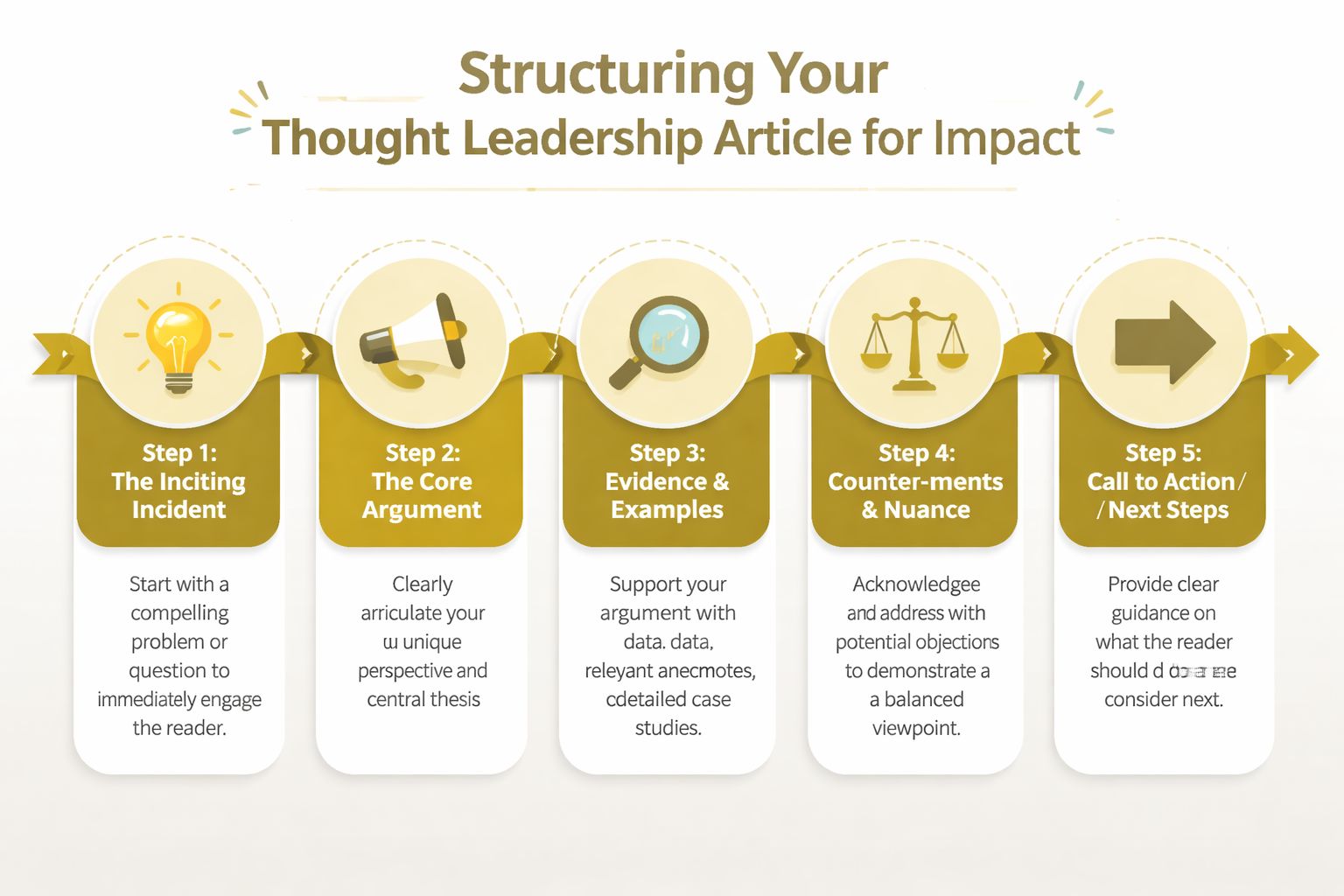
A newsroom solves that with a skeleton storyline. Before drafting, map the sequence of argument on one page. Don’t write paragraphs yet. Build the frame first.
Use a narrative arc instead of a generic blog format
A lot of branded content still follows the school essay model. Introduction. Three body sections. Conclusion. It’s tidy, but it rarely persuades.
A stronger pattern is:
- Problem
- Agitation
- Solution
- New reality
That gives the piece movement. It starts with stakes, increases pressure, offers a clear interpretation and ends by showing the practical consequence.
Thought leadership influences purchase decisions for 84% of UK businesses, and articles with a clear thesis statement in the introduction see 47% higher engagement rates, according to this UK-focused reference on writing thought leadership. That should change how you open. Don’t spend five paragraphs warming up. State the point.
A practical skeleton you can use
Here’s a concise planning template.
| Part of article | What goes there | Common mistake |
|---|---|---|
| Opening hook | A live tension, misconception or urgent shift | Starting with definitions |
| Thesis | Your clear claim in one or two sentences | Hiding the argument |
| Evidence sequence | Proof points in an order that builds momentum | Dumping facts randomly |
| Nuance | Fair acknowledgement of the strongest objection | Pretending there is no trade-off |
| Action | What the reader should do differently next | Ending with vague inspiration |
A good opening for a founder might not be dramatic, but it should be sharp. For instance, if you’re writing for Scottish tech SMEs, you might open on the gap between what buyers say they want and what they trust in practice. If you’re writing for tourism or hospitality, you might open on the difference between brand visibility and booking confidence.
Put the hardest-hitting proof early
Readers don’t owe you patience. Front-load the evidence that changes their understanding fastest.
That doesn’t mean cramming all your data into paragraph two. It means placing the strongest support where it can carry the thesis, then using later sections for detail, examples and nuance. If your best point sits at the end because you wanted to “build up to it”, you’ve probably mistaken suspense for clarity.
Practical rule: Arrange your evidence in the order a sceptical reader would need it, not the order you discovered it.
Make room for objection
Many branded articles sound brittle because they refuse complexity. Serious readers notice. They know there are trade-offs, exceptions and awkward cases.
Include one short section that acknowledges the best counter-argument, then answers it without becoming defensive. For example, if you argue that founders should take a more visible public stance, you can still recognise the legal, reputational or sector constraints that make some claims unsafe. That makes the article more credible, not less.
This is also where storytelling helps. A concise example from live commercial practice often lands harder than another generic paragraph. That’s the logic behind brand storytelling approaches discussed by Carlos Alba Media. The structure carries the evidence, but story gives it memory.
Crafting a Voice of Authority Not Arrogance
A strong article can still fail if the voice is wrong. Plenty of executives have expertise. Fewer know how to sound like they have it.
Authority comes from precision, not puffed-up language. Arrogance usually shows up when the writer doesn’t trust the argument, so they decorate it with clichés, abstractions and self-congratulation.

What authoritative writing sounds like
It is usually built from short declarative sentences mixed with longer explanatory ones. It avoids jargon unless the jargon is necessary. It makes a claim, then earns it.
Compare these two approaches.
- Weak: “Businesses should aim to apply new communication methods to boost visibility results.”
- Better: “Most firms don’t need more content. They need a clearer point of view and the proof to stand it up.”
The second line sounds more confident because it is more specific. It also sounds more human.
Defensible boldness matters in regulated sectors
Generic thought leadership advice often breaks down because it tells leaders to be provocative without acknowledging the legal and reputational risks attached to visibility in finance, healthcare, tourism, technology, education or broadcast-adjacent sectors.
A critical, underserved angle for UK thought leadership is tailoring content for regulated sectors. General advice often overlooks UK-specific nuances such as GDPR compliance and Ofcom rules, even though 42% of UK SMEs faced regulatory scrutiny in 2025. Integrating defensible boldness by embedding case studies and involving legal counsel early builds trust without risking fines, according to this analysis of thought leadership practice.
That phrase, defensible boldness, is useful because it captures the balance. Your article should still take a stand. It just has to be a stand you can support under scrutiny.
A practical checklist looks like this:
- Be precise about scope. Say “for early-stage SaaS firms selling into regulated buyers” instead of “for every business”.
- Separate fact from interpretation. Readers should always know which is which.
- Avoid absolute claims unless you can fully substantiate them.
- Review sensitive passages early if legal, policy or regulator issues are in play.
Strong thought leadership doesn’t sound reckless. It sounds tested.
Edit for clean authority
A lot of executive drafts improve dramatically in the edit. Not because the ideas are poor, but because spoken expertise often arrives on the page padded with caution or clutter.
Cut these habits aggressively:
- Passive openings such as “It is believed” or “It has been observed”
- Corporate filler such as “in today’s fast-paced world”
- Self-protection language that weakens every sentence
- Claims of uniqueness that the article hasn’t proved
Replace them with verbs that show action and judgement.
Before:
“Organisations are increasingly considering the importance of a more strategic approach to content.”
After:
“Most organisations publish too much and decide too little.”
That kind of edit creates authority because it commits to a line.
A useful prompt for founders is simple. Say it as you would in a tough media interview, then write that version down. If the sentence wouldn’t survive a presenter asking, “What exactly do you mean by that?”, it isn’t ready.
For a practical example of clear spoken authority in action, this interview clip is worth watching.
Confidence is a service to the reader
Some leaders worry that direct writing will make them sound too forceful. Usually the reverse is true. Vague writing makes the reader do the interpretive work. Clear writing respects their time.
That’s especially important when your audience includes buyers, journalists, regulators or investors. They don’t want a performance. They want a usable argument. The writer’s job is to provide one.
Distribution SEO and Measuring What Matters
Publishing is not the finish line. It’s the starting gun.
A thought leadership article only becomes commercially useful when it reaches the right audience, earns attention in the right places and creates signals that matter beyond vanity metrics. If the article sits on your site with no search intent, no distribution plan and no follow-up, it’s just a well-written file.

Build search into the article before you publish
SEO for thought leadership is not the same as churning out service pages. The article still needs a strong argument. It also needs to line up with the language your audience uses.
That means checking whether your target phrase belongs in the headline, introduction, subheadings and metadata without making the piece sound mechanical. If your target is how to write a thought leadership article, the phrase should appear naturally where it helps both search engines and human readers understand the page.
A few practical checks matter:
- Headline fit. The title should be clear about the problem solved.
- Search intent. Make sure the article directly answers the query, not a neighbouring one.
- Internal linking. Connect the piece to related service or insight pages so readers can move deeper into the site.
- Metadata discipline. Write a meta description that promises a concrete outcome, not a slogan.
For teams refining on-page performance, Carlos Alba Media’s guide to improving SEO rankings is one practical reference point. The key is to treat SEO as distribution infrastructure, not as a substitute for having something worth saying.
Distribute where decision-makers already pay attention
One article should never live in one place only. The core asset can support several formats and channels, but each version needs adapting rather than copy-pasting.
UK-specific benchmarks show thought leadership articles using a data-driven framework achieve 3.2x more backlinks for SMEs. Optimising for UK searches and distributing via LinkedIn, which accounts for 52% of UK B2B engagement, and newsletters is key. A salesy tone is a common pitfall and leads to a 67% bounce rate among UK executives, according to this UK thought leadership benchmark reference.
That tells you two useful things. First, serious distribution creates compounding value through backlinks and discovery. Second, readers can smell a disguised sales pitch immediately.
A sensible distribution pattern often looks like this:
| Channel | Best use | What to publish |
|---|---|---|
| Website | Canonical version for search and authority | Full article |
| Reach buyers, peers and journalists | One sharp claim, one excerpt, one chart or insight | |
| Newsletter | Nurture warm audiences | Editor’s note plus link and takeaway |
| Sales enablement | Support commercial conversations | Extracted argument, proof points, rebuttals |
| Media outreach | Turn article into commentary opportunity | News hook and spokesperson angle |
Measure business signals, not applause
Too many teams stop at page views, likes and impressions. Those numbers can be useful, but they are not the main point.
A better approach is to ask what the article was supposed to do in the first place. If the piece was written to support lead generation, track enquiries, replies, briefing requests or contact form journeys tied to that topic. If it was written to support PR, track media pickups, interview invitations, speaking opportunities and linked mentions. If it was meant to support search authority, monitor backlinks and assisted conversions.
What to measure should match what the article was built to change.
A few practical signals are worth watching over time:
- Qualified inbound interest from your ideal audience
- Sales conversation usage by commercial teams
- Backlink growth from relevant sites
- Media and podcast invitations triggered by the argument
- Return visits from readers exploring adjacent pages
Use behaviour tools to improve the article after launch
Publishing should create a feedback loop. If readers drop off early, skim key sections or ignore your CTA, the article needs adjustment.
That’s where tools that show on-page behaviour become useful. A visual tool like WriteStack's heatmap tool can help you see where readers engage, where they lose momentum and whether your structure is doing its job. That is especially useful for long-form thought leadership, where a strong argument can still suffer from poor pacing.
For teams that want outside support, one option is Carlos Alba Media, which offers executive thought leadership and personal branding campaigns alongside broader PR and digital strategy work. In practical terms, that means shaping the argument, drafting the article, aligning it with media opportunities and building distribution around it.
Repurpose without diluting the point
A strong pillar article can generate weeks of follow-on material, but only if the original argument is tight. Pull out one contrarian claim for LinkedIn. Turn one evidence section into a founder email. Use one objection-and-response segment in a sales deck. Build a speaking abstract from the thesis.
Don’t repurpose by chopping the article into random fragments. Repurpose by preserving the core line and translating it for the context.
The useful discipline is this. If someone sees only the newsletter version, the LinkedIn version or the sales version, they should still understand your stance. Thought leadership works when the same argument survives contact with multiple channels.
If your team wants a thought leadership process grounded in newsroom discipline rather than generic content advice, Carlos Alba Media helps founders, spokespeople and SMEs shape defensible arguments, turn them into publishable articles and connect them to PR, SEO and reputation goals.