
Most advice on target audience definition is too soft to be useful. It tells founders to pick an age band, choose a location, note a few interests, then call it a strategy. That's how businesses end up with profiles like “women aged 30 to 45” or “SME owners in the UK”, which sound tidy in a slide deck and fail the moment real money goes behind them.
A usable audience definition should behave more like a newsroom brief than a spreadsheet label. A former journalist doesn't ask only who somebody is. They ask what happened to them, what problem they're trying to solve, what they're worried about, what they'll ignore, and what would make them act now. That's the standard worth using in PR and growth.
At Carlos Alba Media, that way of thinking is built into the work. The team is made up of former national news journalists and people with agency experience on international brands, so audience work isn't treated as administrative tasks before the main campaign starts. It is core strategic work.
Your Target Audience Is Not Who You Think It Is
Most businesses define the wrong audience because they start with identity instead of action. They focus on category labels. Founder. Parent. Hotel guest. Operations director. That gives you a rough description, but not a campaign target.
The audience is the group most likely to move when presented with a specific message, through a specific channel, in a specific context. That is much narrower, and much more commercially useful.
The demographic trap
Demographics still matter. They help rule people in and out. But on their own, they don't explain timing, urgency, trust, resistance, or motivation. Two people with the same job title and postcode can behave in completely different ways if one is trying to fix a pressing issue this quarter and the other is only browsing.
This matters even more in PR, because media audiences are layered. The person who buys isn't always the person who notices the story first. A journalist, industry commentator, investor, local stakeholder, or internal advocate may shape whether your message gets traction at all.
If you want a useful primer on that distinction, understanding press release audiences is worth reading because it forces the obvious question many teams skip. Who is this intended for once it leaves your inbox?
A weak audience definition answers “who could care?” A strong one answers “who will act, and why now?”
The journalistic approach works better
A sharper method is to investigate the audience the way a reporter investigates a story.
Ask:
- What pressure are they under: Are they trying to cut risk, save time, justify spend, impress a board, protect reputation, or choose safely?
- What triggers attention: A hard commercial problem, a status signal, a local angle, regulatory change, peer proof, or fear of making the wrong call?
- What blocks action: Budget friction, internal politics, complexity, scepticism, procurement, or simple overload?
- What proof do they trust: Customer evidence, sector expertise, editorial coverage, referrals, product detail, or a credible spokesperson?
That line of enquiry gets you closer to the living story inside the audience. Once you understand the story, your messaging stops sounding generic. Your PR angles improve. Your content gets sharper. Your paid media wastes less budget.
A target audience definition shouldn't read like census notes. It should read like a brief on human behaviour.
A Modern Target Audience Definition
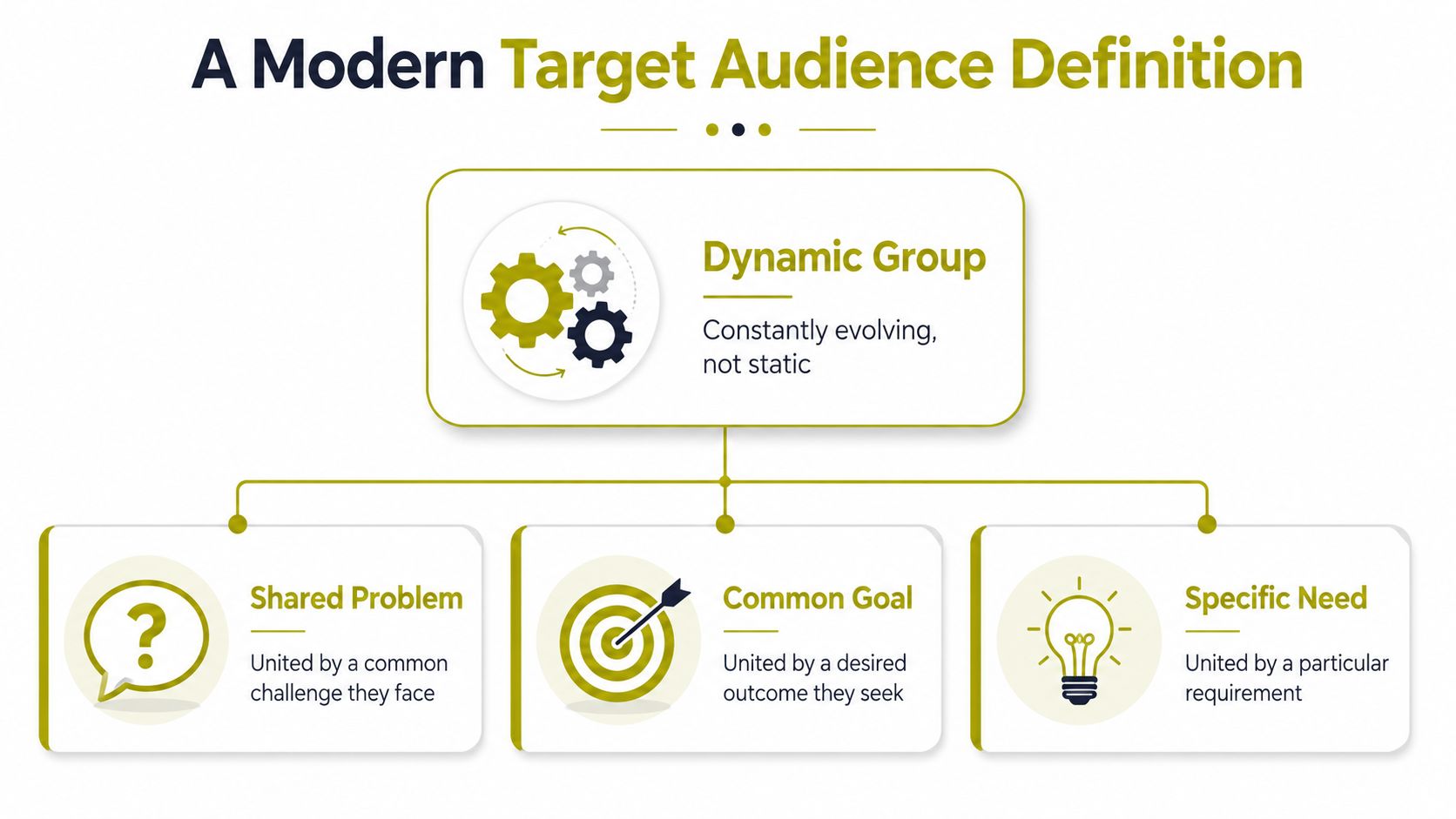
A modern target audience definition is a measurable group linked by shared behaviour, intent, and context, not just a demographic label. Adobe's explanation of audience targeting is useful here because it frames targeting around segments built from demographics, interests, and intent so businesses can personalise content and improve conversion efficiency in competitive markets, as outlined in Adobe's guide to audience targeting.
That's the technical definition. The practical one is simpler. Your audience is the group with the same problem, heading towards the same goal, who tends to respond in similar circumstances.
Three layers that make an audience usable
Think of audience work like building a publishable story. A good reporter needs the facts, the motive, and the sequence. Marketing needs the same three layers.
Demographics
This is the surface layer. Age, role, income band, company size, sector, geography. It helps with relevance and media buying, but it's only the opening line.
If you stop here, you get cardboard personas.
Psychographics
Most weak audience definitions often fail to consider psychographics. Psychographics deal with beliefs, anxieties, aspirations, status signals, and decision style. They tell you why one message lands and another gets ignored.
A founder buying PR support may say they want visibility. Often they also want reassurance that they won't waste money, that they won't be mishandled in the media, and that the work will help them look credible to customers, investors, and peers. That's a very different brief from “SME founder, based in Scotland”.
Behaviour and context
This is the layer that turns a profile into an operational segment. What do they search for, click on, download, ask about, delay, compare, and revisit? What stage are they at? What device are they using? Who else is involved in the decision?
Practical rule: If your segment can't be recognised in analytics, CRM notes, interview transcripts, or campaign data, it's probably too vague to act on.
What a better definition looks like
Bad definition: Marketing managers at mid-sized firms.
Better definition: Marketing managers at mid-sized firms who need board-friendly evidence, consume practical how-to content, compare suppliers carefully, and respond best when the offer reduces complexity rather than promising creativity alone.
That version gives you angles, headlines, proof points, tone, and channel choices.
The key shift
The shift is from describing people to identifying conditions.
A modern target audience definition asks:
- What situation are they in
- What outcome are they trying to reach
- What evidence do they need before they'll move
Once you define the audience this way, messaging becomes easier to write because it's anchored in a live decision, not a static persona.
Why Audience Definition Is Crucial for PR and Growth
Poor audience definition is expensive. Not only in paid media, but in missed coverage, weak positioning, muddled websites, irrelevant outreach, and campaigns that look busy without changing anything.
That cost is sharper in the UK because the market is fragmented. The latest UK business population estimates highlighted by the AMA show there were 5.45 million businesses operating in the UK at the start of 2024, and 99.9% were SMEs, as noted in this analysis of target audiences and the UK business landscape. If you sell to “businesses” in general, you're not targeting. You're broadcasting.
PR has more than one audience
Founders often get caught out. They define the customer and forget everyone else who shapes trust.
In PR, the audience may include:
- Decision-makers: The people who sign off budget or choose suppliers.
- Influencers: Journalists, analysts, sector voices, community figures, or partners who affect perception.
- Trust validators: Regulators, accreditation bodies, investors, and internal stakeholders who signal legitimacy.
- End users: The people who use the service or product, even if they don't control the spend.
A good campaign rarely speaks to only one of these groups. It sequences messages for each.
Precision beats scale for SMEs
Large brands can afford waste. Most SMEs can't. They need campaigns that travel further because the targeting is cleaner, not because the budget is bigger.
That's why audience work has to answer uncomfortable questions early. Which segment is commercially valuable now? Which one is easiest to reach? Which one has the shortest trust gap? Which one needs education before any offer will land? These are strategic choices, not marketing admin.
For founders who want a sensible overview of the mechanics, how audience analysis works is a useful companion piece because it shows the process behind narrowing an audience into workable groups.
If your message needs too much explanation, you may not have a messaging problem. You may have an audience definition problem.
What works and what doesn't
What works is focus. A campaign with a clear commercial audience, a separate reputation audience, and a defined media audience usually has cleaner messaging because each group gets the right proof.
What doesn't work is the “everyone who might be interested” model. It produces generic copy, weak stories, broad targeting, and outreach lists full of people with no reason to care.
In growth terms, audience definition reduces waste. In PR terms, it improves the odds that the story will fit the people who decide whether it gets attention, coverage, or trust.
How to Identify and Segment Your Audience
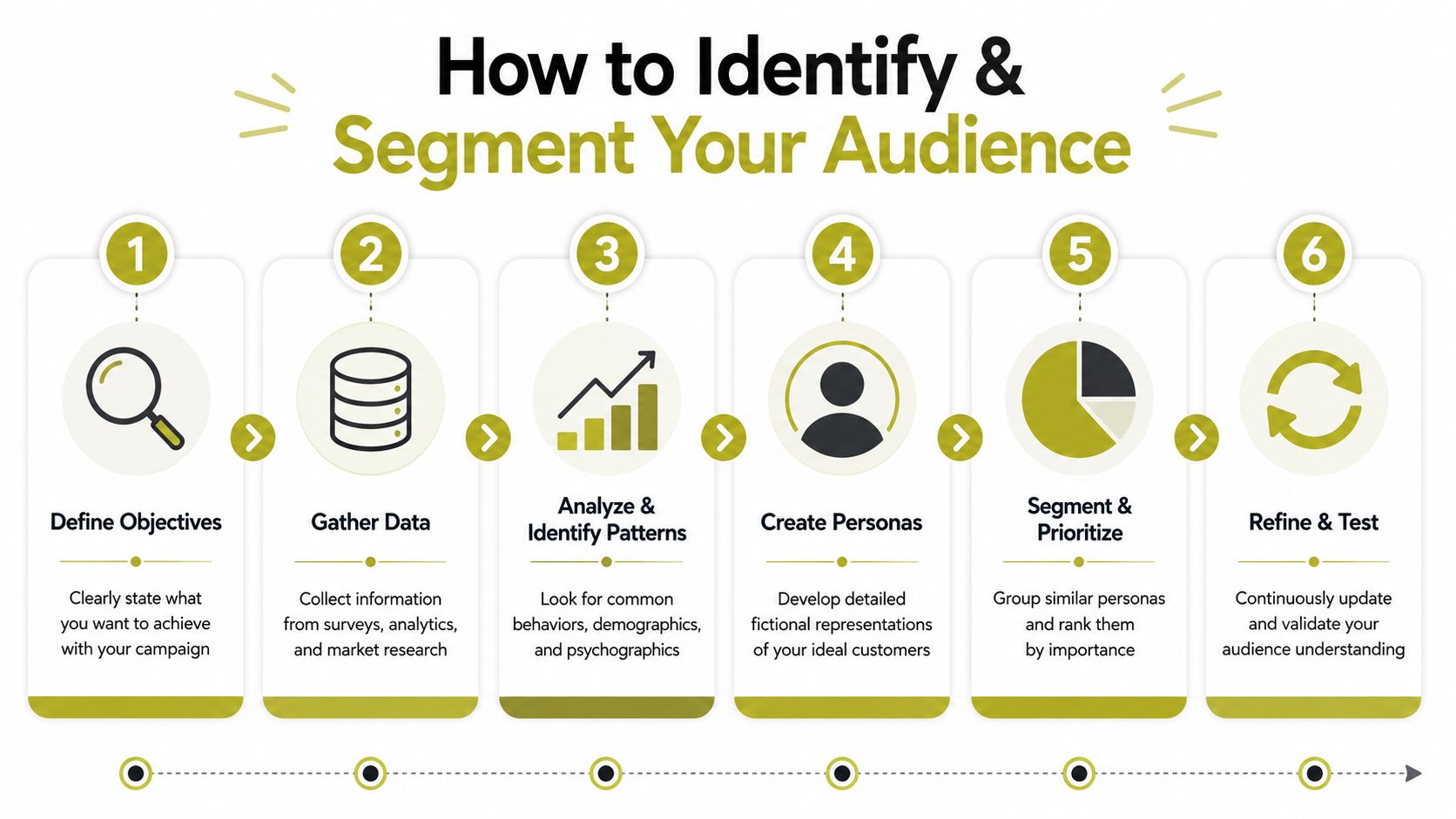
Audience definition should be evidence-led, not invented in a workshop by whoever speaks first. The useful signals are already around most businesses. They're sitting in enquiries, sales calls, CRM records, website behaviour, customer questions, reviews, email replies, and the objections people give when they don't buy.
Because UK internet penetration reached roughly 97% of adults, most consumer and B2B audiences can now be studied through online behaviour rather than demographic assumption alone, as discussed in this overview of target audiences and digital behaviour. That means your best starting point is usually behaviour.
Start with evidence, not imagination
Use a short intelligence sweep before you write a single persona.
Review conversion paths
Look at which pages people visit before enquiring, which services they compare, what they read twice, and where they drop off.Pull real language from conversations
Sales calls, discovery calls, support tickets, and customer emails contain the exact words people use when describing pain, urgency, doubt, and desired outcomes.Interview recent buyers and near-misses
Buyers tell you why they chose. Near-misses tell you what held them back. Both are valuable.Check first-party systems
Your CRM, email platform, booking data, forms, and on-site behaviour often reveal distinct clusters. If your stack is messy, a customer data platform can help centralise those signals so segmentation is based on observed activity rather than disconnected guesses.
Segment in a way you can use
Teams often over-segment by trivia and under-segment by decision behaviour. Don't build ten personas if only three decision patterns matter.
Group your audience using four lenses:
- Geographic signals: region, city, local market, travel distance, cross-border relevance
- Demographic and firmographic detail: age, role, seniority, business size, sector
- Psychographic cues: concerns, values, buying mindset, appetite for risk
- Behavioural markers: search intent, content consumption, referral source, purchase stage, repeat visits
The useful segment is the one that changes your message or channel. If a data point doesn't alter what you say, where you say it, or what proof you use, it may not deserve a place in the model.
Here's a practical explainer that complements the process:
Build personas that can survive contact with reality
A persona should be short enough to use and specific enough to guide decisions. One page is plenty.
Include:
- Their pressing problem
- Their desired outcome
- Their trigger for taking action
- Their top objections
- Their trusted proof
- Their preferred channels
- Their role in the decision
Avoid fluffy biography. Favourite coffee order isn't strategy.
The best persona is the one a sales lead, PR strategist, and content writer can all use on the same day without translating it.
Look for underserved segments
One of the strongest moves is to identify who you've been overlooking. Sometimes the highest-value segment isn't the largest or the loudest. It's the group that reaches your site repeatedly, asks commercially serious questions, and gets almost no customized messaging.
That's where first-party data earns its keep. It lets you spot reachable, profitable clusters that broad demographic work misses. In practice, that often means narrowing your focus, not widening it.
Audience Templates for Key UK Sectors
Sector changes everything. The same audience model won't work for a software start-up, a Scottish hospitality brand, and a regulated financial firm. The basics stay the same, but the pressures, proof requirements, and trust signals differ.
The other variable is geography. Effective UK audience definition should include regional market structure and decision context, combining geographic and occupational signals with behavioural evidence to avoid false precision, as set out in this guide to defining a target audience. A buyer in Glasgow may respond to a very different story from a buyer in London, even if their job title matches.
B2B tech start-up
A young tech business often thinks its audience is “SMEs” or “operations teams”. That's still too broad. The key split is usually between users, budget holders, and credibility audiences.
For a B2B tech start-up, three audiences often matter:
- Early adopters inside target companies: They care about solving a pressing problem and reducing friction.
- Commercial decision-makers: They need confidence, clarity, and proof the solution won't create risk.
- Investors or strategic partners: They look for traction signals, founder credibility, market clarity, and a convincing story about why this matters now.
The messaging shouldn't be identical. A user wants utility. A budget holder wants assurance. An investor wants a coherent market narrative.
Scottish luxury hotel
Hospitality businesses often underspecify audience because they rely on broad tourism language. “Affluent travellers” isn't enough. Why are they travelling? What occasion are they buying for? What standard of proof do they need before booking?
A better hotel audience might include couples booking milestone stays, international visitors looking for a distinct Scottish experience, and UK-based guests comparing service, privacy, dining, and location rather than price alone.
Here's a simple working template.
| Element | Description | Example (For a Scottish Luxury Hotel) |
|---|---|---|
| Audience segment | The specific group you want to attract | Couples planning a high-end short break in Scotland |
| Trigger | What prompts action | Anniversary, proposal, major birthday, or a premium escape |
| Goal | What they want from the purchase | A memorable stay with strong service and a sense of place |
| Anxiety | What might stop them booking | Fear that the experience will feel generic or poor value |
| Trusted proof | What reassures them | Quality photography, press coverage, guest reviews, dining reputation |
| Channels | Where to reach them | Search, social content, travel features, email, referral traffic |
| Messaging angle | The story that resonates | Privacy, craftsmanship, scenery, dining, and distinctive Scottish character |
Healthcare or regulated services
In regulated sectors, the audience map expands quickly. You are not only speaking to the user or customer. You may also need to satisfy professional gatekeepers, regulators, referral partners, and internal stakeholders.
That changes both tone and proof. Claims need to be tighter. Reputation matters more. Message discipline matters more. Thought leadership, media handling, and stakeholder communication have to align.
For organisations working in clinical, care, or health-adjacent spaces, the communication challenge often sits between public trust and operational detail. In those cases, specialist support such as public relations for healthcare is relevant because the audience isn't singular. It spans patients, professionals, partners, and scrutiny bodies.
In regulated sectors, clarity does more than improve conversion. It protects trust.
Established SME with UK growth ambitions
An established SME usually has a hidden audience problem. It has grown with one customer type in mind while the market has shifted beneath it. The result is mixed messaging. The website speaks to everyone. Sales decks are customised from scratch. PR stories land inconsistently because no single audience definition is anchoring the work.
The fix is usually to define primary, secondary, and credibility audiences separately.
Primary audiences buy. Secondary audiences influence or refer. Credibility audiences validate the business in the eyes of the market. Once those groups are clear, the business can decide which stories, channels, and proof points belong to each.
Activating Your Audience for Campaigns That Work
A target audience definition only earns its keep when it changes execution. If the document doesn't alter who you pitch, what headline you write, what proof you lead with, and how you structure a landing page, it's dead paper.
That matters most in PR, where relevance is judged quickly. Journalists don't respond because your company is important to you. They respond when the angle fits their audience, their format, and the moment. That requires a separate audience definition for media targets, not just customers.
Successful audience strategy often needs different definitions for different groups, including influencers and trust validators, not only end users, as discussed in this piece on finding underserved markets and broader audience strategy. That's especially true in reputation-led campaigns.

How the definition gets used day to day
In practical terms, audience definition should shape:
- Media targeting: which journalists, editors, producers, and outlets are relevant to the audience you need to influence
- Message hierarchy: which proof comes first for each segment
- Content planning: whether to produce search-led explainers, opinion pieces, case-led pages, or founder commentary
- Campaign structure: what belongs in PR, what belongs in paid, and what belongs on owned channels
- Measurement: which responses indicate real progress for each audience type
A campaign aimed at buyers may optimise for enquiry quality. A campaign aimed at trust validators may focus on authority signals, credible commentary, and message consistency across public channels. Same business. Different audience. Different job.
The newsroom advantage
Experienced PR operators with newsroom backgrounds readily spot the gap faster. Former national journalists are trained to identify what makes a story matter to a particular audience, what detail earns attention, and what claim won't survive scrutiny. That discipline improves audience definition because it forces specificity.
Used properly, your audience model becomes a live operating document. It should be reviewed against actual behaviour, updated when segments shift, and stress-tested after each campaign. If you're planning outreach, launches, or reputation work, a defined public relations campaign should start with that audience logic before anyone drafts the first pitch.
If your current target audience definition still looks like a broad demographic sketch, it's probably costing you visibility, response, and trust. Carlos Alba Media helps organisations sharpen audience strategy for PR and growth using newsroom-grade investigation, senior agency experience, and practical campaign planning grounded in how real people decide.