
Most SME owners don't have a data problem. They have a decision problem.
You can see campaign clicks in one place, sales in another, CRM notes somewhere else, and social performance in a dashboard nobody opened last week. Then a budget decision lands on your desk. Do you put more into paid social, email, search, PR-led content, or retargeting? Which customers are likely to buy again? Which leads are stalling? Which campaign should be stopped before it burns more money?
That's the point where predictive analytics marketing becomes useful. Not as a flashy AI label, but as a way to replace educated guessing with better odds.
For UK firms, this isn't a fringe tactic. The UK predictive analytics market was valued at $373.95 million in 2024 and is projected to reach $3,930 million by 2035, with a 23.8% CAGR. That matters because it signals a wider shift in how businesses plan campaigns, forecast demand, and personalise messaging. Teams that can anticipate customer behaviour are building an advantage before the click even happens.
For smaller businesses, the opportunity isn't to copy enterprise complexity. It's to use the data you already have with more discipline. If you're already running paid campaigns, email, content, or social, resources like Sovran's Facebook automated ads insights can also help you think more clearly about where automation helps and where strategic oversight still matters.
Beyond Guesswork in Your Marketing Strategy
Most marketing waste doesn't come from bad intentions. It comes from reasonable decisions made too late, with partial information.
A founder backs the ad set that “felt strong” last month. A commercial lead pushes more spend into a channel because leads looked busy, even though sales quality slipped. An e-commerce team sends the same promotion to everyone because segmenting properly seems like too much work. None of that is reckless. It's what happens when the business needs answers faster than its reporting can provide them.
What predictive thinking changes
Predictive analytics marketing works like a business forecast. It looks at historical behaviour, spots patterns, and gives you a probability-based view of what's likely to happen next. Not certainty. Better judgment.
That distinction matters. Good predictive work doesn't promise magic. It helps you answer practical questions such as:
- Which customers are most likely to buy again
- Which leads are unlikely to convert without follow-up
- Which products or services may see stronger demand soon
- Which campaigns deserve more budget before results are fully visible
Practical rule: If your current reporting only tells you what happened last week, you're steering through the rear-view mirror.
For SMEs, this is often the missing layer between raw reporting and actual strategy. Google Analytics, a CRM, an email platform, and sales records already hold signals. The challenge is joining them up and asking a forward-looking question instead of another historical one.
Why timing matters now
The pressure has changed. Media costs move. Customer attention fragments. Audiences expect relevance. Leaders can't afford to keep planning campaigns around broad assumptions and post-campaign explanations.
That's why predictive analytics has become more than a technical topic. It now sits inside day-to-day marketing decisions: spend allocation, retention planning, offer timing, and content sequencing.
A lot of business owners hear “predictive analytics” and assume it means expensive platforms, data scientists, and six-month implementation projects. It doesn't have to. In practice, the first win is usually simpler. Clean data. A narrow question. A model or scoring rule that helps your team make one better decision repeatedly.
That's where smaller firms can move faster than bigger ones. Fewer systems. Shorter approval chains. Quicker testing.
Understanding Predictive Marketing Analytics
At its simplest, predictive marketing analytics uses past behaviour to estimate future behaviour.
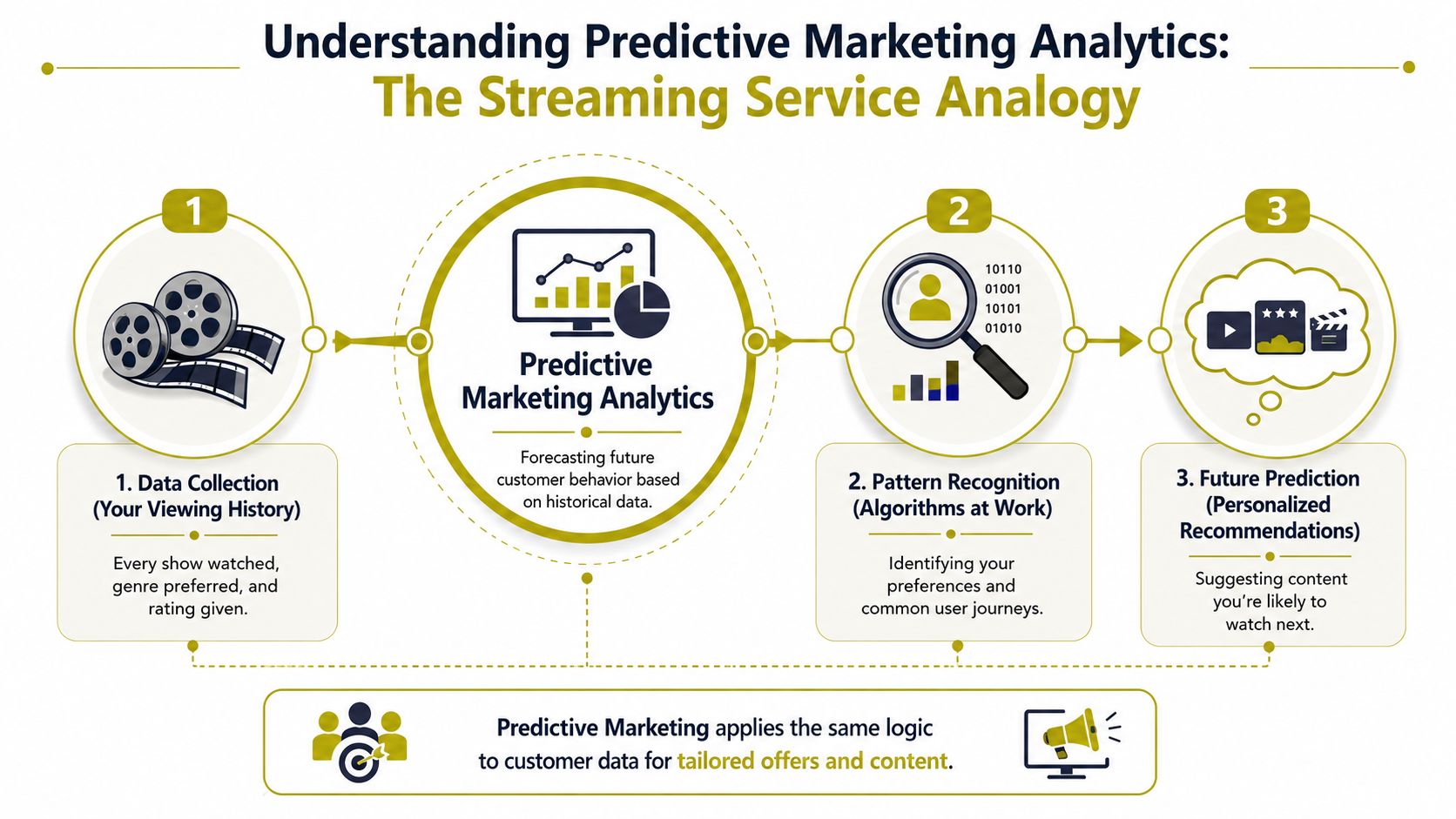
A streaming service is the easiest analogy. It watches what you've viewed, what you skipped, what genres you return to, and what similar users tend to like. Then it recommends what you're likely to watch next. Marketing uses the same logic, just with customer actions instead of films and series.
The basic mechanics
You don't need to write code to understand the flow. It usually works in three parts.
Input
Historical data goes in. That might include website visits, enquiry forms, previous purchases, email engagement, CRM stages, or campaign source data.Processing
A model looks for relationships inside that history. For example, it might find that people who visit a pricing page twice, download a guide, and open a follow-up email are more likely to convert than casual browsers.Output
The business gets a prediction or score. That could be purchase likelihood, churn risk, likely lead quality, or expected demand for a service line.
What key terms actually mean
A model is just a structured way of finding patterns and making forecasts from data. For a non-technical SME owner, think of it as a decision engine trained on your previous customer behaviour.
Training data is the historical information used to teach that model what good outcomes and weak outcomes look like. If your past data is patchy or inconsistent, the model learns bad habits.
A prediction is not a guarantee. It's a probability. That's why the smart use of predictive analytics marketing is to improve decision-making, not surrender judgment to software.
Teams get more value when they treat predictions as a prioritisation tool, not a substitute for strategy.
Where it becomes commercially useful
The key gain is that prediction sharpens resource allocation. Instead of treating all leads, customers, or campaigns equally, you can rank where effort is most likely to pay off.
If you're trying to prove marketing ROI with analytics, this is the bridge between descriptive reporting and commercial action. Standard dashboards tell you what happened. Predictive work helps you decide what to do next.
For businesses trying to map where these signals appear across touchpoints, customer journey mapping is often the missing discipline. If the journey isn't clear, the prediction won't be either.
A lot of SME frustration comes from thinking they need a perfect data environment before they start. They don't. They need enough reliable history to answer one useful question well.
How Predictive Analytics Drives Real Growth for SMEs
The value of predictive analytics marketing isn't theoretical when it changes who you target, when you follow up, and how you spend.
UK businesses that deploy predictive analytics are 2.9 times more likely to document sales booms exceeding the industry average and achieve a 15–20% increase in ROI. Predictive intelligence recommendations also influence 26.34% of total orders on average, according to industry analysis on predictive analytics in digital marketing.
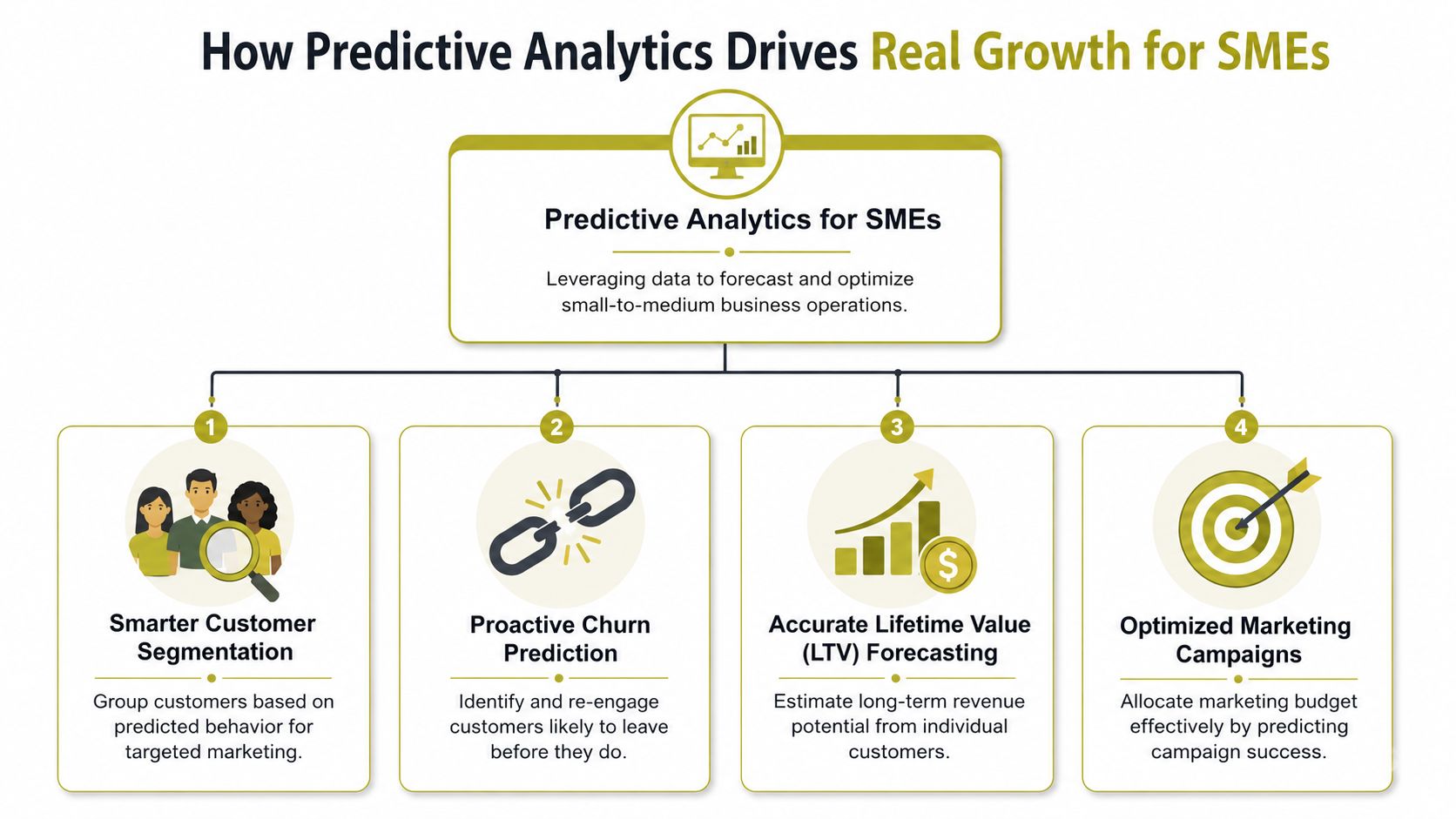
Smarter customer segmentation
Take a Scottish craft gin distillery selling direct online and through trade partners. Before predictive work, it sends one email promotion to the full list. New buyers, repeat buyers, gift shoppers, and dormant customers all receive the same message. Results look mixed because the audience is mixed.
With a predictive lens, the business can separate likely repeat purchasers from occasional seasonal buyers and low-engagement contacts. That changes the campaign entirely. Repeat purchasers get early access to limited releases. Gift-led customers get seasonal bundles. Low-engagement contacts get reactivation content or are suppressed to protect list quality.
That's a better use of budget and attention.
Proactive churn prediction
Service businesses often discover churn after the customer has mentally left. A tourism operator, subscription retailer, or specialist consultancy may only realise a client is disengaging when renewals fall away or bookings dry up.
A basic churn model looks for warning signals. Reduced site visits. Fewer email opens. Longer gaps between purchases. Lower response to account contact. Once those signals are visible, the team can act before the customer disappears.
A retention campaign is cheaper when it reaches someone who's drifting, not someone who's already gone.
Here, many SMEs gain value quickly. They don't need a huge AI programme. They need a shortlist of at-risk customers and a sensible recovery sequence.
Better lifetime value decisions
Some customers buy once. Others become profitable for years.
Without forecasting, teams often overspend acquiring low-value customers while underinvesting in people with higher long-term potential. Lifetime value forecasting helps shift that balance. A premium interior brand, for example, may find that one customer segment returns for accessories, referrals, and repeat projects, while another only responds to discounts.
That doesn't mean abandoning one segment. It means changing the offer, margin expectation, and follow-up intensity based on likely long-term value.
A simple comparison helps:
| Business question | Without prediction | With prediction |
|---|---|---|
| Which leads deserve faster follow-up? | Sales team works first-come, first-served | Team prioritises leads with stronger conversion signals |
| Which customers need retention effort? | Outreach begins after decline is obvious | Team intervenes when early risk patterns appear |
| Which audiences justify more spend? | Budget follows surface-level volume | Budget follows expected value and propensity |
Personalised campaigns that feel relevant
Personalisation works when it's grounded in behaviour, not guesswork. A homeware retailer doesn't need to know everything about a customer. It needs enough data to send something timely and relevant.
That might mean adjusting product recommendations, email timing, offer type, landing page content, or creative angle based on what people are likely to do next. If you want a practical view of what strong relevance looks like in a commercial setting, these effective e-commerce personalization insights are useful reading.
For a closer look at how personalized messaging fits into broader customer experience strategy, see personalization in marketing.
What doesn't work is fake sophistication. SMEs sometimes overcomplicate personalisation and end up with thin segments, messy automation, and messages nobody can maintain. The better approach is narrower and sharper. Fewer segments. Clearer triggers. Stronger creative.
Your Toolkit for Predictive Marketing Success
Most SMEs don't need Salesforce-scale complexity to start using predictive signals well. They need a practical stack, clean habits, and a clear question.
For UK SMEs, implementing predictive marketing requires 6–12 months of clean historical data, including campaign performance, website traffic, and CRM activity, to build useful models. The same source notes that 91% of top UK entrepreneurs cite predictive analytics as essential, which is another way of saying the pressure is real even if the budgets are not. That guidance comes from Invoke Media's overview of predictive analytics for UK SMEs.
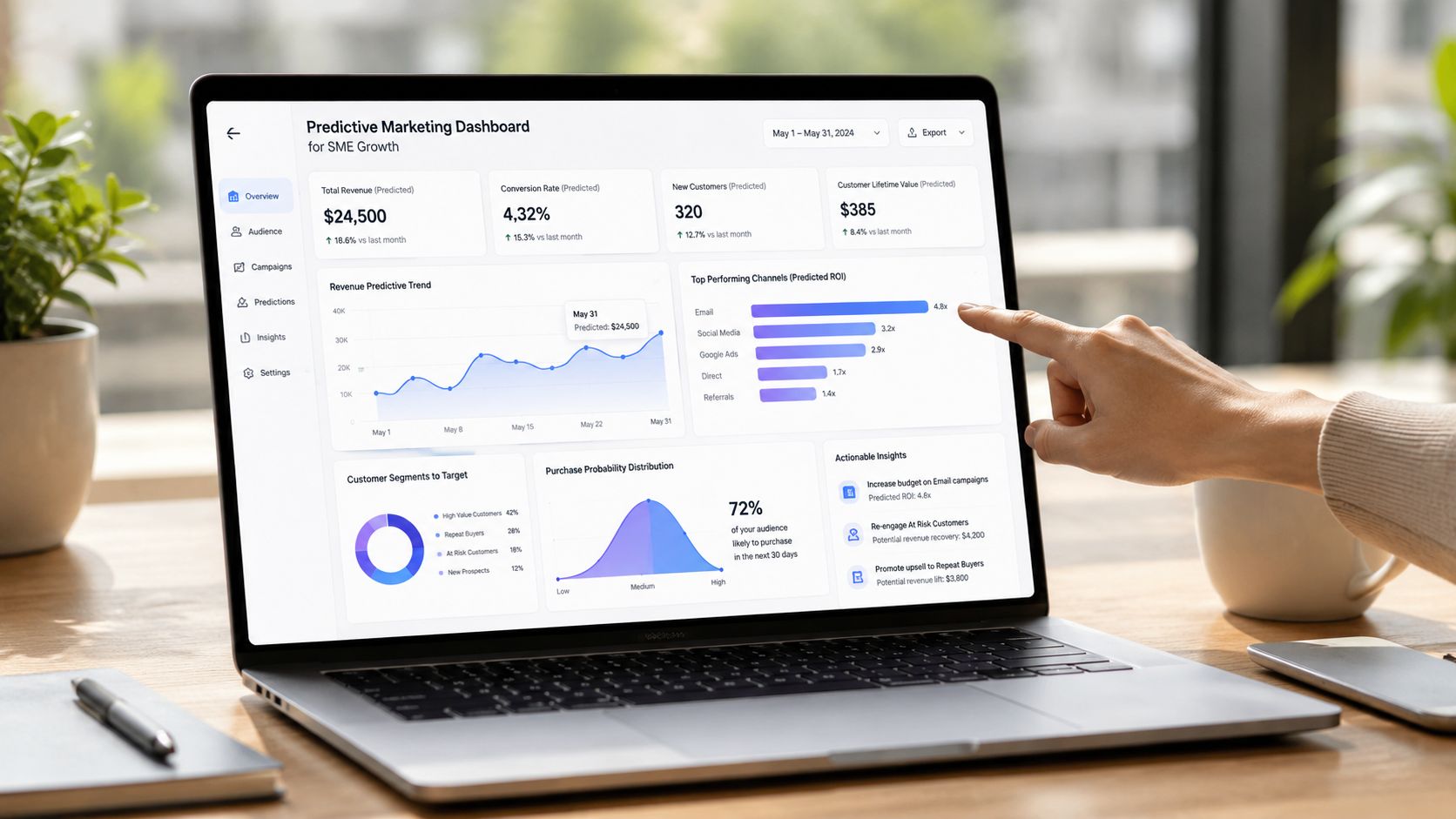
Start with the data you already own
The strongest early setup is usually boring. That's a good sign.
Pull together the customer and campaign history you already have. For most SMEs, that means:
- Website behaviour from analytics tools
- CRM activity such as lead stage, source, notes, and deal status
- Campaign performance from email, paid media, and social platforms
- Sales records that show what converted and what revenue followed
If those sources disagree with each other, stop there and fix that before chasing models. Predictive work fails when teams rush past the housekeeping.
Pick one decision, not ten
A common mistake is trying to predict everything at once. Lead quality, churn, next purchase, budget allocation, and creative performance all sound useful. They are. But they don't belong in your first pass.
Start with one commercial question. For example:
- Which leads should sales call first?
- Which customers are likely to lapse?
- Which campaigns deserve more budget next month?
That focus makes tool selection easier and keeps the team from drowning in dashboards.
Senior-level habit: If a prediction won't change a real decision, don't build it yet.
Use a tiered toolset
The right toolkit depends on maturity, not ambition. A sensible progression looks like this:
| Stage | Best fit for SMEs | What it helps with |
|---|---|---|
| Foundation | CRM reporting, e-commerce analytics, GA4, email platform reporting | Spot patterns and build clean historical baselines |
| Next step | Built-in scoring and segmentation features in modern platforms | Prioritise audiences and automate lighter predictive actions |
| Advanced but still practical | Python-based models or external support for regression and forecasting | Custom lead scoring, churn flags, demand forecasting |
The goal isn't to own the fanciest platform. It's to get to a point where your team can trust the signals.
For businesses trying to unify fragmented data before any scoring or modelling happens, a customer data platform can help create a cleaner operating picture.
A short walkthrough can also make the jump from theory to execution easier:
What works and what usually doesn't
What works is disciplined simplicity. One objective. One accountable owner. One agreed data set. One review cycle.
What usually doesn't work is buying software first, then looking for a problem to justify it. The same goes for models nobody in the business can explain. If sales, marketing, and leadership don't understand how a score is being used, adoption stalls and confidence drops.
SMEs have one major advantage here. They can build a lean process around actual commercial decisions instead of feeding a giant internal system.
Common Pitfalls and How to Avoid Them
Predictive analytics doesn't fail because the maths is weak. It usually fails because the business process around it is weak.
The biggest trap is assuming a model will rescue messy operations. It won't. If data is inconsistent, objectives are vague, and nobody owns the follow-through, the output becomes expensive decoration.
A key concern for UK SMEs is compliance, with 78% reporting GDPR as their top data concern. The same source highlights a practical gap in guidance around privacy-by-design as UK regulators tighten AI audit requirements for 2025–2026. That comes from Kleene.ai's analysis of predictive data analytics and compliance concerns.
Four mistakes that show up repeatedly
Poor data quality
Duplicate contacts, broken attribution, missing fields, and outdated records produce weak predictions. Teams then blame the model for what is really an input problem.Overbuying tools
Plenty of SMEs assume predictive capability only arrives with large enterprise software. That often leads to high cost, low adoption, and systems far beyond the team's current needs.Blind faith in the score
Human review still matters. Market shifts, seasonal context, pricing changes, and buyer sentiment can make a previously useful pattern less useful.No defined objective
“Use AI in marketing” isn't a strategy. Predictive work needs a business question attached to revenue, retention, conversion quality, or efficiency.
A practical compliance checklist
This isn't legal advice, but it is a sensible operating discipline for SME teams:
Minimise the data
Use only the customer data needed for the decision at hand.Document the purpose
Write down what the model is trying to predict and why the business needs it.Check data lineage
Make sure you know where each field came from and whether consent, notices, and usage align.Review fairness and logic
Ask whether the model could create unfair exclusions or skewed targeting.Keep a human decision point
Don't let automated scores trigger sensitive actions without review.
Good predictive practice is part analytics, part governance, and part editorial scepticism. Someone needs to ask, “Does this output make sense in the real world?”
What experienced teams do differently
Seasoned practitioners challenge the output instead of admiring it. They compare predictions against frontline knowledge. They spot when the data tells a neat story that the market no longer supports.
That mindset matters. Scepticism is an asset in predictive marketing, especially when budgets are tight and compliance risk is real.
Measuring the Real Impact of Your Predictive Efforts
If predictive analytics marketing doesn't change business outcomes, it's a reporting exercise.
The cleanest way to measure impact is to tie the prediction directly to the decision it was meant to improve. If the model scores lead quality, track sales-qualified progression and closed revenue from high-priority leads versus lower-priority ones. If it flags churn risk, measure retention inside that targeted group. If it supports customer value forecasting, compare expected value against actual cohort behaviour over time.
Match the metric to the use case
A simple structure helps keep teams honest:
| Predictive use case | Metric that matters |
|---|---|
| Lead scoring | Conversion to qualified opportunity and revenue won |
| Churn prediction | Retention rate among at-risk customers contacted |
| Customer value forecasting | Actual repeat purchase and margin by target cohort |
| Campaign optimisation | Revenue efficiency and cost per meaningful outcome |
Many SMEs go wrong by tracking opens, clicks, impressions, and dashboard activity, then struggling to prove commercial value. Those indicators can be useful, but they aren't the finish line.
Avoid vanity reporting
A predictive initiative should have a before-and-after frame. Before the score existed, how did the team allocate budget, prioritise leads, or time retention outreach? After implementation, what changed in revenue quality, conversion efficiency, or customer longevity?
The test isn't whether the model looks clever. The test is whether your team makes better decisions with it than without it.
That's also why review cadence matters. Teams should revisit assumptions, compare predicted outcomes with actual results, and retire models that no longer improve decision-making. Good measurement isn't a victory lap. It's a calibration habit.
For founders and commercial leaders, the most persuasive proof is simple. Better allocation. Less waste. More profitable growth.
Taking Your First Steps in Predictive Marketing
A common SME scenario looks like this. You have a decent stream of enquiries, some repeat customers, and marketing reports full of activity, but budget decisions still rely too heavily on instinct. Predictive analytics marketing helps close that gap. It gives smaller businesses a practical way to decide who to target, where to spend, and which customers need attention before revenue slips.
The best starting point is a narrow commercial problem you can act on. For one business, that may be ranking inbound leads so sales time goes to the strongest opportunities first. For another, it may be spotting early signs of churn among existing customers. In a resource-constrained SME, focus matters more than sophistication.
Start with the data you already control. CRM records, email engagement, website behaviour, sales history, and campaign results are often enough to test a first predictive use case. Clean inputs beat complicated models every time. If names are duplicated, deal stages are inconsistent, or campaign tracking is unreliable, fix that first.
Mindset matters too.
Treat marketing data as a decision tool, not just a record of last month's performance. That shift is often what separates firms that experiment once from firms that build a stronger, more efficient growth system over time.
This approach also suits SMEs that need agency support without enterprise overhead. Specialist teams can turn scattered signals into actions a founder or marketing lead can use straight away, whether that means tightening audience targeting, improving lead quality, or reducing wasted spend. Carlos Alba Media's specialist nature is an advantage here. Everyone who works for Carlos Alba Media is a former national news journalist or has agency experience with international brands, which helps keep advice sharp, practical, and grounded in how audiences and media respond.
If your business has reached the point where instinct no longer gives you enough confidence, that usually signals progress. You have enough market feedback to start making better decisions with evidence, even if your team, tech stack, and budget are still modest.