
You've probably done this recently. You wrote one decent email, one decent social post, maybe one landing page, and sent the same message to everyone because the week was already full. Then the results came back flat. A few clicks, some polite engagement, very little movement in enquiries or sales.
That doesn't usually happen because the offer is terrible. It happens because the message lands with no sense of timing, context or fit. People don't buy because a business spoke. They buy because a business said something that matched what they needed at that moment.
For SMEs, that creates a frustrating gap. You know personalisation matters, but most advice on personalization in marketing sounds like it was written for teams with enterprise budgets, dedicated data staff and six different platforms. Most smaller businesses don't have that setup. They have a CRM that's half-used, an email platform with some contacts in it, analytics running in the background, and a team that needs practical wins this quarter.
That's exactly where disciplined personalisation works best. Not as a flashy tech project, but as a smarter way to use the data and tools you already have.
Why Your Generic Marketing Is Failing
Monday morning. You send the monthly campaign to your full database because there is no time to split the list, build variants, and set up follow-ups. By Friday, open rates look passable, clicks are thin, and sales has nothing useful to work with. The campaign was not a disaster. It was just too broad to change behaviour.
Generic marketing fails because it pushes the work onto the customer. Each person has to decide whether your message applies to them, whether the timing makes sense, and whether the offer fits what they were trying to do. Inboxes, feeds, and search results give people too many alternatives for that kind of effort.
Relevance decides what gets attention.
A first-time buyer, an active customer, a dormant lead, and someone who abandoned a basket yesterday are not in the same conversation with your business. Sending one message to all four usually protects efficiency at the expense of response. That trade-off feels sensible when the team is stretched. It becomes expensive when good leads stall because the follow-up had no context.
Practical rule: If your campaign could be sent to everyone unchanged, it's probably too broad to perform well.
The problem in SMEs is rarely a total lack of data. It is failing to use the signals already sitting in the CRM, email platform, forms, and website analytics. A repeat visitor to a pricing page has told you something. So has a customer who bought once and then went quiet. If both receive the same generic email newsletter, you lose the chance to match message to intent.
I see smaller businesses make the same mistake often. They treat personalisation as copy decoration instead of journey design. Adding a first name to the subject line does very little if the offer, timing, and next step are still identical for every contact.
That is why process matters more than polish. MarTech Do on lead nurturing for RevOps is useful here because it focuses on how contacts move through a buying process and what follow-up should happen at each stage.
Generic marketing in an SME usually shows up in familiar ways:
- One list, one message: prospects, customers, and stale contacts all get the same campaign
- One landing page: paid clicks, branded search traffic, and returning visitors see the same page and same CTA
- One follow-up rhythm: replies happen when someone on the team has time, not when behaviour shows intent
- One success metric: the campaign gets judged on opens or clicks, even if it produces weak enquiries
The cost is not just lower engagement. Sales gets poorly timed leads. Marketing learns very little about what different groups respond to. Good offers underperform because the delivery is blunt.
SMEs have an advantage here if they use it properly. Smaller teams can change forms, routes, email sequences, and page content quickly. They do not need an enterprise personalisation programme. They need a tighter system that recognises where a contact is, what they have done, and what should happen next.
Beyond the Buzzword What Personalisation Really Is
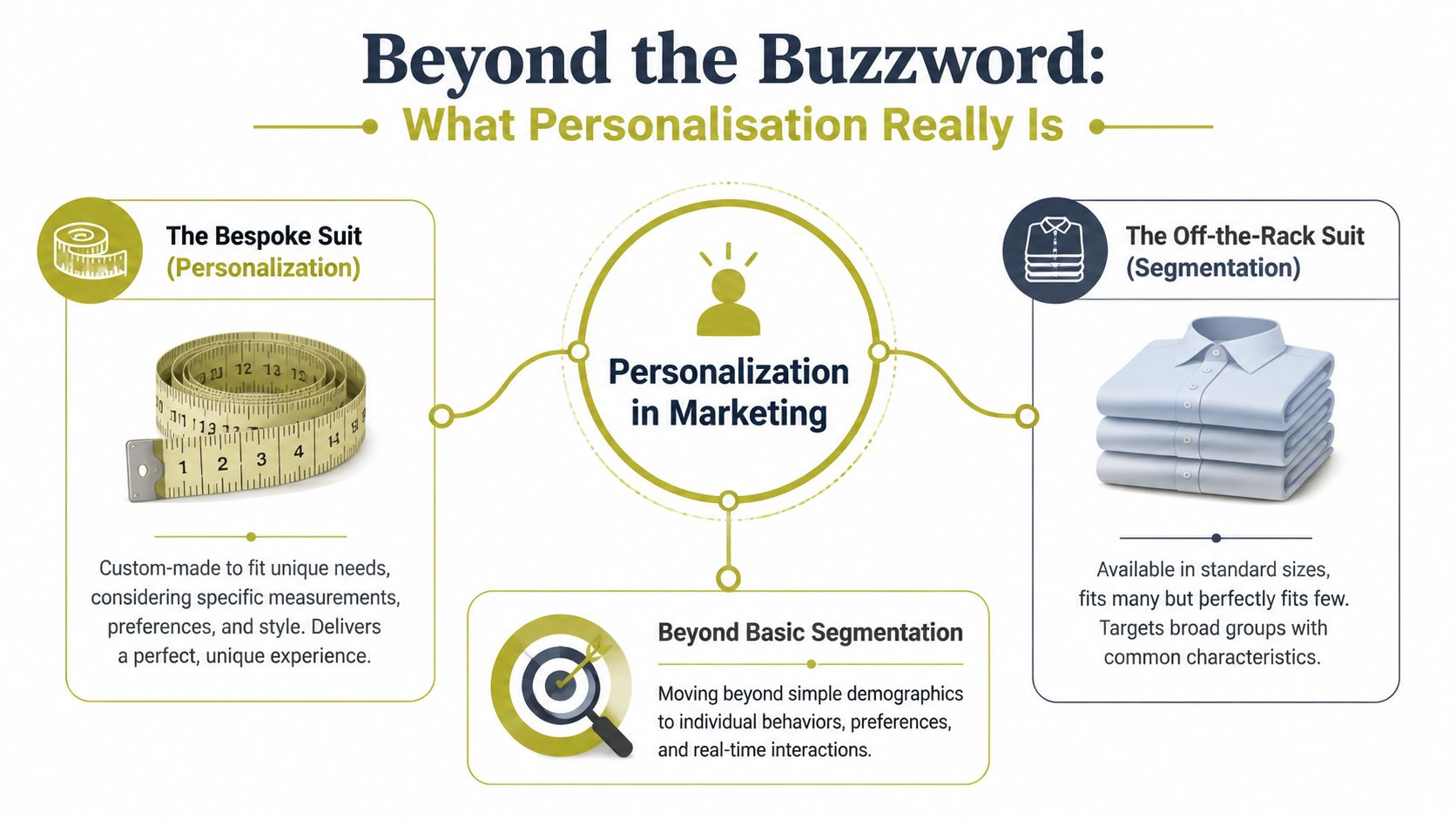
Personalisation isn't a gimmick. It's the difference between fitting the message to the person and forcing the person into a broad category.
Imagine clothing: segmentation is being pointed towards the medium rack. Better than nothing, but still a standard guess. Personalisation is a tailor taking measurements, asking how the suit will be worn and adjusting the fit around real needs.
What it includes in practice
For an SME, personalization in marketing usually rests on three working parts:
| Component | What it means | Simple SME example |
|---|---|---|
| First-party data | Information customers give you or create through their actions | Purchase history, pages viewed, enquiry form details |
| Dynamic content | One campaign that changes based on who sees it | Different product blocks in the same email |
| Behavioural triggers | Automated messages sent after a specific action | Basket abandonment email or post-purchase follow-up |
The important distinction is this. Segmentation groups people. Personalisation responds to individual behaviour inside or across those groups.
Where most marketers fall short
The gap between intention and execution is bigger than many teams realise. 75% of UK marketers believe experimentation is essential for creating personalized content, yet 50% of consumers still report receiving ‘irrelevant' marketing, according to Optimizely's UK personalisation study.
That tells you something important. Many teams are collecting data, testing messages and still not producing a relevant experience. The usual problem isn't effort. It's activation. They have information, but they don't use it quickly enough or consistently enough across channels.
Good personalisation doesn't start with more data. It starts with using the data you already have at the moment it matters.
A simple example makes the point. If a customer browses a product category twice and then leaves, a relevant follow-up might show related products, explain delivery terms or answer a common objection. An irrelevant follow-up sends the weekly newsletter because that's what the schedule says.
If you want a broader commercial view of why this matters, this piece on driving revenue with personalization is worth reading. It connects the strategic case to the mechanics of implementation.
Crafting a Personalisation Strategy for Your SME
A prospect visits your site twice in a week, reads your pricing page, then leaves without enquiring. If your next message is the same newsletter every other contact receives, personalisation is not missing because of budget. It is missing because nobody decided what should happen at that moment.
That is where a workable SME strategy starts. With a few commercial choices, made clearly.
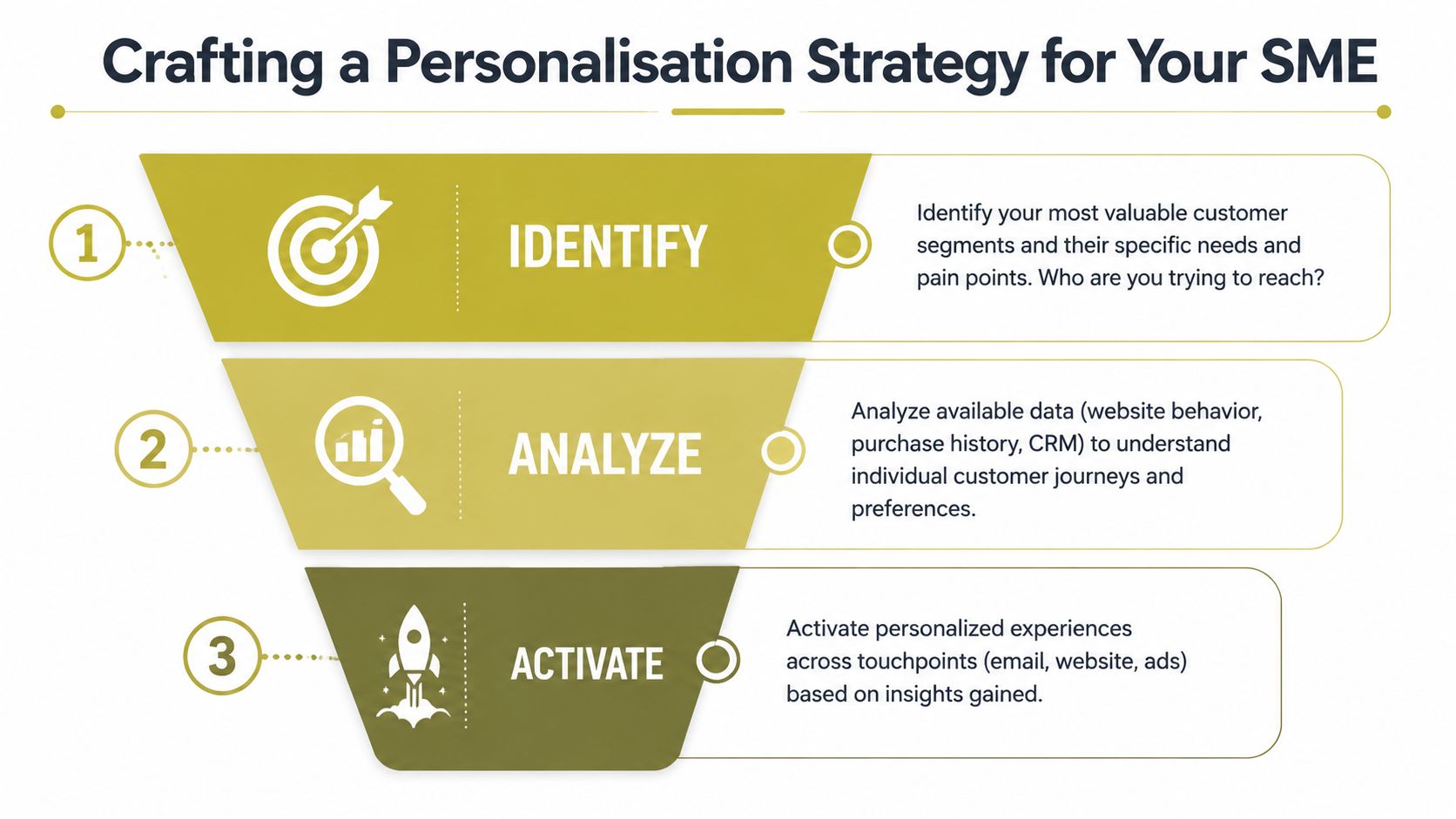
Step one Identify who matters most
Start with the audiences closest to revenue, repeat purchase, or churn risk. A smaller business does not need 40 segments to get results. It needs 2 or 3 groups where a more relevant message is likely to change behaviour.
That might include:
- New subscribers showing clear intent: People who downloaded a pricing guide or requested a demo.
- Recent buyers: Customers likely to buy again, need onboarding help, or benefit from cross-sell recommendations.
- High-value inactive contacts: Past customers who have gone quiet but still fit your best-client profile.
The trade-off is simple. The more segments you create, the harder they are to maintain. For most SMEs, fewer segments with better follow-up beats a long list that nobody updates.
Step two Analyse the journey, not just the list
A contact list tells you who people are. A journey map tells you when relevance matters.
Map the path from first visit to enquiry or sale. Look at entry pages, repeat visits, content viewed, forms started, and points where people stall. That is usually enough to spot one or two moments where a personalized message would do more than another generic campaign.
If you need a practical starting point, this guide to defining your target audience clearly helps connect audience insight to buying intent.
A simple journey for a service business might look like this:
- Discovery: A prospect lands on a blog post from search.
- Consideration: They read a relevant service page and check pricing.
- Decision: They submit an enquiry or leave without converting.
Each stage needs a different job from your marketing. Early content should answer the problem. Mid-journey content should build confidence. Late-stage follow-up should remove friction, such as unclear pricing, delivery times, or proof that you can solve the issue.
Here's a short explainer that helps visualise how to turn that into campaigns:
Step three Activate one high-impact moment first
Start with one trigger you can realistically maintain. That is the part many teams skip. They plan an ambitious personalisation programme, then run out of time to build, test, and review it.
Good starting points include:
- A welcome email that asks for preferences: Useful for retailers, consultants, and membership businesses.
- A post-purchase message based on what someone bought: More relevant than a generic thank-you email.
- A re-engagement email tied to inactivity: Strong option when valuable contacts stop opening, browsing, or buying.
In practice, I would rather see an SME run one journey well than launch six half-built automations that send the wrong message at the wrong time. Personalisation works when the sequence feels logical to the customer and manageable to the team.
Editorial test: If the customer reads the message and thinks, “Yes, that follows,” the strategy is doing its job.
That standard keeps the work grounded. Relevance first. Complexity later, if the return justifies it.
The Right Tech Stack Without the Enterprise Price Tag
Tech becomes a problem when businesses buy platforms before they define the job. For most SMEs, a starter stack for personalisation only needs three things working together: a place to hold customer data, a way to send automated messages, and a way to understand behaviour.
The three tools that do the heavy lifting
A CRM gives you the basic customer record. For many smaller businesses, that means HubSpot CRM, Zoho CRM or Pipedrive. The point isn't brand loyalty. The point is having one place where contact details, notes, source information and deal stage are visible.
An email marketing platform turns those records into action. Mailchimp, Brevo and HubSpot Marketing Hub all support list segmentation and automation at a level many SMEs can manage. You don't need every feature. You need tags, triggers and enough reporting to see what changed.
Web analytics tells you what people did before they converted, or before they left. Google Analytics 4 is the obvious baseline. Search Console helps with query intent. Hotjar or Microsoft Clarity can add behavioural clues if you need to understand page friction.
How the stack works together
Used well, the flow is simple:
| Tool type | Job | What to check before you commit |
|---|---|---|
| CRM | Stores contact and customer data | Can it tag by source, enquiry type or lifecycle stage? |
| Email platform | Sends and automates campaigns | Can it trigger by behaviour or audience rule? |
| Analytics | Shows path and drop-off points | Can your team read the reports without specialist help? |
A contact fills in a form. The CRM captures the record. The email platform places that person into the correct sequence. Analytics shows whether that sequence brought them back, moved them deeper into the site or produced a sale.
That's enough for many SMEs to begin.
Don't build a stack you can't run
The mistake isn't choosing a cheap tool. The mistake is choosing a tool your team won't maintain. A neglected premium platform is less useful than a modest setup that's clean, current and used every week.
If your data currently sits across forms, spreadsheets and disconnected systems, it helps to understand the role of a customer data platform before adding more software. The principle matters more than the label. You need a reliable view of the customer, not another dashboard nobody checks.
A lean stack should pass three tests:
- Your team can explain it: If nobody can describe how data moves from enquiry to campaign, the setup is too murky.
- Your team can maintain it: Tags, forms and automations need owners.
- Your team can act on it: Reports should lead to decisions, not just meetings.
Your Phased Implementation Roadmap
A lot of personalisation projects fail because businesses try to leap straight into advanced targeting. The better route is staged. Build competence first, then automation, then richer experiences.
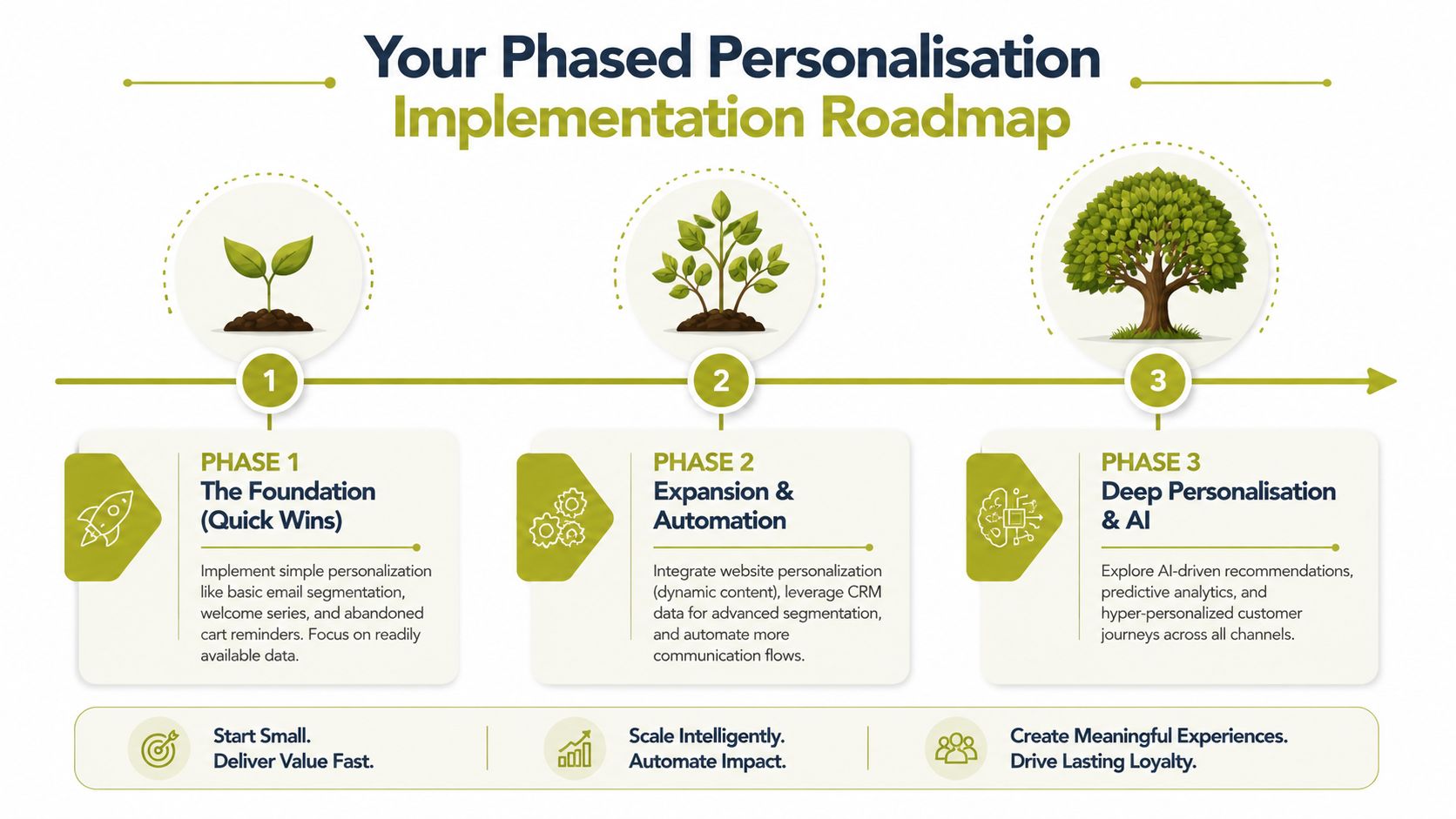
Phase one Build the foundation
Start with what's already available. Your email list, your form fields, your recent customer actions.
At this stage, useful wins include personalising subject lines, segmenting by enquiry type, building a welcome sequence, and separating recent buyers from cold contacts. None of that requires advanced infrastructure. It requires cleaner lists and better decisions.
A practical exercise is to map the first five interactions after a lead comes in. Carlos Alba Media's resource on customer journey mapping can help if your current process feels vague.
Phase two Expand with automation
Once your data is tidy enough, add triggered journeys. Personalisation then begins to feel more responsive.
Examples include:
- Abandoned enquiry follow-up: A prospect starts but doesn't complete a form.
- Browse-based email: A user repeatedly visits a key service or category page.
- Post-purchase sequence: A buyer receives onboarding, care tips or cross-sell content linked to what they bought.
This phase is less about volume and more about timing. You're no longer sending because the calendar says Tuesday. You're sending because a user action suggests the next message should happen now.
The strongest automation often feels invisible to the customer. It simply arrives at the moment they needed it.
Phase three Move into dynamic experience
The final phase adds flexibility across channels. Website content can change based on returning behaviour. Paid campaigns can suppress recent buyers and focus on active prospects. Email content blocks can adapt by interest or category.
You don't need to race into AI-led orchestration to get value here. Many SMEs get strong commercial gains from dynamic website banners, better retargeting logic and more specific on-site calls to action.
The rule across all three phases is consistency. If your forms are messy, automations will be messy. If your audience logic is sound, the system becomes much easier to scale.
Measuring What Matters to Prove Your ROI
If you can't connect personalisation to commercial outcomes, it turns into a creative exercise. That's where many teams lose internal support. Opens and clicks are useful signals, but they're not the end point.
The metrics that deserve your attention
Focus on measures that reflect business movement:
- Conversion rate: Are more visitors, leads or subscribers taking the next step?
- Average order value: Are personalised offers or recommendations increasing basket size?
- Customer lifetime value: Are customers buying again because follow-up content is more relevant?
- Churn or inactivity: Are fewer customers drifting away after purchase or signup?
These numbers matter because they show whether relevance changed behaviour.
Tie the result to a specific intervention
Don't ask, “Did personalisation work?” Ask, “Did this personalised change improve this outcome?”
That means comparing one campaign, sequence or page adjustment against the old version. A welcome flow based on expressed interests. A post-purchase follow-up tied to product type. A service page with content that changes by audience segment.
When brands offer options that fit unique needs, customers experience faster product discovery, leading to higher satisfaction and up to 40% more revenue for fast-growing companies that excel at personalisation, according to Salesforce's personalisation guide. That's the financial logic behind doing this well. Relevance shortens the path to action.
Build a reporting habit your team will keep
A simple monthly review is enough for many SMEs. Track the touchpoints you changed, the audience involved and the commercial measure attached to each one. Drop vanity reporting if it distracts from revenue or retention.
For teams exploring automation and machine support, this article on AI driven customer experience is useful background because it frames the customer experience side without losing sight of business outcomes.
The key is discipline. Report less, but report what matters.
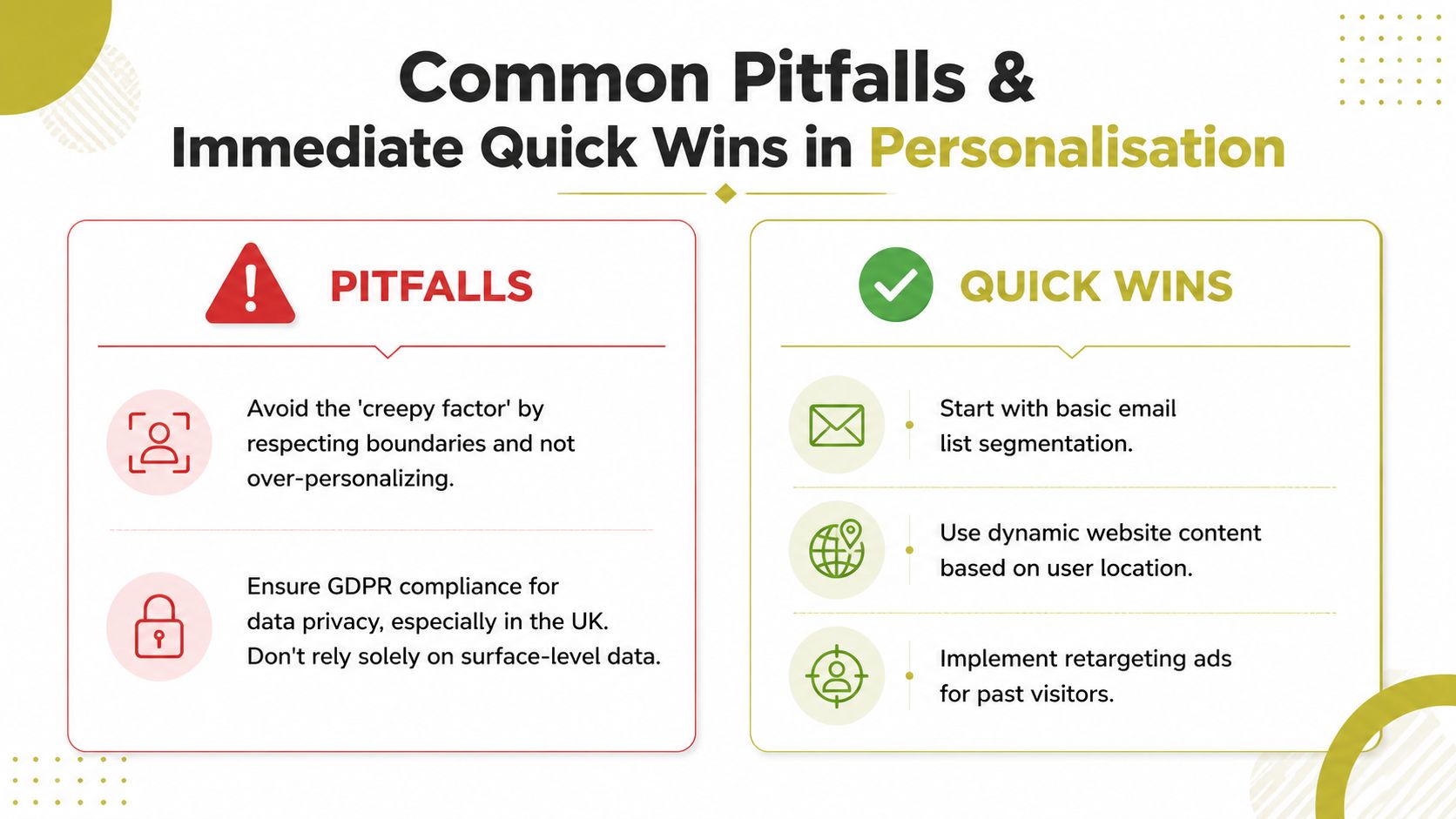
Common Pitfalls and Immediate Quick Wins
The hard part of personalisation isn't usually the idea. It's judgement.
Some businesses overdo it and sound intrusive. Others get lost in systems, workflows and data labels, then never launch anything. The middle ground is where SMEs should aim. Relevant, useful and clearly permission-based.
The pitfalls that cause problems
The most important caution is trust. The UK personalisation debate often runs into a privacy problem. The privacy paradox in UK personalisation, where 75% of UK marketers experiment for personalization but 50% of consumers deem content irrelevant, highlights the need to balance hyper-personalisation with GDPR compliance to maintain customer trust and engagement, as discussed by FT Strategies.
That shows up in a few common mistakes:
- Too specific, too soon: Referencing behaviour in a way that feels invasive rather than helpful.
- Poor consent practice: Collecting data without being clear about why or how it will be used.
- Over-engineering: Building a grand system before proving a single practical use case.
Respect beats precision. Customers respond better to useful relevance than to marketing that sounds like surveillance.
Quick wins you can implement fast
If your team is stretched, start with actions that can be set up quickly and improved later.
- Segment by last purchase or last enquiry date: Recent customers should not receive the same message as people who haven't engaged in months.
- Create a better welcome sequence: Ask what the subscriber cares about, then tailor future content accordingly.
- Use dynamic website cues: Show location-based details, local proof points or service variants where relevant.
- Set up a simple re-engagement campaign: Write specifically to inactive contacts instead of adding them to standard sends.
- Tailor post-purchase emails: Match the follow-up to what the person bought.
These aren't glamorous. They work because they remove obvious mismatches.
For SMEs, that's the opportunity in personalization in marketing. You don't need a sprawling stack, a huge team or a complex model. You need a clearer audience view, a handful of smart triggers and the discipline to measure whether relevance improved the result.
If your business wants a sharper personalisation strategy without big-agency sprawl, Carlos Alba Media offers senior-level support built for SMEs and growing brands. Carlos Alba Media's specialist nature and expertise come from a team where everyone is a former national news journalist or has agency experience of working with international brands. That combination brings clear messaging, practical execution and commercially focused strategy that smaller teams can implement.