
40% of adults who used video-sharing sites and apps created and uploaded their own videos, according to Ofcom's 2020 account of UK internet use. Your business isn't competing only with other advertisers. It's competing with customers, staff, creators and founders who already know how to tell a useful story on camera.
For UK SMEs, that changes the production brief. Effective social media marketing videos don't need to resemble television adverts. They need a recognisable subject, credible evidence and a next step that makes sense for the viewer.
Why Social Media Marketing Videos Matter for UK SMEs
97% of UK adult internet users used social-video sites and apps, Ofcom reported in its 2021 account of a year lived online. The same report recorded TikTok's growth from 3 million UK adult visitors in September 2019 to 14 million by March 2021. Those are historical figures, not a current platform ranking, but they establish why video deserves a deliberate place in an SME's communications plan.
Social media marketing videos are clips published on social platforms to inform, persuade or prompt an action, with a recognisable business and a relevant next step built in. They can be brief product demonstrations, customer interviews, founder commentary or detailed explainers.
Think of the video as your shop window. It stops someone on the pavement and gives them a reason to look closer; your website and sales conversation are the shop floor where they assess the offer and buy.
Attention needs somewhere useful to go
A practical opening test is whether a viewer could explain what your business does within three seconds. That's an editing target, not a promise about how every viewer behaves: show the product, name the problem or demonstrate the service before adding background.
This is especially useful for founder-led and local businesses. A guest-house owner can explain the experience personally, while a software founder can demonstrate a problem that prospects recognise, without commissioning a broadcast campaign.
Simple filming can support that approach.
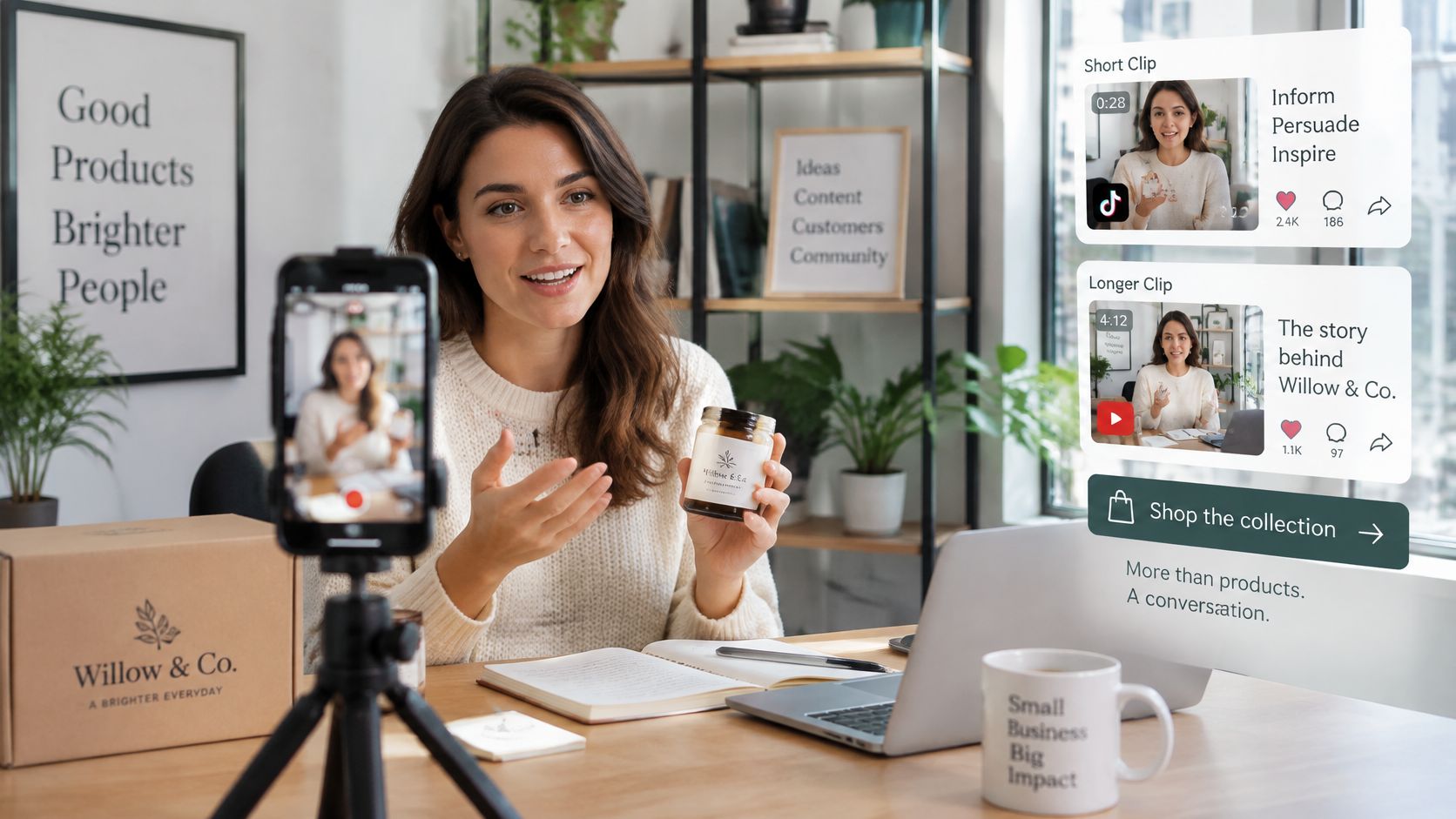
The trade-off is that inexpensive production still needs careful thinking. National distribution is possible without buying television airtime, but publishing doesn't guarantee reach, and reach doesn't guarantee a sale.
For a practical companion to writing the brief, AdCrafty's guide can help you plan marketing videos that convert. Use it to connect the creative idea to a destination rather than treating the final frame as an afterthought.
First-video test: One message, one audience, one action.
A useful video earns attention in its opening seconds, explains a single idea clearly and points towards something worthwhile. Extra filming won't fix an unclear offer.
Platform Formats at a Glance
Platform formats and lengths for UK SME video
| Platform | Preferred format | Typical length | Strongest SME use |
|---|---|---|---|
| YouTube | 16:9 long-form and 9:16 Shorts | Shorts up to 3 minutes; long-form often 8 minutes or more | Explainers and search discovery |
| Instagram Reels | 9:16 vertical | Up to 3 minutes | Product showcases and behind-the-scenes clips |
| TikTok | 9:16 vertical | Usually 15 seconds to 3 minutes | Founder stories and trend-led reach |
| 4:5 or 9:16 feed; 16:9 for desktop | Brief updates; longer demonstrations when needed | Local audiences, events and community updates | |
| 1:1, 4:5 or 16:9 | 30 seconds to 10 minutes | B2B credibility and leadership commentary |
Treat these as planning formats, not permanent upload specifications. Platform limits change, and account features can differ, so check the current publishing controls before approving an edit.
Choose the row that suits the viewer's task, not the platform your team happens to enjoy. A product demonstration might need a close vertical composition; a detailed software walkthrough needs enough space for the interface to remain legible.
Length should follow the question
In Ofcom's 2025 survey, 59% of users watched YouTube videos of up to 15 minutes, while 41% watched videos longer than 15 minutes. The report also identifies YouTube as accounting for nearly all video-sharing-platform viewing on TV sets.
That's a reason to avoid a mobile-only production mindset. Check whether a logo still looks sharp on a television and whether a screen recording is readable on a phone. Tiny captions and soft footage can undermine either version.
Build a modular content system around the subject:
- Master film: Capture the complete explanation and supporting footage.
- Vertical feed cut: Reframe the person or product for discovery.
- Hook edit: Isolate the problem and the reason to care.
- Deeper version: Answer objections for viewers who want detail.
Don't crop a horizontal interview down the middle. A second speaker, product label or demonstration can disappear, leaving an attractive but confusing clip.
YouTube explainers should answer a searchable question. Reels should make the product or experience visible; TikTok founder stories need a genuine point rather than a borrowed trend. Facebook updates benefit from local context, while LinkedIn commentary should demonstrate useful judgement.
A shorter edit isn't automatically better. Remove repetition and unnecessary introductions, but retain the evidence someone needs to understand the claim.
Setting Goals, Audience and Budget for SME Video
Start with the decision you want the viewer to make. Awareness means remembering the business; consideration means examining an offer; conversion means enquiring, booking or buying. Choose the primary goal before discussing cameras.
Product discovery deserves particular attention. In 2025, 49.3% of UK adult internet users said they used social media to find information about products, according to DataReportal and Meltwater's Digital 2026 report, summarised by We Are Social. A video should therefore help people evaluate something, not merely leave them with a favourable impression.
Define the viewer's decision
Your audience may include suppliers, industry partners, regulators and investors as well as customers. We help clients publicise their work to potential customers, industry partners, regulators and investors, and those groups won't all need the same evidence.
A prospective customer may want to see the product working. A partner may care about integration, and an investor may need a clear explanation of the commercial problem. Use buyer persona development to distinguish those needs rather than addressing everyone as business decision-makers.
Keep the planning inputs visible while you agree the brief.
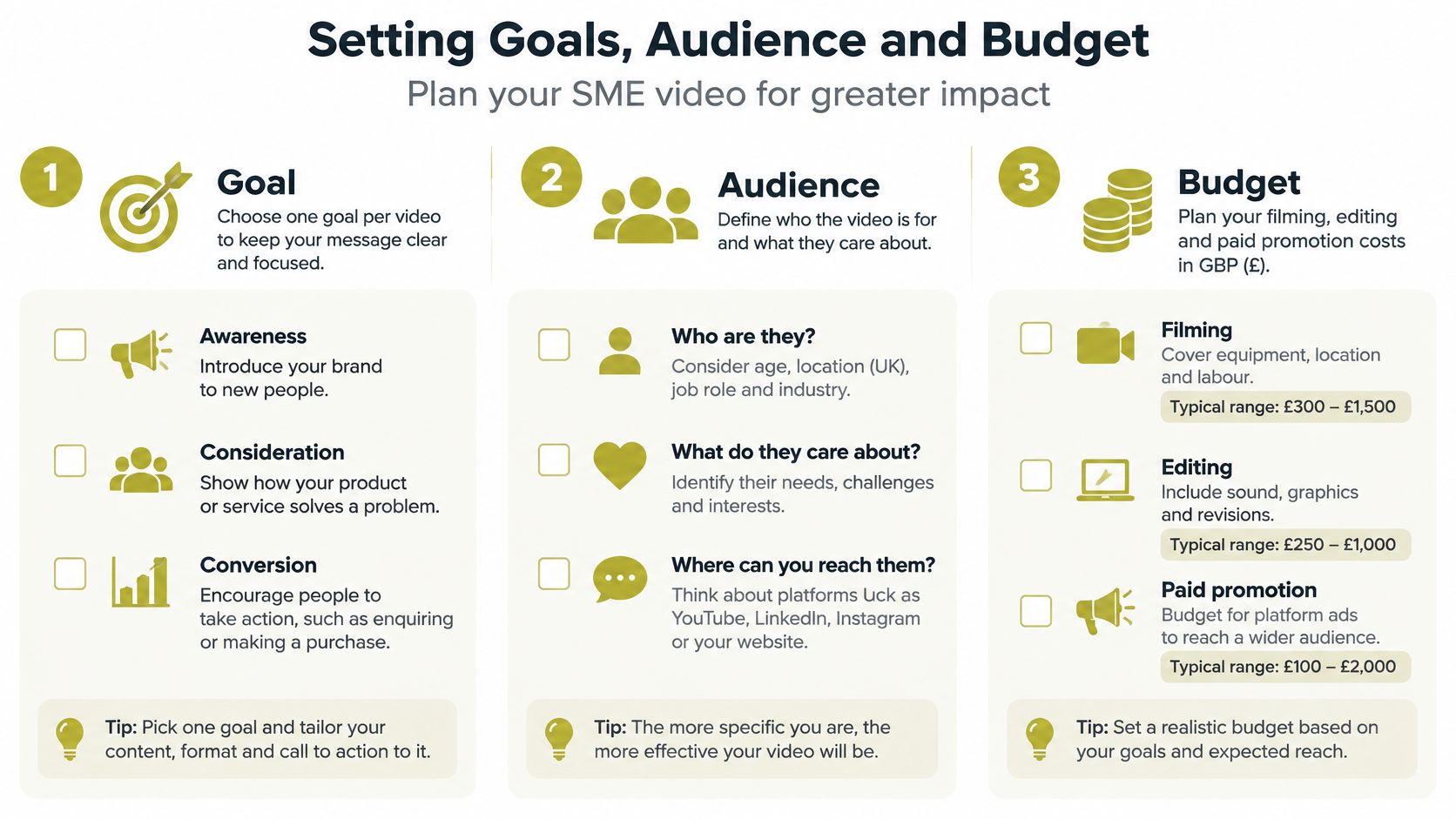
Budget for delivery, not just filming
Budget lines for SME social video
| Budget line | What it covers |
|---|---|
| Staff time | Scripting, shooting and approval, usually shared by the subject expert, presenter and approver |
| Equipment or freelance editing | Phone kit, captions and edit support, delivered internally or by a freelancer |
| Paid distribution | Boosted posts and platform ads, managed by the campaign owner or paid-media specialist |
Get costs quoted in GBP (£) against a defined scope, including revisions, format versions and usage rights. Don't spend the whole allowance on filming and leave nothing for editing or distribution.
A founder with a phone, quiet room and clear script can start economically. Agency production makes more sense for launches, complex demonstrations or reputation-sensitive campaigns where interview direction and approvals matter more than posting speed.
Before filming, create platform-specific tagged links and a CRM source field. Name the deciding KPI so the team knows whether it's optimising for attention, relevant visits or enquiries.
Answer these questions before booking production:
- Viewer: Who specifically needs this message?
- Problem: What question are they trying to resolve?
- Evidence: What can we show rather than assert?
- Next action: What should they do after watching?
- Approval: Who signs off the claims and final edit?
How to Produce and Repurpose Videos in Six Steps
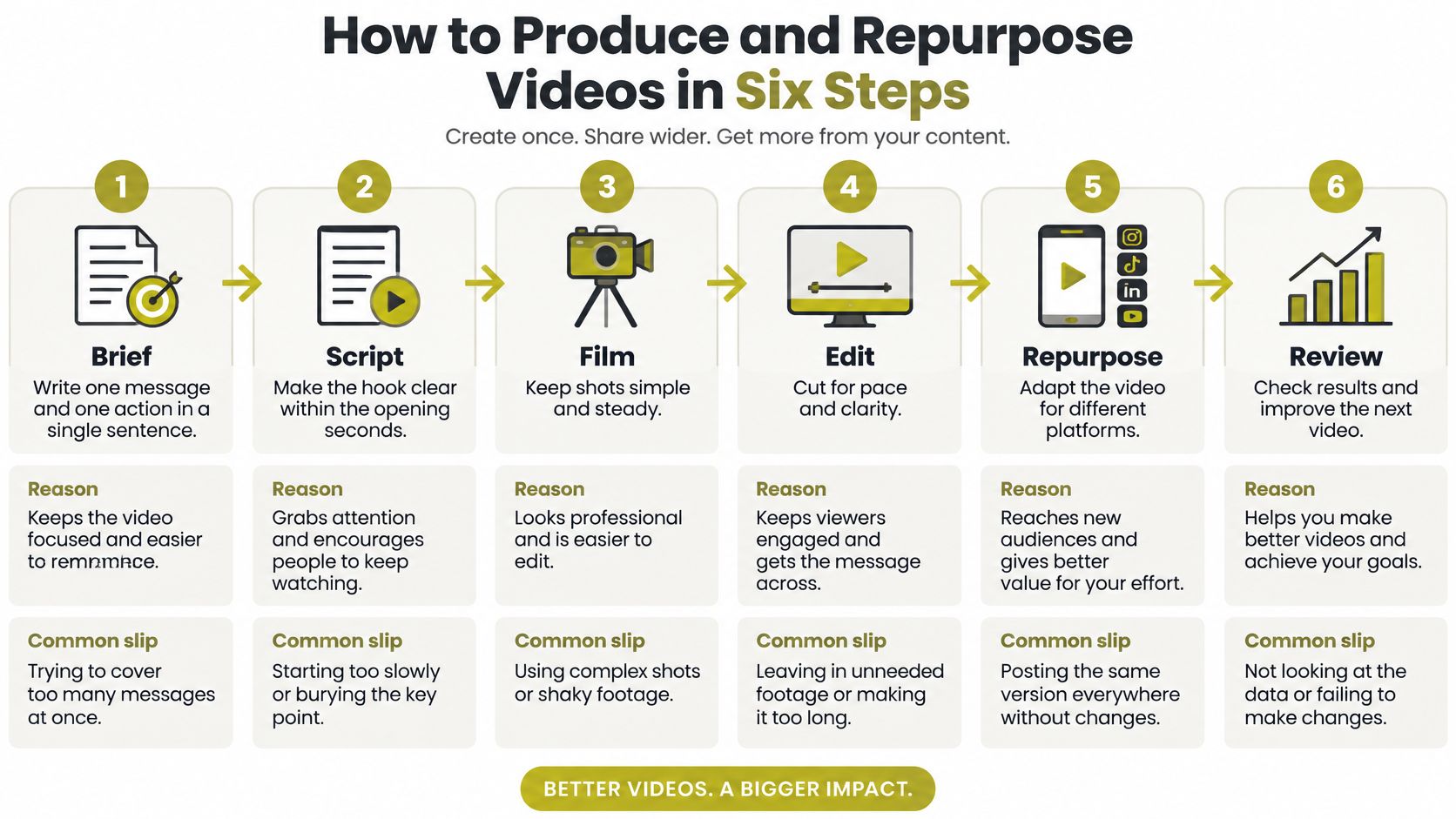
Reliable production depends on repeatable decisions, not constant reinvention. Keep the workflow visible so filming, approval and publishing don't become separate projects.
The Reuters Institute's 2025 Digital News Report describes a shift towards social and video news consumption alongside continuing scepticism about information encountered on social and AI platforms. That finding concerns news audiences, but it raises a useful production question for businesses: what makes this particular claim believable?
From brief to publishable footage
Brief the message and action in a single sentence. For example, ask prospective guests to check accessible-room details after seeing how the entrance and bathroom work, rather than commissioning a general hotel film. The common slip is adding unrelated selling points and leaving the presenter without a clear priority.
Script a hook that makes the subject clear within the first three seconds. Lead with the customer's question or a visible demonstration; use a founder when their knowledge and accountability help, and a journalist-style explainer when a complicated claim needs context. Avoid a dramatic promise the rest of the film can't substantiate, and mark supporting sources in the script.
Shoot a master take with clean audio and crop-safe framing. Use a stable phone or camera, place a microphone close to the speaker, listen through headphones and leave room around important objects for vertical and horizontal versions. Record supporting close-ups separately, because trying to rescue distant audio or a missing demonstration in the edit is usually the expensive mistake.
For an additional video reference alongside the filming workflow:
Edit once, adapt deliberately
Edit for comprehension before decoration. Correct automatic captions, use readable on-screen text, position the logo away from interface controls and show data sources beside the relevant claim. Include clear paid or gifted creator disclosures where relevant, rather than burying them beneath a promotional caption.
Publish versions with distinct jobs. A practical starting package could contain a 15-second hook, a 60-second overview and a three-to-five-minute explainer, provided the subject merits each version. Assign someone to monitor responses and handle corrections, separating legitimate factual challenges from abuse rather than arguing impulsively in hostile comments.
Repurpose the substance, not just the file. Turn a strong answer into a quotation, a carousel, an email and, where there's a genuine news angle, a press pitch; customer testimonial videos can also supply customer-led explanations with permission. When repeated exports and approvals become the bottleneck, RenderIO's guide to building scalable video marketing pipelines provides useful context for organising that process without automating away editorial checks.
A casual delivery style doesn't excuse a claim you can't defend.
Before publishing, run three checks: verify every claim against its evidence, watch the export without sound, and test the next action on a phone. Confirm permissions for customer footage and check that captions haven't covered the feature being demonstrated.
Measuring Video Results and Optimising What Works
A high view count records exposure under a platform's viewing rules. It doesn't establish that someone booked, enquired or invited your spokesperson to comment.
The measurement problem is real: 39% of UK influencer marketers identified measuring ROI as their leading challenge, ahead of rising costs at 33% and data reliability at 26%, according to The Drum's account of the UK influencer market. That's a specific marketer group, not a survey of every SME, but it illustrates why attractive reporting can still leave commercial questions unanswered.
KPIs for judging social video performance
| Metric | What it shows | Where to find it | Business question |
|---|---|---|---|
| Completion rate | Share of viewers who watch to the end | Platform analytics | Does the message hold attention? |
| Click-through rate | Share who click the link or call to action | Platform analytics and link tags | Does the call to action work? |
| Qualified site visits | Visits from people who reach a key page | Web analytics with tagged links | Is the audience relevant? |
| Enquiries by source | Leads tagged to the video | CRM source field | Does video create demand? |
| Assisted conversions | Sales where video appeared earlier in the journey | Attribution reports or post-sale survey | What role does video play over time? |
| Shares and saves | Viewers who pass the content on or keep it | Platform analytics | Is the content worth returning to? |
Connect platform activity to business records
Send viewers to a landing page that fulfils the video's promise. Check that Instagram, TikTok, LinkedIn and YouTube each have distinguishable campaign tags, and record platform-native lead submissions separately from website forms.
In the CRM, preserve both the recorded source and the prospect's answer to what prompted contact. A buyer might first notice a founder's video, later read press coverage and finally arrive through search; the final click won't explain that whole journey.
Agree how to treat assisted conversions and offline sales before reporting. Choose a fixed look-back window that suits the buying cycle, document it and avoid counting the same sale repeatedly as new revenue.
For engagement-specific interpretation, use our guide to measuring social media engagement alongside commercial reporting. Keep awareness, consideration and conversion results separate rather than combining them into an unexplained score.
Test one meaningful change
A Glasgow hotel might prioritise visits to availability pages, while a B2B software firm may care more about qualified demonstrations and partner conversations. A smaller, regionally relevant audience can be more valuable than broad attention from people who can't use the offer.
Testing rule: Change one variable, keep the comparison fair and judge it against the KPI chosen before publication.
Test the hook, length, aspect ratio or call to action separately. Run each comparison for an agreed period with comparable distribution, then retain the version that improves the intended outcome, not merely the most flattering metric.
Real-World Examples from Scotland and the UK
VisitScotland launched Scotland: The Perfect Stage in summer 2022, with Carlos Alba Media contributing to the campaign. Our work included strategic communications planning, audience segmentation and targeting, a multi-platform social media strategy, and content marketing and asset creation.
Partnership work involved event organisers, local tourism boards, hotels, airlines and cultural institutions, aligning messages, gathering assets and amplifying the campaign. The transferable lesson is organisational: agree the story and intended audience before collecting footage from different contributors.
Carlos Alba Media also partnered with VisitScotland to develop an extensive range of high-impact marketing materials to help revive the Scottish tourism industry after Covid. That work illustrates why video should be part of a coordinated communications effort rather than function as an isolated publishing task.
A Highland guest house illustration
This is a hypothetical SME application, not a reported client result. A Highland guest house records a two-minute guest testimonial, creates vertical Instagram clips and pairs them with a longer YouTube property tour.
- Goal and format: Encourage booking consideration through guest testimony and a practical tour.
- KPI: Qualified visits to room and availability pages, followed by enquiries attributed to those assets.
- Reusable lesson: Ask guests to describe specific details, such as arrival arrangements or breakfast, instead of collecting general praise.
An Edinburgh software firm illustration
In another hypothetical example, a founder explains a product problem on LinkedIn and demonstrates how the software handles it. The intended audience is potential integration partners rather than every possible customer.
- Goal and format: Generate partner enquiries through focused founder commentary with a screen demonstration.
- KPI: Relevant partner conversations recorded in the CRM, not the total reaction count.
- Reusable lesson: Explain the operational problem in the partner's language before introducing features.
Neither example needs a large content library to begin. Both need a credible subject, appropriate evidence and a destination that lets interested viewers continue the conversation.
Confirm Your First Video Plan This Quarter
Make the next production a manageable test rather than a commitment to an unsustainable publishing schedule. Carlos Alba Media has completed 300+ social media marketing projects, and the pattern that holds across them is simple: a video that ships comes from a brief one person can approve and another can deliver.
The consultancy is founded and run by former national newspaper editor Carlos Alba, combining newsroom insight with modern brand building. That mix matters at this stage, because a credible message carries more weight than production polish when a business is testing video for the first time.
Commit to a deliverable
- Choose a focused brief: Pick the audience and business outcome, then assign a named message owner.
- Produce an adaptable asset: Commission a master video, a captioned vertical cut and a single call to action, then publish on the platforms where your intended viewers are active.
- Schedule accountability: Confirm tracking before release and hold a monthly review of completion rate, qualified visits and enquiries by source.
Clients do not need to be based in Glasgow or Scotland to use our PR and digital marketing services. What matters is a clear commercial question and access to the people who can explain the answer credibly.
This week, write your one-sentence message, name the viewer and specify the next action. Send that brief to the person who signs off your content, with the evidence and proposed success measure attached.
Carlos Alba Media offers social media marketing, digital content marketing and media skills training to help businesses turn a clear message into credible on-camera content. Visit Carlos Alba Media to discuss your audience, production needs and how you will measure the next campaign.