
Most buyer persona advice starts in the wrong place. It tells you to choose an age range, job title, location and income bracket, then give the profile a name and photograph. That produces a tidy document, but not necessarily a useful understanding of how anyone buys.
For UK SMEs, buyer persona development should begin with behaviour. What problem triggers a search? Which objections delay approval? Does the prospect read a detailed guide, ask a peer, watch a demonstration or look for evidence in the press? Those answers shape your message, channel mix and sales process far more reliably than a demographic label.
The distinction matters because broad communication is failing to feel relevant. A 2025 UK retail study of 2,000 consumers found that 61% considered brand communications irrelevant and 56% said communications lacked personalisation. Retail Economics' UK research also describes a 2026 initiative that identified five customer contact personas from a survey of 2,000 UK adults and cluster analysis of 56 variables. The practical lesson is clear: useful personas are built from multiple signals, then applied to PR narratives, content decisions and executive communication.
Moving Beyond Demographics in Audience Research
Age, income and job title can provide context, but they rarely explain the decision. Two finance directors in similar companies may have completely different buying criteria. One may need a defensible procurement trail, another may prioritise speed, and a third may be trying to avoid reputational risk after a poor supplier experience.
Geography can be just as misleading. A Scottish technology business may serve customers across the UK whose research habits have little to do with where they live. UK-focused B2B guidance argues that geography isn't always a useful segmentation variable, while buying behaviour, objections and content consumption often offer stronger distinctions. White Hat SEO's persona guidance is useful for founders who want to move beyond firmographics and examine actual deal history, interviews, analytics and sales feedback.
Segment the decision, not the stereotype
A practical persona should answer questions such as:
- Trigger: What event turns a background concern into an active search?
- Evidence: What proof makes the prospect believe a supplier is credible?
- Friction: What could cause the buyer to delay, reject or escalate the decision?
- Channel: Where does the buyer look for reassurance, education or authority?
- Expectation: What does good service mean to this segment?
This approach reflects the direction of current UK customer-contact research, which treats personas as a way to understand differences in service expectations and perceptions, rather than as decorative descriptions. For a founder, that changes the output from “Operations Olivia” to something actionable, such as “an operational decision-maker who needs a fast response, clear implementation detail and evidence that the supplier understands regulated environments”.
A useful comparison is the Coachful guide to client segments, which provides context for separating audiences by needs and communication preferences rather than relying on one broad audience label. The same principle applies to PR and digital strategy.
Make the profile earn its place
UK evidence also points to a commercial difference between documented persona work and informal assumptions. A 2025 UK marketing article reports that 71% of companies exceeding lead-generation and revenue targets had documented buyer personas, while 93% of those successful companies segmented their database by persona. By contrast, 26% of companies missing targets had documented personas. These figures are reported in PPC Geeks' UK buyer persona guidance.
That evidence doesn't prove that a persona document alone creates growth. It does show the value of connecting persona work to data hygiene, segmentation and custom content. A profile that never changes a landing page, press angle, email sequence or sales conversation is administrative theatre.
For a practical application, connect research to your segmentation strategy. Start with the behaviour that separates one commercially meaningful audience from another, then use demographics only where they improve targeting or interpretation.
Gathering Behavioural Data and Conducting Interviews
The strongest raw material usually sits inside the business already. Before commissioning a broad survey, examine the evidence created by real prospects and customers. It will often reveal the gap between what your team believes buyers want and what buyers do.
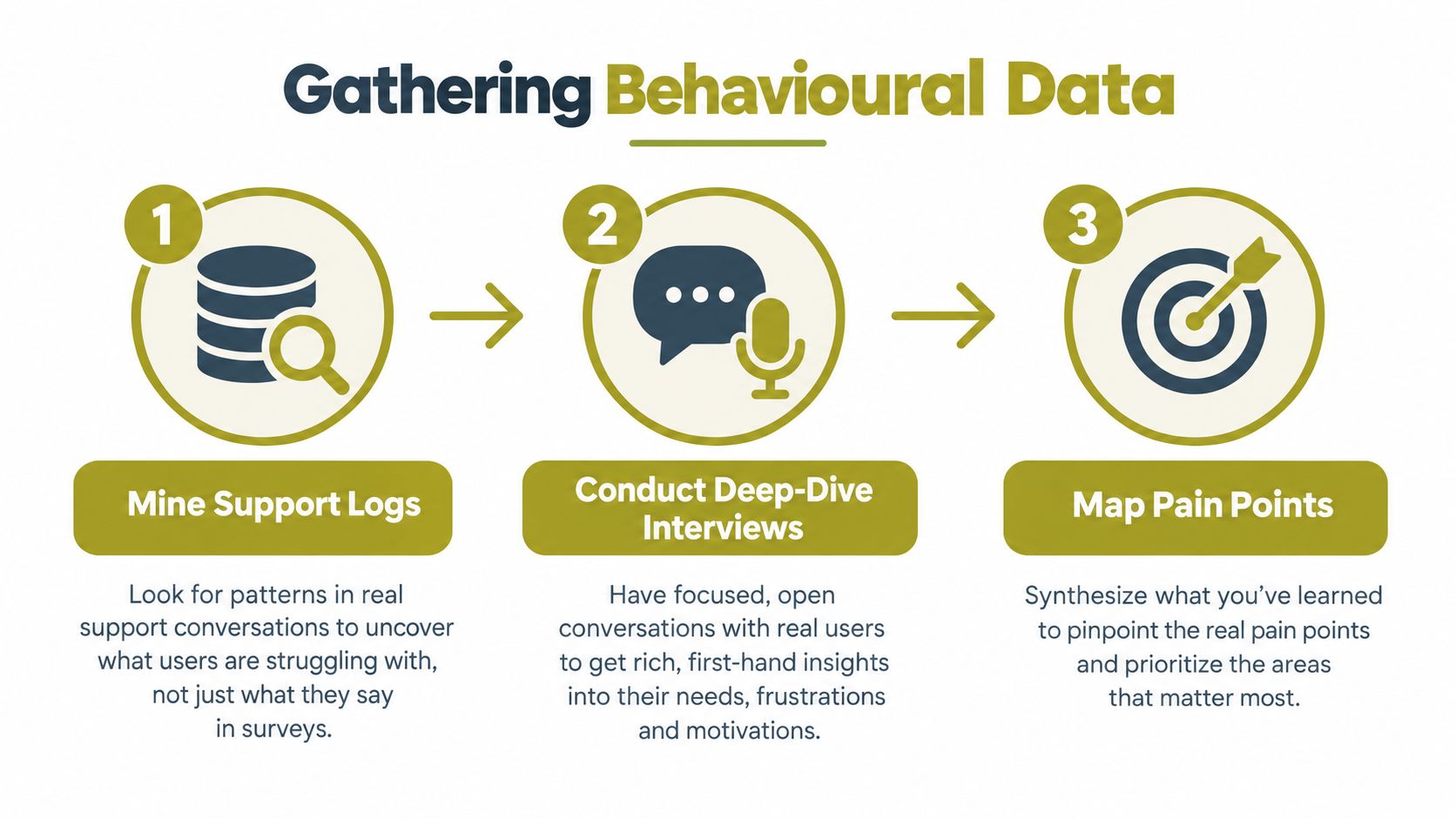
Start with observed behaviour
Use a simple sequence rather than collecting everything at once.
Mine the CRM. Review won, lost and stalled opportunities. Record the original problem, first contact source, people involved, objections, procurement requirements and the point at which momentum changed. Don't just count closed deals. The language in lost-deal notes can expose a positioning problem that conversion reports hide.
Review GA4 paths. Look for the routes people take before contacting you. Do they visit service pages first, read leadership content, return to pricing information or look for proof of sector experience? Group paths by outcome, not just by traffic volume.
Use Search Console queries. Search terms show how prospects describe the problem before they know your preferred terminology. Separate research questions from supplier comparisons, urgent service searches and reputation-led queries. That distinction can guide both SEO and media themes.
Inspect reviews and support records. Repeated questions reveal uncertainty. Repeated complaints reveal friction. Phrases customers use in support conversations are often more persuasive in content than polished internal copy.
Add sales and customer-success observations. Ask which objections appear late, which claims buyers challenge and what makes a prospect bring another stakeholder into the conversation.
UK guidance recommends combining GA4, Search Console, CRM records, reviews and direct interviews so personas reflect actual search terms, site paths and purchase behaviour. The UK audience identification methodology from LocaliQ is a practical reference for organising that evidence. You can also use a structured form platform, including a best Typeform competitor, when you need consistent responses without turning the exercise into a generic questionnaire.
Interview for the decision story
Interviews should uncover sequence and cause. Ask the buyer to reconstruct what happened, rather than asking whether they “value quality” or “prefer helpful content”. Buyers will agree with those statements, but they won't tell you what changed their behaviour.
A useful interview flow looks like this:
- Start with the trigger: “What was happening when you first decided to look for a solution?”
- Reconstruct the search: “What did you search for, read or ask about first?”
- Expose the shortlist: “Which alternatives did you consider, including doing nothing?”
- Test the objection: “What nearly stopped the purchase?”
- Identify approval: “Who else needed confidence before you could proceed?”
- Find the proof: “What made one option feel safer or more credible?”
- Capture the language: “How would you describe the problem to a colleague?”
Keep the conversation separate from sales. A founder who uses an interview to defend the offer will collect compliments and miss friction. Speak to a mix of current customers, lost prospects and people who fit the target market but don't yet know the brand.
Practical rule: Record the buyer's wording, not your interpretation of it. “We couldn't risk another failed launch” is a usable insight. “They care about reliability” is a hypothesis that still needs testing.
Map each finding to a communication consequence. A search query can become an article theme. An approval concern can become a proof point in a press release. A recurring fear about executive visibility can become a media-training scenario. The output should be a set of decisions, not a folder of transcripts.
For broader research and interpretation, the consumer insights research service shows how direct evidence can support more relevant communications. The discipline is the same for a small B2B team. Collect what people did, ask why they did it, and preserve the language that explains the choice.
Building Dynamic Profiles for Complex Buying Groups
In B2B, the “buyer” is often a group with competing definitions of risk. The chief executive may want strategic progress, the finance director may need a credible return and the technical lead may be concerned about integration. A champion can create momentum, but someone else may control the budget, compliance approval or implementation decision.
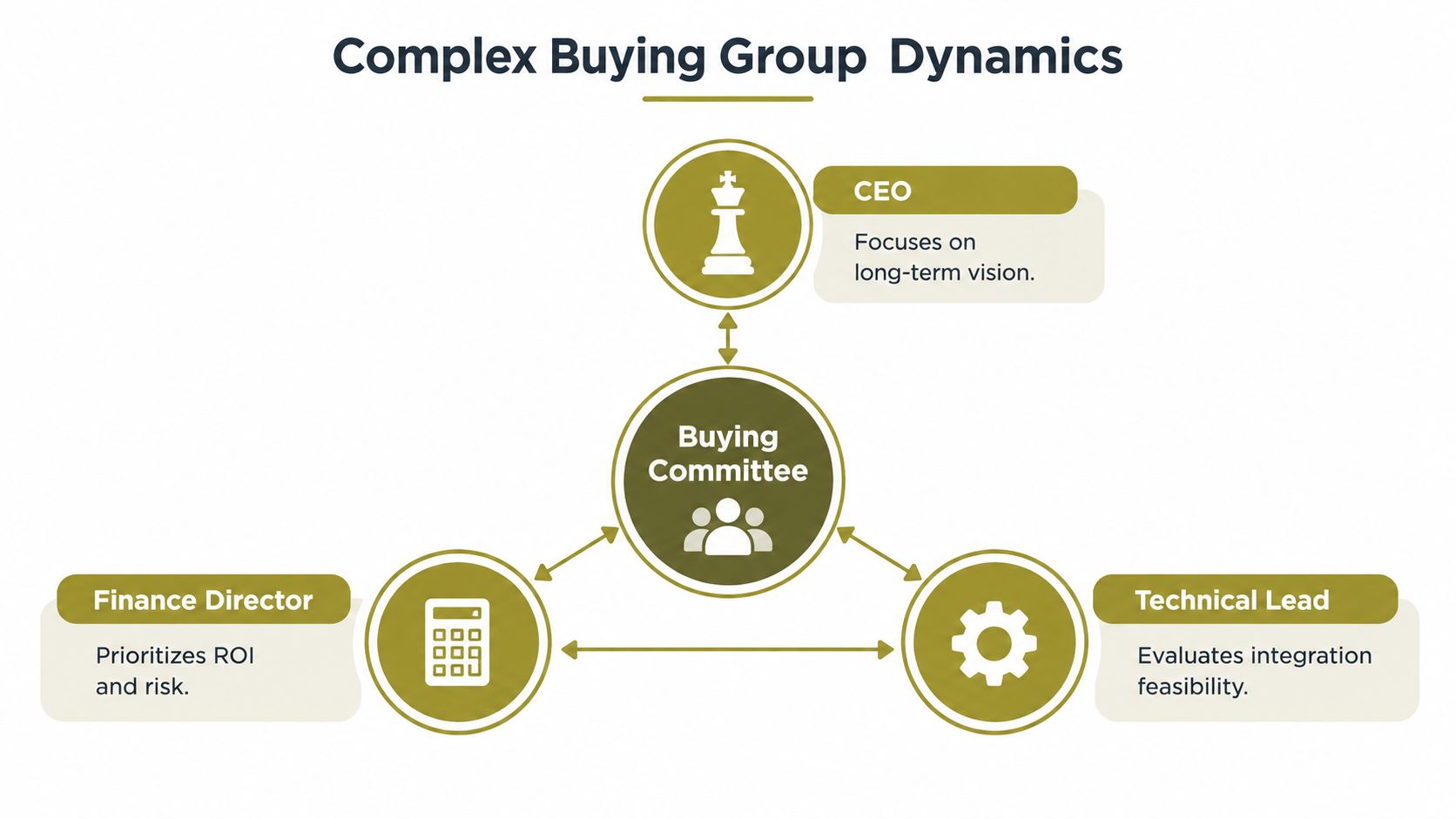
Map influence and approval
Build one profile for each meaningful role, then connect those profiles to the account-level buying process. Don't create separate personas merely because people have different titles. Create them when their questions, objections or required evidence differ.
| Role | Primary concern | Evidence required | Typical influence |
|---|---|---|---|
| CEO | Strategic direction and reputation | Clear business case and visible upside | Sets priority and may sponsor the decision |
| Finance Director | Cost, risk and accountability | Commercial logic, terms and implementation clarity | Controls financial scrutiny |
| Technical Lead | Feasibility and operational impact | Integration detail, process fit and delivery confidence | Can block an unsuitable solution |
The map should show more than a reporting structure. Record who discovers the problem, who champions change, who can veto it, who signs the agreement and who lives with the result. Then identify the message each person needs before the conversation can progress.
Replace the PDF with signals
A static persona document describes a segment at one moment. A dynamic profile records what the buyer is doing now. Relevant signals include the topics they consume, the pages they revisit, the questions they ask, the role of the person engaging and the movement from education to comparison.
Use those signals carefully. A single page view isn't proof of intent, and a senior job title isn't proof of authority. The useful interpretation comes from patterns, such as repeated engagement with implementation material followed by a request for procurement information.
UK and UK-facing B2B guidance increasingly recommends intent data, content consumption, browsing behaviour and micro-behavioural signals for faster segmentation. Infuse's B2B buyer persona guide provides context for treating personas as living frameworks rather than one-off PDFs, particularly in account-based marketing.
A dynamic persona isn't a prediction engine. It's a working record of changing evidence, with clear limits around what you know and what you're inferring.
Keep the framework usable. Each profile needs a short summary, current trigger, buying-stage indicators, objections, proof requirements, preferred formats and next communication action. Add a confidence note where evidence is weak. A profile that admits uncertainty is more useful than one that presents assumptions as fact.
The practical benefit is alignment. Marketing can create content for the committee, sales can prepare stakeholder-specific conversations, and leadership can see where a deal is stuck. The framework also informs executive media preparation because a founder may need to answer a strategic question for the CEO, a risk question for finance and a delivery question from a technical audience.
Prioritising Personas for Maximum Commercial Impact
An SME shouldn't activate every segment it can describe. More personas create more content demands, more channel decisions and more opportunities for inconsistent messaging. The right first persona is the one where commercial value, access and strategic relevance justify the work required.
Use a simple scoring discussion rather than pretending the inputs are perfectly precise. Rate each segment qualitatively against four tests:
- Commercial value: Does the segment have a problem you solve profitably?
- Accessibility: Can you reach it through existing relationships, search demand, media or industry channels?
- Strategic alignment: Does it support the reputation you want to build?
- Activation effort: How much research, content, PR and sales support will it require?
A quick-win persona usually has a visible trigger, a reachable audience and a short path to a credible conversation. A reputation-building persona may be harder to convert directly but could influence partners, journalists, regulators or investors. Both can matter, but they shouldn't receive the same expectations.
Persona Prioritisation Matrix for SMEs
| Persona Segment | Commercial Value | Accessibility | Primary Activation Channel |
|---|---|---|---|
| Founder under immediate growth pressure | High when the offer solves a defined operational problem | High through founder networks, search and referrals | Targeted content and direct outreach |
| Finance-led evaluator | High where risk and accountability shape approval | Moderate, often reached through evidence-led content | Case evidence, commercial guides and stakeholder briefings |
| Technical or operational recommender | High when implementation can block the deal | Moderate through sector communities and search | Technical explainers, demonstrations and expert interviews |
| Reputation-sensitive executive | Strategic value through trust and visibility | Moderate through business media and thought leadership | PR, commentary and executive media training |
| Wider professional audience | Variable and difficult to qualify | High but noisy across broad channels | Selective awareness content |
The matrix prevents a common mistake: confusing reach with opportunity. A large audience may be easy to expose to content but difficult to convert. A narrower segment may produce fewer enquiries while creating stronger trust and better-fit conversations.
Decide what not to pursue
Document an exclusionary profile as well. It might include prospects whose expectations, budget or operating model make the relationship unsuitable. This isn't about dismissing people. It protects a small team from building a campaign around an audience it can't serve well.
Review the matrix against actual capacity. If the founder is the only spokesperson, don't promise a constant stream of commentary for several sectors. If delivery depends on specialist input, choose the audience where the business can demonstrate genuine authority. Prioritisation is a strategic constraint, not a failure of ambition.
Applying Insights to PR, Content and Media Training
Persona research earns its keep when it changes the story you tell outside the organisation. A friction point isn't automatically a press angle, and a motivation isn't automatically a blog topic. The strategist's job is to translate both into a clear public narrative that matters to the audience and has a reason to exist.
Suppose research shows that founders worry about being invisible to credible buyers, while finance stakeholders fear spending on communications that can't be defended. The PR narrative shouldn't merely announce a new service. It could focus on how a specific business problem affects growth, explain the cost of inaction qualitatively, and give journalists a timely issue to investigate. The content version might be a practical guide for evaluating suppliers. The executive interview version would prepare the founder to discuss evidence, trade-offs and accountability.
Turn friction into an editorial angle
Use a four-part translation:
- Observed problem: What are buyers struggling to do?
- Consequence: Why does that difficulty matter to customers, staff, investors or the public?
- Distinctive viewpoint: What does the business understand that a generic provider doesn't?
- Proof: What evidence, experience or external context supports the claim?
This process keeps PR grounded. A buyer who needs reassurance about credibility may respond to expert commentary, transparent methodology and relevant media coverage. A buyer who needs implementation confidence may prefer a detailed explainer, process diagram or technical briefing. The persona dictates the format because it exposes the question the audience is trying to answer.
For the operational content layer, use a content marketing strategy guide to connect audience insight with search, UX, brand positioning and conversion. The important sequence is persona, problem language, content purpose, distribution and measurement. Starting with a keyword list alone can produce traffic that doesn't reflect commercial intent.
Prepare the spokesperson for the real audience
Media training should reflect the buying group, not an imaginary friendly interviewer. A founder may face questions about the customer problem, pricing pressure, delivery risk, regulation or the company's wider social impact. Each question links to a stakeholder concern, even when the interview appears to target the general public.
Carlos Alba Media's specialist nature supports this newsroom-led approach. Everyone who works for Carlos Alba Media is either a former national news journalist or has agency experience working with international brands, as stated on its UK media training page. Its media skills training is led by former national television journalists, seasoned cameramen and experienced actors who use professional broadcast techniques to help clients appear natural on television and radio, according to the media skills training service page.
That background matters because media preparation is more than polishing key messages. It involves pressure-testing the answer against the audience's likely suspicion. If finance is worried about waste, rehearse a concise explanation of value and limits. If technical stakeholders fear overpromising, prepare precise boundaries. If the public needs clarity, remove internal jargon and lead with the human consequence.
Build one message system, not separate slogans
A strong persona framework creates consistency across channels:
- Press release: Lead with the issue, the news value and the proof relevant to the intended publication.
- SEO article: Answer the question expressed in the buyer's own search language, then show the next sensible action.
- White paper: Give cautious buyers enough depth to share the document internally.
- Founder interview: Prepare short answers that acknowledge risk before explaining the response.
- Social content: Extract one useful observation rather than repeating a corporate claim.
The message can remain consistent while the evidence and format change. That is how buyer persona development moves from an internal marketing exercise into external reputation management.
Validating and Updating Your Persona Framework
A persona becomes unreliable when teams stop comparing it with current behaviour. Markets change, procurement processes change and customers develop new objections. A profile that once described a useful segment can become too broad, split into distinct groups or merge with another audience.
Set a review rhythm that fits the business rather than creating an elaborate research programme. A quarterly review can catch immediate changes, while a deeper annual interview cycle can expose motivations that analytics can't explain.
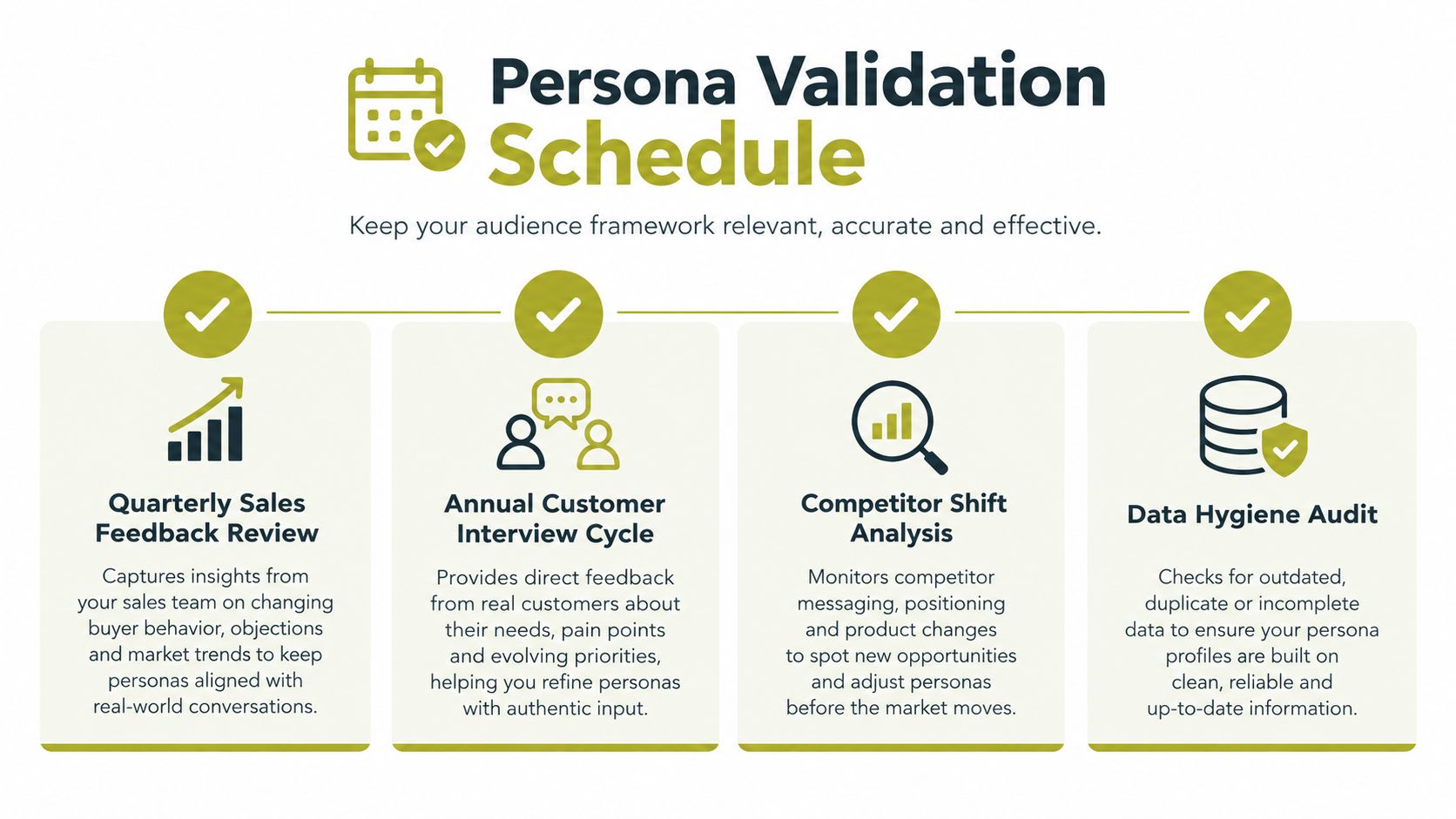
Use four validation checks
- Quarterly sales feedback review: Compare current wins, losses and stalled deals with the documented triggers and objections. Ask sales which stakeholder now appears earlier or later in the process.
- Annual customer interview cycle: Revisit the original motivations with recent customers, lost prospects and important non-buyers. Listen for changed language and new approval barriers.
- Competitor shift analysis: Review how alternatives position themselves, what proof they publish and which concerns they address. Update the persona when the buying conversation changes.
- Data hygiene audit: Remove duplicate records, correct role information and connect engagement to the right account or stakeholder. Poor data can make a dynamic framework look more accurate than it is.
Know when to retire a profile
Retire a persona when it no longer produces a distinct marketing or sales decision. Merge profiles when they respond to the same evidence, use the same channels and face the same objections. Split one when a new buying role, regulation or procurement requirement creates a materially different path to approval.
Track practical signs rather than chasing a single performance metric. If content attracts the wrong questions, sales hears unfamiliar objections, or PR coverage reaches people with no relevance to the buying group, investigate the framework before blaming the channel.
Senior advice: Keep the research notes behind the summary. A one-page persona helps teams act, but the underlying evidence lets them challenge and improve it.
A living framework should inform product decisions, crisis preparation, content planning and executive communication. Store the source of each insight, mark assumptions clearly and assign ownership for updates. That turns buyer persona development into an audience intelligence process the business can use repeatedly, not a PDF that disappears after the strategy meeting.
Carlos Alba Media combines PR, digital content, consumer insights, SEO, media exposure and executive media training to help UK organisations turn behavioural audience research into clearer public communication. If your current personas aren't informing your stories, content or interviews, visit Carlos Alba Media to discuss a practical framework for reaching the people who need to trust and choose your business.
[…] your buyer persona development resource to turn audience assumptions into usable editorial decisions. A tourism business might target […]