
Most SME founders don’t have a content problem. They have a decision problem.
You’re publishing when there’s time. A blog goes live after a quiet week. LinkedIn gets attention when someone in the team remembers. A sales brochure becomes a newsletter because it’s already written. Then everyone wonders why the effort feels busy but the pipeline doesn’t move.
That pattern is common because content is easy to start and hard to systemise. It looks productive long before it becomes useful. The fix isn’t more output. It’s a documented plan that ties every article, email, landing page and media comment to a business objective.
Teams with a plan outperform teams without one. Only 47% of UK B2B marketers have a documented content marketing strategy, yet those who do are 2.6 times more likely to report it as “very successful”, especially when investing over £3,000 per post, according to Reboot Online’s UK content marketing statistics summary.
That gap matters because a strategy isn’t a filing exercise. It’s how you decide what to say, who it’s for, where it goes, how it earns trust, and what happens when the market shifts or a reputational issue hits. For SMEs, that’s the difference between content as admin and content as growth infrastructure.
Moving from Random Acts of Content to a Documented Strategy
A lot of businesses start with scattered good intentions. The founder writes a smart post after a client call. Someone records a quick office video. The marketing lead publishes a service page because the website needs “fresh content”. None of those actions is wrong. The issue is that they don’t build on each other.
A documented strategy changes the standard from “what can we publish this week?” to “what should we publish next, and why?”. That sounds obvious, but it forces discipline. It also gives your team a way to say no to content that looks interesting yet doesn’t support commercial goals.
Former journalists and experienced agency operators tend to approach this differently. In a newsroom, nobody starts with layout or headlines. They start with the story angle, the audience, the timing, the evidence and the likely response. That same mindset sharpens content planning. It reduces waffle, surfaces what is newsworthy, and keeps weak ideas out of production.
A strong strategy should be specific enough to guide decisions and flexible enough to survive contact with the real world.
If you want a useful external perspective on B2B planning, Pollen's guide for B2B content strategists is worth reading alongside your own internal planning work. It complements the wider communications thinking involved in a proper communications strategy for business growth, especially if your content needs to support sales, reputation and media visibility at the same time.
The businesses that get traction usually make one shift early. They stop treating content as a marketing side project and start treating it as a documented operating plan.
Laying the Foundation with Goals Audience and Brand Voice
A founder approves a month of content, the team publishes on schedule, and nothing meaningful changes. Traffic flickers. Enquiries stay flat. Sales still hear the same objections. That usually points to a weak foundation, not a distribution problem.
Start by setting three things properly. Goals, audience and voice.

Set goals that the business would recognise
Content goals need to survive scrutiny from a managing director, head of sales, or finance lead. If they would dismiss the goal as vague, it is not ready.
“Increase awareness” is too soft on its own. “Publish twice a week” is an activity, not an outcome. Stronger goals are tied to business movement: better lead quality, shorter sales cycles, stronger branded search, improved investor confidence before a funding round, clearer recruitment messaging for specialist hires, or content that helps sales answer recurring objections without repeating the same call every week.
The Content Marketing Institute has found that unclear goals are a common weakness in underperforming strategies. The key takeaway is simple. If the goal does not help your team choose one content idea over another, it is too loose to guide anything.
Use three tests.
- Commercial link: Can leadership see how this supports revenue, retention, hiring, reputation, or market position?
- Decision value: Would this help your team reject a topic that is interesting but commercially irrelevant?
- Measurement path: Can you track progress through lead quality, sales conversations, search demand, assisted conversions, or another useful signal?
If not, rewrite it.
For SMEs that want content to contribute to pipeline rather than fill a calendar, this guide to content marketing for lead generation sets out the connection between editorial choices and commercial return in more detail.
There is also a reputational layer that standard content advice often skips. Goals should cover what you want to build and what you need to protect. If your firm operates in a regulated sector, works with public bodies, or relies heavily on founder visibility, your content strategy should support credibility under pressure. That means setting goals around trust, clarity and response readiness, not just reach.
Research your audience like a reporter
Audience research is usually too shallow. A job title and company size will not tell you what pushes a buyer to act, what makes them hesitate, or what language they trust.
A newsroom approach works better. Look for tension, motive, fear, evidence and timing. In practice, that means asking harder questions. What problem gets raised late in the buying process? What does the prospect say in public, and what do they admit privately on a sales call? Which claims trigger scepticism? Which proof points calm things down?
You already have more source material than you think.
Sales call notes
Review objections, repeated questions, procurement concerns and stalled deals.Customer service logs
Spot confusion, friction points and wording customers use without prompting.Website behaviour
Use Google Analytics and Search Console to see what attracts attention, what gets ignored and where intent weakens.Social and community listening
Read LinkedIn threads, Reddit discussions, review platforms and trade comments in your sector.Direct interviews
Speak to current clients, lost prospects and partners who hear the market talk when you are not in the room.
For a structured starting point, this guide to developing customer profiles is useful if you need to turn raw observations into practical personas.
One warning. Do not build personas that only help the marketing team. Build profiles your sales team would recognise instantly.
That changes the quality of the content. It also helps with PR and crisis planning. If you know what your audience is already worried about, you can publish material that answers concerns before they escalate, and you can respond faster when scrutiny lands.
Define a voice your team can actually use
Brand voice should not live in a decorative PDF. It needs to help a founder, marketer, freelancer and PR adviser make the same judgement on a busy Tuesday morning.
For most SMEs, a useful voice framework is simple:
| Dimension | One end | Other end | Better choice for most SMEs |
|---|---|---|---|
| Tone | Formal | Conversational | Conversational, but precise |
| Stance | Promotional | Advisory | Advisory |
| Language | Jargon-heavy | Plain English | Plain English with necessary technical terms |
| Authority | Detached | Direct | Direct |
| Risk level | Reactive | Confident | Confident, with evidence |
The trade-off matters. A highly polished corporate tone can sound safe, but it often strips out personality and makes expertise harder to trust. A loose, chatty tone may perform on social media and still fail in sectors where buyers expect accuracy and accountability. The right answer is usually clear, direct language backed by proof.
If your business has reputational exposure, voice also needs rules for difficult moments. A content strategy should account for normal publishing and stressed conditions. How do you sound when a product issue appears? What changes if a journalist calls? Who approves reactive content if criticism starts spreading? PR and crisis management are not separate from content strategy. They are part of the same editorial discipline.
A simple internal brief can sit on one page:
- Business goal: what the content programme must help achieve
- Primary audience: who matters most
- Core audience problem: what pressure or challenge the content will address
- Brand promise: what your business helps people do better
- Voice rules: how you sound, and what you avoid
- Risk notes: topics, claims or scenarios that need extra review
- Priority actions: enquiry, consultation, demo, newsletter sign-up, media contact, or another concrete next step
That brief becomes a working filter. If a topic does not support the goal, serve the audience, or fit the voice, it should not make it into production.
Building Your Content Pillars and Format Matrix
Once the foundation is set, the next question is practical. What are you going to publish?
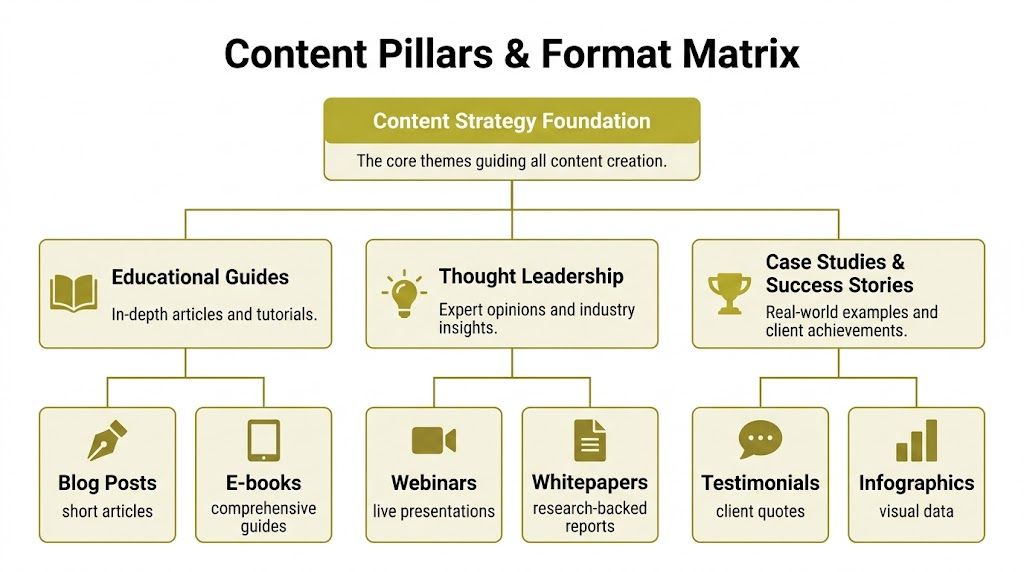
The easiest way to stay coherent is to build a small set of content pillars. These are the themes your business wants to be known for. Good pillars sit at the intersection of audience need, commercial relevance and genuine expertise.
Choose pillars that can carry weight
Most SMEs don’t need ten pillars. They need three or four strong ones.
Take a Scottish tech SME selling into regulated sectors. Its pillars might look like this:
Operational clarity
Content that explains process, compliance, implementation and procurement concerns.Category insight
Commentary on shifts in the market, buyer behaviour and practical implications.Leadership credibility
Founder opinion, expert reaction, media commentary and point-of-view pieces.Proof and application
Detailed stories showing how the service works in practice.
A tourism or hospitality brand would choose different pillars, but the principle stays the same. Every pillar should support authority and help the buyer move toward a decision.
Build a format matrix instead of defaulting to blogs
Blogs matter, but they’re only one format. If you’re working out how to create a content marketing strategy that fits a lean team, choose formats based on purpose, not habit.
Some formats build discovery. Others remove friction in the buying process. Some help PR outreach because they give journalists, producers and editors a sharper hook.
Here’s a simple decision table.
| Business Goal | Primary Content Formats | Key Metrics |
|---|---|---|
| Build authority in a specialist niche | Insight articles, expert commentary, opinion pieces, white papers | Qualified enquiries, media interest, backlinks, time on page |
| Support lead generation | SEO landing pages, downloadable guides, webinar replays, email sequences | Form submissions, consultations booked, lead quality |
| Help sales close deals | Case studies, FAQ pages, comparison pages, founder videos | Proposal progression, sales call usage, conversion to customer |
| Strengthen trust after first contact | Email nurture content, testimonial pages, behind-the-scenes video, thought leadership | Return visits, reply rates, sales engagement |
| Improve visibility for high-value services | Pillar pages, service explainers, reactive commentary, digital PR assets | Organic visibility, branded search, inbound opportunities |
Many teams waste money by creating expensive formats before they’ve proved the message. A polished video about the wrong problem is still the wrong asset.
Start with the format that gives you the clearest route to learning. In many SMEs, that’s a strong article, a usable landing page or a founder-led insight note before it’s a filmed campaign.
Match format to buying stage
Different buyers need different things at different moments. Someone discovering your firm for the first time doesn’t need the same content as someone comparing suppliers.
A simple format map looks like this:
Early attention
Use search-led guides, useful social posts, trade-comment pieces and topical explainers. These should answer real questions and introduce your expertise without over-selling.
Mid-funnel consideration
Use comparison pages, email sequences, webinars, practical guides and expert Q&As. Such content allows prospects to test whether you understand their situation.
Decision support
Use case studies, service pages, pricing conversations, implementation content and objection-handling assets. This is the point where clarity beats creativity.
If lead generation is a key commercial objective, it helps to see how this connects with the wider mechanics of content marketing for lead generation. The content itself isn’t enough. It needs to guide a prospect from interest to action.
Keep pillars stable and topics flexible
A common mistake is changing the pillars every quarter. Don’t. The pillars should hold steady long enough for authority to build.
What changes are the angles inside them. A founder interview, a search-led guide, a media comment, a customer question turned into a post, and a webinar transcript can all sit inside the same pillar. That’s how a content strategy stays structured without becoming stale.
The Engine Room SEO Distribution and PR Integration
Publishing is the midpoint, not the finish line. A good article hidden on your site is still hidden.
Many SME content plans often falter here. Teams spend time on ideation and production, then rely on a LinkedIn post and a hope that Google will do the rest. It won’t. Content needs an engine room. That means SEO, distribution and PR working together.

Think in owned earned and paid channels
A practical content strategy balances three routes to attention.
| Channel type | What it includes | Why it matters for SMEs |
|---|---|---|
| Owned | Website, blog, email list, LinkedIn page, newsletter | You control the message and the conversion path |
| Earned | Press coverage, podcast invites, trade publication quotes, guest commentary, backlinks | You borrow trust and reach from established outlets |
| Paid | Sponsored posts, search ads, paid social amplification, retargeting | You can test distribution fast when organic reach is slow |
The strongest SME strategies usually begin with owned media, add earned media where authority matters, and use paid selectively rather than as a crutch.
That matters even more because many strategy guides skip the budget reality. Many guides for SMEs fail to address how to allocate limited budgets. With 62% of successful marketers using documented strategies, the key challenge for a small business is creating a minimum viable plan that doesn't exhaust resources before showing value, as noted by Screendragon’s guide to building a content marketing strategy.
Get the SEO basics right before you chase volume
SEO is still one of the best ways for an SME to build durable visibility, but only when the basics are handled properly.
Start with keyword research that reflects intent. Use Google Search Console, Semrush, Ahrefs or even your site search data to understand what buyers are asking. Then group keywords by theme and priority. Don’t produce five thin pages on near-identical terms when one strong page would do the job better.
A solid page usually needs:
A clear primary intent
Know whether the user wants information, comparison, reassurance or to make contact.Strong page structure
Use descriptive headings, direct introductions and a logical flow.Original expertise
Add actual examples, commentary, process detail and opinion. Generic copy won’t carry authority.Internal linking
Connect related articles, service pages and proof points so users and search engines can follow the logic.Conversion points
Include useful next steps. Not every reader is ready to buy, but every page should offer movement.
If you need a more detailed framework for this part, it helps to ground the work in a broader SEO strategy for small business rather than treating search as a bolt-on after content is written.
The best-performing content usually does two jobs at once. It answers a search need and gives a real person a reason to trust the company behind it.
Use PR to amplify your strongest content
A journalist-led mindset yields significant power. PR isn’t separate from content strategy. It’s one of the best distribution levers you have.
Most SME websites contain material that could become earned media with the right framing. A founder insight can become a reactive comment for trade press. A useful guide can support journalist outreach if it contains a sharp point of view. A sector trend article can lead to podcast invitations or expert commentary requests.
PR integration works best when you ask these questions before publishing:
What is the news angle?
Is there a timely hook, a local angle, a market implication or a contrarian view?Who would care externally?
Think trade titles, business desks, sector newsletters, podcasters and industry associations.What asset supports the pitch?
A clean article, a quote sheet, a spokesperson bio, a short briefing note or a data-led page can all help.What happens if this attracts scrutiny?
Check legal, reputational and factual accuracy before outreach begins.
This last point matters. Good PR distribution doesn’t just increase reach. It tests whether your content can stand up in public.
Build a minimum viable distribution plan
If resources are tight, keep the first distribution system lean and repeatable.
A workable weekly rhythm might include:
- Website publication of the core asset
- Email send to your list with a strong editorial intro
- Founder LinkedIn post with a distinct angle, not a pasted link
- Sales team use in outreach or follow-up
- Targeted media or partner outreach where the topic has wider relevance
- Simple repurposing into snippets, carousels or FAQs
That’s enough to create momentum without turning one article into a multi-channel circus.
Creating an Editorial Workflow and Calendar That Works
Good strategy often dies in production. Not because the ideas are weak, but because nobody knows who owns the brief, who signs it off, or when the draft is due.
That’s why editorial workflow matters. The most useful model for SMEs is still the newsroom model. Clear deadlines. Clear owners. Clear standards.

Build the workflow before the calendar
Many start by filling dates into a content calendar. That’s backwards. First decide how a piece moves from idea to publication.
A simple SME workflow usually includes:
Idea capture
Add opportunities from sales calls, search trends, customer questions, events and media moments.Briefing
Define audience, objective, angle, format, call to action and distribution route.Drafting
Assign a writer with enough subject knowledge to produce something worth editing.Editing
One person should review for structure, clarity, factual risk and voice.Approval
Keep sign-off tight. Too many approvers slow production and weaken copy.Publication and promotion
Upload, optimise, distribute and brief internal stakeholders.Review
Note what performed, what didn’t and what should be updated.
A spreadsheet can handle this at first. So can Trello, Asana, Notion or Airtable. The tool matters less than the discipline.
Keep the calendar realistic
The best editorial calendar is one your team can sustain. Founders often overestimate production capacity and underestimate review delays.
Use a quarterly view and plan around business moments that matter. Product launches, tenders, funding conversations, seasonal demand, trade events, hiring pushes and regulatory developments should shape the schedule more than arbitrary posting targets.
A useful calendar should show:
- Topic and working title
- Content pillar
- Format
- Owner
- Draft date
- Approval date
- Publish date
- Primary distribution channel
- Supporting assets needed
- Status
If you need a starting point, RepurposeMyWebinar's calendar template offers a practical structure you can adapt rather than building one from scratch.
If your team misses deadlines repeatedly, the answer usually isn’t “work harder”. It’s “simplify the approval chain and reduce the publishing ambition”.
Assign roles like a lean newsroom
Small teams still need distinct responsibilities, even when one person wears more than one hat.
| Role | What they own |
|---|---|
| Strategist or founder | Topic priorities, business alignment, final direction |
| Writer | Draft quality, sourcing, clarity |
| Editor | Structure, voice, risk, accuracy |
| Designer or content producer | Visuals, formatting, supporting assets |
| Publisher | CMS upload, on-page checks, scheduling |
| Promoter | Email, social, outreach, internal circulation |
Avoid group accountability. If everyone owns the article, nobody owns the article.
A short visual explainer can also help teams tighten their process before the next planning cycle:
Create standards that save time later
Workflow gets faster when your team doesn’t reinvent basics every week.
Document a few essential elements:
Headline style
Clear, useful and specific.Opening standard
Get to the point early. Don’t bury the angle.Source handling
Verify facts, dates, names and links before publication.SEO checklist
Metadata, internal links, headings and page purpose.Brand voice rules
Words and claims to avoid, especially in sensitive sectors.Crisis flags
Escalate legal, regulatory or reputational concerns before publishing.
That turns the calendar into a working system rather than a list of hopeful dates.
Measuring What Matters and Preparing for Crises
A founder signs off six months of content, sees traffic rise, then gets asked a harder question in the board meeting. What did it do for pipeline, sales confidence or reputation? If the answer is vague, budget gets cut fast. If the business then hits a service issue or public complaint, weak content governance turns from a reporting problem into a reputational one.
That is why performance measurement and crisis planning belong in the same part of the strategy.
Report business impact, not publishing activity
A lot of SME content reporting still fixates on output. Articles published. Impressions gained. Social engagement ticked upward. Those numbers have some diagnostic value, but they rarely justify continued investment on their own.
Senior decision-makers usually want four things clarified. Did content bring in qualified attention? Did it help sales conversations move forward? Did it strengthen trust with customers, partners or journalists? Did it reduce risk by making the company easier to understand under scrutiny?
Measurement works best when it is set before production starts. Teams that document how content ties to commercial goals are in a far stronger position to defend spend and improve weak spots. A separate roundup by Genesys Growth on content marketing ROI data also points to a familiar problem. ROI can be strong, but attribution is still messy for many marketing teams. That matches what I see in practice. The closer content gets to consideration, sales enablement and reputation support, the more likely its value is to be undercounted if the team only reports last-click conversions.
Use a dashboard your leadership team will actually read
SMEs do not need a sprawling reporting setup. They need a decision tool.
A useful monthly dashboard might look like this:
| Area | What to look at | Why it matters |
|---|---|---|
| Reach | Organic entrances, referral traffic, email clicks | Shows whether distribution is producing relevant visibility |
| Engagement | Time on page, scroll depth, replies, meaningful comments | Indicates whether the content holds attention and answers the brief |
| Conversion | Enquiries, booked calls, downloads, demo requests | Connects content to commercial action |
| Sales support | Content used in proposals or follow-up, questions answered, objections reduced | Captures influence that standard attribution often misses |
| Reputation | Media response, sentiment, stakeholder feedback, search appearance | Shows whether the brand narrative is strengthening or drifting |
Review that dashboard with sales and leadership, not just the marketing team.
The gap between a high-traffic article and a useful article can be wide. I have seen low-traffic pages outperform glossy flagship pieces because they answered one high-intent question that kept coming up in late-stage sales calls. That is the level of judgement good reporting should support.
Build crisis readiness into the content strategy
Standard content marketing advice usually stops at optimisation. For SMEs, that is incomplete.
Content is also part of your public response system. If a complaint gains traction, a supplier issue disrupts service, a regulated claim gets challenged, or a leadership comment draws criticism, your website, email copy, social channels and spokesperson messaging all come under pressure at once. PR and crisis management principles need to sit inside the strategy from day one, especially for businesses in regulated sectors, hospitality, property, healthcare, education or any firm trading heavily on trust.
Start with three protections.
Pre-approved holding statements
Prepare short, factual responses for scenarios you can reasonably foresee, such as outages, delivery failures, customer complaints, data concerns or executive issues.A rapid-update publishing plan
Decide where urgent updates sit on the website, who can publish them, how they are approved, and how audiences will be directed there from email and social.A clear escalation chain
Set out who signs off messaging when time is tight. Include operations, legal, customer service and the named spokesperson.
Carlos Alba Media’s editorial background changes the shape of the strategy. Journalists are trained to ask what happens when a claim is challenged, when facts are incomplete, and when a story moves faster than internal approvals. Bringing that discipline into content planning produces stronger assets before a crisis starts, not after.
Treat defensibility as a quality standard
Every major content asset should pass one more test before publication.
If this page, quote, case study or video is read by an unhappy customer, a regulator, a journalist or a competitor, does it still hold up? Are the claims accurate, the sources sound, the wording proportionate, and the message aligned with the wider communications position?
If not, it is not ready.
That standard improves everyday marketing as well. Clearer claims, better sourcing and tighter approvals usually lead to stronger conversion content because the message is sharper, more credible and easier for sales teams to stand behind.
Your Strategy Is a Compass Not a Map
The best content strategies don’t lock you into a rigid publishing machine. They give you a way to make better decisions repeatedly.
That’s why the useful version of how to create a content marketing strategy is rarely glamorous. It’s clear goals. Better audience work. Strong pillars. Smarter format choices. Reliable workflow. Serious distribution. Honest measurement. Crisis readiness built in from the start.
A small business doesn’t need a huge team to do this well. It needs discipline, judgement and a willingness to stop publishing content that has no job to do. That alone levels the field more than most founders expect.
Start with one page. Write down your business goal, primary audience, core pillars and next three content decisions. If your current output can’t be traced back to those choices, you’ve found the problem.
If you want senior help turning that one-page plan into a content, PR and reputation strategy that can stand up in a practical environment, Carlos Alba Media brings exactly that mix of experience. The team’s specialist edge comes from former national news journalists and agency professionals who’ve worked with international brands, which means your strategy is built for scrutiny, visibility and practical commercial impact, not just publication.