
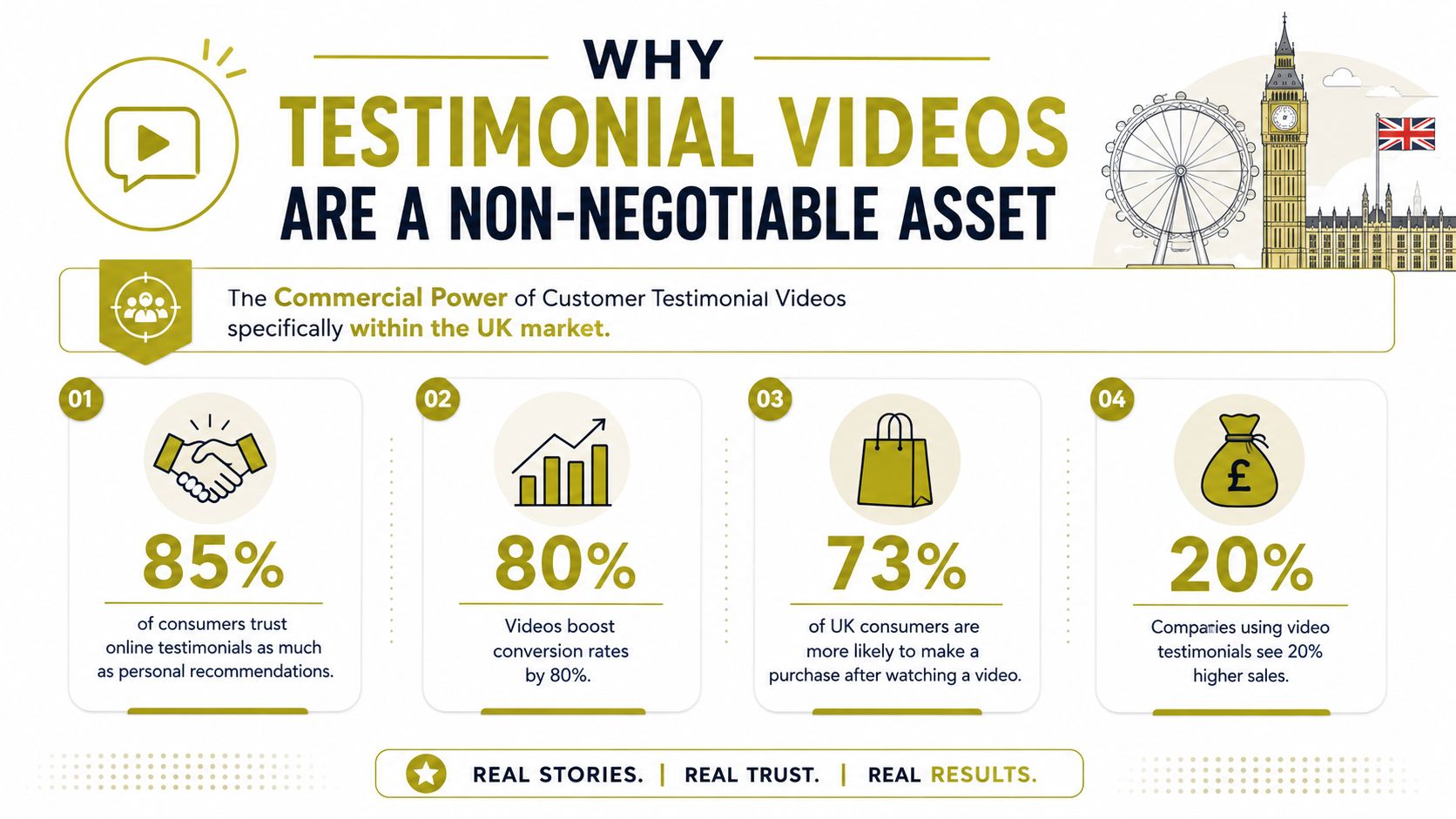
93% of UK marketers say video delivers a positive ROI, and that changes the conversation around customer testimonial videos from “nice content” to commercial evidence. When a single testimonial video on a checkout page can increase sales by 20%, and testimonial-led landing pages can lift conversion rates by up to 80%, the format stops being decorative and starts acting like a trust mechanism inside the buying journey (UK video marketing statistics). For founders, that means the key question is no longer whether to use video, but how to capture the right story so the result feels credible enough to move a buyer.
At Carlos Alba Media, that story-first mindset comes from newsroom habits, not marketing theatre. Everyone who works for Carlos Alba Media is a former national news journalist or has agency experience with international brands, so the instinct is to look for the narrative arc inside a customer's experience, the problem they faced, the turning point, and the result they can stand behind. That approach matters because buyers rarely respond to broad praise. They respond to specifics, tone, and proof.
Why Testimonial Videos Are a Non-Negotiable Asset
A lot of SMEs treat customer testimonial videos as a late-stage extra, something to make once the website is finished or the ad budget is bigger. That sequence usually gets the strategy wrong. Customer testimonial videos belong inside the sales system because they help buyers hear proof from another customer, not just claims from the company. That shift matters in a market where video is already delivering strong commercial returns, and testimonial-led content often outperforms written reviews.
Trust is the primary conversion lever
What gives customer testimonial videos their force is not only motion or production value. It is the chance for a buyer to hear a real person describe a real outcome in plain language. Studies on video testimonials show they are remembered more often than written reviews, and they can also improve email conversion rates in campaigns that include video (video testimonial statistics).
That matters for Scottish businesses and wider UK SMEs because buyers are under pressure to justify every purchase. A testimonial that is specific answers the questions people do not always ask out loud, whether the offer will work for them, whether the team is dependable, and whether the claim stands up. A well-cut video can address those doubts faster than a block of copy.
Practical rule: if the testimonial does not show a problem, a turning point, and a result, it is probably just praise, not evidence.
Why the journalistic method wins
A newsroom approach improves the material before the edit even starts. A journalist does not ask for compliments first, they look for tension, detail, and an ending that feels earned. In practice, that means the strongest customer testimonial videos do not sound scripted, they sound observed.
One useful framing is what we mean by digital storytelling, which Carlos Alba Media applies across client work. The same principle holds here. The audience needs a narrative it can follow, not a slogan it has to believe. The best testimonial content feels like a short reported feature, with a beginning, a middle, and an ending that the buyer can recognise as their own.
This is the difference between generic praise and a story with commercial value. A founder does not need a glowing paragraph on camera, they need the customer's experience shaped into something specific, credible, and useful to the next buyer.
Pre-Production Planning Your Video for Impact
A strong testimonial video is decided before the camera starts rolling. The choice of customer matters, the question set matters, and the job-to-be-done matters. If you plan loosely, you get polite filler. If you plan with one clear objective, you get a story that can sit on a landing page, service page, or follow-up email without feeling generic.
Choose one outcome, not five
The first planning decision is the simplest, pick one primary goal. It might be improving trust on a service page, helping a buyer move from consideration to enquiry, or supporting a sales follow-up. A testimonial video that tries to do all three usually ends up vague.
The second decision is the customer. Don't just choose the happiest client. Choose the person whose experience has a clear before and after. A strong testimonial usually has one of three shapes, a painful process that became manageable, a sceptical buyer who found a better option, or a complex problem that was resolved with visible care.
Build a one-page brief
A useful brief can stay short if it covers the right ground. Include the objective, the ideal viewer, the customer's starting problem, the result you want the audience to understand, and where the video will be used. That last point changes the edit later, because a homepage clip, a service-page asset, and a social cut all need different pacing.
The compliance side matters too. In the UK, the Competition and Markets Authority requires endorsements to be clearly identifiable and not misleading, which means substantiated claims and authenticity matter more than glossy presentation (testimonial video compliance guidance). That's why the planning stage should always include a quick review of what the customer can confirm and what needs evidence elsewhere on the page.
Find the story, not the compliment
The journalistic habit is to listen for the moment where the story turns. Often that's buried in one sentence a client says offhand, a delay that cost them time, a handoff that went badly, a buying decision they nearly delayed. That's the material worth filming.
Start with the tension, not the praise. Buyers trust a solved problem more than a cheerful summary.
For targeting, it also helps to define who the video is really for before you shoot. A clear audience definition keeps the questions tighter and the edit more usable across channels audience targeting framework.
Crafting Compelling Interview Questions and Scripts
Rigid scripts flatten people. Good questions open them up. The best customer testimonial interviews feel guided but not trapped, with enough structure to keep the story moving and enough room for the customer to sound like themselves.
Ask for a story, not a review
A review asks for opinion. A story reveals context. That's why interviewers should start with prompts that pull out the customer's before state, then move to the moment of change, and finally land on the result. The interview becomes more convincing because the buyer hears how the decision unfolded, not just what the customer liked.
| Question Category | Sample Question |
|---|---|
| Before state | What was happening before you chose our service? |
| Before state | What made the problem hard to ignore? |
| Turning point | What changed your mind or made you take action? |
| Turning point | What was the first moment you felt you were in the right place? |
| After state | What outcome mattered most once the project was underway? |
| After state | What would you tell another founder facing the same issue? |
Use questions that pull out detail
The most useful questions often sound ordinary. “What did that look like day to day?” is better than “How did it make you feel?” when you need concrete texture. “What happened next?” can reveal a sequence that would otherwise stay buried behind summary language.
A solid workflow is to record the interview, then transcribe it so you can spot the strongest lines and the repeated themes. If you need a practical workflow for that stage, effective methods for interview transcription can help structure the raw material before you build the edit.
Keep the script flexible
The script should guide tone, not lock words. If a customer sounds rehearsed, the video loses its edge. If they ramble, the edit becomes harder. The balance sits in a simple run-of-show, opening context, one clear challenge, the decision point, the result, and a closing recommendation.
The best answers usually come after the question the customer didn't expect.
That's where a journalist's instinct helps. Follow the detail, not the pre-planned line. If the customer says something specific, stay there long enough to get the fuller version.
Production Low-Budget Setups That Look Professional
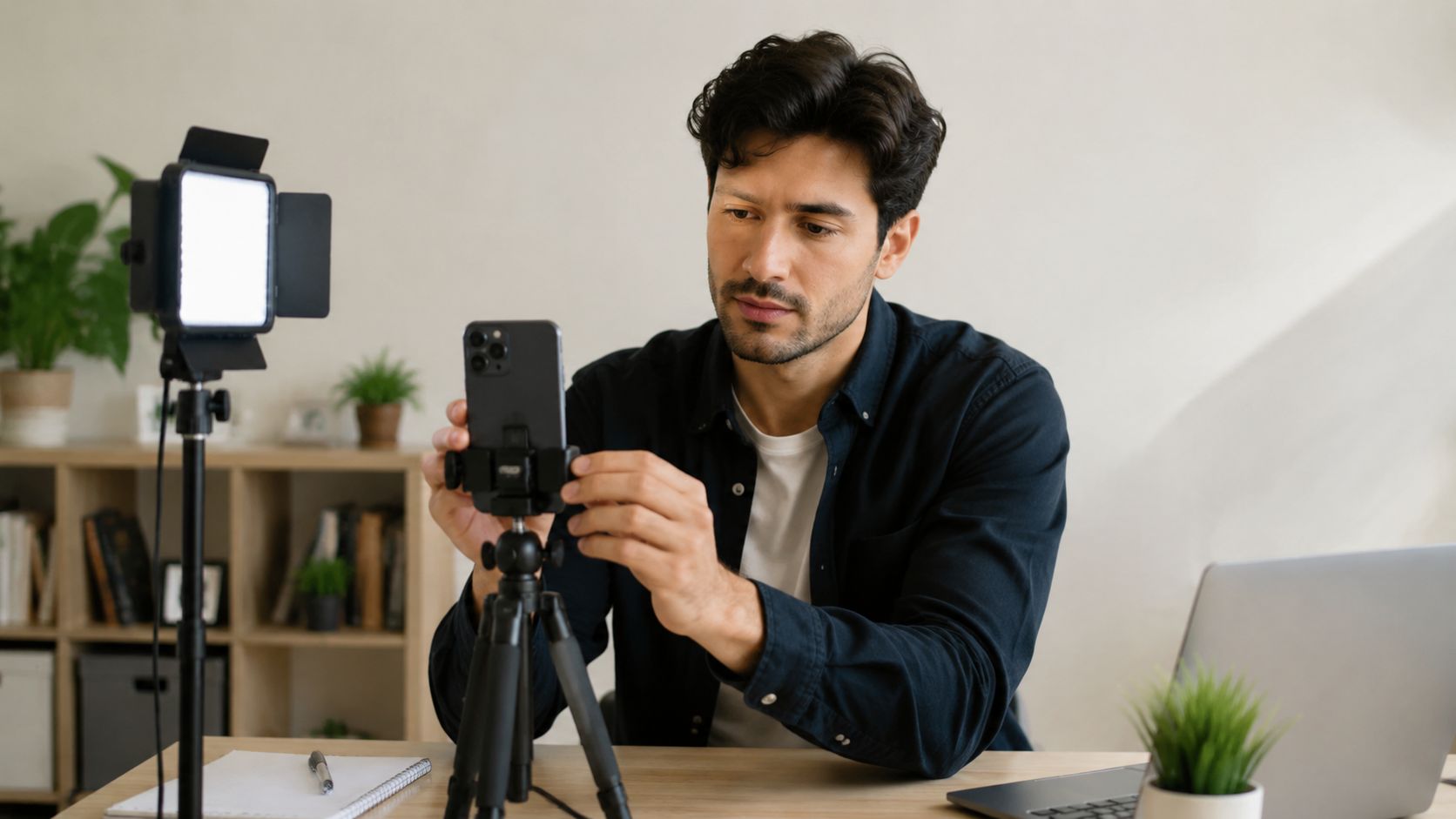
A testimonial does not need a studio to feel credible. It needs clean sound, soft light, and a frame that keeps attention on the person speaking. A smartphone can handle the job if the setup respects those three basics.
Start with the room, not the camera
Choose the quietest room available first, then look for a window that gives the face even daylight. A customer lit slightly from the front usually reads better on screen than someone backlit by a bright window. If the room echoes, add soft furnishings or move to a space with more texture so the voice feels fuller and less brittle.
Sound matters more than image quality in most low-budget testimonial shoots. A small lavalier mic placed near the chest can improve clarity far more than a newer phone camera. If you have to spend a little money somewhere, spend it on audio first.
Frame the person like a conversation, not a passport photo
Place the camera at eye level and leave a small amount of headroom. A simple chest-up shot usually works well because it feels personal without crowding the face. Keep the background clean, and avoid busy walls, oversized branding, or anything that makes the setup feel staged.
Practical rule: if the frame draws attention to the setup, some of the trust the video needs is already gone.
Keep the take short and natural
For landing pages and social use, aim for 60 to 90 seconds and avoid over-scripting the story, because too much scripting can weaken authenticity and trust (testimonial video length guidance). The strongest takes are often the second or third pass, once the person stops thinking about the camera and starts speaking more naturally.
For mobile-first distribution, vertical framing deserves serious attention. UK SME guidance says vertical formats perform about 90% better on mobile than horizontal versions, and short-form videos under 60 seconds can reach 65% to 66% completion rates (mobile testimonial video stats). That makes a simple smartphone setup enough when the shot is planned for where the video will be watched, not just for the recording day.
Post-Production Editing Branding and Legal Consent
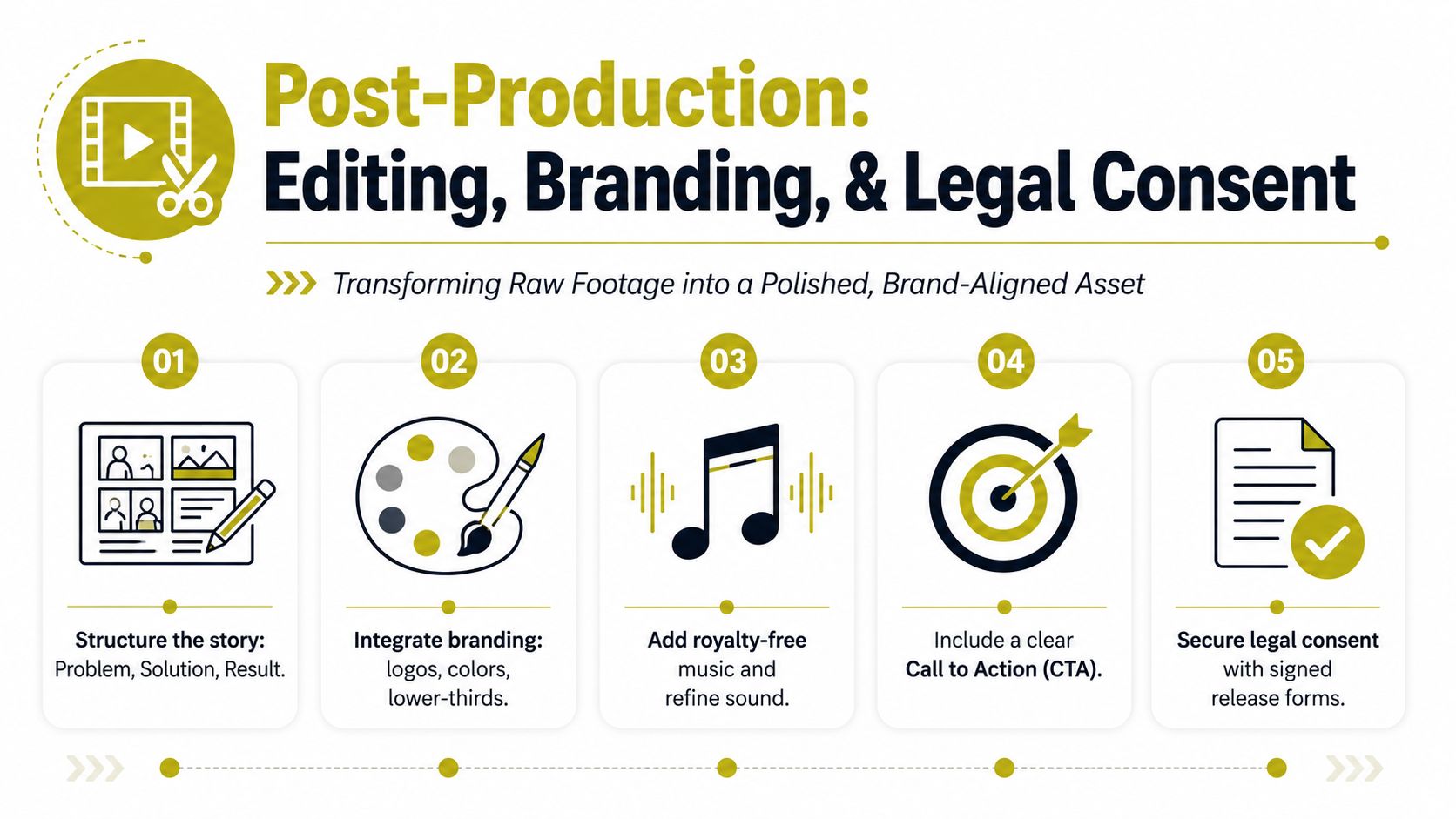
Raw footage becomes useful when the edit turns a conversation into an argument a buyer can follow. That means trimming for pace, shaping the emotional arc, adding branding without smothering the voice, and making sure the legal paperwork is watertight before the clip goes live.
Edit for clarity first
The best edit usually follows the simplest structure, problem, solution, result. Start by cutting any warm-up chatter that doesn't help the viewer understand the issue. Then keep the strongest phrase from the customer's own words, especially if it sounds concrete and lived-in.
Branding should stay subtle. A logo in the corner, lower-thirds for the speaker, and brand colours used sparingly are enough for most SME testimonial videos. If the video starts to feel like an advert, the testimony weakens.
Use music and b-roll with restraint
Music should support tone, not force emotion. A soft, unobtrusive track can smooth transitions, but it shouldn't compete with the voice. B-roll works best when it adds context, a desk, a team huddle, a product in use, a shop floor, a site visit, rather than random generic visuals.
A legal release form should cover the right to use the video, where it can be used, and for how long the business can keep using it. It should also confirm that the customer understands the testimonial may appear on web pages, paid ads, email, press materials, and social channels. Without that clarity, useful content can become a rights problem later.
Consent should be explicit
The safest releases are written plainly. They should identify the speaker, the business, the date, the permissions granted, and any limits on editing or usage. If the testimonial includes product claims, the team should check that the words used are defensible and not misleading, especially under UK endorsement rules already noted above.
A short release form is better than a vague promise. Vague promises create friction when the video starts working.
If you need a production partner, Carlos Alba Media is one option for handling interview-led content, editing, and release management alongside wider PR and digital work, but the key is the process, not the logo on the invoice.
Distribution and Measurement Getting Your Video Seen
A testimonial video only earns its keep when the right people see it in the right place. The story also has to hold together across formats. A longer cut can support a service page, a short vertical clip can work on social, and a smaller extract can fit inside an email sequence without crowding the message.
Match format to placement
A service page usually benefits from a cleaner, more complete version that gives context and proof. Social needs speed and a strong opening. Email works best when the clip feels like a natural trust signal inside an existing conversation, not a loud interruption.
The right format also depends on where the story will do the most work. A founder might want the customer's turning point front and centre on the website, then use a tighter quote for social proof and a shorter cut for follow-up emails. That is where editorial judgment matters, because a good testimonial is not just a nice reaction, it is a story with a beginning, a change, and a result.
The mobile numbers are hard to ignore here. UK SME guidance says vertical video performs about 90% better on mobile than horizontal, and short-form clips under 60 seconds reach 65% to 66% completion rates. That supports a repurposing strategy, one interview can become several assets without changing the core story.
Measure what matters
Track the metrics that connect to business outcomes, not just vanity views. Completion rate tells you whether the edit held attention. Page conversion tells you whether the video helped the page do its job. Email engagement shows whether the clip improved the next step in the nurture sequence.
For social teams, it helps to build a simple review process around those results. A practical framework for what to monitor is available in a practical framework for what to monitor, which helps separate useful interaction from empty activity.
A journalist's instinct helps here too. If viewers stop early, ask where the story lost them. If the page gets views but no action, the quote may be truthful without being specific enough to move a buyer. If the customer's story is strong, the measurement should show whether it is landing in the right place and carrying the right weight.
Repurpose without diluting the story
The same interview can produce a 90-second service-page cut, a vertical short for stories, and a tighter quote-led clip for social proof. The mistake is to make each version too different, because then the narrative loses continuity. Keep the core line, the turning point, and the result consistent.
That consistency matters because the best testimonial videos do not just repeat praise. They surface the detail that makes the praise believable, a moment of doubt, a specific problem, the change the customer felt after using the service. That is the story a viewer remembers, and it is usually stronger than polished slogans.
If you're building a repeatable content pipeline, it can also help to look at automate YouTube Shorts for developers as a way to think about fast repackaging, even if your own workflow is editorial rather than technical.
One useful rule is to keep the edit system flexible without letting the story drift. Use the same interview to support the website, social channels, and email, but keep each version anchored to the customer's real experience. That gives you reach without flattening the testimony into generic praise.