
Google generated more than 90% of UK search traffic in every year from 2009 to 2019, according to the Competition and Markets Authority's analysis of UK search. For most UK organisations, an SEO content marketing strategy therefore needs to work especially well in Google, not spread effort evenly across search engines.
But visibility isn't the same as business value. The useful test is whether a page fits a real search intent, earns trust and helps someone take a meaningful next step, whether that's making an enquiry, booking a stay or requesting a consultation. That distinction matters even more as AI-generated answers can satisfy some searches without a click.
The Seven Stages of an SEO Content Strategy at a Glance
| Stage | Output to hold before moving on | Typical time |
|---|---|---|
| Demand research | Non-brand query list grouped by intent | 2–3 weeks |
| Keyword mapping | One target page assigned to each cluster | 1 week |
| Content planning | Editorial calendar with owners and conversion actions | 1 week |
| On-page and technical SEO | Publish-ready pages that crawl and index cleanly | Ongoing before launch |
| Distribution | Email, social and outreach plan for each asset | Ongoing |
| Measurement | Pre-publication baseline and monthly KPI report | First read at 8–12 weeks |
| Iteration | Pages refreshed, merged or retired | Monthly review |
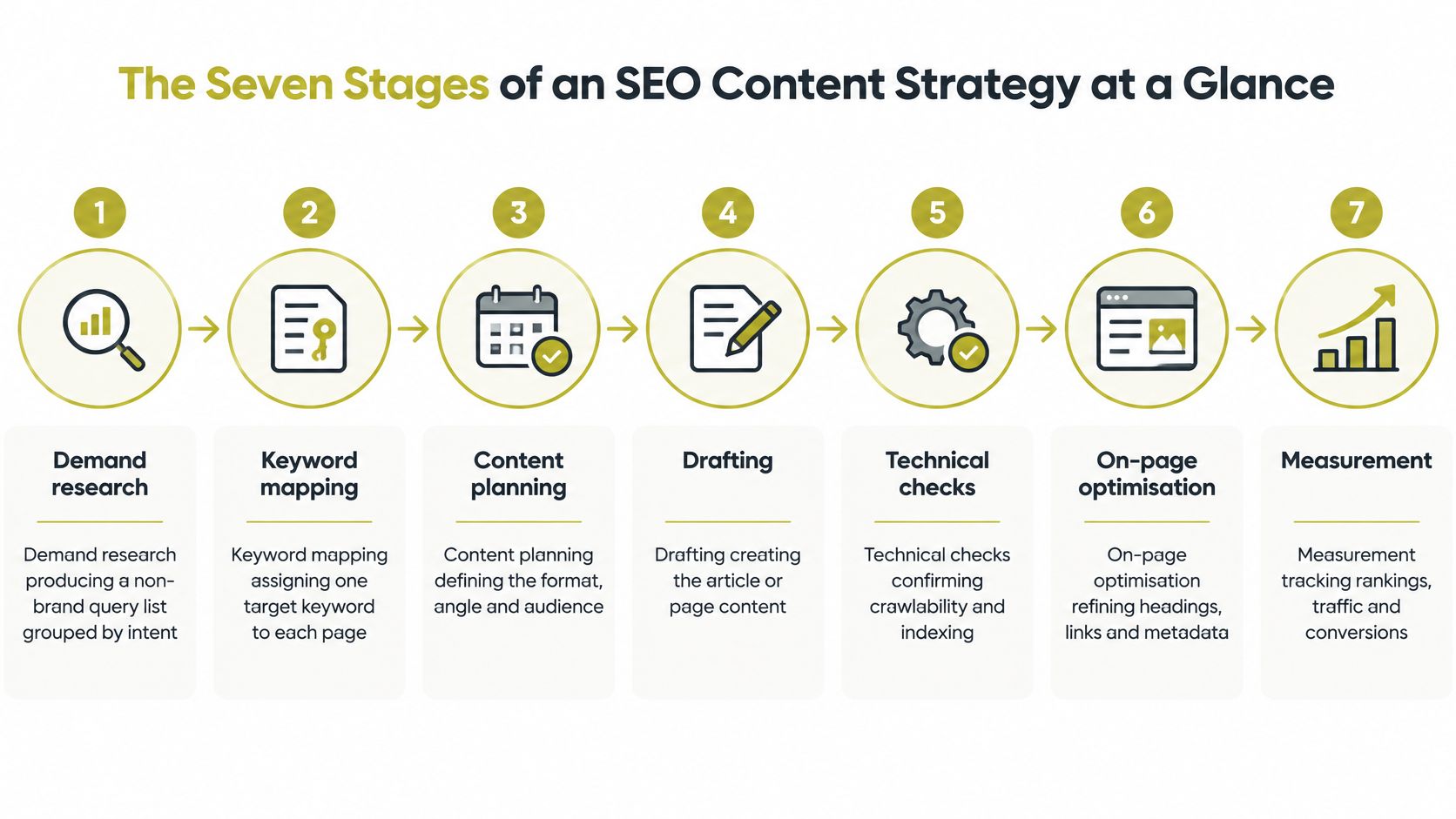
Each stage should produce something the next one can use. Research establishes what people search for and why; mapping decides which page should serve each intent; planning assigns an owner, format and action before anyone starts drafting. If you write first and map later, you risk publishing overlapping pages that compete for the same query.
The same discipline applies to measurement. Record the current position before publishing so you can judge what changed, rather than attributing every rise or dip to new content. Technical checks and distribution also need their own place in the workflow. A strong article can't earn search visibility if crawlers can't access it, and publishing it without a plan to reach existing audiences leaves useful work under-promoted.
The scale of competition makes execution more important than just having a plan. In 2024, 61.8% of UK businesses surveyed by LOCALiQ reported having an SEO strategy, according to LOCALiQ's UK SEO strategy survey summary. That makes a strategy a starting point, not a differentiator. The advantage comes from building pages around genuine demand, maintaining them and measuring whether they contribute to enquiries.
Practical rule: If you have no baseline, start with demand research. If you already publish but can't say which page should rank for each query, begin with keyword mapping.
Mapping UK Search Demand Before You Write
Start with the audience, not a spreadsheet of keywords. Ofcom reports that 82% of UK online adults used Google Search in May 2025, while Google handled approximately 3 billion UK searches per month. The same report says 95% of UK adult internet users searched online for information during the previous three months, and purchase-related research was the leading category at 71%. These figures make demand mapping a more useful starting point than choosing a publishing target and filling a calendar. (Ofcom's Online Nation 2025 report)
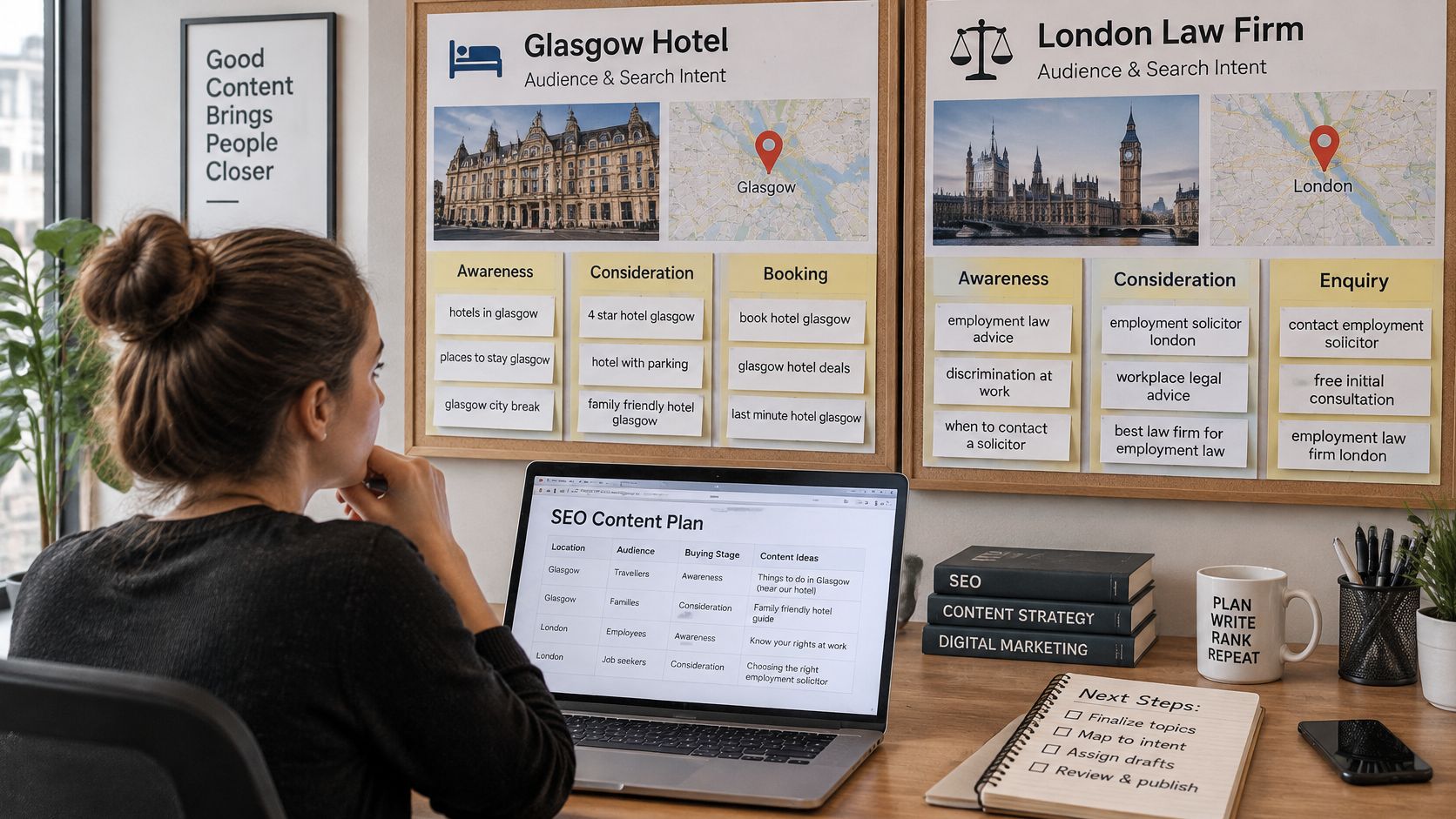
Segment by place and buying stage. Separate audiences such as Glasgow hotel guests comparing venues from London business owners researching legal support. Location and readiness affect what people need from a page, even when their searches share a broad topic.
Export non-brand queries from Google Search Console. Look at at least three months of queries and filter out your organisation's name. That makes it easier to see what people search for before they already know you.
Add keyword-tool data and related questions. Use research tools to find variations and estimate demand, but don't mistake volume for buying intent. A broad informational query may attract readers without helping a sales team.
Classify each query by intent. Mark it informational, commercial, navigational or local. A person asking how a service works needs a different answer from someone comparing providers in Edinburgh or looking for a named company.
Cluster queries that share the same intent. Put searches together only when one page could answer them well. Drop or revisit clusters that have no credible route to an enquiry, booking or sale.
Grouping by topic alone is a common mistake. A company might put “accountant”, “self-assessment deadline” and “accounting software comparison” into one broad cluster because they concern finance. Yet each query signals a different need. One catch-all page is likely to answer all three poorly, while separate pages targeting the same intent can create needless overlap.
For each cluster, define the page that can serve it and the action a visitor should take. Carlos Alba Media begins client work by helping clients define their brand's character and what it stands for, a useful discipline here: the page should reflect a distinctive, believable offer, not just echo search terms. For practical audience work, a buyer persona development framework can help turn broad segments into concrete needs and decision stages.
The workflow is easier to see when the search itself becomes the brief. The video below offers a visual companion to planning content around a defined need.
A useful final test is simple: every cluster must map to one authoritative page with a defined conversion action. If it can't, return to the research and ask whether the cluster is too broad, wrongly grouped or commercially irrelevant.
Choosing Content Formats That Match Search Intent
| Query type | AI Overview share | What to build |
|---|---|---|
| Question and definition searches | 87% | Explanatory guides with a direct answer near the top |
| Local, brand, recipe and live searches | 14% | Local service pages, case studies and booking journeys |
| Weather and sport searches | None observed | Little organic content investment |
A 2026 study of 560 UK searches found AI Overviews for 87% of question and definition searches, but only 14% of local, brand, recipe and live searches. None appeared for weather or sport queries. The finding, reported in the UK study of AI Overviews by search type, is a reason to match format to query type, not to turn every page into a generic “what is” article.
For informational searches, lead with the answer. Then earn the visit with useful detail that a short summary can't replace: a UK-specific example, expert explanation, first-hand evidence or a clear route to a relevant service. For commercial and local searches, put more effort into proof and choice. A Glasgow service page, for example, should make the location, offer and next step clear, rather than rely on a long introduction to a general topic.
Consider a Glasgow hotel with a wedding venue. A search for typical wedding venue costs belongs on one explanatory hub guide. It should answer the question near the top, then link naturally to the venue enquiry form. A search for wedding venues in Glasgow needs a different page: one that helps couples choose through named guest reviews, room capacities, real photographs and a live booking calendar. The first page explains; the second makes the case for booking.
Carlos Alba Media's VisitScotland campaign work included strategic communications planning, audience segmentation and targeting, a multi-platform social media strategy, and content marketing and asset creation. That breadth is relevant when a campaign needs connected formats rather than a run of isolated articles. For product teams choosing how to explain a service visually, browse product demo walkthroughs for ideas on presenting a process in a clear, watchable format.
Before approving any asset, ask three things: which query type does it serve, which conversion action does it drive, and what proof makes it harder to replace with a search summary? If those answers aren't clear, the format or the brief needs work.
Planning the Editorial Calendar with Owners and Conversion Actions
Turn each mapped cluster into a short brief before writing starts. A calendar should tell the team what to make, who owns it and what result the page should support, not merely when to publish.
Record the query, intent, page type and conversion action. Choose one clear next step, such as submitting an enquiry form, booking a room or requesting a consultation. A page without a defined action has no practical way to connect reader interest to business value.
Assign one named owner and a draft date. A named person is accountable for moving the page through drafting and approval. Without an owner, even a promising idea can remain in the calendar indefinitely.
Prioritise briefs by commercial value. Start with the hub page for an important cluster, then schedule supporting service, FAQ and evidence pages. This creates a useful destination for related content instead of scattering effort across disconnected topics.
Add publish and refresh dates. Schedule a refresh when the page depends on information likely to change, such as service details or deadlines. A calendar that plans only publication leaves upkeep to chance.
Include distribution and baseline capture. Decide where the page will be shared and what performance data to record before it goes live. Promotion and measurement are easier to act on when they're built into the brief.
For example, a Glasgow accountancy firm might schedule a self-assessment deadlines hub guide first, name the content lead as its owner and make a booked call the conversion action. The brief can also state when the firm will review the page and which supporting service pages should link to it.
A calendar with no owner or conversion action is just a list of ideas. Keep the format decision and the proof that makes the page valuable in every brief, so writers know what the content must do before they begin.
Technical and On-Page Checks Before You Publish
Content volume won't fix a page that search engines can't crawl or index. Google describes SEO as helping search engines crawl, index and understand pages, and recommends Search Console for understanding search performance in its SEO Starter Guide. Work through the technical foundations before scaling production.
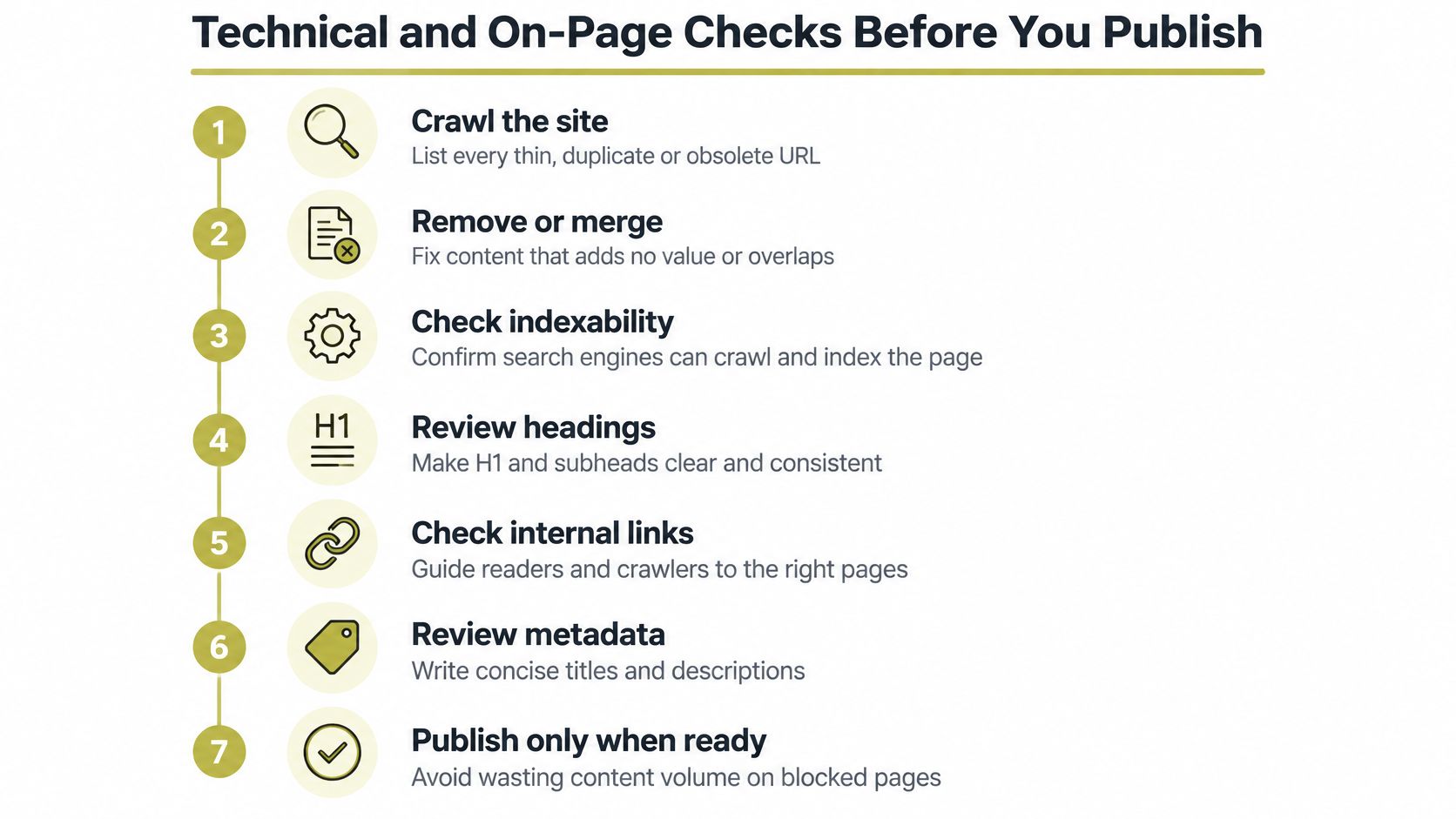
Crawl the site. Use a crawler to build an inventory of thin, duplicate or obsolete URLs. You need to know what already exists before adding more pages.
Remove or redirect pages that don't belong. Retire pages with no useful purpose, or redirect them to a relevant live page. Don't send visitors to an unrelated destination to preserve a URL.
Check important responses. Confirm that key pages return an HTTP 200 response and that important URLs can be indexed. A page that appears live in a browser may still have an indexing problem.
Set canonical signals and submit an XML sitemap. These help search engines interpret the preferred version of a page and discover important URLs.
Test JavaScript-rendered content. Check that text, links and metadata are available to crawlers after rendering. Don't assume that content visible to a person is automatically visible to a search engine.
Connect GA4 and Search Console. Set conversion events consistently so reporting can distinguish useful activity from visits that don't lead anywhere.
Run these on-page checks on every new page:
- Answer the query early. Put the direct response in the opening paragraph, then add the explanation and evidence that give readers a reason to stay.
- Make the structure clear. Use headings that reflect one main intent and keep the title and meta description specific to the page.
- Show who stands behind the content. Add named authorship where it's relevant, and link to the enquiry, booking or consultation page.
- Check internal navigation. Help readers and crawlers reach the relevant hub, service and proof pages without dead ends.
Common failures are near-duplicate local pages, URL changes without redirects, blocked CSS or JavaScript, and treating rankings as the only KPI. Image-heavy tourism and hospitality templates also need careful mobile testing, including Core Web Vitals, before the same design is rolled out across more pages. A practical SEO audit checklist can help teams organise the checks.
Search summaries can present an answer without the page's full context. Answer directly near the top, then use the rest of the page to show evidence, experience and local detail that deserves a visit.
Distributing Content to Reach Editors, Partners and Buyers
For most SMEs, start with four channels in this order: email existing customers, social posts that point to the content, partner and supplier sharing, then editorial outreach to journalists and trade titles. Each channel reaches people through a different relationship, so the right sequence is more useful than trying to publish everywhere at once.
A hotel can send a local guide to recent guests with a booking link. A professional services firm can share original research with trade associations, while a tourism business can offer regional figures to local reporters as the basis for a story. These aren't interchangeable messages: each should give its audience a clear reason to care.
Make one strong hub work harder by turning it into three practical formats, such as an email summary, a social post and a short briefing for partners. Refresh older pages with current information before promoting them, and pitch original evidence rather than a generic company announcement. Track which channel brings qualified enquiries, not just visits. A resource on content promotion for greater reach can help teams plan how an asset travels beyond its original publication.
Don't start every channel at once. Choose the two where your audience already pays attention, watch whether they produce useful conversations or enquiries, and add another only when you can manage it properly. Promotion also needs an owner, just like drafting; otherwise, distribution becomes an afterthought once the page is live.
Carlos Alba Media helps clients publicise their work to potential customers, industry partners, regulators and investors. That matters when a content asset has a wider job than search acquisition, for example, supporting a trade conversation or helping an editor assess a story. A considered backlink strategy can support outreach when the goal is to earn relevant attention rather than collect links without context.
Use the cluster map to set priority: give the most commercially important pages the most distribution effort first.
Measuring Organic Results and Assisted Enquiries
| Metric | What it tells you | Review cadence |
|---|---|---|
| Impressions and clicks (Search Console) | Visibility trend for each cluster | Monthly |
| Non-brand click-through rate | Whether titles and descriptions match intent | Monthly |
| Ranking distribution | Which pages are moving towards page one | Monthly |
| Engaged sessions (GA4) | Whether visitors stay and engage with the content | Monthly |
| Assisted conversions | Content's role in the path before an enquiry | Quarterly |
| Qualified enquiries from CRM | Commercial value of each cluster | Monthly |
| Branded search growth | Influence of PR, AI answers and reputation | Quarterly |
Rankings belong in the report, but they aren't the headline. A page can move up and still attract the wrong visitors; another can contribute to a decision without appearing as the last page before an enquiry. The point of the review is to see whether search visibility and content activity help bring in qualified business.
Before publication, record the page or cluster's current position across the metrics that matter. Then compare it with performance after 8–12 weeks, separating non-brand search activity from branded demand. A PR spike can increase searches for a company name; keeping branded and non-brand views distinct helps avoid mistaking a burst of recognition for durable demand.
Review the path from visibility to enquiry
Run the monthly check in sequence. Start with Search Console impressions and non-brand click-through rate, then review ranking distribution to see which pages are gaining or losing ground. Move into GA4 to assess engaged sessions, and finish with qualified enquiries from the CRM so the team can connect organic activity to prospects that fit the offer.
AI answers complicate attribution because a searcher may encounter a brand or page summary and visit later through a direct route. A 2026 YouGov report on UK web search and AI, based on British adults, identifies trust as a defining challenge in AI-powered search. For measurement, that means keeping an eye on branded search growth, direct traffic, brand mentions and enquiries that refer to a piece of content, as well as the accuracy of AI-generated descriptions.
Once a month, run the questions your content clusters target in relevant answer engines and record whether your pages are cited or paraphrased. Treat that as a visibility check, not evidence that the content generated a sale. A MyMentions SEO tracking guide offers a useful starting point for thinking through wider tracking beyond a ranking report.
Rising impressions with falling enquiries is a warning, not a win.
Say a Glasgow solicitor's probate guide continues to gain impressions while qualified enquiries fall from about six a month to two. Those figures are an illustrative scenario, not a reported result. The page may be explaining the topic but failing to give readers a persuasive next step; the response is to add credible case evidence and make consultation booking easy to find. Review assisted conversions separately on the quarterly read.
Confirm Your Next Step and Review Monthly
Start with one action this week. Export three months of non-brand queries from Search Console, group them into intent-based clusters, then pick a single hub page with one defined conversion action to build first. Keep the scope small. The goal is a useful page and a clean baseline, not a year of content planned before anything goes live.
Set a monthly review with three jobs. Refresh pages that gain impressions but lose clicks. Merge pages competing for the same intent. Retire thin pages that earn neither traffic nor enquiries. Rebuild the cluster map once a year from fresh search data, sooner if services, audiences or priorities change.
Judge each hub on intent fit and enquiries, not rankings alone. A page that ranks but produces no calls, forms or bookings needs stronger proof, clearer pricing context or a simpler next step.
Outside support helps when priorities are unclear or content never connects to coverage. Carlos Alba Media is founded and run by Carlos Alba, a multi award-winning former national newspaper editor, and clients don't need to be based in Glasgow or Scotland to use its PR and digital marketing services.
Fix a review date four months out. Compare the first hub against its baseline. Then decide. Build the next cluster or fix what stops the first one turning visibility into action.
Carlos Alba Media offers SEO-led digital content marketing alongside PR, social media and web services, helping organisations build useful content around search intent and business goals. If you want experienced support to shape your content priorities and connect them to measurable enquiries, visit Carlos Alba Media.