
The most popular backlink advice is also the least useful: publish more content, chase more links, and watch your domain score rise. That approach turns a serious growth channel into a spreadsheet exercise. For UK SMEs, the stronger question is different: what story, evidence or expertise would make a relevant publisher want to reference this business?
A durable backlink strategy combines SEO judgement with newsroom discipline. It starts with pages that deserve authority, builds assets worth citing, and puts those assets in front of journalists, editors and industry publishers with a credible reason to care. Cheap placements can inflate a report while leaving the business with weak relevance, little referral traffic and a profile that becomes harder to trust.
Why Most SME Backlink Strategies Fail Before They Start
Many SME campaigns begin with a target such as “build 50 links”, or with a list of domains filtered by a third-party metric. Neither target explains whether the links will support a commercial page, strengthen topical relevance or help the business compete for a valuable search result.
The UK market already treats link acquisition as a serious investment. A UK-focused SEO survey reports that 86% of marketers use link building, while 28% of a typical SEO budget is allocated to it. The same dataset says boosting SERP rankings is the main goal for 68% of respondents, 56% of companies planned to increase their link-building budgets in 2025, and 60% outsource link building to specialist providers (UK link-building statistics).
Those figures don't mean every business should spend more. They show that link building has moved beyond an occasional add-on. Companies are budgeting for it because relevant referring domains can support rankings, discovery and credibility, but the return depends heavily on the quality of the strategy behind the spend.
Cheap links create expensive problems
The low-cost marketplace model is particularly deceptive. A UK link-building roundup reports that the average link from a UK digital PR campaign costs about £610, while marketplace guest posts average £345 from vendors and £220 direct. It also reports that 96.2% of guest-post-selling sites are low quality, with an average Domain Rating of 24 (UK backlink statistics and outreach benchmarks).
A cheap placement isn't automatically harmful, and a high-priced link isn't automatically valuable. The issue is whether the publisher has a real audience, editorial standards, topical relevance and a reason to include your business. If the only selling point is a metric, the opportunity deserves scrutiny.
Practical rule: Never approve a link because it looks affordable in isolation. Approve it because the surrounding page and audience make sense for the business.
Newsroom thinking changes the workflow. A journalist doesn't ask whether a company can provide a keyword-rich anchor. They ask whether the information is timely, useful, credible and relevant to their readers. That shift helps SMEs stop producing generic outreach and start developing material with a genuine editorial angle.
A useful internal test is simple. Can the team name the target page, the search intent it serves, the competitor pages it must outperform, the type of publisher that would reference it and the story that makes outreach worthwhile? If not, the campaign isn't a backlink strategy yet. It's scattered activity wearing SEO language.
Setting Goals and Mapping Link Opportunities
A good backlink strategy starts with commercial priorities, not a list of available websites. Select the pages that matter most to revenue, enquiries or strategic visibility, then define the search themes those pages need to own. A service page may need authority and trust signals, while a research report may exist primarily to attract citations that support other pages.
The next step is competitor analysis. UK guidance stresses that there's no universal backlink threshold that guarantees page-one rankings. The meaningful benchmark depends on the competitor set, the maturity of the niche, and the authority demonstrated by the competing content and links (UK link-building benchmarks).
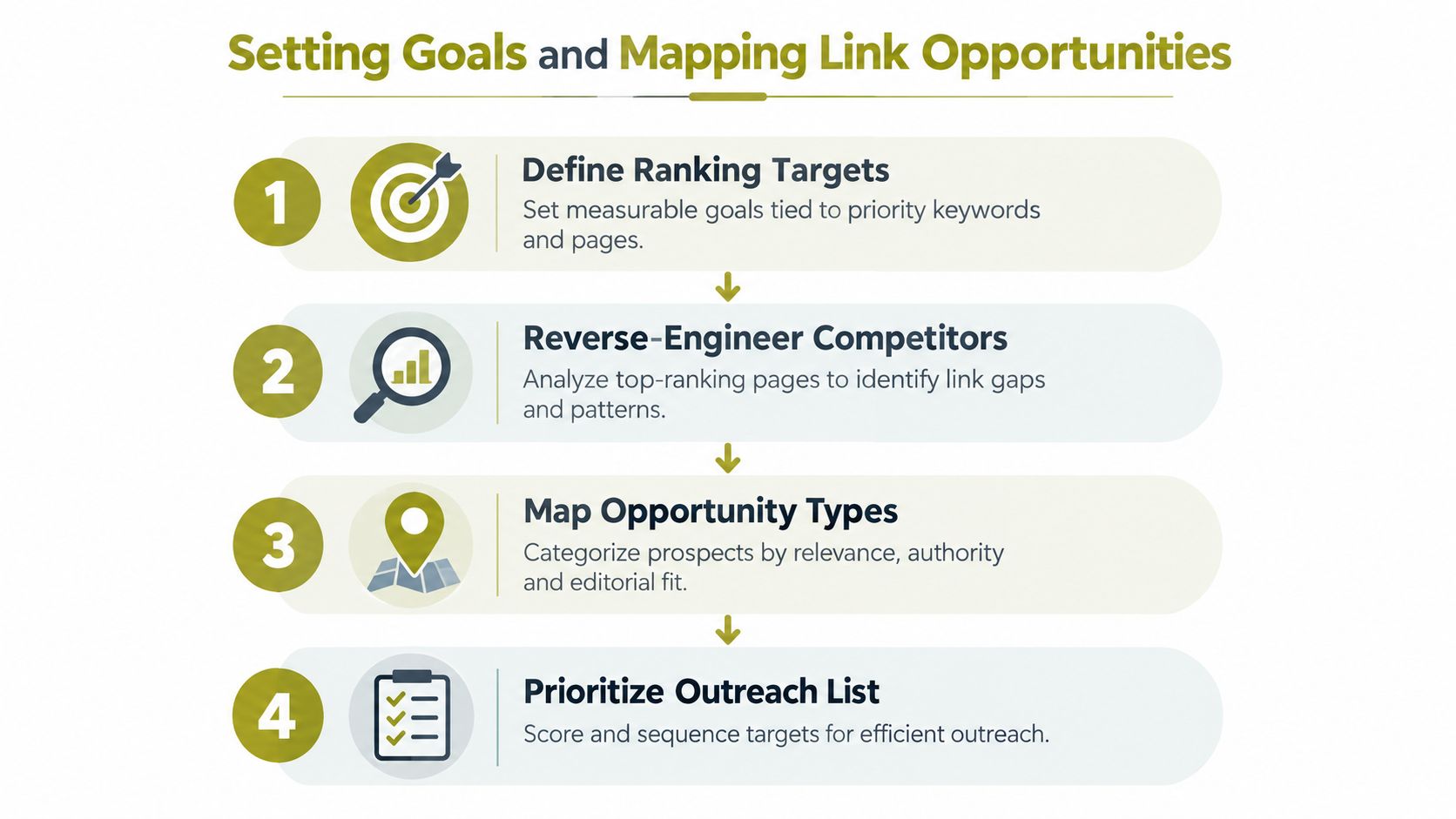
Build the opportunity map
Work through the following sequence:
Define ranking targets. List the priority pages and the queries they should serve. Don't treat every page as equally important. Concentrate effort where stronger visibility would produce a meaningful business result.
Reverse-engineer competitors. Review the pages ranking in the relevant search results and identify their referring domains, link contexts, content formats and publisher types. Look for patterns, not just totals. Several relevant trade publications may reveal a more useful gap than a large collection of unrelated blogs.
Separate link roles. Classify opportunities as editorial news coverage, expert commentary, resource inclusion, partner references, industry directories or content citations. Each category needs a different pitch and carries a different level of editorial control.
Score prospects. Give priority to sites with genuine relevance, recognisable editorial standards, useful audiences and a natural reason to cite the target page. A smaller, carefully qualified list will usually outperform a large database of weak prospects.
Make the asset the centre
Outreach becomes much easier when the destination page offers something a publisher can't recreate quickly. That might be original analysis, a clear methodology, a useful calculator, a well-structured guide, an expert-led explanation or a visual that makes complex information easier to understand.
Before contacting anyone, ask three questions:
- What is new here? A rephrased version of existing advice rarely gives an editor a reason to include it.
- What can another writer cite? Strong assets contain a finding, framework, definition or resource that improves someone else's page.
- Which audience benefits? The answer should describe a reader group, not merely the brand's target customer.
The result should be a ranked opportunity map, not an arbitrary link quota. Measure progress against the competitor profile and the visibility of priority pages. A backlink campaign is working when it improves the authority and discoverability of important content, not merely when a dashboard contains more rows.
Choosing Between PR-Led and Content-Driven Links
PR-led and content-driven acquisition both earn valuable links, but they solve different problems. PR-led campaigns create a reason for journalists to cover a business now. Content-driven assets create a reference point that publishers can use repeatedly over time.
A PR campaign suits a business with a credible spokesperson, a timely issue, original evidence or a strong human angle. It can generate coverage across online, print and broadcast channels, while the resulting mentions may also expose the brand to audiences who won't find it through search alone. The constraint is news value. A company announcement that matters only to the company won't travel far.
Content-led work suits businesses that can explain a difficult topic better than competitors, produce useful research or create a resource that helps an audience. It takes more preparation, and the first round of outreach may be slower, but a well-built asset can continue earning references after the initial campaign ends.
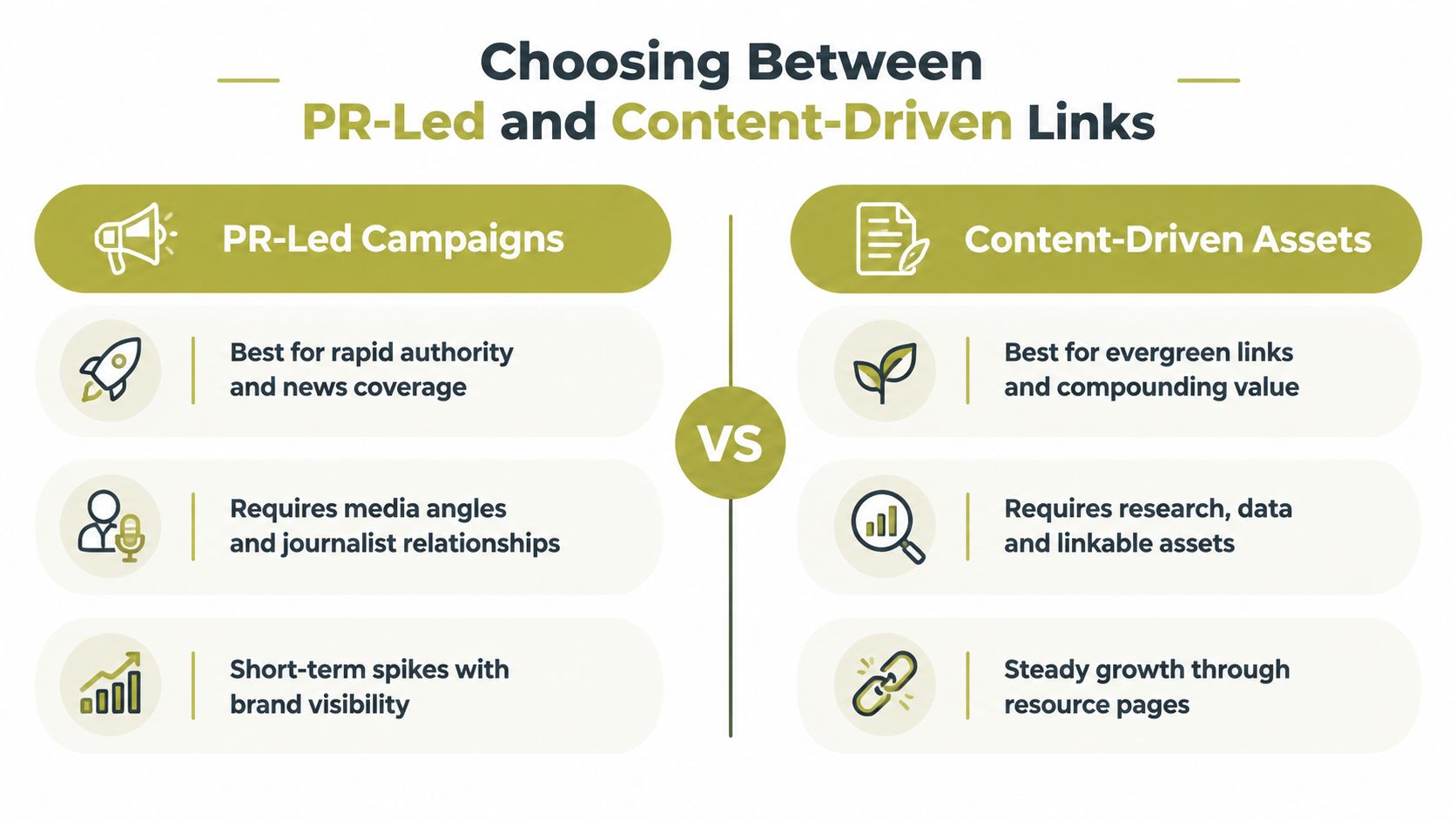
Compare the trade-offs
| Route | Where it works | What it demands | Common failure |
|---|---|---|---|
| PR-led campaigns | News coverage, expert commentary, data stories and broadcast opportunities | A credible angle, responsive spokespeople and targeted media relationships | Pitching a promotional announcement as news |
| Content-driven assets | Resource pages, industry references and evergreen editorial links | Research, useful presentation and a page worth citing | Publishing a generic guide and waiting for links |
| Guest-post marketplaces | Rarely appropriate as a core strategy | Careful quality control and a genuine editorial fit | Buying placements for metrics rather than readers |
The economics require judgement. UK data places the average digital PR link at about £610, compared with lower averages for marketplace guest posts, but the cheaper route comes with serious quality concerns. The same UK roundup reports that 96.2% of guest-post-selling sites are low quality (outreach and link-quality data). A low price is no bargain if the placement contributes no relevance or creates profile risk.
Why newsroom experience matters
A former journalist knows how an editor evaluates a pitch. They can distinguish a genuine story from a sales message, identify the strongest line in a data set, anticipate the questions a reporter will ask and prepare a spokesperson to answer them clearly. That craft is difficult to reproduce with a generic outreach template.
Carlos Alba Media's specialist nature is explicit. Everyone who works for the company is either a former national news journalist or has agency experience working with international brands, supporting a model built on newsroom and global-brand experience rather than generic PR staffing (Carlos Alba Media's B2B public relations expertise).
That positioning isn't unique to one provider. Citypress describes a team that includes ex-journalists and sector specialists, using former journalists for media and presentation training and sector specialists to raise executive profiles across traditional and social channels (Citypress reputation management). Shout! Communications says every team member has worked for regional and national broadcasters, including BBC, ITN, GMB, Sky and Global, and connects that background with securing broadcast coverage (Shout! Communications).
For a small business, the choice isn't always either PR or content. A research asset may provide the evidence, while PR expertise turns it into a timely story. The mistake is running both routes without a hierarchy. Decide whether the primary objective is rapid coverage, evergreen citation value or a deliberate combination, then build the asset and outreach process around that decision. For a useful explanation of the wider media value beyond links, see what earned media means.
Outreach That Actually Earns Editorial Links
Most outreach fails before the email is sent because the list is wrong. A journalist covering Scottish tourism shouldn't receive a pitch about a software feature, and an editor who publishes technical explainers won't value a vague announcement about company growth.
The UK average reply rate across 51 million outreach emails is 3.59%, while digital PR pitches receive under 1% replies, according to a UK link-building roundup (UK outreach benchmarks). Those figures make quality control essential. A campaign can't rely on volume to compensate for weak relevance.

Qualify before you pitch
Build a focused media and publisher list by checking:
- Beat and audience: Read recent articles and confirm that the contact covers the subject, geography or sector.
- Editorial fit: Check whether the site publishes original reporting, expert contributions, research or resource content.
- Link context: Decide where a link would help the reader. Don't make the link itself the entire purpose of the pitch.
- Authority signals: Look for real editorial activity, relevant content and evidence of an audience. Domain metrics can support judgement, but they shouldn't replace it.
- Contact quality: Identify the journalist, editor or content owner who can make the decision. Generic inboxes are sometimes necessary, but they shouldn't be the default.
Lead with the story, not the company. “New research reveals how independent retailers handle rising delivery expectations” gives an editor a possible article. “We're a retail consultancy offering expert services” gives them an advert.
A strong pitch usually contains a specific subject line, one clear news hook, the most useful evidence, the available expert and a direct explanation of why the audience would care. Remove every sentence that exists only to praise the recipient or promote the sender.
Newsroom test: If the email were forwarded without the company name, would the angle still sound like a story?
Follow up without becoming noise
Use one concise follow-up when the story remains timely. Add useful information, such as a new comment, a clearer data point or an available interview slot. Repeating “just checking in” doesn't improve the pitch and can damage the relationship.
For founders who are new to the process, this backlink guide for indie developers offers a useful perspective on building links around relevance and genuine value rather than indiscriminate volume. The principle applies across sectors, even when the publication list and subject matter differ.
The same discipline applies to guest posts. Reject sites that publish unrelated articles, carry obvious paid-placement signals or show little evidence of editorial control. A link from a relevant specialist publication can support authority and referral discovery. A series of thin placements may leave the profile looking manufactured.
This short video can help teams visualise the difference between promotional outreach and a story-led approach:
The practical objective is not a high reply rate in isolation. It's a qualified conversation that leads to coverage, an editorial mention or a useful relationship. For more guidance on turning a credible angle into coverage, use Carlos Alba Media's press coverage guidance.
Technical Foundations and Risk Management
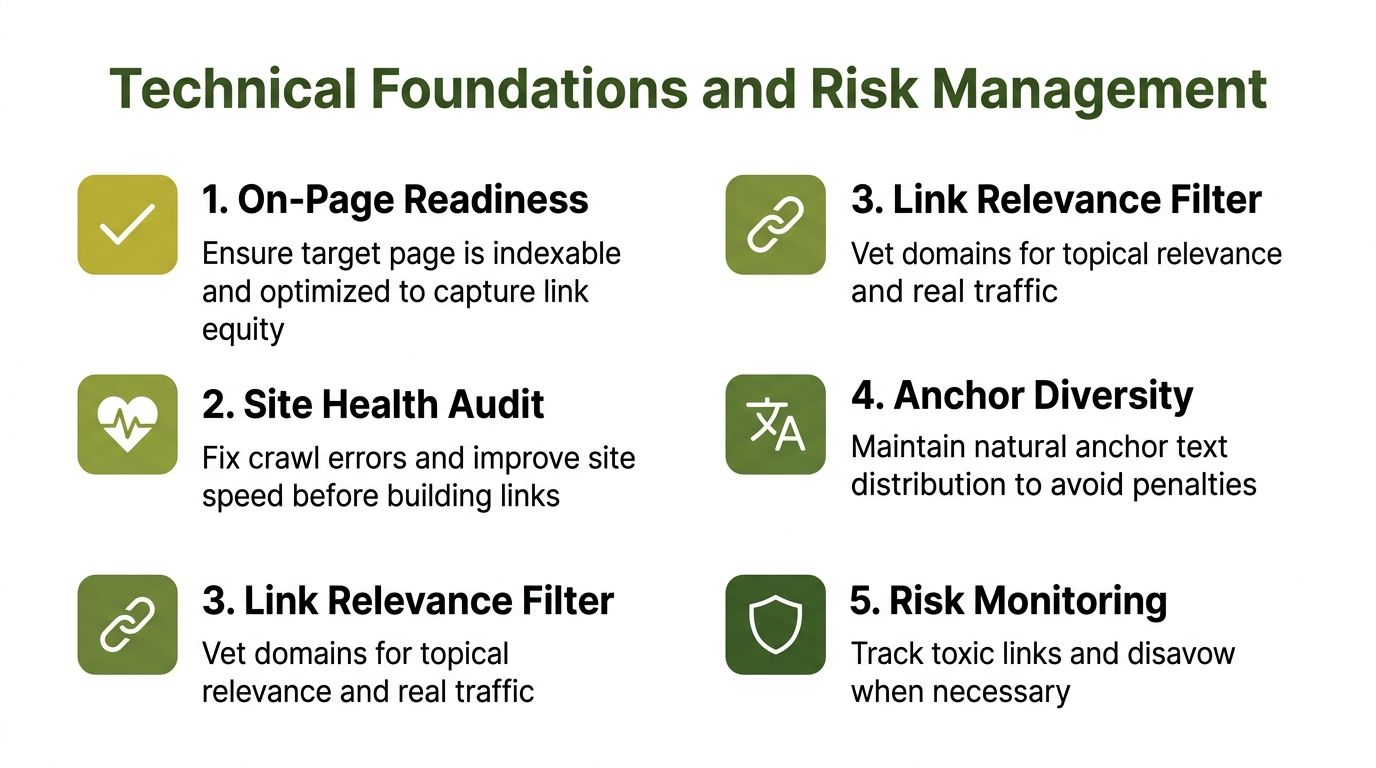
A link can't rescue a page that search engines can't index, users can't use or the business can't convert. Before outreach begins, confirm that the target URL is indexable, internally linked, aligned with search intent and capable of answering the question implied by the query.
Technical readiness also includes site health. Fix crawl problems, broken internal pathways, poor mobile presentation and serious performance issues before sending traffic and authority to the page. A publisher may provide the opportunity, but the website has to turn that opportunity into useful engagement.
Keep the profile natural
Anchor text should describe the destination where appropriate, but a healthy profile won't force the same commercial phrase into every placement. Branded references, natural URLs, descriptive wording and varied phrasing usually reflect how independent publishers write.
Assess each prospective domain for:
- Topical relevance: Does the site cover the subject or an adjacent audience?
- Editorial behaviour: Does it publish useful material with clear ownership and standards?
- Page context: Would the link help a reader understand, verify or explore the point?
- Traffic and engagement evidence: Can the site demonstrate more than a collection of indexed pages?
- Outbound-link patterns: Does it link selectively, or does every article appear to sell placements?
A PDF can be an effective asset when it contains research, a practical framework or a useful briefing that other publishers may cite. Teams creating one should also consider how to create a trackable PDF URL, so shared documents can contribute to a clearer measurement process.
Monitor retention and risk
Link acquisition is only part of the operation. Check whether important links remain live, whether the destination URL still works, whether the surrounding page has changed and whether the anchor has been edited. A UK backlink analysis reports that pages with backlinks generated 14.4 times more organic clicks than pages without backlinks, and found a 0.74 Spearman correlation between referring-domain count and ranking positions 1 to 30 (UK backlink analysis). Those findings support measurement, but they don't justify accepting every link available.
The same analysis reports that brands gained an average of 4.7 new referring domains per month on ranking pages and lost 1.4% of backlinks monthly, implying a 16.8% annual cumulative loss rate (UK backlink analysis). Because the source URL has already been used in this section, treat those figures as an operational reminder: retention deserves a place in the monthly review.
Disavow isn't a routine clean-up button. Investigate the source, assess whether the link is manipulative or harmful, document the reasoning and use the appropriate Google process only when the evidence supports it. The safest risk policy is to reject dubious placements before they enter the profile.
Measuring Impact and Scaling the Operation
A backlink dashboard should connect activity to business outcomes. Track new referring domains, the relevance of acquired links, the pages receiving them, ranking movement for priority queries, organic clicks and referral visits. Review whether coverage also creates branded search interest, enquiries or useful introductions.
The UK backlink analysis found that top-position pages had 4.2 times more referring domains than pages ranking positions 2 to 10 (UK backlink analysis). That doesn't create a universal target for every SME. It shows why competitor comparison is more useful than a fixed quota, particularly in markets where a small number of authoritative publishers shape visibility.
Use a practical operating rhythm
A focused 90-day programme can follow this pattern:
- First phase: Audit the site, select priority pages, analyse competitors and approve one or more citation-worthy assets.
- Second phase: Build a qualified journalist and publisher list, prepare spokesperson material, and begin targeted outreach with clear angles.
- Third phase: Review coverage, referring-domain quality, ranking movement, referral activity and link retention. Refresh the asset or angle based on evidence.
Keep routine monitoring and relationship development in-house when the marketing lead understands the niche, can respond quickly and has enough time to maintain quality. Bring in specialist support when the story requires national media judgement, broadcast handling, research-led campaign development or access to journalists the internal team doesn't already know.
Outsourcing is common in the UK market, but the right partner should show the work behind the outcome. Ask how prospects are qualified, how assets are developed, how links are checked after publication and how reporting separates editorial coverage from low-value placements. A specialist former-journalist team adds value when it improves the story, the pitch and the spokesperson's performance, not merely when it sends more emails.
Scale by repeating what produced relevant coverage and stopping what produced empty placements. A smaller pipeline of strong stories will protect budget, sender reputation and brand credibility better than a volume target that rewards any link at any cost.
Carlos Alba Media combines digital PR, media relations, SEO content and strategic link building for start-ups, SMEs and established organisations across Scotland, the UK and internationally. If your business needs newsroom-led campaign ideas, credible media outreach and a backlink strategy built around measurable commercial pages, visit Carlos Alba Media to discuss the right approach.