
The most popular advice about content marketing on social media is also some of the least useful: post consistently, chase engagement and be present everywhere. That formula keeps a publishing calendar busy, but it doesn't necessarily create trust, qualified enquiries or repeat business. A small business can spend weeks producing polished posts while attracting the wrong audience, measuring the wrong behaviour and giving prospective customers no compelling reason to act.
A better approach treats social media as a newsroom and discovery environment, not a broadcast megaphone. The strongest content answers a real question, proves a point, explains a complex issue or gives a customer enough confidence to take the next step. That requires editorial judgement, audience segmentation and measurement discipline, especially when production resources are tight.
Why Most Social Content Marketing Fails Before It Starts
Likes and comments are visible, which makes them tempting to use as a shorthand for success. They're also incomplete. A prospect may watch a video to the end, save an explanation, share it privately, search for the brand later or visit the website without leaving a public reaction. Those actions can carry more commercial meaning than a casual comment.
Recent UK evidence supports this shift towards quieter behaviour. Social media remained widely used among adult internet users, with 89% using at least one platform, while the proportion actively posting, sharing or commenting fell to 49%, from 61% in 2024, according to reporting on Ofcom findings by IBC. A passive audience isn't necessarily an uninterested audience. It may be researching privately, particularly in B2B, regulated or high-trust sectors.
Stop treating attention as the end goal
The first question shouldn't be, “How do we get more engagement?” It should be, “What should a relevant person understand, remember or do after seeing this?”
That answer determines the content. A financial adviser might need a concise explanation of a confusing rule. A hospitality business might need a visual demonstration of an experience. A technology founder might need a clear point of view on a problem customers already recognise. None of those objectives depends on manufacturing conversation for its own sake.
A credible content system connects each post to a stage in the customer journey:
- Discovery: Make an unfamiliar audience aware of a problem or useful perspective.
- Evaluation: Provide evidence, explanation, customer proof or specialist insight.
- Action: Offer a clear next step, such as a qualified enquiry, booking or consultation.
- Retention: Help existing customers use the service well and remember why they chose it.
Practical rule: If a post earns attention but can't support a customer decision, it may be content activity rather than content marketing.
Build for silent intent
Passive audiences need content that works without public interaction. Use searchable wording, strong demonstrations, concise captions and visible proof. Invite private action where appropriate, such as sending a message, visiting a landing page or saving a practical guide.
Newsroom discipline helps here. Editors don't publish just because a story fills a slot. They assess relevance, evidence, clarity and consequence. The same test applies to a social post. Before approving it, ask whether the claim is supportable, whether the opening gives people a reason to continue and whether the conclusion tells the right audience what to do next.
Production speed still matters, but volume shouldn't replace judgement. For teams that need to produce polished video without turning every post into a major production, create studio-quality videos fast can help with the execution layer. The editorial decision remains human: which story deserves attention, what evidence supports it and why should the audience trust the organisation behind it?
Choosing the Right Platforms for Your UK Audience
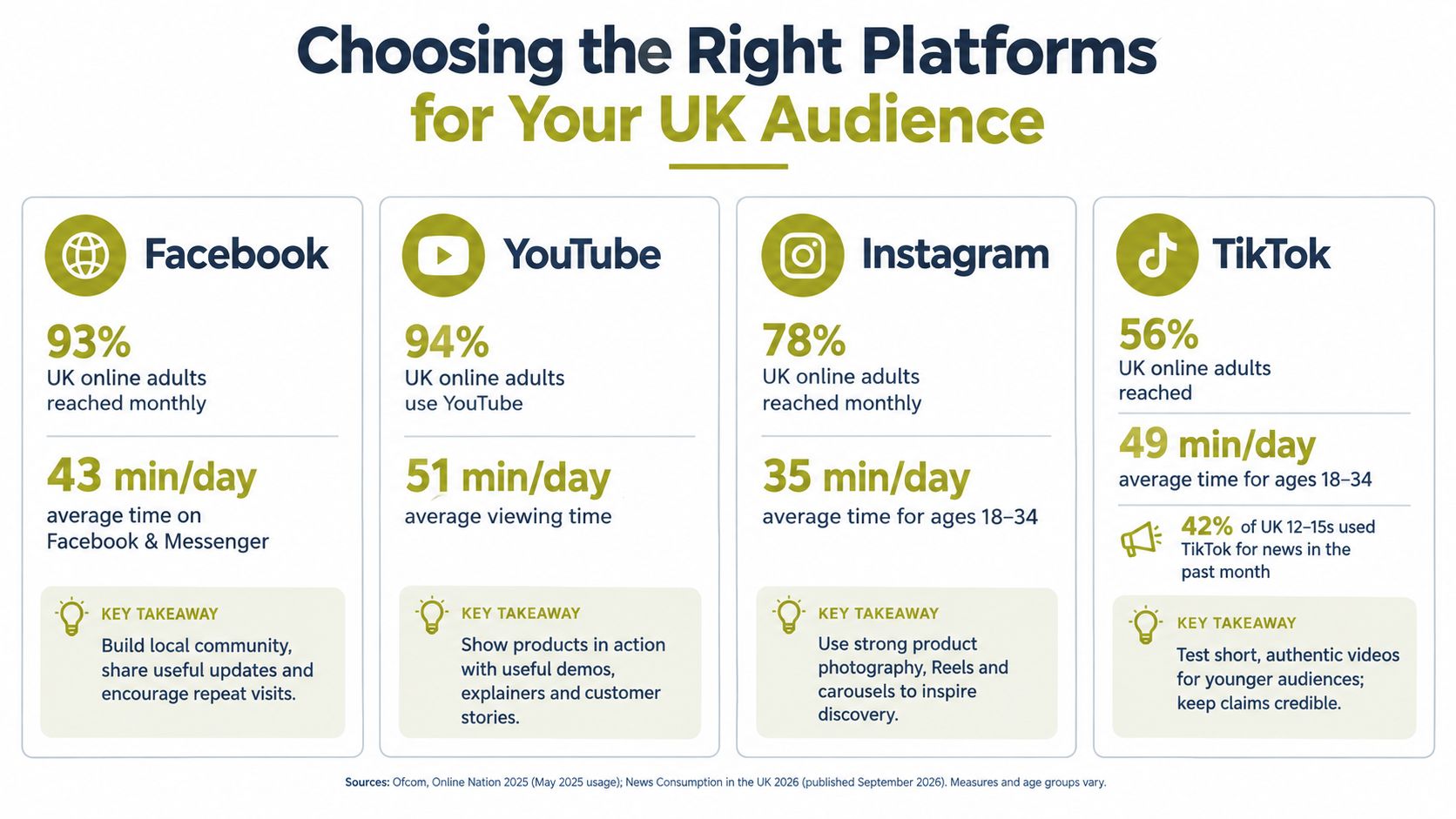
Platform selection should begin with the customer, not the network that happens to be fashionable. Ofcom's 2025 data shows that YouTube reached 94% of UK online adults in May 2025, while Facebook and Messenger reached 93%, WhatsApp 90% and Instagram 78%. Reported average daily usage was 51 minutes for YouTube, 43 minutes for Facebook and Messenger and 20 minutes for Instagram, as summarised by Giraffe Social Media.
Those figures don't mean every SME should publish everywhere. They show why reach, audience fit and format need to be considered together.
Match the channel to the audience
Facebook remains important for broad adult reach and local visibility. Ofcom found that 30% of UK adults used Facebook for news, and Facebook was used by 58% of adults who used social media for news. That makes it useful for community-led businesses, mature audiences, local events and content where credibility matters.
YouTube offers the broadest measured reach in the data above and the highest reported daily usage time. It suits explainers, demonstrations, interviews, customer education and searchable video that can continue working after publication. A well-structured video can answer a question in depth, then provide material for shorter platform-native edits.
Instagram's visual environment favours strong creative direction, concise storytelling and product or place-led content. It can work well for hospitality, tourism, design, retail and founder-led brands, but the format needs to earn attention quickly. A link copied from another platform won't automatically become a good Reel or carousel.
TikTok's trajectory shows why platform planning can't rely only on historical assumptions. Ofcom reported that TikTok reached 11% of UK adults for news in 2025, up from 1% in 2020, while three-quarters of 16 to 24-year-olds used social media for news. Younger audiences also used online platforms or social media more broadly at a much higher level than older groups. The implication is practical: mobile-first video and native storytelling may be essential for younger customers, but they shouldn't be imposed on every audience.
For a broader view of how audience behaviour is changing, review these social media marketing trends, then reduce the findings to a decision your team can execute. Choose one primary platform, one supporting channel and one commercial objective before adding more.
Building a Platform-First Content Workflow
A small team doesn't need an endless stream of original ideas. It needs a repeatable way to turn one strong idea into several useful executions without making each version feel copied.
Start with the business outcome
Begin with one commercial objective. It might be qualified enquiries, event bookings, consultation requests or visits to a specific service page. Don't start with “we need more content”. That instruction is too broad to guide decisions.
Select the primary platform according to the audience and the content's natural strength. Then create one core asset, such as an expert interview, customer story, demonstration or newsroom-style explainer. That asset becomes the source material, not a finished post to paste everywhere.
The adaptation stage is where teams either create efficiency or create clutter. A long-form video may become a shorter YouTube cut, a vertical Instagram edit, a discussion-led Facebook post and a direct follow-up through WhatsApp where consent exists. Each version needs its own opening, captions, aspect ratio and call to action.
Reach tells you who might have seen the message. Conversion events tell you whether the message did useful work.
Adapt the story, not just the file
A platform-native edit changes the editorial emphasis. On YouTube, the title and opening should answer the searcher's question. On Instagram, the first frame and visual sequence need to carry more of the meaning. On Facebook, context and discussion can matter more, particularly for local or mature audiences. A WhatsApp follow-up should be direct, relevant and permission-based.
Track platform-specific actions instead of treating every response as equivalent. Record qualified clicks, enquiries and assisted conversions alongside reach. A post can be commercially valuable even if it doesn't generate public discussion, while a highly shared post can fail if the landing page doesn't support the promise made in the creative.
Teams scaling from one core asset can also benefit from practical smart content scaling tips, provided automation supports a clear editorial system rather than encouraging indiscriminate publishing. A written strategy should define the audience, objective, evidence and approval route. Guidance on how to create a content marketing strategy can help turn those decisions into an operating plan.
Using AI Without Losing Credibility
AI can reduce repetitive work, but it can't take responsibility for a brand's judgement. That distinction matters whenever a business publishes advice, claims, commentary or information that could affect its reputation.
A 2025 survey reported that 72% of new UK SMEs planned to use AI for marketing, while 92% considered technology essential for growth, according to the Constant Contact Small Business Now Report. At the same time, Ofcom-related reporting found that 56% of UK adults were less trusting of AI-written news than human-written material. The second statistic concerns news, but the trust issue applies to brands publishing advice or reputation-sensitive content too.
Automate the production layer
AI is well suited to organising research notes, transcribing interviews, proposing content variations and repurposing approved material. It can help a small team turn a recorded conversation into a draft transcript, a set of social hooks and a list of questions for further review.
It shouldn't decide what a company can safely claim. Human ownership needs to remain visible in positioning, fact-checking, local relevance, customer evidence, disclosure decisions and final approval. A generic sentence may be grammatically clean while still being wrong for the audience, legally risky or indistinguishable from every competitor's content.
Tools such as AI writing tools for creators can support ideation and drafting, but the workflow should make the review stage unavoidable. Give the system source material, define the audience and require an editor to challenge unsupported assertions. Original interviews, founder explanations and verified customer evidence will usually contribute more distinction than another batch of generic captions.
Compare quality, not output
Test AI-assisted and human-led formats against meaningful outcomes. Compare qualified enquiries, returning visitors, message quality and conversion rather than the number of posts produced. If AI increases output but reduces trust, clarity or lead quality, the workflow needs adjustment.
The strongest model is neither anti-AI nor blindly enthusiastic. It uses technology to remove mechanical work while keeping human judgement at the centre of the message. Audiences don't need a business to prove that every sentence was typed manually. They do need to see that someone understands the subject, checked the facts and stands behind the advice.
Measuring What Actually Predicts Enquiries
Social reporting becomes useful when it follows the customer journey rather than rewarding whatever is easiest to count. UK-specific public evidence doesn't establish a universal social-media conversion rate, so each SME needs to create its own baseline.
Start with consistent tracking. Tag every campaign link with UTM parameters and record the following separately:
- Exposure: Impressions and reach show distribution, not commercial success.
- Attention: Video completion and saves indicate whether the content held practical value.
- Intent: Qualified clicks and direct enquiries show stronger action than passive viewing.
- Influence: Assisted conversions capture content that contributed to a decision without receiving the final click.
- Economics: Cost per qualified action and revenue contribution connect activity to business performance.
Test one variable at a time
A controlled loop is more informative than a stream of unstructured experiments. Change one factor, such as the opening three seconds, creative angle, headline, audience or landing page. Keep the rest stable enough to understand what caused the result.
Published benchmark summaries sometimes report average business-account engagement of approximately 0.45% on Instagram and 0.15% on Facebook, but those figures aren't UK-specific and may calculate engagement by followers, reach or impressions. The ProfileTree discussion of social media marketing effectiveness illustrates why benchmark figures should be treated as directional diagnostics, not targets. Check the date, sample, platform and denominator before using any external comparison.
A high-impression, low-click pattern is especially revealing. It usually points to weak relevance, an unclear offer or a mismatch between the post and the landing page. Don't respond automatically by increasing the budget. First check whether the creative attracts the right audience and whether the page delivers what the post promised.
Build a dashboard people can act on
A defensible dashboard segments results by:
- UK geography: Separate local performance from national distribution.
- Audience type: Distinguish prospects, existing customers, partners and other groups.
- Content theme: Compare education, proof, opinion, product information and community content.
- Distribution: Separate organic activity from paid promotion.
- Customer path: Follow exposure through click, enquiry, qualification and conversion.
This approach also prevents passive consumption from disappearing from the record. Combine platform analytics with tagged links, enquiry-source questions, CRM records and periodic brand-search or customer surveys. A prospect who says, “I've been following your explanations for a while,” may not appear in the comment count, but their behaviour can still be captured if the organisation asks the right question.
For more detail on interpreting the signals, use this guide to measure social media engagement. The goal isn't to produce a more elaborate report. It's to identify which subjects, formats and audiences create qualified commercial movement, then give those areas more disciplined attention.
Applying Newsroom Discipline to Social Content Marketing
Credibility improves production. Teams that can find a strong angle, verify a claim, understand media law and explain a complex issue clearly tend to produce more useful social content than teams focused on visual polish alone.
Written evidence submitted to the UK Parliament by the National Council for the Training of Journalists states that 81% of UK journalists hold a journalism qualification, while just over 80% hold an NCTJ qualification. That training develops practical skills social teams use every day, including newsgathering, verification, editorial standards and responsible presentation.
Every specialist at Carlos Alba Media is a former national news journalist or has agency experience with international brands. That background shows up in how the team finds timely angles, questions weak evidence, meets deadlines and adapts one story for online, print, broadcast and social environments.
UK journalism now operates across several channels. Reuters Institute research found that UK journalists produced journalism for just over five distribution platforms on average at least occasionally, and for nearly three platforms regularly, in a survey conducted in September to November 2023. The same research reported that 84% had a main employer with a legacy-media background. Permanent contracts had fallen from 74% in 2015 to 65% in 2023, while freelancing had risen from 17% to 28%, as shown in the Reuters Institute executive summary. Editorial judgement therefore needs to work alongside distribution skills.
For a regulated organisation, founder-led company or high-trust service, accurate and distinctive content can outperform generic volume over time. The commercial asset is a useful body of explanations, evidence and recognisable expertise that helps customers assess the business before making contact.
Carlos Alba Media develops data-led social media campaigns, platform-specific copy, visuals and video that connect content with customer action. If your SME needs newsroom-grade storytelling, measurable distribution and senior-level PR or digital marketing support without a large-agency structure, visit Carlos Alba Media to discuss your audience, objectives and next campaign.