
You opened an Instagram account on Monday, a TikTok on Tuesday, and by Friday you're staring at five empty profiles wondering what to post. Your competitor posts daily. A larger brand has a polished video team. You're running sales, service and payroll yourself.
Stop opening accounts. Learning how to start social media marketing properly means choosing fewer platforms, tying every post to a commercial job, and building a system you can still run in your busiest week.
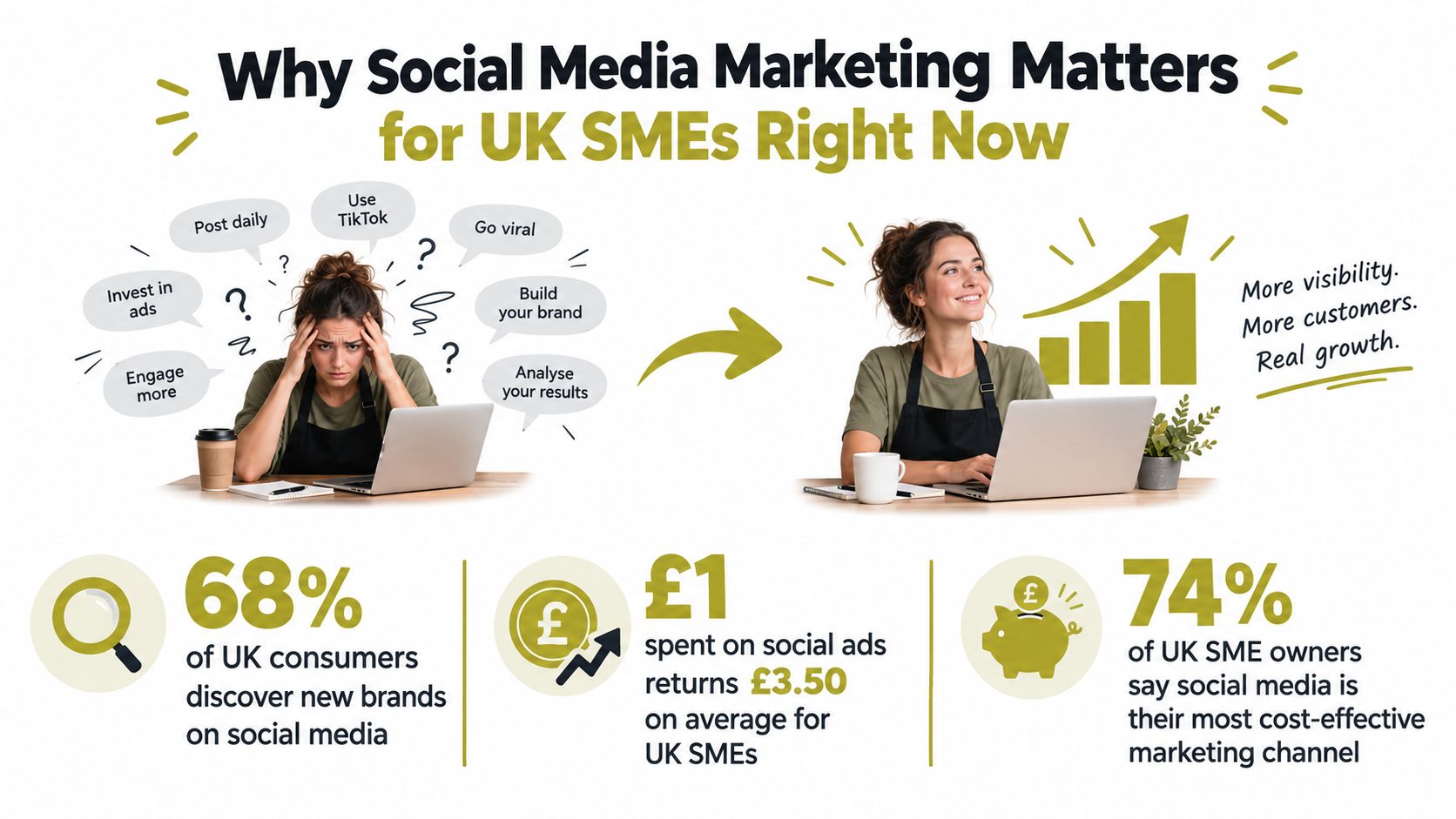
Why Social Media Marketing Matters for UK SMEs Right Now
Most founders don't lack ideas. They lack a filter. Advice tells you to post daily, chase trends and copy brands with far bigger teams. That wastes the two resources you can't replace, time and attention.
Treat social media as a measurable marketing investment, not a free noticeboard. IAB UK Digital Adspend reporting shows the UK social media advertising market reached £11.5 billion in 2025, up 21% year on year and now 28% of the country's £40.5 billion digital advertising market, with social video alone accounting for £6.8 billion and growing 27%. Big budgets aren't your benchmark, but that scale tells you buyers are being reached, influenced and retargeted here every day.
What a Credible Start Looks Like
You need one commercial objective, one clearly defined audience and a controlled test budget before you publish. If you sell locally, that objective might be quote requests from within your service area. For hospitality or tourism, it's direct bookings. For a B2B service, it's qualified calls, not followers.
Set the budget like a test, not a bet. Decide what a qualified enquiry is worth, what you'll spend to learn, and when you'll stop or scale. If you want practical examples of focused paid formats before you spend, see Rapid Ads' best small business ads for context on how smaller advertisers structure their offers.
Practical rule: If a post has no intended next step, don't publish it.
Social is now a buying environment. People check your feed to judge whether you're active, credible and safe to contact, often before they visit your website. A dormant profile creates doubt. A focused profile with recent expertise, proof and a clear enquiry route does commercial work while you're serving customers.
Your starting strategy should therefore be narrow by design. Pick the outcome, prove you can track it, publish content that supports it, and ignore everything else until the basics produce enquiries. That's discipline, and it's where smaller firms can beat larger, unfocused rivals.
Defining Your Audience and Commercial Objective
Don't choose a platform until you can finish this sentence. We need more of X, from Y, in Z location, taking this specific action. If you can't finish it, you're not ready to post.
Pick one commercial objective for your first test period. Qualified enquiries, bookings, demonstration requests, investor attention or newsletter sign-ups are all valid, but you can't optimise for all of them at once. Each points to different content, landing pages and calls to action.
A One Week Audience Routine
Start with customers you already have. List your best recent buyers and note their sector, location, company size or life stage, how they first found you, and what problem triggered the purchase. Then interview a small number directly. Ask what nearly stopped them buying, what they compared you against, and which words they used to describe the problem.
- Buying stage: Are they unaware of the solution, comparing suppliers, or ready to book a call this week?
- Location and sector: Separate local demand, Scottish demand and wider UK demand so you don't blend very different markets.
- Questions they already ask: Mine enquiries, sales calls, reviews and search queries for repeated objections and phrases.
- Trust barrier: Identify what proof they need before contacting you, such as credentials, case evidence, price guidance or a named expert.
Formalising this into a usable profile matters, and structured buyer persona development gives you a reference point when you brief content, rather than relying on memory or gut instinct.
Why Discovery Has Changed
Your audience increasingly meets organisations through intermediaries, not homepages. Ofcom's 2025 UK news consumption research found six in ten UK adults use an online intermediary such as a search engine or social media service for news, with Facebook reaching 58% of adults overall and 30% for news, while TikTok news reach climbed from 1% in 2020 to 11% in 2025. Discovery habits shift, so review your assumptions regularly.
Now connect the objective to your website and CRM. Create a landing page for the offer, define the conversion event, and make sure enquiries are tagged by source before launch. Without that plumbing, you'll argue about impressions later.
Close the exercise by choosing two or three content themes that prove expertise. A Scottish technology firm might use implementation pitfalls, security questions and buyer checklists. A hotel might use local expertise, guest proof and direct booking value. If a theme doesn't help your defined buyer move towards the objective, cut it, however interesting it feels internally.
Choosing Platforms by Customer Journey, Not Popularity
You're not short of platforms. You're short of capacity. UK SME social media usage research from iwoca shows 97% of surveyed SMEs already use social media for business, with Facebook at 69%, Instagram 67%, YouTube 63%, WhatsApp 58% and LinkedIn 52%. Fragmented activity is the problem, not access.
Choose one primary channel and one supporting channel for a 90 day test. The primary channel is where your buyer discovers or evaluates suppliers. The supporting channel either retargets that audience, handles enquiries, or holds longer form proof. Everything else stays dormant, claimed for brand protection but not fed weekly.
Matching SME Goals to UK Social Platforms
| Commercial Goal | Best-Fit Primary Platform | Supporting Channel | Typical Content Format |
|---|---|---|---|
| Local enquiries and bookings | Short video, local proof, offers | ||
| B2B decision maker leads | YouTube | Founder insight, explainers, case evidence | |
| Visual product or venue sales | TikTok | Reels, demonstrations, customer stories | |
| Search led education | YouTube | Tutorials, walkthroughs, retargeted clips | |
| Repeat business and service | Updates, reminders, direct replies |
Use the table as a starting filter, then apply your own constraints. WhatsApp is useful for enquiries and repeat business, but only publish the number if someone can reply quickly. LinkedIn fits a technology firm selling to decision makers, and a focused launch sequence matters there, which is why a LinkedIn teaser video strategy can help you plan native video rather than dumping a corporate film into the feed.
The Decision Framework
Score each candidate platform against five factors. Your audience presence, sales cycle length, content capacity, trust requirements and the action after the post.
If your sales cycle is long, you need content that sustains credibility over months, not just reach this week. If your offer is visual and bought on impulse or short research, short video and retargeting matter more. If buyers need internal approval, produce material they can forward to a colleague, not just consume alone.
Stop feeding any channel that produces no qualified action and eats production time you don't have.
Also define what you'll stop. Close the weekly cross posting habit. Identical posts everywhere signal you're automating, not communicating. Produce a platform native version for your two chosen channels, or don't use the channel at all. YouTube reached 94% of UK online adults in May 2025, Facebook and Messenger 93% and WhatsApp 90%, according to Giraffe Social Media's UK social media statistics, but broad reach doesn't mean your buyers are actively posting or buying there. Journey fit beats headline popularity every time.
Building a Content System Around Three Pillars
Ad hoc posting dies by week three. You need a repeatable system that turns what you already know into content without a daily brainstorm.
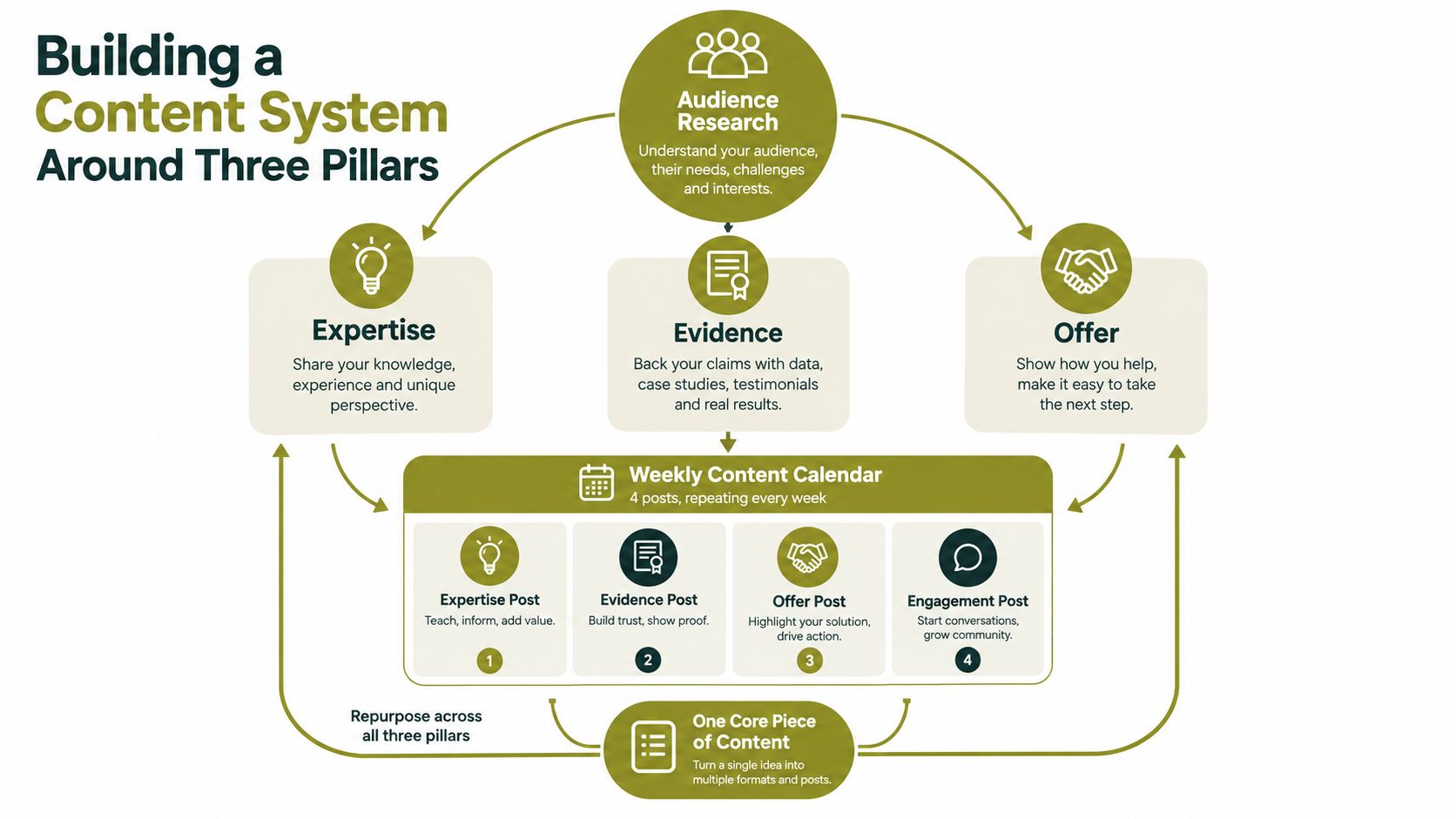
Use three pillars. Expertise teaches the buyer something useful. Evidence proves you can deliver. Offer makes the next step explicit. Most SMEs overproduce offer content, then wonder why nobody engages. Lead with expertise and evidence, so the offer lands with trust already built.
Turning One Idea Into a Week of Content
Start with one core story. A founder records a short explanation of a costly mistake customers make. That becomes a video for your primary channel, a carousel with the key steps for Instagram or LinkedIn, a quote graphic only if it adds clarity, and a hook led clip cut from the same recording for Reels or TikTok. You're reshaping, not repeating.
A workable weekly pattern for a one or two person team is simple. One expertise post, one evidence post, one offer post, and one engagement or behind the scenes post if capacity allows. Batch filming into a single session. Write briefs that state the audience, the single point, the proof and the call to action, so quality doesn't depend on who is available that day.
Why Newsroom Discipline Improves Social Content
Journalists are trained to find the specific, provable angle and cut the rest. The Reuters Institute survey of UK journalists covering 1,130 journalists found 57% worked on or supervised a specific news beat or subject area. That specialist habit is exactly what generic marketing copy lacks. It forces you to understand a sector, an audience and what is new or useful before you write a word.
Apply that discipline to every brief. What's the claim, what's the evidence, why should this buyer care now? Customer stories work because they answer those questions. Founder explainers work when they give a clear point of view, not a summary of your brochure. Behind the scenes material works when it shows craft, standards or people, not filler from the office.
Write in human language. Say what you'd say to a customer in your premises or on a call. If a caption reads like a legal department approved it, rewrite it. Specificity builds authority faster than volume.
Scheduling, Response Capacity and Paid Promotion
Publishing is the easy part. Operating the channel when people reply, complain or ask for prices is where SMEs get caught out.
Here's a practical view of the planning layer that keeps posting, notifications and responses organised.
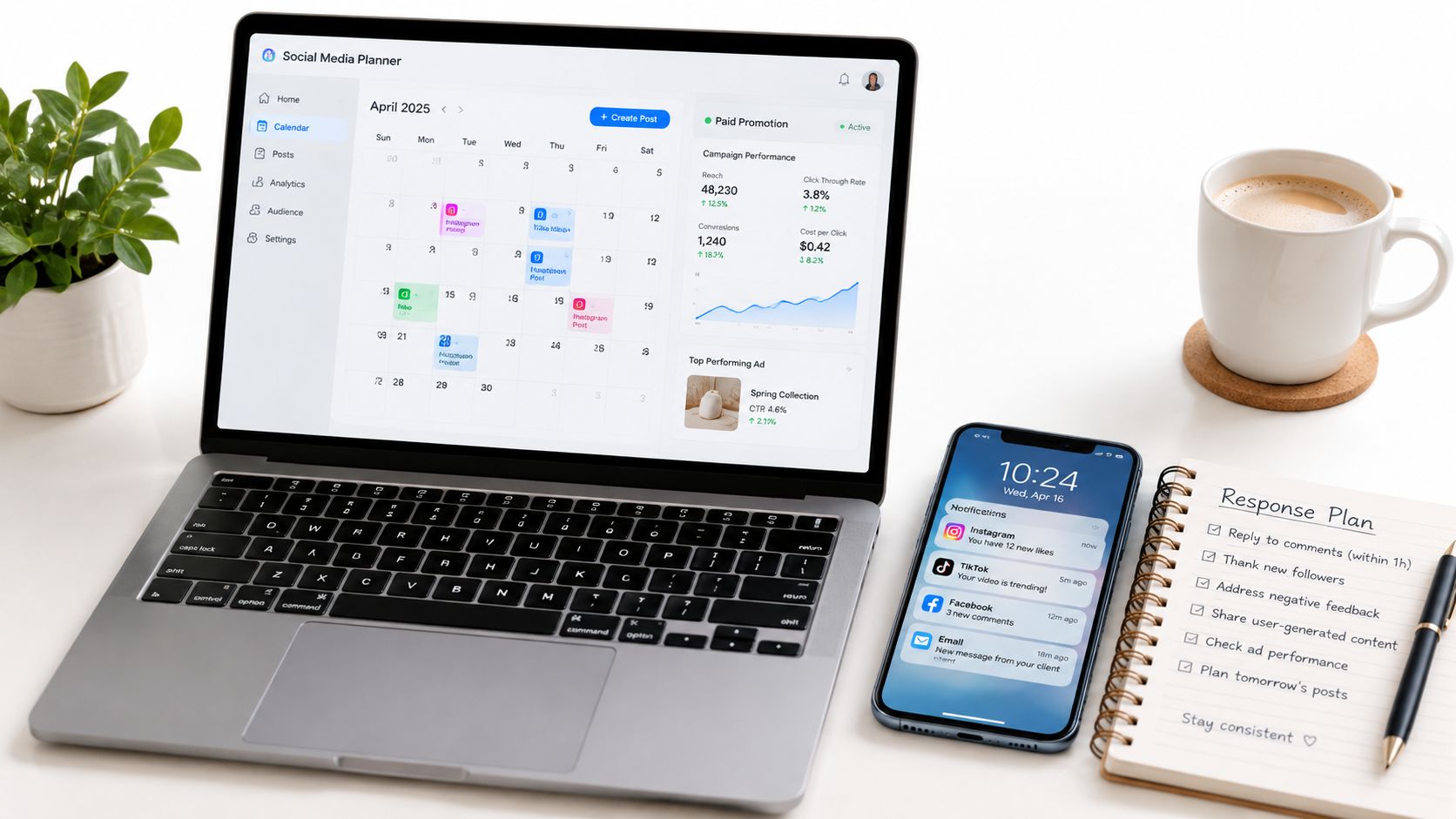
Use a scheduler such as Meta Business Suite, Buffer or Later to batch content, but don't automate conversation away. Structured community management means named ownership, daily checks and escalation routes. Set a service level target for replies during working hours, decide who handles complaints, and agree in advance what gets paused if comments reveal misinformation, safety concerns or a developing reputation issue.
Design for the Phone First
Your audience is scrolling quickly between other tasks. Advanced Television reporting on Ofcom online behaviour notes UK adults spent an average of 4.5 hours online per day in 2025, with smartphone users using around 41 apps per month. That demands mobile first creative, captions on every video, your key message in the first frame, and a short path from post to enquiry. If your landing page loads slowly or your form asks for unnecessary detail, you'll lose people you paid to reach.
The video below is worth reviewing as you plan formats, because execution details such as framing and pacing decide whether useful material gets watched.
Paid Promotion as a Controlled Test
Don't boost posts randomly. Promote content that has already produced saves, qualified clicks or strong watch time organically. Start with a small, fixed test budget, one audience, one creative variable changed at a time, and a defined conversion event installed before launch.
Retarget people who watched, visited or engaged, because they need proof and a clear offer, not another introduction. Keep organic and paid telling the same story in platform appropriate formats. Separate silos produce mixed messages and messy measurement.
If you have no response capacity on a given week, reduce posting and pause paid activity. Driving enquiries you answer slowly is worse than driving fewer enquiries you handle well. Speed and clarity close sales. Silence hands them to competitors.
Measuring Commercial Value When Reach Is Unstable
Likes are rising. Sales aren't. That doesn't automatically mean you need more posts or a bigger ad budget. You may have an offer, landing page, positioning or follow up problem.
UK SME marketing frustrations research found 27% of SMEs say changing social media algorithms obstruct marketing progress, and only 31% effectively track social media ROI. The gap is measurement, not content volume.
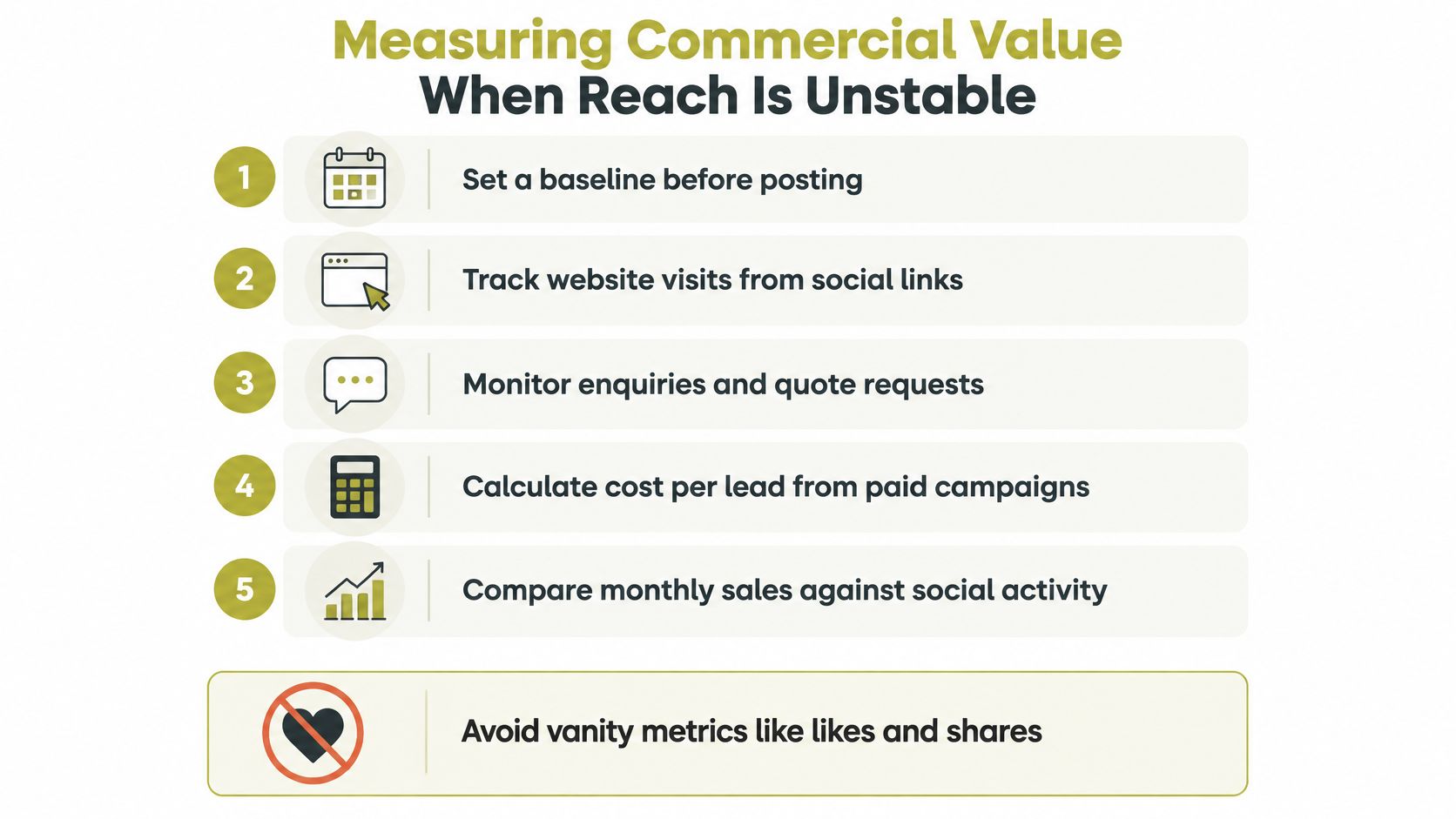
Set the Baseline Before You Post
Record current website conversions, enquiry volume, lead quality and revenue source before launch. Then use UTM parameters on every social link, campaign specific landing pages where appropriate, and event tracking for view content, form start, form submit, click to call and purchase or booking.
Understanding how to measure social media engagement properly helps you separate high value actions such as saves, shares, profile visits and link clicks from low value reactions. A comment from a genuine buyer asking about availability is worth more than broad approval from people who will never purchase.
- Tracking sheet fields: Record platform, audience, creative format, reach, frequency, link click rate, landing page conversion rate, cost per lead, qualified lead rate and closed revenue for every campaign.
- Segmentation: Split results by geography, and separate organic, paid, referral and retargeting traffic so Scottish performance isn't blended with wider UK activity.
- Assisted value: Note enquiries where social played a supporting role, including partner introductions, media opportunities and repeat bookings, not just last click sales.
A Monthly Decision Rule You Can Use
Test one variable at a time. Changing audience, creative and budget together tells you nothing about cause and effect. Optimising for cheap reach that never becomes a lead is equally wasteful.
Scale only when qualified lead cost and lead quality meet your target across at least two consecutive reporting periods.
If they don't, fix the offer, the landing page, the audience or the response flow before increasing spend. Check whether enquiries are answered quickly, whether sales follow up happens, and whether the page repeats the promise made in the post. Unstable reach becomes manageable when every campaign is judged against business outcomes you recorded from day one.
Your First 90 Days and When to Bring in Specialists
Run this as a 90 day test, not an open ended effort. In weeks one and two, finish audience research, set the objective, install tracking and build the landing page. In weeks three to six, launch organically on your two chosen channels and learn which pillar and format produce qualified actions. In weeks seven to ten, add controlled paid tests behind proven content. In weeks eleven and twelve, make a scale or pivot decision from the tracking sheet, not from a single viral post.
Bring in specialists when internal time is the bottleneck, claims need careful handling, or you're producing content but can't connect it to revenue. If partners or creators enter the plan, use a creator selection and attribution guide so selection and tracking standards are agreed before anyone posts.
Carlos Alba Media works on a specialist model where everyone in the team is a former national news journalist or has agency experience working with international brands. That matters because large UK agency groups such as WPP, Publicis Groupe, Interpublic, dentsu and Omnicom, identified in Expert Market Research UK agencies analysis, operate with multinational brand discipline at network scale. You may need that senior judgement and governance, without paying for network overhead you won't use.
Before your first post, confirm the objective, audience, two channels, three content themes, conversion tracking, response owner and monthly decision rule are all written down. If any item is missing, delay publishing and fix it this week.
If you're starting social media marketing and want senior help choosing channels, shaping credible content and tying activity to enquiries, Carlos Alba Media offers social media strategy and content support built on national newsroom and international brand agency experience. Visit Carlos Alba Media to discuss a focused 90 day plan for your business.