
Only 16% of UK food and drink product launches in the year to September 2023 were entirely new products, down from 33% in 2014. Over the same period, packaging redesigns rose from 20% to 31%, while relaunches increased from 4% to 10%, according to UK launch analysis discussed by Energy PR. For SMEs, that changes the central question. Your product launch PR shouldn't just announce something “new”. It must explain why this version matters now, what has changed, and why journalists, retailers or customers should care.
That distinction separates a credible launch from a decorated sales announcement. A redesign needs evidence of improvement. A relaunch needs a reason for returning to market. A genuinely new product needs a clear problem, a useful proof point and a news angle that survives sceptical questioning. The campaign also needs to connect press activity with retail availability, social content, sales follow-up and measurable commercial outcomes.
Why Product Launch PR Is a Staged Campaign
A launch is rarely won on announcement day. By then, the positioning should be settled, the product should be available to test, the spokesperson should be prepared, and the most relevant journalists should already understand why the story belongs on their patch.
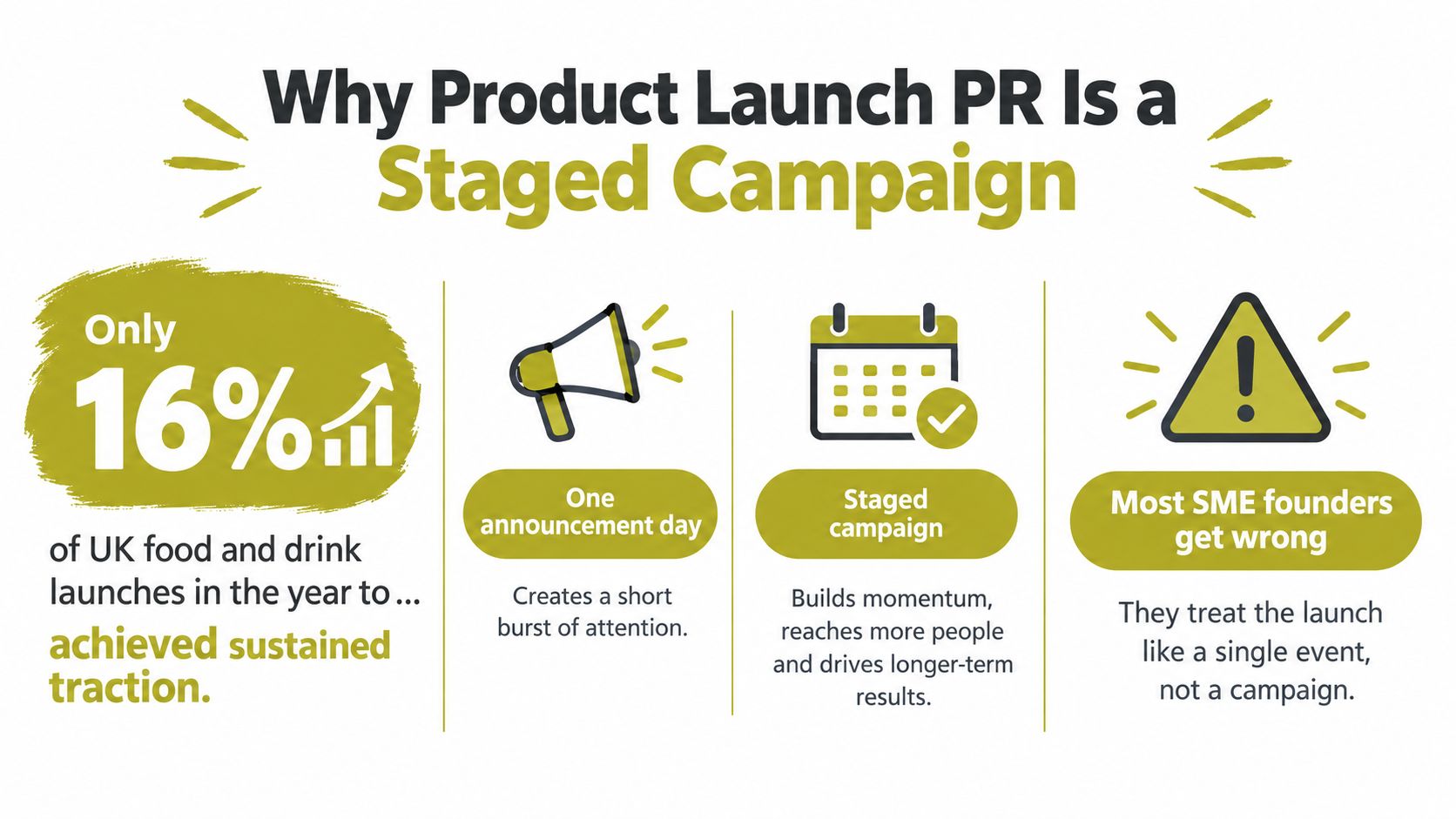
The UK launch figures show why novelty alone isn't a dependable angle. If most launches in a competitive category are redesigns, relaunches or line extensions, journalists have heard “brand-new” many times before. Calling an improved formula revolutionary won't make it so. A sharper story might focus on a meaningful reformulation, a new retail route, a consumer problem the redesign addresses, or a category shift the product reflects.
Start with the editorial judgement
Treat the campaign as a sequence of decisions:
- Classify the launch accurately. Decide whether it's a novelty, redesign, relaunch, retail exclusive or demand-generation campaign.
- Find the news value. Identify what has changed for customers, buyers or the wider category.
- Build proof before outreach. Prepare samples, photography, customer evidence, product access and a spokesperson who can answer difficult questions.
- Sequence the audiences. An influential trade buyer, a national consumer editor and a potential customer may need different versions of the same story.
- Measure what happened commercially. Coverage matters, but it isn't the final outcome.
A newsroom-trained adviser brings a useful filter to each stage. Former editors and reporters know the difference between a product that exists and a story that can be commissioned. They also know that a journalist may reject a weak angle even when the product itself is excellent.
Editorial test: If the launch can be described only with adjectives such as “innovative”, “exciting” or “game-changing”, the story probably needs more evidence.
This is why Carlos Alba Media's specialist nature matters. Everyone who works for Carlos Alba Media is a former national news journalist or has agency experience of working with international brands. That background helps teams shape a launch around what editors can use, rather than what an internal marketing meeting wants to say.
Choosing Your Launch Positioning and Core Message
A launch only gets one first reading, so the positioning has to do real work. Start by deciding whether you are running a media story, a retail event or a demand-generation campaign. They can overlap, but each one asks for a different lead angle and a different proof set.
A media story needs a credible editorial reason to exist. That could be a meaningful product change, a response to a category shift, a founder with a relevant point of view, or evidence that the launch speaks to a wider customer problem. A retail event depends on availability, timing, display assets and a clear reason for buyers or shoppers to act now. A demand-generation campaign puts qualified attention, product education and a direct route to purchase ahead of broad coverage.
Match proof to the format
Ask three questions before you choose the lead channel:
- Who has to move first? A journalist, retailer, distributor, investor, consumer or existing customer?
- What will that audience trust? A sample, demonstration, customer feedback, packaging comparison, founder interview or retail placement?
- What should happen after attention? A briefing, listing conversation, store visit, product trial, purchase or enquiry?
A skincare redesign should not be framed as a wholly new invention if the main changes are packaging and formula refinement. It will usually work better as a retail story with before-and-after visuals, a plain explanation of the reformulation and a reason the new presentation improves the customer experience. A technology SME may need a different route, with trade press and investor-facing content taking priority, and a demonstration plus technical spokesperson carrying more weight than a consumer event.
Build a message that can withstand questions
Use a simple message hierarchy.
- One core claim: What has changed, and why does it matter?
- Three supporting proof points: Use evidence that directly supports the claim, not a list of unrelated features.
- One differentiation statement: Explain what makes this launch distinct from the alternatives a journalist already knows.
Keep the core claim short enough for a headline and specific enough to be tested. “A refreshed skincare range” describes the product, but it does not yet justify coverage. “A redesigned skincare range that makes its routine easier to understand” gives an editor a clearer consumer angle, provided the packaging and customer experience support it.
Calling an improved formula groundbreaking won't make it so without evidence. If the launch can only be described with adjectives such as “exciting” or “breakthrough”, the story still needs proof. Buyers and journalists see iterative releases every day, so overclaiming newness weakens trust and cut-through.
The practical point from UK launch guidance is simple. Product type and proof points need to match. Write separate versions of the message for each audience, but keep the underlying claim consistent. A retailer needs evidence of sell-through potential and shelf relevance. A journalist needs a story. A customer needs to understand the benefit and the next step. If those needs blur together, the copy may sound polished but still persuade nobody.
Building Your Launch Timeline From Three Months Out
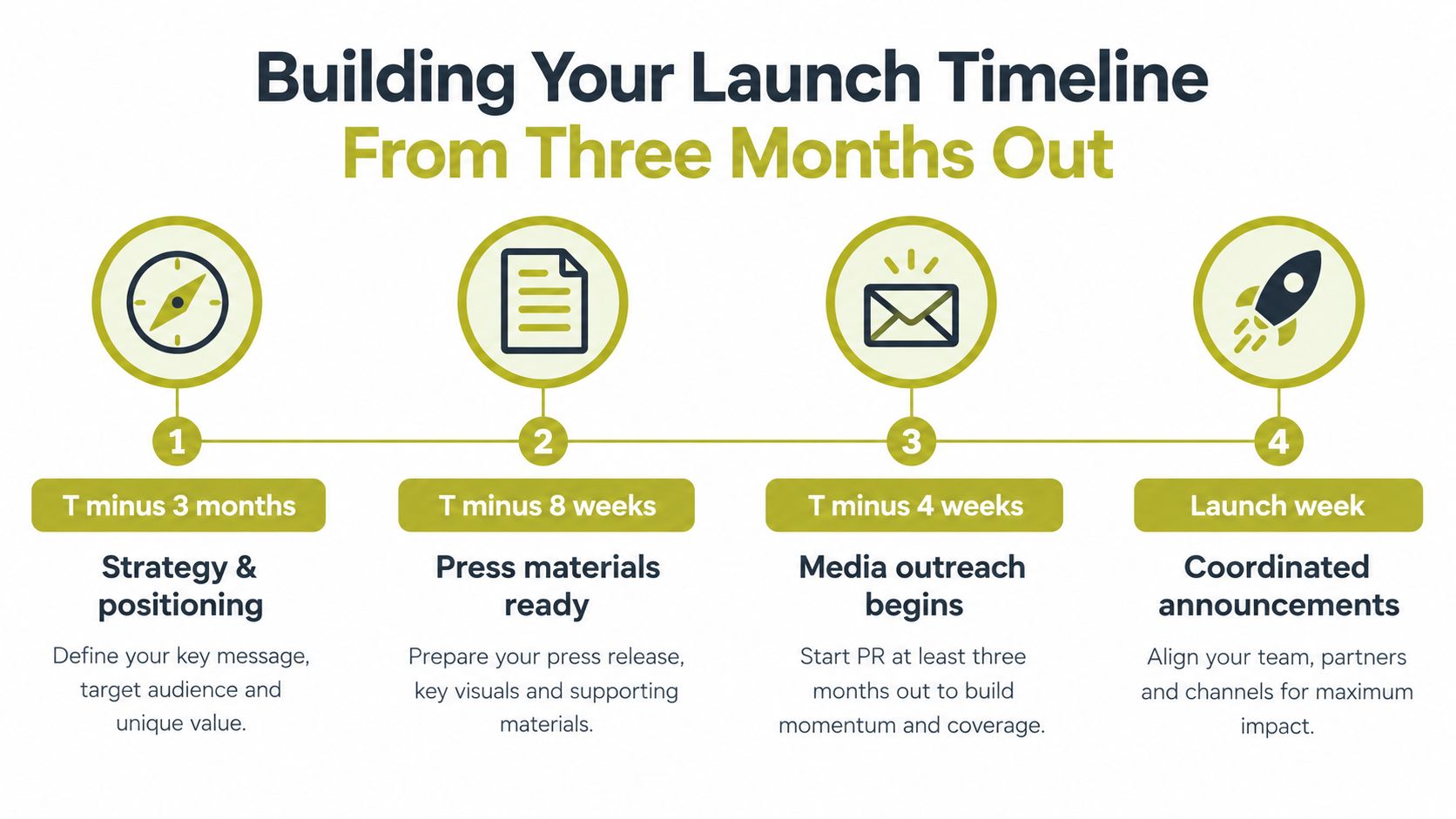
A launch that starts late usually stays messy. UK practitioners commonly recommend beginning PR activity at least three months before launch, and consumer products can need up to six months if long-lead print coverage is part of the plan, as outlined in UK product launch planning guidance from Orange PR. National newspapers, magazines and broadcast teams often need early access to photography, samples, product information and spokespeople. Leave too little runway and you lose time to fix weak assets or sharpen the angle.
Work backwards from availability
At T minus three months, lock the launch classification, audience priority, core message and target media list. Confirm the shelf date or public availability date before you promise journalists access. If that date shifts, every partner, retailer and editor needs the update at once.
At T minus eight weeks, finish the press release, product fact sheet, photography, spokesperson biography, FAQs and sample plan. Test the product or demonstration yourself. If a journalist gets a sample and cannot understand how to use it, you have already made the follow-up harder.
At T minus four weeks, begin targeted outreach where the story and assets are ready. Offer selected journalists a briefing, interview, demonstration or sample rather than sending a generic announcement. Consumer products that need print coverage may need earlier contact, while a faster-moving digital story can be pitched closer to the public date.
Launch week should coordinate press activity, retail availability, creator content, owned social posts, email and sales follow-up. Do not announce a product nationally while customers cannot buy it, retailers have not received stock, or the spokesperson is unavailable for questions.
The post-launch phase should run for 60 to 90 days, giving the team time to test market response, correct messages and keep useful angles alive. A relaunch may generate a second story when early customer feedback shows what the market values most, and launch planning guidance from Motive PR makes the same point in practical terms.
The common failure is under-scoping the window. Press timing, retail availability and creator content depend on one another. If one team announces before another is ready, the campaign may win attention without giving people a reliable next action.
For UK launches, the timeline should also reflect the type of story you are trying to tell. A media story needs enough lead time for editors to see a clear hook and usable assets. A retail event needs stock, staff and venue logistics aligned. A demand-gen campaign needs landing pages, tracking and sales follow-up ready before the first wave of interest lands. Most redesigns and relaunches do not deserve the same treatment as a genuinely new product, so the timeline should match the commercial goal, not just the wish for coverage.
| Phase | Timing | Key activities | Deliverables |
|---|---|---|---|
| Strategy and positioning | T minus three months | Classify the launch, define audiences, settle the core message and build the media list | Message framework, launch brief and target list |
| Press materials ready | T minus eight weeks | Produce copy, images, samples, FAQs and spokesperson materials | Press release, media kit and sample schedule |
| Media outreach begins | T minus four weeks | Brief priority journalists, offer access and manage any agreed embargoes | Confirmed briefings, interviews and coverage plan |
| Coordinated announcements | Launch week | Align press, retail, social, creator and sales activity | Live coverage, owned content and response dashboard |
| Optimisation | 60 to 90 days after launch | Review response, refine positioning and pursue follow-up angles | Commercial report and next-action plan |
The dates above are planning points, not a substitute for editorial judgement. A long-lead magazine, broadcast booking and trade listing each work to different schedules, so confirm requirements with the relevant contact early.
Press Materials and Media Outreach That Get Opened
Journalists need enough accurate, relevant information to understand the story, judge its credibility and decide whether to spend time on it. A strong angle can still fail if the images cannot be used, the sample arrives late or the contact cannot answer basic questions. This matters even more for a redesign or relaunch, where the press material must explain what has changed and why customers should care.
Prepare the complete press kit
Build the kit around the questions an editor, producer or reviewer will ask:
- Press release: Lead with the news, explain the product in plain language and include one clear next action.
- Boilerplate: Give a concise, consistent description of the company and its relevance to the story.
- Photography: Supply high-resolution product, packaging, founder and usage images, with clear usage rights.
- Product samples: Record who receives each sample, when it should arrive and how the product should be tested.
- Spokesperson biography: Explain why the person can comment on the subject, rather than listing only a job title.
- Frequently asked questions: Cover availability, pricing approach, limitations, sourcing, safety and likely objections.
- Media contact: Provide a reachable person who can arrange interviews, demonstrations or further information.
Teams that need help shaping the announcement can use this guide on how to write a press release, especially when converting a product description into a news-led document. Keep the release focused. Put technical details that do not support the main story in a fact sheet or briefing page.
Sequence outreach instead of broadcasting
Begin with a small group of journalists who have a clear reason to cover the launch. Offer an exclusive or early briefing only when the outlet's audience and editorial approach justify it. Then contact carefully selected national, regional and trade journalists with angles suited to their readers. Wider distribution can follow after the most relevant targets have had a fair opportunity to engage.
The angle should reflect the outlet. A trade journalist may focus on listing implications, packaging, supply or category relevance. A national consumer editor may need a strong human or cultural angle, attractive images and a product that can be tested quickly. A relaunch should make the change clear, such as improved usability, a new audience or a response to a recognised customer problem. Sending every contact the same email wastes the opportunity.
Follow-ups should add useful information. Confirm a sample's arrival, provide a missing image, answer a question or offer access to a suitable spokesperson. Repeating “just checking you saw this” does not strengthen the story. Embargoes also require explicit agreement. Sending material early does not mean a journalist has accepted restrictions.
For practical media preparation, a press kit template resource from Carlos Alba Media can help organise the assets and information journalists need in one place.
Budget decisions should match the campaign window. Specialist UK launch guidance benchmarks appointing support at least 12 weeks before shelf date, with a three-month fixed project costing £5,000 to £15,000, or a monthly retainer of around £3,000 to £5,000, as set out by Prohibition PR's UK launch benchmark. An internal campaign can cost less, provided one person owns the media list, approvals, samples, follow-up and measurement. A press kit is working infrastructure, not a substitute for a relevant story.
Broadcast, Social and Spokesperson Readiness
A written announcement and a broadcast interview are different communications jobs. A release can be edited before publication. A founder on radio or television has to explain the product clearly while responding to questions, interruptions and challenges.
Prepare the person, not just the talking points
Give the spokesperson three messages they can deliver naturally, a short explanation of the customer problem, and a direct answer to the most uncomfortable reasonable question. Rehearse without forcing the person to memorise a script. Journalists notice scripted answers, especially when the question changes.
Media training should cover broadcast, print and digital formats. Outwrite's UK media training service describes training delivered by experienced journalists across those formats, which reflects the practical value of newsroom experience. PA Media Academy's communications training also covers news-based communications, writing, editing, content creation and digital storytelling across multiple platforms.
Use launch day as a coordinated sequence. A broadcast appearance can point viewers to a useful product page. A founder's social post can explain the motivation behind the launch. A creator can demonstrate the product in a way that complements, rather than repeats, the editorial story. Community managers should be ready to answer questions while the campaign is receiving attention.
Don't leave crisis preparation until a problem appears. Agree a holding statement, name the first responder and decide who can approve public wording. For regulated or higher-risk products, arrange access to 24/7 crisis counsel with legal support. A complaint, safety question or inaccurate claim can spread quickly when a launch team is focused only on positive coverage.
Founders who need a practical rehearsal can use guidance on preparing for a media interview. The aim isn't to remove personality. It's to help the spokesperson stay accurate, useful and calm when the interview doesn't follow the prepared route.
Measuring Launch PR Against Commercial Outcomes
Clippings show that coverage happened. They do not show that the launch changed buying behaviour, helped retail sell-through, or moved a relaunch into stronger commercial territory. A launch can earn good headlines and still miss the people who matter.
Set the measurement plan before outreach starts. Record a baseline for brand visibility, search demand, retailer presence, inbound enquiries, and competitor coverage where you can measure it. Then set targets by channel. Ask whether the campaign reached the right audience, not whether it produced a pile of mentions.
Use three commercial measures
The launch framework from Prohibition PR recommends linking KPIs to three practical signals:
- Share of voice in launch week: Compare relevant coverage with named competitors, not with every story in the category.
- Sell-outs or rate of sale in the first four weeks: Link media timing with stock movement and availability so a retailer can separate attention from demand.
- Listing gains by month three: Track whether the launch opened discussions with new retailers, distributors, or commercial partners.
The report should also cover message pull-through, outlet relevance, links, search visibility, product page activity, enquiries, and the quality of questions prospects ask. A small set of well-matched stories can be more useful than a large volume of generic mentions.
Report weekly during the active launch window, then monthly as the campaign settles. Ask sales and retail teams what prospects repeat back to them. If customers use the campaign's main message, the positioning is landing. If they focus on the wrong feature, change the content and the briefing materials.
Video can extend the life of launch coverage when the format suits the audience. For teams reworking interviews and demos, boosting video ROI with Klap is a useful prompt to think about distribution and reuse. Use content that supports a commercial action, not video made just to fill a channel.
For a broader framework, use guidance on how to measure PR effectiveness. The final report should state what happened, which audience responded, what the campaign cost to deliver, and what the next launch should do differently.
Bringing It Together for Your Next Launch
A Scottish technology SME launching to investors and trade press should prioritise a precise market problem, a credible demonstration, founder preparation and a small group of relevant briefings. It can skip a consumer-style launch event if the buying audience won't attend or gain value from it. The useful outcome is informed coverage and stronger investor or partner conversations.
A food and drink brand relaunching packaging for retail should lead with what has changed for shoppers and buyers. It needs strong pack photography, clear shelf availability, retailer coordination and a measured follow-up period. Calling the product entirely new when the main development is presentation would create an avoidable credibility problem.
A lifestyle business seeking national consumer coverage should invest in visual assets, a human angle, samples, broadcast readiness and a story that fits the publication's audience. It shouldn't spend the whole budget on a generic wire release if targeted editors and presenters need a more personal pitch.
The decision for this week is practical:
- Name the launch type.
- Write one defensible core claim.
- Choose the audience that must act first.
- Work backwards from availability.
- Prepare proof before contacting journalists.
- Set commercial KPIs before the first pitch.
- Bring in senior counsel when the angle, timing or reputation risk demands it.
Newsroom-experienced advisers can make that process faster and more disciplined. The relevant expertise isn't just knowing how to distribute a release. It's knowing what an editor can use, what a buyer needs to believe and what a spokesperson must be ready to defend.
Carlos Alba Media helps UK SMEs plan product launch PR, secure targeted coverage across broadcast, print and digital, and prepare spokespeople for interviews and launch-day scrutiny. Visit Carlos Alba Media to discuss your launch positioning, media timeline and commercial measurement plan.