
You’ve got the interview request. It might be from a trade title, a local radio producer, a national newsroom, or a journalist who found you after a funding round, product launch or difficult incident. Your first instinct is usually the wrong one. Most founders start thinking about what to wear, whether they look nervous on camera, or how to avoid saying the wrong thing.
That’s not where strong interviews are won.
They’re won much earlier, when you decide what the story is, what the journalist needs from you, and what you’ll do if the coverage goes wrong after publication. That last part barely gets discussed in most media training content, yet it matters enormously for UK businesses, especially in regulated sectors or any organisation without an in-house comms team.
At Carlos Alba Media, that gap matters because the team is built around former national news journalists and agency operators who’ve worked with international brands. That changes the advice. This isn’t PR theory dressed up as confidence coaching. It’s the practical version, shaped by people who know what editors cut, what reporters chase, what weak answers sound like, and what makes a founder worth calling again.
The Foundation Message Crafting and Audience Framing
A media interview is often thought to be about answering questions well. It isn’t. It’s about delivering a clear story under pressure.
In a newsroom, the reporter is already shaping the piece before they speak to you. They’ve got an angle, a deadline, an audience and a rough idea of the quote they need. If your thinking is muddled, they won’t slow down and help you find your point. They’ll move on, simplify you, or use the sharpest fragment they can pull from the call.
That’s why messaging does most of the heavy lifting.
Build three messages, not ten
News works on compression. Long explanations die in edit. Rambling answers rarely survive a package, a write-up or a pull quote. The spokespeople who come across best usually have three core messages and a handful of proof points behind each one.
Use this simple structure:
What’s happening
Keep this factual and short. What is the change, issue, launch, warning or opportunity?Why it matters
Founders often drift into jargon here. Don’t explain your internal strategy. Explain the consequence for customers, staff, investors, communities or the wider market.What should happen next
Give the audience a practical conclusion. That might be action, caution, clarity or context.

A founder preparing for broadcast might write pages of notes. That usually hurts more than it helps. Better to write three lines you can remember, say naturally, and adapt when the questioning moves.
Practical rule: If a journalist can’t repeat your main point from memory after the interview, your message isn’t ready.
Frame for the journalist’s audience
A strong answer can still miss if it’s pitched to the wrong audience. A national consumer outlet wants a different framing from a trade publication. A business desk may care about leadership, growth pressure or market context. A local paper may care about jobs, place and community impact.
Before the interview, ask yourself:
- Who reads, watches or listens to this outlet? Speak to their concerns, not your board deck.
- What angle is the journalist likely to pursue? Is this a success story, a controversy, a trend piece, a warning, or a profile?
- What line would make the editor keep your quote in? That’s usually the line with consequence, tension or clarity.
Brand storytelling is vital. If your message changes wildly from one interview to the next, you don’t have a story. You have fragments. That’s why it helps to think in terms of a consistent narrative spine, not isolated press comments. Brand storytelling gives you that spine.
Don’t script. Prepare a message architecture
Founders often make one of two mistakes. They either over-script every answer and sound brittle, or they “just have a chat” and end up wandering.
The better approach is a message architecture:
- Core line you can say in one sentence
- Supporting point that adds context
- Example or proof that gives it weight
- Safe variation for print, radio, podcast or TV
That architecture lets you sound human without losing control of the interview.
If you want to hear how media professionals think about making a story worth covering in the first place, this podcast for gaining media attention is a useful companion to message prep. It’s worth listening to before you start drafting talking points because it sharpens your instinct for what attracts coverage and what gets ignored.
Mastering Delivery Rehearsal and Bridging Techniques
The spokespeople who look relaxed on air usually aren’t improvising. They’ve rehearsed enough that the pressure no longer scrambles the message.
That doesn’t mean memorising lines. In fact, memorised answers are easy to spot. They arrive half a beat too quickly, ignore the question, and sound polished in a way that makes producers and reporters suspicious. Journalists don’t want a brochure with a pulse.
Rehearsal should feel uncomfortable
The best prep session is not a friendly chat with a colleague who already agrees with you. It’s a pressure test.
Run a murder board. Put one person in the role of sceptical journalist. Another should interrupt. Another should ask the question you’re hoping won’t come up. Make them challenge your weakest claim, your vaguest wording and any sentence that sounds evasive.
Listen for these warning signs:
- You answer in paragraphs, not sentences
- You start with background instead of the point
- You repeat internal jargon
- You become defensive when challenged
- You guess when you don’t know
One practical way to sharpen this is formal spokesperson coaching. Media training for executives typically focuses on handling scrutiny, tightening delivery and improving interview control under realistic pressure.
Bridging without sounding slippery
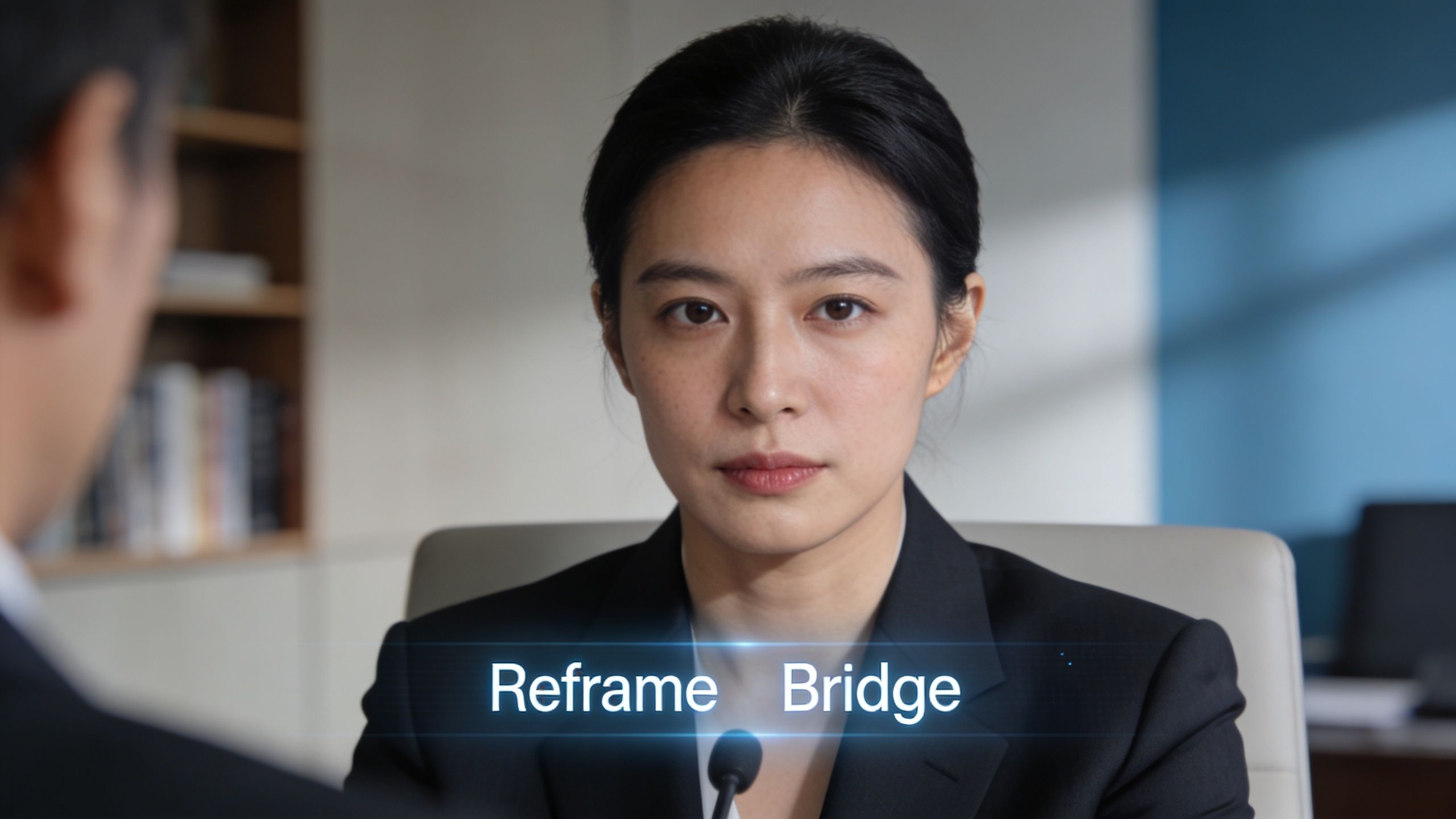
A bridge helps you acknowledge the question, answer the useful part, and move to the point you need on the record. Used badly, it sounds like avoidance. Used well, it sounds calm and disciplined.
The key is simple. Answer first, bridge second. If you bridge before giving any recognition to the question, you’ll sound coached in the worst way.
Here’s a practical toolkit.
Essential Bridging Phrases to Control the Narrative
| Scenario | Bridging Phrase Example |
|---|---|
| The question is too narrow | “That’s one part of it, but the bigger issue is…” |
| The journalist wants conflict | “I understand why that’s being asked. What matters for customers is…” |
| You need to move from detail to impact | “The key point here is…” |
| You’ve been asked a hypothetical | “I won’t speculate on that, but what I can say is…” |
| The question contains a false premise | “I wouldn’t characterise it that way. What’s accurate is…” |
| You need to return to your core message | “What we’re focused on is…” |
| You don’t have a figure to hand | “I don’t want to guess on that. What I can speak to is…” |
| The interview becomes repetitive | “We’ve looked at that closely, and the central issue remains…” |
What works and what fails
Bridging works when your tone stays conversational. It fails when you sound like you’re batting away the interviewer.
The audience will forgive nerves. They won’t forgive someone who sounds as if they’re dodging.
A few delivery habits make a difference fast:
- Slow your first sentence: Individuals often start too quickly.
- Land the point early: Give the quote before the explanation.
- Use shorter words than you use in meetings: Spoken English needs less decoration.
- Stop when you’ve made the point: Silence feels longer to you than to the journalist.
If you’re learning how to prepare for a media interview, this is the stage where confidence starts to become visible. Not because you’ve become more charismatic overnight, but because your answers now have shape.
The Technical and Personal Prep Checklist
A good interview can still be damaged by sloppy logistics. That’s even more true now that so many interviews happen on Zoom or Teams rather than in a studio or office. Existing guidance hasn’t kept up with post-2020 media formats. There is virtually no coverage of camera positioning for Zoom, managing on-screen presence versus in-person body language, or technical troubleshooting for video calls, despite how important that now is for UK founders and SMEs speaking to national media by video conference, as noted in this interview guidance reference.
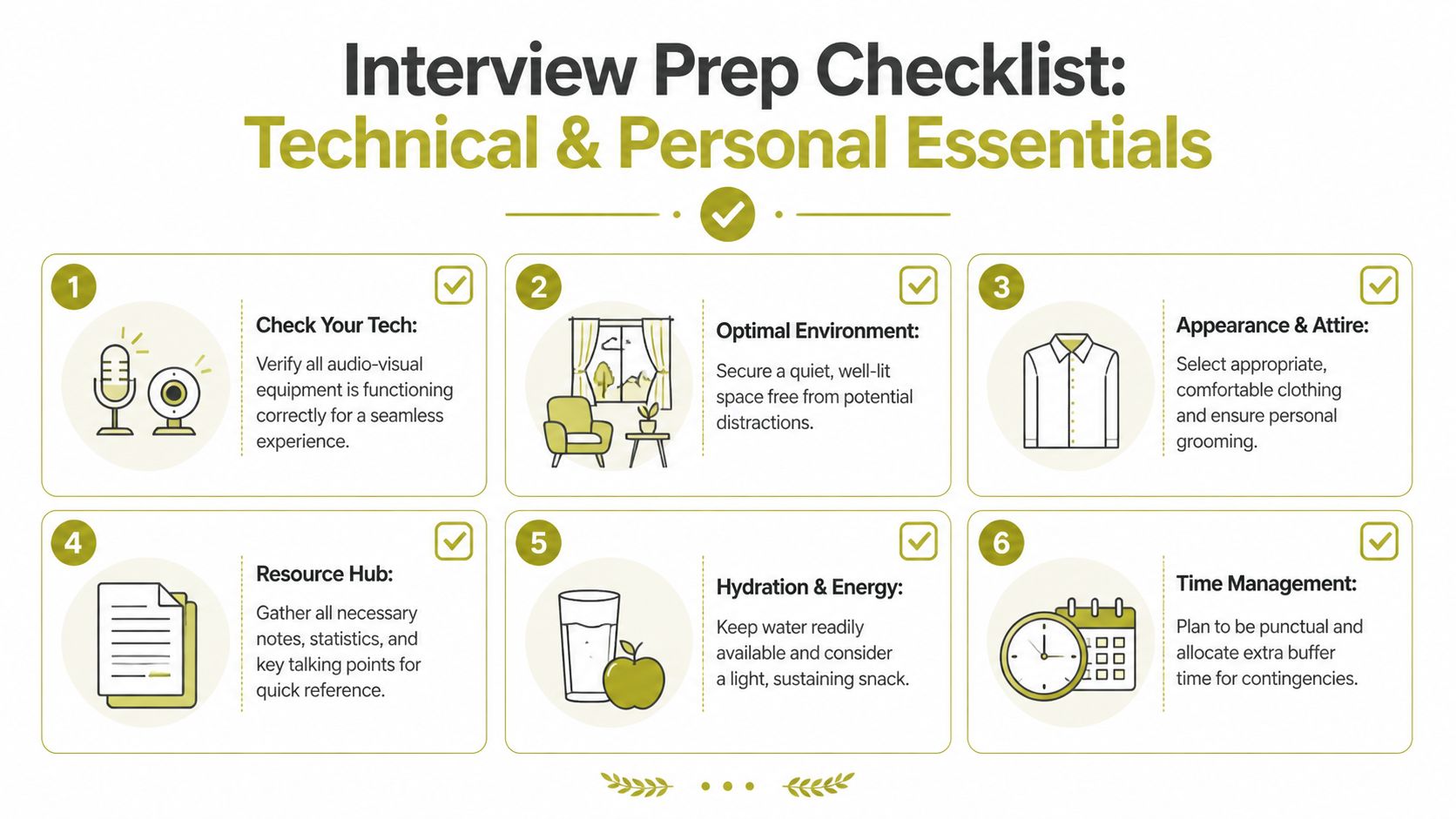
Virtual setup that looks credible
Your laptop on a low table is a bad idea. It points the camera up your nose, exaggerates your chin, and makes you look underprepared before you’ve even spoken.
Use this checklist instead:
- Raise the camera to eye level: Stack books under the laptop if needed.
- Face a light source: A window in front of you works better than a bright light behind you.
- Keep the background quiet: Plain wall, tidy bookshelf, neutral office corner. Don’t make the reporter study your room.
- Frame mid-torso upward: Too close feels intense. Too wide looks distant.
- Close notifications and browser tabs: Nothing undermines authority like glancing at pop-ups.
Personal prep that changes delivery
Wardrobe matters less than people think, but patterns can shimmer on camera and distract the viewer. Busy checks, tiny stripes and overly bright white shirts can be awkward on some video feeds. Solid colours usually behave better.
Your body language also needs adjusting on video. In person, a journalist can read your full posture. On screen, they mostly see your face and upper body. That means small habits become larger signals.
- Look into the camera when making key points
- Keep your shoulders still
- Use hand gestures sparingly and within frame
- Have water nearby
- Sit forward enough to look engaged, not rigid
For cleaner sound from a home setup, these professional webinar audio tips are useful. Audio failures make people seem less credible than they are, even when the content is solid.
Your final pre-flight check
Before the call starts, do this in order:
- Join early and test sound
- Check your visible background
- Place notes beside the camera, not on your lap
- Put your phone on silent
- Confirm name, role and pronunciation details
- Take one slow breath before the first answer
Most technical mistakes aren’t dramatic. They’re small distractions that erode authority. The journalist may not mention them, but the audience notices.
Navigating Difficult Questions and High Stakes Scenarios
Difficult questions rarely arrive by accident. A reporter usually asks them for one of three reasons. They need clarity, they want tension, or they’re testing whether you really know your brief.
Founders often misread all three as hostility. Sometimes it is hostile. Often it isn’t. It’s just reporting.
When the journalist wants a sharper headline
A common situation in newsroom interviews is the compressed challenge question. It sounds something like this: “So has your company failed customers or not?” That’s not a neutral framing. It’s binary on purpose. The reporter is trying to force clarity, create tension, or generate a direct quote that works in copy.
A weak spokesperson argues with the wording for too long.
A stronger one does this:
- rejects the premise briefly
- states the accurate position cleanly
- adds the action being taken
For example: “No, that’s not how we see it. The issue was limited, we responded quickly, and our focus now is making sure customers have clear information and support.”
That answer doesn’t sound defensive. It also gives the journalist usable language that is firmer and more precise than “no comment” or a rambling denial.
When you don’t know the answer
This one catches smart founders because they feel they should know everything. Journalists know that pressure point and will sometimes test it.
If you don’t know, don’t fill the silence with a guess.
Newsroom view: a wrong answer is much more damaging than a deferred answer.
Use a clean line: “I don’t want to give you an inaccurate answer on that. I can confirm the detail after this interview.” Then stop. Don’t pad the sentence with speculation.
That matters even more in regulated sectors, legal disputes, active investigations or situations involving staff welfare. In those settings, discipline is part of credibility. If an issue carries legal or reputational risk, structured preparation around crisis communication management can help define where the line is between helpful and harmful disclosure.
A short example of on-camera composure under interview pressure can be useful to study before your own appearance:
Competitors, hypotheticals and loaded comparisons
Another trap is the competitor question. “Why are they ahead of you?” or “Are you saying their model is unsafe?” Journalists ask this because comparison creates movement in a story. It gives readers conflict and hierarchy.
You don’t need to attack. In fact, that usually backfires.
Try this approach:
- Acknowledge the wider market: “It’s a competitive space.”
- State your lane: “Our focus is…”
- Differentiate by outcome or principle: “Where we think we stand apart is…”
Hypotheticals need similar discipline. “What if this gets worse?” “What if regulation changes?” “What if your funding falls through?” These questions are often designed to expose weakness or force a future commitment.
The clean response is to separate speculation from action. Don’t play out fictional disasters for the sake of sounding open. Speak to current decisions, current safeguards, and current priorities.
The founders who handle these moments best don’t try to win every exchange. They try to leave a clear, usable, accurate record.
After the Interview The Follow Up and Correction Protocol
It's often assumed the job ends when the microphone goes off. It doesn’t. The period after the interview is where reputations are either protected or left to luck.
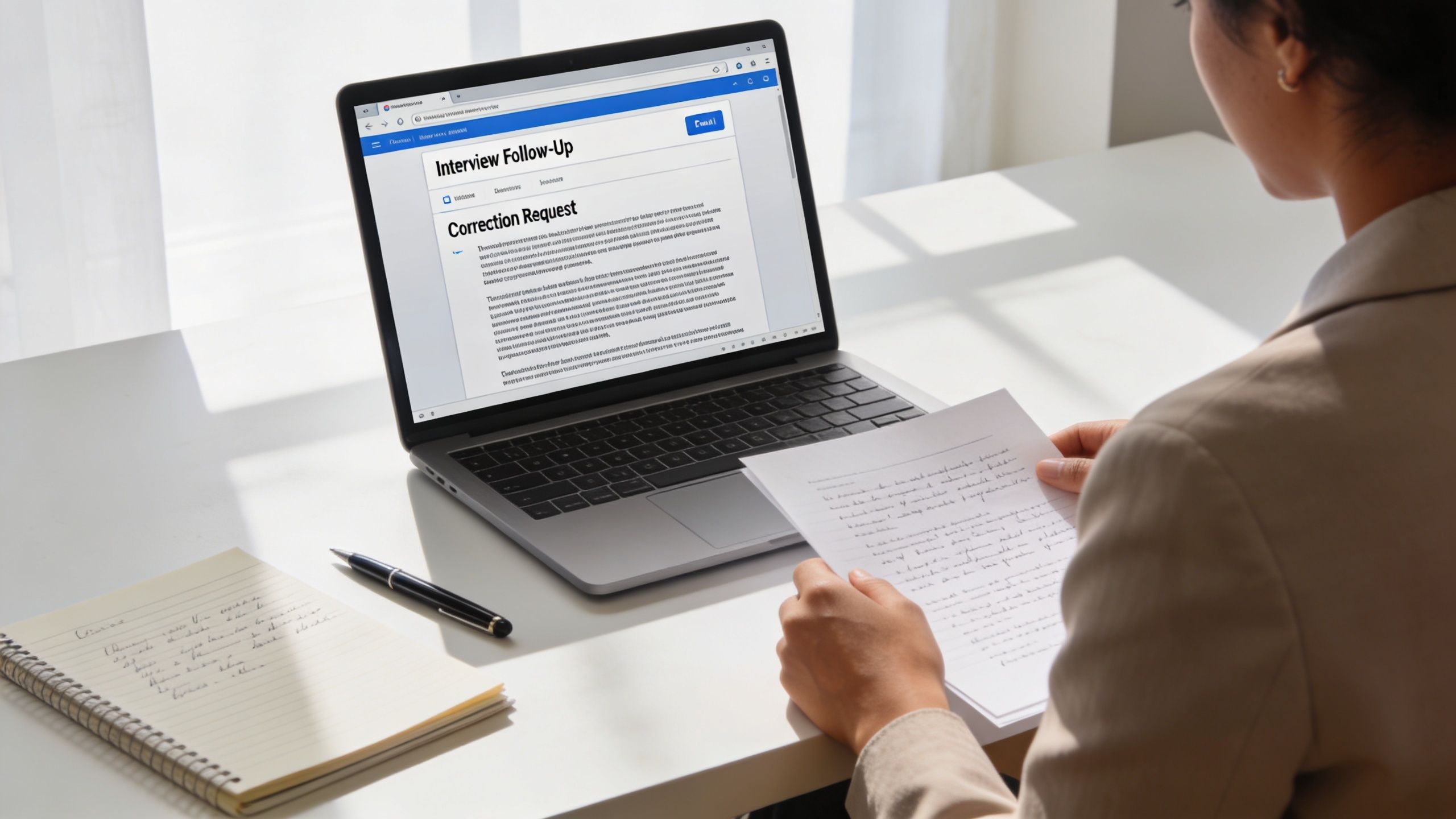
This is also where most generic advice falls apart. Most media preparation guides fail to address post-interview protocols, including how UK businesses can formally request corrections from national newspapers or broadcast outlets under frameworks like the IPSO Editor’s Code of Practice context noted here. That gap matters most for regulated organisations, high-risk sectors, and start-ups that don’t have legal or comms support sitting in-house.
The professional follow-up
A short follow-up email can be useful if it adds value. It should not be a disguised attempt to rewrite the interview.
Good follow-up usually includes:
- A brief thanks: Keep it polite and unforced.
- One clarification if needed: Not a fresh argument.
- Supporting material promised during the interview: Document, statement, image, or technical note.
- A reliable contact route: So the journalist can verify quickly before publication.
Don’t send a long email full of extra positioning points. Reporters read that as panic.
What to keep on file
If the interview concerns a sensitive issue, keep a record immediately after it ends. Don’t trust memory once a story starts moving.
Retain:
- The date and time of the interview
- The journalist’s name, outlet and programme or section
- What was discussed
- Any documents you supplied
- Any on-the-record wording sent afterwards
- A copy or screenshot of the published item
If there is a dispute later, vague recollection won’t help you much. A clear paper trail will.
If you may need a correction, start acting like you may need evidence.
How to handle a misquote or misrepresentation
Not every imperfect line deserves escalation. Journalists paraphrase. Headlines compress. Broadcast edits remove context. The question is whether the published material is materially inaccurate or unfairly misleading.
When it is, take a measured route:
Read or watch the item carefully
Identify the exact wording that is wrong. Not the tone you dislike. The actual inaccuracy.Check your record
Confirm what was said, what was supplied, and whether the problem is a quote, a paraphrase, a headline, a caption or surrounding context.Contact the journalist or producer first
Be specific, calm and factual. State the correction you’re requesting and why.Escalate to the newsdesk, editor or complaints contact if needed
Keep the tone professional. Angry emails get forwarded. Clear ones get dealt with.Reference the relevant accuracy obligation
Don’t make legal threats unless legal counsel has advised it. A precise standards-based complaint is usually stronger than emotional language.Document every exchange
Save emails, screenshots and timestamps.
For print and digital outlets, online corrections can sometimes be handled faster than print clarifications, but speed varies widely by outlet and by the seriousness of the error. Broadcast complaints may follow a different internal route. The practical point is this: act promptly, use evidence, and ask for a remedy that matches the problem.
Requesting quote approval before publication is sometimes possible, but many journalists won’t agree to it, particularly in fast-moving news. If you do ask, ask early and politely. Never assume you have approval rights unless they’ve been explicitly granted.
This is the part inexperienced spokespeople miss. They prepare to get through the interview, but not to manage what happens after it. That’s a mistake.
From Preparation to Performance
The best media interviews don’t feel like tests. They feel like controlled performances built on hard preparation.
That shift matters. If you treat every interview as a trap, you’ll sound tense, over-defensive and narrow. If you treat it as a chance to get your version of events on the record, you’ll prepare differently. You’ll tighten your messages, rehearse properly, sort your technical setup, anticipate difficult questions and protect yourself after publication.
That’s how anxious founders become credible spokespeople.
The practical lesson is simple. Confidence in interviews is usually engineered, not gifted. It comes from knowing your three messages, understanding the reporter’s angle, answering without waffling, and keeping enough discipline to stay useful under pressure. It also comes from knowing that the work isn’t finished when the interview ends.
Plenty of people can talk well in meetings. Far fewer can deliver a sharp line to a journalist, hold their ground when the question turns difficult, and still follow up correctly if the story needs fixing. That’s a distinct skill.
If you want to know how to prepare for a media interview at a serious level, stop thinking only about performance on the day. Think like a newsroom insider. What quote will survive edit? What answer creates trust? What wording exposes risk? What evidence will you need later if the coverage is wrong?
Those are the questions that change outcomes.
If you want structured support before your next interview, Carlos Alba Media offers practical media training shaped by former national journalists and agency professionals, with support for founders, executives and organisations facing routine press opportunities or higher-stakes scrutiny.