
Most advice on B2B digital marketing strategy starts with channels. Build a funnel. Publish more content. Automate nurture. Run paid campaigns. Track engagement. That advice is incomplete, and often expensive.
B2B buyers aren't rational robots moving neatly from impression to form fill. They're founders, finance directors, procurement leads and technical specialists trying to reduce risk, defend a recommendation and choose a supplier they can trust. Your marketing must therefore do more than explain what you sell. It must make your judgement visible.
For SMEs, the strongest advantage is often editorial rather than financial. A newsroom mindset gives your business a disciplined way to find meaningful stories, challenge assumptions, respond to industry change and turn expertise into useful content. The result is a digital presence that feels active, credible and human, not a static brochure surrounded by interchangeable blog posts.
A practical guía esencial de inbound de Ploot can help clarify how useful, buyer-led content attracts attention. But inbound only works when the content has a point of view. Generic automation produces volume. Editorial thinking produces reasons for the right buyer to remember you.
Rethinking the Modern B2B Digital Marketing Strategy
The popular assumption is that B2B communication should sound formal, restrained and corporate. Founders often approve copy that removes every distinctive phrase, every strong opinion and every human detail. The final result is technically safe and commercially invisible.
Business buyers don't switch off their personalities when they reach work. They still respond to clarity, relevance, tension and evidence. A managing director wants to know whether you understand the commercial problem. A technical buyer wants confidence that your claims survive scrutiny. A procurement team wants a supplier whose promises won't create problems later.
Replace the brochure with a newsroom
A newsroom mindset changes the operating rhythm. Instead of asking, “What should we post this week?”, ask:
- What changed: Has regulation, technology, customer behaviour or market pressure altered the buyer's priorities?
- Who knows something useful: Which customer, consultant, engineer or executive can add a credible perspective?
- What needs explaining: Which question keeps appearing in sales calls, proposals and support conversations?
- Why now: What makes this subject relevant to the audience today rather than merely interesting to your team?
Those questions create stronger material for search, LinkedIn, email, media outreach and sales enablement. They also force senior people to contribute insight, which is where most SME differentiation begins.
Editorial rule: Don't publish because the calendar says so. Publish because your audience has a problem, a question or a decision that deserves a sharper answer.
Data still matters. Search demand, conversion paths, CRM stages and campaign performance should shape your priorities. But data tells you where attention exists. It doesn't automatically give you a compelling story. Your B2B digital marketing strategy needs both, precise targeting and a narrative that makes your expertise easy to recognise.
How B2B Buyer Behaviour Differs From Consumer Purchases
A consumer can see a product, like it and buy it quickly. A B2B buyer usually has to build agreement around a decision that affects colleagues, budgets, systems and reputation. Treating those journeys as interchangeable leads to the wrong content, the wrong calls to action and unrealistic expectations from sales.
| Consumer purchase | B2B purchase |
|---|---|
| Often centred on one person | Usually involves several roles |
| May be driven by convenience or immediate emotion | Requires evidence, internal confidence and commercial justification |
| Can move quickly from discovery to transaction | Often develops through research, comparison and approval |
| The buyer carries the personal cost | The organisation and its stakeholders share the operational risk |
| A product page may be enough | Buyers often need education, proof and implementation detail |
The difference isn't that B2B buyers lack emotion. They may feel urgency, frustration or ambition just as strongly as consumers. The difference is that they must translate that emotion into a defensible business case.
Build content for the decision, not just the click
At the awareness stage, buyers need language for the problem. Publish clear explainers, opinion pieces and search-led guides that help them understand the issue.
During consideration, they compare approaches. Give them process detail, implementation guidance, FAQs, expert commentary and honest distinctions between options.
At the decision stage, they need reassurance. Make it easy to assess your team, delivery method, commercial fit, governance and likely obstacles. A strong call to action might be a consultation, diagnostic conversation or customized briefing, not an aggressive “buy now” prompt.
The sales team should recognise the same narrative across every stage. If the website promises strategic rigour but the sales call sounds improvised, trust falls away. Marketing and sales need a shared vocabulary for pain points, objections, proof and next steps.
Some SMEs also need additional capacity for prospecting once the strategy has created demand. Resources such as Hire SDRs can be useful when a founder wants to consider outsourced or specialist sales development, provided the outreach reflects the positioning established by marketing.
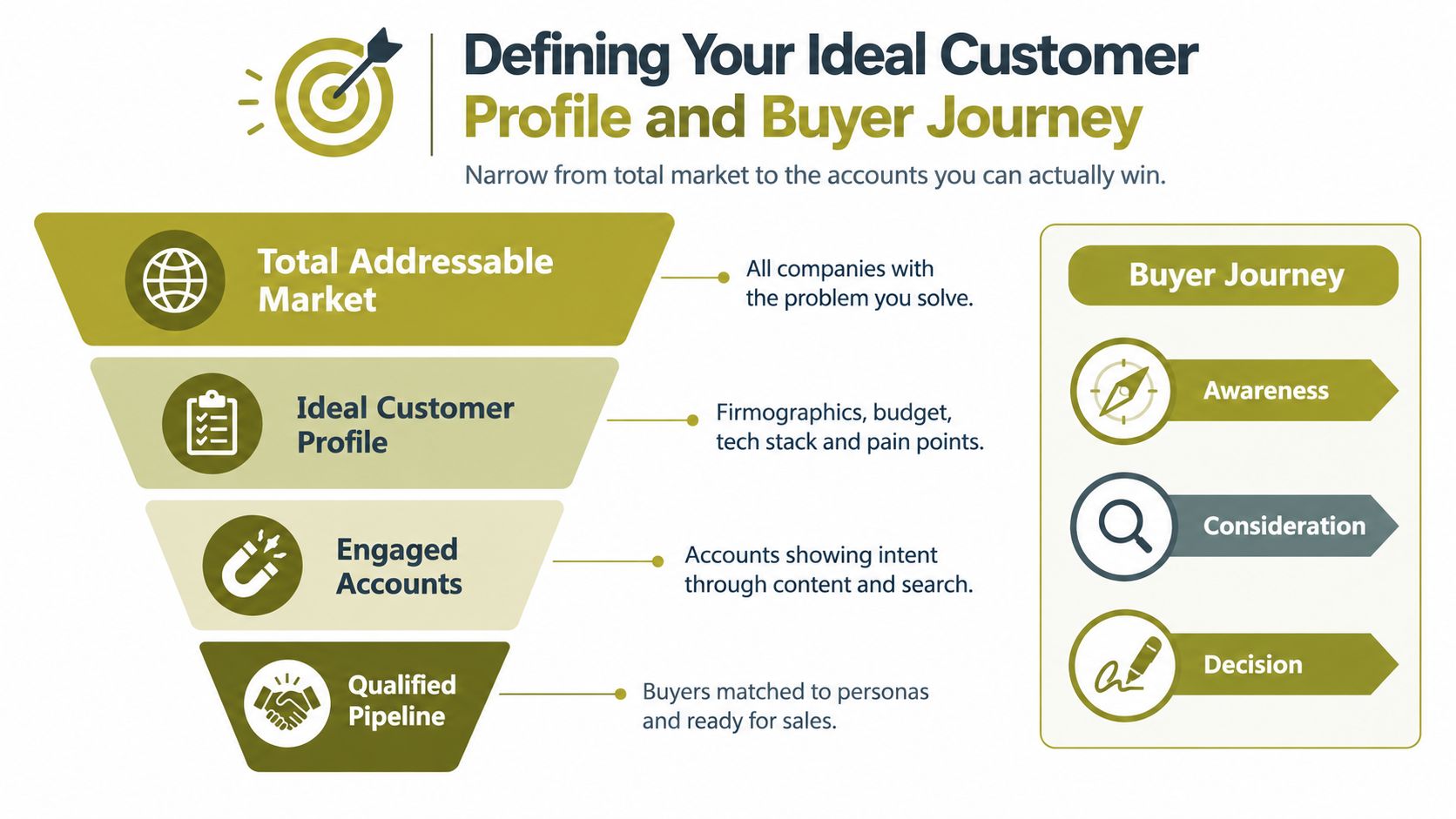
Defining Your Ideal Customer Profile and Buyer Journey
An Ideal Customer Profile isn't a description of everyone who could buy from you. It's a practical filter for deciding where your time, content and budget deserve to go.
Start with the accounts that have produced the healthiest relationships, clearest value and strongest commercial fit. Then look beyond industry and size. Ask what operational conditions made those clients ready to act.
Create an ICP that sales can use
Document the following:
- Commercial fit: Identify the type of organisation that can afford, implement and value your offer.
- Operational pressure: Record the events that make the problem urgent, such as expansion, leadership change, new compliance demands or a failed existing process.
- Buying group: Name the user, budget holder, technical evaluator, blocker and executive sponsor.
- Decision criteria: List the evidence each person needs before recommending you.
- Disqualifiers: State which prospects should not enter the pipeline, even if they show interest.
The last point protects SMEs from weak-fit work. A broad audience may create more enquiries, but a precise ICP gives the team better conversations and more useful content.
Next, interview customers and sales colleagues. Capture the words buyers use to describe the problem, the alternatives they considered and the moment they decided to investigate. Use those phrases in page titles, article briefs, email subject lines and sales collateral. Don't replace customer language with internal jargon.
Map the journey as questions
A buyer journey map should show questions, not just stages. At awareness, the buyer may ask what is causing the problem. At consideration, they may ask which approach is credible. At decision, they may ask whether your team can deliver safely and consistently.
Match each question to an asset:
- Search-led article: Clarifies the problem and captures relevant intent.
- Point-of-view briefing: Shows how your leadership interprets the issue.
- Case study or project narrative: Demonstrates how work happens in practice.
- Commercial page: Defines scope, fit, process and next action.
- Email sequence: Keeps useful evidence in front of buyers who aren't ready yet.
A customer journey mapping resource such as Carlos Alba Media's customer journey mapping guide can support this exercise. The important point is ownership. Someone must maintain the map as objections, search behaviour and sales conversations change.
Core Digital Channels and the Power of Editorial Storytelling
Your channels shouldn't operate as separate departments. SEO discovers demand. Content develops understanding. LinkedIn distributes a human perspective. Email maintains relevance. Account-Based Marketing gives the team a coordinated way to approach priority organisations.
Editorial storytelling connects them.
A single well-researched subject can become a search article, an executive LinkedIn post, a sales briefing, a short email series, a media pitch and a conversation starter for a named account. That isn't lazy repurposing. It's consistent distribution of one useful idea in formats suited to different moments.
Give each channel a defined job
SEO should capture questions with commercial relevance. Avoid writing only for broad category terms. Build pages around the problems your ICP describes, then make the route from information to enquiry obvious.
Content marketing should earn authority. A founder's opinion on a difficult trade-off can be more valuable than another generic checklist. Strong content includes a clear argument, practical evidence and a conclusion that helps the reader act.
LinkedIn social selling works best when people distribute insight, not when a company page repeats brochure copy. Ask subject experts to explain what they're seeing, challenge an assumption or interpret a development for customers.
Email nurturing should behave like useful editorial correspondence. Segment by role, need and buying stage. Send the next most relevant idea, not every asset your team has produced.
Account-Based Marketing needs restraint. Choose accounts that fit the ICP, identify the buying group and develop a narrative around the account's context. Personalisation means relevance, not inserting a company name into a template.
A clear explanation of what digital storytelling means is useful for teams that still treat narrative as decoration. In B2B, storytelling means selecting facts, voices and sequence so the reader understands why an issue matters and what decision follows.
Borrow the discipline of journalism
National journalism offers useful habits for commercial marketing:
- Find the consequence: Explain who is affected and what changes for them.
- Use real voices: Bring in customers, practitioners and internal specialists.
- Separate evidence from opinion: Make the argument strong without pretending every interpretation is a fact.
- Lead with relevance: Put the important point near the beginning.
- Edit without mercy: Remove claims that don't help the reader decide.
PR then extends the life of the story beyond owned channels. A useful insight can support commentary, interviews, digital coverage and search visibility while giving the sales team a credible reason to start a conversation. The objective isn't attention for its own sake. It's recognition among people who could become customers, partners, regulators or advocates.
Budget Allocation and Measuring True Marketing Performance
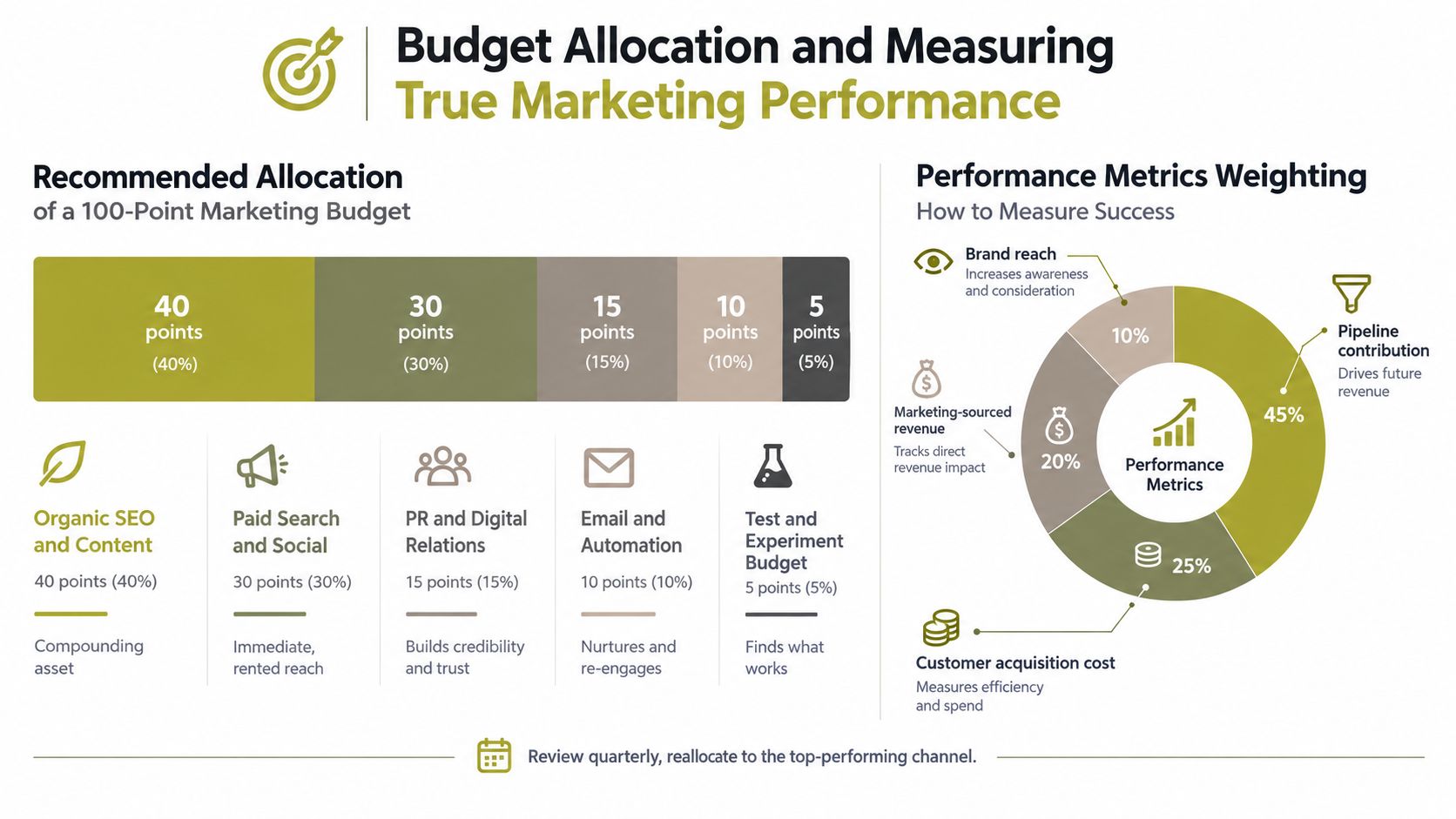
Founders rarely have the resources to fund every channel properly. The answer isn't to spread a small budget across every platform. Choose a few connected activities, define their commercial role and review whether they create qualified conversations.
The allocation shown in the visual is a planning model, not a universal rule. It places emphasis on organic search and content, while reserving room for paid distribution, PR, email and controlled experiments. Adjust the mix according to your sales cycle, existing authority, competitive environment and internal capacity.
Track the path to revenue
Your dashboard should connect activity to movement in the pipeline. Useful measures include:
- Qualified enquiries: Count conversations that match your ICP, not every form submission.
- Opportunity creation: Record which campaigns and assets influenced opportunities.
- Pipeline progression: Watch whether marketing-engaged accounts move from interest into a genuine sales process.
- Acquisition cost: Compare spend with the cost of generating customers, not just leads.
- Content quality: Review time spent, return visits, replies, meaningful clicks and assisted conversions.
- Sales feedback: Ask whether content answers objections and helps buyers reach internal agreement.
Email illustrates why measurement needs judgement. UK email benchmarking data from the Data & Marketing Association shows average open rates rose to 35.9%, with a 2.3% unique click rate across six UK email service providers. In an Apple Mail Privacy Protection environment where open rates are inflated, the evidence indicates that click-through performance is a more reliable engagement signal than opens.
That benchmark also records a third consecutive annual rise in clicks, while open rates became less diagnostic of intent. For UK B2B teams, the practical recommendation is direct: optimise for click quality, segment-specific relevance and downstream conversions rather than celebrating a headline open rate.
Build a measurement routine
Use your CRM to record source, campaign influence, buyer role, opportunity stage and outcome. Make sure forms, booked meetings and sales-qualified opportunities pass cleanly into the reporting system. Without that connection, marketing ends up defending activity while finance judges revenue.
Review the dashboard regularly, but don't change strategy because one post underperforms. Look for patterns across a meaningful body of work. Reallocate effort when a channel repeatedly attracts poor-fit leads, fails to create useful engagement or doesn't help sales progress opportunities.
A first-party data strategy can help you build a more dependable view of known prospects and customers. Treat permission, relevance and data quality as commercial assets, not technical housekeeping.
Why Specialist Expertise Outperforms Generalist Agencies
A complicated B2B strategy doesn't need more people in meetings. It needs sharper judgement at the points where positioning, story, channel and reputation meet.
Generalist agencies can offer broad capability, but breadth often creates diluted messaging. A specialist team understands how journalists assess relevance, how editors test claims, how executives speak under pressure and how a digital story should support search and conversion. That combination matters when an SME is competing with organisations that have greater reach and larger budgets.
Editorial judgement changes the output
Former journalists know how to identify the detail that makes a story credible. They ask better questions, challenge weak evidence and cut inflated language. Agency professionals with international brand experience bring a different discipline, including brand governance, stakeholder coordination and sensitivity to reputational risk.
Carlos Alba Media is described as a Scottish PR agency run by Carlos Alba, a multi award-winning former national newspaper editor, with teams in London and Glasgow and experience in PR and digital marketing. Its own account states that Carlos founded the consultancy in June 2010 after a 20-year career in national newspaper journalism, including 10 years at The Sunday Times and senior roles including Scotland Editor. Those details support a specialist-led model rooted in national press experience.
The company also states that its team combines former national news journalists with people who have agency experience working with international brands. A staff example describes 25 years' experience as a PR and marketing professional and event organiser, with work involving Olympus, Bacardi, Campari, Finlandia and Bombay Sapphire. That is more useful evidence than a vague claim that a team is “senior”.
Choose counsel that can protect the story
Specialist execution helps in three practical areas:
- Positioning: The team turns technical expertise into a clear commercial argument.
- Distribution: PR, SEO, social and email reinforce one another instead of competing for attention.
- Risk: Claims, spokespeople and sensitive announcements receive stronger editorial scrutiny before publication.
That doesn't mean every SME needs a large retained agency. It means founders should buy judgement where the internal team lacks it. A focused partner can help establish the narrative, train subject experts, build the content system and leave the business with a repeatable operating model.
The Executive Checklist for Launching Your Strategy
A strategy becomes useful when a founder can inspect it, assign ownership and see whether it changes pipeline quality. Use this checklist as a working document rather than a presentation slide.
Establish the commercial foundation
- Name the business priority: Decide whether marketing must support a new category, improve lead quality, enter a market, strengthen reputation or help sales convert existing demand.
- Define the ICP: Record firmographic fit, operational triggers, buying roles, objections and disqualifiers.
- Audit the current journey: Review search visibility, key landing pages, conversion paths, CRM fields, email sequences, LinkedIn activity and sales collateral.
- Interview customers and sellers: Capture exact language, recurring questions and the reasons good-fit buyers chose you.
- Choose the narrative: State the problem you understand, the point of view you bring and the evidence that supports it.
Build the operating system
Create a content register that maps every priority question to a format, owner, channel and commercial next step. An article without distribution is an isolated asset. A LinkedIn post without a useful destination is a conversation with no route forward.
Set up conversion tracking before launching campaigns. Name the events that matter, such as a qualified enquiry, booked consultation, opportunity creation or meaningful reply. Connect those events to the CRM so the team can distinguish attention from progress.
Use a simple editorial meeting to decide what deserves attention. Bring sales objections, customer questions, search data, industry developments and potential media angles. Give each approved story a primary audience and a clear reason to exist.
Align people and partners
Brief sales on the ICP, narrative and content plan. Ask representatives to report which assets help them open or progress conversations. If outbound capacity is the main gap, resources such as Best place to hire SDRs may help you assess options for adding sales development support.
Choose specialist partners by examining the people who will do the work. Ask who writes, who edits, who handles media, who reports on pipeline and who makes the final strategic decisions.
The company page for Carlos Alba Media states that everyone working there is either a former national news journalist or has agency experience working with international brands. That background is relevant when your strategy depends on strong stories, disciplined messaging and credible executive communication.
Finally, set a review cadence. Examine qualified pipeline, opportunity progression, acquisition cost, content-assisted conversions and sales feedback. Keep what produces useful commercial movement, improve what shows promise and stop activity that exists only to make the dashboard look busy.
Carlos Alba Media combines editorial-grade PR storytelling with SEO-led content, digital marketing, social media, web development, media training and crisis communications for start-ups, SMEs and established organisations. Visit Carlos Alba Media to discuss a B2B digital marketing strategy built around sharper positioning, credible stories and measurable pipeline progress.