
A lot of founders start in the same place. The product is taking shape, cash is tight, paid ads feel risky, and the team needs attention now, not six months from now. So they post a few updates on LinkedIn, publish an occasional blog, maybe film a quick video, then wonder why none of it seems to move the business forward.
The problem usually isn't effort. It's structure.
For startups, content works best when you stop treating it like a stream of posts and start treating it like a growing asset base. One strong article, one useful founder insight, one clear customer story can keep attracting search traffic, building trust and creating sales conversations long after you hit publish. That matters when you can't afford to buy reach every week.
Introduction Why Content Marketing Matters More for Startups
A startup begins with two shortages. Money and attention.
Big brands can compensate for weak organic visibility with media spend. Startups usually can't. They need people to find them, understand them and trust them before they'll book a call, join a waitlist or make a purchase. That's where content marketing earns its keep.
A useful way to think about it is this. Paid ads are like renting a stall at a busy market. The moment you stop paying, the footfall disappears. Content is closer to building a small shop on a street you want to own over time. At first, traffic is light. Then more people pass by, recognise your sign, come in, and tell someone else.
That's why content marketing for startups isn't just a brand exercise. It's often the most realistic route to early visibility.
What's changed in the UK market
This isn't theory. UK small businesses have normalised digital promotion as part of growth. A study cited in Nettl Pulse 2026 found that 93% of UK SMEs use organic digital promotion, up 26 percentage points in three years. The same source reports that 74% say digital advertising is important to business success, 74% say it delivers good ROI, and 64% invest in paid-for digital marketing, including 32% in paid search and 25% in online display.
For a founder, the signal is clear. Organic channels aren't optional extras any more. They're part of the operating model.
If you're weighing the finer points of brand language, audience fit and even whether your market prefers one term over another, this short guide on start-ups or startups is a useful reminder that clarity matters more than style points.
Practical rule: If your content disappears the day you stop posting, you're still thinking in campaigns. If it keeps answering buyer questions next month, you're building assets.
What success actually looks like
Many founders expect content to behave like ads. Publish on Tuesday, leads by Friday. That expectation wrecks good strategy because it pushes teams towards noise. More posts. More channels. More activity with less thought.
A better starting point is simpler. Create one strong asset each month that does one of three jobs:
- Explains a painful problem your buyer is already trying to solve
- Shows how your team thinks so prospects can judge your credibility
- Reduces buying friction by answering the objections that stall deals
That kind of content compounds. Not overnight. But steadily, and often more cheaply than trying to buy every click.
Understanding How Content Marketing Works for Early Stage Growth
Content marketing works when it helps a stranger take the next sensible step. Not the final step. Just the next one.
For startups, that usually means answering a question before asking for a conversion. A buyer discovers you through search, social or a shared link. They read something useful. They realise you understand the problem. Then they decide whether you're worth more of their time.
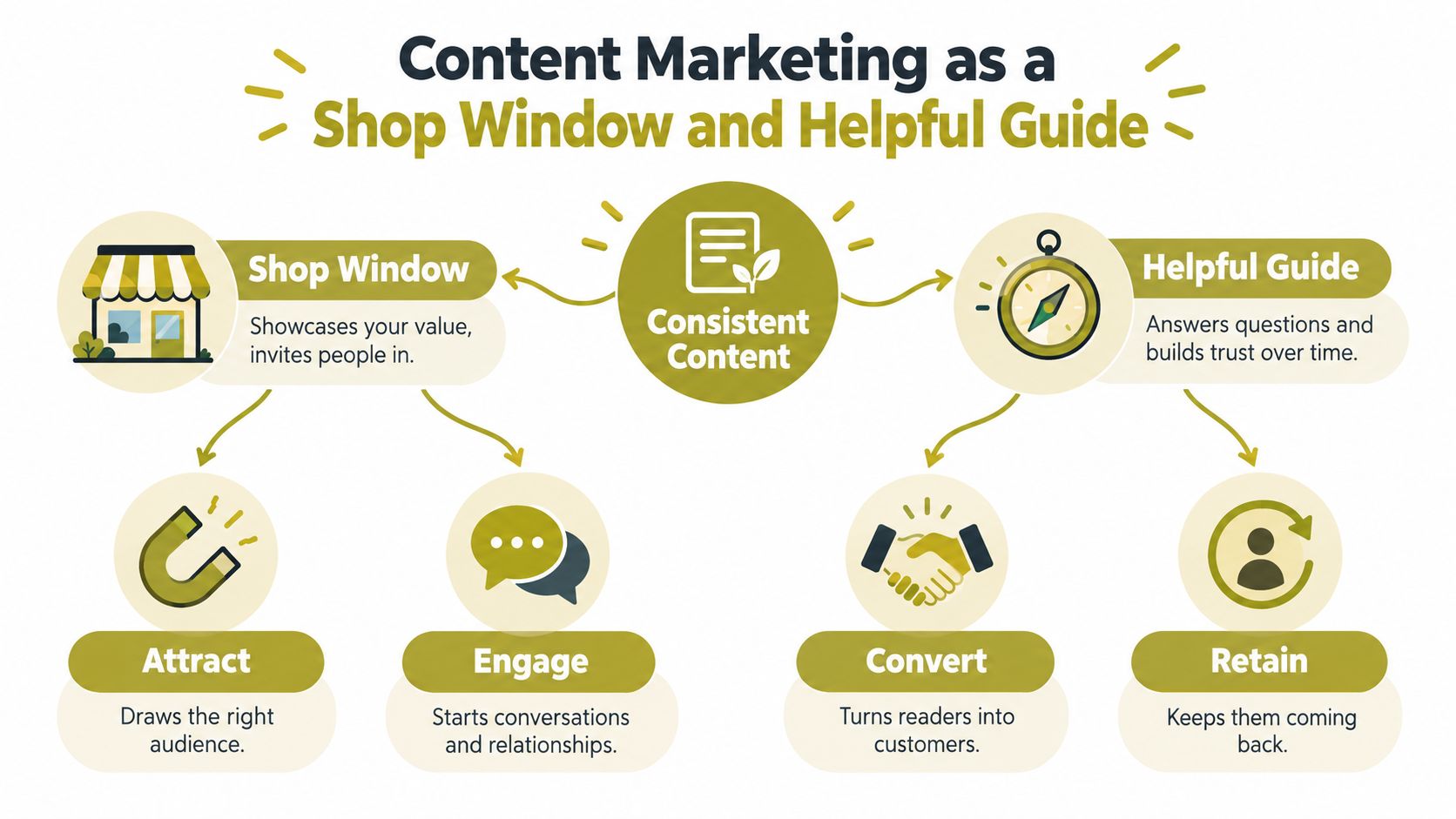
Think shop window first, salesperson second
Traditional advertising often interrupts. Content earns attention.
A startup blog post, explainer video or founder memo is doing two jobs at once. First, it acts as a shop window. It shows what you know, what you solve and how clearly you think. Second, it acts as a helpful guide. It gives buyers enough value that they trust you before they've spoken to you.
That's why weak content rarely fails because of grammar or design. It fails because it doesn't help anyone move.
Good startup content answers the question a buyer would type into Google at 10.30 pm when nobody from your team is available.
How one piece creates several outcomes
A single strong piece can travel further than most founders realise.
Say you write a practical article on “how to reduce failed demos in B2B SaaS onboarding”. That same asset can become:
- A search page that ranks for a useful problem-led term
- A LinkedIn post from the founder with a strong point of view
- An email to prospects who haven't booked a call
- A short video script summarising the main lesson
- A sales follow-up link sent after discovery calls
Startups gain an advantage. A large business may need approvals from brand, legal and regional teams. A founder-led startup can move faster, publish sharper thinking and sound more human.
Match content to buyer intent
Confusion often creeps in because teams bundle all content together. They shouldn't.
Different stages need different content:
- Early interest: educational blog posts, simple videos, commentary on common mistakes
- Mid-stage evaluation: comparison pages, implementation guides, FAQs
- Late-stage decision: case stories, founder credibility, pricing clarity, objection handling
The channels are different, but the underlying logic is the same. Help first. Capture interest second. Sell when the reader is ready.
That's why content marketing for startups works best when the founder's voice is part of the mix. Buyers aren't only judging the offer. They're judging whether the people behind it seem competent, clear and trustworthy.
Building a Lean Content Strategy That Fits Startup Reality
Most startup content problems begin before anyone writes a word. The team hasn't decided who the content is for, what it should prove, or which business outcome matters most.
That's why lean strategy beats busy execution.
Start narrower than feels comfortable
Early-stage teams often describe their audience too broadly. “SMEs”, “busy parents”, “operations leaders”, “hospitality brands”. Those aren't audiences yet. They're buckets.
Pick one urgent problem for one specific buyer. For example, not “HR software for growing firms” but “HR leads in regulated SMEs who need a cleaner way to document onboarding decisions”. The narrower the problem, the easier it is to sound useful.
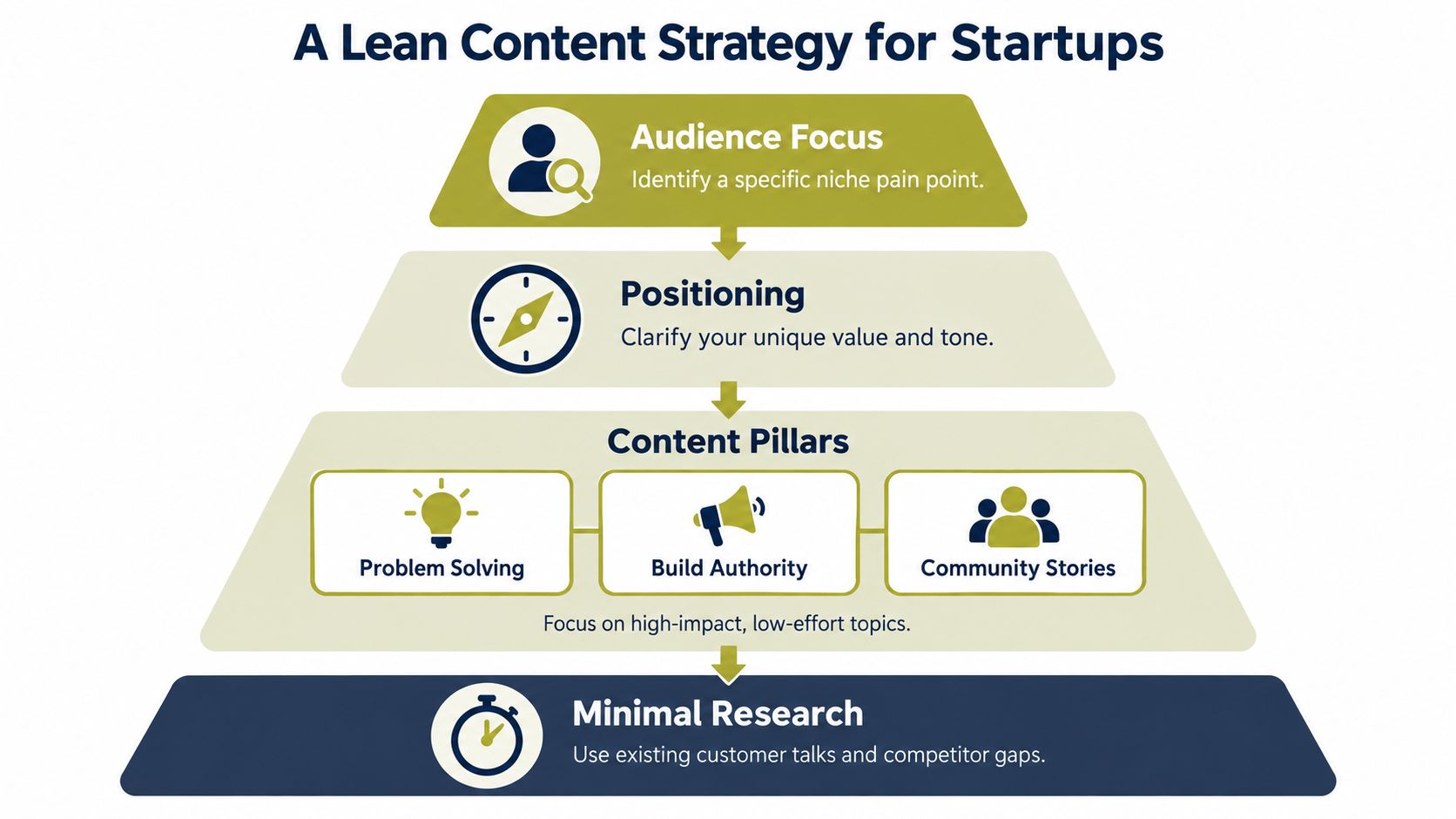
A lean strategy usually rests on four choices:
- Audience focus: who has the problem you can explain best
- Positioning: why your angle is different from a generic alternative
- Content pillars: the repeatable themes you can speak on with authority
- Research method: what you already know from calls, demos, objections and sales notes
Build around three practical pillars
You don't need a huge editorial machine. You need a small set of repeatable themes.
One workable model looks like this:
| Pillar | What it does | Example topic |
|---|---|---|
| Problem solving | Brings in relevant search and social interest | “Why onboarding breaks after a successful sale” |
| Authority building | Shows expertise and judgement | “What founders get wrong about customer education” |
| Community stories | Adds proof and human detail | “What we learned from our first ten customer calls” |
This is also where channel planning starts to matter. If your team wants to turn a monthly article into clips or short social assets, it helps to learn how others boost reach with ClipCreator.ai by building a structured content workflow around one core idea rather than ten disconnected posts.
Use AI carefully, not blindly
AI can speed up research, summarising and repurposing. It can also flatten your voice if you let it write everything.
UK marketing teams are clearly moving in that direction. LocaliQ UK's marketing trend predictions report that 45% of businesses expect to use more AI for content creation, 37% for marketing automation, and 61% plan to grow content marketing. The gap isn't whether startups will use AI. The core question is how they'll keep the output distinct, accurate and commercially useful.
A simple governance rule helps:
- Use AI for speed: outlines, transcript clean-up, first-pass summaries
- Use humans for judgement: positioning, examples, claims, tone and final approval
- Use data discipline: track whether AI-assisted content contributes to signups, replies or pipeline
For a practical framework on structure, messaging and distribution, this guide on how to create a content marketing strategy is worth reading before you commit to a publishing schedule.
Editorial test: If a competitor could publish your article with only a logo swap, the strategy isn't sharp enough yet.
Choosing the Right Channels and Formats on a Startup Budget
A startup doesn't need to be everywhere. It needs to be findable in the places that match buyer behaviour.
That sounds obvious, but many teams still spread themselves thin across blog, LinkedIn, Instagram, YouTube, email, webinars and podcasts before they've made one channel work properly. A tighter mix usually performs better.
What UK usage tells you
Content marketing is already mainstream across UK businesses. An IAB UK news article reports that 74.5% of UK businesses use content marketing and 25.5% do not. The same source lists the most-used formats as blogs at 59.5%, images at 54.1%, video at 43.4%, infographics at 41.0%, case studies at 35.6% and podcasts at 18.0%.
For startups, that pattern is useful. Blogs and video have become the backbone. Podcasts and infographics are usually supporting formats unless your audience has a strong reason to prefer them.
Startup Channel and Format Decision Matrix
| Format | Best For | Startup Effort | Compounding Value |
|---|---|---|---|
| Blog articles | Search visibility, trust, sales enablement | Moderate | High |
| Short-form video | Reach, personality, message testing | Moderate | Medium |
| Images and carousels | Social engagement, summarising ideas | Low to moderate | Low to medium |
| Case studies | Decision-stage trust | Moderate | High |
| Email newsletters | Nurture, repeat attention, launches | Low to moderate | High |
| Podcasts | Depth and relationship building | High | Low to medium early on |
| Infographics | Simplifying complex ideas | Moderate | Medium |
Where to focus first
If you're running a lean team, start with a practical sequence rather than a broad rollout.
- Begin with blog content if search intent matters in your category. One clear article can support SEO, sales and social at the same time.
- Add short video when the founder or team can explain ideas clearly on camera. Video often helps people trust a young brand faster.
- Use email early even with a small list. An owned audience matters when algorithms change.
- Develop case studies as soon as you have credible customer outcomes you can describe qualitatively and responsibly.
The owned, earned and paid balance matters here. This explainer on owned earned paid media is useful because it helps founders see why owned content should carry more weight when budgets are constrained.
A simple rule helps. Pick one searchable format, one social format and one nurturing format. For many startups, that means blog, video and email. Everything else can wait.
Budget Friendly Tactics and Execution Playbook for Small Teams
Execution is where founders either build momentum or burn out.
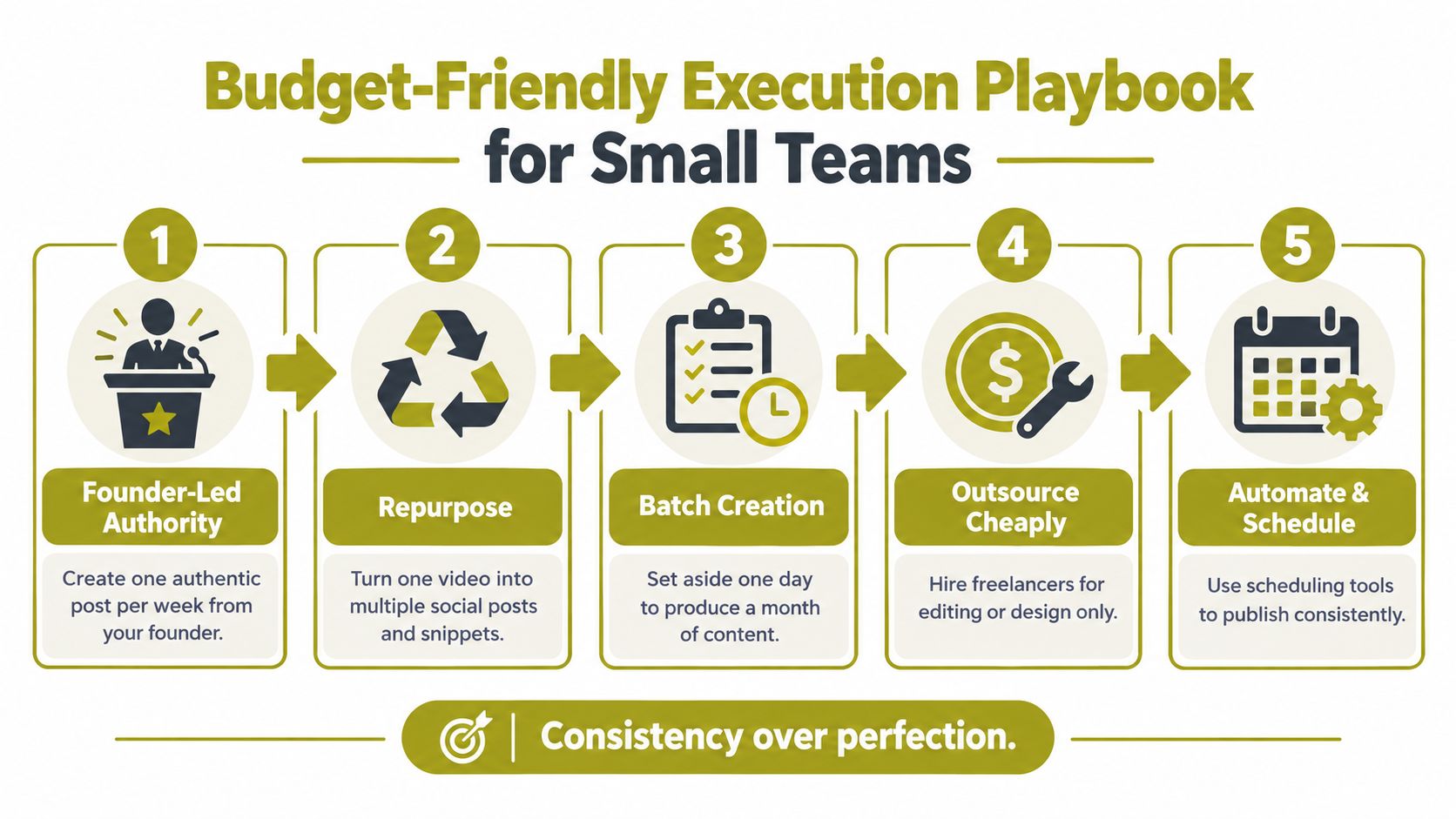
The trap is trying to create a full-scale content engine with a one-person team. The smarter move is to build a repeatable publishing system around one substantial asset each month, then squeeze more value out of it through reuse.
Build the month around one high-signal asset
Think of your monthly article, guide or founder memo as the trunk of a tree. Everything else grows from it.
A straightforward workflow looks like this:
- Pick one commercial question that keeps appearing in calls or emails.
- Draft one substantial piece that answers it properly.
- Pull out five to eight sub-points for LinkedIn posts or carousels.
- Record a short video summarising the strongest argument.
- Send the piece by email with a plain-language introduction.
- Reuse it in sales when the same objection appears again.
This is also where specialist partners can help without replacing the founder's voice. For example, Carlos Alba Media is a specialist UK PR and digital marketing consultancy where everyone is a former national news journalist or has agency experience of working with international brands, which matters when a startup needs senior editorial judgement, clearer messaging and stronger distribution without building a large in-house team.
Match effort to budget reality
Budget shapes channel choice whether founders admit it or not.
For UK SMEs, ProfileTree's SME content marketing benchmarks say micro-businesses typically allocate £500–£1,500 per month, small firms £2,000–£5,000, and medium firms £6,000–£20,000+. That benchmark matters because content should be engineered differently at each spend level.
Spend changes the system. It doesn't just change volume.
At the lower end, the priority is usually founder-led authority, one strong article a month and direct engagement with a niche audience. As budget rises, the system can expand into deeper SEO work, stronger lead capture, design support and broader distribution.
Keep production light and organised
This short video is a useful prompt if your team needs a simpler production rhythm.
Small teams also benefit from cleaner workflow discipline. If you're choosing tools for planning, approvals and scheduling, this guide can help you compare marketing workflow platforms without overcomplicating your stack.
A practical weekly pattern often works better than a giant calendar:
- Monday: capture ideas from sales calls, demos and customer emails
- Tuesday: draft or record the core asset
- Wednesday: edit, add visuals and prepare email copy
- Thursday: publish and distribute across chosen channels
- Friday: review engagement, replies and sales usage
That rhythm is boring in the best possible way. Boring systems produce publishable work.
Measuring What Matters and Proving ROI Over Time
Content usually disappoints founders when they measure it too early or too narrowly.
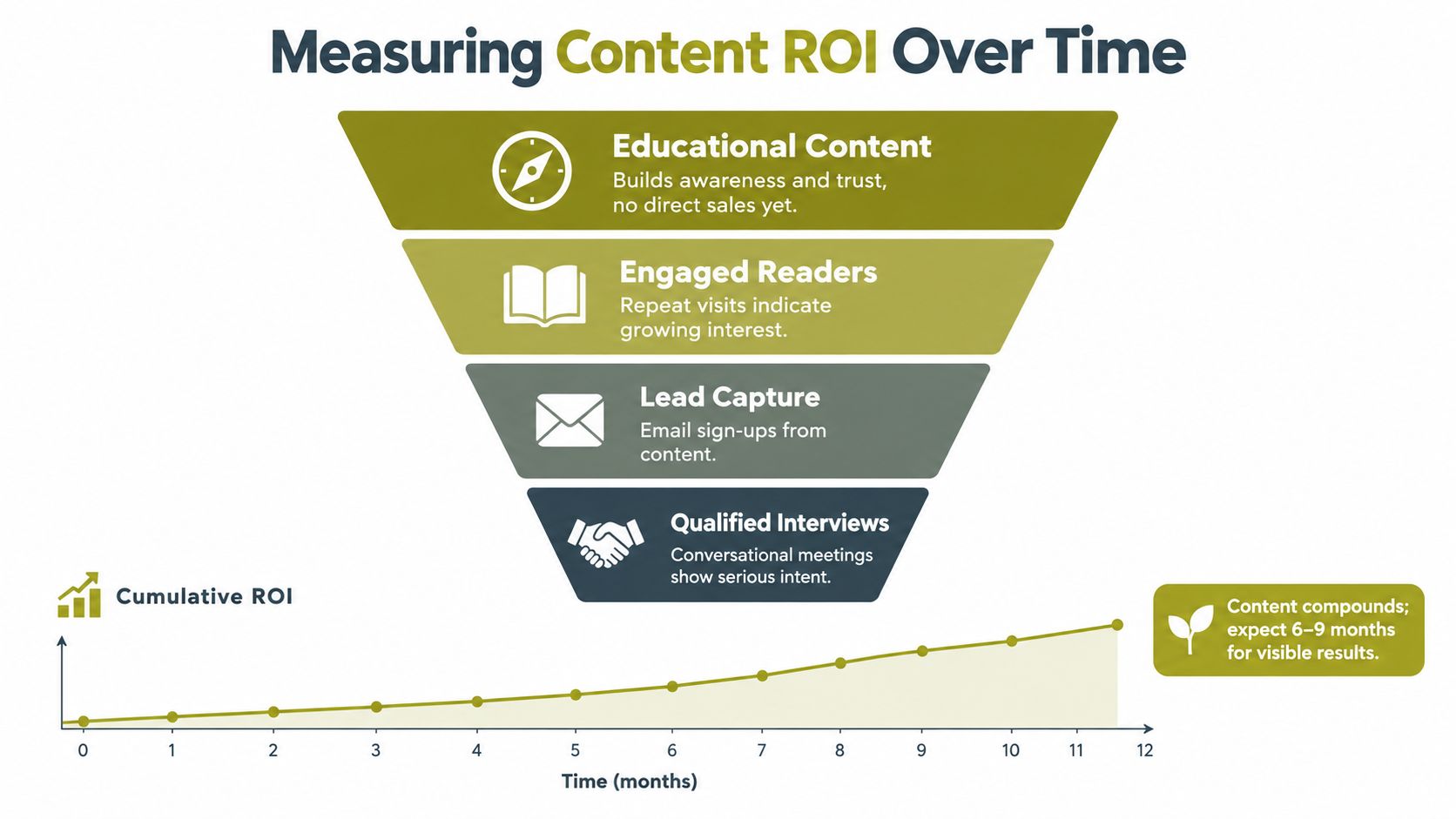
If you only look for last-click leads after a few weeks, good content can look weak. A buyer might read three articles, watch a founder clip, join the email list and only convert months later through a direct visit or referral. If you ignore that path, you'll under-value the work.
Treat content like a delayed-return asset
UK ROI guidance points in the same direction. According to Transformation Junction's UK content marketing ROI analysis, reliable ROI often appears only after 9–12 months for UK businesses with a new domain or limited SEO authority. The same source says well-run UK B2B programmes investing roughly £2,000–£4,000 per month for 12+ months can reach directly attributable revenue of £10,000–£40,000 per month, implying a 3:1 to 10:1 return, and notes that 5:1 is a healthy threshold for a mature programme rather than a launch-stage target.
That should calm two common anxieties. First, early content often looks slower than it really is. Second, a startup doesn't need every piece to convert on first touch for the programme to work.
Track leading and lagging indicators separately
A simple measurement model helps keep expectations sane.
Leading indicators show whether your content is earning attention and trust:
- Search visibility: are more relevant pages being found?
- Engagement quality: are people reading, replying, saving or sharing?
- Email growth: are more readers choosing ongoing contact?
- Sales usage: are team members reusing content in real conversations?
Lagging indicators show commercial impact later:
- Qualified enquiries
- Demo or consultation requests
- Pipeline value influenced by content
- Closed revenue with content touchpoints
Don't ask month-two content to prove month-twelve economics.
Build a small dashboard, not a giant report
You don't need enterprise attribution software to start. A lean dashboard can live in a spreadsheet, CRM or analytics tool.
Track each core asset against:
| Measure | Why it matters |
|---|---|
| Topic and publish date | Shows what themes were tested |
| Channel distribution | Tells you where the asset travelled |
| Assisted conversions | Captures influence beyond last click |
| Lead capture | Connects education to identifiable interest |
| Pipeline notes | Links content to real sales conversations |
The point isn't perfect precision. It's better judgement. Content marketing for startups becomes much easier to defend when you can show how education, trust and pipeline build in sequence rather than pretending every article should close business on its own.
Putting It All Together and Scaling With Specialist Support
Founders often overcomplicate the early phase. The better route is staged.
In the first stretch, build the foundation. Define one audience problem, choose a small set of content pillars, and publish one asset that helps. In the next stretch, build consistency. Repurpose that work across email, search and social so each idea travels further. After that, scale what proves useful. Improve conversion paths, sharpen distribution and double down on topics that create real sales conversations.
A practical growth rhythm
A simple progression tends to hold up well:
- First 90 days: establish positioning, publish consistently, create a basic distribution habit
- Next phase: improve reuse, add stronger lead capture and track assisted conversions
- By 12 months: refine the winners, retire weak formats and invest more where content supports pipeline
Common mistakes are usually predictable. Publishing too broadly. Sounding generic. Letting AI flatten the message. Measuring too soon. Ignoring sales feedback. Treating each post as a one-off instead of part of a connected system.
Specialist support starts to make sense when the team has enough signal to scale but not enough time or editorial skill to do it well alone. That's where senior judgement matters. Carlos Alba Media is a specialist UK PR and digital marketing consultancy, and everyone who works there is either a former national news journalist or has agency experience of working with international brands. For a startup, that kind of background can help turn founder knowledge into sharper stories, clearer positioning and stronger media-facing content.
If you remember one thing, make it this. Content isn't a volume game first. It's a compounding game first.
If your startup needs clearer messaging, stronger thought leadership or a content system that supports search, trust and pipeline, Carlos Alba Media offers senior-level PR and digital marketing support shaped by newsroom discipline and brand experience. They work with startups that need practical content strategy, sharper storytelling and execution that doesn't waste scarce budget.