
Only 39.4% of UK startups born in 2017 were still trading five years later, so if you're asking whether you should care about the difference between “start ups” and “startups”, the answer is yes, because the modern term points to a specific high-risk, scale-driven business model, not just any new company. And if you build yours like a normal small business when it's a startup, you'll make the wrong decisions on messaging, funding, hiring and growth when the margin for error is already thin.
For start ups or startups, use startups. One word. That's the modern spelling, and the change matters because the concept has matured. A startup isn't just a business that started recently. It's a company built to test demand fast, sharpen a repeatable model, and scale harder than a traditional small business ever needs to.
A lot of founders get stuck at this exact point. You've got a product idea, maybe a landing page, a deck, a few early conversations, and a head full of noise from LinkedIn, podcasts and investor content. Everyone tells you to “build in public”, “raise fast”, “go viral”, “hire a growth lead”, “do founder-led sales”, “own your category”. Fine. But what should you do this month if you want customers, credibility and a business that survives?
That's the part most startup advice skips. As former journalists and agency operators know, the companies that get attention aren't always the ones with the best product. They're the ones that explain themselves clearly, prove relevance early and give buyers, investors and media a reason to care.
The Startup Spelling Debate and What Is at Stake
A founder emails a journalist with a subject line about their “new start up”. It sounds small. Local. Early. A bit vague. The same founder rewrites the pitch and calls it a startup building software for a defined market problem. It suddenly sounds like a company with ambition, a model and a story.
That shift isn't cosmetic. Language shapes perception. If you describe yourself loosely, people assume you think loosely.
Why startups is the right term
Startups is the accepted modern spelling because it describes a distinct category of company. It signals more than “new business”. It suggests speed, testing, risk, funding pressure and the expectation of growth.
“Start ups” still appears in casual use, but it reads dated. Beyond that, it blurs two very different things:
- A startup is built to find and scale a model quickly.
- A new business might be built for steady profit, owner income or a defined local market.
- An SME can be healthy and successful without behaving like a venture-backed company.
That distinction affects your branding, your media strategy and your investor conversations. If you pitch like a neighbourhood business but ask to be valued like a startup, nobody takes you seriously.
Practical rule: Call it a startup only if you're building for repeatable growth, not simply because you launched recently.
The stakes are higher than most founders admit
The spelling debate seems minor until reality kicks in. In the UK, about 39.4% of startups born in 2017 were still trading five years later, meaning roughly 6 in 10 had closed by year five, according to UK startup survival data summarised from the Office for National Statistics.
That's the issue. Most founders don't fail because they used the wrong word on their homepage. They fail because fuzzy thinking leads to fuzzy positioning, and fuzzy positioning makes it harder to win customers, money and trust before time runs out.
What founders should do with that reality
Treat your category, language and narrative as operating decisions, not branding fluff.
A useful test:
| Question | Weak answer | Strong answer |
|---|---|---|
| What are you building? | “A platform for everyone” | “A product for one painful business problem” |
| Who is it for? | “SMEs and enterprises” | “A defined buyer with a clear need” |
| Why now? | “The market is changing” | “Buyers need a faster, cheaper, clearer outcome” |
| Why you? | “We're passionate” | “We understand the problem and can explain it sharply” |
Founders who can answer those cleanly are easier to buy from, easier to back and easier to cover.
What Exactly Is a Startup Not Just a New Business
A startup is not just an early-stage company with a logo and a launch post. It's a business model under pressure. It's built to validate demand, prove unit economics and scale if the signals are strong enough.
That means you shouldn't copy the habits of a traditional small business if your goal is startup growth. The mechanics are different.
The defining difference
The clearest way to think about it is this. A small business often starts with a known service, a known market and a plan to become profitable as soon as practical. A startup often starts with an assumption that still needs proving.
That assumption might be about demand, pricing, activation, retention, sales motion or market timing. Until it's proved, the company is still searching.
The broader startup model also reflects how these firms operate. Startups typically rely on lean teams, often need external funding, and move through stages where validation comes before scaling. That's why stage-appropriate measures such as activation rate, cohort retention and CAC payback matter more than revenue alone in the early journey, as outlined in Salesforce's explanation of how startups are structured and funded.
Startup vs SME at a Glance
| Feature | Startup | SME (Small & Medium Enterprise) |
|---|---|---|
| Primary goal | Find a scalable model | Build a stable, profitable business |
| Growth mindset | Fast expansion if demand is proved | Controlled, sustainable growth |
| Risk profile | High uncertainty | Lower uncertainty if model is established |
| Funding approach | Often external capital | Often owner-funded, loan-funded or revenue-funded |
| Metrics that matter early | Activation, retention, CAC payback | Revenue, margin, cash flow, repeat business |
| Messaging challenge | Explain a new category or problem clearly | Build trust and local or sector reputation |
| PR need | Educate, differentiate, attract belief | Build credibility, awareness and preference |
Why founders keep confusing the two
A lot of businesses call themselves startups because it sounds more ambitious. That's usually a mistake.
If you run a specialist agency, consultancy, retailer, studio or trades business, there is no shame in building an SME. In many cases, it's the smarter route. The problem starts when founders borrow startup language without startup logic. They chase visibility before validation, hires before revenue, and investor attention before they can explain the basics.
A startup that can't explain its market problem in plain English isn't early. It's unclear.
What this means for PR and marketing
Your communications strategy should follow the model you're building.
If you're a startup, your marketing has to do more than generate clicks. It has to answer four questions fast:
- What painful problem exists
- Why your solution is different
- Why buyers should trust a new entrant
- Why this matters now
That's why startup PR is harder than many founders expect. You're not just promoting a business. You're trying to make the unfamiliar feel credible.
Former journalists tend to spot this earlier than others because they know how editors, investors and buyers assess relevance. They ask the same brutal question: why should anyone care right now?
The Four Key Stages of the Startup Lifecycle
Most startup mistakes happen because founders apply the wrong strategy to the wrong stage. They try to look scaled before they've learned anything. Or they stay in “testing mode” long after the market is asking for conviction.
This is the roadmap that matters.
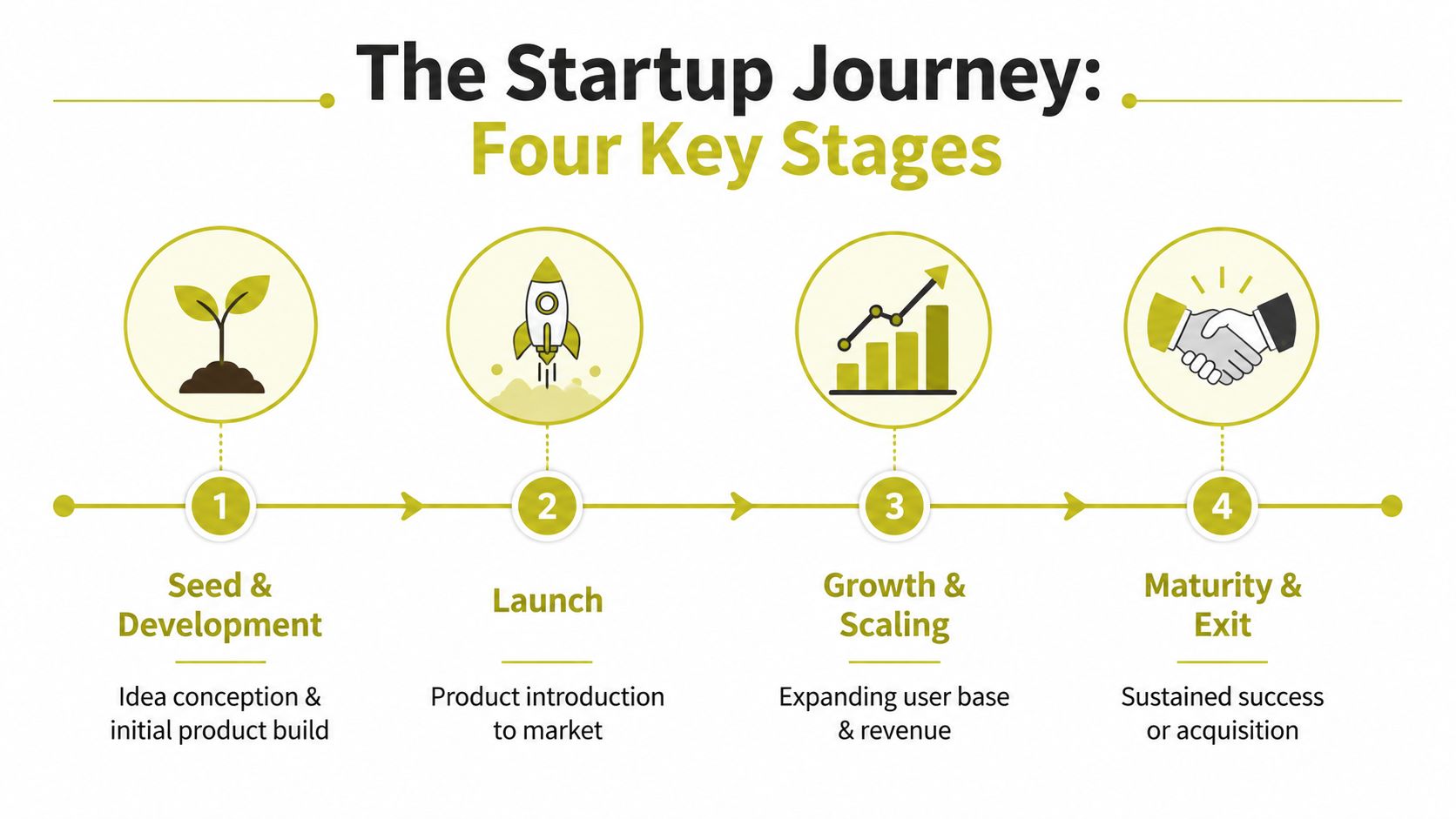
Seed and Development
At this stage, your job is not to look impressive. Your job is to learn quickly.
You're shaping the proposition, building the smallest viable version of the product and pressure-testing whether the problem is painful enough to matter. Your communications should be narrow and precise. Broad brand campaigns are a waste here.
Focus on:
- Founder narrative: Explain why you understand the problem better than outsiders.
- Problem clarity: Use the language real buyers use, not invented category jargon.
- Early proof: Collect feedback, objections and usage patterns you can learn from.
PR at seed stage is usually about selective credibility. You don't need a huge media splash. You need the right conversations with the right people.
Launch
Launch is where many founders become noisy and careless. They confuse activity with traction.
At launch, your key job is to get the product into the market and observe what happens. Messaging should support activation, onboarding and first conversion. Every word should reduce friction.
The metrics that matter now are behavioural. If users sign up but don't stick, your positioning or product promise is off. If buyers love the message but still hesitate, the offer may be weak or unclear.
A useful explainer on startup stages and founder expectations is this video:
Growth and Scaling
This is where discipline matters most. Once you see evidence of demand, the temptation is to expand everything at once. Don't.
Your PR and marketing choices should get sharper here, not wider by default. Choose one audience, one proof point and one market story before adding channels and headcount.
Use this stage to tighten:
| Priority | What to do |
|---|---|
| Positioning | Refine the message buyers actually respond to |
| Sales enablement | Give the team proof, case language and objection handling |
| Brand credibility | Build visible trust markers through media, partnerships and thought leadership |
| Demand efficiency | Back channels that create qualified interest, not vanity attention |
Finance pressure also becomes more visible as you move upmarket or grow the team. The funding picture isn't level either. The British Business Bank's 2024/25 Small Business Finance Markets report says external finance use remains uneven across groups and regions, with support still flowing disproportionately toward repeat founders and firms near major innovation hubs, as discussed in this analysis of underestimated startup founders.
That means founders outside those networks need a stronger story, tighter evidence and more deliberate visibility.
Maturity and Exit
By this stage, your communications stop being purely about demand generation. They become reputation management.
Buyers, investors, partners and potential acquirers want consistency. They want confidence in leadership, clarity in market position and signs that the brand can hold up under scrutiny.
That changes what good PR looks like:
- Leadership visibility matters more than hype-driven announcements.
- Message consistency matters more than clever campaigns.
- Reputation control matters because one clumsy statement can undermine trust built over years.
If you're approaching maturity, speak like an operator, not a disruptor cliché.
Navigating the Challenges That End Most Startups
Most startup deaths don't arrive as dramatic collapses. They start as ignored signals. A weak activation rate. Sales calls full of polite interest but no movement. Cash getting tighter while the team tells itself the market “just needs educating”.
Usually, the problem is simpler. You built something people don't need enough, or you ran out of time to fix it.
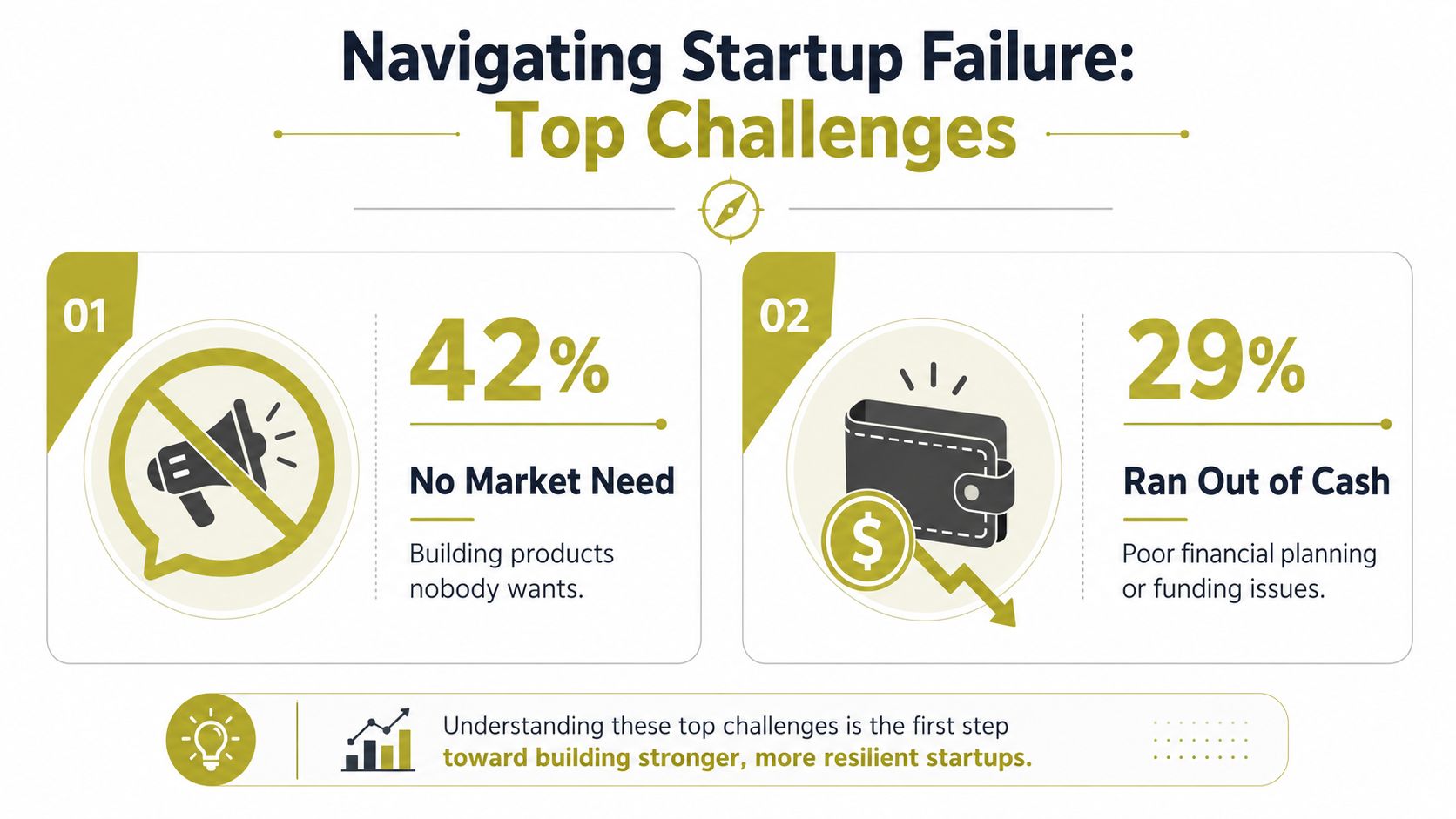
No market need is a positioning problem before it becomes a product problem
42% of failed startups cite “no market need” and 29% cite running out of funding, according to Founder Facts startup failure data. Read those together, not separately.
If the market doesn't care enough, cash goes next. That's why validation is not a motivational exercise. It's an operational one.
Here's where founders go wrong:
- They build around features, not pain.
- They pitch everyone, so nobody feels addressed directly.
- They mistake compliments for buying intent.
- They spend on growth before they've earned retention.
A good early test is brutally simple. Can a potential customer describe the problem back to you in their own words and say they'd fix it now, not someday?
Your first marketing job isn't reach. It's signal detection.
Cash problems usually begin with bad sequencing
Running out of money rarely comes down to one bad month. It usually starts with premature scale.
Founders hire before the message works. They buy ads before the funnel is clear. They spread effort across LinkedIn, SEO, PR, events, partnerships and outbound at the same time, then wonder why nothing compounds.
Better sequence looks like this:
- Prove the pain
- Test the message
- Win a small group of real users
- Study what keeps them engaged
- Only then add spend, systems or staff
For sales operations, stack discipline matters too. If you need to organise outreach, follow-up and pipeline without wasting time on bloated tooling, it helps to review practical options like find effective sales apps for 2025, then choose only what supports your current stage.
Reputation risk can finish a fragile startup faster than founders expect
When cash is tight and the product is still evolving, one messy public issue can do real damage. A founder overpromises. A customer complains publicly. A launch breaks. A media enquiry lands and nobody knows who should respond.
That's why startups need a communications plan earlier than they think. A practical starting point is this guide on how to develop a crisis communications plan.
A few rules matter immediately:
- Name a spokesperson: Don't improvise under pressure.
- Write holding statements: Prepare short responses before anything goes wrong.
- Track public risk points: Product delays, complaints and delivery failures are comms issues too.
- Keep claims modest: Startups damage trust when they market certainty they haven't earned.
What smart founders do instead
They treat validation as engineering, messaging as part of product, and PR as risk control as much as visibility.
That mindset changes everything. It stops you chasing applause and forces you to earn traction.
Building Your Narrative PR and Marketing on a Budget
Most founders treat PR as something you buy after traction. That's backwards. If you're unknown, underfunded and selling into a sceptical market, narrative is one of the few advantages you control early.
You don't need a giant budget to build credibility. You need a clear story, consistent proof and disciplined distribution.

Efficiency matters more than hype now
The current shift is toward efficiency-led, revenue-first startups, which makes the question of how UK founders build credibility, visibility and demand without burning cash especially urgent, as noted in Digital Native's look at underserved startup growth questions.
That should change how you market.
The old playbook told founders to look bigger than they were. The smarter playbook is to look sharper than competitors who are spraying money everywhere. Tight positioning beats generic exposure.
What a budget-conscious startup should prioritise
You don't need to do everything. You need to do the few things that create trust.
Nail the founder story
People back people before they back positioning statements. Your founder story should answer three things cleanly: what problem you saw, why you understand it, and why you're building this now.
Avoid autobiographies. Buyers and journalists don't care about your whole life. They care about relevant authority.
Build a usable message house
Your team needs a consistent way to talk about the company. Keep it simple:
| Message layer | What it should do |
|---|---|
| Core message | State the problem and solution in plain English |
| Proof points | Show why the claim is credible |
| Audience variants | Adapt the same message for customers, investors and media |
| Objection handling | Answer the most common doubts clearly |
Turn one idea into multiple assets
A good founder memo can become a LinkedIn post, website copy, sales follow-up, media comment and newsletter topic. Budget startups win when they repurpose intelligently.
If you're trying to stay consistent on social without creating chaos, tools built for lean teams can help. For example, PostPlanify for startups is useful context for planning and managing social content without turning it into a full-time internal job.
Credibility grows when the same clear message shows up everywhere, not when you keep reinventing it.
Why journalist-led PR is different
In this context, specialist support matters. Founders often get generic marketing advice when what they really need is editorial judgement.
At Carlos Alba Media, the relevant difference is practical, not decorative. Everyone working there is either a former national news journalist or has agency experience working with international brands. That changes the work. Former journalists know what makes a story publishable, what kills interest instantly and how to shape a founder narrative so it sounds like news rather than self-promotion. Agency experience then translates that story into campaigns, digital content and market visibility.
If you want a deeper look at that kind of support, their page on PR for startups shows the sort of work early-stage companies usually need.
What to do this month
Keep it practical:
- Rewrite your homepage headline: Make the problem and audience obvious.
- Create three proof points: One commercial, one customer-led, one founder-led.
- Write one opinion piece: Take a clear view on a problem in your sector.
- Pitch fewer media targets: Choose relevant outlets, not every outlet.
- Brief your team properly: Everyone should describe the business the same way.
Most startup marketing improves when founders stop trying to sound impressive and start trying to sound clear.
When to Hire an Agency for Your Startup
You should hire an agency when DIY marketing starts stealing time from the work only you can do. Not before. But definitely not long after.
A founder can write early copy, test messages and post on LinkedIn. That's normal. The problem starts when comms becomes a drag on product decisions, fundraising, sales or hiring.
The trigger points are usually obvious
Bring in outside help when one or more of these starts happening:
- You're preparing for a meaningful launch: National attention, partner visibility or investor scrutiny raises the standard.
- You need founder profiling: If your name is becoming part of the company's trust signal, it needs handling properly.
- Your story is messy: If buyers, investors and journalists all hear a different version, you've got a positioning problem.
- You've raised funding or are raising soon: That's when message discipline and reputation management matter more.
- You're firefighting communications issues: Reactive comms usually means the system is broken.
Don't hire on vibes
Founders often choose agencies the same way they choose conference swag. They pick the one with the slickest deck.
Bad move. You need judgement, pace and relevance. If you're working in tech and trying to benchmark how startups assess specialist partners more broadly, this guide on vetting tech agencies for startups is a useful reminder to look past polish and ask how the work gets done.
A good PR or marketing agency should be able to answer plainly:
- What story are we telling?
- Who is it for?
- What proof supports it?
- Which channels matter now?
- What should we stop doing?
A related practical read is this guide on how to choose a PR agency. It helps founders avoid paying for activity when they need strategic judgement.
If you can't tell whether your current marketing is producing clarity, trust and useful momentum, that's usually the moment to get help.
If you want senior-level PR and digital marketing support without big-agency bloat, Carlos Alba Media is built for that kind of work. The team combines newsroom instinct with agency execution, which is useful when a founder needs sharper messaging, stronger media handling and a clearer path to credibility.