
You're probably doing what most SME owners do. You've got Google Ads running, you post on LinkedIn when you remember, your website has some decent pages, and you've maybe had the odd bit of press coverage. Yet it still feels disjointed. One channel spikes. Another goes quiet. Costs creep up. Leads arrive without much consistency. You're spending money, but you're not building momentum.
That usually happens when marketing is being handled as a list of separate tasks instead of a connected system. Paid gets treated as the growth engine. Social becomes a box-ticking exercise. The website sits there like a brochure. PR happens only when someone has time to chase it. The result is noise, not traction.
The owned, earned and paid media model fixes that, but only if you use it properly. It isn't jargon. It's a practical way to organise how your business gets seen, trusted and chosen.
A newsroom mindset makes that model sharper. Journalists know how to find the angle, shape the story, and connect what matters to the audience. That matters because attention is cheap, but credibility isn't. Carlos Alba Media's specialist nature is defined by its team exclusively comprising former national news journalists or agency professionals with international brand experience, ensuring campaigns are shaped by those with 20 years of editorial journalism credentials, as outlined on ResilienceWeb's Carlos Alba Media profile. If you want to see how this fits into a wider customer journey, their thinking on building an omnichannel strategy is worth your time.
Introduction Why Your Marketing Feels Disconnected
Your marketing feels disconnected because each channel is doing its own job badly instead of doing one job together.
Paid media gets you attention fast. Owned media gives people somewhere to go when they want to check you out. Earned media gives them a reason to believe you. Most SMEs overwork one of those and neglect the other two. Then they wonder why results feel unstable.
What disconnected marketing looks like
You'll recognise the signs:
- Your ads generate clicks, but not enough trust: People visit, skim, and leave because the website doesn't carry enough authority.
- Your website exists, but doesn't pull its weight: It explains what you do, but it doesn't answer objections, prove expertise, or convert interest.
- Your PR activity is sporadic: You get coverage now and then, but nobody turns that coverage into sales assets, retargeting material, or lead nurture content.
- Your reporting is channel by channel: One person tells you ad performance. Another talks about engagement. Nobody ties it back to commercial outcomes.
Marketing breaks when every channel has its own agenda.
The fix is integration, not more activity
Most businesses don't need more posts, more ads, or more random PR outreach. They need one message, one plan, and one sequence.
Use paid media to create initial visibility. Use owned media to deepen interest and convert it. Use earned media to add independent validation. Then feed each one back into the others.
That's how owned earned paid media works when it's done properly. Not as three separate budgets, but as one commercial system.
Decoding Owned Earned and Paid Media
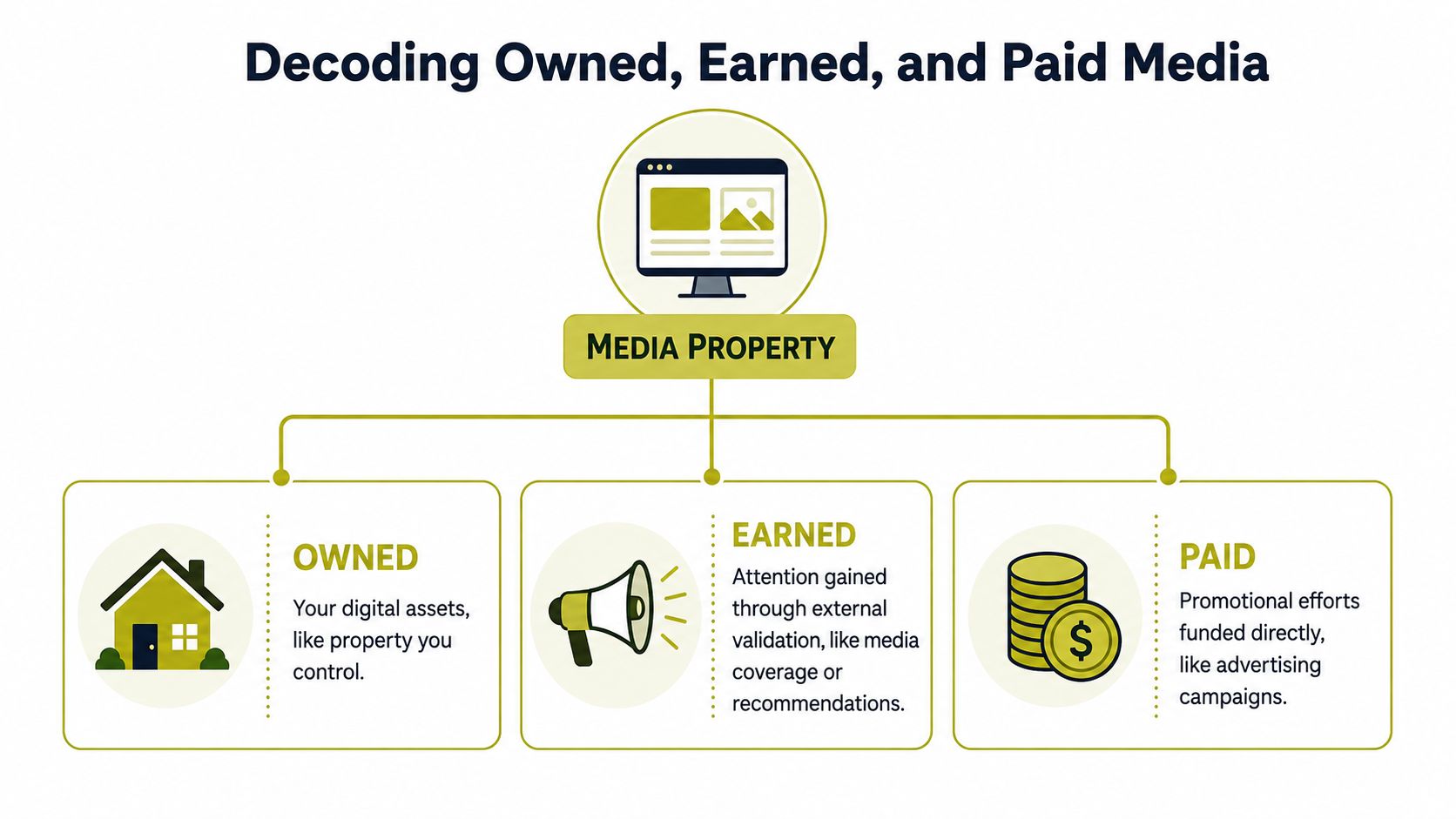
If you want a simple way to understand owned earned paid media, think about property.
Owned media is your home.
Paid media is rented space.
Earned media is your reputation in the neighbourhood.
That framework matters because each type of media does a different job. Confuse the roles and you waste money.
Owned media is what you control
Your website. Your blog. Your email list. Your landing pages. Your case studies. Your podcast. Your LinkedIn company page. These are all assets you can shape, update and improve without asking permission.
That control is the whole point. If a buyer wants to check whether you're credible, they'll land on owned assets at some stage. If those assets are thin, unclear, or badly organised, you'll lose them.
Examples for SMEs include:
- Website service pages: Clear commercial pages built around specific buyer needs.
- Thought leadership articles: Useful pieces that answer the exact questions buyers type into search.
- Email sequences: Follow-up messages that move prospects from interest to enquiry.
- Resource hubs: Guides, FAQs and insight pages that make your expertise visible.
If you want a cleaner definition of what counts as earned versus owned, Carlos Alba Media has a useful explainer on what earned media is.
Paid media is rented reach
Paid media is anything you pay for to put your message in front of people. Google Ads, LinkedIn ads, sponsored posts, promoted content, display placements. You're buying access to attention.
That's useful, but temporary. Stop paying and visibility drops. Paid media is excellent for speed, testing messages, and getting in front of defined audiences. It is not a substitute for having a strong website or a believable reputation.
Think of paid as acceleration. It helps good strategy move faster. It won't rescue weak positioning.
Earned media is credibility you don't buy
Earned media is coverage, reviews, recommendations and mentions that come from third parties. A feature in a national title. A trade press article. A podcast appearance. Client reviews. Expert commentary. Backlinks from respected outlets.
Many SMEs get lazy. They assume earned means lucky. It doesn't. It means you created something worth covering, asking for, or talking about.
Earned media carries weight because someone else is doing the talking for you.
A strong earned mention in a respected publication often does more for trust than another month of shouting through ads. That's why smart firms don't treat PR as decoration. They treat it as proof.
Comparing Media Roles and ROI
If you're deciding where to put time and budget, stop asking which channel is “best”. That's the wrong question. Ask what role each channel should play in your buying journey.
In the UK, businesses often lean too hard on paid activity and underinvest in their own assets. Research highlighted by TLC Ads says approximately 30% of UK service businesses struggle with this gap, spending heavily on paid media while failing to build owned media that supports long-term brand equity, as noted in its guide to paid, owned, borrowed and earned channels. That's a strategic error, not a tactical one.
Owned vs Earned vs Paid Media at a Glance
| Attribute | Owned Media | Earned Media | Paid Media |
|---|---|---|---|
| Cost | Built through time, planning and content production | Usually slower to win, but doesn't rely on buying placement | Direct spend required for reach |
| Control | High control over message, timing and format | Low control once the story is out | High control over audience targeting and spend |
| Credibility | Moderate, because it comes from your brand | High, because third parties validate you | Lower than earned on trust alone |
| Scalability | Improves over time as assets compound | Harder to scale on demand | Easy to scale quickly if budget allows |
| Longevity | Strong, if content stays relevant | Strong when coverage keeps ranking or gets reused | Weak once spend stops |
| Best use | Education, conversion, proof, search visibility | Trust, authority, reputation, social proof | Speed, testing, reach, retargeting |
What this means in practice
Owned media is where your margin improves. You pay to build it, then it keeps working. A strong article, landing page or case study can support sales calls, search visibility, email nurture and retargeting for months.
Earned media changes the quality of attention. It filters out some of the scepticism that paid media creates. If a prospect sees your ad, then visits your website, then notices you've been covered by a respected publication, the whole journey feels more credible.
Paid media is still valuable. You just need to use it with discipline.
- Use paid to test messages: It tells you quickly which headlines, offers and audiences respond.
- Use paid to amplify proof: A solid article, founder interview or customer story is often better ad material than a generic sales message.
- Use paid to support launches: New offers, events and campaigns need velocity.
If you're exploring formats that sit between owned authority and audience development, crafting branded podcasts can be a useful way to build a long-life content asset that supports both trust and distribution.
The blunt recommendation
Don't pour money into paid media if your website is weak and your proof is thin. Fix the foundation first. Then amplify what deserves attention.
The Newsroom Approach to Media Integration
Most marketing advice treats integration like an admin exercise. Align the calendar. Reuse content. Share dashboards. Fine. That's not enough.
The better approach is to run your media strategy like a newsroom. Newsrooms don't start with channels. They start with what matters, why it matters now, and who needs to hear it. That's why they produce stories people pay attention to.
Every individual writing and shaping campaigns at Carlos Alba Media is a former national news journalist or an agency professional who has worked with international brands, a workforce threshold that guarantees senior-level counsel without big-agency overheads, according to the agency's introduction for newsrooms. That matters because integration works better when the people creating the strategy understand how editors think, how stories get selected, and how public credibility is built.
Start with the story, not the platform
SMEs often begin in the wrong place. They ask, “What should we post this week?” A newsroom asks, “What's the strongest angle we can stand up publicly?”
That angle could come from:
- A business milestone: Product launch, expansion, funding, recruitment, partnership.
- A strong point of view: A founder who can comment clearly on a live issue in their sector.
- Customer evidence: Trends you're seeing in client work that reveal a wider shift.
- Useful data or expertise: Insight that helps a journalist explain what's happening in the market.
If it isn't relevant, specific or useful, it won't earn attention. That's true in journalism and it's true in marketing.
Turn one strong angle into three working assets
Once you've got the story, you build it into each media type with intent.
Owned media
Publish the fuller explanation on your website. That might be a commentary piece, a landing page, a founder article, a case study, or a resource page. Here, your business controls the depth, accuracy and call to action.
Earned media
Pitch the sharpest version externally. Journalists don't want your brochure. They want the timely hook, the evidence, and the expert who can speak clearly. Reviews, interviews, features and commentary all sit here.
Paid media
Put spend behind what has already proved it can hold attention. Promote the article, interview, insight page or event page to a target audience. Retarget visitors who engaged but didn't act.
Practical rule: Don't pay to amplify weak content. Pay to extend credible content.
Here's a short example. A cyber security SME publishes a strong owned article on a newly emerging business risk. The founder then comments on that issue for trade media, generating earned coverage. The company runs paid LinkedIn promotion to put that article and the earned mention in front of operations directors, compliance leads and procurement teams. One angle. Three channels. One coherent message.
Build a repeatable editorial rhythm
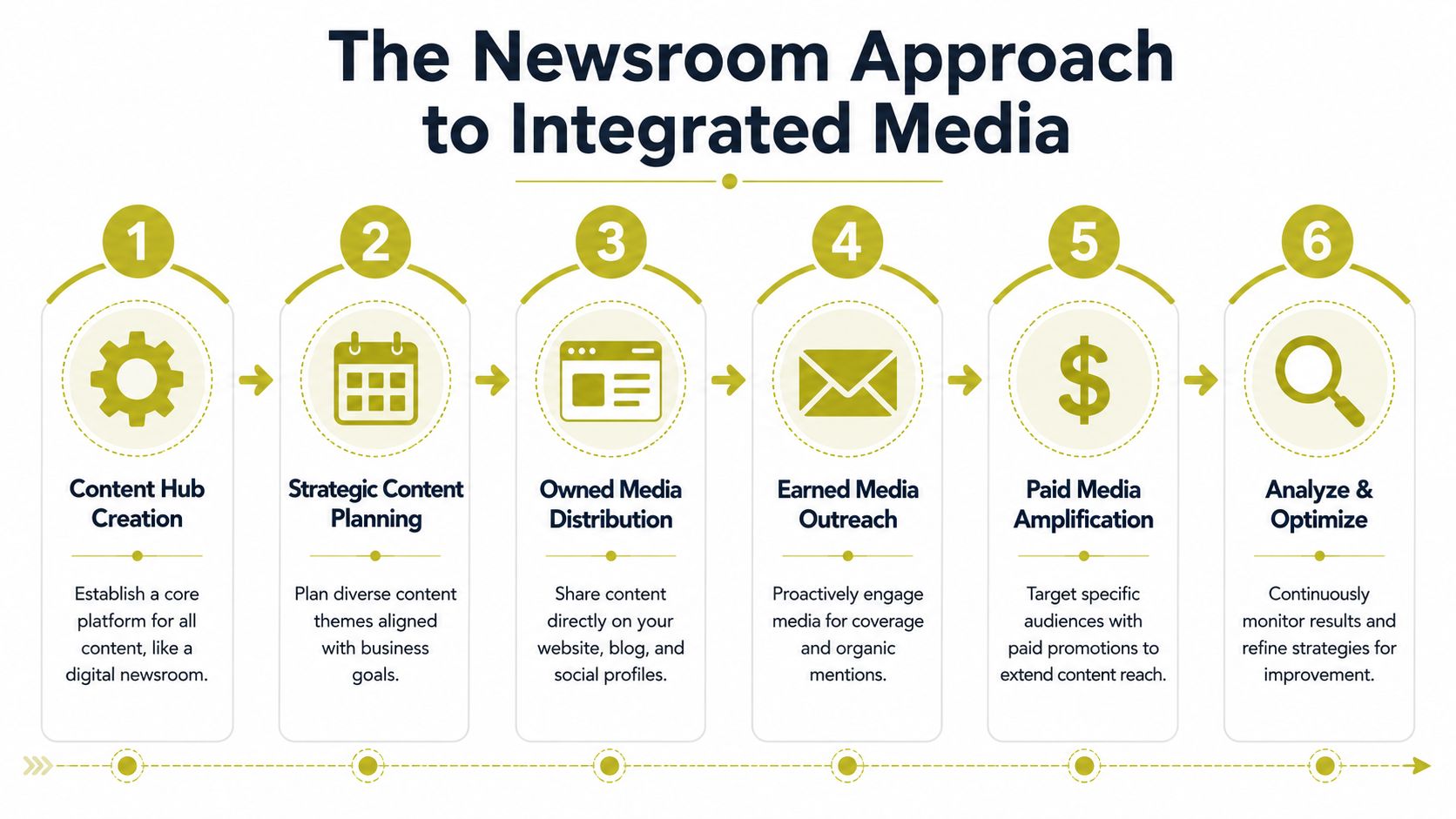
A newsroom approach only works if you stop acting randomly. Set a recurring editorial process.
- Choose the commercial priority: New service, sector focus, hiring push, investor visibility, event, product release.
- Find the public angle: What makes this timely, relevant or useful beyond your own business?
- Create the owned hub: Build the page or article that becomes the factual centre of the campaign.
- Pitch for earned validation: Tailor outreach by outlet and journalist, not with bulk email nonsense.
- Use paid for precision: Promote what lands. Retarget smartly. Keep spend tied to business intent.
- Review response and adapt: Which angle got traction, which audience stayed engaged, which assets moved people forward?
For a practical discussion of this kind of integrated media thinking in action, this short video is worth watching.
Why journalists beat generic content planning
Former journalists spot the difference between a claim and a story. They know how to frame a pitch so it sounds publishable, not promotional. They know what gets ignored because they've ignored it themselves in newsrooms.
That's the advantage of applying a journalistic filter before content gets created. You stop producing safe, forgettable marketing and start producing material that can earn trust, travel further, and feed the full owned earned paid media system.
Measuring Success Beyond Vanity Metrics
Most SMEs still measure media badly. They count likes, impressions, clicks and mentions, then try to pretend that means commercial progress. It doesn't. Those are activity signals, not business outcomes.
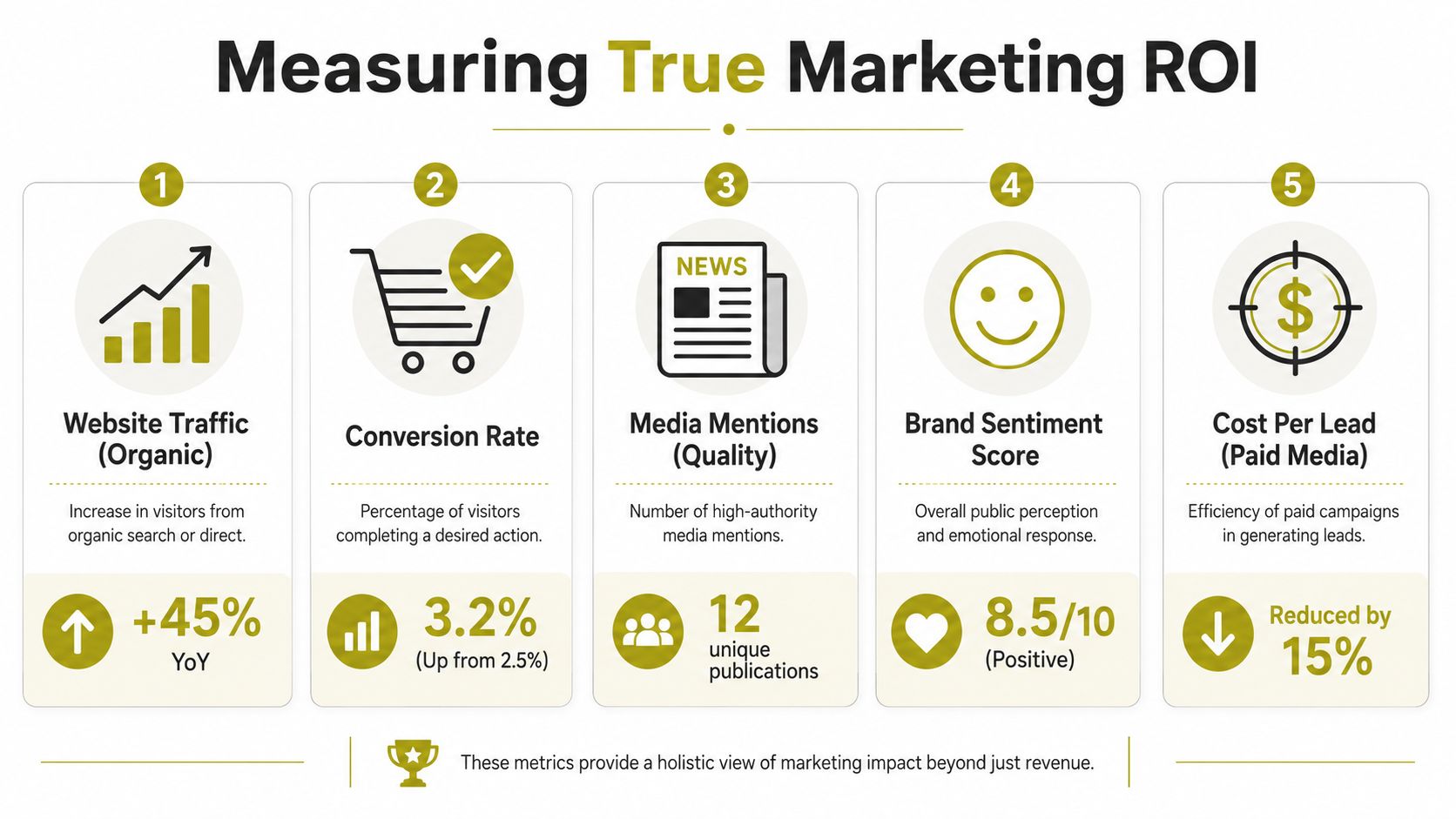
If you want to justify investment in owned earned paid media, track what people do after exposure. That means following the journey from attention to action.
UK industry data highlighted by Found says earned media drives 35% more customer trust than paid media alone, yet only 18% of UK businesses effectively measure the business impact of earned media articles, leaving a major gap between visibility and proof of value, according to its analysis of the paid, owned and earned media mix.
What to measure instead
You need a tighter set of questions.
- Did the coverage or campaign send qualified visitors? Track referral traffic, branded search lifts, and engaged sessions.
- Did those visitors consume proof assets? Watch movement into service pages, case studies, pricing pages, and contact pages.
- Did they convert into something useful? Enquiries, booked calls, demo requests, newsletter sign-ups, downloads.
- Did paid amplification improve efficiency? Compare the quality of visits when you promote thought leadership or press coverage instead of generic ads.
- Did sentiment improve sales conversations? Sales teams often hear trust signals before dashboards do.
If you're trying to maximize search visibility and ROI, tie SEO and paid search reporting together with PR and content performance. That gives you a more honest picture of how visibility converts into demand.
A simple attribution framework for SMEs
You don't need a bloated enterprise dashboard to get started. You do need discipline.
Track the source
Use proper tagging and campaign naming. If a trade title covers your founder, tag the linked page so you can see what traffic came from that article and what those users did next.
Track the journey
Watch the next step, not just the first click. Did they read a case study? Did they visit a service page? Did they return later through branded search? At this point, many SMEs halt their tracking prematurely.
Track the outcome
Define conversion actions that matter to your business. Not all conversions are equal. A booked consultation usually matters more than a social follow.
A media mention isn't the result. It's the trigger.
Use better tools and better questions
The more mature version of this uses pixel tracking, CRM integration and media monitoring that can connect external coverage to on-site behaviour. That's especially important in regulated or reputation-sensitive sectors, where likes and shares tell you very little about whether trust is moving in the right direction.
Cision's UK material on integrating earned media argues for pixel tracking and connected MarTech and AdTech systems to see which earned articles people consumed and how that shaped behaviour, and it also notes that 73% of UK communications teams now use AI-augmented media databases to identify relevant influencers, with 28% higher engagement rates among UK SME audiences compared with non-influencer-driven campaigns in that context, as set out in its UK ebook on integrating earned media.
For businesses that also want a clearer view of channel-by-channel audience response, Carlos Alba Media has a practical guide on how to measure social media engagement. Use that as one layer, not the whole measurement model.
The rule that keeps reporting honest
Report on business movement, not platform vanity. If a press hit, article, ad or campaign didn't improve trust, traffic quality, conversion behaviour or sales conversation quality, treat it as weak performance and move on.
Tactical Plays for SMEs and Startups
A small budget doesn't excuse messy thinking. It forces better sequencing.
Take a Glasgow-based B2B tech startup trying to win leads from operations directors and IT decision-makers. The team has a modest monthly budget and no room for waste. They don't need a dozen channels. They need one integrated campaign built properly.

Month one builds the owned foundation
The first job is to create one serious owned asset. Not fluff. Something commercial and useful.
That could be:
- A flagship article: A clear piece on a pressing industry problem the startup solves.
- A sector landing page: Designed for one audience, with objections handled properly.
- A proof page: Case study, founder credibility, process, FAQs, and contact path in one place.
This page becomes the campaign hub. Ads can point to it. Journalists can reference it. Sales can use it. Without this hub, the rest falls apart.
Month two pushes for earned attention
Now the company finds the angle inside the content. Maybe the founder has a sharp view on a sector risk. Maybe the team is seeing a pattern in client demand. Maybe there's a new regulation or operational issue they can comment on.
The outreach should be selective.
- Trade media first: Go where the buying audience already pays attention.
- Local business media next: Useful if the company's growth story has regional relevance.
- Podcast and interview opportunities: Good for founder visibility and longer-form credibility.
The point isn't to “get PR”. The point is to win third-party proof that supports the sales process.
If your pitch sounds like marketing copy, it won't land. If it sounds like a useful story, it might.
Month three uses paid to amplify what already worked
Once there's a credible owned page and some earned validation, paid spend becomes more efficient. Many founders ought to be more ruthless here.
Don't spend against broad awareness if you can't afford it. Spend with intent.
- Retarget engaged visitors: Put paid social or search in front of people who already visited the owned hub.
- Promote proof, not promises: Use earned mentions, founder interviews or strong insight headlines in the ad creative.
- Narrow the audience: Job titles, sectors, geographic focus, and specific buying triggers matter more than scale.
A practical split of effort
For a startup, the smartest allocation often looks like this in principle:
| Focus area | Main priority | Why it matters |
|---|---|---|
| Owned | Build one strong conversion asset | Gives every other channel somewhere useful to send attention |
| Earned | Secure targeted third-party validation | Adds trust and improves message credibility |
| Paid | Amplify proven messages | Reduces waste and increases precision |
One option for SMEs that need support across PR, social and paid amplification is Carlos Alba Media, which offers an integrated PR and social media function designed to connect earned media, owned channels and paid social activity for SMEs.
The lesson is simple. Don't try to do everything at once. Build one campaign spine, then layer channels around it in the right order.
Conclusion Building Your Unfair Advantage
Relying on one channel is lazy strategy. Ads alone get expensive. Owned content alone can sit unread. PR alone can become a vanity exercise. The advantage comes when you make all three work together.
That's what owned earned paid media should do. Paid creates reach. Owned converts interest. Earned adds belief. The strongest system usually starts with a story worth telling and a plan disciplined enough to reuse that story across every relevant touchpoint.
A newsroom mindset makes that system sharper because it forces relevance, clarity and proof. That's why businesses that think like publishers often outperform businesses that “do marketing”.
If you want media that works as a commercial engine rather than a scattered set of tactics, build it as one joined-up system and run it with editorial discipline.
If you want help turning disconnected marketing into a joined-up owned, earned and paid media strategy, speak to Carlos Alba Media. The agency combines newsroom thinking, PR, digital content and strategic amplification to help SMEs build authority, improve visibility and create a more coherent path from attention to enquiry.