
You send the release. You've checked the spelling, added a quote, attached the logo, and copied in the founder. Then nothing happens. No reply from the trade press. No follow-up from the regional desk. No call from radio. Just silence.
That usually isn't because the story had no merit. It's because the introduction for news failed the first test. It didn't tell a busy journalist, fast enough, what happened, why it matters, and why they should trust the sender.
Teams at Carlos Alba Media know this from both sides of the inbox. The people writing and shaping campaigns there are former national news journalists or agency professionals who've worked with international brands. That changes the advice. It isn't theory from a marketing handbook. It's the same judgement used on real news desks, where editors scan quickly, cut hard, and move on without apology.
Why Your First Sentence Is Your Only Chance
An editor doesn't read your email the way you read your own draft. They don't admire the build-up. They don't care how long legal took to approve it. They look for the line that tells them whether there is a story.

That pressure is sharper now because audiences consume news differently. In the UK, online news is the main source for 71% of adults, while TV remains important for 69%, according to Ofcom's News Consumption in the UK 2024 coverage referenced by Pew Research. Your opening has to work for people who scan a headline, deck and first paragraph before deciding whether to continue.
What editors scan for first
They want four things immediately:
- A clear fact: What has happened.
- A reason to care: Why this matters now, not next month.
- A sign of credibility: A checkable detail, not a slogan.
- A sense of fit: Whether this belongs in their patch, programme, page or feed.
If your first sentence starts with the company boasting about itself, the release is already in trouble. “Award-winning”, “original”, “ground-breaking” and “exciting announcement” are not news facts. They're padding.
Practical rule: If the first line could sit on your homepage unchanged, it probably isn't a news introduction.
What works instead
A proper introduction for news does three jobs at once. It summarises the development, frames the angle, and reassures the journalist that the information is usable.
Write the opening as though it's the line an editor might lift into a headline conference note. Short. Specific. Verifiable. If there's a useful number, put it high. If there's a strong local or sector angle, make that visible at once.
This is also where PR teams often confuse content formats. A release, a LinkedIn post, and a video hook serve different reading habits. If you're adapting one message across channels, it helps to understand the mechanics of visual scripting as well, which is why a practical guide on how to plan social media videos can sharpen the discipline of opening strong.
Mastering the Foundations The Inverted Pyramid and the 5Ws
Journalists didn't invent the inverted pyramid to sound clever. They use it because it respects time. The most important information goes first. Everything else is arranged beneath it in descending order of value.
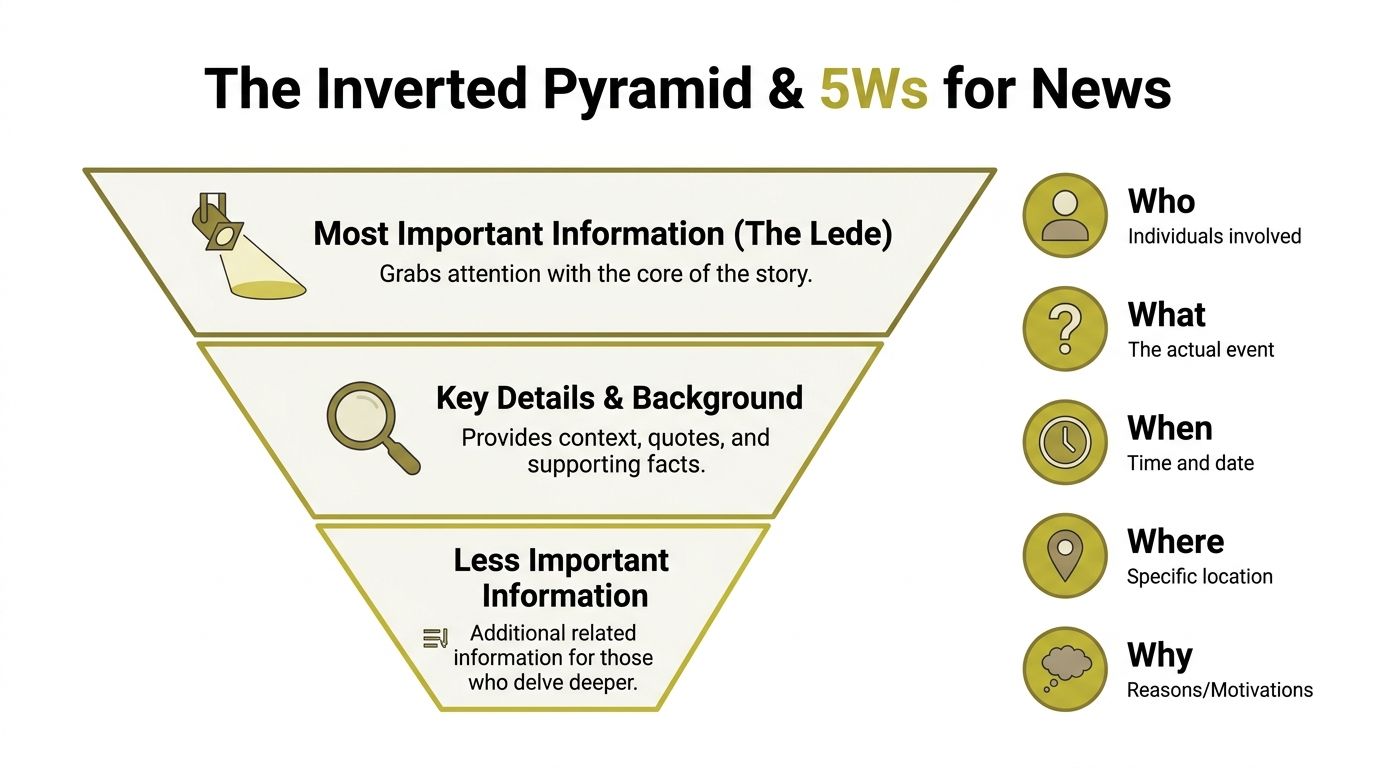
That matters in PR because your introduction for news is rarely read in isolation. It gets skimmed on a phone between meetings, viewed in a crowded inbox, or copied into planning notes. If the key fact appears halfway down, you've made the journalist do unnecessary work. Most won't bother.
Historically, UK news writing has been shaped by concise, checkable facts. TED-Ed's fact-checking guidance defines facts as checkable answers to who, what, when, where and how, and includes statistics, dates and survey data as core factual material in its fact-checking explainer. That's why a strong modern lead often places the biggest verified number first, then adds context.
Use the 5Ws as a pressure test
The 5Ws and How are not a school exercise. They're a filter.
- Who: Who is doing something, affected by it, or accountable for it?
- What: What is new here, in plain English?
- When: Is this happening now, launched today, announced this week, or due later?
- Where: Why does the location matter?
- Why: Why should the publication's audience care?
- How: How did this happen, or how will it work in practice?
If one of those answers is weak, the lead usually collapses. Not every story needs each element in the first sentence, but you should know them before you write a word.
Build the lead in the right order
Most weak releases are written in company order. Most strong ones are written in news order.
- Start with the development. “A Glasgow software firm has launched…” is better than opening with company history.
- Add the point of consequence. What changes for customers, investors, regulators, or the local area?
- Insert the proof. Use a date, a number, a named partner, a document, or another checkable detail.
- Move background down. Company boilerplate belongs later.
For stories built on documents or public data, filing a proper request can produce a stronger, cleaner lead than a vague claim. Carlos Alba Media has a practical guide on how to make a Freedom of Information request that's useful when the angle depends on official evidence.
A short video can also help fix the structure in your head before you draft:
Put the fact a reader can verify at the top, then earn the right to add colour underneath.
Beyond the Basics Types of News Leads
Not every story wants the same opening. A hard business announcement needs one kind of lead. A founder profile or regional feature may need another. Good PR people know the standard form. Better ones know when to break it.
The straight summary lead
This is the default. It gives the core development immediately.
Use it when the news is clear, timely and easy to state. Product launches, funding announcements, partnerships, appointments, research releases and site openings usually belong here.
Weak version
A dynamic Scottish brand is delighted to announce an exciting new chapter in its growth journey.
Stronger version
A Scottish travel business has opened a new booking hub in Glasgow to support UK expansion this summer.
The second line gives an editor something to work with. The first gives them nothing.
The anecdotal lead
This works when the human detail makes the story easier to grasp. It's often effective for healthcare, education, technology adoption, tourism and workplace change, where the subject can otherwise sound abstract.
Weak version
A tech company has developed a platform to simplify compliance workflows.
Stronger version
At many small firms, compliance still means spreadsheets, email chains and a deadline everyone hopes they haven't missed. A Scottish software company thinks that's the gap it can close.
This format buys you texture, but it needs discipline. Don't drift into a feature intro if you're pitching a straight news desk on a hard deadline.
The delayed lead
A delayed lead withholds the core point briefly to create momentum. It's common in colour pieces, features and longer reads. It is less useful for a daily news reporter who needs the peg immediately.
Example
For months, local hospitality operators had the same complaint. They could attract visitors, but not keep staff. Now one hotel group says it has found a way to tackle both problems at once.
Use this when the tension is the story. Don't use it to hide weak news.
The quote lead
Most quote leads are dreadful because they begin with a line no outsider cares about. But a quote lead can work if the quote is sharp, consequential and impossible to paraphrase without losing force.
Poor example
“We are thrilled to unveil this exciting development,” said the chief executive.
Better example
“If local firms can't get heard regionally, they disappear nationally as well.” That's the complaint many founders make before they seek media support.
Even then, be cautious. Quotes often belong in paragraph three or four, not the top line.
Choosing the right lead type
| Lead Type | Primary Goal | Best For |
|---|---|---|
| Summary lead | Deliver the news fast | Press releases, hard news, trade media, business desks |
| Anecdotal lead | Humanise a complex topic | Features, founder stories, tech, healthcare, tourism |
| Delayed lead | Build tension before the reveal | Long-form features, comment-led pieces, magazine reads |
| Quote lead | Add immediacy or voice | Interviews, opinion pieces, rare cases with a truly strong line |
A lead earns its place by helping the journalist faster. If it slows them down, change it.
Tailoring Your Introduction for Print Broadcast and Press Releases
A line that reads well on a screen may sound clumsy on air. A sentence that works for a presenter may look thin in a business release. The core fact stays the same. The delivery changes.

That adjustment matters because PR only proves its worth when it serves a business objective. Campaigns built with explicit business use cases show 3-4x higher ROI than campaigns focused only on press mentions, according to the referenced analysis on strategy-to-execution alignment. Your introduction isn't just a writing flourish. It's the front end of a commercial process.
For press releases and online news desks
Write for scan value. Lead with the development, include one checkable detail, and make the relevance obvious.
Template
[Company or organisation] has [done what] in [place], with [specific consequence or audience impact].
Example
A Glasgow legal technology firm has launched a new compliance service for UK employers, targeting faster handling of routine staff policy queries.
Why this works: a reporter can see the subject, action, location and angle in one pass. If they want more, they'll keep reading. If they don't, at least they understood the story.
If your team needs a proper release structure around that opening, press release writing guidance from Carlos Alba Media gives the standard shape.
For broadcast
Write for the ear. Broadcast intros need cleaner rhythm, shorter clauses and fewer stacked nouns.
Template
A [place] business says it is [doing what], and claims it will help [audience or outcome].
Example
A Scottish healthcare firm says it's opening a new patient support service in Edinburgh. It says the move will give families faster access to advice.
Why this works: presenters can read it without stumbling. Producers can hear the line immediately. If the sentence sounds awkward aloud, rewrite it.
For direct channels such as blogs and social
Your own channels allow more flexibility, but the opening still needs journalistic discipline. Start with the fact, not the applause.
- For a company blog: Use a news line first, then explain the context.
- For LinkedIn: Lead with relevance to the audience, then add the announcement.
- For social captions: Strip the sentence to one claim and one reason to care.
Template for owned content
Today we're [announcing/launching/opening] [thing]. It matters because [clear audience benefit or business reason].
Many brands falter at this stage. They assume channel ownership means they can relax the news standard. In practice, the opposite is true. If your own opening is woolly, journalists who check your channels for context will trust you less, not more.
Avoiding Common Mistakes That Guarantee Deletion
Journalists don't delete releases because they're cruel. They delete them because they're busy, unconvinced, or irritated by writing that hides the story.

The worst openings usually share the same faults.
What journalists hate in the first paragraph
- Buried news: The first sentence talks about the company's mission instead of the development.
- Marketing language: Words like “groundbreaking,” “significant,” “disruptive” and “world-class” signal spin, not reporting value.
- Sentence overload: If one line contains three commas, two claims and a quote fragment, it's too much.
- No reader angle: The copy states what the company wants to say, not why an audience should care.
- Fake authority: Claims are presented as fact without any checkable support.
The regulated-sector trap
This gets harder in fintech, healthcare, legal services and other regulated areas. Current guidance often misses the fact that these firms need to introduce themselves credibly while satisfying both media and regulatory expectations, as noted in this discussion of trust-building gaps in newsroom practice. That gap often leaves firms under-represented or dependent on crisis specialists after the fact.
Here's the trade-off. If you sound too cautious, the pitch has no news value. If you sound too promotional, you create legal and reputational risk.
Newsroom advice: In regulated sectors, understate the claim and over-deliver the proof.
That means:
- Use precise language: Say what the service does. Don't imply outcomes you can't substantiate.
- Name the status clearly: Pilot, launch, partnership, consultation, filing, appointment. Pick the right term.
- Avoid loaded shortcuts: Don't hint at endorsement, approval or guaranteed results unless you can state that cleanly and safely.
- Let the detail carry the credibility: A named location, date, document, spokesperson or process step is often stronger than a glowing adjective.
A journalist can work with caution if the opening is clear. They can't work with puffery wrapped in compliance jargon.
Turning Good Intros into Great Coverage
A strong introduction for news doesn't just help you get opened. It helps you get understood. That's the difference between coverage that lands and coverage that drifts past.
This matters even more for smaller firms outside the London bubble. There is minimal guidance on how UK-based SMEs can manage the growing shortage of local journalists, and that gap hits start-ups and regional businesses hard. Scottish and northern English tech SMEs can struggle to secure introductory coverage because local newsrooms often lack specialist reporters, a challenge discussed in this look at underserved communities and newsroom capacity.
That's why the intro has to do more work. It must tell the story quickly, truthfully and in the language a newsroom can use. If you can do that, you improve your odds before the follow-up call, before the interview, before the headline.
A useful next step is learning how to extend that same discipline into bylined content and expert positioning. This guide on how to write a thought leadership article helps when your news introduction opens the door and your authority needs to keep it open.
If your team needs sharper media openings, stronger press materials, or senior PR judgement shaped by real newsroom experience, Carlos Alba Media supports SMEs, founders and established brands with practical communications that are built to be used by journalists, not ignored by them.