
You're probably here because you need something specific that isn't on a public webpage.
Maybe you're pitching for work and want a council's supplier performance records. Maybe you run a tourism business and need visitor data, complaint logs, inspection correspondence, or grant paperwork. Maybe a regulator has made decisions that affect your market and you want the documents behind them, not the polished press release.
That's where knowing how to make a freedom of information request properly becomes useful. For journalists, it's a reporting tool. For SMEs, it's market intelligence, due diligence, risk management and, sometimes, a competitive advantage. Used well, it helps you understand how public decisions are made, who influences them, and where the gaps are.
At Carlos Alba Media, the team is made up of former national news journalists and agency professionals who've worked with international brands. That background matters because good FOI work isn't just administrative. It's about asking for the right record, in the right way, from the right body, with a realistic sense of how officials will try to narrow, delay or refuse it.
Unlocking Public Data for Your Business
You lose tenders, miss policy shifts, and get blindsided by local decisions when the official record sits inside a public body and you never ask for it.
If your firm depends on councils, regulators, NHS bodies, transport authorities, or agencies, the records they hold can have direct commercial value. A local authority may hold tourism figures, planning correspondence, event safety documents, contract performance reports, complaints trends, inspection results, or briefing notes that tell you far more than a polished strategy document. A health body may hold procurement records. A regulator may hold meeting notes or enforcement correspondence. A transport authority may hold consultation responses and project updates.
For journalists, that is reporting material. For SMEs, it is market intelligence.
The UK's Freedom of Information Act 2000 changed what professionals can get from public bodies if they ask properly. The MPs' expenses disclosures remain the obvious example because they showed what happens when reporters pursue the underlying record instead of accepting official messaging. The business lesson is just as important. Public files often show how decisions were made, which risks were known, whose concerns were logged, and whether performance on paper matched performance in practice.

What SMEs often get wrong
A common mistake SMEs make is approaching FOI too broadly.
They ask for “all information” about a project, send the request to the authority with the highest profile rather than the one holding the files, or ask an open question that invites a vague answer. That is how requests get delayed, narrowed, or refused on cost grounds.
In a newsroom, the standard is tighter. Ask for the records that should exist if a decision was made. Minutes. Briefing notes. Internal emails between named teams. Contract reports. Complaint logs. Review papers. Defined dates matter because they make retrieval easier and excuses harder.
Practical rule: Ask for the paper trail, not an explanation.
That is the difference between an enquiry and a workable FOI request.
Why this matters beyond journalism
Used properly, FOI supports commercial decisions that SMEs usually make with partial information:
- Tender research by showing how an incumbent supplier performed
- Market entry planning through local demand, enforcement, and policy records
- Reputation management by revealing complaint patterns or internal concerns before they become public problems
- Public positioning by grounding your commentary in documents rather than guesswork
I have seen disclosures that looked dull at first glance turn into strong stories, sharper pitches, and better strategic calls once someone read the appendices, annexes, and email chains properly.
That is also where process matters after disclosure. If records arrive as large scanned PDFs, advanced PDF AI extraction methods can help turn awkward files into usable material for sorting, searching, and analysis. Public bodies often release board papers and reports in formats built for archiving, not scrutiny.
If the end goal is to publish a strong point of view based on what you found, learn how to turn findings into persuasive commentary. Raw disclosure has limited value until you can explain what it means for clients, stakeholders, or your market.
Before You Write Your Request
The strongest FOI requests are usually won before the email is drafted.
Preparation is what stops a request being rejected, delayed, or priced out. The law gives you rights, but the wording still has to work in the actual world of overworked FOI officers, fragmented filing systems and risk-averse legal teams.
Start with the decision, not the data
If you're unsure what to ask for, begin with one question. What decision or activity am I trying to understand?
That question usually leads you to records, not opinions. If a council awarded a contract, there should be an evaluation record, correspondence, meeting notes or performance reporting. If a regulator engaged with a business sector, there may be consultation responses, internal briefings or stakeholder meeting records.
A useful way to tighten your focus is to jot down:
- The event you care about
- The likely date range
- The people or teams involved
- The document types that would prove what happened
That exercise turns “I want information about tourism strategy” into something usable, such as a request for meeting minutes, internal emails, and briefing papers relating to a named project over a set period.
Find the body that actually holds the records
A lot of requests fail because they're sent to the organisation that talks about an issue, not the one that stores the records.
If you need licensing data, it may sit with a council department rather than a central communications team. If you need NHS material, a trust or health board may hold it rather than a department in Whitehall. If your issue involves outsourced services, the public authority may still hold oversight records even when a contractor did the work.
Before writing, check the authority's website, committee pages, board papers, publication scheme and contact details. Existing publications can sharpen your wording and help you identify the exact unit or project name.
If the request has reputational implications for your business, it also helps to think through how the eventual disclosure fits into wider press relations management. FOI isn't separate from comms strategy. It often becomes part of it.
FOIA and FOISA at a glance
If you're dealing with Scottish public bodies, don't assume the rest of the UK system applies in exactly the same way.
| Feature | FOI Act 2000 (Rest of UK) | FOI (Scotland) Act 2002 |
|---|---|---|
| Main geography | England, Wales and Northern Ireland public authorities | Scottish public authorities |
| Regime | UK Freedom of Information framework | Scottish devolved FOI framework |
| Bodies covered | Public authorities covered under FOIA | Scottish public bodies covered under FOISA |
| What matters in practice | Use when the authority sits under the UK-wide regime | Use when the authority is a Scottish body |
| Cost ceiling context | Different authorities apply different cost limits under the relevant rules | Scottish bodies operate under FOISA rules |
The practical point is simple. Match the request to the law that governs the authority.
A well-aimed request to the right body under the right regime beats a clever request sent to the wrong inbox.
How to Write a Request That Gets Results
A supplier loses a council contract. A rival wins. You do not need a speech about openness. You need the papers that show how the decision was made, who signed it off, and what concerns were raised along the way.
That is how professionals should approach FOI. For an SME, a good request can reveal procurement patterns, enforcement priorities, spending decisions, complaint trends, and internal assessments that change a sales strategy or support a challenge. In the newsroom, the same rule applies. Ask for records, not answers.
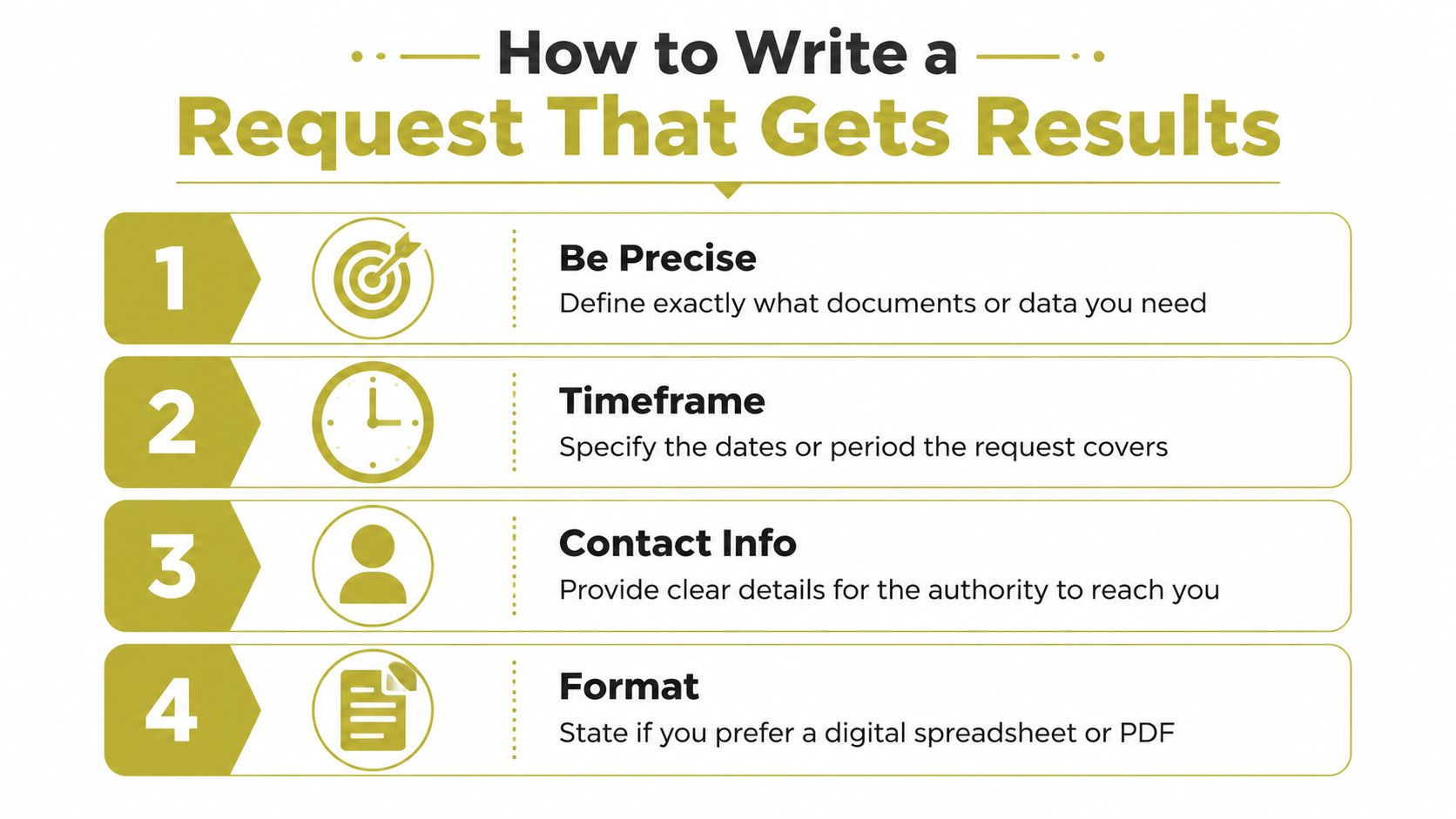
A request works when the authority can identify the material quickly and has less room to claim your wording is too unclear or too broad. Keep it tight. Use the language the authority uses internally. Name the project, contract, service, site, meeting, or policy exactly.
A template you can use
You can adapt this for routine commercial, regulatory, or reporting enquiries:
Dear FOI team,
I am making a request under the Freedom of Information Act.
Please provide the following recorded information relating to [project, contract, issue or decision]:
- Minutes, agendas and notes of meetings between [team or named roles] concerning [subject], from [start date] to [end date].
- Internal briefing papers, reports or decision documents prepared during the same period on that subject.
- Emails between [named role/team] and [named role/team] regarding [subject], from [start date] to [end date].
- Any final performance reports, complaints summaries, or review documents produced in relation to [subject] during that period.
If any part of this request is likely to exceed the cost limit, please tell me which element is causing the issue so I can narrow it.
I would prefer the information in electronic form.
Name
Email address
That wording does four jobs well. It identifies the records, sets boundaries, gives the authority a workable search brief, and invites refinement before refusal.
What strong wording looks like in practice
The best requests share a few habits:
- They ask for recorded information. Minutes, reports, decision notices, complaint logs, inspection records, procurement evaluations, email correspondence.
- They set a date range. A clear start and end date cuts search time and limits arguments about scope.
- They name the subject precisely. Use the contract title, planning reference, school name, depot location, tender number, or policy title.
- They identify likely holders of the records. Named teams and job roles often work better than personal names.
- They ask for a usable format. If the information is likely to sit in a spreadsheet or database export, say so.
That last point matters for businesses. A PDF bundle is fine for a one-off story. A spreadsheet is far more useful if you want to compare suppliers, track inspection outcomes, or build a prospect list from public spending data.
What gets requests rejected or watered down
Three mistakes come up again and again.
The first is asking for “all information.” That tells the authority nothing about what to search for and gives it every reason to push back.
The second is asking questions instead of asking for records. “Why did you do this?” invites a refusal or a vague reply. “Please provide the report, briefing note, meeting minutes and email correspondence discussing the decision to do this” is much harder to dodge.
The third is trying to tell the whole story in the request itself. Long introductions, accusations, and arguments do not improve your odds. They usually signal that the request has not been framed properly.
Use this test before sending it. If the authority gave you exactly what you asked for, would you have documents you could publish, analyse, or act on commercially?
If not, rewrite it.
A practical drafting trick from the newsroom
Build your request around document types that answer the point from different angles. For example, if you want to know whether a local authority had concerns about a contractor, do not ask only for emails. Ask for the evaluation document, contract management reports, complaint summaries, meeting notes, and any final review. If one class of record is missing or withheld, another often gives you the same story in a cleaner form.
Another trade-off is breadth versus speed. A narrow request often gets a faster, cleaner result. A broad request may uncover more, but it raises the chance of delay, clarification, or cost refusal. For SMEs, the smart move is often to start with the decision records and summary documents, then file a second request for supporting correspondence once you know the language and timeline.
Plain drafting wins. Precise drafting wins more often.
What Happens After You Submit
You send a tight request on Monday. By Friday, the authority has either found the right team and started searching, or your wording is already causing friction.
That stage matters more than many SME owners realise. A freedom of information request is not processed by magic. It goes through an internal workflow, and small drafting choices often decide whether you get useful records within the time limit or spend weeks answering clarification emails.
The legal clock is still the key benchmark. Public authorities normally have 20 working days to respond. That does not mean a full disclosure pack arrives on day twenty. It means the authority must issue its response within that window, or explain why more time is being taken where the law allows it.
What the authority is doing behind the scenes
Once the request is logged, the FOI team usually works through the same set of questions.
- Which department or officer is likely to hold the records
- Whether your wording is specific enough to run searches
- How many systems, inboxes, or file stores may need to be checked
- Whether any exemption is likely to apply
- Whether they need clarification from you before they can continue
Newsroom experience proves useful in this context. If your request can be searched quickly, it is easier for an authority to process and harder for them to stall behind vague objections. If it reads like it could cover five teams, three years, and every email account in the building, you have given them room to slow the job down.
Clarification requests are a turning point. Answer them fast, and answer narrowly. The aim is to remove ambiguity, not reopen the whole request or add fresh material.
The cost problem that catches SMEs
Cost is one of the main reasons a sound request gets knocked back.
Public authorities can refuse a request if locating and retrieving the information would exceed £600 for central government or £450 for other bodies, under section 12 of the legislation. In practice, broad email trawls, long date ranges, and requests spread across several business units are the usual trouble spots.
SMEs run into this more often than they expect because they tend to ask commercial questions that touch procurement, contract management, complaints, finance, and legal records at the same time. Journalists hit the same wall on investigations. The trade-off is simple. The wider the request, the better the chance of finding something interesting. The wider the request, the better the chance of a section 12 refusal.
A good working rule is straightforward. If the records may sit across several teams, several years, or several inboxes, narrow the scope before the authority asks you to.
What to do if cost becomes an issue
You still have room to salvage the request.
- Shorten the timeframe
- Limit the request to one business unit or office
- Ask for final reports, reviews, or decision papers first
- Drop record types that create heavy search work, especially emails
- Request a sample where the volume sounds high
That last move works well in commercial investigations. A small first request can reveal the exact project name, contract reference, meeting title, or decision date used internally. Once you have that language, the follow-up request is usually sharper and cheaper to process.
If you are using FOI as a business tool, speed often beats breadth. Get the decision record first. Then build the second request from what the authority has already admitted exists.
Handling Refusals and The Appeals Process
A refusal often tells you something useful.
It may show the authority has identified sensitive material. It may reveal they think your request is too broad. It may expose confusion about whether you're asking for general records or your own personal data. The mistake many requesters make is treating the first “no” as final. It isn't.
The ICO received 5,700 FOI complaints in 2022/23, a 12% annual rise, with delays making up 51% and refusals 28%, according to the figures cited in the ICO complaints overview. If that sounds high, it should. A serious requester needs to understand appeals because disputes are a normal part of the system.

The exemptions you're likely to meet
You don't need to memorise every exemption. You do need to recognise the common ones.
- Section 40 personal data. This is used where disclosure would reveal personal information. The point isn't to stop all disclosure. It often means names or identifying details are redacted.
- Section 43 commercial interests. Authorities use this when they say disclosure could prejudice commercial positions, procurement, or negotiations.
- Section 35 formulation of government policy. This usually appears where internal policy development is still considered sensitive.
The practical move is to separate what may be exempt from what should still be disclosable. Even if names, pricing details or parts of legal advice are withheld, meeting dates, participants, decision documents and high-level summaries may still be releasable.
FOI and personal data confusion
This catches founders and executives more than most guides admit.
If you're seeking records that are partly about you or your business dealings with a regulator, the authority may say your request belongs under data protection law rather than FOI. That's where requesters often lose momentum. They argue about the label instead of forcing the authority to deal with the overlap.
Use a two-track mindset. Some records are general public authority records. Some are your personal data. Those categories can overlap, and authorities don't always handle that overlap well.
When the body tries to push you into the wrong legal lane, the issue isn't technical. It's strategic.
How to challenge a refusal properly
The appeals route is straightforward if you keep it disciplined.
Ask for an internal review
Keep it short. Identify the request, the refusal, and the exact point you challenge. If the request was called too broad, offer a narrower version. If an exemption was applied, explain which parts could still be released in redacted form.Escalate to the ICO if needed
Your complaint should include the original request, the refusal, the internal review outcome, and a clear explanation of why the authority got it wrong.
A good appeal doesn't rant. It isolates the weak point in the authority's position. Often that weak point is overbreadth, poor explanation, or failure to consider partial disclosure.
Insider Tips for FOI Success
A strong FOI request gives you more than documents. It gives you a reporting line into how a regulator, council, agency or quango made a decision that affects your market, your competitors or your reputation.
That is why experienced reporters and sharp SME owners treat FOI as a business intelligence tool, not a form-filling exercise. The edge comes from timing, scope and phrasing.

Start small, then tighten
Big requests fail for predictable reasons. Cost limits, vague wording, or simple delay.
In newsroom practice, the better move is often to ask for a foothold first. Request the final report, the decision note, the meeting attendees, or one month of correspondence. Once you see the authority's file names, internal language and date markers, the next request stops being speculative. It becomes targeted.
That saves time on both sides, and it often gets you to the useful record faster than a grand first sweep.
Write for the case handler, not for yourself
The officer reading your request is deciding how hard this will be to process. If your wording is clean, specific and calm, you improve your chances of a constructive reply.
Use phrases that keep the request alive if part of it causes difficulty:
- If any part of this request exceeds the cost limit, please advise how it can be refined
- If some material engages an exemption, please disclose any segregable or redacted material
- If another department is more likely to hold the information, please forward this request or advise me accordingly
Those lines are not courtesy for its own sake. They show later, on review or complaint, that you invited assistance and partial disclosure.
Use a hybrid request where FOI and personal data overlap
Founders, directors and regulated businesses often need records that sit in two categories at once. Part of the file may be a public authority record. Part may be personal data.
In those cases, it can help to ask for consideration under both FOIA and data protection law. The Information Commissioner's Office explains how organisations should handle freedom of information requests in its guide to freedom of information for organisations. The practical point is simple. You give the authority less room to sidestep the request by arguing over the label instead of the record.
I use this approach where complaint files, contact logs, inspection records or correspondence mention a named founder alongside wider regulatory handling. It forces clearer handling and often produces a more useful response.
Plan for use, not just release
The best requesters know what they will do with the material before they send the request.
Ask yourself:
- Which single document would prove the point fastest?
- Which team or official is most likely to hold it?
- What wording would still get the core record if the wider ask is refused?
- Will the disclosure support litigation, negotiation, a story, or market positioning?
For SMEs, that last point matters. A good FOI result can support credibility with clients, investors and trade press if you know how to frame it. If public positioning is part of the plan, it helps to understand the mechanics of earning press coverage from evidence-led stories.
The best FOI requests win the first useful document, then build pressure from there.
That is the habit that separates routine requests from strategic ones.
If you need senior help turning documents, scrutiny and public-interest angles into real media outcomes, Carlos Alba Media brings together former national journalists and agency specialists who know how stories move from records to headlines. Whether you're an SME, founder or established brand, the consultancy can help you shape the evidence, handle the risk and present it in a way that gets noticed for the right reasons.