
If you've spent months running ads, publishing posts and sending emails, yet last month's qualified enquiries still feel impossible to trace, the problem usually isn't effort. It's the system.
That's the fault line in lead generation digital marketing for UK SMEs in 2026. Teams aren't short of activity, they're short of a conversion path that joins audience, offer, landing page, consent and follow-up into one measurable flow. With weaker third-party tracking and uneven AI adoption shaping the year ahead, the businesses that keep winning aren't the ones chasing more traffic, they're the ones redesigning capture around first-party data, tighter qualification and disciplined automation.
Why Most Lead Generation Programmes Quietly Stall
A founder rings up after six months of “doing everything right”. Ads have been running, the blog has been active, LinkedIn posts have gone out, and the CRM is full of names. Yet when someone asks where the best enquiries came from, nobody can answer cleanly.
That's usually because the team has built a channel list, not a conversion system. Traffic alone doesn't create pipeline, and lead generation only works when the business decides in advance who counts as a lead, what action matters, and what happens next. The market context makes that even more important, because digital lead generation is now a core part of the UK marketing stack. UK consumers spend significant time across digital channels, and UK digital advertising remains the largest advertising channel by share of spend, which helps explain why businesses lean on websites, search, social and email to create leads instead of relying on offline promotion alone (Insivia's 2025 digital marketing statistics).
Where the leak usually sits
Most stalled programmes fail in one of three places.
Practical rule: if you can't describe your lead in one sentence, every channel decision after that becomes guesswork.
First, the team is attracting the wrong audience. Second, the landing page is asking too much, too early. Third, the follow-up is slow or inconsistent, which matters because lead generation is widely prioritised but often inefficient without strong nurturing. Industry research says 91% of B2B marketers call lead generation a top priority, yet the average organisation generates 1,877 leads per month and around 80% never convert to customers (Cirrus Insight). That's a reminder that volume isn't the same as value.
The quickest self-check is simple. If your team can't answer these three questions, the system is leaking:
- Who exactly are we trying to reach?
- What action makes someone a genuine lead for sales?
- How quickly do we respond when they raise their hand?
The agencies and founders who get this right usually stop arguing about channel preferences and start fixing the machinery underneath them. That's where Carlos Alba Media's specialist nature matters, because the firm is built around former national news journalists and people with agency experience of working with international brands, which suits the discipline of shaping credible stories, sharp offers and conversion-ready campaigns for smaller teams that need senior judgement, not just more noise.
Defining the Audience and Mapping the Funnel
Start with the people you want, not the people who are easiest to attract. A good ideal customer profile comes from patterns in your best clients, not from a vague wish list. Look at the accounts that buy quickly, stay profitable and need little hand-holding, then write down their sector, company size, decision-maker role, typical pain point and buying trigger.
A Glasgow-based professional services firm can turn a fuzzy brief like “we want more leads” into something usable by narrowing to the right buyer, for example a finance director in a mid-sized company who needs a reliable external specialist, values speed, and won't sit through a long sales process. That is a far better starting point than trying to appeal to everyone with generic content.
Set the qualification threshold first
Don't ask sales to define quality after the leads arrive. Decide in advance what makes a lead worth passing over, and keep the threshold practical enough that the team will use it. If sales says a form fill with no budget, no timeframe and no company fit is junk, then marketing shouldn't celebrate it as a win.
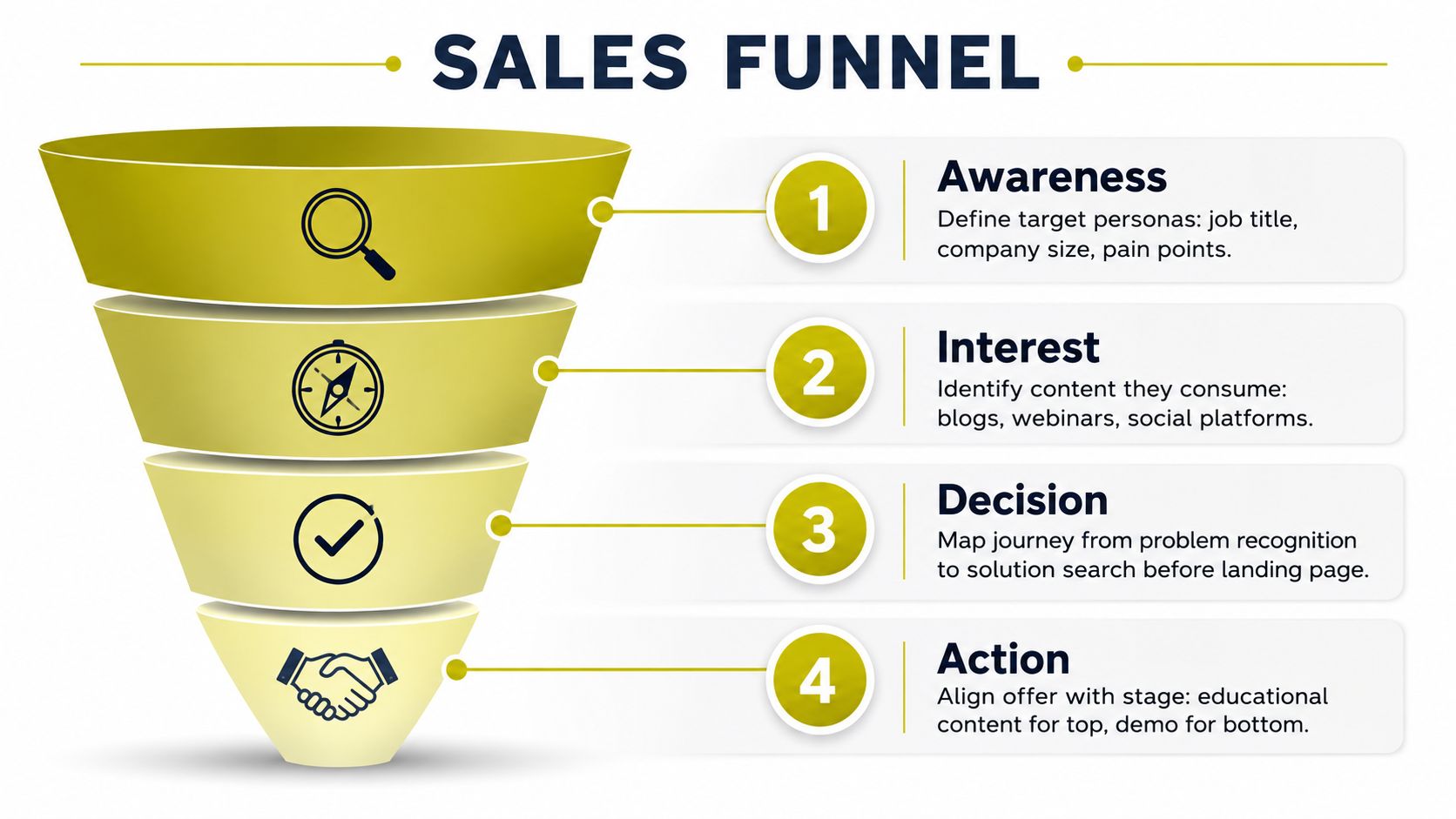
For a simple three-stage funnel, use one clear conversion goal per stage:
- Awareness, capture attention with educational content or PR-led visibility.
- Consideration, move people towards a useful asset, such as a checklist, webinar or guide.
- Decision, offer a direct sales step, such as a consultation, demo or proposal request.
That structure stops you pushing a hard offer too early. It also helps you line up message, format and landing page with the stage the prospect is in.
For a useful framework on how to sharpen the audience side before you build campaigns, optimize ad ROAS by demographics is a practical reference point because it pushes you to think about fit before spend.
If you want a working template, use a short brief and fill it in before any campaign launch. Carlos Alba Media's target audience definition resource fits naturally here because it keeps the work anchored in audience clarity rather than channel enthusiasm.
Your one-page brief should answer
- Who is the buyer? Role, sector, company size and buying authority.
- What problem are they solving? Make it specific enough to guide copy.
- What proof do they need? Case studies, credentials, media coverage or benchmarks.
- What is the next step? One action only, not three competing CTAs.
Once that document exists, channel choice gets easier. You stop asking, “What should we do on social?” and start asking, “Where does this buyer already pay attention, and what offer will feel worth their contact details?”
Channel Tactics That Actually Fit UK SMEs
UK SMEs don't need five channels at once. They need two or three that fit budget, cycle length and the buyer's mindset. With a tighter monthly budget, the wrong channel mix burns cash in a hurry, especially when the team still has to write the content, manage follow-up and report back on performance.
Here's the honest view.
| Channel | Cost shape | Time to first lead | Best funnel stage | Main weakness |
|---|---|---|---|---|
| SEO | Front-loaded effort, lower marginal cost later | Slower | Awareness and consideration | Takes patience and consistent publishing |
| Content | Time-heavy, budget-light if written in-house | Moderate | Awareness and consideration | Needs distribution or it disappears |
| Paid social and SEM | Cash up front, scalable when conversion works | Fastest | Decision and retargeting | Breaks quickly if the landing page is weak |
| Low direct spend, high operational discipline | Fast if the list exists | Consideration and decision | Fails when the list is cold or poorly segmented | |
| Partnerships | Relationship-heavy, variable cost | Moderate | Awareness through trust | Depends on other people's priorities |
What each channel is good for
SEO is still useful when the buyer is already searching for a solution, but it's not a shortcut. Content works when you can answer a real problem better than competitors do, and it becomes stronger when PR coverage, industry mentions or founder commentary feed the same topic cluster. Paid social and SEM are the quickest ways to test offer-market fit, but they tend to punish sloppy tracking and broad audiences. Email remains one of the most efficient ways to nurture interest, provided the contacts are permissioned and segmented. Partnerships are underrated because they borrow trust, which is often more valuable than pure reach.
A small team should skip any channel that needs constant babysitting before it proves it can pay back.
That's why founders under a £5k monthly budget often do better by focusing on a narrow stack. A common pattern is one search-led channel, one nurture channel and one credibility channel. For many firms, that's a better use of time than trying to build a presence everywhere and performing badly across all of it.
If you want a broader tactical reference point, Salesmotion lead generation techniques is useful because it reinforces the idea that lead gen is a sequence, not a single tactic.
Where channels reinforce each other
The best programmes don't treat channels as silos. A podcast mention, guest article or trade publication quote can feed SEO, give sales a credibility asset and create a reason to email the list. A useful blog post can support search, lower paid traffic cost and give partners something worth sharing. That compounding effect is what most small teams miss when they chase standalone wins.
The mistake is overcommitting to channels that look impressive but demand more money, more creative volume or more patience than the business has. For most UK SMEs, the winning move is to choose the channels that match the buyer's intent, then execute them cleanly enough to learn fast.
Landing Pages and UX Conversion Levers
A landing page is not a brochure. It's the point where the lead either becomes visible or disappears. In B2B benchmark data, average website conversion rates sit around 2.9%, so teams should use that as a reality check before increasing spend (SalesHive).
If a page underperforms, don't start by redesigning everything. Start with the elements that most directly affect friction and clarity.
The page has six jobs
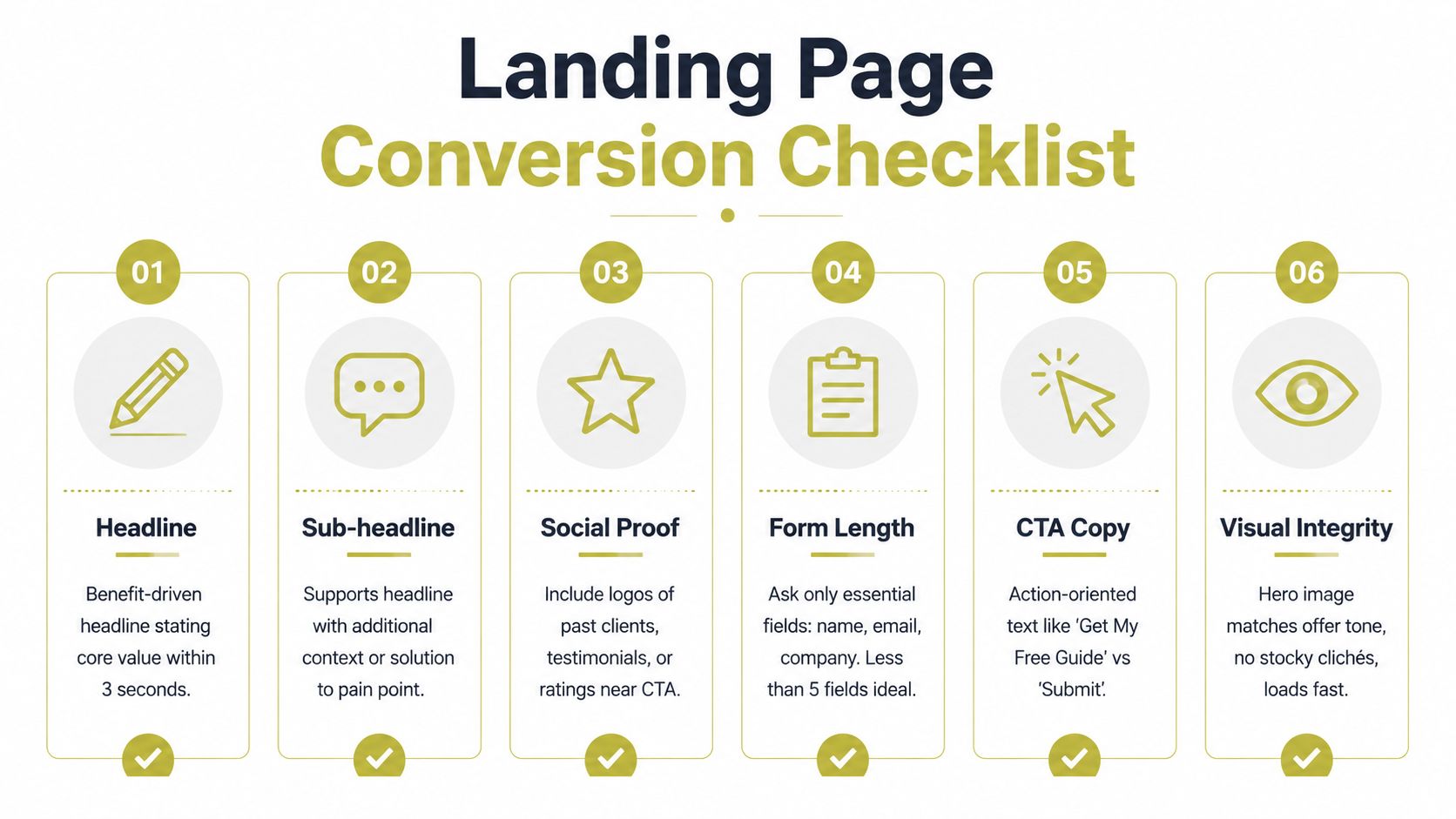
The headline should say what the visitor gets, fast. The sub-headline should explain the value in plain English. Social proof should sit close to the form, because people want reassurance before they hand over details. The form should ask only for what sales needs. The CTA copy should describe the action in the buyer's language. The visual hierarchy should guide the eye rather than compete with it.
That aligns with what works in practice, especially for small teams that can't afford sprawling test plans. Carlos Alba Media's landing page best practices fit naturally with this approach because landing pages need to support both clarity and conversion.
Test one variable at a time
Run tests in this order:
- Headline first, because message match usually matters more than design polish.
- CTA copy next, especially if the button says something vague like “Submit”.
- Form length after that, because unnecessary fields create friction.
- Social proof placement, since trust cues often change behaviour.
- Hero image or visual, but only once the fundamentals are stable.
A useful rule is to match the page to the traffic source. A search click from someone already comparing providers needs a different page from a social click that came from a founder's post or a news feature. If you send both to the same generic page, one of them will usually underperform.
Short forms don't just feel easier. They reduce the number of small objections a prospect has to overcome before they click.
The quiet mistakes are predictable. Asking for a phone number too early. Hiding the form below the fold. Using stock imagery that looks unrelated to the offer. Writing CTA copy that sounds like a software admin task instead of a useful next step. These issues don't always kill conversion outright, but they drag it down enough to make paid traffic look worse than it is.
Fix the page first, then scale the traffic. Otherwise you're paying more to prove that the page doesn't work.
AI-Driven Lead Generation Without Losing Lead Quality
AI can help a small team, but only if the data is clean and the ICP is already clear. If the funnel is messy, AI doesn't solve the problem, it speeds it up. That's why the most useful applications are the ones that improve qualification, routing and relevance rather than bulk content output.
The UK angle matters here. The government's Business Insights and Conditions Survey has repeatedly shown that AI use is far more common among larger businesses than smaller ones, so many SMEs are still figuring out how to use it without wasting time or damaging trust. That leaves a real opening for disciplined use, not generic automation.
Where AI adds value
AI-assisted prospecting can speed up research, but it still needs human review before outreach. AI lead scoring is stronger when it's built on your actual conversion history, because it can route hotter leads faster and surface patterns that sales might miss. Personalisation can help with subject lines, follow-up sequences and content recommendations, as long as the brand voice stays human.
A Scottish tech SME, for example, can use AI to score inbound form submissions by fit signals, then route the strongest ones to sales within minutes. That kind of setup helps because lead speed still matters, and fast follow-up is where many programmes leak value. Benchmark datasets associate responding within five minutes with a lead being 9 times more likely to convert, while SLA-based routing and multi-channel nurture have been associated with uplifts of +47% in SALs and +62% in multi-channel nurture performance (SalesHandy).
What to watch for
AI creates problems when it invents firmographic detail, duplicates records or scores in leads that don't fit the offer. It can also produce a lot of activity that feels productive but doesn't move qualified opportunities forward. That's why governance matters more than novelty.
If you need a practical lens on staffing and setup, AI staffing guides is useful context for deciding which parts of the workflow need automation and which ones still need people.
The decision rule is simple. Use AI where speed, pattern recognition or personalisation improves qualified lead flow. Keep humans in the loop where trust, judgement or brand tone matters. If the tool can't improve response time, qualification or consistency, it's probably adding noise, not value.
Designing Lead Capture for a Privacy-First UK
The old habit was easy. Run retargeting, lean on third-party tracking and assume the platform will sort the rest out. That playbook is getting weaker in the UK, because the compliance and trust bar keeps rising, and buyers are more selective about what they hand over.
The better default is consent-led, first-party capture. That means building the pipeline around newsletter sign-ups, gated tools, event registrations, direct-response PR traffic and partner co-marketing, then making the exchange clear enough that people understand why they're sharing their data. The ICO keeps stressing lawful basis, transparency and minimisation in digital marketing, while Ofcom and the ICO have both highlighted rising user sensitivity around tracking and advertising technologies. The practical takeaway is simple, fewer businesses should optimise for raw lead volume alone.
What to drop and what to keep
Drop the habit of relying on weak retargeting alone. Drop long, vague forms that don't explain the benefit. Drop any campaign that can't function when attribution gets fuzzy.
Keep the capture models that still work when tracking is constrained:
- Newsletter sign-ups, because they create an owned audience.
- Gated tools, because the value exchange is obvious.
- Event registrations, because intent is already high.
- PR-driven traffic, because trust travels with the mention.
- Partner co-marketing, because the audience arrives with borrowed credibility.
Operationally, this shift needs shorter forms, clearer consent copy, server-side tagging where appropriate, and a CRM that can work on first-party signals alone. Carlos Alba Media's first-party data strategy sits neatly in this conversation because the work now starts with data you can legitimately keep and use.
The brands that win here won't be the ones with the most intrusive tracking. They'll be the ones that make the exchange obvious, keep the data clean and build capture around permission rather than assumption.
Tracking, Attribution and a 90-Day Quick Start
If the dashboard isn't connected to the CRM, the team will argue about opinions instead of pipeline. Tracking needs to be boring, consistent and shared across marketing and sales. You don't need to measure everything, but you do need enough structure to know which leads are worth more and which channels are wasting time.
What to instrument and report
On the website, track source, campaign, key page visits, form submissions and the conversion path into the CRM. In the CRM, pass through lead source, campaign, form data and sales status. Weekly reporting should focus on cost per lead, conversion rate by source, lead quality, and whether sales is following up quickly enough.
If the sales team ignores the handoff SLA, the rest of the stack looks worse than it really is.
The programme works best when the first 30 days are about foundation, not volume. That means clarifying the ICP, fixing landing pages, and setting up consent-led capture. Days 31 to 60 should focus on launching two channels, instrumenting attribution and running A/B tests on the message and the page. Days 61 to 90 is where AI-assisted scoring, routing and review can start, along with pruning any channel that isn't producing qualified leads.
A simple 90-day sequence
- Days 1 to 30, clean the base. Finalise the ICP, tighten the form, align the offer to the stage and make sure consent is explicit.
- Days 31 to 60, learn fast. Turn on two channels, track every lead source properly and test one variable at a time on the landing page.
- Days 61 to 90, scale what proves itself. Introduce scoring and routing, review lead quality with sales and cut the weakest spend.
The most common mistakes are predictable. Chasing volume before qualification. Treating attribution like a one-off project. Ignoring the follow-up SLA because the lead has already been “captured”. Those habits waste budget and create false confidence.
For a smaller team, the goal isn't perfection. It's a system that tells the truth quickly enough to let you act on it. If you can do that inside a quarter, you're already ahead of most programmes.
Carlos Alba Media builds lead generation digital marketing programmes that combine audience definition, conversion-focused content, landing pages, SEO, paid media and clear follow-up. If you want a senior team that understands both newsroom credibility and practical digital execution, visit Carlos Alba Media and see how that mix can support your next pipeline push.