
The first sign you're measuring PR badly is usually a good one. Coverage lands, journalists reply, the founder forwards a clipping to the team, and then the board asks what any of it achieved. If the answer is “we got mentions”, the reporting has already fallen short.
The better question is whether the work changed anything a business cares about, such as awareness, reputation, traffic, leads, or sales. That shift matters because modern PR measurement moved away from clip counting and towards outcomes, with the Institute for Public Relations distinguishing between outputs, outtakes, and outcomes in its measurement guidance (Institute for Public Relations). In a fragmented UK media environment, across national press, broadcast, online, and social channels, simple totals rarely tell you whether coverage mattered.
A newsroom-trained team sees this gap quickly. Journalists are used to separating what ran from what resonated, and that instinct transfers directly into PR measurement. At Carlos Alba Media, that kind of experience matters because everyone on the team is either a former national news journalist or has agency experience working with international brands, so the focus stays on media quality and commercial impact, not vanity totals.
The Measurement Gap Some SME PR Teams Miss
A startup founder often celebrates the wrong thing. The team gets a burst of coverage, the Slack channel fills with screenshots, and someone asks for the results deck. Then the room goes quiet, because the report shows mentions, not movement.
That gap exists because outputs and outcomes are not the same thing. Outputs are the visible by-products of activity, such as articles, mentions, and interviews. Outcomes are the business effects, such as changed awareness, stronger reputation, higher-quality traffic, or more enquiries. The Institute for Public Relations' guidance pushes measurement in that direction, and it also notes that media content analysis, cyberspace analysis, and trade-show or event analysis are among the common ways to measure PR impact at the output level (Institute for Public Relations).

Why clip counts fail in the real world
A clip count treats every mention as equal. In practice, a thoughtful trade feature, a hostile comment, and a passing mention on an irrelevant site don't have the same value. UK teams need to assess whether the coverage reached the right people, carried the right message, and nudged a commercial action.
Practical rule: if a report can't explain what changed after the coverage landed, it's a publicity report, not a measurement report.
That judgement matters even more for small teams. A newsroom-trained consultant looks at placement quality, message pull-through, audience fit, and whether the publication reaches the buyers, partners, or investors the campaign was meant to influence.
For founders and board members, this reframing makes reporting more useful. Instead of saying PR “got picked up”, you can say it contributed to awareness, supported search demand, and drove visits to a campaign landing page. For teams without enterprise analytics, that is usually the right level of detail, because it connects earned coverage to commercial progress without pretending every mention has the same value.
Set Objectives Before You Choose a Single Metric
Start with the business goal, then work backwards. If the objective is to generate leads, the measurement has to capture more than coverage volume. If the objective is reputation recovery, the report needs to show sentiment shift, message consistency, and audience reaction.
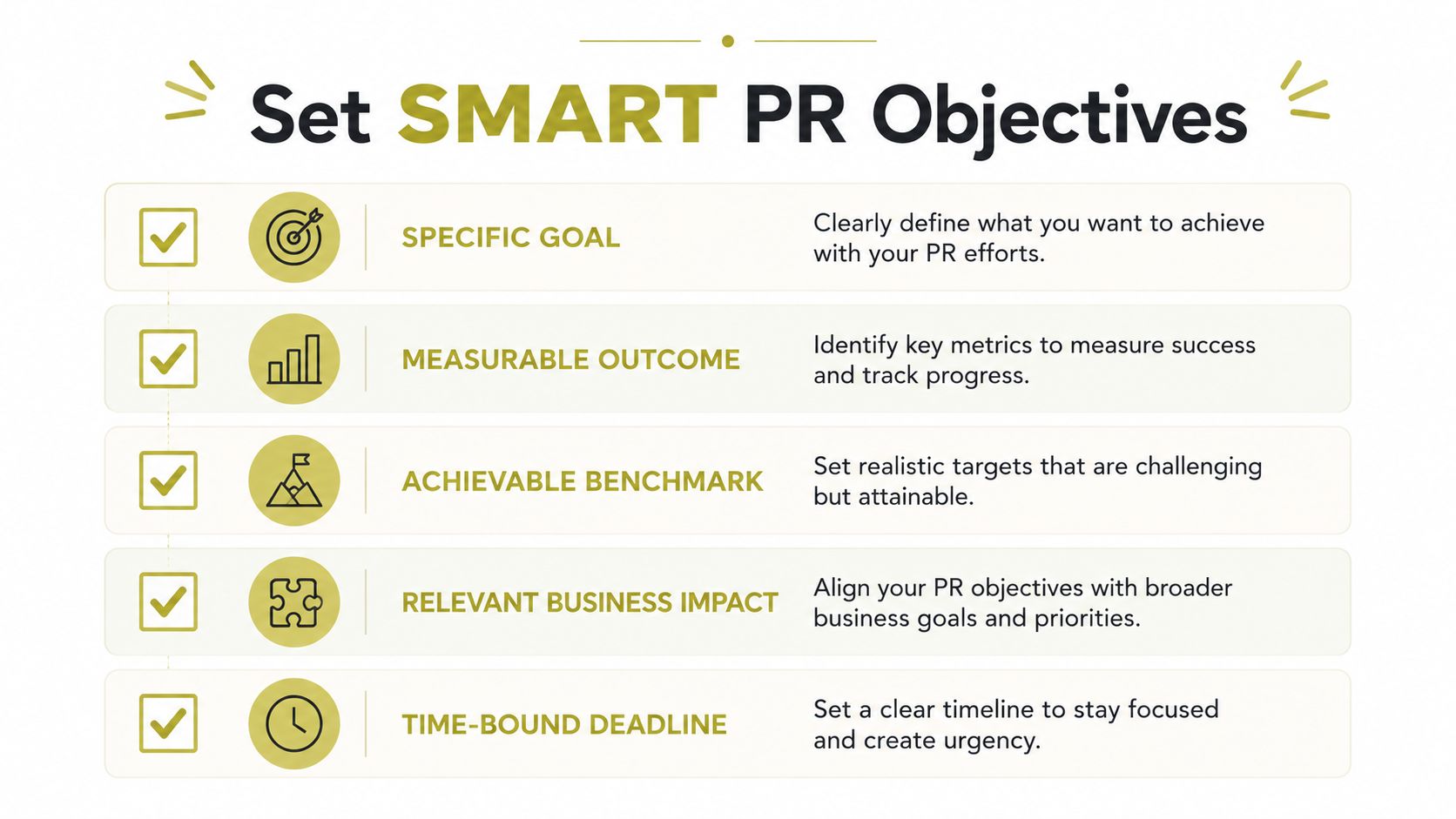
The cleanest way to do this is to write SMART PR objectives, with each objective tied to a commercial outcome. Keep them specific, measurable, achievable, relevant, and time-bound. A founder-led B2B firm might aim to increase qualified enquiries from earned media. A consumer brand might want more branded search and direct visits after a launch. A recruitment campaign might care more about applications and employer-brand perception than about press mentions.
What a usable objective looks like
A weak objective says, “Raise awareness.” A stronger one says, “Use earned coverage to increase qualified traffic to the product page and support sales conversations around the new offer.” The second version is measurable, tied to a business outcome, and easier to report back to leadership.
That difference is why starting with outputs is such a common mistake. If the goal is only to “get media”, the team will measure media. If the goal is to change buyer behaviour, the team has to measure the signals that show movement towards that behaviour.
Write the objective the same way you'd brief a journalist. If the angle, audience, and desired reaction aren't obvious, the measurement plan won't be either.
A senior, newsroom-trained team catches weak objectives early because it knows when a story is newsworthy but commercially fuzzy. That matters for SMEs, where every hour spent on pitching, follow-up, and reporting has to justify itself.
Before the campaign starts, run the brief through this check. What business result are we trying to influence? What would count as progress? What would count as noise? If those answers aren't clear, the metrics won't be clear either.
The Core Metrics That Matter for SMEs
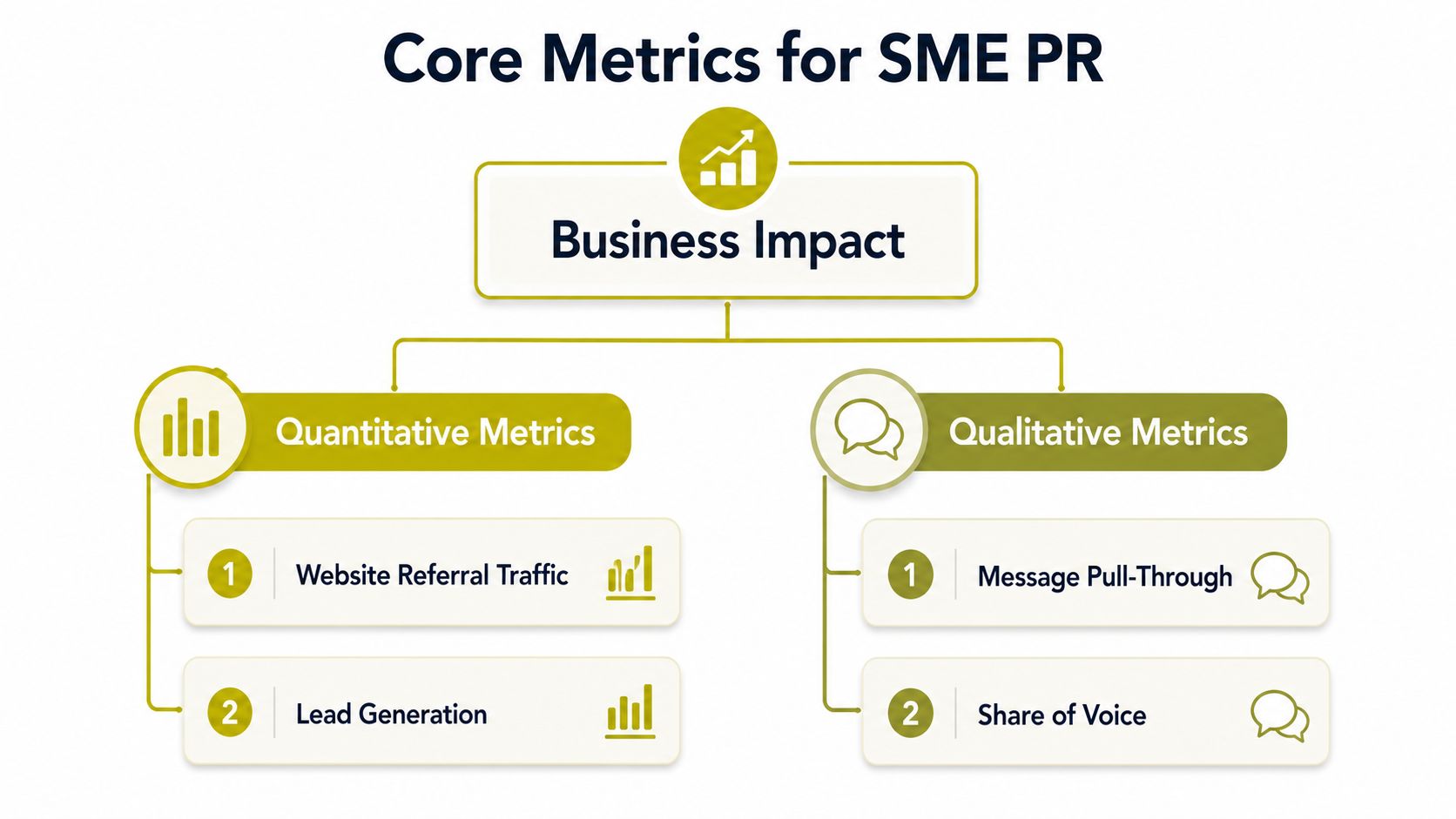
Small teams do not need a sprawling dashboard. They need a short set of metrics that show whether PR is helping the business move in the right direction. For many SMEs, that means grouping measures into four families, coverage quality and share of voice, audience response and sentiment, referral behaviour on owned channels, and commercial signals such as branded search and assisted conversions.
Keep the dashboard small enough to use
The strongest practical advice in modern measurement is to keep the core set focused. Onclusive recommends defining business goals first, then selecting 5–8 core PR metrics that map directly to those goals, with reporting cadence set at weekly for active campaigns, monthly for ongoing monitoring, and quarterly for strategic review (Onclusive). That is a better operating model than reporting every possible number and hoping someone notices the pattern.
For SMEs with lean teams, the most useful qualitative metrics are often the ones people ignore. Message pull-through tells you whether journalists repeated the points you wanted. Sentiment tells you whether the tone helped or hurt the brand. Share of voice shows whether you are visible in the right conversation, not just visible somewhere.
A practical dashboard might include:
- Coverage quality, because a relevant article in the right publication can matter more than a larger pile of weak mentions.
- Share of voice, because competitors do not disappear just because you issued a release.
- Sentiment and message pull-through, because tone changes how audiences interpret the coverage.
- Referral traffic from earned links, because visits from coverage are a visible sign that people acted on what they read.
- Branded search and assisted conversions, because these reveal whether PR helped people move closer to buying.
If you want a useful reference point for how referral metrics connect to landing-page performance, boost conversion with these metrics is a decent place to compare PR traffic thinking with conversion-focused page analysis.
Coverage should make a site easier to discover, easier to trust, and easier to act on. If it does not do one of those things, it is probably not carrying its weight.
For broader supplier research, the category list in top PR firms in Cape Town is a useful reminder that different agencies package measurement differently, but the logic stays the same, focus on business impact rather than vanity totals.
Emerging signals matter too
Earned media now affects discoverability beyond traditional search. Practical measurement guidance is already starting to include AI suggestions and references alongside SEO, share of voice, and backlinks as signs that coverage is strengthening visibility in generative-answer environments (Brand24). You do not need to over-engineer this, but you do need to notice when a campaign starts showing up in more places than a media monitoring alert.
A smart SME dashboard stays small, readable, and tied to action. If a metric cannot change what you do next, it probably does not belong on the report.
A reputation monitoring tool can help smaller teams keep that picture clear without building a heavy analytics stack. Carlos Alba Media reputation monitoring tools is one example of the kind of resource that can support that workflow.
Calculate the Numbers Without Drowning in Data
The easiest way to ruin PR reporting is to make it feel like a finance system. You don't need enterprise tooling to measure the basics well. A spreadsheet, a media monitoring feed, website analytics, and disciplined tagging are enough for most smaller teams.
A simple calculation sheet you can reuse
Use one row per metric, one source of truth per metric, and the same pre- and post-campaign windows every time. That keeps the results comparable. It also makes it easier to spot whether a campaign shifted anything or just produced a noisy spike.
| Metric | Formula | Data Source | What It Tells You |
|---|---|---|---|
| Reach | Sum of audience estimates across relevant placements | Media monitoring platform, outlet data | Approximate exposure across earned coverage |
| Share of voice | Brand mentions divided by total competitor-set mentions | Media monitoring, manual competitor set | Your visibility relative to rivals |
| Sentiment ratio | Positive mentions compared with neutral and negative mentions | Manual coding or monitoring tool | Whether tone is helping or hurting |
| Referral uplift | Post-campaign referral traffic minus pre-campaign referral traffic | GA4, campaign URLs | Whether coverage sent people to the site |
| Branded search lift | Post-campaign branded search interest compared with baseline | Search Console, search trend tools | Whether awareness or curiosity increased |
| Assisted conversions | Number of conversions where PR was part of the journey | GA4 attribution, UTM tags | Whether PR supported later action |
For teams managing reputation-focused monitoring, the internal guide on reputation monitoring tools can sit alongside this spreadsheet approach without making the process heavier.
How to keep the maths honest
Reach and impressions are fine as context, not as proof. They become useful when you pair them with behaviour. If coverage reached a relevant audience but nobody visited the site, the campaign may have built visibility without creating action. If referral traffic rose and branded search increased, the story is different.
Assisted conversions need a clean tagging habit. Use UTM parameters on links you control, then check whether PR appears in the path to conversion rather than claiming it caused every sale. That's especially important in longer sales cycles, where a prospect might read coverage, return later through search, and convert after several other touchpoints.
For agencies or in-house teams comparing channel mix, the logic in owned earned paid media helps separate what PR directly influenced from what the wider marketing system captured later.
If you can't explain where the number came from, don't put it in the report.
The goal is not a perfect model. The goal is a believable one that helps a founder see whether PR changed the conditions for growth.
Attribution and ROI Without an Enterprise Stack
Founders usually want one answer, did PR pay off. That's the wrong starting point. A better question is whether the campaign changed the conditions that make sales more likely. In small firms, that distinction matters because the customer journey is rarely neat, and the data usually isn't either.
Read the signals as evidence, not absolutes
Look for a cluster of indicators rather than a single magic number. Branded search, direct traffic, and referral traffic can show that coverage made people curious enough to look for the brand again. If prospects mention a piece of media in a sales call, that's not a vanity note, it's proof that the coverage entered the buying conversation.
Conditions-based reporting is stronger than a forced attribution claim. If PR lifted awareness, supported recall, and encouraged more visits from people who already had buying intent, it helped create a better sales environment. That's commercially meaningful even when the final purchase happened later through another channel.
Assign confidence, not false certainty
Use a simple three-part readout in leadership reports.
- Proven, when the evidence is direct, such as tracked referral traffic or tagged landing-page visits.
- Indicative, when several signals point the same way, such as branded search and mention quality moving together.
- Directional, when the signal is early or incomplete, such as a spike in media interest without enough conversion data yet.
That structure keeps the conversation honest. It stops teams from overselling weak evidence and helps leadership understand what to act on now versus what to watch.
PR measurement guidance has long recommended starting with business goals and then selecting the metrics that map to those goals, not the other way round (PRSA). For SME reporting, that's the practical standard. A good report doesn't promise perfect attribution. It shows whether the campaign made the next sale more likely.
The one thing not to do is report ROI as if every sale came directly from a clip. That's where credibility goes.
Reporting Cadence and Turning Data Into Action
A report only helps if it arrives at the right pace. Weekly reporting keeps live campaigns honest, because it shows what is being picked up while editors are still deciding what to run. Monthly reporting is where patterns start to show, including shifts in audience response and whether the campaign is feeding the wider commercial conversation. Quarterly reporting is where leadership should check whether the measurement mix still fits the business goals, using the same objective-first discipline covered earlier and a performance benchmarking approach that compares results against a realistic baseline.
What to include at each cadence
Weekly reports should stay tight. Include coverage secured, referral spikes, message pull-through notes, and any reputational issues that need escalation. Monthly reports should add share of voice, sentiment shifts, branded search movement, and a short note on what the sales team is hearing. Quarterly reviews should focus on whether the metric set still reflects the business objective, what changed in the wider market, and whether the team is still measuring what matters.
One simple structure works well.
- What happened, a short summary of coverage and traffic.
- What changed, the movement in audience response or commercial signals.
- What to do next, the message, outlet mix, or landing-page adjustment.
- What to stop, any metric that is not helping decisions.
Turn the report into the next brief
Good measurement should shape the next campaign brief. If journalists responded to one angle but ignored another, tighten the message. If coverage came from the wrong tier of outlet, sharpen media targeting. If referral traffic was healthy but conversions stayed flat, the landing page probably needs work.
Reporting only matters if it changes the next decision.
Quarterly reviews should also compare current results with prior campaigns or the benchmarks the team has agreed. That comparison stops vanity wins from being mistaken for progress and gives founders a clearer read on whether coverage quality, referral behaviour, and commercial outcomes are moving in the same direction. The practical question is simple, what should stay, what should be cut, and what should be tested again in the next cycle.
If you want senior-level support that treats measurement as part of PR strategy rather than a bolt-on, Carlos Alba Media builds reporting around coverage quality, referral behaviour, sentiment, and business outcomes for SMEs and growth-stage brands.