
You're trying to finish a customer proposal when a journalist emails for comment. Meanwhile, your product launch still needs a clear story, your website doesn't explain what makes you different, and a customer complaint is gathering attention online. Hiring communications help starts to look sensible, but another monthly bill needs a clear purpose.
A small business PR agency should help you earn relevant attention and make sound decisions under pressure. Judge its monthly retainer against both opportunities gained and the price of one badly handled week: missed deadlines, contradictory statements, distracted staff and customers left without answers. That isn't a reason to buy more support than you need. It's a reason to understand exactly what you're paying for.
What a Small Business PR Agency Actually Does
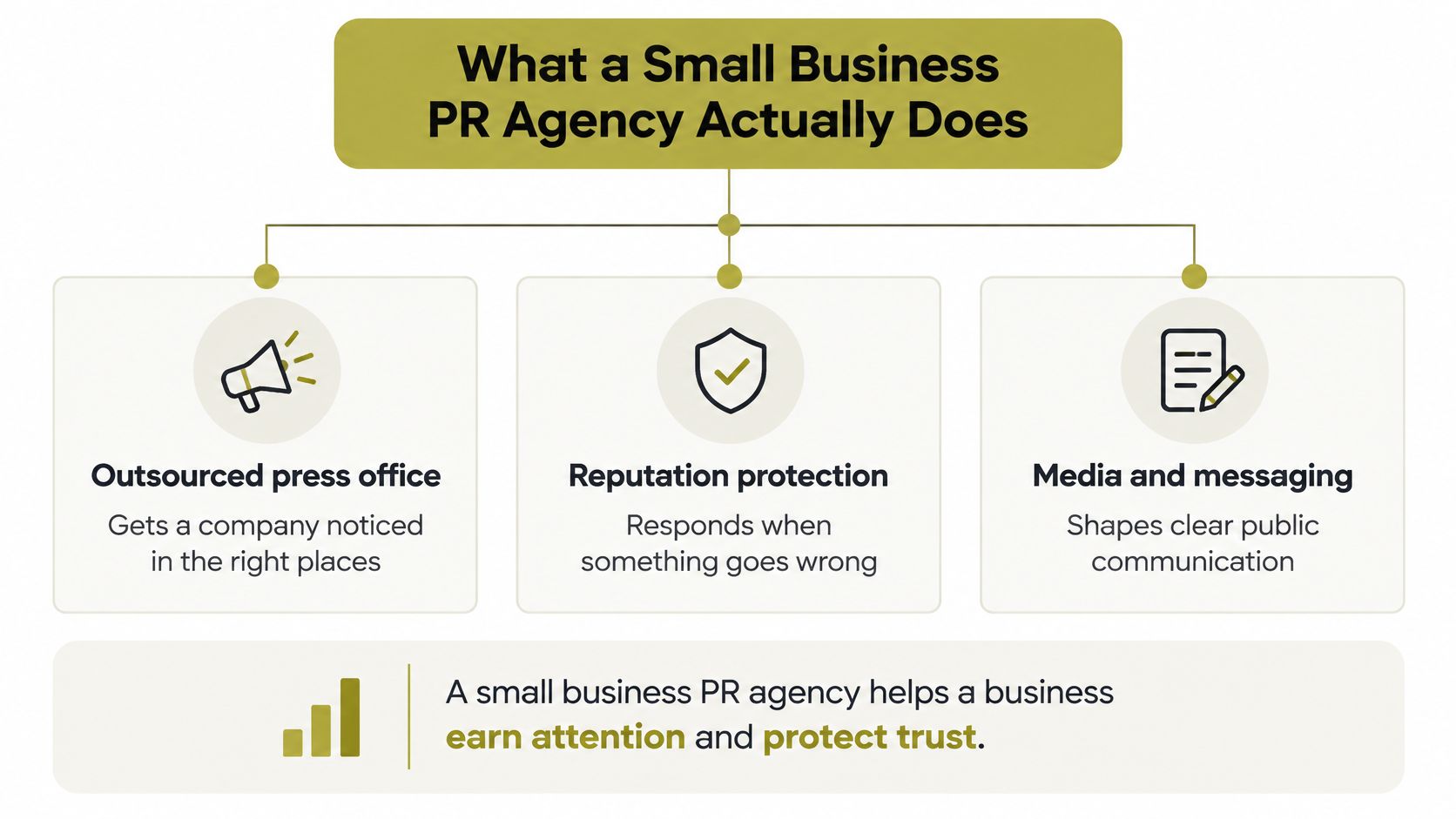
A small business PR agency is an outsourced press office that gets a company noticed in the right places and protects its reputation when something goes wrong. Think of it as a translator, turning the work your company does into a story an editor can understand, verify and consider publishing.
The work falls into earned coverage, owned channels and protection. These are connected services, not interchangeable purchases.
Core services and what each one delivers
| Service | What the client gets | Best suited to |
|---|---|---|
| Media exposure | News articles, features, interviews and national TV or radio slots placed in high-circulation outlets, subject to editorial decisions | Brands that need credibility with customers and investors |
| Digital content and SEO | Website copy, articles and landing pages that support media coverage and search visibility | Newer firms with little offline brand recognition |
| Social media marketing | Content calendar, posting and engagement designed to turn attention into enquiries | Consumer-facing and lifestyle businesses |
| Branding | Identity and collateral that communicate the brand to its target audience | Start-ups without a clear market position |
| Media skills training | A single-day session on delivery, body language and on-camera presence | Founders and spokespeople facing interviews |
| 24/7 media crisis management | Immediate strategic guidance to contain and counter negative publicity | Regulated or high-risk sectors |
At Carlos Alba Media, we offer these services alongside web design and development. Our branding work creates an identity and collateral for the intended audience, while our crisis service provides immediate guidance to contain, control and counteract negative publicity.
Decide what needs fixing first
Limited time makes prioritisation essential. In Nettl's 2026 survey of 223 UK businesses, 42.6% named increasing brand visibility as their leading priority, while 25.5% identified lack of time as their biggest marketing barrier.
Don't commission publicity just because you're busy. If visitors can't understand your offer, improve the website first; if buyers need reassurance about your expertise, targeted coverage may be more useful than another publishing schedule.
For smaller firms, being discoverable is part of being credible. UK government qualitative research on online search identified search visibility as particularly important to businesses without established offline brands. Use consistent business names, locations and expertise in your communications, supported by problem-led website pages.
Outrank's SEO playbooks for PR specialists provide a useful resource when connecting editorial ideas with search-focused content planning.
Expect the opening month to establish your brand's character, target outlets and a dated media plan. We begin by helping clients define what their brand stands for; a clear PR communication strategy should connect that definition to an audience and an achievable objective.
Why PR Matters More for Small Firms Than You Think
Reputational exposure doesn't require a large company. A small employer can face a difficult press enquiry, an allegation about its product or a complaint that attracts wider attention, without having anyone whose job is to coordinate the response.
In research covering 300 UK business leaders, the Chartered Institute of Public Relations reported that more than 40% placed reputation among their top three risks, yet roughly one-third had no process for identifying or addressing reputational risk and more than one-quarter lacked a crisis-communications plan.
Small businesses need an organised response
This matters across an economy dominated by smaller employers. According to the UK government's business population estimates for 2024, SMEs represented 99.8% of businesses, 60% of private-sector employment and 52% of private-sector turnover.
Without an agreed spokesperson, approval route and evidence-based holding statement, staff can give inconsistent answers. A founder might post a defensive reply while a colleague promises something the business can't deliver.
Preparation matters: Agree who verifies the facts, who approves the response and who speaks before an incident forces those decisions.
Useful PR support should provide:
- Credibility with stakeholders: Explain your work to customers, investors, regulators and partners.
- Senior counsel: Give the owner access to experienced judgement without building a full communications department.
- Faster, coordinated responses: Establish escalation thresholds and authorised messages.
- Discoverability: Help interested readers find the business behind a third-party mention.

Consider a hypothetical two-person start-up that earns one relevant trade feature. That's a modest, useful outcome if prospective buyers read the publication and the founder can reuse the coverage appropriately in sales conversations.
If branded searches rise in the following weeks, record that as a signal worth investigating. Don't promise that the feature will produce a search increase, investment or sales, and don't confuse publication with commercial success.
What a Small Business PR Agency Costs
One badly handled week can cost a small firm more than a year of agency fees: management hours lost to firefighting, customers left uncertain, a defensive reply that makes things worse. That is the comparison to make when a monthly retainer lands on your desk, because the retainer is the line item you can plan for while the bad week is the one you cannot.
Use £1,000 to £3,000 a month as a working bracket for a scoping conversation. The figure that matters is the written quote for your scope, the seniority of the team doing the work and the level of crisis cover included.
Buying a release, retaining a press office and securing emergency availability are three different commitments, priced differently. A modest ongoing budget funds a tightly defined programme, and expecting unlimited outreach, design, website work and round-the-clock support inside it invites disappointment on both sides.
What changes the quote
Ask the agency to separate routine delivery from additional work. Costs reflect the breadth of the media list, regional versus national ambitions, the number of spokespeople involved, and whether the assignment includes original content, design or website copy.
Crisis work needs its own boundaries. Out-of-hours availability, incident handling and legal review should be priced and agreed separately rather than assumed to sit inside an ordinary publicity retainer.
What Common PR Packages Include
Treat the packages below as buying specifications. Each price should be confirmed in writing before you sign.
| Package | What it includes |
|---|---|
| One-off press release | Written release and distribution to a targeted media list. Request a fixed project quote with revisions specified. |
| Monthly PR retainer | An illustrative scope of 2 to 4 story pitches a month, media outreach and monthly reporting. Request a monthly fee with capacity and exclusions stated. |
| Social media management | Content calendar, posting and engagement across two platforms. Request a fee specifying content formats and moderation hours. |
| Media skills training | One-day coaching for one spokesperson on delivery and on-camera presence. Request a session price and preparation requirements. |
| 24/7 crisis readiness | Holding statements, spokesperson preparation and on-call strategic guidance. Request a readiness fee plus the charging basis for an active incident. |
A retainer buys professional work and access to journalists. It never guarantees editorial coverage. Ask the agency for its expected timeframe to a first placement, the assumptions behind that estimate and what it will change if journalists do not respond.
For an adjacent service priced in another market, Wispra's guide to French SEO pricing shows how agencies package monthly fees. The numbers do not transfer to a UK PR budget, yet the way deliverables are itemised will sharpen the questions you ask about scope.
Before signing, check:
- Contract commitment: Minimum term, notice period and additional charges.
- Placement definition: Whether earned editorial, paid content and syndicated copies are reported separately.
- Reporting depth: Whether branded search and referral activity accompany coverage records.
Weigh the monthly retainer against the management time and customer uncertainty of one badly handled week, using your own exposure rather than a generic crisis figure, and against more than the count of articles published.
How to Evaluate and Choose the Right Agency
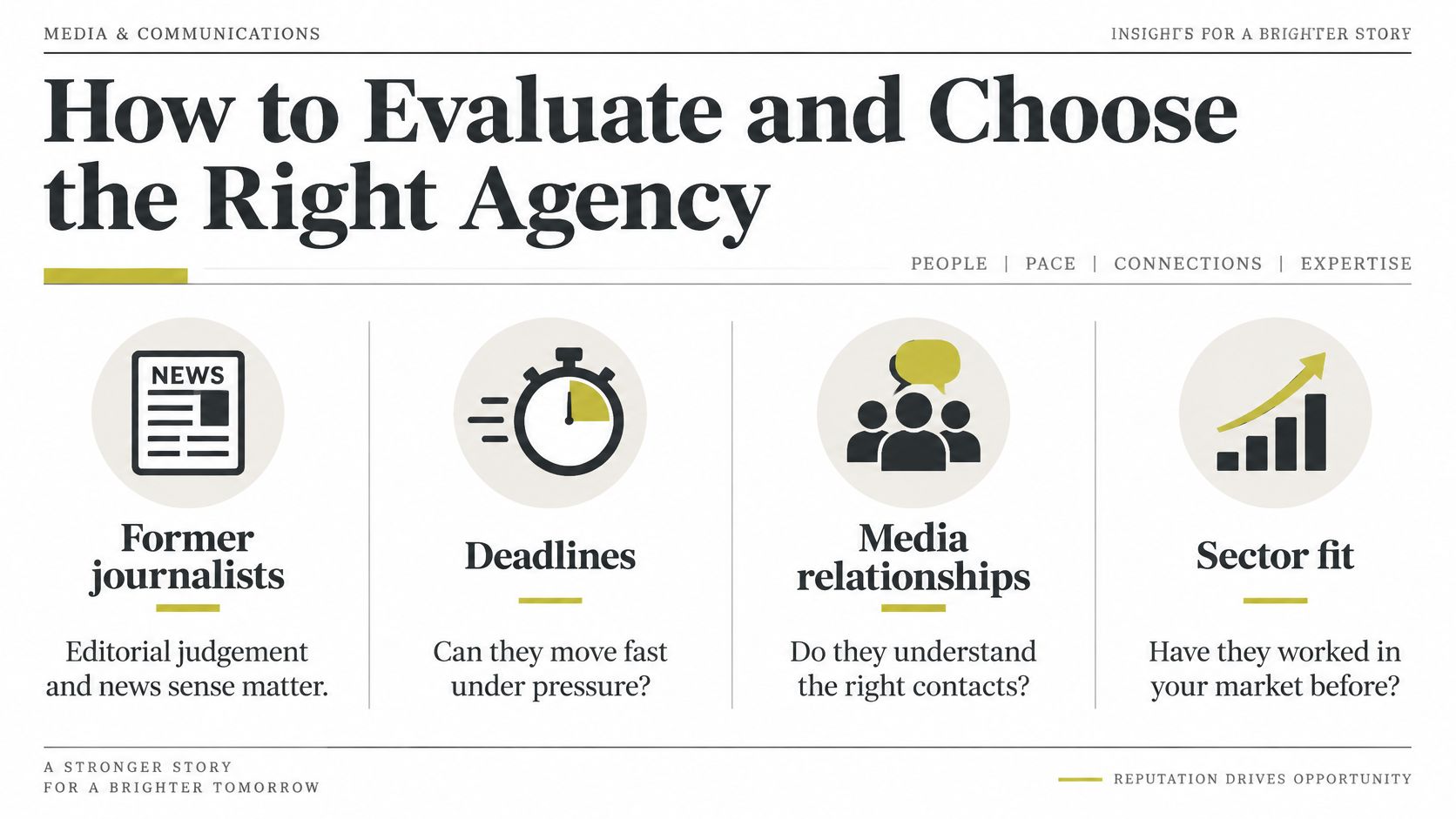
Choosing an agency works like a reference check: credentials explain why a team may be suitable, while delivery evidence shows whether it can do the job. Editorial judgement matters more than a long contact list. All our consultants at Carlos Alba Media are former national print and broadcast journalists, which reflects the specialist nature of the work.
The Reuters Institute's 2023 study of 1,130 UK journalists found that 84% had a main employer from a legacy-media background. Newsroom familiarity is relevant because editors work to deadlines, verification standards and audience needs. A previous job title is the first test, followed by evidence that the person can turn that experience into a workable campaign.
Seven checks before appointing a team
Confirm who does the work. Meet the person who will develop stories, respond to enquiries and challenge weak claims. Ask what they would pitch during the first month, which parts they would advise against and how they prepare clients for difficult interviews. The senior person at the pitch should identify their day-to-day role clearly.
Request case studies with outcomes. Ask for two or three examples covering the objective, audience, work completed and resulting response. A recognisable client name shows experience, while a fuller account shows whether the agency secured relevant coverage, strengthened messaging or supported a difficult announcement.
Test sector understanding. Give the team a realistic issue from your market and ask how they would assess it. A tourism business needs different editorial hooks from a technology supplier, while a regulated organisation needs careful boundaries around evidence and claims. Listen for questions before recommendations.
Establish fit with your business stage. We work with businesses of all sizes, including start-ups and early-stage, pre-revenue companies. For any proposal, check that the recommended workload matches the evidence, approvals and founder time you can supply. A smaller, better-prepared campaign may be more useful than continuous activity based on thin material.
Inspect the decision value of reporting. Request a sample document and ask how it helps the client decide what to do next. Coverage should be connected to relevant audiences rather than presented as an activity total. If search support is bundled into the proposal, use Riff Analytics' resource to compare search agency pricing and services and separate PR deliverables from SEO work.
Follow the crisis route. Ask who answers out of hours, who approves a statement and when legal advice becomes involved. Our crisis management service works alongside some of the UK's top media lawyers and safeguards the client's legal position. The proposal should still distinguish preparation, live incident guidance and legal work so each cost and responsibility is clear.
Read the delivery obligations. Beyond minimum terms and notice, check what happens when a launch slips, approvals arrive late or supporting evidence is incomplete. Both parties need to understand what must be supplied before pitching can begin, who owns each dependency and how missed deadlines affect the work.
Red flags worth taking seriously
- Guaranteed earned coverage: Editors decide what runs, so an agency can guarantee effort and standards rather than publication.
- Unnamed delivery staff: You cannot assess expertise when the proposal hides who is responsible for the work.
- Vague reports: Activity totals without audience relevance or decisions are not enough.
- No editorial challenge: A team that agrees with every claim may create weak pitches or expose the business unnecessarily.
A useful agency should tell you when a story needs stronger evidence, a clearer angle or a prepared spokesperson. That candour protects your budget and journalist relationships. Treat the monthly retainer as a line item to test: it should reduce wasted outreach and provide a prepared route through a difficult week, while remaining honest about what earned media can deliver.
Where PR Fits Alongside SEO and Social Media
The channel you notice most isn't necessarily the one you should fund first. A busy social feed can coexist with an unclear website, weak enquiries and no explanation of why buyers should trust the business.
Start with the customer's next decision. Can they understand your offer, find supporting evidence and contact the right person? If not, fix that route before paying to attract more attention.
Which channel to start with, by situation
| Situation | Start with | Why |
|---|---|---|
| New brand with no website pages yet | Website and basic search pages | Coverage sends people to a page that must explain and convert |
| Known locally, needs national credibility | Earned media | Relevant third-party coverage provides evidence beyond self-published claims |
| Long buying cycle in a regulated sector | PR combined with networking and referrals | Trust and introductions matter more than broad reach |
| Consumer product with frequent launches | Social content supported by targeted PR | Launch moments create stories that social can extend |
Local reputation and national credibility serve different jobs. A hospitality operator may need nearby customers to understand an offer, while a tourism business seeking travel-industry partnerships may need recognition beyond its immediate area. A professional-services founder may benefit more from a specialist interview and trusted introductions than from frequent general-interest posts.
Distinguishing owned, earned and paid media helps prevent double spending. Your website explains the offer, journalists independently assess stories, and paid distribution purchases access to an audience.
Budget rule: Choose a channel because it helps a buyer take a useful next step, not because competitors publish there.
Use Google Search Console for branded search impressions and Google Analytics for referral sessions and enquiry events. Add a simple enquiry-source question to your contact process, because buyers don't always follow a trackable path.
Review the allocation quarterly. Pause or redesign channels that produce neither useful enquiries nor credible signs of progress, allowing for the buying cycle rather than judging everything by immediate sales.
A Worked Example on a Realistic Budget
Consider an illustrative four-person Glasgow technology start-up with a £1,500 monthly budget, preparing a product launch. This is a hypothetical allocation, not a client result, package offer or promise that every listed activity fits that fee.
The founder's priority is to reach relevant business buyers, not secure the widest possible audience. Before work starts, the agency and founder agree which tasks fit the budget and what the internal team will handle.

From preparation to publication
In month one, the team defines the brand, shortlists trade and business outlets, and agrees a media plan with dates. The founder supplies product evidence and permission to discuss customer problems, while the website gains two problem-led pages that substantiate the launch claims.
During months two and three, the agency pitches relevant journalists. In this scenario, the work leads to one trade feature and a founder interview, with a focused media skills session preparing the founder to explain limitations as well as benefits.
The agency records branded search and referral sessions monthly. The founder logs which enquiries mention the publication, so a useful conversation isn't lost because someone called instead of clicking.
The budget expressly excludes:
- Guaranteed national coverage: No editorial outcome is purchased.
- A crisis retainer: Emergency availability needs a separate agreement.
- Paid advertising: Distribution spend isn't hidden inside the PR allocation.
After three months, the founder judges the work by enquiries associated with named outlets, product-name search impressions and whether the team can answer a difficult question on camera. A practical approach to measuring PR effectiveness keeps those observations separate from unsupported claims about sales attribution.
The decision to continue rests on relevance, learning and commercial conversations, not a thick folder of screenshots.
Book a Scoping Call Before You Commit
A short conversation can reveal more than a polished proposal. Explain your communications problem, then listen for a clear diagnosis rather than an immediate recommendation to buy every service.
Carlos Alba Media offers a free consultation with a public relations expert for people facing a communications challenge or media crisis. You don't need to be based in Glasgow or Scotland: we work with clients across Scotland, the UK and internationally, including early-stage businesses.
Bring enough information for a useful discussion
- A one-page brief: State the goal, audience and obstacle preventing progress.
- Your budget and commitment: Explain what you can sustain, not just what you could spend at launch.
- A 90-day target: Choose a meaningful milestone, such as a launch date, relevant coverage or qualified enquiries.
- Your evaluation questions: Bring two or three questions about the delivery team, evidence of sector fit or emergency support.
Our national-newsroom background and international-brand agency experience provide specialist foundations for that discussion. The practical test is whether the proposed work suits your circumstances.
A good agency should explain its plan in plain language before you sign. You should leave knowing what will happen, what you'll need to contribute and what remains uncertain.
Carlos Alba Media offers specialist PR, digital marketing, media training and crisis communications support for businesses that need to earn attention and protect trust. Visit Carlos Alba Media to arrange a free consultation about your communications challenge and discuss a scope that fits your priorities and budget.