
At the start of 2024 the Department for Business and Trade estimated 5.5 million private-sector businesses in the UK, and 5.45 million of them, 99.2%, had 0–49 employees. Most of the firms chasing attention are small. A handful of people cannot outspend a national brand, but they can earn a mention that a customer, a partner or an investor treats as someone else's judgement.
PR for small business is that system. It is not a pile of clippings. It is a low-cost way to turn a clear story into enquiries, a reputation that holds when something goes wrong, and evidence that search tools and AI answers can use.
What PR Means for a Small Business
A firm of eight people, or forty, sells against names that already fill the trade press. Small and medium-sized firms make up the vast majority of UK businesses and employ most of the private-sector workforce, so the field any new entrant steps into is already crowded. Standing out in that crowd cannot depend on budget alone.
Public relations here means earned coverage: expert comment, interviews and features that an editor chooses to run because the story serves their readers. No fee buys the placement.
The difference is who vouches. Advertising is you standing up and saying the product is good. PR is a journalist, a trade editor or a respected peer saying it after deciding the story deserves their readers' time. Buyers discount the first kind of claim automatically. They still pause for the second.
Carlos Alba Media helps clients publicise their work to potential customers, industry partners, regulators and investors, and that work starts by defining the brand's character and what it stands for. Those audiences have to find the firm, then decide it is safe to buy from, hire through, partner with or back. Owners usually want four results: customer enquiries, stronger recruitment, partnerships and investment readiness. A practical strategy for growing small firms still needs a sales process and a product people want. PR feeds each of those jobs; the selling and the product still have to deliver.
Set expectations before the first pitch goes out. Coverage will not repair a weak offer, and it moves on a quarter's clock, not a week's. Judge a run of pitches after three months of steady effort, not after one silent Friday.
Name the one audience you most need this year, and the decision you want that audience to make. If you cannot say both in a sentence, you are not ready to pitch.
Affordable PR Channels Compared at a Glance
| Channel | Typical cost | Time to first results | Best for |
|---|---|---|---|
| Local and regional media pitching | Low (staff time) | 2–6 weeks | Local services, openings and community stories |
| Trade and niche publications | Low to medium (staff time) | 4–8 weeks | B2B firms and specialist markets |
| Expert comment for journalist requests | Low (staff time) | Days to weeks | Founders with a clear point of view |
| Guest articles and thought leadership | Low (staff time) | 1–3 months | Firms building authority in their field |
| Awards and industry listings | Low to medium (entry fees) | 3–6 months | Firms with client results or data to show |
| Podcast and speaking appearances | Low (staff time) | 1–3 months | Founders and executives who can talk clearly |
| Outsourced PR retainer | Medium to high (monthly fee) | 3–6 months | Firms that want national reach without building an in-house team |
Read the columns as ranges a planner can budget against, not as promises. Staff time is the price of the DIY rows. An outsourced retainer moves that time into a monthly or project fee, and the fee scales with how many markets, spokespeople and stories you ask for. "Time to first results" is a typical window from a usable pitch to a first placement or booking.
Budget in hours and money together. A DIY channel usually needs a named person for three to four hours a week. A retainer is worth it only when the fee is lower than the cost of those hours, including the meetings you would otherwise sit in. We work with businesses of all sizes, including start-ups and early-stage, pre-revenue companies, so a firm that is not yet invoicing can still use the low rows. The constraint is a person and a point of view, not a turnover line.
Three choices that follow the rows
Local and regional media usually answer first. A new shop, clinic or contractor should test that row before chasing a national desk. Two to six weeks is short enough to learn whether the story is clear.
Trade and niche titles often produce more useful enquiries than a national hit for a B2B firm. A plant manager reading a process magazine is closer to a purchase than a general reader who will never buy.
Awards and listings only pay off once you can show client results or a data point. Entry fees on a story that is still "we launched" buy a logo and little else.
The row you pick here is the one to run in the 90-day test at the end of this guide. One channel, properly logged, teaches more than seven half-started ones.
Story Angles and Pitches Journalists Will Read
A pitch is a news story in miniature. It needs a reason the item matters this week, one specific detail, and a person who can speak to it on the record. A long release that lists services fails that test before an editor opens the second paragraph.
Three pitches that have a reason
Say a bakery is opening a second site. The hook is jobs in that town, not "we're excited to grow". The proof is the number of roles, the street, and the week they start. The target is the local business desk, because a regional reporter already covers employment and high streets. A national food page has no reason to care about one extra counter.
An engineering firm that has surveyed its own customers has a different spine. The hook is a headline figure from that survey, such as the share of sites still using a named process. The proof is the sample, the date and a founder who will explain what the figure means on a job. The target is a trade title whose readers specify that kit. The survey is the news. The company is the source.
A consultancy whose founder has a settled view on a regulation change does not need a launch at all. The hook is the rule moving, and a plain consequence for local employers. The proof is the founder's name, role and one concrete example. The target is a comment slot on a regional daily that already runs reaction pieces that week. Comment without a news peg is an advert. Comment tied to a change is copy an editor can use today.
A City University London survey of 700 UK journalists found an average of 18.5 years in the job. Nearly one-fifth called public-relations activity "very" or "extremely" influential on their work, and a further 37% called it "somewhat influential". Influence follows material that respects how those people already work.
Build the list from their pages
Make a list of 20 journalists from pieces they have published in the last few months, not from a bought database of job titles. Note the beat, the last relevant story and the detail they cared about. A short note that says why their readers would use this story beats a 600-word release. Lancaster University research on UK journalists and PR practitioners found that some practitioners had been journalists and knew how to get attention, and that journalists viewed some PR material positively when it was transparent, trustworthy and useful to news production.
Before you send, ask one question of the angle. Would a reader of this title share it with a colleague? If the answer is no, the outlet is wrong or the proof is thin. Our guide to what makes a story newsworthy is a useful filter before that list goes out. People who have worked in national newsrooms are quicker at spotting the line an editor will cut, because they have cut those lines themselves.
How to Build a Low-Cost PR Plan Step by Step
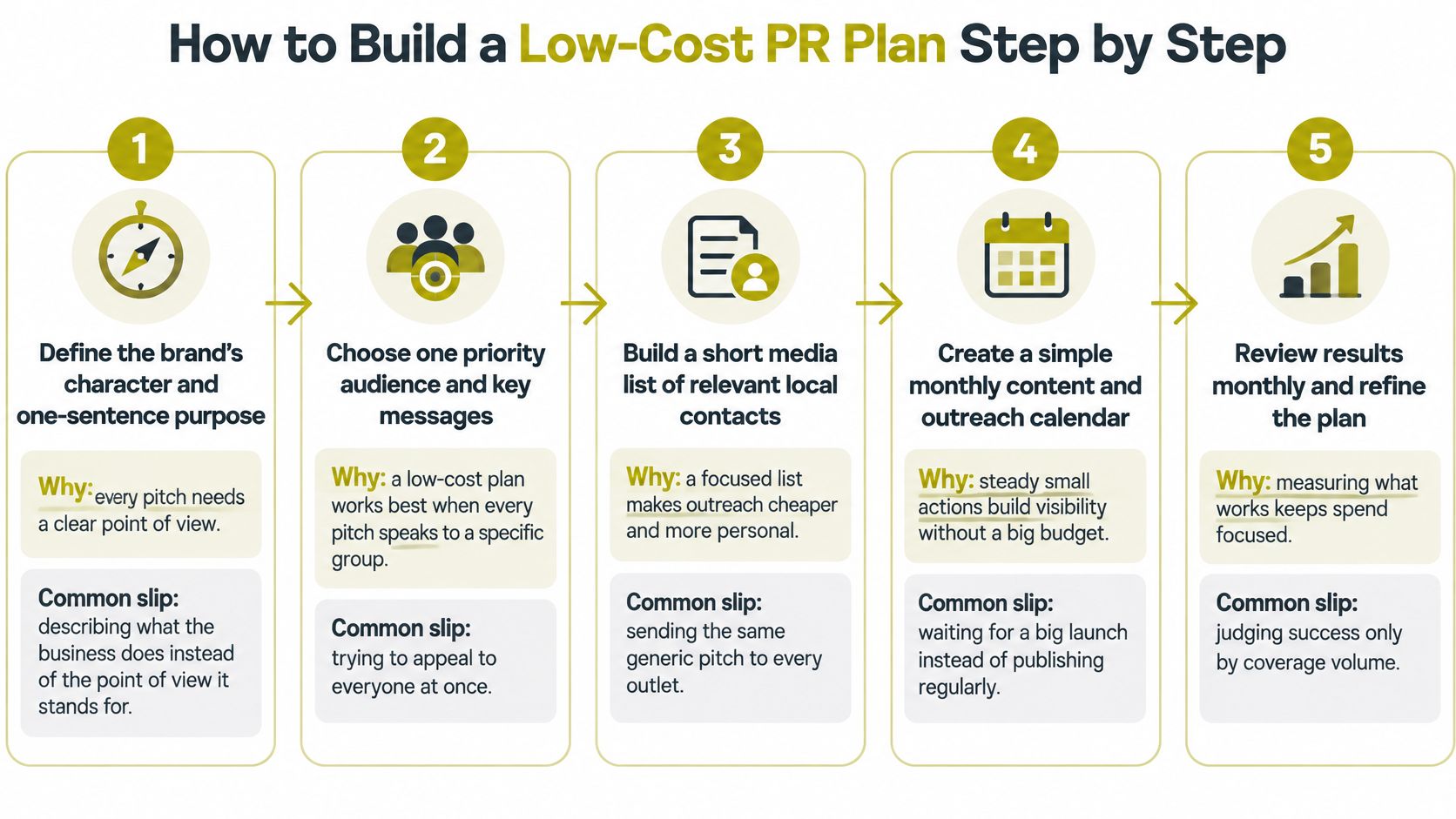
Treat the plan as a short operating routine. Each step has a reason, and a slip that wastes the week.
- Write the brand's character and a one-sentence purpose. Every pitch needs a point of view, not a catalogue. The slip is listing services ("we do accounts, payroll and tax") instead of the stance ("we help owner-managed firms file on time without a finance director").
- Name four audiences: customers, partners, regulators and investors. You will not pitch all four at once. You need them written down so a story aimed at buyers is not accidentally written for a funder.
- Pick two or three channels from the comparison table that reach the audience you ranked first. A third channel is a spare, not a duty.
- Build a 12-week story calendar with six to eight angles. Tie each angle to a news hook, an anniversary, a data point or a seasonal moment. The slip is waiting until something "has happened" and then discovering the newsdesk has moved on. Put the bakery's hiring week, the survey release and the regulation comment on dates before you need them.
- Name one spokesperson and a fixed time budget, such as three to four hours a week in the diary. The slip is leaving PR with whoever is free, which means nobody owns the follow-up.
- Write each pitch in three lines plus one asset: a photo, a data point or a quote. Line one is the news. Line two is the proof. Line three is who will talk and when.
- Follow up once, after three working days, and do not send a second chase. Repeating the email trains the journalist to ignore you. If there is no reply, the next contact should be a new story, not the same one louder.
- Log every placement and every enquiry each month. A notebook or a simple spreadsheet is enough. Without the log, you cannot tell a quiet channel from a broken pitch.
What a healthy first quarter looks like
A sound first quarter is not a wall of headlines. It is two or three pieces of relevant coverage, a trail from at least one of them to an enquiry, and a short list of journalists who replied, even with a no. That list is the asset. The clippings are the receipt.
Practical rule: If a step has no named owner and no date, it is not in the plan.
Measuring PR Results Beyond Press Clippings
| Level | Indicator | How to track it |
|---|---|---|
| Output | Publication reach | Audience figures supplied by the publication or a clipping report |
| Output | Message prominence | Whether the proof point appears in the headline or first paragraph |
| Output | Share of voice | Coverage count compared with two named competitors |
| Intermediate | Branded search growth | Monthly search console impressions for the business name |
| Intermediate | AI-search recommendation share | Share of AI-search answers to target queries that name the business |
| Intermediate | Direct traffic | Visits to the campaign landing page without a referral source |
| Intermediate | Referral conversion | Enquiries from tagged links in the coverage |
| Intermediate | Sentiment by stakeholder | Short survey of customers, partners and investors |
| Outcome | Conversion rate | Enquiries that become paying customers, tracked in the CRM |
| Outcome | Pipeline value from earned coverage | Deal value where the CRM source field names the coverage |
Research on 153 UK SMEs found that a positive reputation mattered for attracting customers and investors, while a customer-service orientation increased loyalty and helped bring in new clientele. The same work treated innovation and digitalisation as responses that strengthen resilience. Reputation is a commercial input only when you can see the behaviour that follows it.
Why reach on its own misleads
A big audience figure is an output. It says the piece was available. It does not say a buyer in your patch saw the proof, trusted it, and got in touch. Coverage that lands outside the service area, or that never states a proof point, can look busy in a clipping report and still leave the pipeline untouched.
Tracking you can run with tools you already have
- Publication reach: Take the title's own audience figure or a clipping report, and write it next to the outlet name so you are not guessing.
- Message prominence: Check whether your proof point is in the headline or the first paragraph. A mention in paragraph twelve rarely travels.
- Share of voice: Count your pieces against two named competitors over the same month. The comparison is the point, not a vanity total.
- Branded search growth: In Google Search Console, watch monthly impressions for the business name after a placement.
- AI-search recommendation share: Ask a fixed set of supplier questions in the AI tools your buyers use, and record how often the business is named. That is the intermediate row most clipping reports skip.
- Direct traffic: Send each story to its own landing page and separate visits that arrive with no referral.
- Referral conversion: Put a tagged link in any bio or follow-up you control, and count enquiries that carry the tag.
- Sentiment by stakeholder: A five-question note to a handful of customers, partners and investors tells you whether the story matched how they see you.
- Conversion rate: In the CRM, mark which enquiries become paying customers.
- Pipeline value: Record the deal value only when the source field names the coverage, not when someone later "thinks they saw an article".
A campaign landing page, a tagged link, a CRM source field and a form question, "how did you hear about us?", cover most of this at no extra software cost. Finding citations without a link matters too, because a name-check that never points at your site still shapes search and AI answers, and you will miss it if you only watch referral traffic. Our note on how to measure PR effectiveness sets the same split between outputs and outcomes in more detail.
Review once a quarter. Keep a channel when outcomes move. Drop it when you have only clippings.
Protecting Reputation When a Crisis Hits

PR is also a resilience control. A study of 215 UK SMEs found that crisis-planning capability was associated with resilience across prevention, operational response, financial impact and post-crisis recovery, among other dimensions. The same research found that managers judged planning differently depending on the type of crisis and their experience of it. A single generic statement does not fit every incident.
Pre-agreed roles, thresholds, messages and contact lists cut the time people spend arguing about who may speak. That gap is where contradictory lines leak.
A cyber incident, minute by minute
For a cyber incident, use the first 30 minutes only to verify facts. Which systems are affected? Is customer data involved? Is the attack still under way? The named spokesperson, and nobody else, may issue a holding statement. Customers get a short note that says what they should do, such as reset a password or wait for a direct email. Media get a separate factual statement, without the customer instructions mixed in. If personal data may be involved, that is the legal review trigger before any further detail goes out. An evidence log records the time of each decision and who made it.
The other four scenarios use the same five elements. Do not invent a new structure on the day.
- Service failure: Verify which customers are hit and whether the fault is yours or a supplier's. The spokesperson confirms the holding line. Customers hear the fix and the timing. Media hear the scope, not individual account details. Legal review starts if contracts or safety duties are in play. Log every status change.
- Allegation: Verify what is claimed and what you can evidence today. One spokesperson only. A short acknowledgement goes to the people affected. Media get "we are checking" until facts are stable. Legal review is the default before naming anyone. Log the claim and your response word for word.
- Executive conduct: Verify the scope of the allegation and whether the person still speaks for the firm. Move spokesperson authority to a named deputy immediately. Staff and customers hear who is in charge. Media do not get a character reference. Legal review comes before any personal detail. Log the handover.
- Supply disruption: Verify what you can still deliver and for how long. The spokesperson sticks to that window. Customers hear alternatives or delays. Media hear the operational fact, not blame. Legal review applies if penalties or regulated supply are involved. Log promises you make about dates.
Track four numbers afterwards: time to first holding statement, correction rate, message consistency across channels, and whether inbound enquiries recover. Those tell you if the playbook worked. A wall of sympathetic coverage does not.
The short film above is a useful prompt for a team talk before you write the page. Then print a single sheet: the five scenarios, the spokesperson's mobile, the lawyer's number, the customer-message rule, the media-message rule, and where the evidence log lives. Our page on PR in a crisis is the reference to pin beside that sheet. Keep the sheet with the plan, not in a folder nobody opens on a Sunday night.
Where AI Search and AI Tools Fit Your PR
Prospects now ask an AI tool which supplier, venue or adviser to use, then read the answer before they open a website. Press coverage on its own does not guarantee you appear in that answer. Treat AI search like a receptionist who repeats only what it can find on a clean, public card.
Small Business Britain reported that only 9% of UK businesses had improved their AI-search visibility, 53% said they were not planning action, and 30% of businesses with fewer than 10 employees were unaware they could appear in AI search. That is a discoverability gap, not a publicity gap. The practical fix is to make your facts easy to find, easy to repeat and consistent wherever they appear.
A modest piece in a trusted regional or specialist outlet can be worth more than a high-reach national mention when it carries facts a journalist and a model can both check: who you are, where you work, and a proof point in plain language. National reach that never states those facts is hard for an answer engine to cite. Use the AI-search recommendation share row in the measurement table for this. Do not build a second scoreboard.
Statista's figures on AI in UK advertising and marketing sit next to a wider adoption picture founders already feel: many small firms use AI, marketing is a leading use, and worries about accuracy and data security have not gone away. The tool is common. A sign-off process often is not. That gap matters because AI can produce polished wording while changing a claim, a name or a number.
A short approval workflow
Use AI for research, transcription and draft variants. Keep news judgement, claims approval, crisis decisions and the executive voice with a person.
- The tool drafts.
- A person checks every claim against a source document.
- The named spokesperson signs off.
- Only then does anyone publish.
Prohibited inputs stay out of the prompt box: confidential client material, unpublished financials, and personal data about staff or customers. A tidy media kit and press assets page gives both journalists and answer engines a clean, public version of the facts, so nobody is tempted to paste a private deck into a chatbot to "save time". Think of that page as the shop window. The private deck is the stock room, and it does not belong in public view.
Correct any AI-written claim before publication. Never publish a statistic you cannot trace to a named source.
Choose Your First Low-Cost PR Move
Pick one channel from the comparison table, the one that reaches the audience you named at the start, and run it as a 90-day test. A second channel before day 90 only blurs the result.
Before the first pitch, write a baseline: enquiries per month, branded search volume for the business name, and how many relevant journalists you already know. During the 90 days, log each pitch, each piece of coverage and each tracked enquiry with the same fields as the measurement table. On day 90, choose one of three moves. Continue, switch channel, or add a second. Judge by enquiries and pipeline, not by how many clippings you collected.
Carlos Alba Media is one route when you want that judgement without hiring a full in-house desk. Everyone who works here is a former national news journalist or has agency experience of working with international brands. That mix is what adapting a story for more than one market, and matching it to the right UK media, requires. Clients do not need to be based in Glasgow or Scotland to use our PR and digital marketing services, and we have London and Glasgow-based teams. The same 90-day test runs fully in-house if you would rather keep the hours inside the firm. Keep the provider decision behind the results, not in front of them.
Carlos Alba Media helps start-ups and SMEs earn coverage, protect reputation and connect stories to real enquiries, with senior newsroom judgement rather than a large agency machine. If you want a practical plan for PR for small business, including media relations and crisis support, visit Carlos Alba Media and book a conversation about the audience you need to reach this quarter.