
89% of UK respondents wanted companies to explain how they were supporting employees and customers, according to a March 2020 Edelman Trust Barometer special report. In the same report, 74% said they would permanently lose trust in companies that put profits before people. That is the brief for PR in crisis. People judge whether you were useful, clear and on their side, not whether the statement sounded polished.
I would rate the incident before anyone drafts a line. The level you assign decides who decides, how fast you move, and how often you speak.
Rate the Crisis and Set Your Response Level
A single complaint and a safety failure need different people and different clocks. Call everything a crisis and you exhaust the chief executive on issues a department head should close. Call a serious incident a customer-service ticket and the story moves before you do.
| Level | Typical trigger | Who decides | First response within | Update cadence |
|---|---|---|---|---|
| Level 1: contained | Single complaint or small error with no media interest | Department head | 24 hours | Only when facts change |
| Level 2: rising | Social posts gaining traction, trade press interest or a regulator enquiry | Managing director and communications lead | 2 hours | Every 4 to 6 hours |
| Level 3: severe | Injury, data breach, safety failure or national media coverage | Chief executive, legal counsel and communications lead | 30 minutes (internal escalation), 1 hour (senior decision) | Scheduled updates at least twice daily, even without new facts |
Three triggers that raise the level
Move the case up as soon as any of these is true.
- Harm to people: Injury, illness or a credible safety risk is Level 3 even if no journalist has called.
- A second audience starts asking: A complaint that also draws a regulator, a trade title or staff questions is no longer contained.
- The story leaves one channel: A post that jumps into email chains, local groups and news desks is rising, and it may already be severe.
If you are unsure between two levels, take the higher one until the facts narrow it. Downgrading later is cheap. Upgrading after a newsdesk has your silence on the record is not. Managing reputational risk starts with that call, not with a press release.
Practical rule: Write the level, the named decision-maker and the clock time of the next update at the top of the fact log before anything else.
If you can't name those three, you don't have a response. You have a conversation.
How to Respond in the First Hour
The first hour is about control of facts, not a finished explanation. Work the steps in order. Skipping one is how teams contradict themselves by lunchtime.
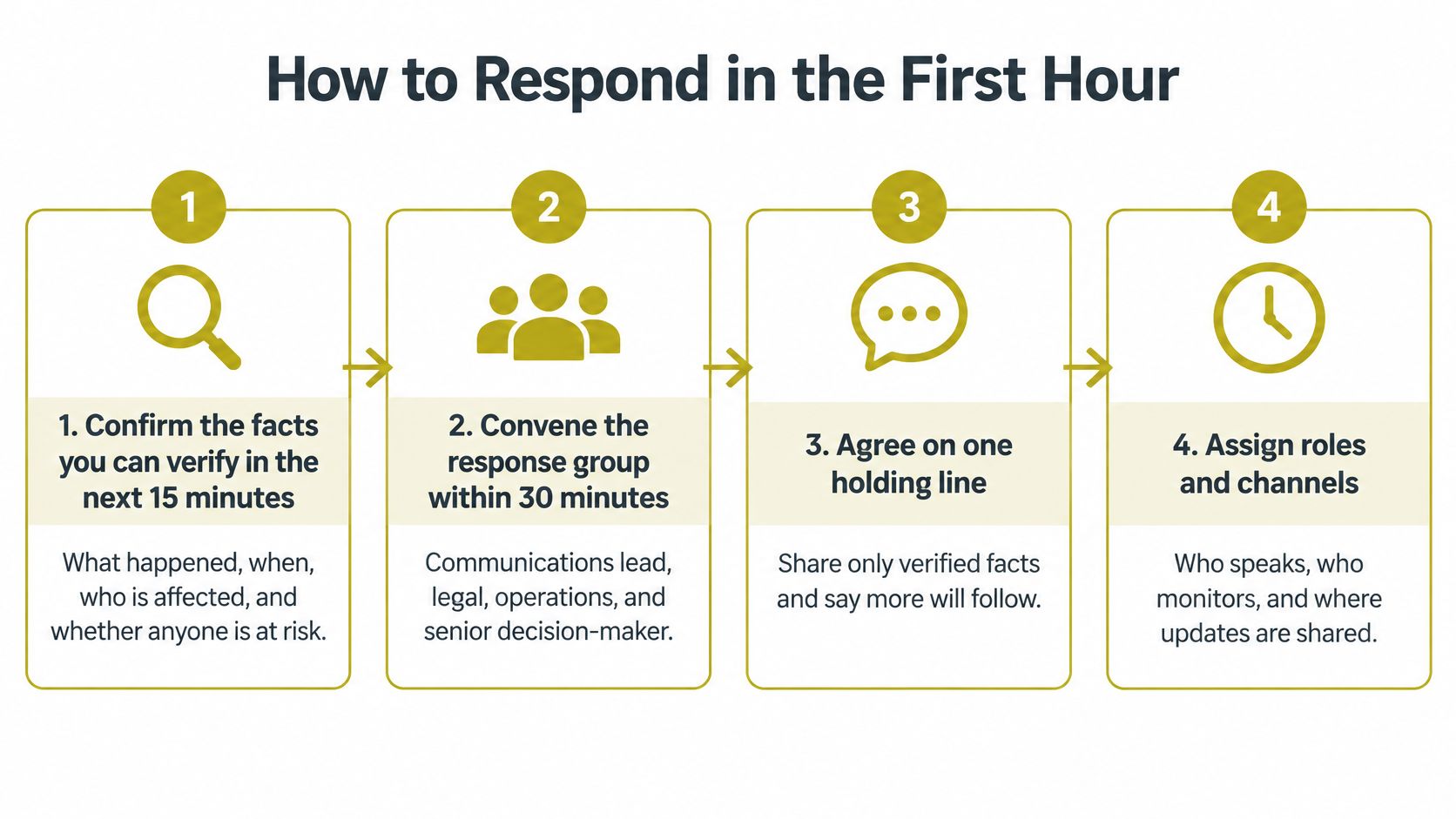
- Confirm what you can verify in 15 minutes, covering what happened, when, who is affected and whether anyone is still at risk, because a statement built on a rumour is worse than a short one.
- Convene the response group within 30 minutes, with the communications lead, operations, legal counsel and one person who can commit resources, because a committee without authority only delays the line.
- Pause scheduled posts and paid ads on the affected channels, because a discount or a brand film running beside the incident reads as indifference.
- Open a fact log, a shared, timestamped document that records every verified statement with its source and marks every unverified claim as such, because memory is a poor record once three people are editing.
- Agree who speaks and who stays silent, including staff on personal accounts, because a well-meant Slack screenshot becomes the story.
- Issue a holding statement within the hour, even if it only acknowledges the issue and names the next update, because waiting for a complete account leaves the narrative to everyone else.
- Brief staff before the public line goes out, so frontline teams don't learn the company position from the press or from a customer.
- Publish the next update time and keep it, because a missed clock destroys more confidence than an update that says nothing material has changed.
Where the first hour usually slips
Waiting for complete information is the most common miss. You will not have it, and the audience will not wait. The second slip is legal review that turns a clear sentence into vagueness. Counsel should strip claims you can't support, not delete the acknowledgement. The third is posting to social before the line is agreed, which forces a correction in public.
Teams that already practise rolling out response systems with Fluidwave tend to waste less of this hour hunting for a template, a contact list and a place to log what is known.
A finished first hour is plain to see. The fact log exists, the holding statement is approved, staff have a line to use, and a next update time is public.
Verifying Misinformation Before You Respond
A suspicious clip is not a story until you know what it is. Ofcom's Online Nation 2025 report found that misinformation was the most commonly encountered online harm in 2025, experienced by 41% of UK internet users aged 13 and over in the previous four weeks, and that 22% of adults had encountered fake or deceptive images or videos, rising to 32% among 18 to 34-year-olds. Denial on instinct is how a small fake becomes your headline.
A checklist before you comment
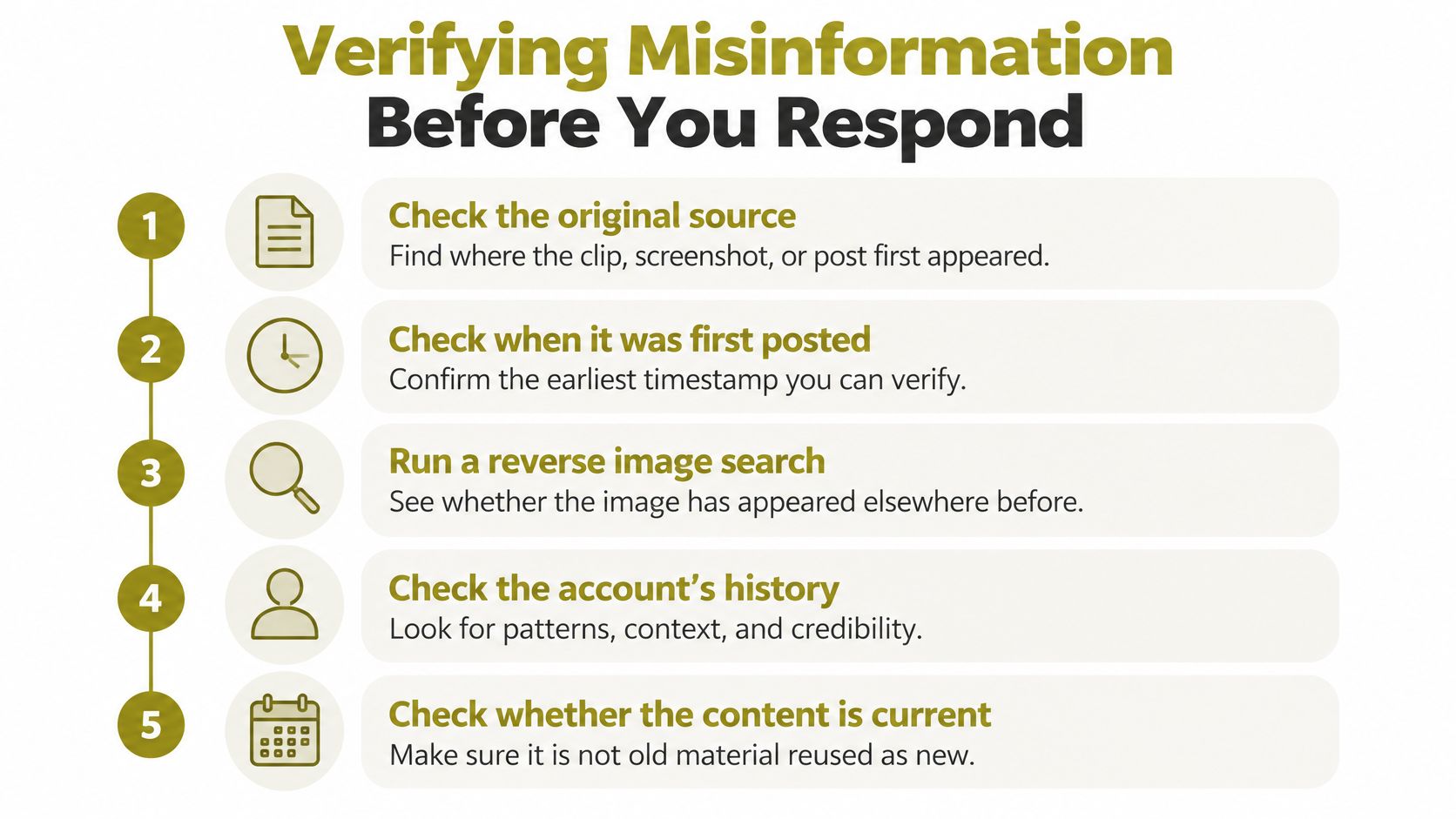
- Original source: Find where the clip, screenshot or post first appeared, not the account that shared it to you.
- First timestamp: Record the earliest time you can verify, because old footage is often reposted as if it were today.
- Reverse image search: See whether the picture has circulated before, under another name or another place.
- Account history: Look for a pattern of fabricated claims, recycled images or a brand-new profile.
- Internal log: Check whether the event, booking, shift or system alert exists in your own records.
- Preserve the file: Save the original with its URL and timestamp before a platform, or the poster, deletes it.
Sort every claim into one of three labels: verified true, verified false, or not yet verified. "We cannot verify this" means you don't yet have evidence either way. "This is false" means you have checked it and it did not happen. Use the second only when the check is done. A fast denial can amplify the clip, and it collapses if later evidence shows part of it was real.
Say a Highland holiday let appears in an edited photo that suggests sewage in the garden, posted the morning bookings open. Check the original upload, search the image, and match it to the property log before you reply. A public "fake" that turns out to be last year's genuine flood photo is harder to walk back than a line that says you are checking and will update at a stated time.
Escalate on three tracks: the platform's reporting process, legal counsel where the post may be defamation or fraud, and the cyber team if the clip suggests systems were compromised. Our media law and ethics work is there to stop a rebuttal creating a second problem. Give staff and customers one pre-approved line, and tell them not to improvise under the post.
What to Say and Who Needs to Hear It
Say a hotel hears that several guests became unwell after dinner. The kitchen is closed for checks, environmental health has been told, and the cause isn't known. That is enough to speak, and not enough to explain.
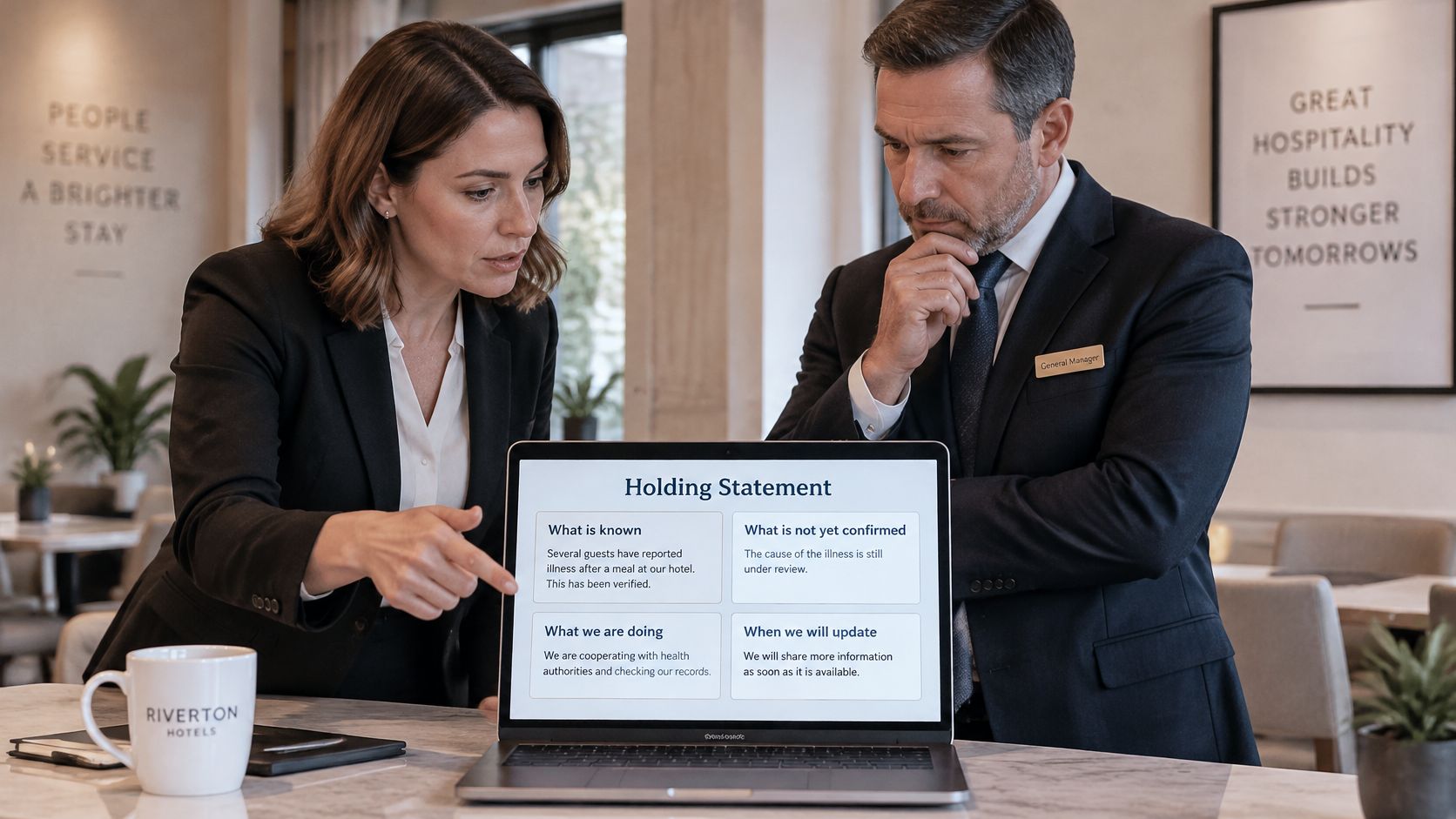
The most reliable UK structure, set out in the Government Communication Service behavioural approach to crisis communications, is five parts: what is known, what isn't yet known, what you are doing, what affected people should do, and when and where the next update will appear. It lets you speak before the investigation ends.
We are aware that several guests reported feeling unwell after dinner yesterday. We don't yet know the cause, and we won't speculate. The kitchen is closed, retained samples have gone for testing, and we have notified environmental health. Guests who feel unwell should contact the duty manager and seek medical advice. The next update will be on this page at 4pm.
Each part earns its place. Known facts stop rumour filling the gap. Stating what you don't know stops you inventing a cause. Actions show the response is operational. Instructions give people something to do. A time and a place mean they don't have to hunt.
Phrases such as "we are shocked" or "we take this very seriously" add nothing a journalist can use and nothing a guest can act on. Cut them.
One message will not fit every audience
The same guidance warns that an information vacuum lets false information spread, and that customers, employees, regulators, journalists and local communities often need different instructions. Senior managers should be briefed on the key messages at the start and again as the facts move.
| Audience | What they need first | Best channel | Who delivers it |
|---|---|---|---|
| Customers | Whether their order, data or safety is affected and what to do next | Direct email, app notice or website banner | Customer service lead or chief executive |
| Employees | Facts before they read the press, plus the line to use with customers | Internal briefing before the public statement | Line managers with HR support |
| Regulators | Confirmed facts, actions already taken and a named contact | Direct call, followed by written notice | Legal counsel and a senior executive |
| Journalists | A holding statement, the time of the next update and spokesperson access | Press statement and a dedicated phone line | Named spokesperson |
| Local community and partners | Practical instructions and where updates will appear | Local channels and partner networks | Operations lead |
Before publication, counsel checks that the statement claims no cause or liability you can't yet support, names no individuals, and matches what regulators have been told. Where facts are incomplete, say so.
Run three tests on any draft. Can an affected person act on it? Can a journalist quote it without a follow-up that you haven't prepared? Does it promise only what you can deliver?
A short briefing on how newsrooms read a holding line is worth ten minutes before the first call. The questions below are the ones that usually arrive first.
Spokespeople and Journalists Under Deadline
The wrong answer can turn a contained incident into a damaging clip. Choose the spokesperson by the question: the chief executive addresses harm, leadership accountability or decisions only they can make. A technical lead explains methods, figures and systems. Have both roles briefed, and give the chief executive a clear hand-off if a technical question falls outside their knowledge.
If a journalist calls on deadline, respond within the time you can meet. When facts are incomplete, say what is known and give a specific time for the next update. Do not guess at figures, case numbers or causes. If a report is factually wrong, send the evidence and request a correction in writing; an argument over the phone leaves no clear record.
What the pre-brief contains
Prepare the approved statement, three likely difficult questions and the phrases the spokesperson must avoid. Make “we don't yet know” an acceptable answer, and keep any figure out of the briefing unless it appears in the fact log.
The brief should reflect how a newsroom tests an answer, not repeat the organisation's preferred narrative. All Carlos Alba Media consultants are former national print and broadcast journalists. Broadcast media training for spokespeople helps them practise concise answers under questioning before they face a live deadline.
Keep one spokesperson, one agreed statement and one promised update time. Extra voices can create conflicting versions. If the underlying facts change, update the statement before anyone repeats it.
Rebuilding Trust With Proof of Change
A fresh campaign is a weak repair. In a nationally representative YouGov survey of 2,062 UK adults, the leading causes of lost brand trust were unfair customer treatment (40%), unethical business practices (35%) and failure to address complaints (31%). Among people who had lost trust, 66% said they stopped buying from the brand entirely. Only 5% said a positive new campaign would restore trust, against 18% who wanted internal reforms and 17% who wanted open, transparent communication.
| Cause of lost trust | Share citing it | Proof to publish |
|---|---|---|
| Unfair customer treatment | 40% | Redress for affected customers, with refund and remediation figures |
| Unethical business practices | 35% | Findings of the internal or independent review and the policy changes made, with dates |
| Failure to address complaints | 31% | Complaint-resolution rate and backlog cleared, reported at a set interval |
Tie every promise to proof
List each public promise on one page. Give it one owner, one deadline, and one measure that shows it happened, such as refunds paid, a policy published with a date, or a complaint-resolution rate reported on a set day. If a promise has no owner, it isn't a promise. It's a slogan.
Pause communications when nothing new can be said until the underlying failure is fixed. Another statement that repeats the apology, without a change in the operation, teaches people that the words are the product. Say what is still unknown, name the date you will next report a number, and stop.
A smaller business can disclose incomplete information without widening legal exposure by sticking to confirmed facts, avoiding cause and blame, and matching the public line to what a regulator or insurer has already been told. Don't publish a review finding before counsel has seen it. Do publish the action you have already taken, with the figure that proves it.
Recovery is a record of change, not a change of tone.
Test Your Crisis Plan Before You Need It
A plan that has never been timed will fail on the clock. The Government Functional Standard for communications sets a six-stage cycle, Plan, Rehearse, Implement, Maintain, Evaluate and Recover, and it expects communication that is open, transparent, informative, fact-based and frequent. Crises often involve more than one organisation, so coordination is part of the plan, not a courtesy.
- Plan: Map stakeholders, worst cases, messages, channels, decision rights and escalation contacts, and write each level's response window in now so nobody debates it mid-incident.
- Rehearse: Run a 60-minute tabletop with senior managers, operational leads, legal advisers and one external partner. Approval bottlenecks show up here, when they are cheap.
- Implement: Assign roles at once, separate verified facts from rumour, and keep the holding statement moving.
- Maintain: Keep one fact base and change the message only when the evidence changes.
- Evaluate: Record response times, corrections, reach, stakeholder questions and unresolved risks.
- Recover: Repair reputation with the same proof, owners and deadlines you would publish, then write the lesson into the plan.
Watch for unclear ownership, spokespeople who drift off the line, unverified claims, and the habit of treating silence as risk reduction. Silence is usually the risk.
We have completed 100+ crisis management projects, and our 24/7 Media Crisis Management service gives immediate strategic guidance to contain, control and counteract negative publicity. If you want an outside check, book a free consultation with one of our public relations experts. This week, confirm the level, the decision-maker and the next update time in the plan. That single page is what you will reach for when the phone goes.
Carlos Alba Media helps start-ups, SMEs and established organisations handle PR in crisis with senior newsroom judgement, from the first holding line through to proof that something has changed. Our team combines former national news journalists with agency experience on international brands, and we work alongside leading UK media lawyers so the public line and the legal position stay aligned. If you are facing a live issue or want the plan tested before you need it, visit Carlos Alba Media.