
Most advice on PR campaign planning still starts in the wrong place. It starts with a press release, a big media list and the hope that volume will compensate for weak relevance.
That approach doesn't hold up in UK newsrooms. Editors and reporters are dealing with inbox overload, aggressive promotion, AI-assisted content and constant pressure to publish quickly without getting facts wrong. If your material isn't immediately usable, clearly evidenced and matched to the right desk, it won't just be ignored. It may damage trust before the campaign has even begun.
Good campaign planning is less about broadcasting and more about newsroom usability. Can a journalist verify the claim, see why their audience should care, and turn your material into accurate coverage without stripping out the hype first? Former newsroom people understand that test instinctively. That's why specialist firms such as Carlos Alba Media, where everyone is a former national news journalist or has agency experience of working with international brands, tend to build campaigns differently from generic outreach shops.
Why Traditional PR Outreach is Failing UK Brands
The old spray-and-pray model assumes repetition creates credibility. It doesn't. In the UK, only 19% of people said they trusted the media in the 2023 OECD Survey on Drivers of Trust in Public Institutions, as reported by the Office for Statistics Regulation. That matters because low trust raises the standard for everyone in the chain, including brands, spokespeople, agencies and journalists.
When trust is that fragile, a campaign can't rely on noise. It needs evidence, restraint and clear editorial judgment.
Why volume stops working
A generic release sent to hundreds of contacts used to be inefficient. Now it's often counterproductive. Newsrooms are under pressure to move fast, but they are also under pressure to avoid publishing inflated claims, synthetic filler and corporate language dressed up as news.
That changes the planning brief. Before writing a headline, ask:
- Is the claim provable? Can you show the source material, internal data, named expert or documentation behind it?
- Is the spokesperson credible? Reporters don't want a title on a website. They want someone who can answer sharp follow-ups.
- Is the angle legitimate for that outlet? A trade publication, a Scottish regional title and a national broadcaster won't use the same framing.
- Can the material survive scrutiny? If challenged, can your team correct, clarify or substantiate quickly?
Practical rule: If a reporter can't verify your central claim inside their deadline, your campaign asset isn't ready.
Newsroom usability is now the real standard
Much of PR campaign planning goes wrong here. Teams optimise for sending, not for being used. They produce promotional copy rather than a reporting-ready evidence pack.
Usable material looks different. It gives the journalist a fact pattern, context, a named contact, rights-cleared assets and a clean explanation of why the story matters now. It also avoids the padded language that screams marketing rather than reporting.
For some brands, that may also mean reducing dependence on traditional earned coverage alone and widening the credibility mix. A useful perspective comes from FindClout's creator network approach, which explores how trusted creator relationships can complement conventional media when audience attention is fragmented. That's not a substitute for PR discipline. It's a reminder that trust has to be earned in the channels people actually pay attention to.
What doesn't work anymore
A few habits keep failing:
- Mass personalisation at scale: It usually reads like automation with a first name added.
- Claims without proof: If the evidence sits behind vague wording, journalists notice immediately.
- Overwritten quotes: Reporters rarely lift copy that sounds like it came from a corporate committee.
- Weak local relevance: UK campaigns often fail because they don't distinguish between national, regional and sector audiences.
The brands that still win coverage are the ones that plan for credibility first, then distribution.
Defining Commercial Outcomes and Priority Audiences
A campaign brief should answer one question before any messaging work starts. What commercial or behavioural outcome is this activity supposed to produce?
Too many PR plans are built backwards. They define assets, channels and launch dates before they define the result.
A more disciplined process looks like this:
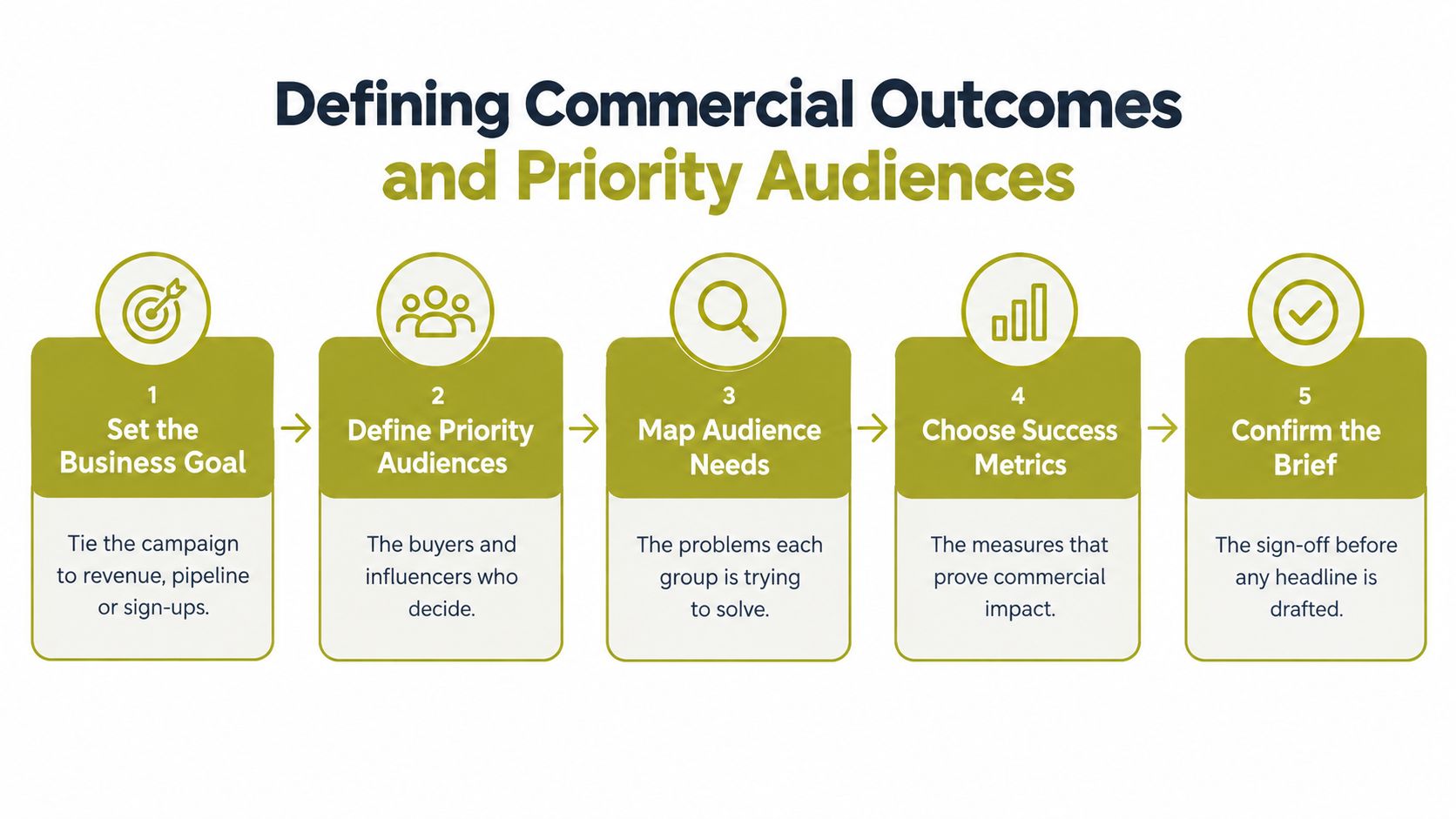
The commercial context matters. The Chartered Institute of Public Relations' 2024 research identified approximately 63,500 PR professionals in the UK, and reported that average annual full-time income fell from £56,340 in 2022 to £53,052 in 2024, indicating tighter commercial scrutiny around campaign spend and delivery, according to the CIPR annual report.
Start with the outcome, not the publicity
If you're a founder or marketing lead, define the end point in operational terms. Qualified enquiries. Investor conversations. Event registrations. Better conversion from a target sector. Improved stakeholder understanding in a sensitive market.
Then establish a baseline. If you don't know what level of direct traffic, referral traffic, branded search interest, inbound enquiries or stakeholder engagement existed before launch, you won't know whether the campaign changed anything meaningful.
A simple campaign brief should include:
The business objective
Revenue, demand generation, recruitment, policy influence, investor visibility or reputation repair all require different campaign architecture.Priority audiences
Not "the general public". Name the decision-makers, buyers, introducers, regulators, community groups or sector commentators who matter.Required capabilities
Split out strategic counsel, media relations, content production, digital distribution and measurement. If one area is under-resourced, the plan needs adjusting before launch.Deadlines and approvals
Who signs off claims, spokespeople, legal points and crisis responses?
Define the audience tightly
Broad audience language wastes budget. A much better method is to map audiences by their role in the decision.
| Audience type | What they need | What your campaign must provide |
|---|---|---|
| Buyers or customers | Confidence and relevance | Clear use case, proof and timing |
| Investors or partners | Credibility and traction | Commercial clarity and strategic context |
| Regulators or public bodies | Accuracy and accountability | Precise claims, records and named ownership |
| Journalists and producers | A usable story | Evidence, access and speed |
A useful companion read on that discipline is Carlos Alba Media's guide to target audience definition, particularly if your current brief still uses vague labels instead of real stakeholder groups.
Later in the planning process, video can help align internal teams on what a campaign is trying to achieve:
The fastest way to waste a PR budget is to ask one campaign to do five jobs for five different audiences.
Scope protects performance
A realistic brief also prevents the usual sprawl. If budgets are constrained or internal skills are stretched, don't promise simultaneous national media, trade media, founder profiling, content production, social rollout, event support and deep analytics unless you have the people and process to deliver it.
Strong PR campaign planning is selective. It chooses the audience that matters most, the outcome that can be measured and the tactics the team can execute well.
Building a Message Matrix That Passes the Relevance Gate
Reporters don't reject most pitches because they hate PR. They reject them because the material fails a basic relevance test.
That failure often starts with targeting. Cision's UK journalist research found that 46% of journalists received more than 50 pitches weekly and 22% received more than 100, making indiscriminate outreach a practical failure risk, according to Cision's UK State of the Media research.
Your pitch isn't competing with silence. It's competing with dozens of other emails arriving the same day.
Build one angle per segment
A message matrix is a disciplined way of avoiding lazy outreach. Instead of one generic story pushed everywhere, create one evidence-backed angle for each outlet segment.
Segment by:
- Geography: UK national, Scottish, regional, local, sector-specific
- Beat: business, consumer, tech, property, travel, health, policy
- Format: print, online, radio, television, newsletter, podcast
- Deadline pattern: breaking news, next-day print, long-lead features
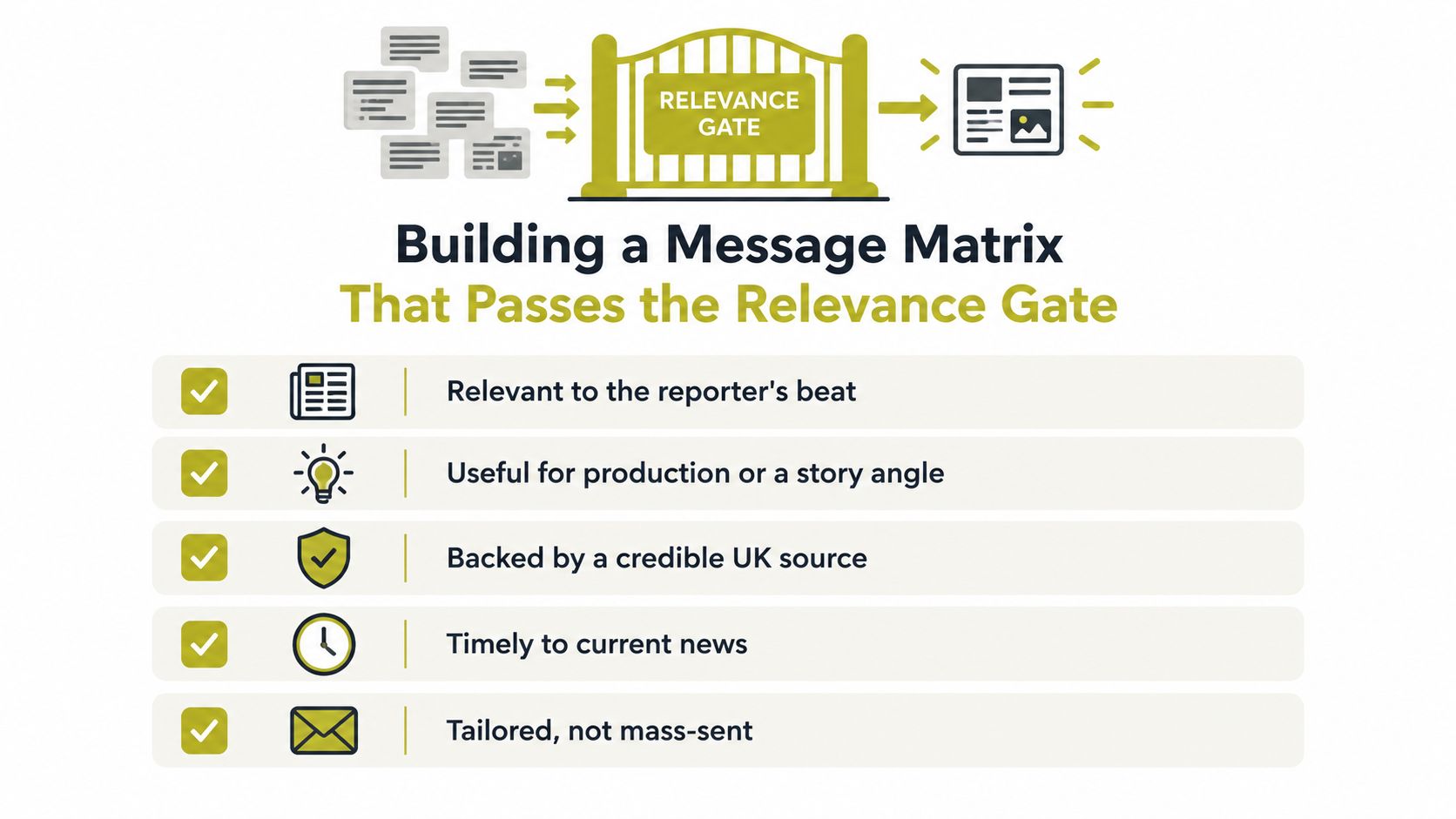
Then test each angle against a relevance gate:
- Outlet fit: Does this publication actually cover this kind of story?
- Audience fit: Will its readers, viewers or listeners care?
- Topicality: Why now?
- Proof: What's the evidence?
- Timing: Can the desk use this inside its workflow?
Package for production, not promotion
Journalists use material that saves time without creating verification risk. That means your asset pack should be practical.
A good pack usually includes:
- A concise release: not bloated, not adjective-heavy, with the central claim clear in the first lines
- A short fact sheet: definitions, dates, names, locations and context
- Spokesperson access: someone reachable who can answer questions properly
- Rights-cleared images: horizontal and portrait options, clean captions, clear usage rights
- Data visualisation if relevant: simple charts or graphics a desk can understand quickly
If your release needs a reporter to decode what the news is, you've already lost them.
Treat AI as a risk-control issue
AI can help with drafting, summarising or formatting. It shouldn't be allowed to blur accountability. In an AI-saturated newsroom, the practical question is whether the journalist can verify what you've sent and trust that a human has checked it.
That means specifying where AI is permitted in your campaign workflow and where it isn't. Claims, attributions, numbers, expert statements and supporting evidence all need human review. If you cite original information, retain the source documents and name the owner responsible for fact-checking.
For smaller organisations, this matters even more. One unsupported claim can wipe out the value of ten decent placements. The best message matrices aren't clever. They're usable, provable and tightly matched to the newsroom receiving them.
Selecting Channels and Preparing for Crisis Contingencies
Good PR campaign planning doesn't treat earned media as the whole plan. It sits inside a wider mix of Paid, Earned, Shared and Owned channels, each with a different job.
The mistake is letting those channels drift apart. Paid says one thing, the press office says another, social posts amplify an unproven claim, and the website still carries old wording. That's how organisations create avoidable risk.
Choose channels by function
A practical way to evaluate the mix is to compare what each channel is good at and where it can go wrong.
| Channel | Best use | Common failure |
|---|---|---|
| Paid | Precision, amplification, testing messages | Driving traffic to weak or unproven claims |
| Earned | Third-party credibility, visibility, scrutiny-tested messaging | Chasing coverage with no business hypothesis |
| Shared | Real-time engagement, community response, executive visibility | Escalating complaints or overreacting publicly |
| Owned | Control, depth, conversion and documentation | Publishing unsupported claims that others can challenge |
That comparison matters because channel selection should follow audience behaviour and risk profile, not habit. A regulated business, tourism brand and venture-backed tech company may all need earned media, but they won't need the same balance of supporting channels.
Prepare the response before launch
Every serious campaign needs a contingency layer. Not because every campaign becomes a crisis, but because scrutiny arrives faster than internal sign-off in most organisations.
Build a pre-launch response pack that includes:
- Claim substantiation: the evidence behind every material statement
- Spokesperson rules: who speaks, on what topics, and with what approval
- Correction process: who handles inaccuracies, complaints and takedown requests
- Escalation path: legal, executive and communications contacts with response thresholds
Carlos Alba Media's guide to developing a crisis communications plan is a useful reference if your current campaign process still treats crisis planning as a separate document that nobody checks before a launch.
Response standard: If a hostile question lands at 7pm, someone should already know who answers, what evidence is available and what can't be said yet.
Sign-off is part of strategy
Stakeholder sign-off is often treated as admin. It isn't. It determines whether the campaign can move quickly when challenged.
Founders, legal teams, product leads and external advisers need to agree in advance on where the boundaries sit. Which claims are approved? Which words create exposure? Which scenarios trigger executive involvement? If that work happens after launch, the campaign is already behind events.
The strongest plans don't just select channels. They align them, stress-test them and make sure the organisation can stand behind every public line it puts out.
Measuring Real Business Impact Beyond Vanity Metrics
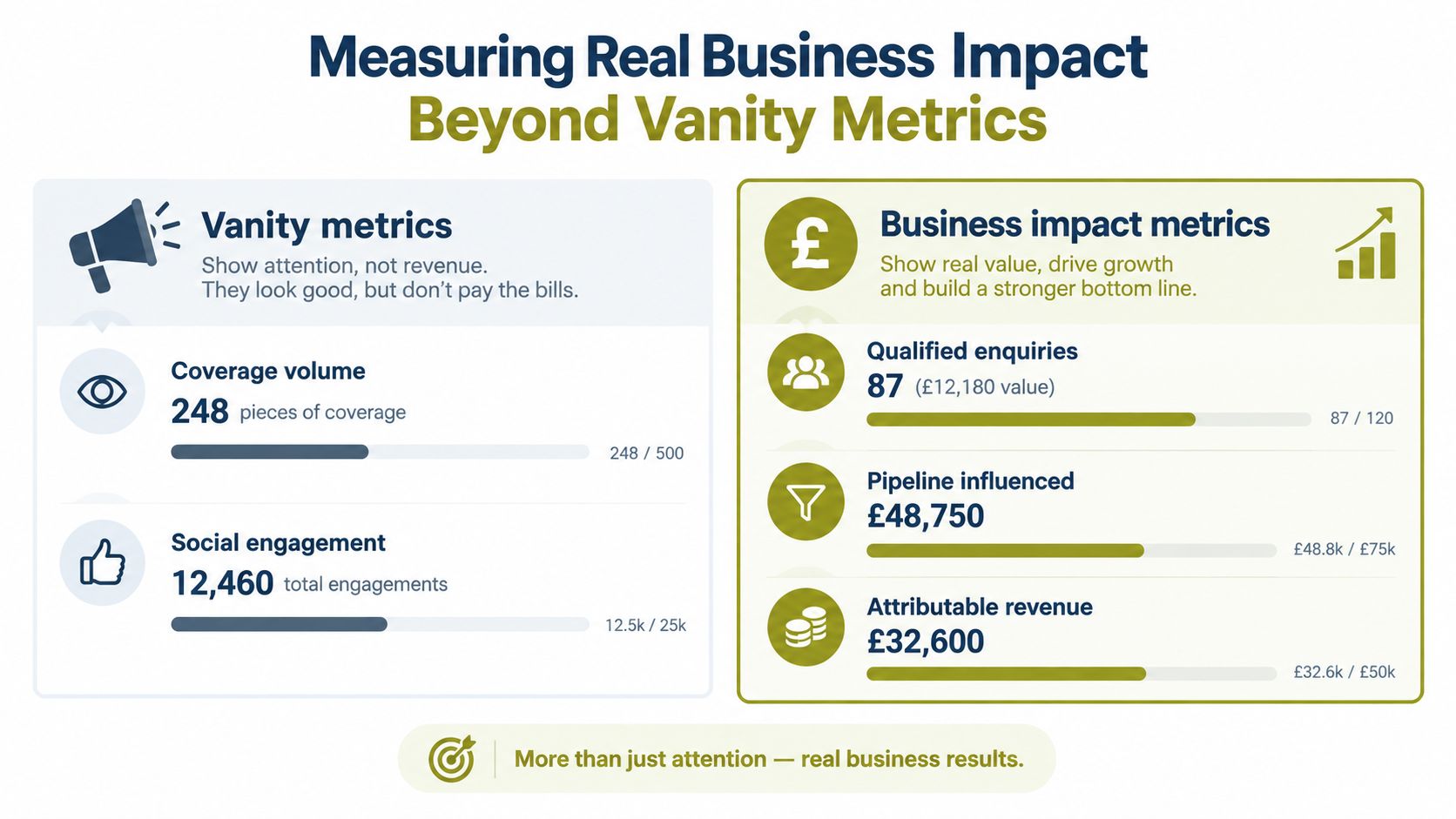
Coverage volume is easy to report and often meaningless. A campaign can generate mentions, social chatter and a flattering clipping book while doing very little for pipeline, trust or stakeholder action.
Measurement has to answer a harder question. What changed in the business because this campaign ran?
AMEC's guidance is useful here because it explicitly recommends measurable goals, targets and KPIs across Paid, Earned, Shared and Owned channels, translating outputs into outcomes such as qualified website visits or investor enquiries rather than relying on reach or advertising-value equivalents, as set out in AMEC's full guide to measurement.
Track the action, not just the exposure
A practical attribution model for SMEs doesn't need to be complicated. It needs to be disciplined.
Use a mix of:
- Trackable landing pages: especially for campaigns tied to one offer, event or audience segment
- Referral codes or source fields: where appropriate for partnerships, media offers or event invitations
- CRM notes on assisted conversions: because not every lead converts on the first click
- Structured inbound logs: what did the prospect mention, where did they hear about you, what coverage did they reference?
This matters particularly for campaigns where PR works indirectly. A prospect may hear a founder on radio, search the company name later, revisit through direct traffic, then convert after a sales call. If you only credit last-click traffic, you'll undervalue the PR work.
Use a reporting rhythm that forces decisions
The strongest measurement models don't wait until the campaign ends. They create moments where the team has to make choices.
A sensible operating rhythm looks like this:
Baseline before launch
Record the starting position for the outcomes that matter.Weekly tactical monitoring
Check journalist responses, placements, referral patterns and message pull-through.Mid-campaign optimisation review
Drop weak angles, back the strong ones, adjust spokespeople or move budget.Post-campaign outcome report
Connect coverage and content exposure to web analytics, CRM actions and stakeholder feedback.
If events are part of the mix, measurement discipline matters there too. PSW Events on proving event value offers a useful perspective on linking experiential activity to commercial outcomes rather than just attendance optics.
Report fewer metrics, but better ones
Most boards and founders don't need more dashboards. They need cleaner answers.
Report metrics such as:
- Qualified enquiries generated
- Investor or partner conversations opened
- Traffic from target audience segments
- Sales conversations influenced by coverage
- Stakeholder feedback that changed after exposure
What you should retire is the habit of presenting reach as if it were a result. Reach is distribution. Outcome is value.
The Strategic Advantage of Newsroom Experience
There is a practical difference between someone who has observed newsrooms and someone who has worked inside them under deadline pressure. In campaign terms, that difference shows up in judgment.
A Cardiff University study examining 2,207 articles from five UK national newspapers and 402 broadcast reports found extensive reliance on public-relations material and news-agency copy in UK news production, according to the Cardiff University research archive. That doesn't mean journalists publish whatever lands in the inbox. It means usable material matters, and weak material gets exposed quickly.
Former journalists spot the real story angle
People with newsroom experience tend to ask different questions at the planning stage:
- Is this new?
- Is there a line an editor can put in a headline?
- Can the first claim be defended on air?
- Will a producer need a stronger picture, a clearer case study or a better spokesperson?
Those questions save time because they strip out assets that look impressive internally but don't survive external scrutiny.
That editorial perspective also improves campaign packaging. A basic example is imagery. Teams often underestimate how much poor photography hurts a story's chances. If you're reviewing headshots, executive portraits or announcement images, this AiHeadshots press photo guide is a practical checklist for avoiding the sort of visuals desks routinely reject.
Specialist counsel matters when stakes are high
Specialist agencies have a real role here. Carlos Alba Media is built around that newsroom lens. Everyone who works for Carlos Alba Media is a former national news journalist or has agency experience of working with international brands, which makes it easier to shape material in a way that suits broadcast, online and print workflows rather than generic promotional distribution.
That approach is particularly useful for founders, Scottish SMEs and brands in sensitive sectors where a campaign has to do two jobs at once. It has to generate visibility and hold up under challenge.
For a clearer sense of how that works in practice, Carlos Alba Media's examples of PR strategy work show the difference between tactical publicity and a campaign built around business outcomes, editorial judgment and reputation control.
Newsroom experience doesn't guarantee coverage. It does improve the odds that your campaign will arrive in a form editors can trust and use.
The strongest PR campaign planning combines strategic discipline with editorial realism. It knows what audiences need, what journalists can use, what the business must prove and what the organisation will do if the attention turns hostile. That's the level the market now expects.
Carlos Alba Media plans and executes PR campaigns for UK brands that need more than media noise. The agency combines newsroom judgment, strategic messaging, digital support and crisis-ready thinking to help organisations build campaigns that are credible, usable and commercially accountable. If that's the standard you're aiming for, visit Carlos Alba Media.