
According to Ofcom's latest look at UK media habits, 87% of UK adults aged 15 and over listened to radio every week in Q1 2025, and live radio makes up 55% of smart-speaker listening time. Most founders overlook that reach because they picture radio as an old-fashioned medium reserved for politicians, household names and national breakfast shows.
That assumption costs smaller organisations their most accessible broadcast channel. Working out how to get a radio interview isn't about chasing a national network with a generic company press release. Producers don't book logos or product launches; they book credible voices who can explain a timely issue clearly to a defined local, regional or specialist audience.
With a clear station-selection rule, a tight one-page booking proposal and a spokesperson rehearsed for live audio, a modest UK business can secure regular air time. The workflow below breaks down how UK broadcast desks evaluate pitches and what turns an initial booking into repeat invitations.
Why Radio Still Puts Guests in Front of Millions
Few marketing channels match the sheer scale of UK broadcast audio. Data from the RAJAR Q3 2025 release shows 50.145 million UK adults tuned in to radio in an average week, equivalent to 86.1% of the population aged 15 and over. Across that quarter, audiences consumed 1.022 billion hours of radio, averaging 17.5 hours per adult per week and 20.4 hours per listener.
A single five-minute interview puts a founder's voice in front of listeners who have never heard of their brand and aren't scrolling their LinkedIn feed. Owned social channels require months of paid promotion or algorithm luck to reach beyond existing followers. When weighing up different types of media coverage, broadcast radio stands out because listeners treat the host as a trusted filter, transferring immediate credibility to the guest.
Digital Listening Changes How an Interview Lives On
Radio is no longer confined to a dashboard dial or a kitchen FM set. In Q3 2025, RAJAR recorded 73.8% of listening on digital platforms, with 29.7% coming through online streams and 18.2% via smart speakers. A live studio chat now travels simultaneously across DAB, mobile apps, desktop streams and on-demand catch-up clips.
That multi-platform distribution changes how a spokesperson must speak. Many listeners hear interviews while driving, cooking or working, so long wind-ups and corporate jargon lose the room inside ten seconds. Producers favour guests who land one clear point quickly, knowing that a crisp ten-second exchange works just as well on a morning commute as it does in a clipped audiogram shared online later that afternoon.
Editorial reality: A producer isn't looking for a summary of your business history. They need a timely public-interest angle that makes their specific listener pause and pay attention.
That distinction sits at the heart of every successful pitch. Broadcasters reject self-serving company announcements immediately, yet they actively hunt for grounded voices who can explain a price rise, a regulatory change, a skills shortage or a shift in consumer behaviour.
Choosing Local, Regional, Specialist or National Radio
UK radio is fiercely competitive, yet it's also highly segmented. Sending one blanket email to BBC Radio 4, LBC and every local station in the country guarantees silence, because each programme serves a different listener at a different moment in the day.
Audience behaviour confirms why context shapes the pitch. Ofcom's 2025 Audio Report found that AM/FM and DAB/DAB+ sets together accounted for 69% of all radio listening hours, while BBC Sounds' weekly online-radio audience grew from 7.8 million adults (14%) in Q1 2020 to 11.5 million (20%) in Q1 2025. Also, 26% of live radio listening in Q1 2025 took place in cars, vans and lorries, where commuters want direct, memorable commentary rather than dense theory.
Commercial networks deserve equal weight alongside public broadcasters. According to RadioToday's analysis of RAJAR Q4 2025 figures, commercial radio captured 55.2% of total UK radio listening, meaning a single commercial group can reach more than half the market. Even so, format fit matters just as much as total audience size.
| Outlet type | Best for | Pitch angle that fits | Geographic reach | Format to prepare for |
|---|---|---|---|---|
| Local station (BBC local or commercial) | Local customers, councils and community stories | Local consequence with a named local spokesperson | City or town area | Short breakfast news bulletins, 20-30 second answers |
| Regional station | Regional business, policy and sport | Regional statistic with a clear local link | Multi-county area, often Scotland-wide | Drive-time discussion, one memorable argument |
| National network programme | Major national issues with broad appeal | One timely argument with a clear audience benefit | UK-wide | Live studio or remote link, tight timing |
| Specialist show | Technical, sector or hobby audiences | Informed analysis and a detailed, specific question | Niche, UK-wide or online | Longer segment, evidence and sources ready |
| Commercial station | Mass listening across music and lifestyle formats | Short, memorable point suited to drive time | Station-specific coverage area across the UK | Brief music-format chat, clip-friendly lines |
Applying the Local-First Decision Rule
Smaller organisations waste weeks pitching national desks when local radio would book them tomorrow. Use a simple rule before opening your inbox: target local radio first whenever your story carries a local consequence, features a named local spokesperson and includes a real customer or community example. Step up to regional or national shows only when the issue is timely across the wider UK and your guest can debate it credibly without leaning on a postcode hook.
Say a Glasgow tourism operator tracks a sudden drop in midweek winter bookings after local rail timetable changes. That story belongs on a local BBC or commercial breakfast show first, anchored by a Glasgow spokesperson and a real visitor impact. By contrast, say a Scottish software founder has deep technical evidence on how a new UK data-privacy rule affects small retailers. That angle belongs on a specialist technology or business programme where informed analysis matters more than local colour.
Adapting One Story Across Three Programme Formats
The same underlying story needs a different shape depending on the time slot and presenter style. Before you write the pitch, decide which of these three treatments fits the show you're targeting:
- Breakfast news bulletins: Strip the story down to one urgent development and a single local effect. Presenters want immediate, plain-English reactions delivered in under 30 seconds before the next travel update.
- Specialist analysis shows: Lead with evidence, trade-offs and technical nuance. Producers on sector programmes have longer slots to fill and value a guest who can explain the mechanics behind a headline.
- Drive-time and commercial magazines: Anchor the pitch around one memorable argument commuters can retell at the dinner table. Keep language conversational and cut any acronym that needs a footnote.
Understanding how producers balance audience habits with programme pacing makes outlet selection much faster. The video below walks through practical radio interview fundamentals that pair directly with choosing the right station format.
How to Pitch a Radio Producer Step by Step
A useful radio pitch gives a producer enough information to make an editorial decision and arrange the booking. For a smaller UK organisation, that means connecting a timely story to the programme's listeners, naming a credible guest and making the practical arrangements clear.
Carlos Alba Media's consultants are former national print and broadcast journalists. That newsroom background informs pitches built around how broadcast desks weigh relevance, timing and operational ease.
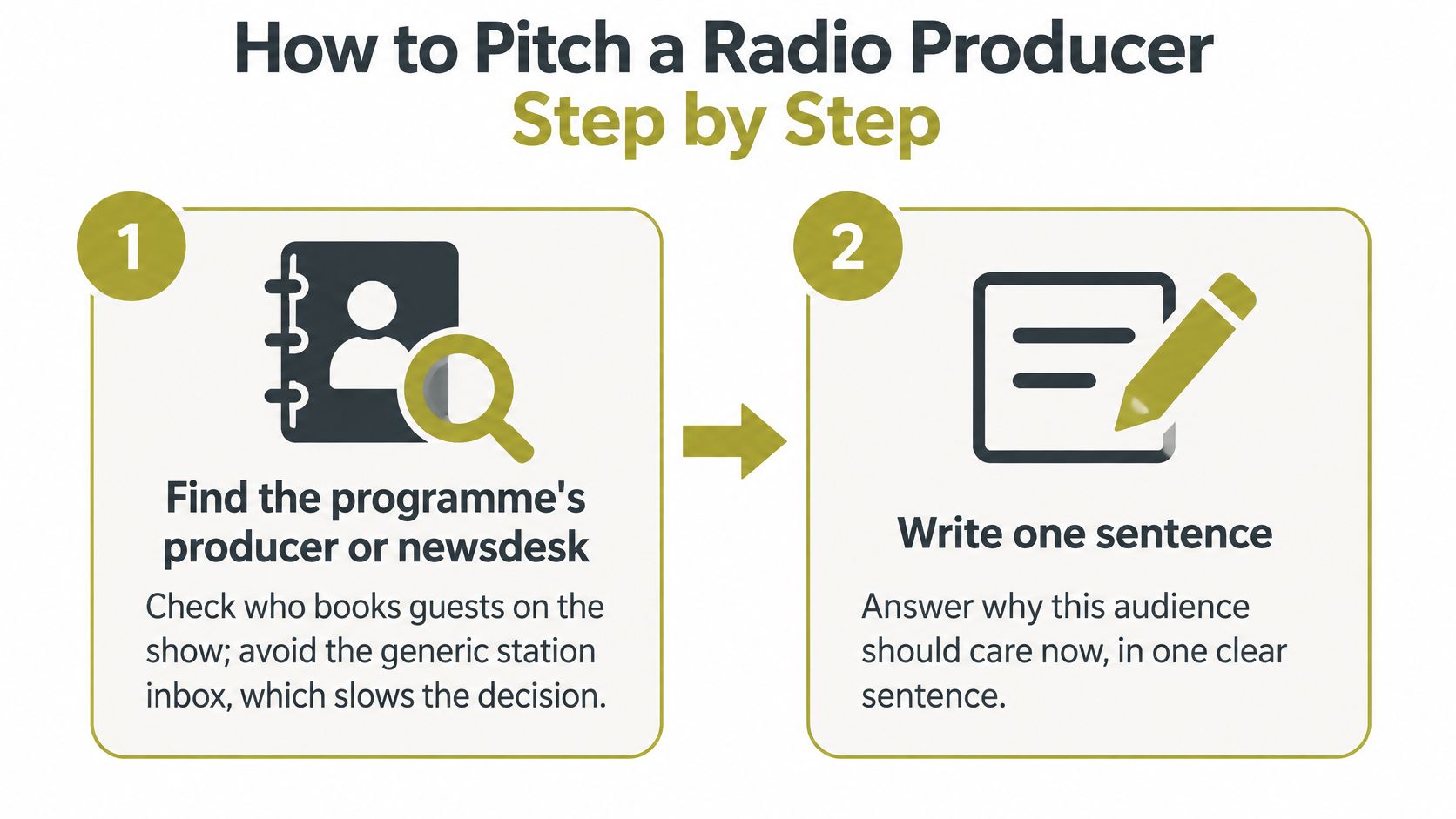
Use these seven steps to make your proposal easy to assess:
- Locate the programme's producer or newsdesk directly. Check episode credits on BBC Sounds, station websites, LinkedIn or X for the named producer or forward-planning desk. Use the programme's published contact route where available. Addressing the relevant team makes the intended programme clear from the outset.
- Distil the pitch into one core sentence. Answer three questions: why this audience, why today and why this guest? Write that sentence before adding background. If it needs a lengthy explanation, narrow the angle until the listener benefit is clear.
- Assemble a strict one-page booking proposal. Include a time-sensitive UK hook, a clear listener benefit, a named spokesperson and three focused interview questions. Each should allow a short, direct answer. Our guide on how to write a media pitch explains how to organise the news hook and supporting detail. Keep company background subordinate to the proposed conversation.
- State availability, location and audio connection upfront. Give exact live windows, the guest's town or city, available studio access or remote connection, and a direct mobile number. Specify whether Cleanfeed, ISDN or a clean phone line is available rather than leaving the producer to establish the options.
- Define the strongest geographic fit. RAJAR's Q2 2026 listening charts report 51.119 million weekly listeners (86.6% of UK adults), with 75.5% of listening delivered digitally across DAB and online platforms. Those national figures establish radio's scale; your pitch still needs to identify the relevant audience. State whether the development affects Scotland, a particular local authority area or listeners across the UK, then explain that connection.
- Follow up once with fresh value. For a story that remains timely, send a shorter follow-up after a few days. Add something useful, such as a confirmed local case study, a newly published council figure or a related news development. A repeated email without new information gives the producer little reason to reconsider.
- Track your own conversion metrics. Record pitches sent, producer replies, initial bookings and repeat invitations in a spreadsheet. Compare responses by programme and story angle. Your own record gives you a practical baseline for deciding which approaches deserve more attention.
Anatomy of a One-Page Radio Pitch
Make the proposal readable at a glance. A producer should be able to identify the story, assess the guest and find the booking details without searching through attachments or a long organisational introduction.
Use the following fields as a copyable one-page structure. Replace each description with the specific detail for your proposed interview.
| Pitch field | What to put in it | Why the producer needs it |
|---|---|---|
| Time-sensitive UK angle | The development that makes the story relevant this week, including its date | Establishes whether the story is still timely |
| Audience benefit | One sentence explaining what this programme's listeners will learn | Establishes the editorial value |
| Named spokesperson | Full name, role and one line explaining their relevant knowledge | Identifies who will answer the questions |
| Three interview questions | Focused questions that allow brief, clear answers | Shows the proposed shape of the conversation |
| Live availability | Available dates, times and time zone, including a same-day option if possible | Allows the producer to check the running order |
| Location and connection | Town or city, studio access and tested remote or phone options | Clarifies how the guest can join |
| Producer-ready contact | Direct mobile number and email for the person authorised to confirm | Makes confirmation straightforward |
Keep each entry specific. “Available for interview” leaves scheduling unresolved; exact live windows let the producer assess whether the guest can fill the slot. Likewise, a job title needs a short explanation of why that person can answer the proposed questions.
For independent audio shows, the guide to podcast guest outreach for authors offers a related outreach resource. Keep the radio proposal focused on a concrete listener takeaway and specific talking points, with the scheduling details a broadcast desk needs.
Give the producer a clear story, a credible human voice and a workable booking. Each detail should help them decide whether the interview belongs in their programme.
Preparing the Spokesperson and Surviving the Live Interview
Securing the slot is only half the work. A hesitant, jargon-heavy or poorly connected guest rarely gets invited back, and a sloppy live answer can create reputational trouble within minutes.
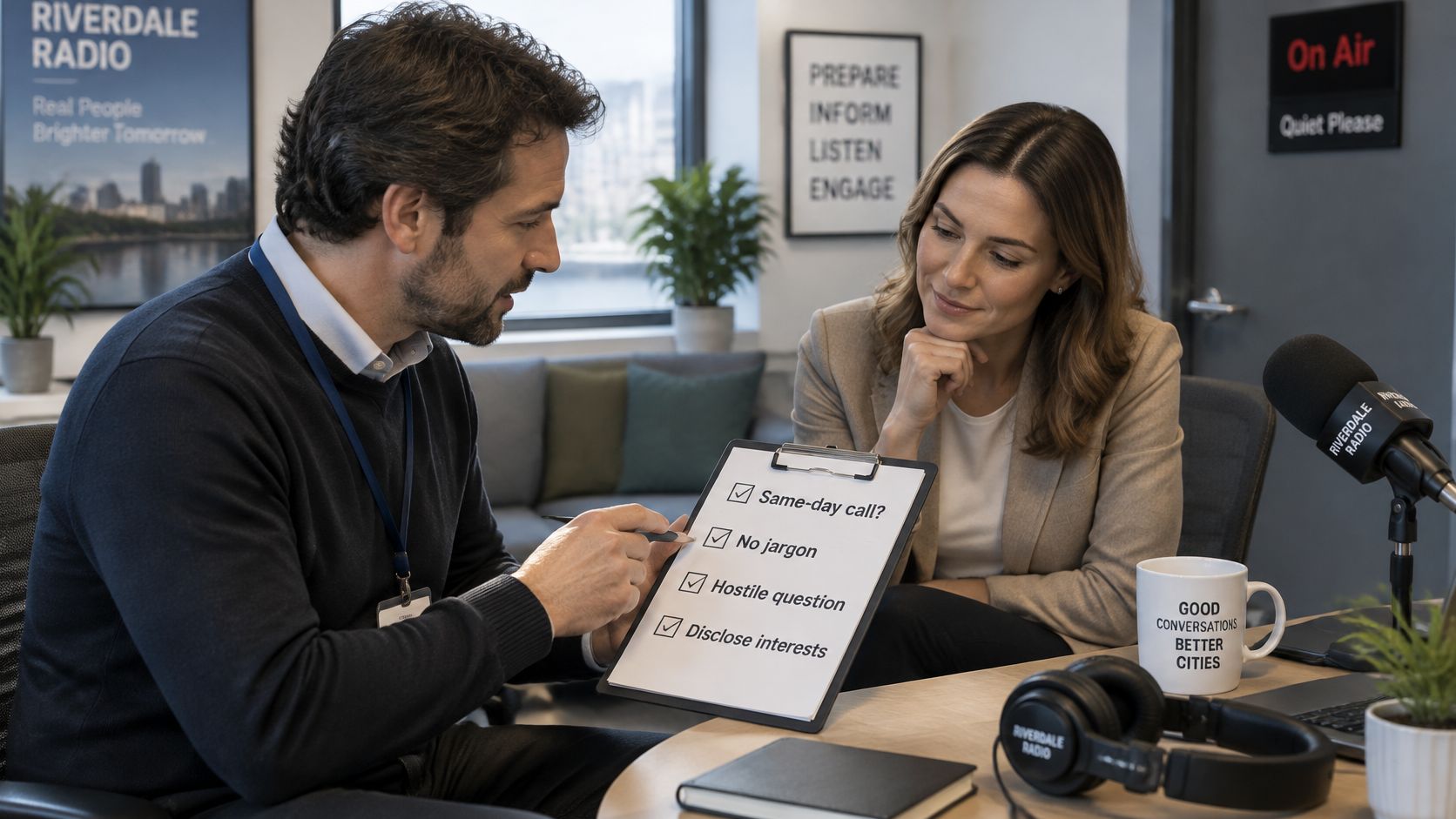
Before accepting any booking, score your spokesperson against five basic operational checks. Can they take a same-day pre-interview call with a researcher? Can they explain their subject without industry acronyms, stay calm under a likely hostile question, disclose relevant commercial interests upfront and share a concise one-page verification pack with sources?
Rehearsal Packs and Editorial Compliance
Once a guest passes that check, build a disciplined rehearsal pack rather than a full script. Prepare a 15-second introduction, three 30-second core answers, one supporting statistic with its exact source, one concrete human example and a bridging phrase (such as "What matters most to customers right now is…") to steer back to the key point if the conversation drifts.
We've completed 200+ media skills training projects, and the biggest gap we see isn't subject knowledge; it's failing to match delivery to the specific show format. Practise for the exact environment you're entering:
- Rapid news commentary: A presenter wants a crisp headline reaction in two sentences, with zero preamble.
- Specialist analysis: The host will probe your evidence, so keep your source dates, sample sizes and caveats written in large print beside you.
- Live phone-ins: Callers may challenge you directly; keep your voice steady, acknowledge the caller's concern briefly and stick strictly to verified facts.
For financial, health, regulated or crisis subjects, pre-clear every figure and define clear red lines on what your spokesperson won't speculate about. Disclose commercial affiliations or conflicts to the producer before going live, never mid-sentence on air. Broadcasters enforce strict accuracy rules, and BBC Editorial Guidelines explicitly cover statistics, polls, data and surveys, meaning every claim needs a traceable origin and honest limitations rather than inflated certainty.
Digital distribution also raises the stakes for tight phrasing. RAJAR's listen market trends data recorded 29.8% of radio listening hours online (across websites, apps and smart speakers) and 74.6% through digital platforms overall in Q4 2025. Because stations routinely cut short clips for social feeds, rehearse 10-second, 30-second and 60-second versions of your main argument so a clipped soundbite stands cleanly on its own. For deeper coaching on message discipline and tough questioning, read our guide on how to prepare for a media interview.
Technical Setup and Fixing Live Problems Fast
Audio quality makes or breaks remote radio bookings. Confirm the station's preferred connection method early, whether that's a local studio, Cleanfeed, Source-Connect or a clean landline. Sit in a quiet room with curtains or carpet to absorb echo, plug in wired headphones, connect over stable wired broadband rather than weak Wi-Fi, keep a charged backup telephone beside you and run a five-minute pre-live sound check. Never rely on a bare laptop microphone in a reflective office.
Even well-prepared guests hit glitches on air. Knowing the immediate fix keeps a small hiccup from derailing the slot.
| Symptom | Likely cause | Fix |
|---|---|---|
| Line drops or audio breaks | Weak mobile signal or unstable broadband | Switch to the backup telephone and move to a quiet room |
| Guest talks over the presenter | No agreed turn-taking cue | Pause for two seconds before answering and agree a signal in advance |
| Answer runs past 30 seconds | No timing rehearsal | Practise the 10-, 30- and 60-second versions |
| Hostile question with no verified answer | Not prepared for the challenge | Use the bridging line and state only what you can verify |
| Clip taken out of context | Long, unstructured answer | Lead with the key message in the first sentence |
As soon as the broadcast finishes, save a copy of the recording and log the programme name, broadcast date, topic, audience geography and any call to action mentioned. Ask the producer briefly for candid feedback while the interview is still fresh in their mind.
Confirm Your Pitch Before You Send It
Rushing an unfinished email to a busy radio desk damages your chances on future stories as well as this one. Producers remember reliable contacts, and they also remember pitches that wasted ten minutes of a tight morning planning cycle.
Before you press send, run a quick final check across every element of your proposal. Verify that the exact programme and producer are named and match the scale of your story, whether local, regional, specialist or national. Confirm that your hook is timely with a clear UK or local consequence, and check that all three suggested questions can be answered crisply in 20 to 30 seconds. Make sure every statistic sits beside a traceable source, your spokesperson has rehearsed their 15-second introduction and declared any commercial interests, and your chosen connection method has been tested alongside a working backup line.
If even one of those pieces is missing, hold the email until you fix it. Recovering from an under-cooked pitch sent to the wrong desk takes far more effort than spending an extra hour tightening your angle.
If you're facing a communications challenge, dealing with a media crisis or want an experienced second opinion before approaching broadcasters, Carlos Alba Media offers a free consultation with one of its public relations experts. All of our consultants are former national print and broadcast journalists who understand how producers assess a story from the inside. Call the team directly on +44 (0) 203 857 7655 to talk through your angle.
Following Up After the Pitch and Turning One Booking into More
Most first-time radio guests treat an interview as a one-off event. Producers, however, build a small black book of articulate voices they trust to pick up the phone at short notice, which means your follow-up habits matter as much as the initial email.
- Send one short, value-adding follow-up after a few days. If a week passes without a reply, don't resend the original pitch untouched. Write three crisp lines introducing a new reason to cover the story, such as a confirmed local case study, a fresh regional figure or a competing news development.
- Turn a polite decline into a redirect. When a producer says the story isn't right for their slot, reply thanking them and ask which programme or time slot on the station might fit better. Note their reasoning immediately so you refine the angle rather than repeating the same mismatch.
- Confirm logistics in writing the day before. Once booked, send a brief confirmation covering the exact live time, the tested connection method and the producer's direct mobile number. That single message removes last-minute panic on both sides.
- Follow up after the broadcast with usable assets. Send a short thank-you note within 24 hours attaching any supporting data or public link the producer can reference if the story develops. Being helpful without asking for anything back is the habit that most reliably earns a repeat invitation.
- Review your pitching log every quarter. Compare pitches sent, producer replies, trial bookings and repeat invitations across each station tier. Patterns emerge quickly, showing you which topics, spokespeople and regional desks deliver the strongest return on your time.
- Reuse the same one-page framework on the next story. Keep your proven pitch structure, verification template and technical checklist ready for the next timely UK development so radio outreach becomes a repeatable communications system rather than a scramble.
Repeat-guest mindset: The easiest radio interview to win is your second one, because you've already proved to the producer that you turn up on time, sound clear and give the listener something worth hearing.
Carlos Alba Media helps UK founders, SMEs and established organisations secure broadcast radio and print exposure while preparing spokespeople to perform with calm authority on air. Whether you need former national journalists to shape your broadcast pitches or one-day media skills training before a live appearance, explore our services at Carlos Alba Media.