
You're staring at a campaign report that should've felt encouraging, and it doesn't. The list grew, the email went out, a few people clicked, and the result still looks too small for the time, money and patience you've put in. That's the point where most founders start wondering whether email is broken, when the actual problem is usually the way it's being handled.
Email still deserves serious attention in the UK because the audience is already there. Ofcom reported in 2024 that 93% of UK adults used the internet daily or almost daily, and email sits inside that everyday behaviour, not outside it source. With global benchmark compilations putting average email ROI at about $36 to $42 returned for every $1 spent source, the channel isn't a vanity play. It's a commercial system, if you run it properly.
The mistake I see again and again is treating email as a volume game. That's the cheap route, and it usually creates more noise than revenue. Senior-led email promotion services work differently, they combine editorial judgement, compliance, segmentation and deliverability so each send earns its place in the inbox.
Why Email Promotion Services Matter for Growing Businesses
A founder I'd speak to over coffee would usually describe the same frustration in different words. They've got a small list, they've sent the newsletter, and the response feels underwhelming, so the instinct is to send more often or try louder subject lines. That is the wrong fix. The channel usually fails because nobody has built the right system around it.
The value is not volume, it's control
Email promotion services matter because they give you control over the thing most paid channels don't. You can speak directly to people who've already shown interest, move them through a sequence, and measure what happened without guessing. In the UK, permission and proof matter just as much as reach.
The UK market is mature enough for this to work. Daily or near-daily internet use is normal for most adults, and email remains one of the core online habits behind that behaviour. Ofcom reported in 2024 that 93% of UK adults used the internet daily or almost daily, which is why email still earns attention when the message is sharp and the list is well managed source. So the question isn't whether email can reach people. It's whether your send deserves attention when it lands.
Practical rule: If your last three sends looked like the same message in a different coat, you don't need more sends. You need sharper strategy, cleaner data and stronger writing.
Senior-led service changes the output
A senior-led agency earns its fee. A junior generalist often sees email as template selection and a subject line tweak. A specialist team looks at list quality, timing, consent, segmentation, copy hierarchy and what the email needs to do inside the wider campaign. That difference shows up in the work.
Carlos Alba Media's positioning fits that model clearly. It is founded and run by multi-award-winning former national newspaper editor Carlos Alba, and the team is described as a mix of former national news journalists and people with agency experience of working with international brands. That is editorial discipline applied to commercial messaging. In email, that matters because the inbox punishes vague, lazy writing.
The strongest providers do more than send. They decide what should be sent, to whom, and why it belongs there. That is the shift from basic newsletters to a proper promotional channel, and it is why founders who are serious about growth should stop buying “sending” and start buying judgement.
Defining Email Promotion Services and the Core Service Types
Email promotion services cover the work of planning, writing, building, sending and measuring commercial email campaigns. That is the service, not just access to a platform. A founder who tries to run email on tools alone usually gets volume without judgement. A senior-led team brings editorial discipline, compliance awareness and campaign integration, which is where email starts to earn its keep.
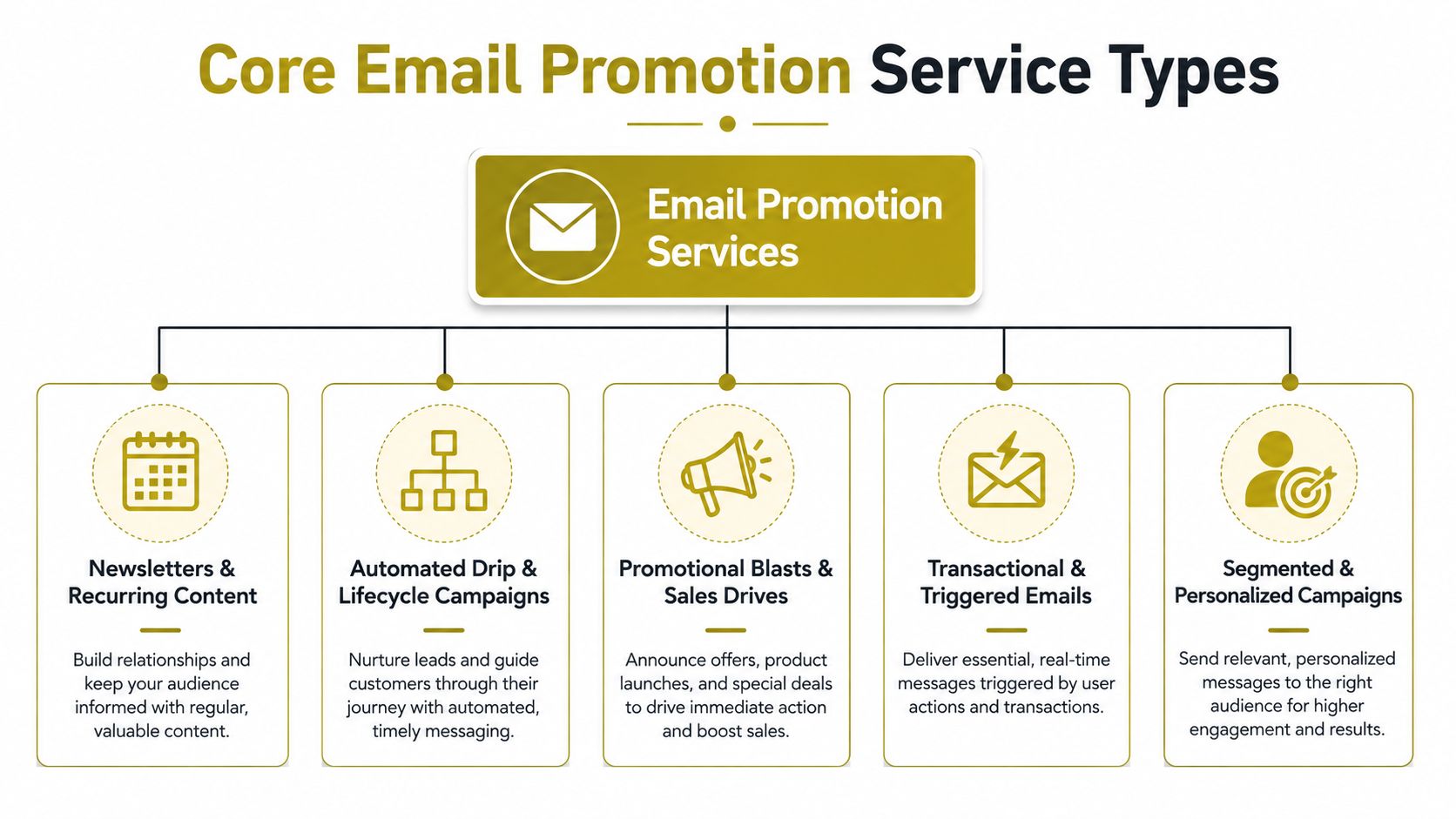
Five core service types
Newsletters and recurring content keep your audience warm, make your brand familiar and give people a reason to stay subscribed. For an SME, this is usually the cleanest starting point because disciplined consistency beats random bursts of activity. Keep the writing useful, keep the cadence steady, and stop treating the newsletter like a dumping ground for every update your team has.
Automated drip and lifecycle campaigns handle the work that should not rely on memory or manual effort. A welcome series, onboarding flow or re-engagement sequence keeps moving while the team is busy elsewhere, and it usually delivers more value than one-off sends because it responds to behaviour. This is the part of email that belongs in a proper customer data platform approach. If the journey is set up badly, every message feels generic. If it is set up well, the right people get the right next step without your team chasing each send by hand.
Promotional blasts and sales drives are for moments that need attention now. Launches, events, seasonal offers and deadlines all fit here, provided the message is sharp and the call to action is clear. Send this kind of campaign without a reason and it reads like noise. Send it with a real commercial trigger and it becomes a useful sales tool.
Transactional and triggered emails carry the operational side of trust. Order confirmations, password resets and other behaviour-based messages are not decorative extras, they are part of the customer experience. If they fail, customers notice immediately, and the credibility hit lands on the whole email programme. A senior provider watches these messages closely because they affect how people judge the brand long before a promotional campaign arrives.
Segmented and personalised campaigns are where service quality becomes visible. Good teams use data, behaviour and preference to make each message relevant rather than generic. Generic volume-sending is cheap, but it wastes attention. Proper segmentation takes more thought, more clean data and more judgement, which is exactly why specialist teams outperform broad generalists.
Carlos Alba Media's thinking on data-led marketing is reflected in its customer data platform approach. If you are a start-up, start with newsletters, one or two automations and clean list management. If you are established, ask for segmentation, lifecycle journeys and tighter reporting. The wrong move is buying all five services at once without a strategy. Start with the service type that matches your stage, then add complexity only when the foundations are working.
Deliverability and the Technical Foundations of Every Campaign
An email can be well written and still fail if the technical setup is careless. Founders usually see the send button, not the infrastructure behind it. Inbox placement starts before a subscriber opens anything.
Authentication is the gatekeeper
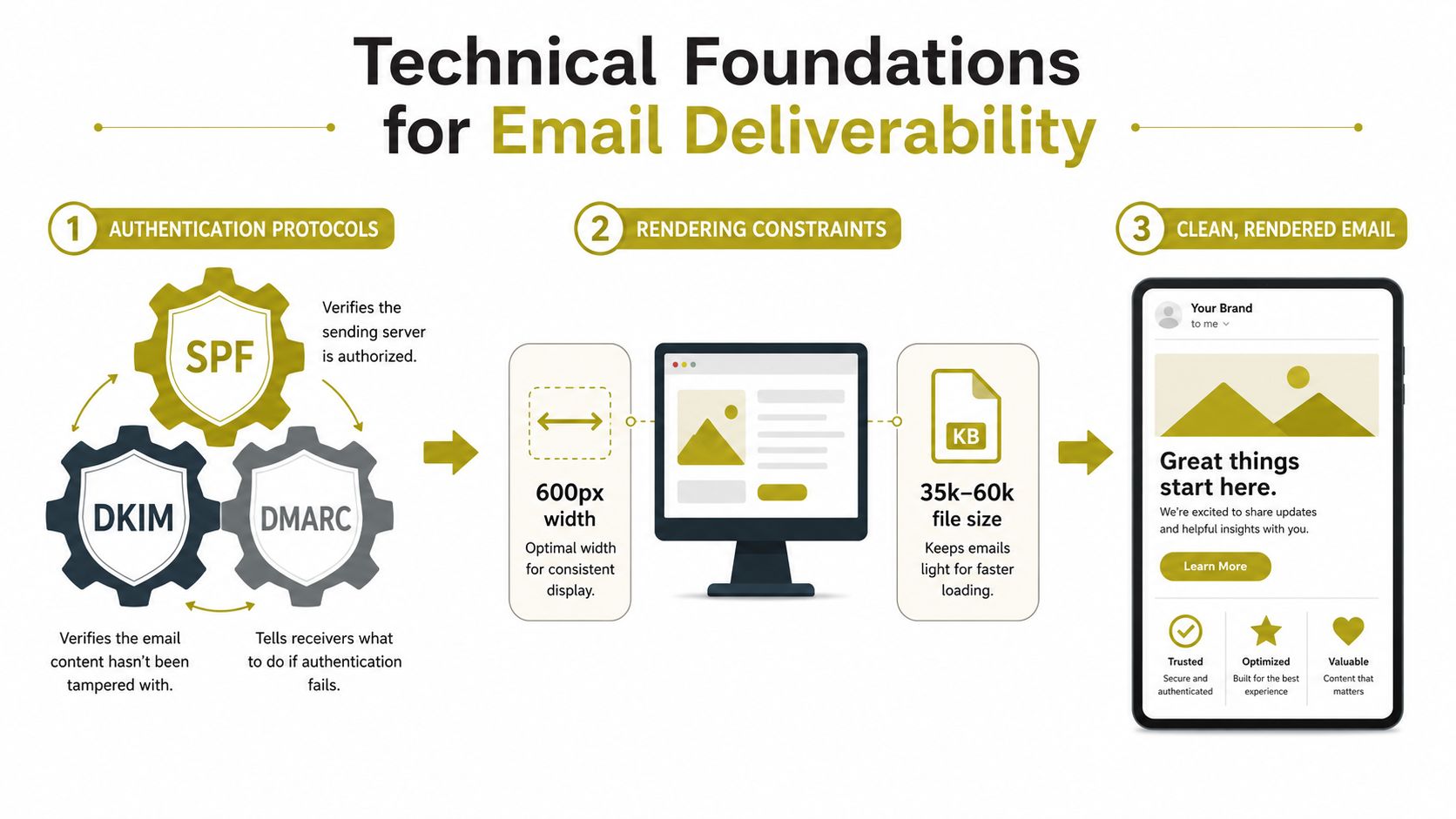
The three core authentication mechanisms are SPF, DKIM and DMARC. In plain English, they help mailbox providers verify that your email really came from you and not from a spoofed sender. For a clear primer, Mailadept's email authentication guide is worth reading.
The result is practical, not abstract. A benchmark report cited in the brief says 89.1% inbox placement is reported for fully authenticated domains using SPF, DKIM and DMARC source. That is the difference between a campaign being seen and the same message drifting into spam or junk folders. A properly authenticated send has a real chance of reaching the inbox, while a badly configured one can miss even when the copy is stronger.
Rendering discipline keeps the message usable
Technical design matters as much as authentication. Supplier specifications commonly cap HTML email width at 600px and recommend small file sizes, often 35k-60k max, with under 25k total preferred source. They also favour inline CSS, table-based layouts and avoiding background images because Outlook and other clients can break more elaborate builds.
That sounds fussy until you see the commercial cost. Lighter, standards-compliant code reduces broken formatting and load issues, so the offer still reads properly when images are blocked. A poor-looking email is not just unattractive, it is weaker commercial infrastructure.
Why experienced teams treat deliverability as invisible
The strongest agencies treat deliverability as plumbing, not a creative side issue. They check authentication, clean lists, stabilise templates and review engagement patterns before they blame subject lines. They also understand data architecture, which is why the link between email, CRM and customer records matters, and why a customer data platform conversation belongs in onboarding rather than later.
If a provider talks endlessly about creative and barely mentions authentication, walk away. They are selling decoration, not outcomes.
Compliance Essentials for UK and International Campaigns
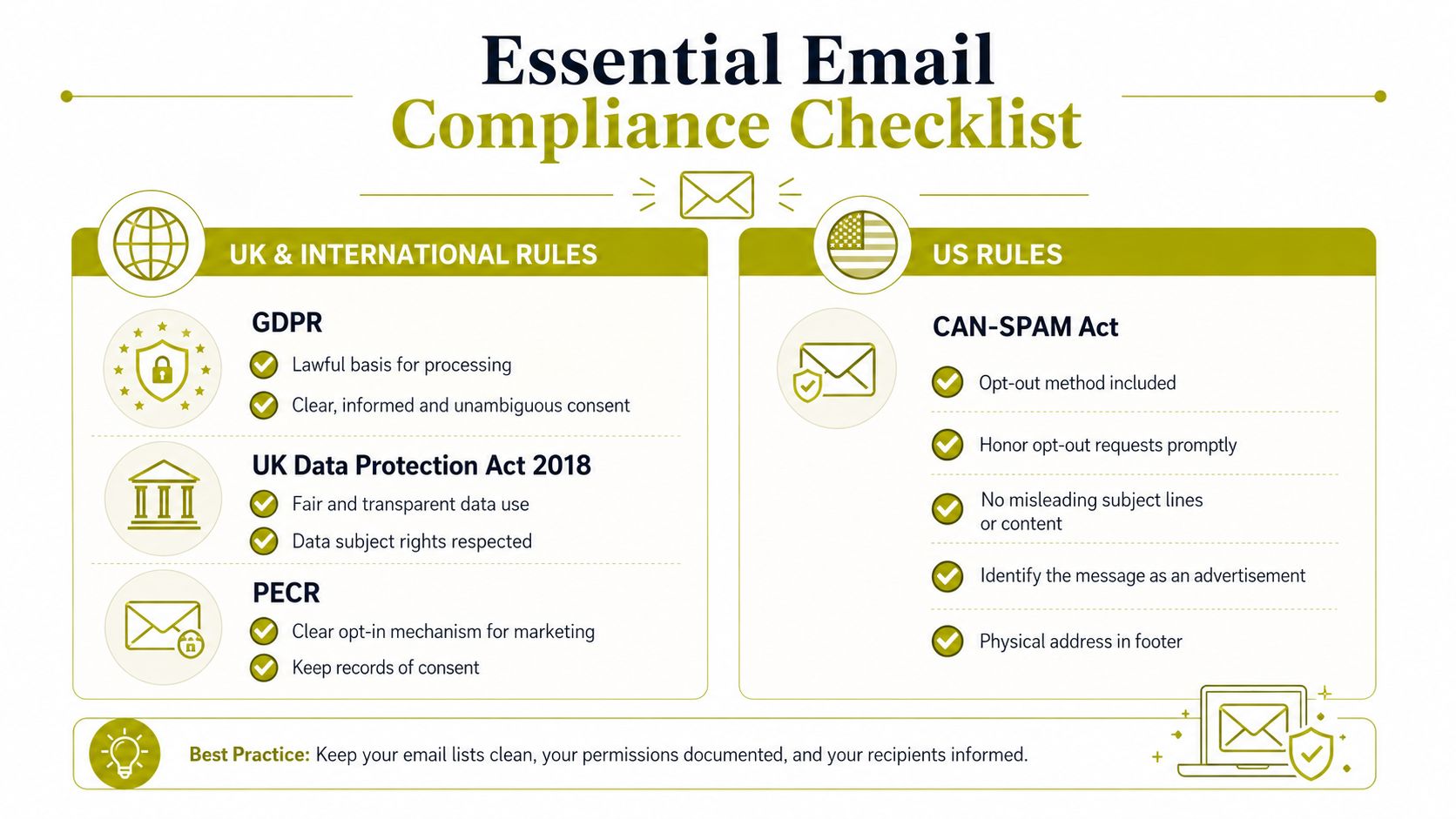
UK email promotion lives or dies on permission. The Information Commissioner's Office treats unsolicited electronic marketing as a compliance issue under UK e-privacy rules, and the Data Protection Act 2018 and GDPR framework raised the bar on consent, lawful processing and opt-outs. That's not optional admin, it's the boundary between marketing and a mess.
What compliant promotion looks like in practice
The UK rulebook is straightforward once you stop overcomplicating it. You need a lawful basis for processing, a clear opt-in mechanism, and a visible way to opt out. If you don't have that, don't send.
A SaaS start-up that buys a list and blasts it with a launch email is creating risk before the first open. A tourism brand re-marketing to past customers still needs to respect consent and the relevant legal basis, not just assume the audience is warm. A charity running a raffle campaign can't skip permission because the cause is worthy.
For a plain-English data handling reference, the consent and data storage guide from CleanMyList is a useful companion to the legal basics. You still need to apply judgement, though. Guides don't replace policy.
Don't confuse UK rules with US rules
If you're mailing internationally, remember that CAN-SPAM is a different framework. It still expects a clear opt-out mechanism and a proper footer identity, even when the audience is outside the UK. That means global campaigns need separate compliance thinking, not copy-paste habits.
If in doubt, do this: ask for proof of consent, send only to contacts you can justify, keep unsubscribe handling simple, and store your records like you might need to explain them later.
The same principle applies to breach handling and audit readiness. Good agencies don't just write the email, they protect the onboarding process and the records behind it. That's why a senior-led team is a practical choice, not a luxury.
For a broader first-party data conversation, the first-party data strategy page sits naturally alongside compliance, because both are about owning the relationship the right way.
KPIs, Reporting and Pricing Models You Should Understand
A decent proposal should talk less about sends and more about outcomes. If a provider cannot explain what they will measure, they are not running email promotion services, they are renting a platform. You need metrics that connect to money, behaviour and list health.
Metrics that matter
Open rate tells you whether the subject line and sender name earned the inbox visit. Click-to-open rate is often a stronger commercial signal for promotional campaigns, because Salesforce reports general marketing emails typically achieve CTOR in the 10% to 25% range source. That makes post-open engagement the better test of whether the message itself was worth reading.
You also want conversion rate, list-growth rate, unsubscribe rate and revenue per email. If a report gives you polished screenshots but no commercial reading, it is not a report, it is decoration. The point is to see what changed behaviour and what did not.
Senior-led agencies also look at reporting quality. A useful monthly pack should show send performance, segment performance, content performance and list health in one place, so a founder can see whether the programme is building momentum or just filling inboxes. Ask who interprets the numbers. A strategist should do that, not a junior account manager reading a dashboard aloud.
Pricing should match the job
A retainer fits ongoing newsletter programmes, lifecycle work and steady optimisation. It is the right shape when you need someone embedded in the rhythm of the business, not just parachuted in for one launch. For agency-led email promotion services, this is usually the cleanest option because it supports editorial judgement, testing and compliance checks without resetting the relationship every month.
A project-based fee fits a template rebuild, a welcome-flow build-out or a major list clean. That is the option when there is a defined start and finish. It suits work that needs specialist input, then hands back to your team once the structure is in place.
A pay-per-send model works for a simple launch campaign or a limited seasonal drive, but it can make strategy feel transactional. A hybrid model usually suits growing brands, because it blends continuity with bursts of campaign activity. It also gives you a cleaner split between the work that should stay in-house, like offer decisions and final approvals, and the work worth outsourcing, like copy, design, testing and reporting.
| Pricing Model | Best For | Typical Inclusions | Watch Out For |
|---|---|---|---|
| Retainer | Ongoing newsletter and lifecycle work | Strategy, planning, copy, design, reporting | Scope creep if weekly revisions are not defined |
| Pay-Per-Send | Launches and one-off promotions | Campaign build, send, basic reporting | Hidden costs in list prep and versioning |
| Project-Based | Automation builds and audits | Audit, setup, templates, testing | Extra rounds of amendments and sign-off delays |
| Hybrid | Growing brands with regular and seasonal activity | Monthly support plus campaign bursts | Unclear boundaries between retainer and project work |
If a quote looks cheap, check what is missing. List cleanup, segmentation, QA and reporting usually live in the gaps. That is where agencies protect performance, and where generic volume-sending services usually fall apart.
How Email Promotion Fits With PR and Multi-Channel Campaigns
Email is not the whole campaign. It's the part that makes the campaign keep working after the headlines start fading. That's why the best results usually come when email sits beside PR, social and SEO rather than competing with them.
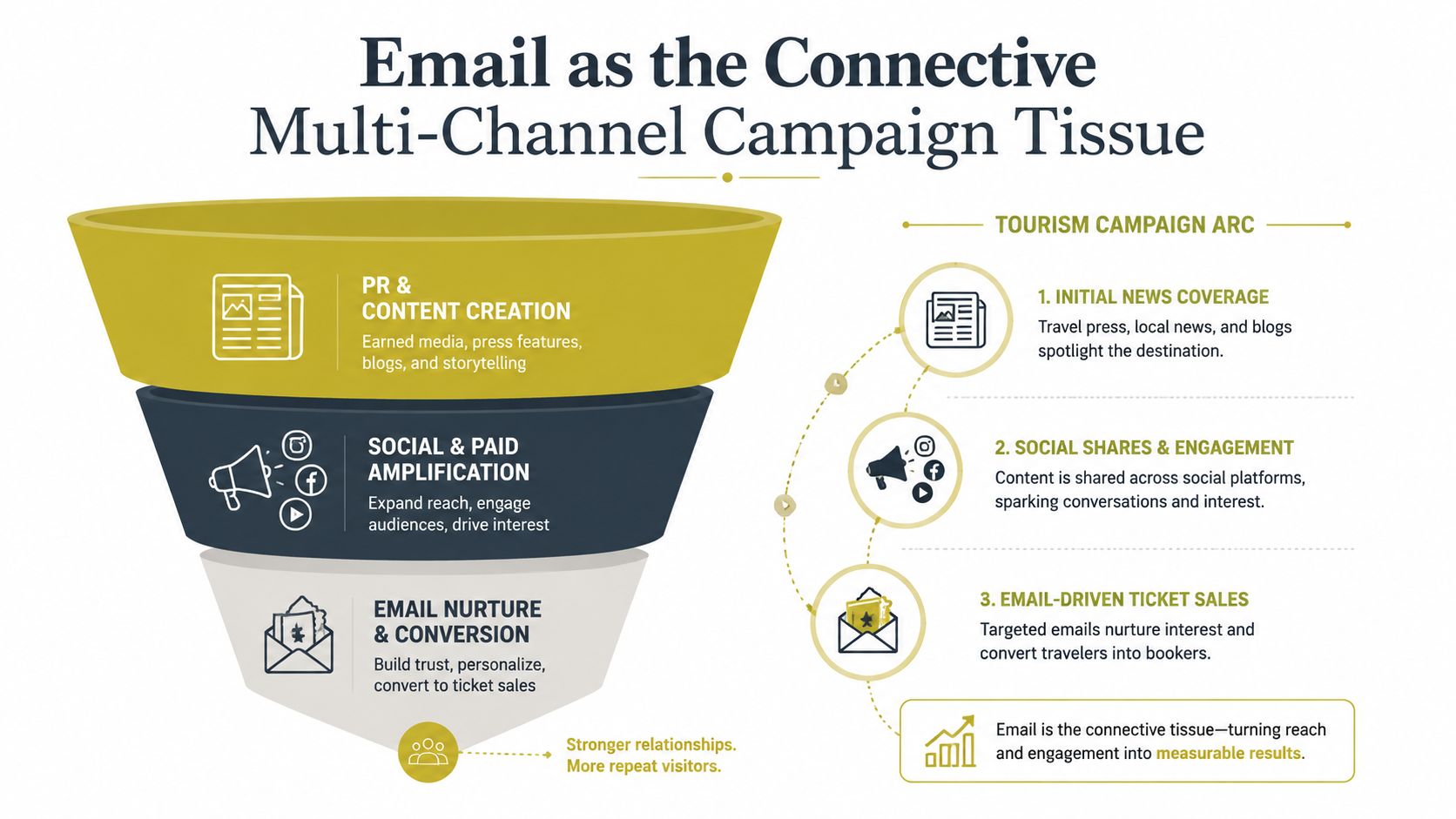
The campaign arc that makes this obvious
Take a tourism launch. National media coverage creates awareness, social amplification extends the reach, and an SEO-optimised landing page catches search intent. Then email does the work that the other channels can't reliably do on their own, it nurtures the warm list, repeats the offer with context, and pushes the final conversion.
That's where editorial judgement matters. A former national newspaper editor doesn't just know how to write. They know what makes a line worth opening, what should sit in the subject line and what can be cut. That kind of instinct is rare, and in email it's commercially useful.
Why most guides miss the point
Generic service providers talk about templates and cadence because those are easy to sell. They rarely explain how email supports the wider campaign arc. In practice, the email sequence often does the compounding work, because it reaches people who already showed intent, keeps the story consistent and gives you another chance to convert.
Carlos Alba Media's integrated campaign planning thinking fits here, because email only performs properly when the PR, content and paid elements are aligned. The media hit gets attention, the social layer broadens the audience, and the email sequence turns interest into action.
This is also why writing quality matters more than people admit. The inbox is crowded, and bland copy gets ignored fast. If you're paying for email promotion services, you're paying for someone to make the message worth the click, not just to press send.
Choosing the Right Provider and a 30-Day Onboarding Roadmap
Don't start with price. Start with whether the provider can run the job you need. Sector experience, senior involvement, compliance posture, reporting depth, technical stack and integration with PR and content are the right questions, in that order.
What to ask before you sign
- Who does the work: If the person selling the service won't be involved, ask who will.
- How they handle compliance: You want a clean answer on consent, records and unsubscribe handling.
- What they measure: If the answer stops at opens, they're underpowered.
- How they handle integrations: Ask how email connects with CRM, content and campaign planning.
- How they manage deliverability: Authentication, list hygiene and testing should be standard, not upsells.
Lead Printer's agency approach is a useful comparison point if you want to see how a specialist team structures its service thinking around growth rather than volume.
A sensible first 30 days
Week one should be discovery and goal-setting. Define the audience, the offer, the business goal and the channel role. Hidden cost alert, bad briefs usually create revision loops later.
Week two is the list and data audit. Clean the database, check consent, map segments and identify gaps. Scope creep begins if nobody owns the data.
Week three is template build and authentication. The sender setup, design framework and testing need to be locked before the first send. Do not let this drift.
Week four is the first compliant campaign and the reporting baseline. Send once, measure properly and build from what the data says. That's the starting point, not the finish line.
The founders who get value from email promotion services treat onboarding as a disciplined setup, not a creative brainstorm. That's how you avoid paying for avoidable mistakes.
Five Operating Principles and the Road Ahead for Email Promotion
Five rules matter more than the rest. Lead with consent. Treat deliverability as infrastructure. Write like an editor. Measure what matters. Integrate email with the wider campaign. If a provider can't work inside those rules, they're not a serious partner.
The category is changing too. AI-assisted personalisation is making segmentation more ambitious, inbox saturation is still making attention harder to earn, and privacy expectations aren't softening. The agencies that win through 2026 and beyond will be the ones that combine automation with judgement, not automation with laziness.
Short answers to the questions founders keep asking
How do I move from a basic Mailchimp setup to something more senior-led? Start by auditing the list, the automations and the sender setup, then rebuild around consent, segmentation and better reporting. Don't migrate just to change tools.
How long before I see meaningful ROI? The honest answer is that it depends on list quality, offer strength and send volume, but you should expect the first few campaigns to establish a baseline before you call anything a win.
How do I stay compliant across the US and EU? Separate the rule sets, keep consent records tight, include clear opt-outs and don't assume one country's standard covers another's.
If you want email promotion to do more than fill the inbox, treat it like a senior-led growth channel. Carlos Alba Media plans and runs email as part of wider PR and digital campaigns, with editorial judgement, compliance awareness and performance thinking built in. Visit Carlos Alba Media to see how that approach can support your next campaign.