
You know the feeling. The PR note is ready, paid social is scheduled, the SEO article is half-finished, and someone in the team is still asking for the latest email copy. Everyone is busy, everyone is working hard, and yet the campaign still feels like four separate efforts stitched together at the last minute. That's where integrated campaign planning earns its keep, because it gives SMEs a way to coordinate message, timing, and measurement before the budget starts leaking through the cracks.
The core issue isn't a lack of activity, it's a lack of orchestration. UK audiences move across digital, broadcast, and audio every day, and the media habit data makes that obvious, 94% of UK adults used the internet every day in 2023, while 87% watched TV at home weekly and 75% listened to radio weekly according to Ofcom, which is why planning in silos misses how people consume information (Ofcom media habits and UK campaign planning context). At the same time, UK ad investment is already heavily digital, with £38.0 billion spent on internet advertising in 2023, up 11.9% year on year, so the commercial case for coordination is already there (IAB UK and PwC digital ad spend data).
Why Most Campaigns Fail Before They Launch
A typical SME campaign starts with energy and ends with confusion. The PR person is chasing coverage, the paid specialist is adjusting audiences, the content lead is publishing SEO pages, and the founder wants an email out by Friday. No one has a single narrative, the calendar lives in three places, and the KPIs do not line up, so the campaign launches as a collection of tasks instead of a coordinated market move.
Many campaigns fail before a prospect ever sees them because the story changes from channel to channel. If the press release says one thing, the landing page says another, and social pushes a different promise again, people do not get a clear reason to act. The team also burns time rewriting the same asset for each channel, and nobody can say which touchpoint moved the buyer forward.
Fragmentation looks efficient until you measure it
Teams often think they are saving time by letting each channel run on its own. In practice, they duplicate effort and weaken the message. The issue gets sharper in the UK, because audience behaviour is already multi-channel and budget allocation is too, so channel sprawl does not just add complexity, it makes attribution harder and leaves SMEs with a fuzzy read on what drove response.
Practical rule: if the campaign brief does not fit on one page, the team probably has not agreed the story yet.
Integrated campaign planning is not a luxury reserved for large brands with big teams. It is a discipline for SMEs that need to make every asset work harder, especially when budgets are tight and management still wants proof that the activity mattered. The strategic shift is simple, stop treating PR, paid, owned, and earned as separate jobs, and start treating them as parts of one customer journey. That also means planning measurement before launch, so you can test whether one channel lifted another instead of guessing after the spend is gone. A practical consumer insights research approach helps teams decide what to track, what to ignore, and where the key decision points sit.
That framing matters because multi-channel coordination is where the evidence points. Integrated campaigns using four or more channels have been reported to outperform single- or dual-channel campaigns by 300%, and integrated campaigns are also cited as 31% more effective at building brands (multi-channel integrated campaign research summary, Kantar Millward Brown cross-media studies summary). The point is not to chase more channels for their own sake. The point is to make each channel do a distinct job inside one plan, then measure the combined effect with enough discipline to show incremental impact rather than channel-by-channel guesswork.
Setting Objectives and Defining Your Audience
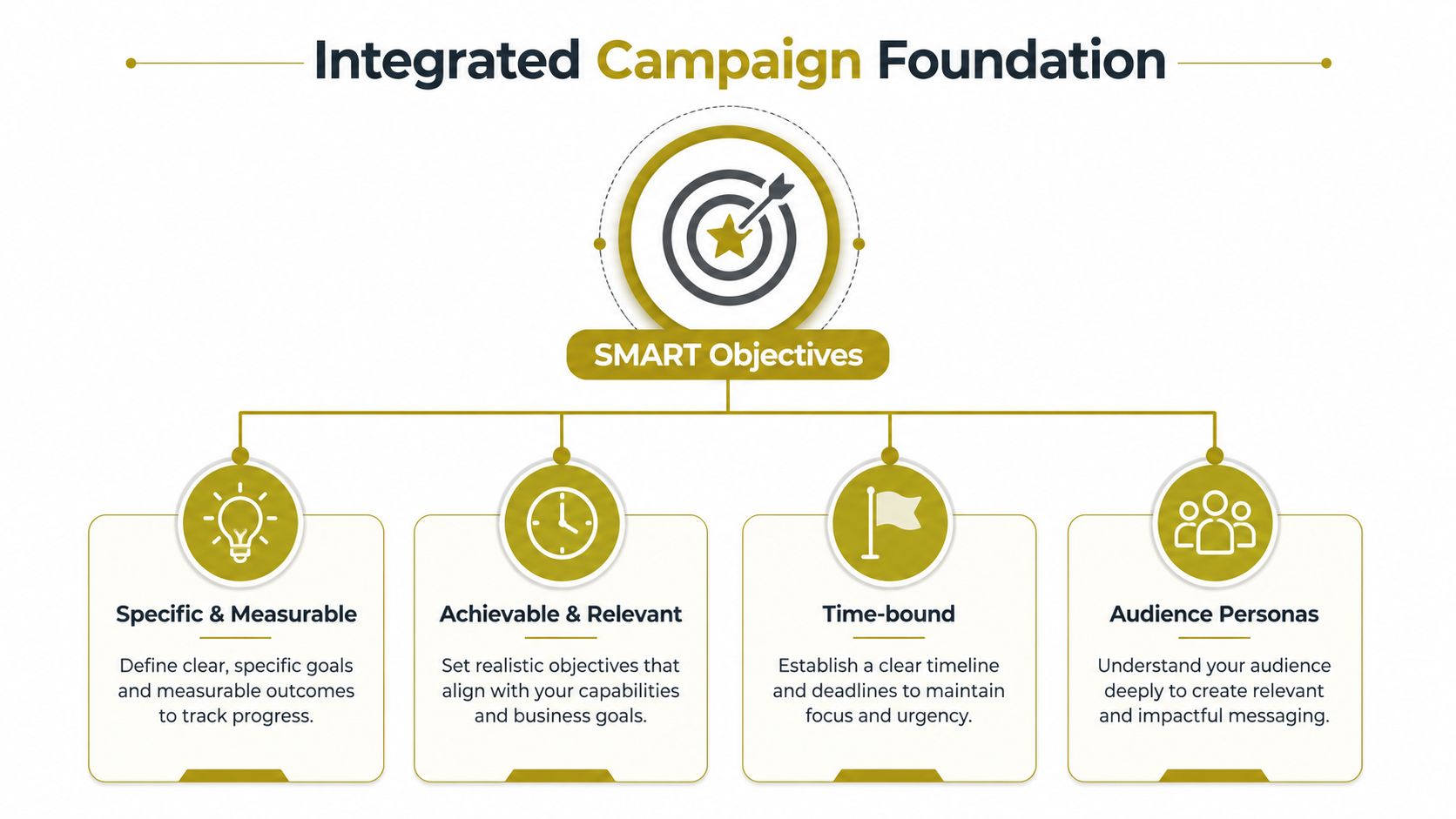
The campaign brief should start with outcomes, not outputs. “Launch three posts” is an output. “Generate qualified leads from finance decision-makers in eight weeks” is an outcome. If the objective isn't tied to the business result, the campaign can look busy and still fail.
SMART objectives help because they force trade-offs early. They ask what success looks like, how it will be measured, and when the team will review it. For a Scottish tech SME, that might mean pipeline quality or demo requests. For a tourism business, it might mean booking enquiries, press coverage in the right markets, and assisted conversions from travel content.
Build personas from behaviour, not guesswork
Audience work goes wrong when teams describe people by job title and stop there. Better personas use behaviour, media consumption, pain point, and buyer-stage context. A founder reading industry news, a procurement lead comparing vendors, and a repeat visitor looking for proof all need different messages, even if they're part of the same account.
A useful way to write the brief is to separate KPIs into layers:
- Awareness KPIs: reach, share of voice, and quality of exposure.
- Consideration KPIs: content engagement, time on page, repeat visits, and email sign-ups.
- Conversion KPIs: leads, demo requests, sales-ready enquiries, and pipeline contribution.
Practical rule: one campaign, one primary objective, three supporting metrics at most.
That discipline prevents the common mistake of trying to optimise for everything at once. If awareness is the goal, don't judge the campaign as a failure because the final conversion lagged in week one. If conversion is the goal, don't celebrate clicks that never moved into sales conversations.
The strongest briefs also map persona to channel before creative starts. That's where behavioural insight matters more than broad demographic labels, because people don't live inside channel categories. They move between search, social, email, and editorial coverage, often in the same week. If you want richer input on how audiences behave, a useful starting point is the consumer research work at Carlos Alba Media's consumer insights and research page.
Building a Channel Mix That Actually Performs
The right channel mix is a system, not a shopping list. PR can create credibility, paid social can amplify or retarget, SEO can catch intent, email can nurture, and partner activity can extend trust. None of them should be asked to do everything.
Give each channel one clear job
Channel roles need to be explicit from the start. If PR is being used for credibility, don't measure it as though it were direct response. If paid search is capturing bottom-funnel demand, don't judge it on brand-building. The campaign gets stronger when each channel has a job that fits its strengths and sits inside the same narrative.
The UK case for coordination is strong because audiences move fluidly across media. Ofcom's data on internet, TV, and radio use, plus the scale of UK digital spend, shows why the old “one channel first” thinking is too narrow (Ofcom media habits and UK ad spend context). A buyer might see a press mention, search the brand later, then convert after a retargeting ad and an email sequence. If those touchpoints weren't designed together, the team won't know what really helped.
A channel role matrix keeps teams honest
| Channel Type | Primary Role | Key KPIs | Isolation Risk |
|---|---|---|---|
| PR and earned media | Credibility and early awareness | Coverage quality, referral traffic, assisted conversions | High if measured only on mentions |
| SEO and owned content | Intent capture and education | Organic sessions, engaged visits, conversion assists | High if content is treated as standalone |
| Paid search | High-intent demand capture | Conversion rate, cost per lead, pipeline contribution | High if brand and non-brand are mixed badly |
| Paid social | Amplification and retargeting | Click-through, audience quality, assisted conversions | High if it runs without a message ladder |
| Email and automation | Nurture and follow-up | Open quality, click quality, lead progression | High if it's disconnected from other touchpoints |
| Partnerships and affiliates | Reach extension and trust transfer | Referral quality, engagement, assisted revenue | High if tracking is weak |
The most common failure is adding channels because a competitor is active there. That creates channel sprawl, where teams chase presence instead of performance. Better to run fewer channels with clearer roles than to spread one small team across five loosely related tactics.
A channel mix should also reflect the buyer journey. Use earned media and content early, paid and retargeting in the middle, email and sales enablement near the end. That sequencing matters more than channel count on its own. It's also why the right mix usually looks less glamorous than a pitch deck and more like a working system.
For a useful framing of how owned, earned, and paid media fit together in practice, see Carlos Alba Media's owned, earned and paid media overview.
Crafting Unified Messaging and Repurposing Content
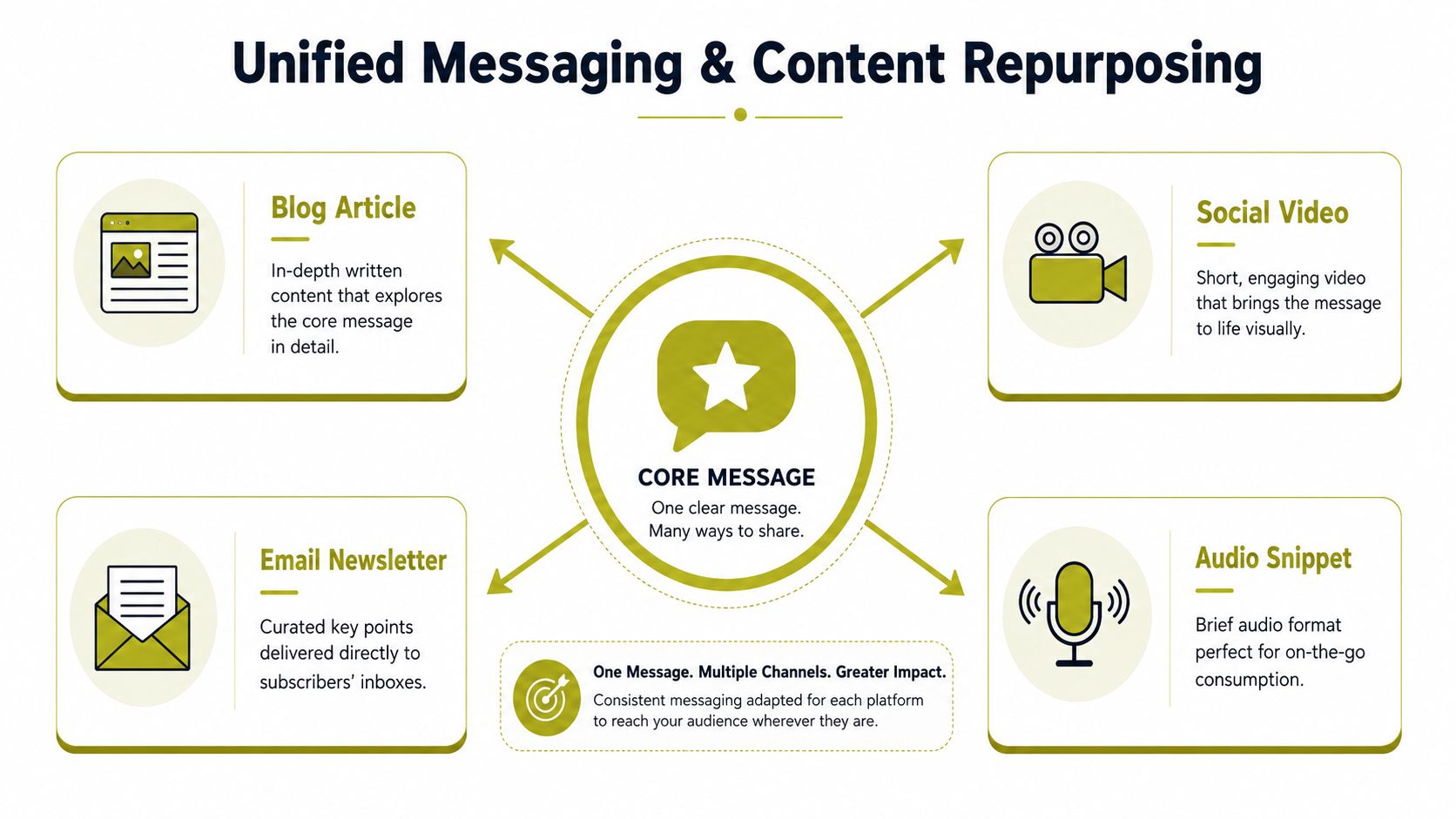
One strong story beats five weak ones. The campaign needs a central message platform that stays consistent, then adapts by format and audience. That's how a press release, landing page, social post, sales deck, and email sequence can all feel related without sounding copied and pasted.
Start with one source of truth
The single biggest operational win is a shared repository for campaign language, assets, approvals, and status. Adobe's campaign-planning guidance is blunt about this, teams should identify where data and information live, find commonalities, and merge taxonomies so everyone works from one shared planning base (Adobe campaign planning best practices). That sounds dull until a journalist asks for the latest quote and the sales team is still using a stale case study from two weeks ago.
The practical test is simple. If someone in the team can't answer, “Which version is live, and where is the master copy?”, the campaign is exposed to drift. That's especially dangerous when fast approvals, media outreach, and stakeholder edits all land at once.
Repurpose the idea, not the wording
Hero content should be created once, then broken down into smaller assets. A single briefing can become a press release, a blog article, three social posts, an email sequence, and a short video script if the underlying message is tight enough. The point isn't volume for its own sake, it's consistency with efficiency.
A useful content hierarchy is:
- Core narrative, the main argument or launch story.
- Proof points, the facts, testimonials, or examples that support it.
- Format adaptations, the version each channel needs.
- Derivative assets, the smaller pieces repurposed from the hero item.
If the core message can't survive in a press quote and a landing page headline, it's not ready.
That approach keeps the brand voice stable while allowing the surface layer to change. It also saves SMEs from the trap of over-producing new content for every channel. In reality, most small teams don't need more ideas, they need better packaging of one good idea.
Timelines, Budgets, and Team Workflow
A good campaign calendar reduces stress before it starts. It should show when PR embargoes lift, when paid media flights begin, when content goes live, and when social support kicks in. If those dates are not aligned, the campaign will leak momentum or go live with missing assets.
Budget should follow role, not habit
Too many SMEs budget by historical comfort. They fund the channel they know best, then underfund the work that makes the whole thing function. A better approach is to allocate by role, so budget aligns with where the campaign needs reach, trust, content, or conversion support.
The workflow itself should be visible to everyone who touches the campaign. The strongest teams don't just assign tasks, they assign ownership. That means one person owns the narrative, one owns delivery, one owns approvals, and one owns reporting. If too many people can approve something, nothing moves.
There's also a real advantage in specialist counsel here. A team made up of former national news journalists or people with agency experience across international brands tends to move faster on approvals, media angles, and timing because the discipline comes from newsroom habits, not generic marketing process. That matters when a campaign depends on credibility as much as distribution.
Build the calendar around dependencies
Use a simple structure:
- Planning phase: brief, audience, message, and asset map.
- Execution phase: production, media outreach, launch, and amplification.
- Measurement phase: reporting, review, and budget reallocation.
Practical rule: never let paid media launch before the landing page is signed off and tracked.
The other discipline is contingency. SMEs often need to leave space for reactive opportunities, especially when a news hook, product update, or partner announcement lands unexpectedly. If the calendar is packed too tightly, the team can't move.
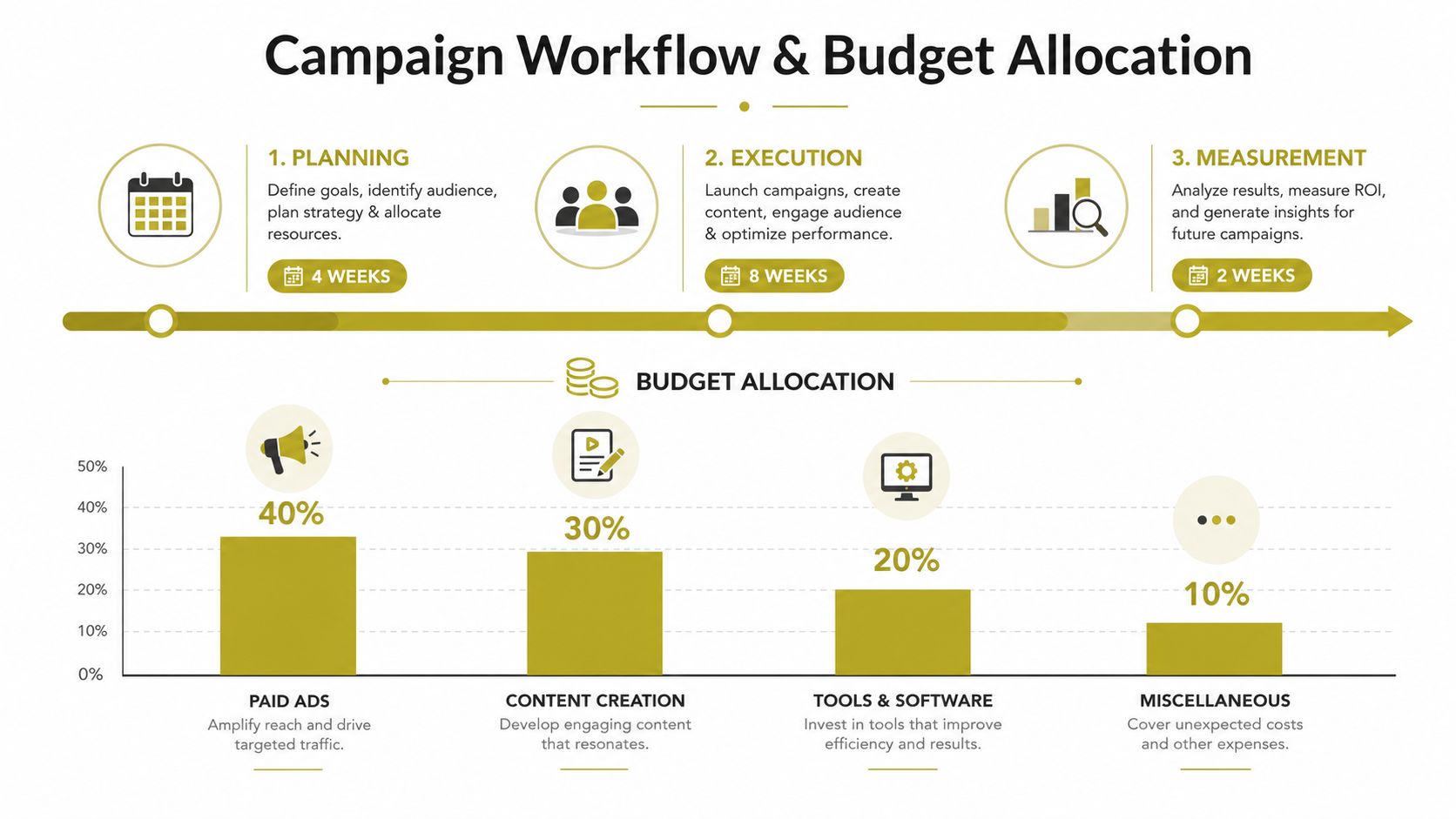
Here's a useful guide to how one team can think about planning, execution, and measurement in practice.
Measuring What Matters
A campaign can win attention and still miss the business outcome. Reach is useful, but it does not prove impact on its own, especially when the goal is leads, sales conversations, or revenue. That is why the measurement model has to focus on incremental efficiency across the funnel, not vanity totals.
Shared KPIs show the contribution
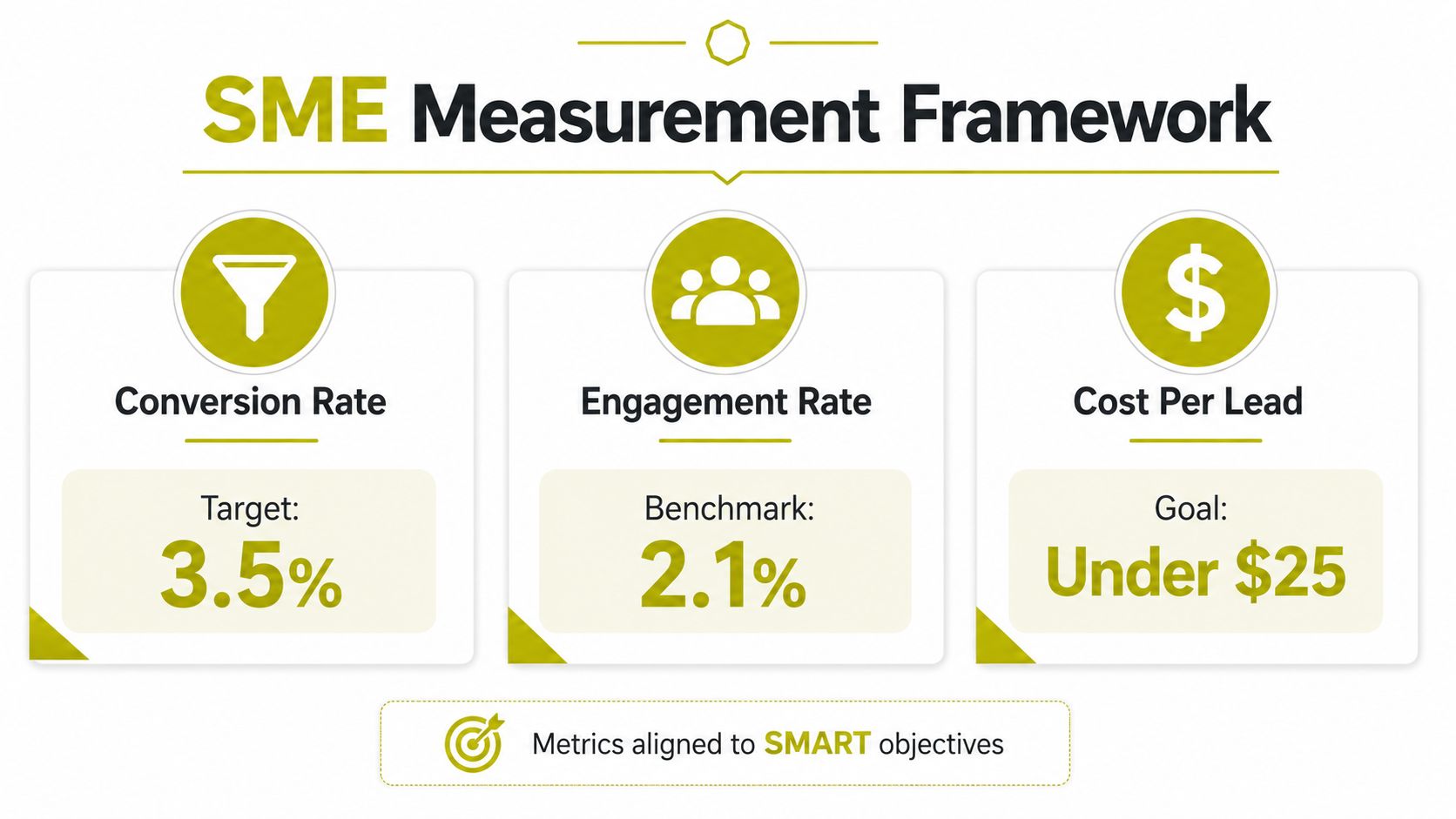
The strongest SME reporting setup uses a small set of shared KPIs tied to the journey. Conversion rate, cost per lead, and pipeline contribution tell you more than isolated channel reports when the campaign is integrated. They also help stop the habit of cutting activity too early just because one channel looks weak on its own.
Pedowitz Group's integrated-campaign guidance gives a useful operational benchmark, when landing pages, retargeting, SEO, and paid media are aligned, conversion rates can rise from 1.8% to 5.4% and cost per lead can fall by 32%, even without increasing media spend (Pedowitz Group integrated campaign planning guidance). The lesson is not to chase those exact outcomes blindly. It is to understand that integration can improve efficiency without increasing spend if the funnel is wired properly.
Proving incrementality is the primary SME challenge
Most guides stop at “track everything.” That is not enough. If PR, paid, owned, and partner activity overlap, the job is to separate baseline demand from the lift created by the campaign. A practical approach for SMEs is to set a pre-launch baseline, track shared KPIs, and review performance on a fixed cadence so the team can see what changed after launch.
The hardest part is attribution overlap. One channel may introduce the brand, another may create the return visit, and a third may close the lead. If each channel is judged alone, the team risks giving credit to the last click and ignoring the earlier work that made the conversion possible. The reporting view should show the journey, not just the final action.
A practical reporting cadence looks like this:
- Launch week: check tracking, assets, and landing pages.
- Weeks two to four: review early signal, but do not overreact to noise.
- Monthly: assess shared KPIs and reallocate budget if needed.
- Post-campaign: compare baseline to outcome and capture lessons.
For a closer look at performance review discipline and benchmark thinking, use Carlos Alba Media's performance benchmarking page.
Why Specialist Counsel Gives Campaigns an Edge
Integrated campaign planning works better when the team understands both the story and the system. Former national news journalists know how to shape a hook, pressure-test a claim, and time an announcement so it lands cleanly. People with international brand-agency experience bring the coordination needed to keep the message consistent across channels without making it flat.
That newsroom discipline matters because credibility is built differently from clicks. A campaign that earns attention in the right place, at the right time, with the right proof points, tends to perform better across the rest of the funnel. That's why specialist teams often produce cleaner execution, tighter messaging, and faster course correction when things shift.
The brands listed in Carlos Alba Media's portfolio, including The Johnnie Walker Experience, VisitScotland, and Hamilton & Inches, show the value of that editorial-plus-strategy approach. The practical lesson is simple: use one narrative, give each channel a distinct role, keep assets in one source of truth, and measure impact by what changes in the buyer journey.
If you need senior-level support on integrated campaign planning, Carlos Alba Media builds coordinated PR and digital campaigns that connect message, media, and measurement without big-agency overheads. Visit Carlos Alba Media to see how a newsroom-led team can help you turn your next campaign into something clearer, sharper, and easier to prove.