
You're probably in one of two positions right now. Either you've built something useful and almost nobody knows it exists, or you've tried posting on LinkedIn, fiddled with a few ads, maybe boosted a post, and you still can't tell what's working.
That's normal. Most startup marketing fails because founders spread too thin, chase channels they don't understand, and spend before they've nailed the message. If your budget is under £250 a month and you don't have an in-house marketer, you don't need more tactics. You need a tighter sequence, better filters, and the discipline to ignore most advice.
Digital marketing for startups works when you treat it like product development. You run small tests, learn quickly, cut what doesn't work, and build on the channels that show real buying intent. That matters even more in the UK, where digital isn't a side activity anymore. It's where customers search, compare, doubt, click, and decide.
Why Digital Marketing Is Non Negotiable for UK Startups
A founder launches, gets a burst of referrals, then the pipeline goes quiet. The next prospects do what UK buyers always do. They search on Google, check reviews on their phone, skim a competitor's site, watch a short demo, and shortlist the company that looks credible first.
For a startup, that decision often happens before anyone books a call.
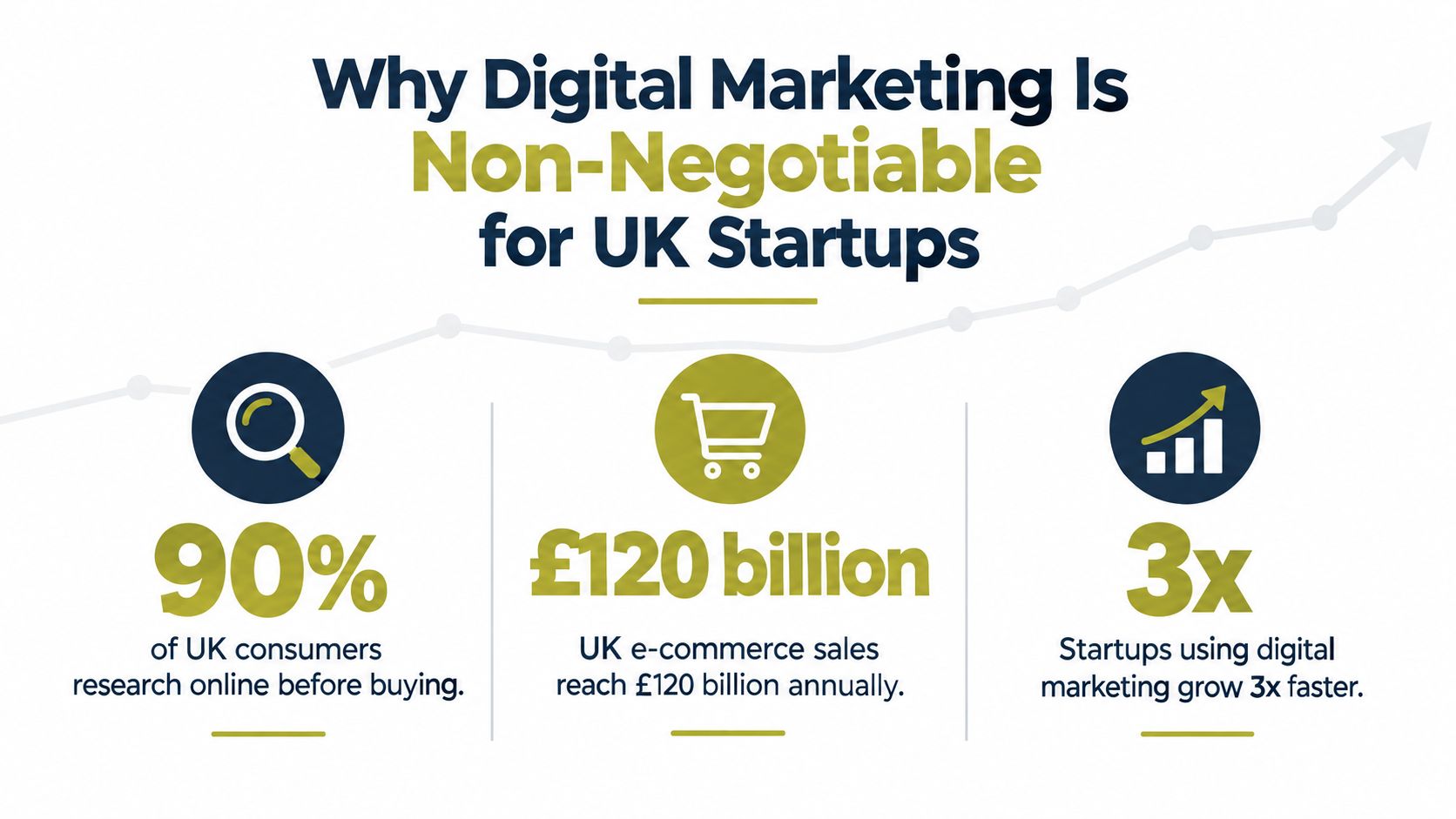
In the UK, digital is the buying environment. The market makes that obvious. UK digital ad spend reached £40.5bn in 2025, up 10% year on year, while GDP growth was 1.4%. In the same period, video spend rose 20% to £9.3bn, according to IAB UK ad spend data. Startups should read that plainly. Buyers are spending more of their attention online, and established brands are paying to stay in front of them.
The market has already shifted
This is not a branding nice-to-have you postpone until after product-market fit. If you are trying to grow in the UK with under £250 a month and no in-house marketer, digital marketing is your cheapest way to test demand, message, and channel fit without hiring a team or committing to large media spend.
The priority is not “being active online.” The priority is being visible where intent shows up and making it easy for a buyer to trust you fast.
Analysts at IAB UK reported that in the first half of 2025, digital ad spend totalled £18.7bn. Search took £8.3bn, or 44% of spend. Video reached £4.3bn, or 23%. Mobile accounted for 71% at £13.3bn. Online retail media also hit £1.5bn in that same period, according to IAB UK's H1 2025 forecast update.
That matters because it gives founders a practical map. Search is still the best place to capture existing demand. Mobile is where people compare options and drop weak brands. Video helps explain a new offer faster, but it is rarely the first place a cash-strapped startup should spend.
If you want a grounded view of how lean teams are sequencing tests across channels, AdManage's growth marketing guide 2025 is a useful companion to your own planning.
What founders should do first
Do the boring, high-intent work before the flashy stuff.
- Start with search visibility: Make sure your site can be found for the problem you solve, not just your brand name.
- Fix the mobile experience: A slow, messy mobile page will waste every click you pay for.
- Use video only if it shortens the sales process: A simple founder-led demo can help. Expensive brand video can wait.
- Skip broad paid social early: If you have less than £250 a month, awareness campaigns are usually a bad trade.
The point is simple. Digital marketing is not required because everyone else is doing it. It is required because UK buyers use digital channels to filter, compare, and rule you out. If you are not visible in those moments, your competitor gets the click and you get silence.
Defining Your Positioning and Ideal Customer Before You Spend
If your message is vague, every channel gets expensive.
That's why most startup spend gets wasted before the first ad runs. Founders say they serve “SMEs” or “busy professionals” or “growing brands” and then wonder why nobody clicks, converts, or replies. Broad audiences feel safe. They kill performance.

Write the sharpest version of your offer
Start with one sentence. Not a mission statement. Not a slogan.
Use this structure: We help [specific buyer] solve [specific problem] without [main frustration or trade-off].
Examples are easier than theory:
- Weak: We provide software for modern teams.
- Better: We help independent financial advisers organise client follow-up without relying on spreadsheets.
- Better still: We help small legal firms capture and respond to inbound enquiries faster without hiring a full-time intake team.
That sentence becomes your filter for homepage copy, ad messaging, sales outreach, and content topics.
If your positioning still sounds broad, refine it until one buyer says, “That's for me.” The thinking behind that process is close to the approach outlined in this guide on what brand positioning means in marketing.
Define a real customer, not a fantasy persona
Skip the nonsense about favourite coffee shops and vague demographics. You need five practical facts.
- Who already feels the pain
- What triggers them to look for a solution
- What they're using now
- What would stop them buying
- What outcome they want
That gives you a usable customer profile. It also stops you building campaigns around assumptions.
Talk to actual prospects before you spend. Five honest calls will save you more money than five weeks of guessing.
Turn audience assumptions into testable segments
Don't target “everyone in professional services”. Break your early market into segments you can test.
A good early segmentation approach looks like this:
- By urgency: Buyers with an active problem now
- By awareness: Buyers comparing options versus buyers still diagnosing the issue
- By buying context: Founder-led firms, in-house teams, or regulated businesses with slower approval cycles
Then build one landing page or one message angle for each segment. Not ten. One each.
Match the message to the job
People don't buy products because you listed features nicely. They buy because the product helps them get a job done.
Your copy should answer:
- What changes after they buy
- Why your route is simpler
- Why they should trust you
- What to do next
If you can't answer those clearly on a landing page, paid traffic won't rescue you. Better targeting won't rescue you either.
Do the cheapest validation first
Before you pour money into ads, run these low-cost checks:
- Customer interviews: Ask what they searched, what confused them, and what nearly stopped them buying.
- Landing page test: Put one offer in front of one audience with one call to action.
- Search language review: Pull phrases from customer emails, calls, sales notes, and LinkedIn comments.
Most founders want channels first. Wrong order. Positioning first, then channels. Otherwise you're paying to learn that your message was muddy.
Choosing Priority Channels Without Spreading Your Budget Too Thin
You've got £250 for the month, no in-house marketer, and three people telling you to post more on LinkedIn, run Meta ads, and start SEO at the same time. Ignore them.
Early-stage startups rarely fail because there are no channels available. They fail because they spread tiny budgets across too many channels and learn nothing useful. Your job is to pick one channel that captures demand now, then one channel that helps you keep and convert that attention later.
What the UK benchmark data actually means for a tiny budget
Channel choice gets clearer once you look at conversion rates and cost side by side. One UK benchmark set reported average conversion rates of 2.9% for SEO or organic search, 3.8% for email, 2.2% for generic PPC, 1.8% for LinkedIn paid, and 1.4% for Meta B2B targeting. The same source put generic PPC CPL at £38 to £95 and LinkedIn paid at £55 to £130. For a founder working with less than £250 a month, those ranges matter a lot because one bad week on the wrong platform can wipe out the month's test budget according to these UK marketing benchmarks.
Startup Channel Prioritisation by Intent and Cost
| Channel | Typical Conversion | Typical CPL Range | Best Use for Startups |
|---|---|---|---|
| SEO and organic search | 2.9% | Not stated in the benchmark | Capture high-intent searches and build compounding visibility |
| 3.8% | Not stated in the benchmark | Nurture interest, reactivate leads, and convert owned audiences | |
| Generic PPC | 2.2% | £38 to £95 | Test clear buying intent and validate offer-message fit |
| LinkedIn paid | 1.8% | £55 to £130 | Narrow B2B targeting once positioning and conversion path are proven |
| Meta B2B targeting | 1.4% | Not stated in the benchmark | Retargeting and message testing, not broad cold acquisition |
That is why broad “omnichannel” advice is useless for a cash-tight startup. Costs are uneven. Buyer intent is uneven. Your plan should be uneven too.
The order I'd use on a tight budget
If you are under £250 a month, use this order.
1. Start with demand capture and owned follow-up
Your first priority is simple. Show up where people are already looking, then give them a way to come back.
Focus on:
- A single landing page: One offer, one audience, one action.
- Core search presence: Service pages, problem-led copy, sensible page titles, and a basic Google Business Profile if relevant.
- Email capture and follow-up: A form, a short automated reply, and one useful next step.
This setup is not exciting. It is profitable sooner than random posting.
2. Use paid search before paid social
Search traffic is usually the cleaner first test because the buyer is declaring intent. Social traffic often asks you to create interest from scratch, and that is expensive when your message is still being tested.
Paid search is not cheap, so keep the test narrow. Bid on a small set of high-intent phrases. Send every click to one page. If the clicks are irrelevant or the page does not convert, fix that before spending another pound.
3. Keep social in a support role
Organic social can help with credibility and consistency, but it should not consume your week. Founders often treat posting as marketing because it feels productive. It usually is not.
Use social to reinforce your offer, share proof, and stay visible to prospects already in your orbit. If you need a practical framework for that, Hooked's social media strategy tips are a useful reference.
4. Treat PR and paid reach as accelerants
PR helps once the core message is clear and the site converts. Paid reach helps once you know what message gets response. Neither should be your first fix.
A better way to structure the mix is through owned, earned, and paid media. If owned media is weak, paid media becomes an expensive rental. Build the base first.
Expensive traffic to a weak page does not create growth. It just shortens the time between spend and disappointment.
What to skip for now
Founders with tiny budgets need a stop-doing list as much as a to-do list.
Skip these early:
- LinkedIn ads as a first channel: The targeting is attractive, but the lead costs are usually too high for an unproven offer.
- Broad Meta campaigns for B2B: Fine for retargeting later. Weak as a first cold acquisition bet.
- Content with no job to do: If it does not support search intent, trust, or conversion, leave it.
- Equal spend across four or five channels: That only buys scattered data.
- Vanity metrics reporting: Reach, likes, and impressions do not pay for the next month's budget.
A startup on less than £250 a month does not need more channels. It needs sharper choices. Pick one demand-capture channel, one owned follow-up channel, and run small tests until something earns the right to scale.
Your Lean 90 Day Experiment Plan and Budget
If your budget is tiny, your calendar matters as much as your cash.
One UK SME survey found 58% spend less than £250 per month on marketing, 65% say time is their biggest barrier, 49% lack a formal marketing strategy, and 27% say changing social algorithms blocks progress, according to this UK SME marketing frustration survey. That's the environment most founders are operating in. Not ideal conditions. Not full teams. Just limited money and limited hours.
So stop pretending you'll execute a full-stack marketing programme before breakfast. You won't. Build a minimum-viable system instead.
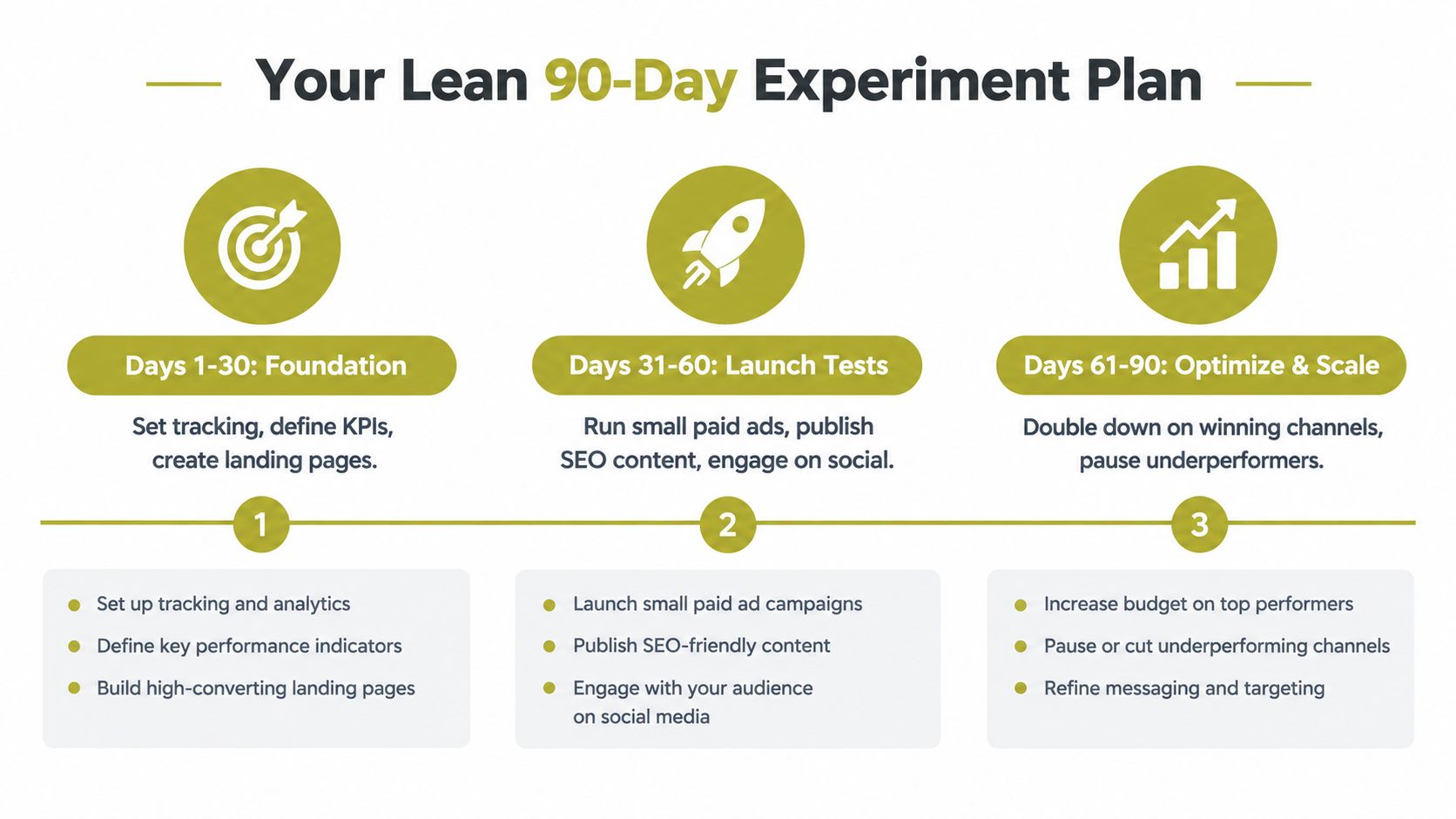
Days 1 to 30
The first month is about clarity and setup. No cleverness. No scale.
Your job is to make sure every click can land somewhere sensible and every enquiry can be traced back to a source.
Build the minimum setup
- Create one conversion page: One offer, one audience, one call to action.
- Set basic tracking: Use Google Analytics 4 and Google Search Console. If you can't read them yet, still install them.
- Add lead capture: Simple contact form or enquiry route. Make it obvious.
- Write core copy: Homepage, one service page, one proof-led about page.
Publish the first useful assets
You don't need a giant content plan. You need a few pieces that answer real buying questions.
Create:
- One bottom-of-funnel page targeting a clear service or product search
- One comparison or alternative page if buyers are weighing options
- One trust-building article that addresses a common objection
Days 31 to 60
Now you can test traffic. Lightly.
Start with a small paid search campaign around high-intent terms. Don't chase broad volume. Chase relevance. Tight themes, clear copy, and a single landing page beat a messy campaign every time.
Here's a straightforward weekly rhythm for a founder doing this part-time:
- Monday: Check search terms and lead quality
- Wednesday: Improve landing page copy or form flow
- Friday: Review spend, pause weak queries, expand only what looks promising
Your goal in month two isn't scale. It's signal.
At this stage, also start a basic email follow-up. If someone enquires or downloads something useful, send a short sequence that answers obvious questions and nudges the next step.
To keep the plan practical, this walkthrough is useful to watch before you build your own test cadence:
Days 61 to 90
By month three, you should have enough evidence to make decisions. Not perfect certainty. Enough evidence.
There are only three outcomes:
- Something is working: Improve it and give it a bit more room.
- Something is unclear: Tighten the message or the targeting and retest.
- Something is weak: Pause it.
Founders often sabotage themselves here. They keep weak channels alive because they “might work later”. That's not discipline. That's avoidance.
A sample under £250 monthly split
If I had to work with a founder on a very lean budget, I'd keep it simple:
- Largest share to paid search: For direct intent testing
- A smaller share to tools or essentials: Analytics, forms, scheduling, or basic design support
- The rest to content production support if needed: Only if the page or article directly supports conversion
No broad paid social. No fancy automation. No overbuilt funnel.
The founder checklist for each experiment
Before any test goes live, answer these questions:
- What exact audience is this for
- What action do I want
- What would count as a useful result
- What would make me pause it
- What did I learn even if it failed
If you can't answer those in plain English, the experiment isn't ready.
Where specialist support actually helps
Founders don't need a bloated agency setup. They need sharper execution in a few places: positioning, conversion copy, search-led content, and media-facing credibility. Carlos Alba Media is built around that specialist model. Everyone who works for Carlos Alba Media is a former national news journalist or has agency experience of working with international brands, which is useful when you need content, digital PR, and messaging that can stand up in public rather than just fill a page.
Measuring What Matters and Knowing When to Scale or Pause
Founders often say they're “tracking performance” when they're really just checking traffic and hoping.
That's not measurement. It's spectatorship.
If you want digital marketing for startups to produce something useful, track the numbers that affect decisions. Keep the dashboard small. Keep the definitions tight. And don't scale anything you can't explain.
The KPIs that matter early
You do not need enterprise reporting. You need these.
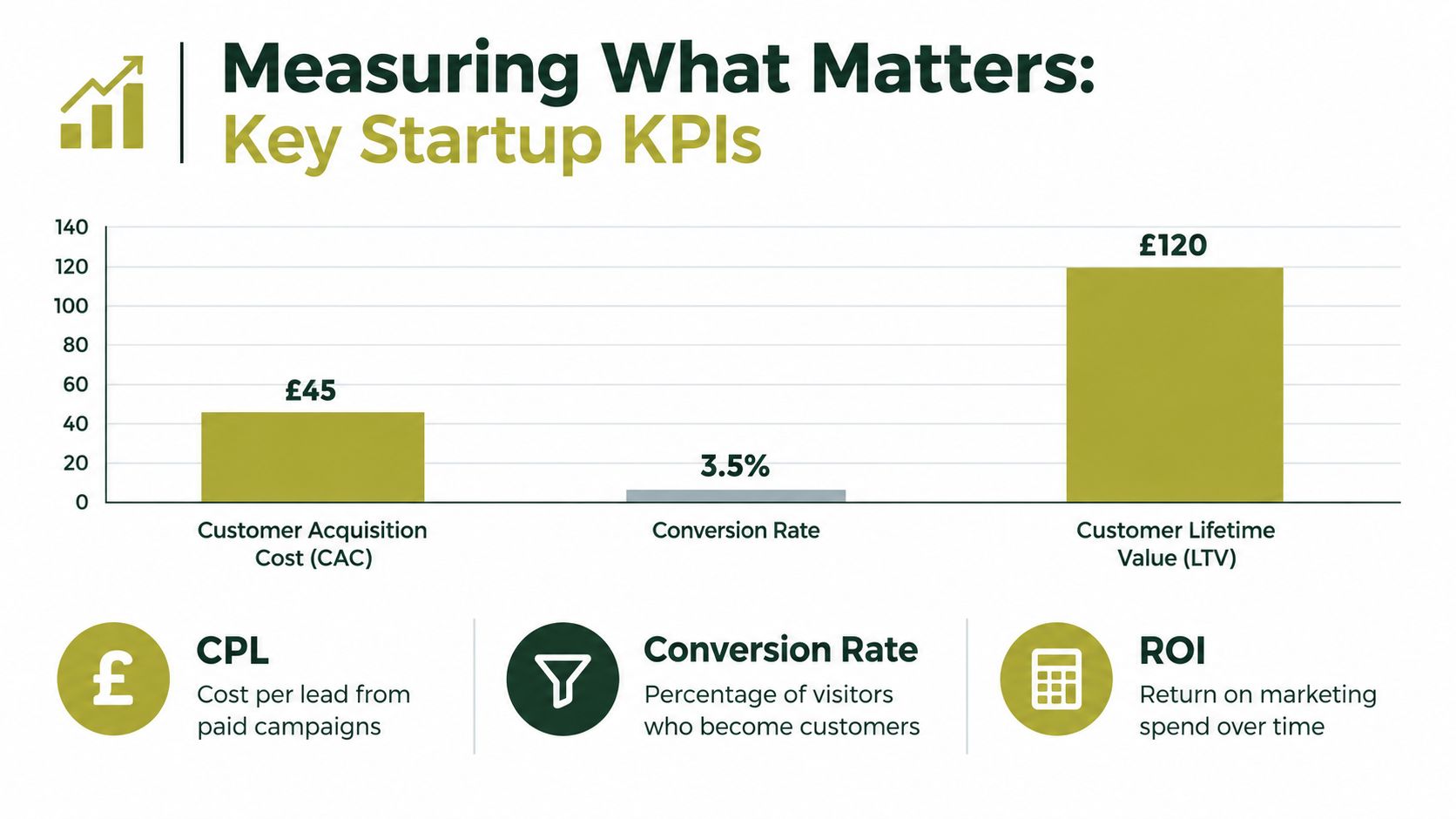
- CPL: What it costs to generate a lead from a paid campaign
- Conversion rate: What share of visitors complete the action you want
- CAC: What it costs to acquire a paying customer
- Payback logic: How quickly the spend starts making commercial sense
The visual above includes example KPI labels, but your own business should use actual numbers from your campaigns, not generic dashboard filler.
Use benchmarks properly
Benchmarks are guardrails, not excuses.
You already know from the earlier benchmark data that channels can behave very differently in the UK. Use that reality to pressure-test your own numbers. If your PPC costs are climbing and the traffic isn't converting, don't “give it more time” indefinitely. Check whether the keyword intent is weak, the page is vague, or the offer is wrong.
This is also where structured reporting helps. A simple review cadence beats an overbuilt dashboard. If you need a reference point for how to think about that process, Carlos Alba Media's page on performance benchmarking is a useful framework for comparing channel output against business goals rather than vanity metrics.
If a channel burns budget and teaches you nothing, pause it.
Build a startup dashboard you'll actually use
Your reporting sheet can be ugly. It just can't be confusing.
Track these fields each week:
| Channel | Spend | Leads | Conversions | Notes |
|---|---|---|---|---|
| Paid search | Your figure | Your figure | Your figure | Search terms, lead quality, page issues |
| Organic search | Your figure if relevant | Your figure | Your figure | Rankings improving, enquiries increasing |
| Your figure if relevant | Your figure | Your figure | Replies, clicks, assisted conversions |
That's enough for most early teams.
Don't ignore AI-mediated discovery
Search behaviour is changing. Founders who rely only on rented reach will feel that change first.
UK internet penetration reached 97.8% with 68.1 million users at the end of 2025, and recent UK marketing data shows only 30% of marketers budgeted for AI technologies in 2026, while 70% did not, according to DataReportal's UK digital 2026 report. I read that as a readiness gap.
The practical takeaway isn't “panic about AI”. It's this:
- Strengthen first-party data: Capture and organise your own audience signals.
- Publish clearer source content: Helpful pages, useful expertise, and direct answers travel better across search and AI summaries.
- Reduce dependence on one platform: If a single channel disappears tomorrow, your pipeline shouldn't collapse.
Know the difference between a weak channel and weak execution
Sometimes the channel is fine. Your execution is the problem.
Ask in this order:
- Is the audience definition clear
- Is the offer compelling
- Is the page built to convert
- Is the traffic intent strong
- Is the follow-up fast enough
Only after that should you blame the channel.
Scaling Smartly and Integrating PR for Trust and Growth
Once you've got a channel producing sensible results, the next move isn't to spray more budget everywhere. It's to reinforce what's already working.
That usually means adding trust assets around your strongest conversion path. Better proof. Better authority. Better visibility in places your buyers already respect.
When to layer in PR
PR makes sense when you can already answer three questions clearly:
- What do you want to be known for
- Who needs to believe it
- What proof do you have
If your startup has early traction, useful customer outcomes, a distinctive founder perspective, or a timely point of view, PR can amplify all of that. It also supports search, strengthens sales conversations, and gives prospects a reason to trust you before they enquire.
Specialist background matters. Carlos Alba Media's model is unusually practical because everyone who works for Carlos Alba Media is a former national news journalist or has agency experience of working with international brands. That matters when you need sharper narratives, stronger media handling, and content that can stand scrutiny outside your own website.
Trust compounds faster than traffic
Not all growth assets look like leads in a spreadsheet on day one.
A strong media mention, a well-framed founder interview, a credible speaking appearance, or a useful quoted comment can improve conversion quality across your existing channels. It can also make email outreach less cold and sales follow-up less fragile.
UK media training providers and the National Council for the Training of Journalists describe media training as a structured discipline involving message development, mock interviews, question handling, body-language coaching, and bespoke training for communications and marketing teams, as outlined by this UK media training provider overview. That's worth remembering if you're putting founders in front of journalists, podcasts, or cameras. Media confidence doesn't come from winging it.
Keep scale narrow before you go broad
When you're ready to expand, use a narrow logic:
- Scale what already converts: Add budget or output to proven paths first.
- Add adjacent channels, not random ones: If search works, strengthen SEO, conversion pages, and remarketing before jumping to unrelated experiments.
- Use PR to support commercial goals: Tie coverage to trust, recruitment, partnerships, fundraising, or category authority.
If you operate in a niche local service category, it's also worth looking at examples outside your sector to see how local visibility gets structured. Even a specialised reference like this Local SEO tool for Lawyers can help founders think more clearly about local intent, listings, and geography-based search behaviour.
Your next 30 days
Be ruthless with the next month.
- Tighten one offer
- Fix one landing page
- Test one intent-led channel
- Set one reporting sheet
- Collect one form of trust proof
That's enough. Done properly, it will beat a scattered plan every time.
If you want senior help without the usual agency sprawl, Carlos Alba Media works with startups and SMEs on the parts that move performance: positioning, digital content, SEO-led visibility, PR, media training, and conversion-focused execution. If your team is stretched and your marketing feels reactive, it's a sensible place to start the conversation.