
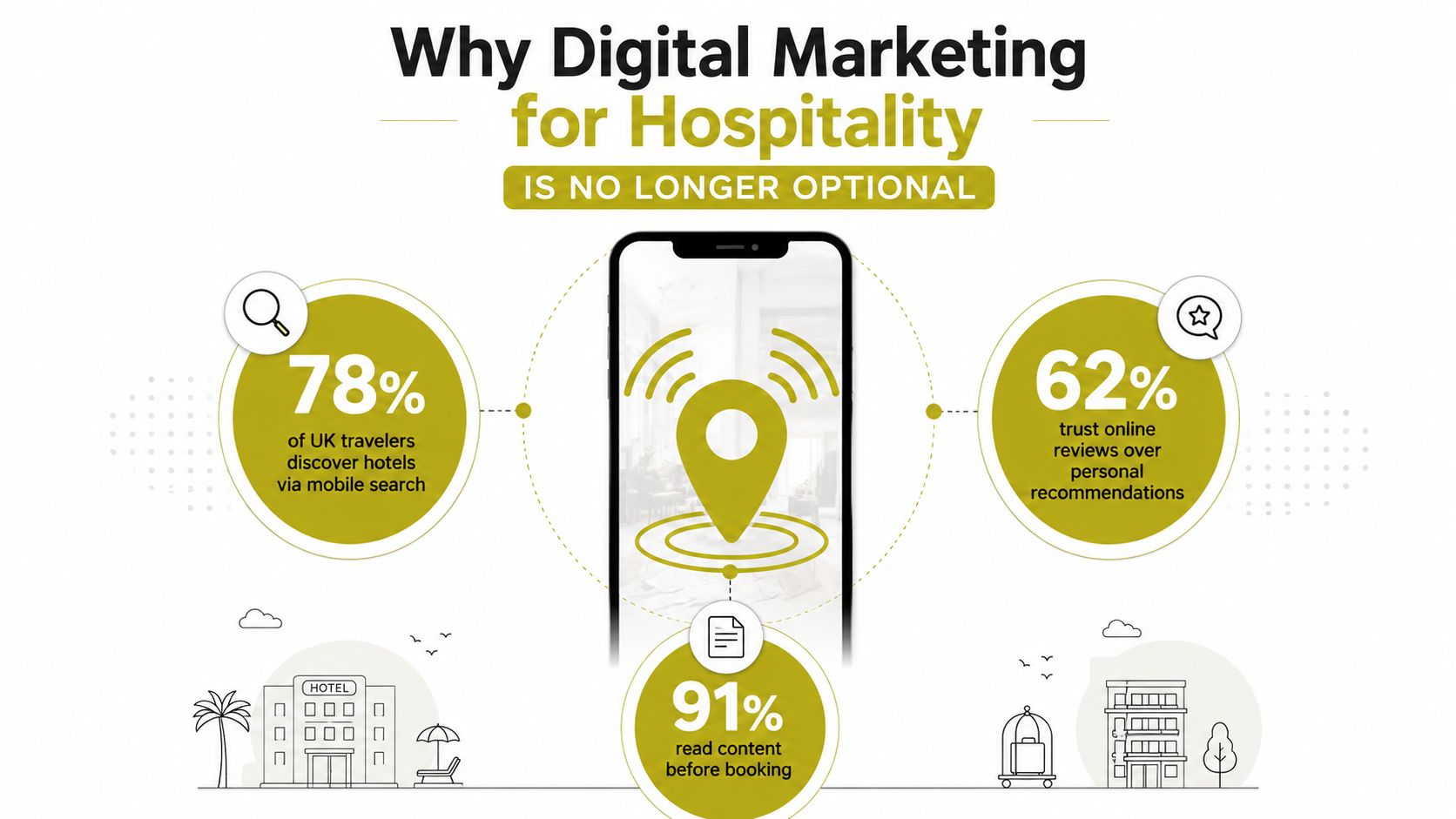
43% of UK travellers now use their smartphones to search for accommodation, and 78% say content-rich destination guides influence booking decisions. That means digital marketing for hospitality starts long before a guest calls reception or clicks “book”, it starts the moment they search, compare, and decide whether your place feels worth trusting.
For hotels, restaurants, and attractions, that changes the job of marketing completely. The challenge isn't posting more often, it's connecting search, social proof, content, and conversion so the guest journey keeps moving toward a direct booking, a table reservation, or an enquiry you can measure.
Why Digital Marketing for Hospitality Is No Longer Optional
Hospitality demand is already digital, social, and review-led. In the UK, 43% of travellers use smartphones to search for accommodation, 55% follow or engage with hospitality brands on social media, and 53% say friend-shared reviews and photos influence their travel decisions, while 78% say content-rich destination guides affect booking choices Talking Hospitality. That changes the shape of demand generation, because the guest is no longer waiting to be persuaded at the front desk. They've often decided whether you're even in the running before they speak to anyone on your team.
The guest journey starts before the enquiry
The old model treated SEO, social, PR, and email as separate silos. In hospitality, they work as one chain. Search answers the first question, social proof reduces doubt, and good content gives a traveller the confidence to click through, check rates, and make a direct booking rather than drifting back to an OTA.
That's why a channel list is never enough. A hotel can have decent Instagram content and still leak revenue if the landing page is thin, the booking path is unclear, or the local search presence is weak. A restaurant can post beautiful food shots and still lose covers if the Google Business Profile is stale or the menu is impossible to understand on mobile.
For a practical framework, a useful starting point is the direct booking platform view of hospitality media channels, because it pushes the conversation toward booking outcomes rather than vanity metrics. The point isn't to chase every channel. It's to pick the ones that move a guest from interest to transaction.
What a specialist approach gets right
A newsroom-led, performance-aware agency tends to outperform generic posting because hospitality lives on timing, relevance, and proof. Carlos Alba Media is positioned as a Scottish-led consultancy run by a former national newspaper editor, and its team is described as blending newsroom insight with modern brand building, plus services spanning media exposure, content, web design, social media, and crisis management. In practical terms, that matters because hospitality marketing needs story sense and commercial discipline at the same time.
Practical rule: if a campaign doesn't improve discovery, trust, or booking clarity, it's just content noise.
The rest of this playbook follows the guest journey, not a channel checklist. That's the difference between marketing that fills feeds and marketing that fills rooms, tables, and tickets.
Mapping the Guest Journey and Audience Segments
A useful hospitality journey map has five stages, inspiration, planning, booking, stay, and advocacy. Each stage has different questions attached to it, and each segment behaves differently inside it. A leisure couple wants atmosphere and a reason to escape. A business traveller wants speed, location, and certainty. A family wants practicality. A local regular wants convenience and familiarity. A group booker wants confidence that the venue can handle logistics without drama.
| Guest Journey Stages and Channel Priorities | |||
|---|---|---|---|
| Stage | Guest Mindset | Primary Channels | Key Content |
| Inspiration | “Is this somewhere I'd like?” | Social, PR, guides, video | Destination stories, atmosphere, experiences |
| Planning | “Does it fit my needs?” | Search, website, FAQs, reviews | Location pages, access info, menus, room types |
| Booking | “Is this the best choice?” | Booking engine, remarketing, email | Rate clarity, direct-booking benefits, reassurance |
| Stay | “Is the experience matching the promise?” | SMS, email, in-house prompts | Arrival info, upgrades, practical service details |
| Advocacy | “Would I come back or recommend it?” | Email, reviews, social follow-up | Review requests, shareable moments, loyalty offers |
A boutique hotel in Scotland can use that map to write very different content for the same property. In the dreaming stage, a weekend couple needs destination-led inspiration, maybe a city break guide or a winter escape story. In the planning stage, that same couple wants parking, check-in times, and nearby restaurants. A corporate guest, by contrast, cares less about romance and more about transport links, fast Wi-Fi, and easy invoice handling.
The most common mistake is treating segments as audiences instead of jobs-to-be-done.
A family does not want “family content”. They want proof that the trip will be easy, safe, and worth the money.
That's why the customer journey mapping approach matters, and why it's worth aligning content briefs to each stage rather than asking every channel to do everything. A good reference point is the journey-mapping discipline outlined in Carlos Alba Media's customer journey mapping guidance, because the mechanics are the same, even when the end sale is a room, a meal, or a venue hire.
When the map is done properly, channel priorities become obvious. Inspiration content goes to social and earned media. Planning content sits on the website. Booking content supports the engine and retargeting. Stay content reduces friction. Advocacy content turns satisfied guests into repeat demand.
SEO and Local Search for Hotels, Restaurants and Attractions
SEO in hospitality isn't about publishing generic blog posts and hoping Google notices. It's about making each page answer the exact questions people ask when they're close to booking. For hotels, restaurants, and attractions, the strongest local-search wins usually come from a tight mix of Google Business Profile work, clear location pages, schema markup, and destination content that reflects genuine intent rather than keyword stuffing.
Build pages that answer booking questions
The practical question set is more important than the keyword list. Travellers want to know about parking, accessibility, pet policies, rail links, check-in times, menus, event proximity, and whether the venue suits the reason for the trip. Those facts also matter in AI search, because answer engines tend to quote the clearest, most structured information they can find.
A strong attraction page should have a concise opening summary, opening hours, ticket or entry information, access details, what's nearby, and one or two clear calls to action. Then add structured data where it fits, especially local business, reviews, events, menus, and room or facility details. If the venue hosts changing exhibitions or seasonal activity, keep those updates easy to scan, because freshness matters to both users and crawlers.
For multi-site brands, it's also worth reading about local SEO for multiple locations so each property page stays distinct and doesn't collapse into duplicate copy. The same discipline applies to restaurants with several branches and attraction groups with different sites under one brand.
Ship the basics in a week
A small team can make real progress quickly if it focuses on the right fixes.
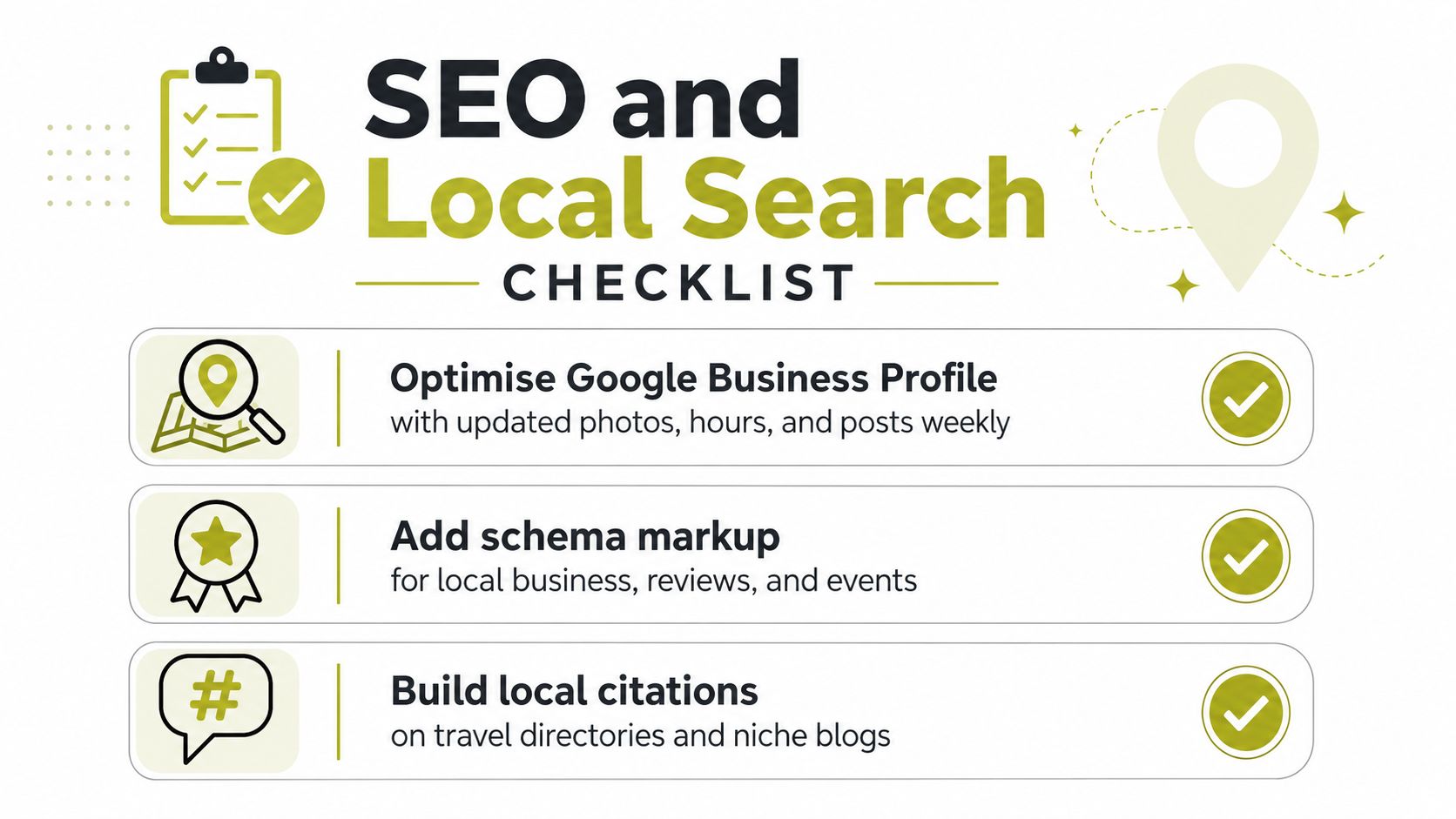
- Refresh Google Business Profile listings: update hours, photos, attributes, and recent posts.
- Add structured data: mark up local business details, reviews, events, menus, or room types.
- Rewrite location pages: answer access, transport, parking, and nearby landmarks clearly.
- Tighten headings and meta copy: match real search intent, not brand language alone.
- Add internal links: connect destination pages, booking pages, and practical FAQs.
A voice-search-friendly page also helps, which is why a practical guide such as voice search optimisation is worth a look for properties that rely on local discovery. The pattern is the same across hotel, restaurant, and attraction SEO. Clear facts beat clever copy when the guest is ready to choose.
Rule of thumb: if a page doesn't help someone decide, it won't help you rank for long.
Content, Social and Paid Media Without Wasting Budget
Hospitality content works best when it feels like proof, not promotion. The strongest pillars are usually behind the scenes, local stories, staff and craft, guest experiences, and user-generated content. Those themes work because they answer the question behind the click, “What will it feel like if I book here?”
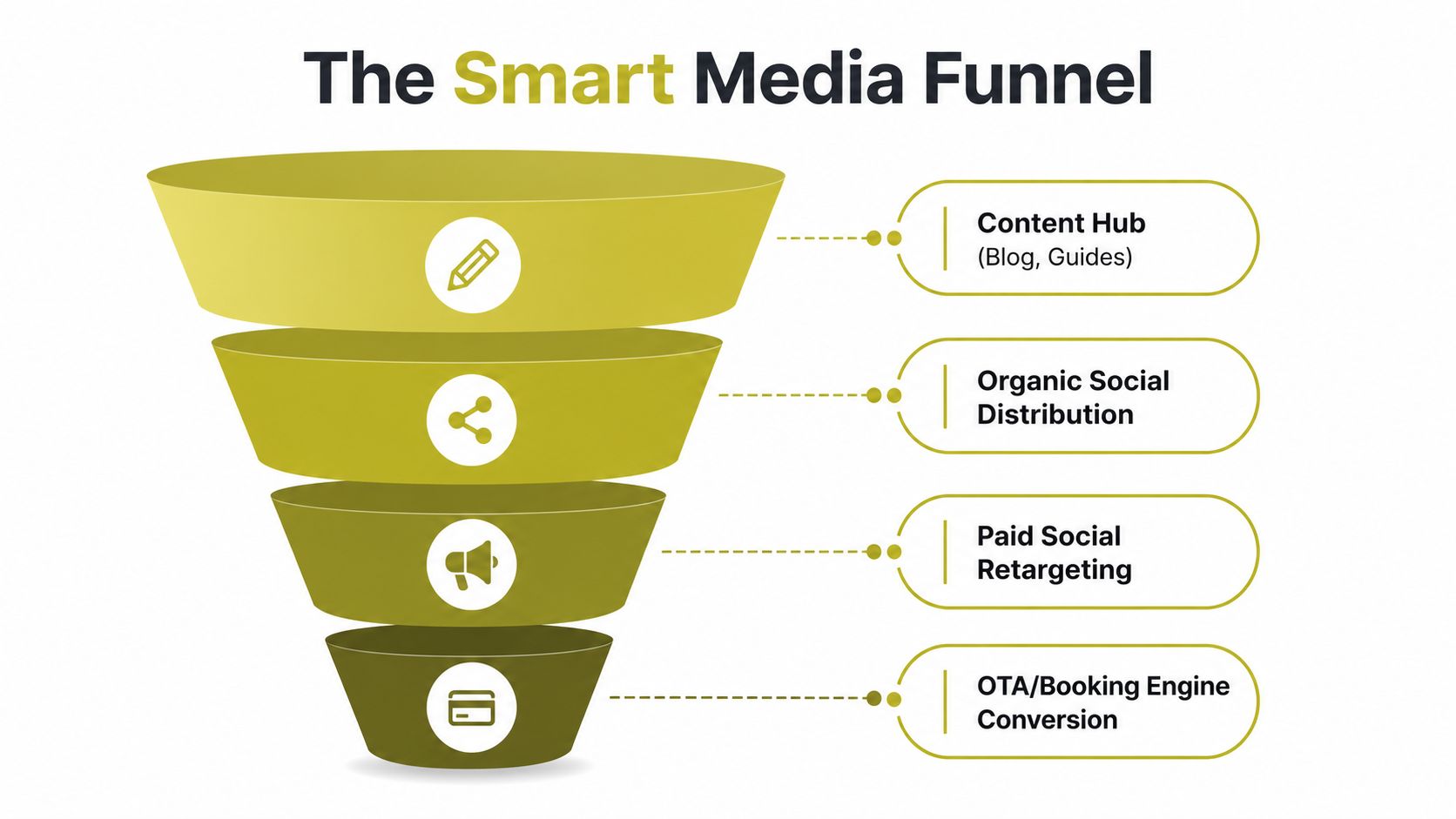
The mistake is treating organic and paid as separate worlds. Organic content creates the story, paid media extends the reach of the best pieces, and retargeting keeps the brand in view until the booking is made. OTAs sit in that system too. They can work as a discovery layer, especially for travellers comparing options, but they should not be the end of the strategy if direct demand is the goal.
A budget split that small teams can run
For an SME, a 60/40 organic-to-paid split is often more realistic than trying to run everything through paid spend. Organic does the heavy lifting on trust, content depth, and social proof. Paid should amplify what is already working, not rescue weak creative.
Owned, earned and paid media planning gives small hospitality teams a clearer way to decide what deserves budget and what should stay organic. A newsroom-style team helps because it does more than schedule posts, it looks for angles, tightens the copy, and packages the story in a way that feels native to the channel. Carlos Alba Media can sit in that mix as one option for brands that want media-led storytelling alongside digital execution, but the broader point is simple. Hospitality content gets sharper when someone knows how to find the story fast and turn it into a usable asset.
What to amplify and what to leave alone
Use paid spend on the content that already shows traction. A local guide that gets saved often, a room video that keeps people watching, or a chef-led post that drives comments are all better candidates than generic “book now” creative. Retargeting can then follow people who visited the site, looked at dates, or engaged with booking-related content, which keeps the message focused on conversion instead of broad awareness.
The webinar guidance in the verified data recommends performance-led media with direct-booking efficiency in mind, and suggests that luxury properties often invest about 1-2% of booked revenue back into media across Google Ads, metasearch, Microsoft Ads, and paid social YouTube hospitality media webinar. The bigger lesson is not the exact number, it is that underfunding upper and lower funnel activity at the same time can make the mix look efficient while starving demand.
The media funnel only works if every layer earns its place.
The smartest hospitality teams do not ask, “Should we post more?” They ask, “Which story will help a guest move one step closer to booking, and which channel is best for that step?”
Email, CRM and Loyalty That Lift Repeat Bookings
Retention is where hospitality marketing becomes properly commercial. If the booking data is captured cleanly, CRM can segment guests by stay type, booking source, and timing, then trigger messages that feel relevant instead of random. That starts with the booking form. If a guest never consents to email or the property never tags their stay properly, the whole lifecycle programme weakens before it begins.
A sensible lifecycle flow has five parts, pre-arrival, in-stay, post-stay, win-back, and loyalty. Pre-arrival emails should be brief and practical, with the useful details a guest needs. In-stay messages should reduce friction, not sell too hard. Post-stay emails should ask for feedback and reviews. Win-back emails should be seasonal or event-led. Loyalty emails should reward behaviour that supports direct bookings.
For a small Scottish hotel group, a simple direct-only mechanic works better than a complicated points system. A “stay three, get a fourth night” offer tied to direct bookings is easy to understand, easy to promote, and easy to segment. Frequent leisure guests get one version of the message. Corporate travellers get another. Families who book school holiday dates get a different cadence again.
Subject lines and cadence that don't feel robotic
Subject lines should be clear first, catchy second. “Your arrival details for Friday” will usually beat clever wordplay when the guest is close to check-in. Personalisation can help, but it should stop before it becomes creepy. Use name, stay date, and property name where it's useful, then leave it there.
A realistic cadence is light and regular. Send the pre-arrival message once the booking is confirmed, the in-stay prompt only if it helps, the review request after departure, and the win-back message when there's a credible reason to return. Too many emails flatten response, and over-automation strips out the human voice that hospitality depends on.
The point is to sound like the property knows the guest, not like software is watching them.
Useful test: if a guest would find the email helpful at the desk, it's probably worth sending.
The best CRM programmes are not flashy. They're tidy, timely, and specific, and they make direct bookings feel like the natural way to return.
Reputation, Reviews and Trust in an AI-Search World
“Get more five-star reviews” is lazy advice. Reputation is really a system across Google, Tripadvisor, OTAs, social, and the AI answer layer that increasingly sits on top of search. The guest doesn't just read the star rating. They scan the response style, the language used by management, and the clarity of the booking path before they decide whether to trust the property.
A good response to criticism does three things. It acknowledges the issue without becoming defensive, it explains any relevant fix or context, and it shows future guests that the team is accountable. That public reply is not only for the unhappy reviewer. It's also for every traveller reading the thread and every system that summarises business quality from visible signals.
Transparent pricing matters more than polished copy
UK hospitality also has to stay alert to rate parity and search transparency, because the booking journey can feel fractured if pricing looks inconsistent or hidden. Clear pricing on the booking page reduces friction. Guests are more likely to convert when they can see what's included, what isn't, and how direct booking compares with other routes.
A single well-handled response can do real work for the rest of the site. If a review complains about parking, for example, and the manager replies with clear, calm guidance, that response can inspire a booking-page note or FAQ section that handles the issue before it becomes a blocker. That's how reputation becomes conversion copy.
When guests see a thoughtful response to a complaint, they see a business that can handle their stay too.
The AI-search angle matters because answer engines reward facts, not vague claims. If your public content clearly states access, parking, transport, pet policy, and location context, it becomes easier for systems to quote you and easier for travellers to trust you. That is especially useful for independent venues that can't rely on scale alone.
Reputation management is no longer just about damage control. It's part of the booking engine's trust architecture.
Measurement, Attribution and a 90-Day Action Plan
Hospitality marketing only improves when the numbers make sense. The weekly dashboard for an SME should be simple enough to run without an analyst and useful enough to guide decisions. Track direct booking share, cost per acquisition by channel, direct revenue versus OTA revenue, repeat guest rate, and review velocity. Those measures tell you whether the mix is creating net-new direct value or just redistributing demand.
Attribution matters because last-click reports can flatter the wrong channel. A traveller may discover the property in search, revisit through social, and finally book after a branded search or retargeting ad. If you only credit the final click, you underinvest in discovery and overestimate the channel that happened to close the sale. Simple blended tracking, with UTM discipline, booking-engine notes, and quarterly channel review, is enough to start proving the contribution of each touchpoint.
The verified guidance on hospitality digital workflow also recommends starting with SMART goals, then segmenting audiences, allocating budget by channel, testing the mix, and monitoring results MyLighthouse hotel digital marketing guide. That sequence works because it keeps the plan grounded in execution, not theory.
A realistic 90-day plan
Days 1 to 30, foundations. Audit the website, fix tracking, clean up Google Business Profile listings, and baseline the content you already have.
Days 31 to 60, acceleration. Launch content updates, test paid search and paid social, and build the CRM capture flow.
Days 61 to 90, scale. Add loyalty mechanics, refine AI-search friendly pages, and review which channels are producing net-new direct revenue.
For a small UK hospitality business, the budget does not need to be huge to be useful. What matters is that the spend is consistent enough to test, learn, and reallocate with confidence. If the work is fragmented, you'll never know which part is helping.
Bottom line: digital marketing for hospitality works only when strategy, content, and measurement are run by people who understand both the newsroom and the booking engine.
If you want a hospitality programme that connects PR, SEO, social, and conversion-led content without the usual agency bloat, visit Carlos Alba Media. The team can help shape a practical plan around direct bookings, reputation, and measurable growth, with the kind of editorial instinct that makes hospitality content more credible and more commercially useful.