

More than 1 billion voice searches are performed every month globally (Sixth City Marketing). That figure changes the conversation. Voice search optimization isn't a niche SEO tweak for gadget fans. It's part of how people now look for answers, compare options and choose local businesses.
For UK SMEs, this transformation is bigger than search mechanics. People aren't typing fragments into a box. They're asking full questions out loud and expecting a direct answer. That means the best-performing content often reads less like keyword stuffing and more like a clean interview answer.
That is where specialist communication matters. Carlos Alba Media draws on a team made up of former national news journalists or people with agency experience working with international brands. Carlos Alba Media's team is explicitly composed of former national newspaper and broadcast journalists, leveraging insider expertise to craft compelling narratives that capture media attention, confirming the agency's specialist nature rooted in newsroom experience (Carlos Alba Media media exposure). In practice, that newsroom discipline maps neatly to voice search. Get to the point. Answer the question clearly. Give the assistant something safe to quote.
The Future of Search Is Spoken
Voice search optimization used to sit in the “worth watching” category. It doesn't anymore. Search behaviour has moved from clipped keywords towards natural speech, and businesses that still write only for typed search are leaving visibility on the table.
Voice changes the format of the search result
A typed search gives users options. A spoken search often gives them one answer first. That changes the standard. Your page doesn't just need relevance. It needs to sound authoritative, concise and easy to read aloud.
That's why weak copy gets exposed quickly in voice search. Long introductions, vague service pages and generic FAQ sections don't help an assistant decide what to say. Clear answers do.
A voice assistant isn't browsing your site like a person. It's hunting for the cleanest answer it can trust.
There's also a measurement problem. Many SMEs know they're seeing broader AI-driven search behaviour but struggle to isolate what's coming from conversational interfaces. A practical starting point is learning how to measure AI search traffic, especially if your analytics reporting still treats these visits as an afterthought.
What good voice content actually does
The best voice-ready pages tend to share a few traits:
- They answer early: The first lines deal with the actual question, not brand history.
- They sound natural: The wording matches how a customer would ask the question out loud.
- They reduce ambiguity: Product names, locations, services and next steps are all explicit.
- They hold up under scrutiny: If an assistant reads one paragraph aloud, it still makes sense on its own.
This is why voice search optimization is as much an editorial job as a technical one. A search engine can index a cluttered page. A voice assistant needs something better than that. It needs a usable answer.
Why Your Customers Are Talking Not Typing
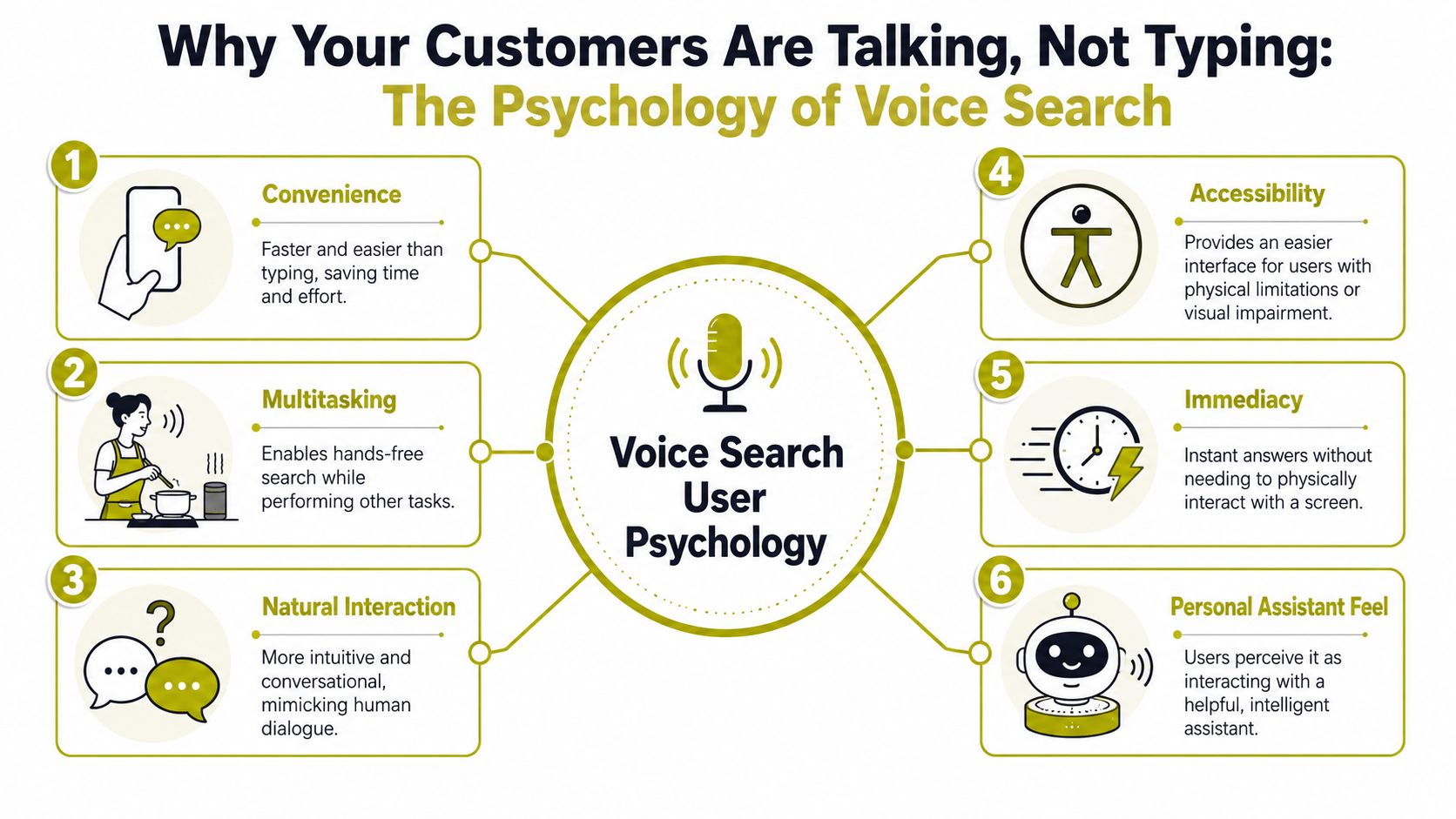
Voice search usually happens in the middle of something else. A customer is driving to a job, cooking dinner, walking through town, or checking options while standing in a shop. They want the fastest clear answer with the least effort.
That changes behaviour.
Typed search often starts with fragments. Voice search sounds more like a real request. People ask full questions, add context, and reveal what they need right now. A search for “accountant Manchester” becomes “Who can help with small business tax returns in Manchester?” A search for “boiler repair” becomes “Can someone fix my boiler today?”
Your site is being asked a question
A voice query puts pressure on clarity because the user is not browsing. They are asking for a direct answer. If your page opens with generic marketing copy, the moment is lost. If it answers the question in plain language, you have a chance to be the response that gets read aloud.
This is less about keywords in isolation and more about stated intent. A page built around “emergency plumber Glasgow” can still be useful. A page that clearly answers “Who can fix a leaking pipe in Glasgow tonight?” is closer to how people speak, and closer to what they need.
The format also changes what counts as good content. Scanning a list of blue links gives people room to compare. Listening to one spoken answer does not. The winning page is often the one that removes doubt fastest.
What voice queries reveal about intent
Voice searches tend to surface the details marketers often strip out. Urgency. Location. Price sensitivity. Trust. Timing.
Common patterns look like this:
- Immediate need: “Where can I get my phone screen repaired today?”
- Local intent: “What's the best accountant near me for a small business?”
- Clarification: “How much does boiler servicing usually cost?”
- Trust check: “Which cafe in Edinburgh is open now and has good reviews?”
Those are strong commercial signals. They tell you what the customer wants to know before they are ready to click, call, or visit.
A useful rule for SMEs is simple. If a customer can ask the question in one breath, your page should answer it in one glance.
That means shorter openings, clearer service descriptions, and fewer vague claims. It also means writing in the language customers use, not the language a business prefers in internal documents. For a plain-language explanation of the systems interpreting these requests, what is an AI voice assistant is a helpful reference.
The AI Behind the Voice Answering Questions
Voice assistants don't “read the internet” the way humans do. They parse language, identify intent and select an answer they can deliver confidently. That's why traditional SEO alone often falls short. Ranking matters, but so does machine comprehension.

Search engines have become answer engines
When somebody asks a voice assistant a question, the system usually isn't looking to present a menu of ten blue links. It's trying to produce a single spoken response. That pushes search closer to an answer engine model.
Natural language processing helps the system work out what the user means, even when the wording is informal. It then looks for content that is structured, unambiguous and easy to summarise. If your page buries the answer inside filler, the AI may skip it, even if the topic is relevant.
If you want a plain-language explainer on the technology itself, this breakdown of what is an AI voice assistant is a useful companion.
The answer engine gap
A lot of SMEs have decent websites that still underperform in voice. The reason is simple. The content may be relevant to a human reader, but awkward for AI summarisation.
That gap has consequences. Recent data shows UK businesses lose 40% of voice-driven local traffic when their content isn't structured for AI summarisation, despite high relevance (UltraScout).
A page can fail in several ways:
| Problem | What the assistant sees |
|---|---|
| Long introductory waffle | No clear answer near the top |
| Dense paragraphs | Hard to extract a concise spoken response |
| Vague service descriptions | Unclear entities, locations or benefits |
| No structured question headings | Weak match for conversational queries |
What AI prefers
AI systems tend to favour content that does three things well:
- Names the question clearly
- Answers it directly in the next lines
- Supports the answer with useful detail after that
This doesn't mean writing for robots. It means removing friction. A human reader benefits from that clarity as well.
How to Write for Voice A Conversational Content Strategy
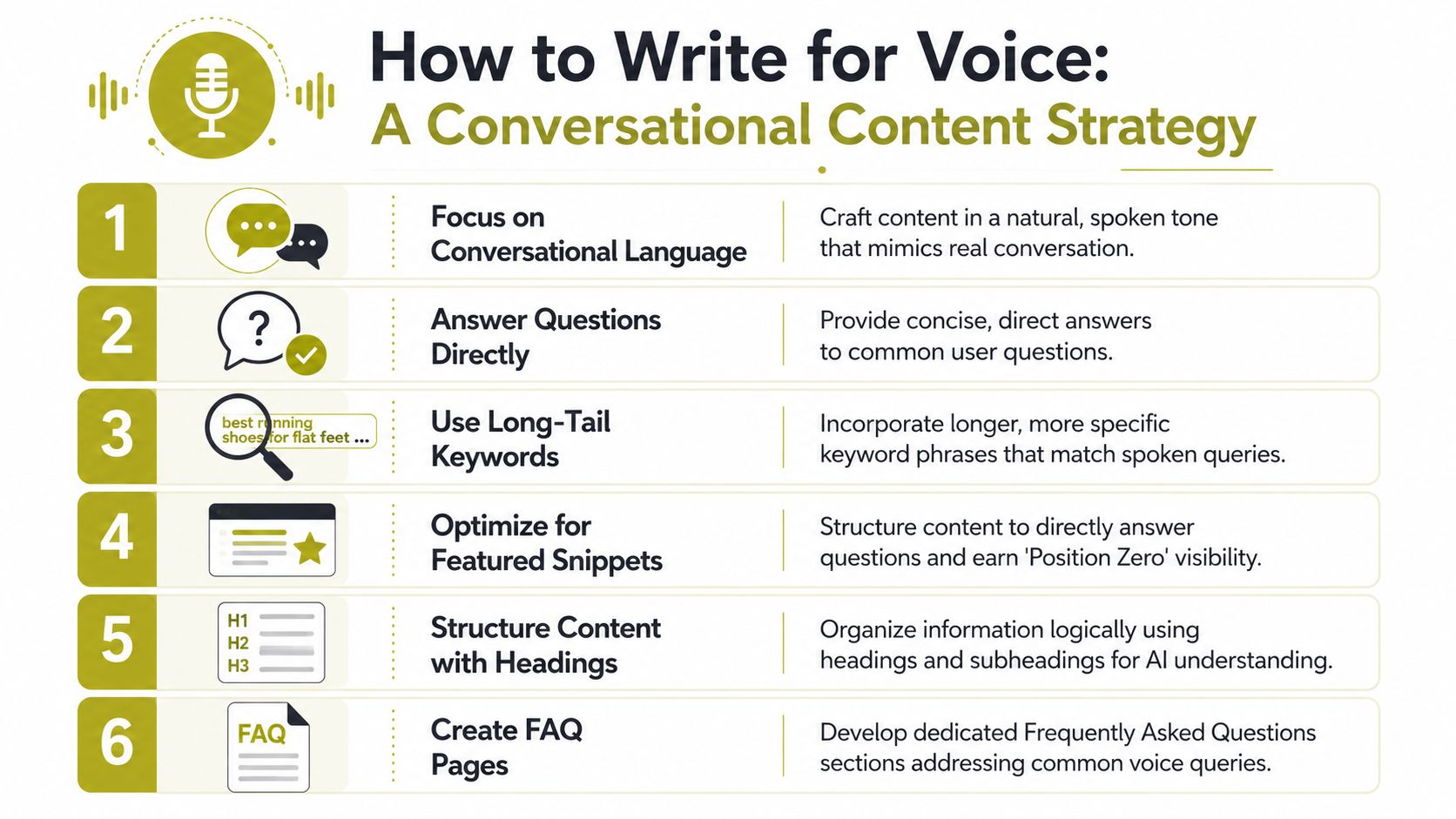
Voice content wins when it answers like a good reporter. Get to the point fast, use the words people say, and add detail only after the core answer is clear.
That matters because voice search is not only an SEO formatting task. It is a communication test. Search systems favour pages that sound like the clearest available answer to a spoken question, and users judge that answer in seconds.
Start with real spoken questions
Keyword tools help, but they should not be the first source. The stronger input usually comes from customer conversations: phone calls, enquiry forms, emails, reviews, sales notes and chat transcripts. That language is messy, specific and far closer to how people speak to Siri, Alexa or Google Assistant.
Useful places to find those questions include:
- Google Search Console: Review longer queries and question-based searches.
- Customer service inboxes: Repeated concerns often map neatly to voice intent.
- Sales calls: These reveal comparison questions, objections and urgency.
- Google Business Profile Q&A: A strong source of local phrasing.
Use that wording in headings where it makes sense. “How long does roof repair take in winter?” gives both users and search systems a clear target. “Project Timelines” does not.
Answer first, then support the answer
A lot of business copy still behaves like a brochure. Voice search prefers an answer file.
The practical structure is simple:
- Put the question in the heading
- Answer it in the first one or two sentences
- Add specifics, exceptions or examples underneath
- Link to related pages after the main point is established
Here is the difference in practice:
| Weak approach | Stronger voice-ready approach |
|---|---|
| Long brand introduction before the answer | Direct answer in the first paragraph |
| Generic service language | Specific explanation tied to the query |
| One page covering too many intents | Sections built around distinct questions |
| Overwritten copy | Short sentences and plain English |
A good test is to read the opening answer aloud. If only that portion were quoted by an assistant, it should still make sense and still sound trustworthy.
Write for the ear, not just the screen
Some pages are optimised on paper and awkward in speech. They are packed with keyword fragments, long subordinate clauses and vague claims. A voice assistant can still crawl them, but that does not make them a strong spoken result.
Three habits improve that quickly:
- Use natural phrasing: Write the way a customer would ask the question.
- Keep sentences short enough to say comfortably: Spoken answers need room to breathe.
- Name the specifics: Include the service, location, audience or scenario where relevant.
Tone plays a role too. Formal copy can sound distant when read aloud, while over-casual copy can weaken trust. A clear set of tone of voice guidelines for business content helps teams keep answers conversational without losing authority.
Make FAQs work harder
FAQ sections help when they answer real questions that deserve a clean, separate response. They fail when they exist only to stuff in extra phrases.
Useful FAQ entries usually do four things well:
- cover one question at a time
- answer it immediately
- cut promotional padding
- point to the most relevant service or location page where needed
For SMEs, this is often the fastest content fix. A service page with three or four well-written question blocks can outperform a longer page full of vague marketing copy. The goal is not to sound clever. The goal is to be the answer an assistant can trust and a customer can act on.
Technical SEO Foundations for Voice Search Success
Voice search rewards the clearest answer, but that answer still has to be accessible, readable and easy for search systems to verify. Technical SEO earns its keep. For SMEs, the job is rarely to add flashy features. It is to remove friction so your best answer can be found and trusted.
Speed and mobile usability shape whether your answer gets seen
Voice queries often happen on phones, in the car, or while someone is doing something else. Patience is low. If a page is slow, cluttered or awkward to use on a small screen, you lose ground before your content has a chance to compete.
Start with the pages that carry commercial intent, not just the homepage. In practice, that usually means service pages, location pages, contact pages and high-performing FAQs.
- Compress oversized images: Hero banners and stock photography often add weight without adding clarity.
- Reduce script bloat: Chat widgets, trackers and animation libraries can slow the pages that matter most.
- Check mobile interactions: Tap targets, sticky menus and forms need to work cleanly on a phone.
- Test important URLs one by one: A site can look fine overall while its key conversion pages are underperforming.
A technical review against an SEO audit checklist for crawling, speed and on-page issues helps catch these weaknesses before they limit the return from your content work.
Structured data removes guesswork
Voice optimisation is partly a communication problem and partly a translation problem. You need to tell both the customer and the machine what the page means. Structured data helps with the second part.
The markup types that usually matter most are:
- FAQPage for clean question-and-answer sections
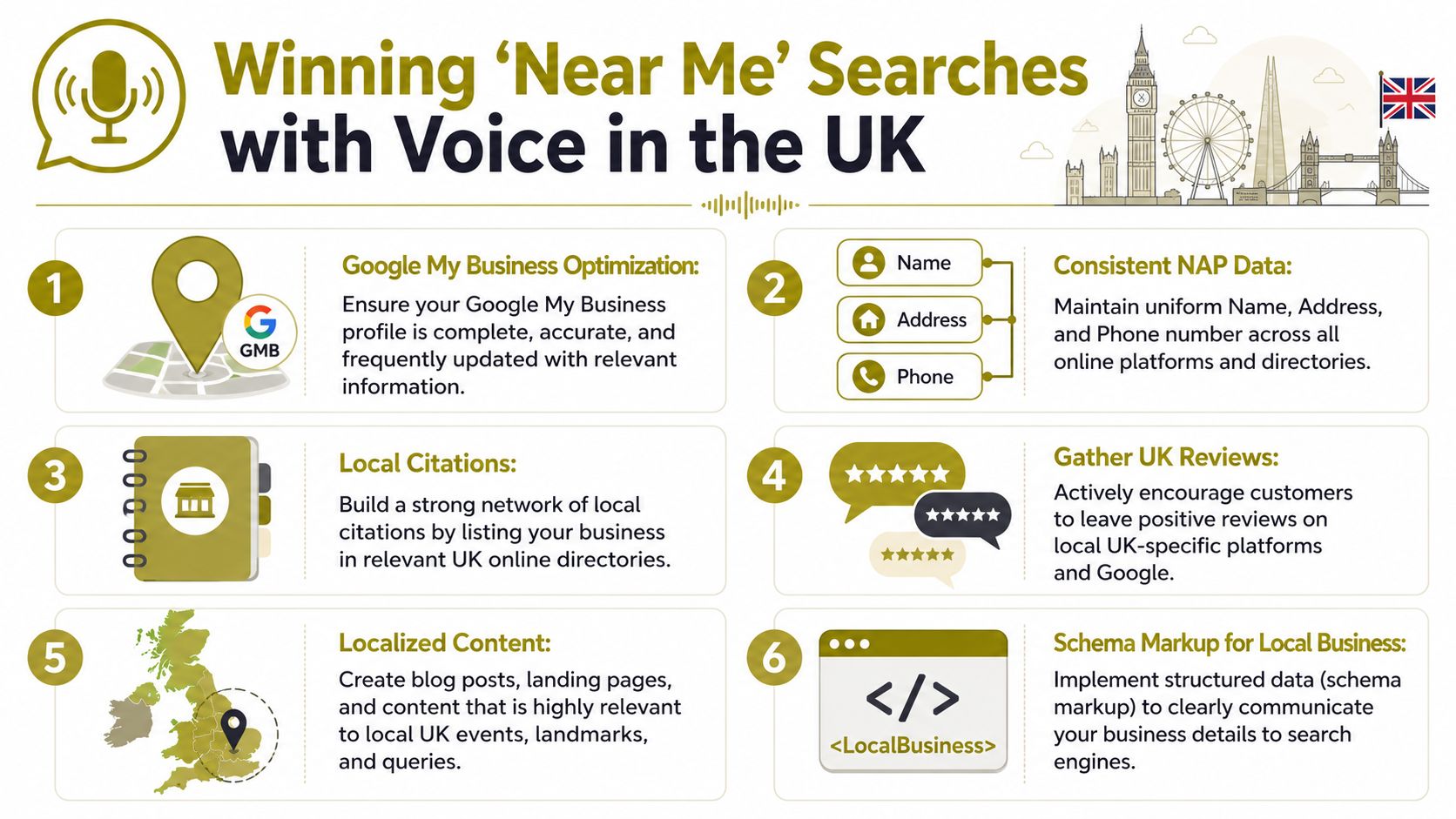
- LocalBusiness for address, phone number, opening hours and service area
- Article for explainer content that supports topical authority
- Product or Service schema where the offer needs clearer definition
Schema does not rescue weak copy. It clarifies strong copy. If your visible page says one thing and your markup says something else, or key business details are missing, you create uncertainty. Search systems tend to reward consistency.
Build pages machines can extract answers from
Design choices often get in the way of retrieval. A stylish page can still be hard for search engines to interpret if important details are hidden inside images, tabs, sliders or vague headings.
Use structure that supports extraction:
| Better for voice | Worse for voice |
|---|---|
| Plain HTML text | Key details embedded in graphics |
| Clear heading hierarchy | Styling that ignores semantic structure |
| Separate location or service pages | One broad page trying to cover every audience |
| Visible contact and service details | Information hidden behind clicks or interactions |
This matters for local businesses in particular. Teams still sorting out the basics of defining local marketing often focus on channels first and site structure second. For voice search, that order causes problems. If your site makes it hard to extract who you serve, where you operate and what you offer, assistants have less confidence in your answer.
If a machine has to infer the basics, your page is already harder to surface than it should be.
Winning Near Me Searches with Voice in the UK
Local voice queries often come from people who want to act now. A user asking, “Who's open near me?” or “Where can I get my phone screen fixed today?” is not browsing. They are trying to choose.
For UK SMEs, that changes the job. Voice search is not only about rankings. It is about being the clearest and most credible answer a device can repeat with confidence.
Google Business Profile often decides whether you get surfaced
Assistants pull local answers from signals they trust. Your Google Business Profile sits near the top of that stack, especially for searches with clear local intent.
Get the basics right first:
- Correct business details: Name, address, phone number, opening hours
- Tight category selection: Use the closest primary and secondary categories available
- Up-to-date operational info: Holiday hours, temporary changes, service updates
- Useful customer prompts: Add Q&A entries based on real questions customers ask
- Current visual proof: Recent photos that match the location and service experience
A neglected profile creates hesitation. A complete one helps search systems match your business to the question being asked.
If you need a broader frame for how local visibility supports growth, this guide to defining local marketing is a useful reference.
Consistency helps assistants trust your business
Voice platforms are risk-averse. If your address is different across listings, your phone number varies by directory, or your service area is vague, you make the decision harder for the system.
That is why local voice performance often comes down to operational discipline:
- Standardise NAP details across your website, directories, and listings.
- Build reviews steadily and reply with useful, specific responses.
- Publish location pages for actual towns, cities, or service areas you want to win.
- Use the language customers speak in headings, FAQs, and opening paragraphs.
Teams refining local pages can also review practical ways to improve SEO rankings for location and service pages.
The business that wins a voice-led local query is often the one with the clearest public record and the clearest answer.
Write for spoken local intent
Local voice searches tend to bundle three things together: place, need, and urgency. “Who repairs boilers in Leeds?” “What time does the pharmacy near me open?” “Where can I get flowers delivered in Bristol today?”
Those queries need direct answers on the page. A florist in Glasgow, a solicitor in London, and a hotel in Edinburgh should each have copy that reflects the questions people actually ask in that area. Generic local SEO text rarely does enough, because it sounds interchangeable.
This is where the communication side matters. Good voice optimisation is clear reporting. State what you do, where you do it, when you are available, and why someone should trust you. If a spoken query sounds like a real question from a real customer, your page should answer it just as plainly.
Measuring Impact and Future-Proofing Your Strategy
Voice traffic can be awkward to isolate cleanly, so measurement needs a practical mindset. Instead of chasing a perfect “voice search” report, track the signals that usually move when voice search optimization is working.
What to watch
Start with a small set of indicators:
- Question-based queries in Google Search Console: Look for increases in conversational searches.
- Performance of FAQ and service pages: These often improve first when voice-focused edits land.
- Featured answer visibility: If your pages start winning direct-answer placements, that's a strong sign.
- Google Business Profile activity: For local firms, this can reveal whether near-me visibility is improving.
What holds up over time
The durable lesson is simple. Voice search rewards the same things good journalism rewards: clarity, relevance, authority and respect for the audience's real question.
That matters because the interface will keep changing. Smart speakers, mobile assistants, AI answer engines and hybrid search experiences won't all behave exactly the same way. But they all favour content that is easy to interpret and safe to repeat.
Businesses that treat voice search optimization as a communication discipline, not just a plugin task, are better placed for what comes next. They publish pages that answer questions cleanly, support those answers with sound structure, and remove friction for both humans and machines.
If your business needs a sharper voice search strategy, Carlos Alba Media brings a rare mix of newsroom judgement and digital marketing expertise. Everyone on the team is a former national news journalist or has agency experience working with international brands, which means your content gets shaped by people who know how to find the angle, tighten the wording and build authority that earns attention. For SMEs that want senior-level support without big-agency drag, it's a practical partner for content, SEO and local visibility work that has to perform in practical settings.