
You're probably doing some version of this already. A bit of SEO work. A few LinkedIn posts. Paid social when there's budget. The odd email campaign. Maybe some PR activity when there's news to share. The problem isn't effort. It's that the activity often sits in separate boxes, and the business owner is left asking a fair question: what's moving revenue, and what's just keeping the marketing machine busy?
For SMEs, digital marketing and branding only starts to work properly when those pieces stop acting like separate tactics and start behaving like one system. That's the difference between a business that looks active online and one that becomes visible, trusted and easier to buy from.
At Carlos Alba Media, that joined-up approach comes naturally because the team combines agency experience with former national news journalists. That changes how the work is framed. Journalists are trained to look for the authentic story, the proof behind the claim, and the angle that makes people care. In digital terms, that discipline matters more than ever.
Beyond Random Acts of Marketing
A common SME pattern looks like this. The website says one thing, the social channels say another, paid ads push an offer with no clear link to the wider brand, and the sales follow-up sounds like it came from a different company altogether. Marketing happens, but it doesn't compound.
That disconnect matters because customer expectations are no longer shaped by advertising alone. 66% of consumers say they expect companies to understand their individual needs and expectations, and 65% say a positive experience with a brand is more influential than great advertising according to recent evidence highlighted by Build Grow Scale. If the brand promise and the lived experience don't match, the campaign might generate attention, but it won't build trust.
Branding is the operating system
For many firms, branding gets reduced to visuals. Logo, colours, fonts, maybe a slogan. Those things matter, but they aren't the engine. The engine is the set of decisions that tells people what you stand for, how you speak, what you prioritise and why they should believe you.
That's why branding should sit underneath digital execution, not beside it.
Practical rule: If your paid ads, website copy, sales deck and customer emails sound like four different businesses, you don't have a channel problem. You have a brand coherence problem.
The strongest SMEs don't treat digital marketing as a series of isolated tasks. They use it to express one clear position again and again, adapted to context but recognisable in every touchpoint. Social content creates familiarity. Search content captures intent. PR creates authority. Email carries the relationship forward. The brand ties the whole thing together.
What usually fails
Three habits usually get in the way:
- Channel-first planning. The business asks whether it should be on TikTok, LinkedIn, Google Ads or email before it has decided what the market should remember.
- Inconsistent messaging. One campaign pushes expertise, another pushes price, another tries to sound quirky because that's what social media seems to reward.
- No editorial discipline. Content gets published because the calendar says something has to go out, not because it supports a specific commercial narrative.
If your team needs a useful reference point for day-to-day publishing, these actionable social media marketing strategies are a sensible companion to a stronger brand framework. The tactic is useful. It just needs a clear story behind it.
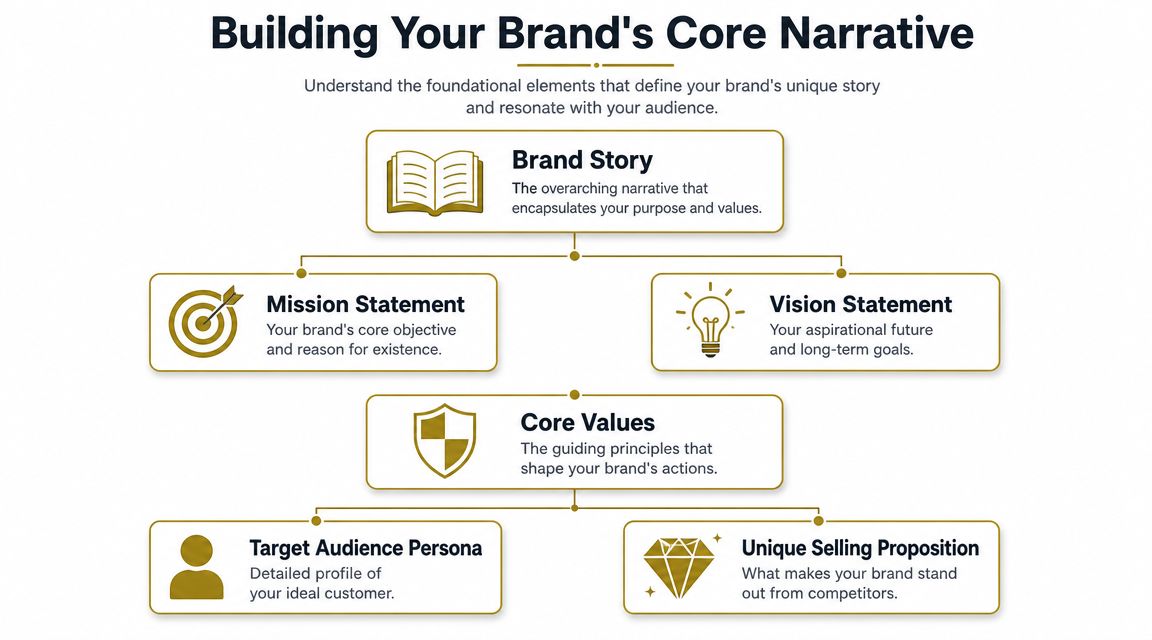
Defining Your Brand's Core Narrative
Before you put budget into reach, decide what people should understand about you once they've found you. Too many businesses skip that step, then wonder why traffic doesn't convert.
That's a costly mistake in a market where UK digital ad spend is around £35 billion, yet nearly 47% of businesses admit they don't have a defined digital marketing strategy, as noted in Optimizely's marketing statistics roundup. Spend without a narrative usually produces noise.
Use the newsroom test
A good brand narrative should survive the same questions a journalist would ask when testing whether a story is real, relevant and worth publishing.
Ask the five Ws.
Who are you really for?
Not everyone who could buy. The group whose problem you understand well enough to speak plainly.What do you solve better than the obvious alternative?
That alternative may be a competitor, doing nothing, hiring in-house, or choosing the cheaper option.Where do you matter most?
This could be a sector, a geography, a moment in the buying journey, or a reputation gap you can close.When are you most valuable?
At launch, during growth, in a crisis, before investment, when conversion stalls, when a brand needs national visibility.Why should anyone believe you?
Proof matters. Experience, examples, credentials, reviews, results language, specialist knowledge, media coverage, expert authorship.
Turn vague values into usable messaging
A lot of brand work stalls because it gets trapped in abstract language. “Authentic.” “Groundbreaking.” “Customer-centric.” Every competitor can say the same.
Use this instead:
| Question | Weak answer | Strong answer |
|---|---|---|
| What do you do? | We help brands grow | We help SMEs turn PR, SEO, content and UX into one coherent growth system |
| Who is it for? | Businesses of all sizes | Founder-led SMEs, growing firms and established brands that need senior-level visibility and trust |
| Why choose you? | We care about results | We combine newsroom storytelling with agency delivery, so the message is sharper and easier to earn attention with |
The strongest brand stories aren't decorative. They make choices. They tell you what to emphasise, what to ignore and what not to promise.
A useful companion resource is Press Release Zen's brand story guide, especially if you need prompts to turn raw business detail into a clearer market position. For a more specific look at narrative-led positioning, Carlos Alba Media's explanation of brand storytelling is also relevant.
The test that matters
Once your narrative is drafted, check whether it can do these jobs without changing shape:
- Homepage headline
- Sales intro
- LinkedIn bio
- Media quote
- Email nurture copy
- Paid search landing page
If it falls apart across those contexts, it's still too vague. A usable narrative is stable under pressure. It doesn't need reinvention every time a new campaign starts.
Choosing Your Digital Channels Strategically
You do not need to be everywhere. You need to be obvious in the places that match buyer behaviour and support the story you're trying to tell.
That sounds simple, but channel sprawl is one of the fastest ways SMEs waste budget. A business starts with LinkedIn, adds Instagram because competitors are there, experiments with paid social, launches a newsletter, posts short video with no plan, then wonders why none of it compounds.

The better question is this: which channels let your audience discover you, assess you and trust you with the least friction?
Start with behaviour, not fashion
The fundamentals are clear. Mobile devices account for over 63% of web traffic, less than 1% of searchers go to the second page of Google, and short-form video is the top content format for marketers, according to MediaValet's digital marketing statistics summary. For SMEs, that means channel choice can't ignore mobile usability, search visibility and the growing role of video in discovery.
But that doesn't mean every business should pour effort into every video platform or chase every trend.
A B2B consultancy might need:
- Search-led content to capture high-intent queries
- LinkedIn content to build authority
- Digital PR to create third-party credibility
- Email to nurture longer buying cycles
A hospitality or lifestyle brand might prioritise:
- Instagram and TikTok for visual discovery
- Local SEO for intent-based traffic
- Short-form video to communicate atmosphere fast
- Review generation because social proof often closes the gap between interest and booking
Match the format to the promise
A serious mistake is using the same content logic on every platform. Your brand narrative should stay consistent, but the expression should change.
If your proposition depends on expertise, long-form articles, quoted insights, case-led landing pages and interview-style video often work better than trend-led posting. If your proposition depends on experience, visual platforms carry more weight. If trust is the issue, earned media and expert commentary can outperform another month of generic brand posts.
For teams building that editorial layer properly, a documented content marketing strategy framework helps stop channel activity becoming reactive.
One practical way to think about channels is as jobs:
| Channel | Best job |
|---|---|
| SEO | Capture demand already forming |
| PR and media coverage | Build borrowed authority |
| Social media | Create familiarity and repeat exposure |
| Move prospects from interest to action | |
| Video | Compress trust and explanation into a faster format |
A quick visual primer can help if you're reviewing how formats fit together:
Choose fewer channels than you think you need, then execute them well enough that a buyer sees the same business each time.
That's the trade-off. Breadth feels safer because you're present in more places. Focus usually performs better because buyers encounter a clearer pattern.
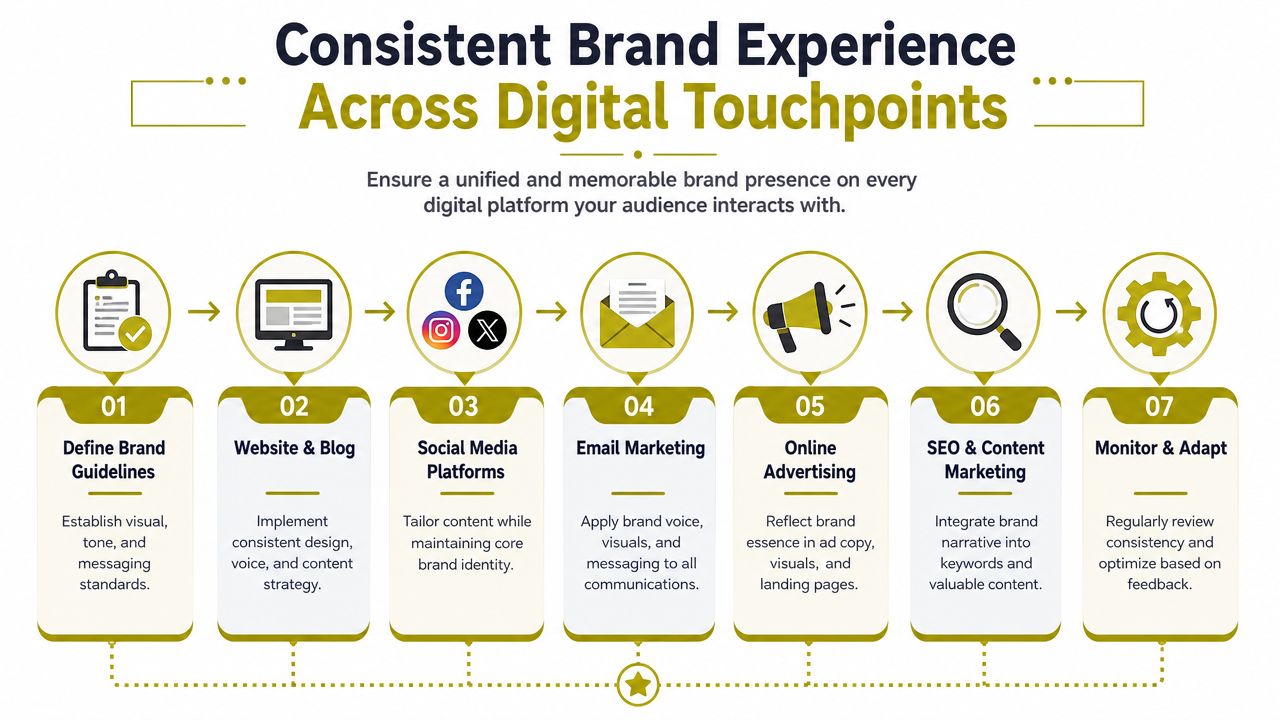
Weaving Your Brand into Every Digital Touchpoint
Consider a Scottish hospitality business positioning itself around authentic luxury. Not expensive for the sake of it. Not stiff. Not overly polished. The promise is warmth, quality and a sense of place.
That message shouldn't live in a deck that nobody reads. It has to show up where customers form opinions.
One message, different executions
On the website, authentic luxury might mean restrained copy, fast load times, strong photography, clear room or experience descriptions, and a booking journey with very little friction. If the site feels cluttered, slow or generic, the promise collapses before the customer reaches the second page.
On paid social, the same brand doesn't need ten product features in one ad. It needs atmosphere. A short video of arrival, detail shots that signal quality, and concise copy that sounds confident rather than salesy.
On the blog, the message becomes useful content. Local guides written with authority. Seasonal recommendations. Behind-the-scenes stories that prove the place has substance, not just styling.
Where consistency usually breaks
Most inconsistency isn't visual. It happens in tone, pacing and follow-through.
- The website promises care, but the confirmation email feels automated and cold.
- The Instagram feed looks premium, but the landing page is messy.
- The ad speaks to a specific audience, but the enquiry process asks generic questions and offers no reassurance.
- The blog sounds expert, but customer service replies sound rushed.
A brand earns trust when the experience confirms the claim.
That applies beyond hospitality. A legal firm that markets clarity can't hide fees in dense copy. A tech SME that markets innovation can't publish stale thought leadership. A founder-led consultancy that markets personal service can't vanish after the first enquiry.
Build from a touchpoint audit
A simple audit often reveals the mismatch quickly. Review these in order:
Homepage
Does the opening line state a clear value, or does it default to bland category language?Key service pages
Do they explain outcomes, proof and next steps, or just list features?Organic social
Would someone understand your position after seeing six posts?Lead capture and follow-up
Does the process feel aligned with the promise you're making?Owned content
Are you publishing material that deepens authority, or just filling a schedule?
The practical aim is coherence. Not sameness. Each touchpoint should do its own job while still sounding like the same organisation.
Measuring What Matters From Visibility to Revenue
If branding is the operating system, measurement is the discipline that stops it becoming self-congratulatory. Plenty of teams can show impressions, reach, follower growth and engagement graphs. Much fewer can explain what those signals mean for enquiries, sales quality, customer value or retention.
That's where digital marketing and branding often split unnecessarily. Branding gets treated as hard to measure, performance gets reduced to last-click numbers, and neither side gets a truthful picture.
Stop reporting what nobody can act on
A useful first filter comes from the idea that metrics should be actionable and tied to business goals, not collected because dashboards make them available. The review in PMC on data-science methods in digital marketing stresses the importance of data quality criteria such as reliability, accuracy, precision, validity, consistency, recall, sensitivity and specificity. In practice, that means your KPI set should be small, deliberate and trusted.
Use the distinction below.
| Metric Type | Examples | Business Question Answered |
|---|---|---|
| Vanity Metrics | Likes, impressions, follower growth, video views in isolation | Are people seeing or reacting to content at a surface level? |
| Business Metrics | Conversion rate, qualified leads, revenue, ROI, churn, click-through rate tied to a campaign goal | Is marketing creating commercial value and improving decision-making? |
A vanity metric isn't useless. It just becomes misleading when it's reported without context. A spike in reach might help if it leads to branded search, direct traffic, lead volume or assisted conversions. On its own, it's only a signal of exposure.
Use a tiered measurement model
For SMEs, the smarter path is staged. A practical measurement framework starts with digital tracking, then moves to experimentation such as conversion-lift studies once spend reaches the £3M to £5M range, and only then considers marketing mix modelling, based on Supermetrics' guide to marketing measurement. That approach matters because many firms jump from basic platform dashboards straight to overcomplicated models they can't maintain.
The key lesson is to avoid over-trusting platform attribution.
Start with core tracking
Know which channels drive enquiries, leads and sales events.Add incrementality thinking
Ask what would have happened without the campaign, not just what the platform claims it influenced.Layer broader models later
Once the spend and channel mix justify it, wider modelling can help with budget allocation.
If every channel claims credit for the same sale, your reporting isn't measuring contribution. It's measuring self-interest.
This is also where discoverability in AI-mediated environments starts to matter. Teams that want a practical overview of LLM brand visibility strategies should treat that as an extension of measurement, not a separate trend. If your brand appears in answer engines, branded queries, citations and high-trust content ecosystems, that visibility should be monitored alongside traditional channel performance.
What a useful dashboard includes
For most SMEs, a senior-level dashboard should answer a short list of questions:
- Are we being found by the right people?
- Are those visitors taking meaningful action?
- Which content or channels assist conversion, even if they don't close it directly?
- Where does the customer journey slow down?
- Which activities deserve more budget, and which only look busy?
That's the standard. Not perfect attribution. Better decisions.
The Journalist's Edge Earning Trust and Optimising for Tomorrow
One assumption still causes trouble in SME marketing. It's the idea that if you buy enough reach, trust will follow. Sometimes it does. Often it doesn't.
Attention bought through ads is rented. Authority earned through proof tends to last longer.
That's where a journalistic mindset gives a brand an edge. Former reporters and editors are trained to ask whether a claim stands up, whether there's evidence behind it, whether an angle is interesting, and whether another person would repeat it because it's credible. Applied to marketing, that changes the standard of content immediately.

Earned media sharpens the whole system
PR is often misunderstood as a brand extra. In practice, it can strengthen search, improve conversion and make paid media work harder because the buyer finds independent proof after the click.
A useful digital brand has evidence in public:
- Credible founder commentary
- Media quotes
- Expert-authored articles
- Reviews and testimonials
- Structured, well-labelled content
- Clear signals of sector knowledge
That matters even more as AI-mediated discovery grows. In the UK, 47% of marketers are using generative AI for content, while 49% of consumers are uncomfortable with it, creating a trust gap noted in this roundup discussing AI and digital marketing trends. The implication is straightforward. Publishing faster isn't the same as becoming more believable.
Credibility has to be machine-readable and human-readable
The next phase of brand visibility isn't just ranking in search or posting more often. It's building material that humans trust and systems can interpret.
That usually means:
- Expert authorship attached to meaningful content
- Original insight rather than generic summaries
- Structured pages that make services, people and proof easy to understand
- Consistent reviews and reputation signals
- Thought leadership that says something specific
For firms developing that authority layer, guidance on writing a thought leadership article is useful because it forces the brand to move beyond generic opinion and into defensible expertise.
Carlos Alba Media fits this approach because it combines PR, content, SEO, UX and digital strategy with teams made up of former national news journalists and agency professionals who've worked with international brands. For SMEs, that blend is practical. It helps turn expertise into stories that can earn attention, support search visibility and convert interest into action.
Paid media can create the first visit. Trust usually decides the second one.
The brands that hold up over time are the ones that can prove what they say, repeat it clearly and adapt without losing the thread.
If your business needs a sharper approach to digital marketing and branding, Carlos Alba Media helps SMEs and established brands align PR, content, SEO, UX and messaging into one coherent growth system. That means clearer positioning, stronger visibility and marketing that's easier to measure against real commercial goals.