
UK startups raised $23.7 billion in venture capital in 2025, the third consecutive year above $23 billion, according to UK startup funding evidence. That isn't just a funding milestone. It tells founders that investor attention is valuable, competition is serious, and a startup needs more than a working product to be remembered and trusted.
Brand strategy for startups should therefore begin with credibility, not colour palettes. Your positioning, proof, reputation, media presence and measurement system influence how investors assess potential, how customers understand value and how partners judge risk. A logo supports that system, but it can't replace it.
Why Brand Strategy Decides Startup Success Early
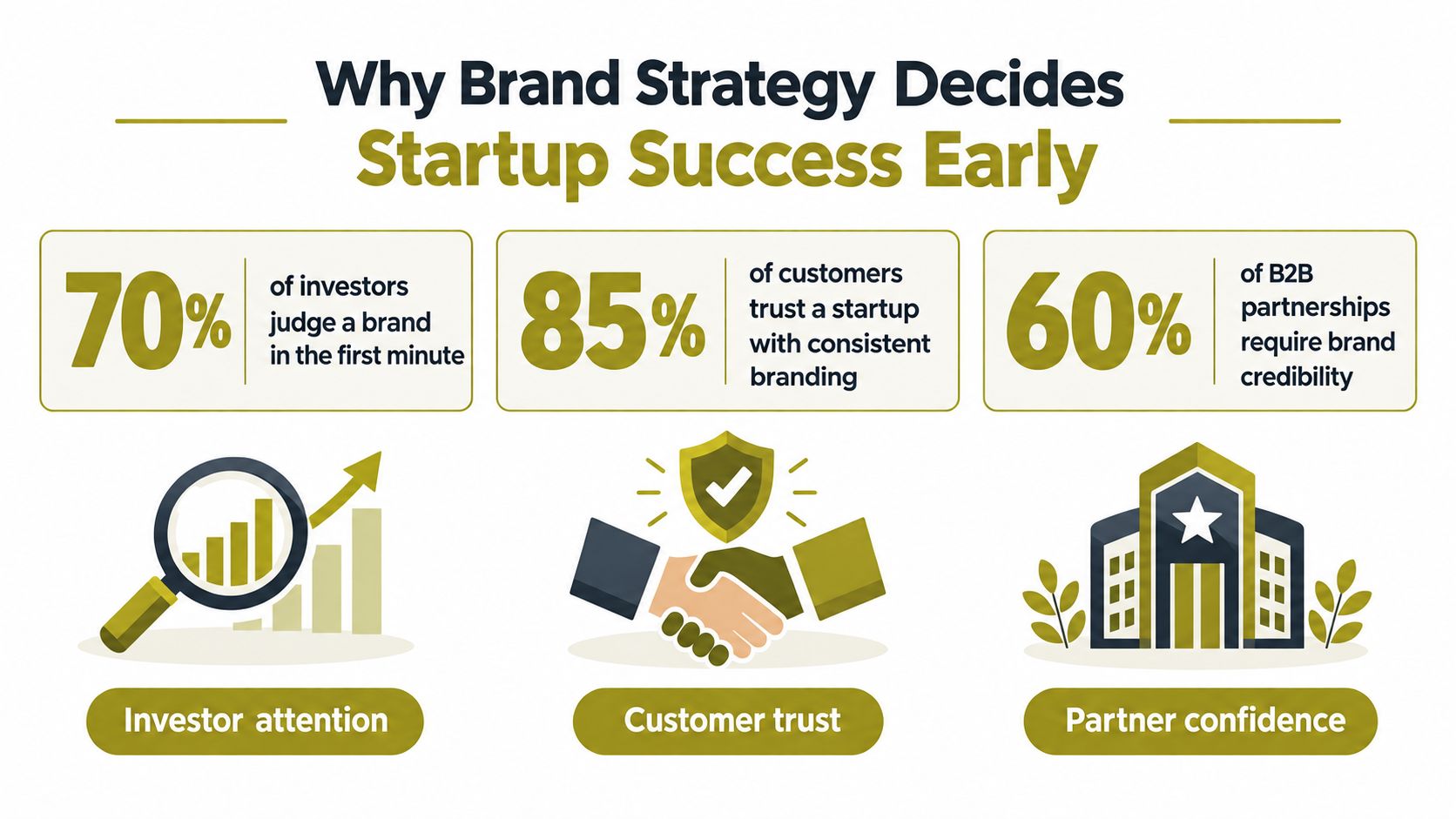
A startup brand is a commercial asset because it helps people make decisions under uncertainty. Investors want to understand the opportunity, customers want confidence that the product will solve a meaningful problem, and partners want evidence that the founders can deliver. If your message changes from one pitch deck to the next, or your website makes a bold promise that your customer experience can't support, each audience has to work harder to believe you.
The funding environment makes that problem more urgent. The UK startup market is mature, and the scale of capital raised means founders are competing for attention within a substantial pool rather than operating in a small niche. Clear positioning gives investors a faster answer to three questions: what category are you in, who needs you, and why can you win?
A weak brand usually doesn't fail because the logo is unattractive. It fails because the company hasn't made disciplined choices about its audience, category, message or evidence. Founders then spend on disconnected content, paid promotion and redesigns, while prospects still can't explain the difference between the startup and its alternatives.
The cost of waiting
A UK small-business survey found that 20% of businesses reported underinvesting over the previous three years, while about three quarters considered their investment levels appropriate, as summarised by UK branding agency market research. For founders, that points to a familiar trade-off. Product development, hiring and operations feel immediate, while brand work gets pushed into a later funding round.
That decision creates avoidable friction. Without a documented positioning statement, teams write different versions of the company story. Without proof points, PR becomes announcement-led rather than relevance-led. Without a measurement plan, founders can't tell whether a campaign produced awareness, qualified interest or empty reach.
Practical rule: Treat the brand as the operating layer between what you build and what the market believes.
Start with a written system. Define the audience, problem, category, difference, evidence and desired action. Then connect those decisions to your website, investor materials, media pitches, social content, sales conversations and customer onboarding. A useful way to map every interaction is this brand experience map for marketers, particularly when different teams own different touchpoints.
Brand strategy doesn't guarantee funding or sales. It does make the business easier to understand, easier to trust and easier to choose. That is the foundation required before a startup spends seriously on reach.
Research Your Market and Define Your Positioning
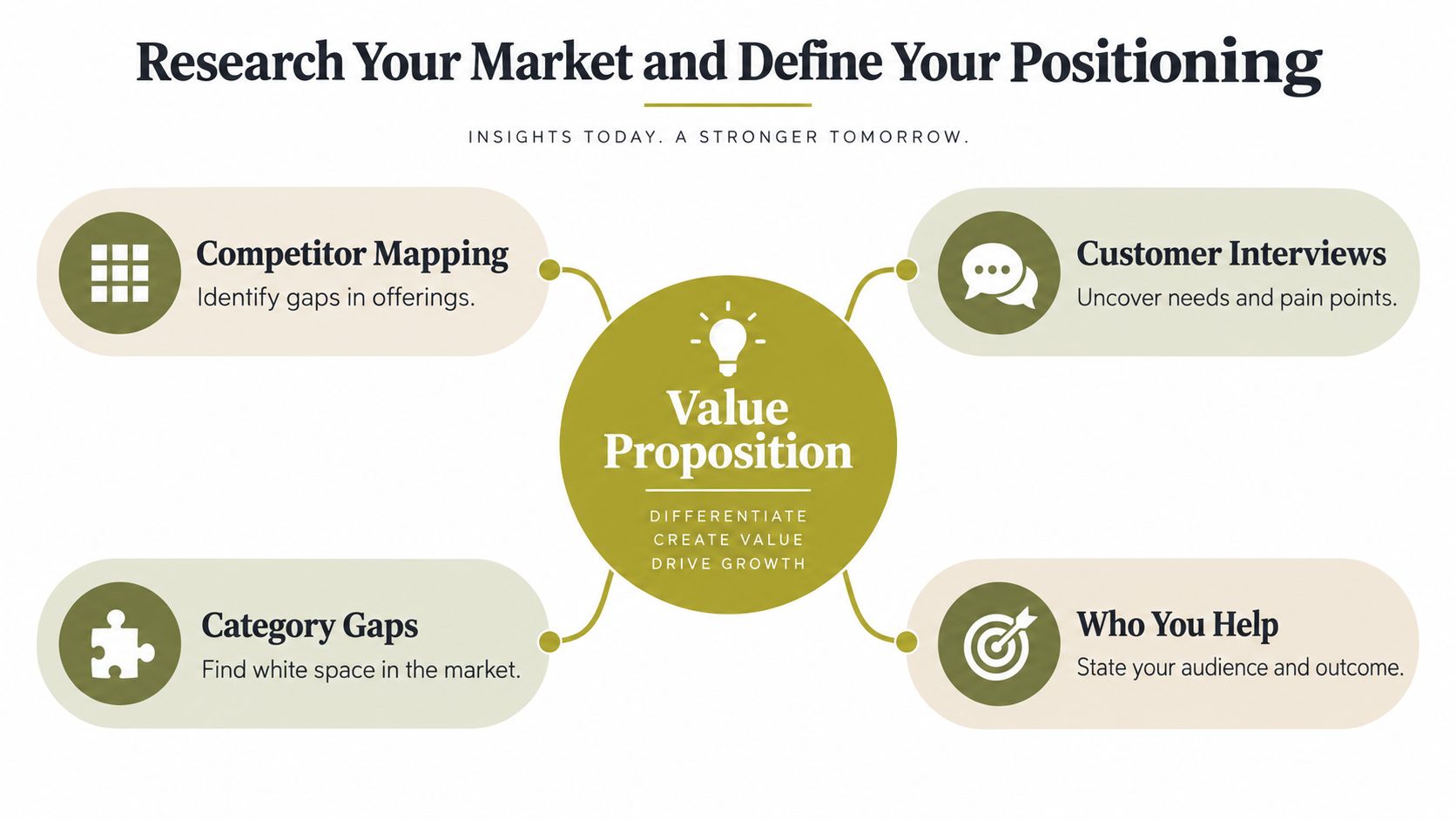
Positioning starts with evidence, not internal enthusiasm. Founders often describe a product through its features because they know how it works. Buyers evaluate something else, namely the cost of their current problem, the alternatives available and the level of confidence they have in the supplier.
Begin with a competitor map. List direct competitors, adjacent providers, internal workarounds and the option of doing nothing. Compare their audience, promise, pricing logic, proof, tone, distribution and obvious weaknesses. Don't copy the category leader's language. Identify the claim everyone makes, then look for the important need nobody owns clearly.
Ask better customer questions
Customer interviews should focus on behaviour rather than compliments. Ask:
- Trigger: What happened immediately before you started looking for a solution?
- Current method: How do you handle the problem now?
- Risk: What could go wrong if the problem continues?
- Choice: What would make you reject a provider?
- Evidence: What would convince you that a new option is credible?
- Language: Which words would you use to describe the problem to a colleague?
Look for repeated situations, objections and phrases. Don't build personas around age, job title or generic lifestyle details unless those characteristics change the buying decision. A useful persona snapshot records the buyer's responsibility, urgent problem, current alternative, decision criteria, internal objection and desired outcome.
Next, define the category you want to occupy. A startup can describe itself as a tool, platform, consultancy or service, but those labels rarely create distinction on their own. Choose the frame that makes your value easiest to understand and gives the buyer a reason to compare you on your strongest ground.
Write the positioning sentence
Use this structure:
For [specific audience] who struggle with [important problem], [brand] is the [category or alternative] that delivers [distinct outcome] because [credible proof or capability].
The sentence isn't website copy. It's a decision filter. If a campaign, feature launch or partnership doesn't support it, question the activity.
Test the statement against three alternatives. Can a competitor claim the same thing? Does the audience recognise the problem immediately? Can your team prove the difference without leaning on empty adjectives? If the answer is no, revise it.
Founders who want examples of how positioning can work in practice can review this guide to brand positioning for founders. For a deeper explanation of the strategic principle, use Carlos Alba Media's resource on what is brand positioning in marketing.
Document the final choice in a single working brief. Include the audience, category, core promise, supporting proof, objections, approved language and phrases to avoid. That document protects the brand from drift when a new marketer joins, an investor asks for a rewrite or the product expands into a neighbouring market.
Craft a Brand Story and Tone That Earns Trust
A persuasive startup story isn't a founder biography stretched across a website. It is a clear sequence that connects a real problem to a credible change in the customer's situation.
Start with the tension. What is difficult, wasteful, risky or confusing today? Then explain why existing options leave a gap. Introduce the startup as the response, describe the customer transformation and finish with evidence that makes the promise believable.
A strong story usually contains four ingredients:
- The problem: Describe the situation in the customer's language.
- The insight: Explain what the startup understood that others missed.
- The change: Show what becomes easier, safer or more effective.
- The proof: Support the claim with customer evidence, founder expertise, product behaviour, partnerships or independent recognition.
The founder's motivation matters when it clarifies commitment, not when it turns the narrative into self-promotion. “We built this because we care” is weak without a specific observation, experience or decision behind it. A newsroom-trained writer will ask the harder question: why should a sceptical reader believe this now?

Build a usable voice guide
Tone needs rules, not mood words. “Friendly and professional” gives a team almost nothing to apply. Define how the brand behaves when explaining complexity, answering criticism, celebrating progress and speaking to investors.
For example:
- Clear: Use the shortest accurate explanation before adding technical detail.
- Calm: Don't inflate urgency or promise certainty you can't support.
- Specific: Replace broad claims with a concrete process, result or example.
- Human: Use direct language and natural contractions, without forcing jokes.
- Accountable: Acknowledge limits and explain what happens next.
The same voice can adapt by channel. A homepage should make the value obvious quickly. An investor deck should connect market problem, model and evidence. A LinkedIn post can sound more personal, while a crisis statement must be concise, factual and controlled.
Avoid jargon that hides the absence of proof. Words such as “disruptive” and “world-class” don't create authority unless the audience can see the evidence behind them. A startup earns confidence by making fewer claims and supporting them better.
Teams refining their verbal identity can use this practical resource on finding your unique brand voice. Carlos Alba Media also explains the wider role of what is brand storytelling in turning strategy into consistent communication.
Carlos Alba Media's specialist nature is relevant here. Everyone who works for Carlos Alba Media is a former national news journalist or has agency experience of working with international brands. That background brings newsroom discipline to message development, including sharper angles, stronger evidence standards and an understanding of what editors, producers and audiences need.
Create a story toolkit containing the one-sentence positioning statement, 30-second explanation, founder narrative, three proof points, key objections and channel examples. If the team can't use it in a pitch, interview or customer call, it isn't finished.
Build a Lean Visual Identity That Scales
Visual identity should make the right message recognisable, not distract from a weak one. Once positioning and story are settled, build the smallest system that gives the startup consistency across a website, sales deck, social profile, email signature and media asset.
The logo is only one component. Start by defining how it appears, where it can sit, what space surrounds it and when a simplified mark is necessary. A logo that looks fine on a large presentation cover may fail as a social avatar or mobile browser icon. Test it at practical sizes before approving a final package.
Choose flexible essentials
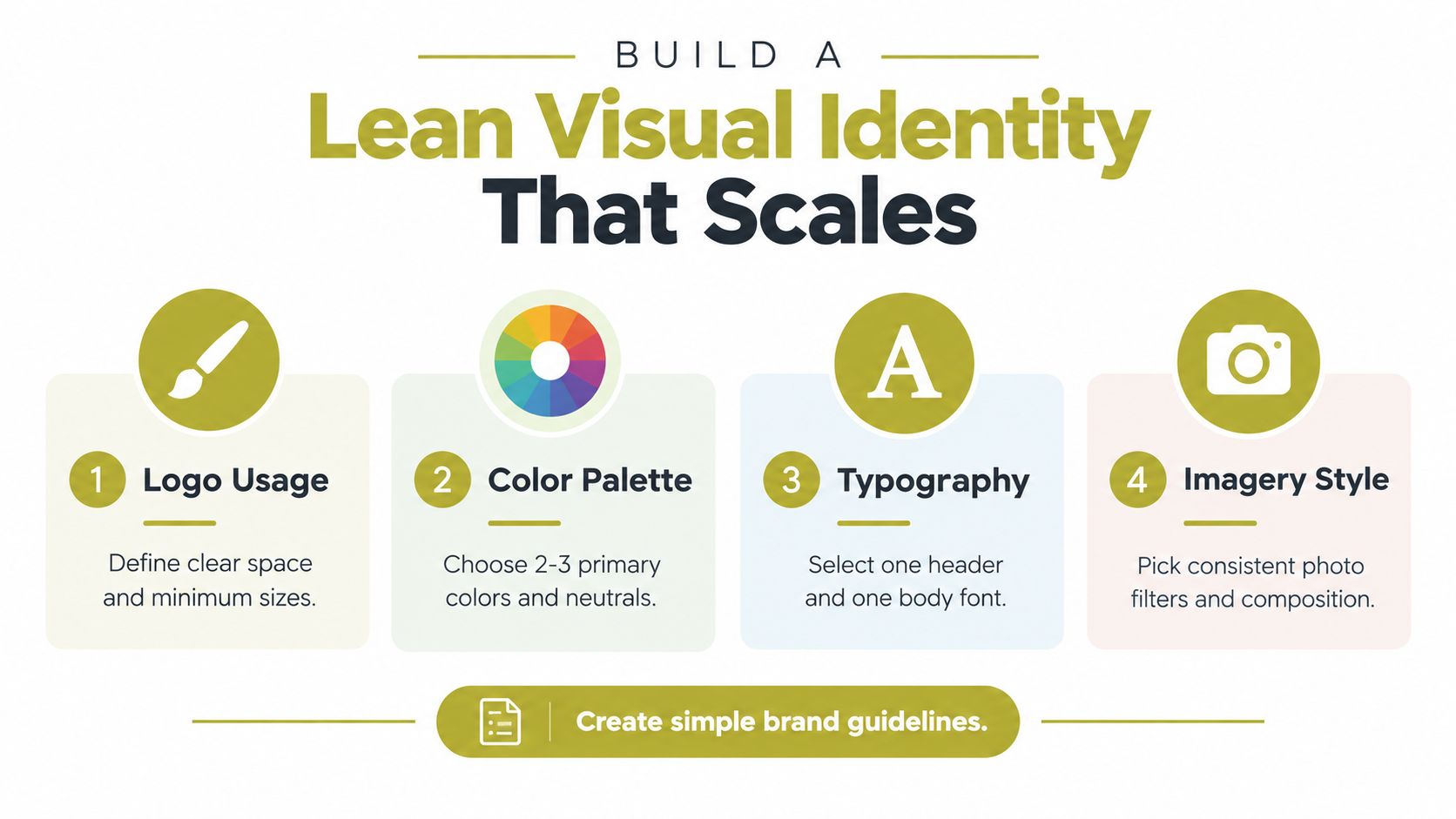
A lean identity needs:
- Logo system: Primary lock-up, compact mark, light version and dark version.
- Colour palette: A small group of primary colours, supporting tones and accessible neutrals.
- Typography: A display style and a highly readable body style, with clear hierarchy.
- Imagery direction: Guidance on subject, composition, lighting, cropping and treatment.
- Layout rules: Consistent spacing, grids, buttons, headings and use of empty space.
- Asset library: Correctly sized files for presentations, social platforms, press materials and web use.
Don't choose colours because they look fashionable in a design presentation. Check contrast, reproduction, accessibility and how the palette behaves beside competitors. Typography should remain legible on mobile screens and in documents that users may print or share.
The same discipline applies to photography and illustration. A startup that uses polished stock images on its homepage but inconsistent screenshots and founder photos elsewhere creates a credibility gap. Decide whether the visual language should feel documentary, technical, editorial, warm or premium, then brief every contributor against that choice.
Spend where rework is expensive
Keep the first identity lean when the audience, category or product is still changing. Spend more on the parts that affect recognition and daily execution, particularly logo adaptability, typography, templates and clear guidance. Avoid elaborate motion systems, oversized asset libraries and complex brand books that nobody uses.
Before launch, test the identity without the company name. Ask whether a prospective customer can distinguish it from nearby alternatives and whether the important message remains clear when visual decoration is removed. Capture the decisions in how to create brand guidelines so freelancers, employees and partners can execute consistently.
The best early identity is not the most elaborate. It is the one your team can apply correctly under pressure.
Launch Your Brand With PR Content and Social
Launch activity should follow the credibility job each channel performs. A logo announces that a company exists. PR can give the company a reason to matter. Content can answer buyer questions. Social can make expertise visible and create a route into conversation.
UK founder data supports that sequence. In the UK StartUp Report discussion, founders ranked PR and reputation management at 62%, market research and analysis at 53%, and advertising at 47%, while branding and logo design stood at 24% in the published discussion. The practical lesson is clear. Identity matters, but early credibility work deserves serious attention.
Match the channel to the job
| Business job | Strongest early activity | What to produce | Signal to watch |
|---|---|---|---|
| Awareness | Newsworthy PR and founder commentary | Media angles, briefings, contributed insight | Relevant coverage and audience fit |
| Consideration | Search-led content and proof | Explainers, comparison pages, customer questions | Qualified visits and engaged enquiries |
| Conversion | Website, sales materials and targeted social | Clear calls to action, proof points, objection handling | Lead quality and sales progression |
| Reputation | Spokesperson preparation and monitoring | Key messages, response process, holding statements | Accuracy, response quality and stakeholder confidence |
PR isn't a press release distribution exercise. A newsroom-led pitch starts with public relevance, a clear human consequence and evidence that the founder can explain the issue. Target a small number of journalists whose brief matches the story, then offer useful detail, access and a concise angle.
Content should answer questions that appear before a purchase. Build pages around the language customers use, not around internal product architecture. SEO can support discovery, but the content still needs a clear point of view and a reason for the reader to trust the author.
Social works best when it extends the story rather than repeats the homepage. Founders can publish decisions, lessons, customer questions, expert analysis and responses to relevant news. The aim isn't constant performance. It is a recognisable pattern of useful thinking that gives prospects a reason to start a conversation.
Use a phased launch
First, establish the evidence. Prepare the positioning brief, founder biography, proof points, media list, press assets, spokesperson messages and crisis contacts. Make sure the website answers who the startup helps, what it changes and why the claim is credible.
Then, create a focused news moment. Use a product milestone, research finding, partnership, founder perspective or customer problem with broader relevance. Coordinate the announcement with a small set of useful web pages and social posts so attention has somewhere credible to go.
Finally, deepen what gains traction. If a journalist responds to a particular angle, develop that expertise. If a content topic produces qualified enquiries, build related answers. If social engagement comes from a specific audience, refine the message for that audience rather than opening several unrelated channels.
A Scottish-led consultancy can provide senior-level counsel without the overhead of a large agency structure. Carlos Alba Media combines media exposure, digital content, SEO and brand strategy, web development, social marketing, media-skills training and crisis communications, with teams in London and Glasgow. The fit matters most when a startup needs one coherent story across broadcast, online, print, social, investors and customers.
Measure Brand Health and Prove Commercial Impact
A brand that isn't measured becomes a matter of opinion. Founders shouldn't try to reduce every perception to one number, but they should establish a baseline and track whether the market is becoming more familiar, more confident and more likely to consider the company.
Early tracking should cover spontaneous awareness, prompted awareness, perceptions, consideration and competitive benchmarks, as outlined in UK guidance on brand tracking for start-ups. As the brand matures, add usage, loyalty and advocacy. The sequence prevents a common mistake, measuring loyalty before enough people know or understand the brand.
Build the dashboard in layers
| Layer | Questions to answer | Useful evidence |
|---|---|---|
| Awareness | Do relevant people recognise the name or category? | Unprompted and prompted research |
| Perception | What do they believe about the company? | Attribute tracking and interview language |
| Consideration | Would they evaluate the startup? | Short surveys, enquiries and shortlist mentions |
| Commercial quality | Are prospects suitable and progressing? | Lead source, qualification and sales-stage data |
| Retention | Do customers continue and recommend? | Cohort reviews, renewal signals and advocacy |
Measurement discipline is a known weakness in the UK SME market. A UK marketing maturity benchmark found that 54% of businesses have no documented business plan, 67% have no marketing action plan, only 33% set out a marketing plan, and just 27% set clear objectives when using specialist marketing services. The same research found only 41% measure customer profitability. A startup should avoid that pattern by documenting the commercial question before launching activity.
Stage expectations realistically
The most widely cited marketing ROI target in a UK-focused benchmark is about 5:1, but new programmes usually underperform that during the first six months while tracking and attribution are being built, according to UK SME marketing ROI guidance. That doesn't justify vague reporting. It means early activity should prioritise instrumentation, customer insight and message testing.
For a new or rebuilt programme, the same benchmark proposes year-one goals of roughly 2:1 to 3:1 blended ROI, with mature systems potentially moving towards 5:1 to 8:1 once channel mix, retention and tracking are optimised. Treat those figures as planning benchmarks, not promises. A founder should also examine lead quality, sales progression, retention and margin, because cheap attention can still produce poor economics.
Review the dashboard on a fixed rhythm. Check channel signals regularly, review message tests after enough evidence has accumulated, and examine customer profitability alongside reach. Don't cut brand activity just because early attribution is incomplete. Fix the instrumentation, compare multiple signals and keep a written record of what changed.
A credible brand system connects reputation to revenue without pretending the relationship is perfectly linear. That is the standard founders should demand from every adviser, designer, PR team and marketing channel.
Carlos Alba Media helps startups and SMEs turn positioning into credible PR, digital content, social activity, media training and crisis communications. Visit Carlos Alba Media to discuss a practical brand and reputation programme built around your audience, proof points and commercial priorities.