
A one-star review appears before breakfast. An AI-generated answer describes your service inaccurately. By mid-morning, a regulator's letter is sitting in the inbox, and the founder is asking the same question every team asks in that moment: what do we do first?
Online reputation management is no longer a marketing clean-up exercise. It affects customer experience, compliance, search visibility, media relations and confidence among investors, partners and employees. The organisations that handle pressure best don't improvise a polished statement. They establish the facts, assess the risk and respond at the speed of a newsroom.
Why Online Reputation Management Now Demands a Newsroom Mindset
A reputation rarely collapses because of one isolated comment. More often, small inaccuracies, unanswered complaints and inconsistent information accumulate until a customer, journalist or regulator encounters a version of the organisation that nobody internally recognises.
The exposure is constant. UK adults spent an average of approximately four and a half hours online each day in 2025, up 10 minutes from 2024, with YouTube, Facebook, Messenger and Instagram among the leading services used, according to Ofcom's 2025 Online Nation reporting. A complaint can therefore travel through a review platform, social network, search result and private message before the leadership team has agreed on a response.
That environment rewards editorial judgement, not merely faster content production. A reporter asks what happened, which evidence supports the claim, who is affected and what remains unverified. A reputation team should ask the same questions before it posts, contacts a journalist or requests a removal.
Reputation is an operating discipline
Everyone who works for Carlos Alba Media is a former national news journalist or has agency experience of working with international brands. That specialist nature matters because newsroom experience teaches people to separate allegation from fact, relevance from noise and urgency from panic.
Generic content marketing won't protect a business when its public information is contradictory or its customer service has failed. A well-written article may help search visibility, but it won't resolve a delivery problem, correct an inaccurate claim or prepare a spokesperson for hostile questions. Practical guidance on the wider principles of protecting a digital footprint is available in PeopleFinder's advice on protecting your reputation, but implementation still depends on people, evidence and clear ownership.
Editorial rule: Publish what you can prove, correct what you can verify and never use visibility as a substitute for credibility.
A useful starting point is to connect reputation work with PR campaign planning. That connection prevents the common mistake of treating positive coverage, review responses, search content and crisis communications as separate activities. Reputation is built and defended daily, and every response should make the organisation easier to understand.
Running a First-Week Reputation Audit That Actually Maps Risk
Start with evidence, not assumptions. A first-week audit should show what a customer, journalist, employee or regulator can find without access to your internal context.
Days one and two
Create a master list of:
- Owned channels: Record the official website, domains, Google Business Profile, social accounts, leadership profiles and location pages.
- Public names: Search the organisation, founders, executives, products, services, locations, campaigns and common misspellings.
- Review surfaces: Include Google, Trustpilot, sector-specific platforms, social comments and relevant forums.
- Search results: Capture the first page and any prominent news, review, directory or AI-generated summaries.
Classify each result as accurate criticism, opinion, outdated information, impersonation or a potentially defamatory factual allegation. Do not label an unpleasant opinion as defamation just because it is damaging. Preserve screenshots, timestamps, page URLs and relevant CRM or order notes so the team can demonstrate what was visible and when.
Days three to five
Look for patterns rather than isolated comments. Several complaints about the same service failure deserve operational attention, while a single hostile post may require a proportionate response. Check whether executive profiles are approved, whether contact information is consistent and whether old pages still make claims the business can no longer support.
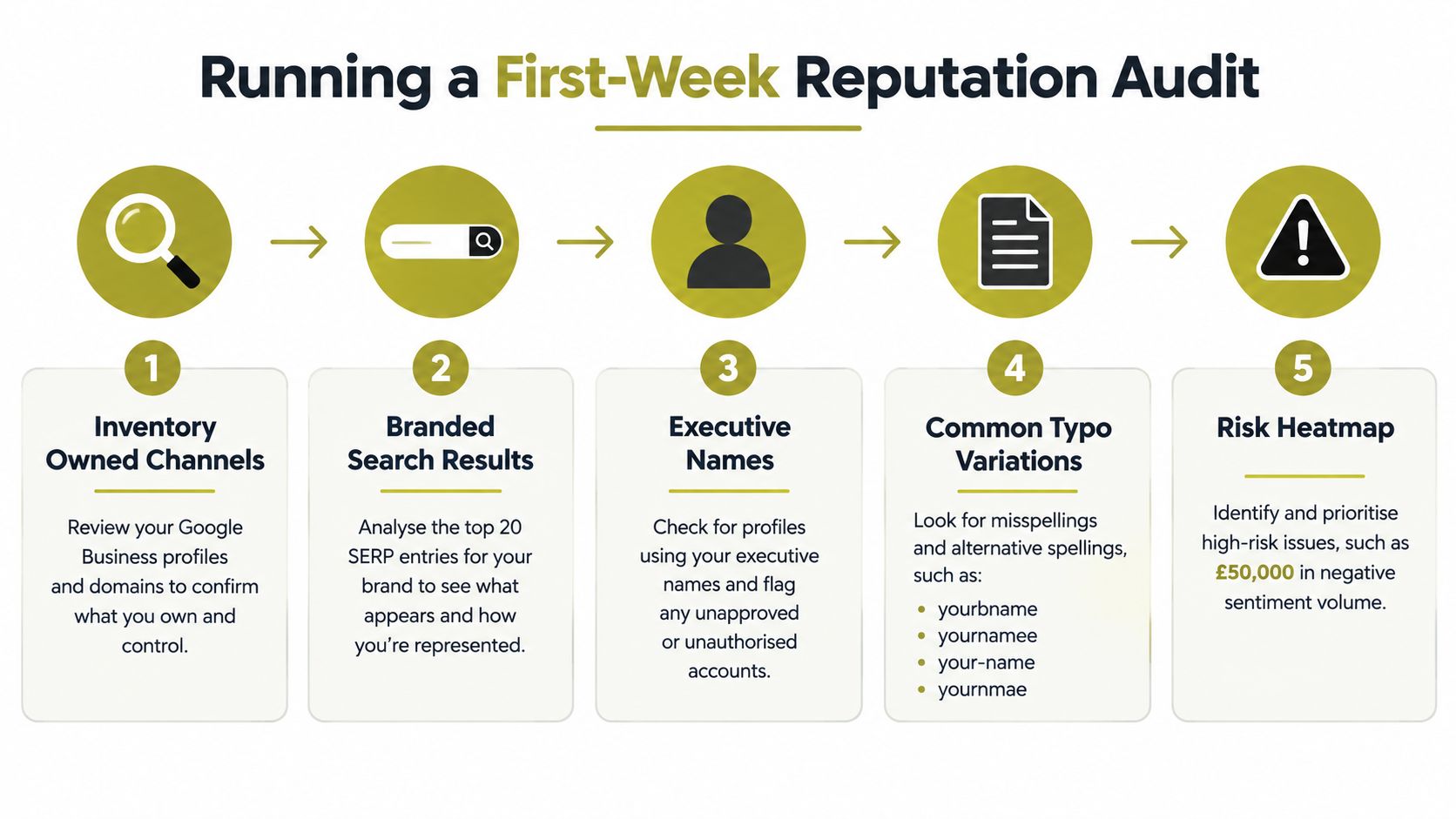
By the end of the week, create a baseline snapshot. Record review volume, average rating, rating distribution, review recency, response time, unresolved complaints and recurring themes. Research cited by the UK Competition and Markets Authority found that 89% of consumers use customer reviews when researching a product or service, while the CMA estimated that as much as £23 billion of UK consumer spending may be influenced by online reviews each year, as set out in its action on fake reviews.
The baseline gives leadership something better than a general feeling of exposure. It creates a record against which response speed, complaint recurrence and search visibility can be reviewed. Teams looking to organise this monitoring layer can compare suitable reputation monitoring tools, but no platform replaces a named person who verifies and escalates what the system finds.
Designing a UK Review Programme That Builds Trust, Not Just Stars
A review programme should make customer feedback more representative, easier to investigate and more trustworthy. It shouldn't manufacture a perfect-looking profile.
Recent UK research found that 63% of consumers worry about fake reviews before purchasing, 80% believe fake reviews actively damage a brand's reputation and 69% consult at least two review providers before buying, according to Feefo's UK trust research. Those findings change the commercial calculation. More reviews aren't automatically better if customers suspect selective requests, synthetic language or undisclosed incentives.
Build the request process around eligibility
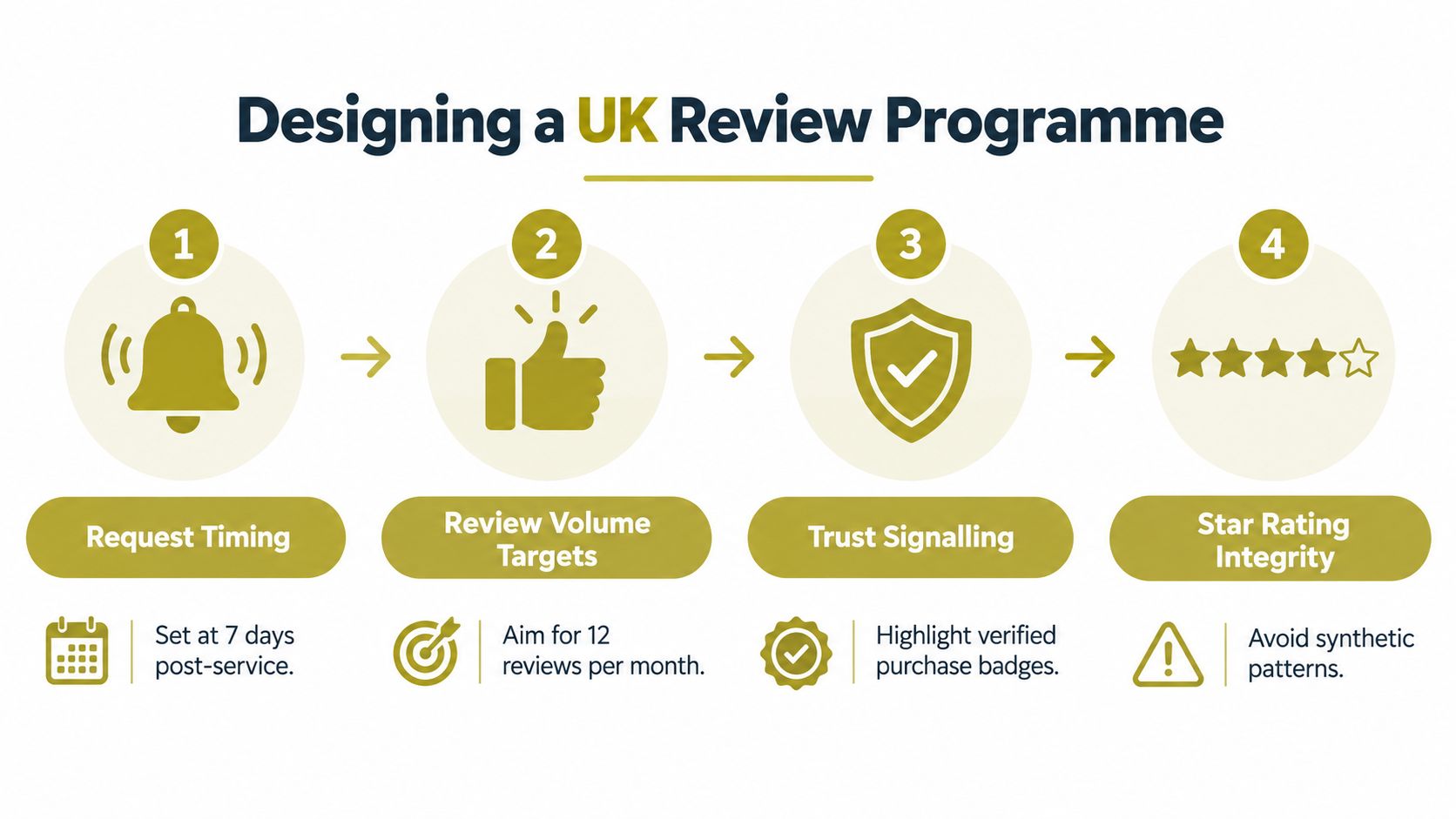
Invite every eligible customer after delivery or service completion, using neutral wording and no requirement for positive sentiment. Keep the timing consistent, explain where the feedback will appear and make it possible for customers to raise a private service issue without being diverted away from a public review.
Don't buy reviews, suppress negative feedback, commission undisclosed incentives or present misleading ratings. The CMA's treatment of misleading reviews as a consumer-protection issue means these shortcuts create regulatory and trust risks, not just platform problems.
A credible programme also treats negative feedback as operational intelligence. A hospitality group might discover recurring comments about check-in, while a professional services firm might find that clients praise expertise but criticise communication. The response is to fix the underlying service and show what changed, not to bury the criticism under a burst of promotional posts.
Measure the feedback loop
Use a rolling view rather than isolated star ratings. A useful review dashboard includes:
- Response-time percentile: Shows whether the team responds consistently, not just quickly on its best days.
- Complaint-resolution rate: Separates acknowledgement from completed action.
- Recurring service themes: Tracks how often reviews mention each failure or strength.
- Review provenance: Records platform, customer journey and any verification available.
- Recent feedback mix: Shows whether the profile reflects current service quality.
A transparent response can be more persuasive than a flawless average. For practical implementation details, a useful online reviews management guide can sit alongside internal policies, escalation routes and customer-service training. The key principle remains simple: ask fairly, respond authentically and make visible improvements that customers can recognise.
Further guidance on turning reviews into a managed customer-experience process is available through online review management. The strongest programmes don't chase stars as an end in themselves. They use feedback to make the organisation more reliable.
Responding to Negative Coverage and Reviews With Newsroom Discipline
The first public response doesn't need to solve everything. It needs to show that a real person has seen the issue, understands the concern and is taking the next responsible step.
Start with a short acknowledgement. Move order numbers, health information, personal details and case-specific discussion to a private channel. Check CRM records, delivery logs, contracts or correspondence before making a factual statement. If the issue is genuine, explain the corrective action without exposing private information.

Match the reply to the evidence
For a service failure, write: “We're sorry this happened. We've checked the details and have asked our customer-care team to contact you directly so we can resolve the matter.”
For a factual inaccuracy, write: “We've checked the information available to us and one detail in this post is incorrect. The relevant policy is published on our website, and we're happy to provide the supporting information privately.”
For a personal attack, don't mirror the tone. A restrained acknowledgement, or no response where engagement would amplify the post, is often stronger than a defensive exchange.
Lawful negative opinion should generally be answered with service facts and empathy, not contested as if it were a legal allegation. A potentially defamatory factual claim requires evidence preservation and specialist legal advice. Blanket removal demands often backfire by drawing more attention to the disputed material.
Response test: Could a neutral reader understand what happened, what you know and what you're doing next?
Don't paste AI-generated replies into every review. Generic wording can sound evasive, misstate the facts or inadvertently acknowledge liability. Use technology to identify themes and draft options, but require a human to check names, dates, promises and tone.
The credibility challenge matters. UK trust in scientists stood at 83%, compared with 28% for journalists in the 2021 Ipsos Veracity Index, while journalists ranked alongside bankers and business leaders at 23% globally, as discussed in independent analysis of the trust findings. Media visibility alone doesn't create confidence. Evidence and transparent sourcing do.
Escalate when the volume grows, a vulnerable person may be affected, a regulator is involved, journalists are asking questions or the allegation could materially damage public confidence. At that point, appoint one spokesperson, introduce an approval threshold and use a holding statement that buys time without speculating.
Owning Search Results and AI Answers as One Connected Workflow
Search remediation and AI visibility are now parts of the same reputation problem. A prospect may find your website through Google, then ask ChatGPT, Gemini or Google AI Mode to interpret what they have read. If your organisation's facts are inconsistent across authoritative sources, the systems may produce an answer that sounds confident but is wrong.
UK AI-visibility research measured 2.5 million UK prompts per month across ChatGPT, Gemini and Google AI Mode, and found only 36.7% to 45.3% overlap between the 100 brands most frequently mentioned and the 100 domains most frequently cited, according to The Drum's report on AI search visibility. Strong conventional search presence therefore doesn't guarantee accurate AI representation.
Correct the source before challenging the summary
Classify the problem first. Is the result accurate criticism, opinion, personal data, outdated content, impersonation or a potentially defamatory allegation? Correct the originating page where possible, then publish authoritative information with consistent organisation, executive, location, service and regulatory identifiers.
Technically sound pages help. Use clear titles, indexable content, meaningful internal links and credible third-party references. Earn independent coverage through newsworthy work. Manufacturing mentions may create a larger footprint, but it won't necessarily create reliable evidence.
| Category | What to record | Where to look |
|---|---|---|
| Branded identity | Official names, leaders, locations and services | Website, Companies House profile, professional directories |
| Search results | Ranking position, title, sentiment and accuracy | Google branded queries and news results |
| AI answers | Summary, cited sources and recurring inaccuracies | ChatGPT, Gemini and Google AI Mode |
| Owned evidence | Corrections, policies, leadership pages and FAQs | Website, newsroom and regulatory pages |
| Business outcomes | Click-through rate, referral traffic and qualified enquiries | Analytics, CRM and search reporting |
For teams exploring getting cited in ChatGPT answers, the practical focus should be verifiable entity information and credible references, not attempts to force a particular answer. Monitor recurring inaccuracies, publish evidence-based corrections and record which sources systems cite.
For personal data that is no longer necessary, unlawfully processed or disproportionate, consider a UK GDPR Article 17 erasure or search-engine delisting request. Allegedly false statements need specialist legal advice, particularly because section 1 of the Defamation Act 2013 requires serious harm to reputation to have occurred or be likely.
Measure the workflow monthly through ranking position, indexed positive or neutral assets, click-through rate, referral traffic and qualified enquiries. AI reputation needs additional qualitative review because traditional SEO metrics won't capture every conversational answer.
Building a 24/7 Crisis Posture for UK Regulated and High-Visibility Sectors
A crisis plan is useful only if people can activate it under pressure. Regulated businesses, public-facing SMEs, tourism groups and technology companies should define triggers before an incident forces them to negotiate responsibilities in public.
Triggers might include a serious allegation, a regulator contact, a data or safety concern, coordinated impersonation, a journalist deadline, a sudden rise in complaints or an issue involving a vulnerable person. Each trigger should have an owner, escalation route and approval threshold.
Prepare the first statement before the first question
A holding statement should confirm what the organisation knows, explain what it is checking and identify the next update point without promising an outcome that hasn't been verified. One trained spokesperson should lead external communication, while legal, operational and customer teams work behind the scenes.
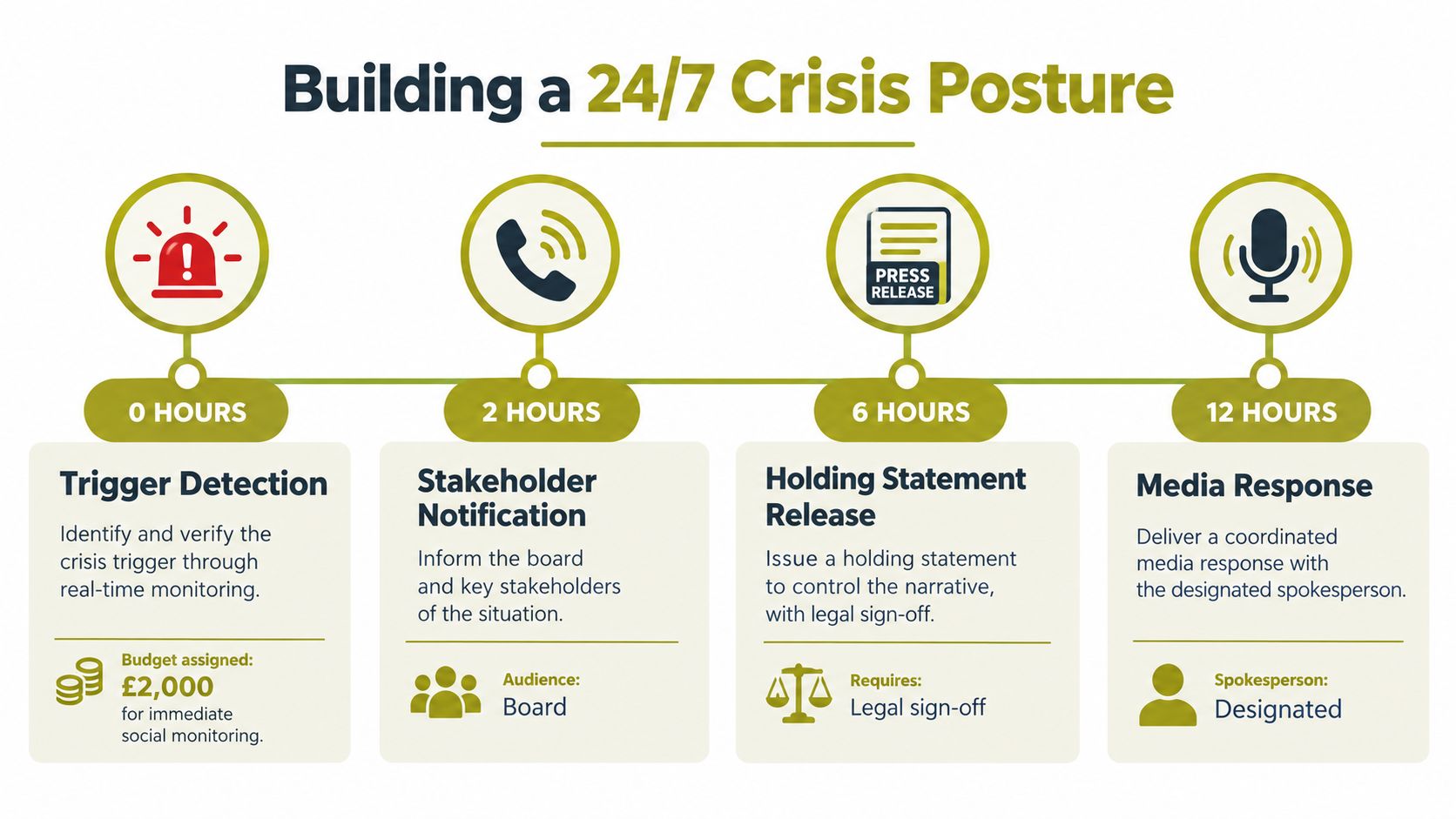
The strongest posture combines editorial scrutiny with rapid execution. Everyone at Carlos Alba Media is either a former national news journalist or has agency experience working with international brands, and its 24/7 media crisis management work operates in partnership with leading UK media lawyers. That combination is relevant when a statement needs to be accurate, legally careful and usable in a live interview.
Rehearse the plan through tabletop exercises. Ask who approves a statement, who contacts affected customers, who briefs the board, who monitors social channels and who answers a broadcaster's follow-up. Add media-skills training so the spokesperson can hold the line on camera rather than retreat into jargon.
A 2023 survey of 1,130 UK journalists found that 88% considered educating audiences a very or extremely important role, 71% prioritised countering disinformation and 82% agreed that interpretation is necessary to make sense of facts, according to the Reuters Institute survey of UK journalists. A useful response therefore gives journalists evidence and context, not just promotional language.
A permanent posture doesn't mean treating every complaint as a crisis. It means recognising escalation early enough to choose the right response.
Your 30-60-90 Day Online Reputation Rollout and the Signals That Prove It Works
A board-ready rollout should produce working habits, not a presentation that disappears after approval. Divide the work into phases, assign owners and report what changed.
Days one to thirty
Complete the reputation audit and preserve the evidence. Establish the baseline for reviews, response time, unresolved complaints, recurring themes, branded search results and owned-channel accuracy. Claim or correct core profiles, document the review-request process and agree which issues require legal or executive escalation.
The first indicators are operational. The team should know who monitors each channel, who verifies a complaint and who can approve a public response.
Days thirty-one to sixty
Add AI-answer monitoring to the branded search routine. Test consistent prompts across relevant systems, record recurring inaccuracies and publish corrections supported by evidence. Strengthen leadership, service, location and regulatory pages, then train the spokesperson on hostile questions, uncertainty and concise factual answers.
At this stage, report whether response times are becoming more consistent, whether recurring service failures are reducing and whether authoritative information is easier to find.
Days sixty-one to ninety
Embed the crisis playbook, run a tabletop exercise and produce a 90-day scorecard. Include review volume, average rating, review recency, response-time percentile, complaint-resolution rate, recurring themes, branded ranking positions, indexed positive or neutral assets, click-through rate, qualified enquiries and AI-answer accuracy.
Don't claim success just because negative content has moved down the results. A stronger result is a combination of faster detection, fewer repeated complaints, more representative feedback, clearer evidence and better-informed spokespeople.
A 2023 survey of UK executives whose organisations experienced reputation-impacting crises found that 76% said those crises were preventable with better preparation and earlier detection, according to the State of Corporate Reputation report. That is why the rollout should continue after the first 90 days. Review the scorecard, challenge weak assumptions and adjust the workflow before pressure exposes the gaps.
The practical answer to how to do online reputation management is therefore straightforward, although not easy: monitor continuously, verify quickly, respond proportionately, improve the underlying experience and make reliable information available across search, reviews, media and AI interfaces.
Carlos Alba Media helps founders, SMEs and established organisations combine online reputation monitoring, review response, search-content improvement and 24/7 crisis communications with senior PR and digital judgement. Visit Carlos Alba Media to discuss an evidence-led reputation programme, media training or a crisis posture built for your sector.