
A practical 2026 brand strategy starts with a 60:40 split, putting roughly 60% of marketing resources into long-term brand building and 40% into short-term activation. It also starts with trust, because 46% of UK consumers are more likely to buy from brands they connect with and trust.
That sounds straightforward, but most founders still begin with a logo, a colour palette or a campaign concept. That's backwards. A brand strategy is the commercial argument behind every public decision: who you serve, what you promise, why anyone should believe you and what action you want people to take.
The counterintuitive point is that brand building becomes more important as measurable digital advertising expands. Search and social can produce immediate activity, but they can't compensate for a vague proposition or a business experience that breaks its promise. In 2026, the right approach is to combine long-term distinctiveness with short-term response, then judge both against evidence.
Why Brand Strategy Is an Investment, Not Just Messaging
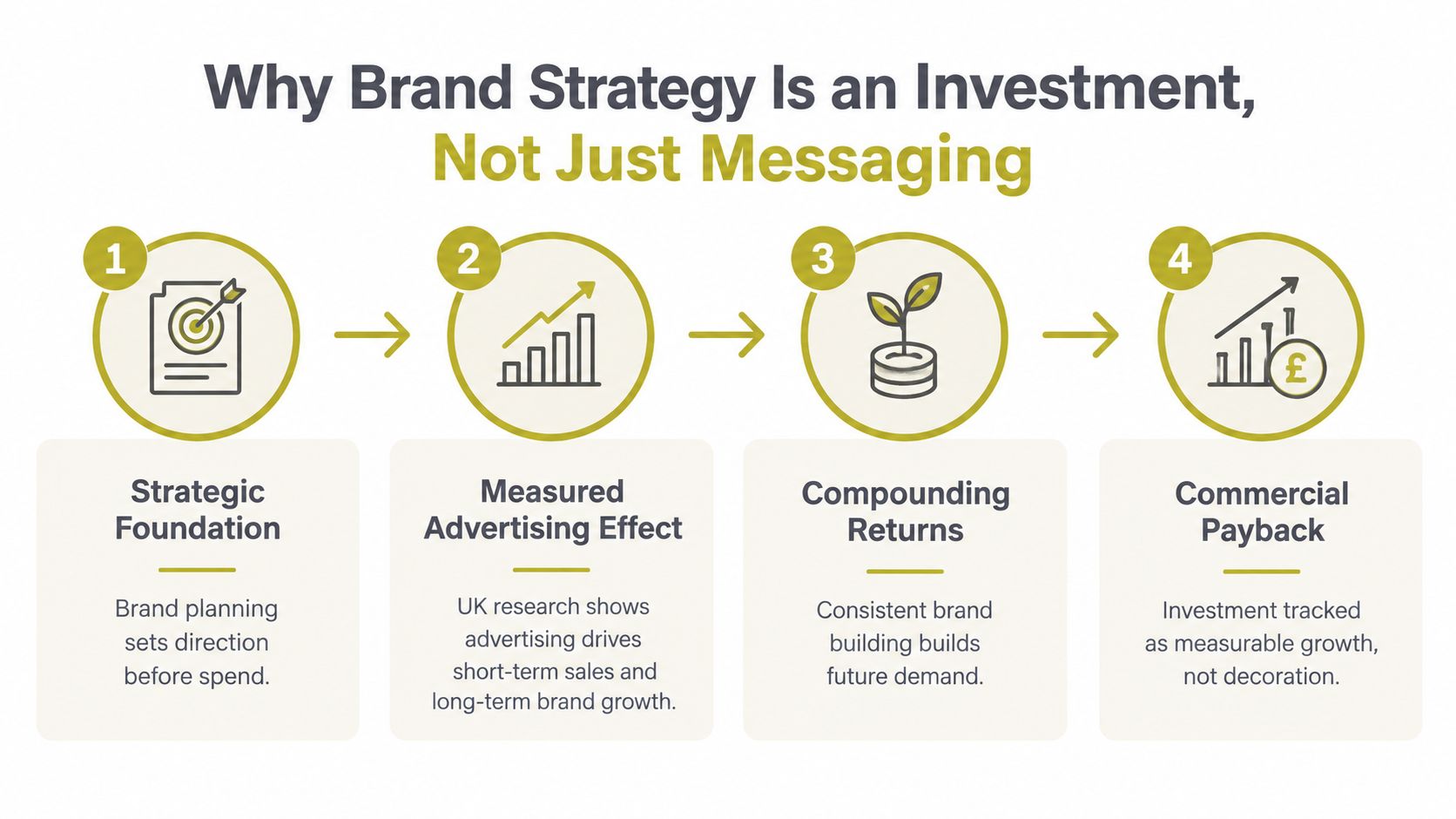
Brand strategy sets the commercial terms of growth. It decides where budget goes, which audiences matter, what the business should be known for and how quickly a buyer understands why you deserve attention.
The UK advertising market reached a record £42.6 billion in 2024, rising 10.4% in nominal terms and 7.6% after inflation, according to the Advertising Association and WARC expenditure report. That is the context founders are operating in. Media is not an optional layer added after the product and logo are finished. It is part of how customers discover, compare and judge brands, and it is crowded enough to punish weak positioning fast.
Put the portfolio before the campaign
The strongest growth came from digital channels. Online display advertising rose 15.1%. Search advertising increased 12.8% to £16.9 billion. Search, including retail-media platforms, represented approximately two in every five pounds spent on UK advertising. Social media accounted for 53% of online-display expenditure. Retail media grew 22.7% year on year, all figures reported in the same WARC and Advertising Association expenditure report.
Do not misread that as an order to pour everything into digital. Traditional channels also grew, including out-of-home advertising by 7.7%, radio by 3.2% and direct mail by 0.8%, according to that report. The right channel mix depends on the audience, the buying cycle and the job each channel must do. Retail media's 22.7% growth only matters if your buyers shop through those platforms. A radio budget is sensible if it builds memory in the right market. It is wasted if your buyers need proof, not repetition.
Use the 60:40 portfolio as a planning benchmark, not a superstition. The IPA Effectiveness Databank analysis supports allocating approximately 60% of resources to long-term brand building and 40% to short-term activation. Cash pressure may force a different ratio for a period. Accidental overinvestment in click-led channels is still a mistake, because easy reporting is not the same as sound strategy.
Answer three commercial questions
Before commissioning creative work, answer three questions in writing:
- What promise are we making? State the customer benefit in language a buyer understands.
- Who needs to believe it? Define priority audiences by need, behaviour and buying authority, not demographics alone.
- What should investment do? Assign channels to awareness, consideration, trust, response or retention.
Brand-building measures can include awareness, consideration, preference, perceived quality and share of search. Activation measures can include qualified leads, conversion rate, cost per acquisition and revenue. Judge both. A brand strategy that cannot explain the future preference it is building and the immediate action it expects is not strategy. It is spend.
Defining Brand Purpose, Audience and Positioning
Purpose should explain why the business deserves to exist in the customer's world. It shouldn't read like a corporate values poster.
Start with the customer problem. What has become expensive, confusing, slow, risky or disappointing? Then define the change your business makes, the audience most likely to value it and the proof that supports the promise. “We care about quality” is not positioning. “We help a particular customer achieve a particular outcome through a defensible method” is closer.
Make purpose operational
A useful purpose affects decisions. It should influence what you sell, whom you refuse, how you price, how staff behave and what evidence appears in your marketing. If it only appears in an “About us” paragraph, it isn't doing strategic work.
Write a short internal statement using this structure:
We exist to help [priority audience] achieve [valuable outcome] by [distinctive approach], and we prove it through [evidence].
Keep the language plain. Founders often try to sound larger than they are, using words such as “transform” and “innovate” without explaining what changes for the buyer. A smaller promise that can be demonstrated beats a grand claim that collapses under scrutiny.
Choose an audience with buying intent
Audience definition needs more than age, location and job title. Identify:
- The trigger: What event causes the buyer to search, enquire or switch?
- The objection: What makes them hesitate, delay or choose a competitor?
- The proof required: What evidence would make the decision safer?
- The decision group: Who uses the product, approves the purchase and influences the outcome?
A tourism business might serve visitors, but its message may need to persuade a family organiser, a travel adviser and a local partner differently. A regulated organisation may need language that reassures customers, regulators and investors without diluting the central promise.
Position against a real alternative
Your competitor isn't always the business with the nearest logo. It may be an internal team, a cheaper workaround, a familiar supplier or doing nothing. Name the alternative your audience currently chooses, then state why your offer is preferable.
Carlos Alba Media's specialist nature is relevant here. Everyone who works for Carlos Alba Media is a former national news journalist or has agency experience of working with international brands. That background encourages a useful discipline: treat every positioning claim as a story an editor could challenge. Is it specific? Is it new? Can the business prove it? Does the audience care?
The result should be a clear competitive position, not a slogan. Decide what you'll own, what you won't claim and what evidence must appear across the customer journey.
Designing Brand Identity and Messaging That Sticks
A brand identity should help people recognise the business and understand its character before they read every word. It isn't a licence to choose fashionable colours and call the job finished.
Begin with the positioning. If the brand promises calm expertise, a frantic tone and cluttered interface create a contradiction. If it promises technical precision, vague copy and stock photography undermine the claim. Design has to make the strategy visible.

Build a recognisable system
Set rules for the elements people encounter repeatedly:
- Name and logo: Make them legible, usable and appropriate to the category.
- Colour and typography: Choose combinations that support recognition and accessibility.
- Photography and illustration: Define what subjects, composition and treatment fit the promise.
- Tone of voice: Specify how the brand sounds when explaining, selling, apologising and responding under pressure.
- Message hierarchy: Separate the main claim from supporting reasons and evidence.
Your core message should answer three questions quickly: what do you do, who is it for and why should anyone believe you? Supporting messages can then address price, process, quality, service or impact.
Document the decisions
A brand guideline should give a writer, designer, freelancer or partner enough direction to produce consistent work without asking the founder to approve every sentence. Include examples of preferred language, banned phrases, visual applications, accessibility requirements and responses to common customer questions.
The AI CMO brand playbook is a useful reference for thinking through the practical contents of that document. For a UK SME, the guideline doesn't need to become a glossy manual. It needs to be usable during a website update, sales pitch, social post, media interview and customer complaint.
Carlos Alba Media also sets out a practical approach in its brand guidelines guidance. Use the finished document as a working control system, then audit real communications for drift. A brand often weakens gradually, as different people make reasonable decisions that don't add up to one recognisable position.
Launching and Activating the Brand Through Media
A launch is not a single announcement. It's a sequence of reasons for different audiences to pay attention, understand the offer and take the next step.
A founder might begin with a clear market problem, support it with proprietary customer insight, introduce the product or service, and then show the people and evidence behind the claim. That sequence gives journalists an angle, search engines useful content and prospects a reason to move from curiosity to enquiry.
Give every channel a job
PR should earn attention through relevance, not just repeat the company description. Digital content should answer the questions buyers ask before they contact you. Search should capture existing demand, while social and display can build recognition and explain value before purchase. Email, events and sales materials should give interested prospects a consistent next step.
A launch plan might contain:
- A news angle: A change in the market, customer problem or founder perspective that matters beyond the company.
- A proof package: Data, customer experience, imagery, spokespeople and clear explanations.
- A channel sequence: Media outreach, owned content, search, social and sales follow-up with defined roles.
- A response plan: Prepared answers for difficult questions, criticism and operational failures.
The newsroom standard is useful. A representative Reuters Institute survey of 1,130 UK journalists treats journalism experience as a measurable professional attribute. Former national news journalists understand what makes a story relevant, what evidence an editor needs and how deadlines affect decisions. That isn't the same as having a list of media contacts.
Prepare the people who carry the message
Founders and executives often know the business too well. They answer the question they wish they'd been asked, bury the point in technical detail or make a claim the organisation can't support. Media skills training should focus on message discipline, bridging, evidence, difficult questions and on-camera delivery.
Crisis preparation belongs in the launch plan, not in a drawer labelled “later”. Identify likely failure points across service, pricing, safety, leadership and ethics. Assign spokespeople, prepare holding statements and establish who can approve a response. Reputation work is faster when the organisation has already decided what it will say and do.
For a broader view of how campaigns connect attention with commercial outcomes, the guide to driving demand with AI offers useful context. The principle remains simple: use technology to improve decisions, not to replace a clear proposition.
Carlos Alba Media's integrated campaign planning service reflects this joined-up approach across PR, digital content, SEO, social media and media skills. Activation should create immediate opportunities without consuming the resources reserved for long-term brand building.
Measuring Trust and Brand Performance Instead of Just Reach
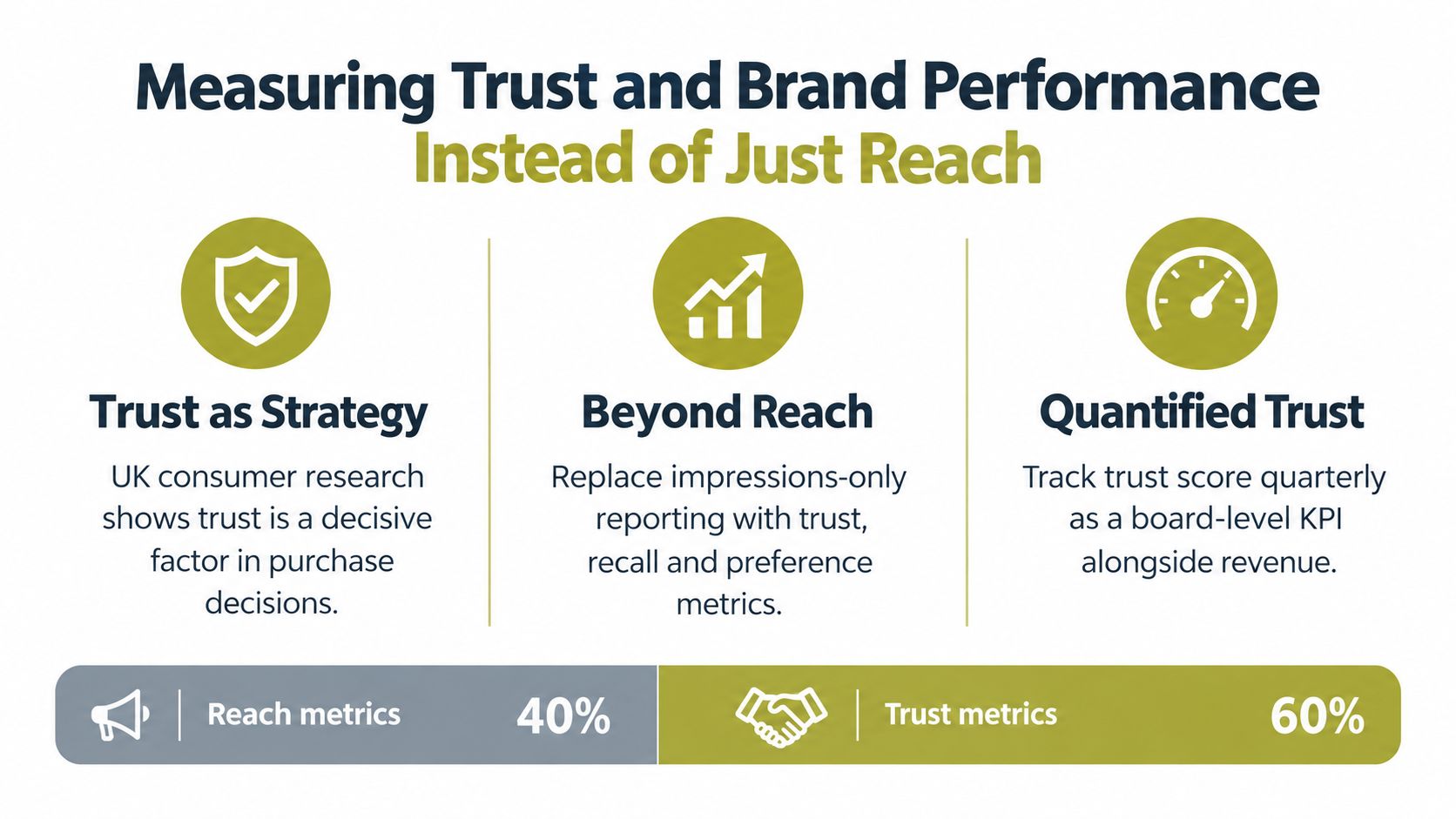
Reach is a distribution measure. It doesn't tell you whether the audience believes the claim, remembers the brand or would choose it when the purchase becomes real.
UK consumer research makes trust a commercial issue. A 2024 study of 1,500 UK consumers found that 46% were more likely to buy from brands they connected with and trusted, while 49% stayed loyal to high-quality brands even when those brands cost more. Those findings point to a sharper question than “How many people saw the campaign?” Ask whether the campaign strengthened confidence in the promise.
Audit the causes of distrust
Trust falls when experience contradicts communication. Build a working audit around:
- Customer treatment: Check whether policies, pricing and service feel fair in practice.
- Claims: Match environmental, quality and performance statements to evidence.
- Complaints: Record recurring issues, response times and unresolved friction.
- Risk: Map failures involving safety, ethics, leadership and delivery.
- Recovery: Decide what the organisation will disclose, change and monitor after an incident.
A UK YouGov study on lost brand trust found unfair customer treatment was cited by 40% of UK adults as a cause of lost trust. Unethical business practices followed at 35%, ignored complaints at 31%, health-and-safety risks at 29% and misleading advertising at 28%. Among people who had lost trust, 66% said they stopped buying from the brand.
The lesson is operational. Don't promise values that frontline staff, suppliers or customer service teams can't demonstrate.
Report brand health beside response
Brand-building reporting should include prompted and unprompted awareness, consideration, preference, perceived quality, share of search and trust. Activation reporting should include qualified leads, conversion rate, cost per acquisition and revenue.
Track the movement over time, then investigate the cause. A rise in reach with no improvement in consideration may indicate weak creative or poor audience selection. Strong engagement with falling trust may signal that the campaign is attracting attention for the wrong reason.
Use a quarterly trust measure with a consistent question set, segment the findings by audience and connect changes to customer experience data. The brand trust planning resource from Carlos Alba Media provides a practical route into that process.
Common Brand Strategy Pitfalls and a Practical Implementation Timeline
Brand strategy usually breaks through drift. A founder signs off a broad promise, sales tightens it for conversion, a freelancer changes the tone, and the website ends up describing a different business from the one the team is trying to sell.
Trust falls apart even faster when a company treats sustainability as a vague brand mood instead of a claim that needs proof. Ipsos research on sustainable purchasing found that 66% of Britons consider environmental impact important, while only 4% of UK adults completely trust large corporations. The same research shows cost is the main barrier to buying sustainably, reported as 2.5 times more likely to stop UK consumers buying sustainably than the next-largest barrier. The lesson is simple. Make a narrow claim you can prove, state the limitations plainly, and give one person responsibility for maintaining the evidence.
Use a staged implementation plan
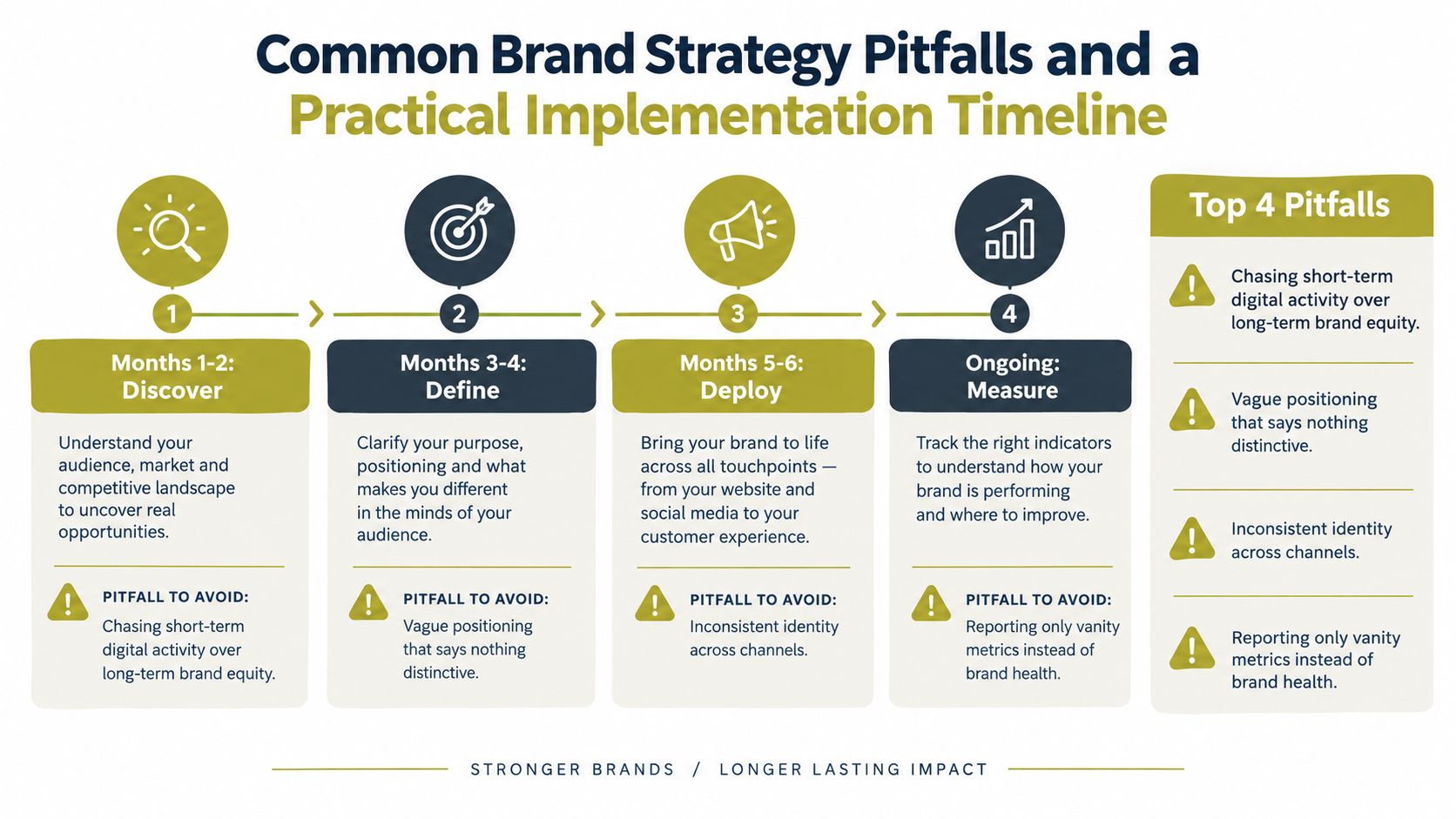
Months 1 to 2, discover: Interview customers, review competitors, audit current communications and identify the strongest proof for your position. Do not let short-term digital activity consume this phase. If you skip the evidence-gathering, you end up optimising ads and landing pages around a proposition that is still vague.
Months 3 to 4, define: Set purpose, audience, positioning, message hierarchy and measures. Cut any line that could describe half the category. If the wording sounds polished but interchangeable, it is weak.
Months 5 to 6, deploy: Finalise identity, update core touchpoints, prepare spokespeople and sequence PR, content, SEO, social and sales activity. Every channel should repeat the same promise in language suited to the format, not invent a new version of the brand.
Ongoing, measure: Review brand health and commercial performance quarterly. Track awareness, consideration, preference, perceived quality and trust alongside qualified leads, conversion rate, acquisition cost and revenue.
As noted earlier, the IPA Effectiveness Databank research supports the practical 60:40 planning benchmark. Use it as a starting ratio between long-term brand building and short-term activation, then adjust for cash flow, regulation, category maturity and buying cycle. Make that choice deliberately. Do not let quarterly pressure make it for you.
Carlos Alba Media offers senior-level PR, digital marketing, brand strategy, media skills training and crisis communications for start-ups, SMEs and established organisations. If your proposition is unclear or your launch needs a credible route from attention to trust and action, visit Carlos Alba Media to discuss the strategy, content and media support required.