
More blog posts won't fix an SEO problem caused by weak intent, generic advice and no plan for what happens after publication. That's the popular advice most founders receive, publish consistently, add keywords, wait for rankings, then publish again. It turns SEO content creation into a treadmill.
The search environment has changed. Your content now needs to earn conventional rankings, survive zero-click results and give search systems enough clarity and evidence to cite your brand accurately. The standard is closer to a newsroom than a keyword spreadsheet: find a useful angle, verify every claim, explain the subject clearly and give the reader a reason to continue.
Why Most SEO Content for SMEs Quietly Fails
The failure usually starts before writing. More content equals more growth sounds efficient, but publishing pages without a clear job creates overlapping topics, weakens editorial focus and leaves visitors with answers that lead nowhere commercially.
AI Overviews make that weakness easier to expose. A 2025 UK study found that 67% of AI Overviews appeared for informational-intent queries, including “how to” and “what is” searches. The UK study on AI Overviews shows why generic SME explainers face a difficult trade-off: they may earn visibility while satisfying the query without sending anyone to the site.

The publishing treadmill produces the wrong assets
The common process is predictable. An SME chooses a keyword, commissions an article and judges the outcome by impressions or a Google position. It rarely answers four commercial questions:
- Who is searching: A founder, procurement manager, tourist, patient or regulator may use different language and have different priorities.
- What happens next: The reader may need an explanation, comparison, proof point, service page or conversation.
- Why the business deserves trust: Generic summaries offer little evidence of experience or judgment.
- Who will maintain the page: Facts, offers, regulations and market conditions change.
A useful content programme connects discovery, education, trust and conversion. It combines service pages, expert guides, interviews, case studies, visual assets and updates instead of producing an endless run of similar posts.
A 2024 UK survey reported that 61.8% of businesses had an SEO strategy, while 74.5% used content marketing in their wider strategy. The UK digital marketing survey confirms that publishing is already common. Competitive advantage comes from assigning each asset a specific search purpose, evidence standard and commercial next step.
The newsroom standard is useful for SMEs
Former national journalists apply disciplines that generic SEO production often misses. They find a defensible angle, challenge unsupported claims, write for distracted readers and make complex information usable under deadline. Those habits matter in AI-era search because clear, trustworthy pages have a better chance of being understood and cited accurately.
That is the specialist nature of Carlos Alba Media. Everyone who works for Carlos Alba Media is a former national news journalist or has agency experience working with international brands. The result is an editorial approach applied to business content, not journalism theatre. For production context, ContentBuck's SEO content work provides a further reference for creating search-focused material.
Practical rule: Every page needs a purpose beyond ranking. Name the reader's next commercial or trust-building step before commissioning it. If that step does not exist, do not publish the page.
Researching Keywords Around Real Buyer Intent
Keyword research should begin with business decisions, not a tool export. Your task is to identify the searches that expose a problem you can solve, then separate them from searches that may only produce passive attention.
Start with your existing customers. Review enquiries, sales calls, support emails and proposal language. Record the phrases buyers use when they describe their problem, the alternatives they compare and the evidence they request before committing. Then group the phrases by intent:
- Discovery: The person is learning about a problem or possible solution.
- Comparison: The person is weighing providers, approaches or products.
- Conversion: The person is ready to enquire, book, buy or request a quote.
Search the phrases manually. Examine the page types appearing in the results, featured questions, related searches, maps, videos and comparison pages. Google is showing you the format it believes matches the query. Don't force a long article into a results page dominated by service pages, and don't build a sales page for a question that clearly needs education first.
Match the query to the asset
| Intent Category | SERP Signals | Best-Fit Content Asset |
|---|---|---|
| Discovery | Explanatory results, “People Also Ask”, guides and definitions | Expert guide, glossary, video script or visual explainer |
| Comparison | Review pages, provider comparisons, alternatives and feature discussions | Comparison page, buying guide, case study or analyst-style article |
| Conversion | Service pages, local listings, product pages, booking or enquiry features | Location-led service page, landing page, product page or consultation page |
Local intent deserves particular attention. A 2024 UK survey reported that 46% of Google searches in the UK had local intent, while 86% of UK businesses used content marketing as part of their marketing activity. Andava's UK digital marketing statistics support a straightforward recommendation for Scottish and UK SMEs: build pages around the places you serve, the problems local customers face and the proof that makes your offer credible.
Use your buyer persona development resource to turn audience assumptions into usable editorial decisions. A tourism business might target “rainy day activities in Edinburgh” for discovery, “best family hotels near Edinburgh Castle” for comparison and “boutique hotel Edinburgh” for conversion. Those are different needs, so they require different evidence and page structures.
Volume is not a strategy. A high-volume query can attract visitors who will never buy, while a narrower phrase can reveal a serious prospect. For practical guidance on making SEO content with Humantext.pro, focus on matching the content to the reader's question rather than repeating a keyword until the prose becomes unnatural.
Building a Brief Your Writers Actually Use
A content brief should function as an editorial contract. It must tell the writer what the page needs to achieve, what evidence is acceptable and what the reader should do next. A long document full of tool screenshots and disconnected keyword variants won't achieve that.
Include these fields:
- Target query: The primary phrase and close variations, with no demand for awkward repetition.
- Search intent: Discovery, comparison or conversion, plus the evidence from the results page.
- Audience segment: A specific buyer and their current problem.
- Required sections: The questions the page must answer and the order that makes sense.
- Proof points: Customer evidence, first-hand experience, named experts, original research or verified sources.
- Internal links: The pages that should receive relevant, natural context.
- Success metric: A qualified enquiry, assisted conversion, brand search, booking or another commercial action.
A worked tourism brief
Consider a Scottish tourism SME targeting an informational cluster around planning a short break. The brief might read like this:
- Query: Scottish weekend itinerary for couples.
- Intent: Discovery, with a route towards accommodation and activity pages.
- Audience: Couples planning a short UK break who need a realistic itinerary rather than a generic list.
- Angle: A practical itinerary built around travel time, weather flexibility, local food and bookable experiences.
- Required sections: Choosing a base, a first-day route, a wet-weather alternative, food planning, transport considerations and links to relevant local services.
- Proof: Named local contributors, current opening information, original photographs and clearly dated facts.
- Internal links: Accommodation, experience and booking pages, each used where the reader naturally needs more detail.
- Success metric: Assisted bookings and qualified enquiries, not page views alone.
That brief gives a writer an editorial decision to make. It also prevents the common failure where an article lists attractions but offers no point of view, local knowledge or useful route through the decision.
Put accountability into the workflow
The person closest to the customer should shape the brief. An SEO specialist can validate the search environment, while a subject expert checks accuracy and a senior editor protects clarity. One named person should approve the final version, so responsibility doesn't disappear between marketing, sales and freelance contributors.
The professional journalism benchmark matters here. The Office for National Statistics estimated that 83,500 journalists worked in the UK economy in 2023, and 81% held a journalism qualification, according to the NCTJ's Journalists at Work report. A strong brief borrows the useful parts of that profession: a clear angle, verifiable facts and visible authorship.
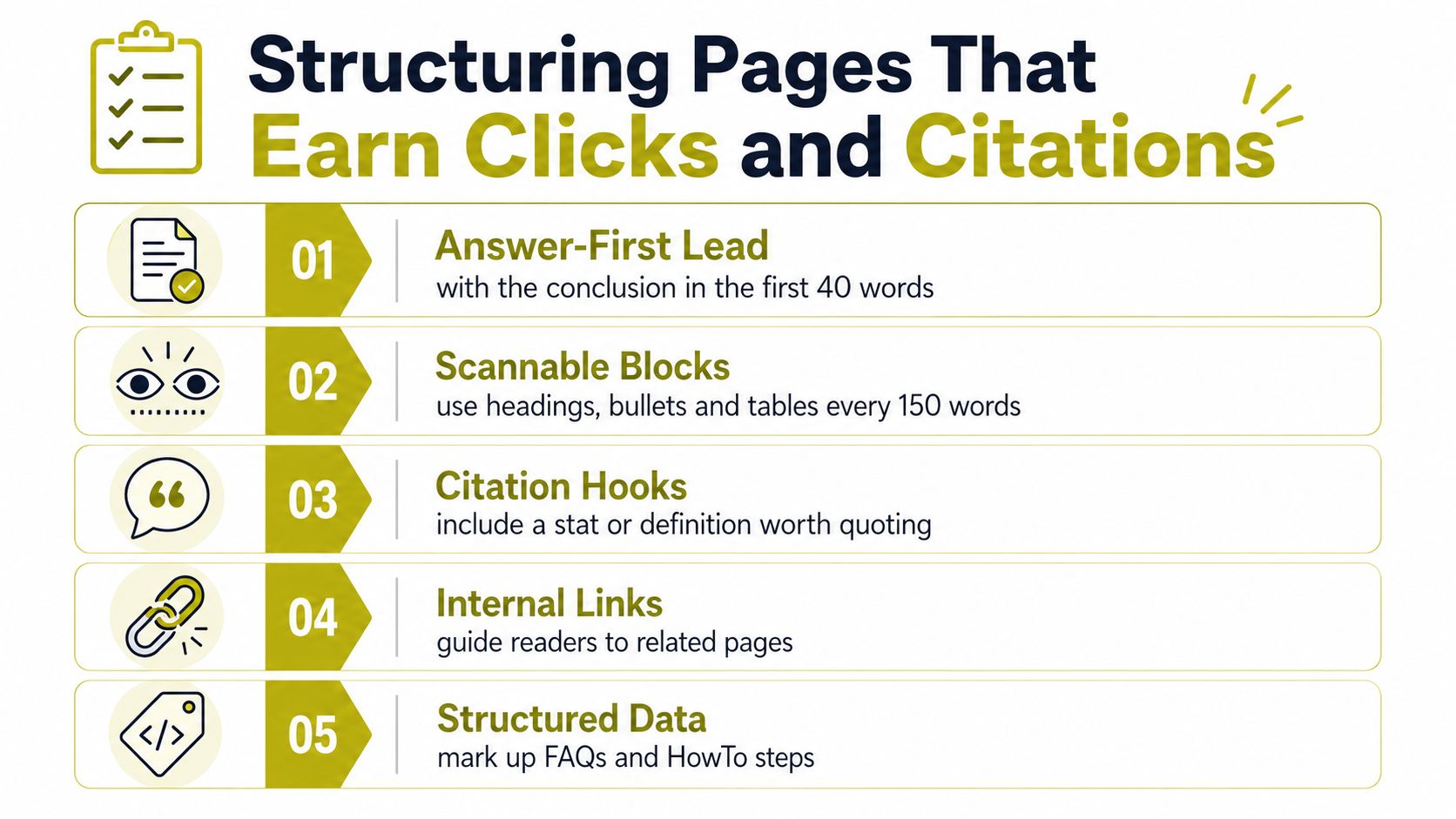
Structuring Pages That Earn Clicks and Citations
A search page has two audiences. A person scans it for a useful answer, while an automated system tries to identify clear, extractable information. Good structure serves both without making the page sound mechanical.
Lead with the answer. The opening paragraph should state the conclusion in plain English, then explain the reasoning and evidence underneath. Don't bury the useful point beneath a personal introduction, a history lesson or several paragraphs of scene-setting.
Write for scanning and extraction
Use headings that describe the question or decision, not vague labels such as “Our thoughts”. Put one idea in each section. Use a table when the reader must compare options, a numbered list when sequence matters and bullets when the information is parallel.
A citation-worthy passage usually has three qualities:
- A clear statement: Define the point without jargon.
- A specific basis: Name the source, date, method or example.
- A distinct angle: Add an observation that isn't interchangeable with every competitor's article.
Press Gazette reported that 68.8% of searches with an AI Overview produced no click to the publisher site, compared with 54.9% where an Overview was absent. The Press Gazette report reinforces why answer-first writing matters. Visibility without a click still has value, but only if the answer identifies your brand accurately and gives the reader a compelling next action.
Treat on-page optimisation as editorial craft
A title tag should state the subject and promise a useful outcome. A meta description should help the right searcher decide to click, rather than merely repeat the title. Headings should form a logical hierarchy, internal links should guide the reader towards relevant evidence or commercial pages, and image alt text should describe the image for people using screen readers.
Before publishing, check:
- Opening: Does the first paragraph answer the primary question?
- Hierarchy: Can a reader understand the page by scanning headings?
- Evidence: Are important claims dated, sourced or clearly presented as expert judgement?
- Links: Does every internal link help the reader make progress?
- Conversion: Is the next step visible without interrupting the answer?
- Markup: Are relevant FAQs, products or HowTo steps represented with accurate structured data?
- Media: Do images load efficiently and carry useful, accurate alt text?
Keyword placement is a consequence of clear subject coverage, not the writing objective. If the page is useful, the relevant language will appear naturally. If you're inserting terms into every heading, you're editing for a spreadsheet instead of a reader.
UX, Performance and Trust as Ranking Inputs
A strong article can still underperform when the page is slow, obstructed by pop-ups or difficult to use on a phone. Performance belongs inside the content workflow because readers judge the page while they consume the information, not after a technical team has finished its audit.
Core Web Vitals are best understood in practical terms. Loading performance asks how quickly the main content appears. Interaction responsiveness asks whether the page reacts when someone taps or clicks. Visual stability asks whether buttons, text and images jump around while the page loads.
Fix the problems that block comprehension and conversion first. Compress oversized images, remove unnecessary scripts, reserve space for media, reduce intrusive overlays and make contact or booking actions easy to find. Don't spend the afternoon polishing a minor design detail while the main article takes too long to become usable.
Make trust visible
AI systems and human buyers both need signals that help them judge reliability. Add a named author with relevant experience, a review or publication date, source notes for factual claims, a clear distinction between advice and promotion, and an obvious way to contact the organisation.
The newsroom benchmark is relevant because national journalism is a defined segment of the profession. Evidence submitted to the House of Lords Communications and Digital Committee recorded 81,000 people working as journalists or newspaper editors in the UK in 2019, with national newspapers representing 13% of journalism employment in 2018. The parliamentary evidence provides context for why national-news experience is specialist rather than a synonym for general communications work.
A page earns trust when a reader can identify who made the claim, when it was checked and why that person is qualified to make it.
Run these checks in an afternoon:
- Open key pages on a mobile connection and note delays or layout movement.
- Ask a colleague to find the main answer without your help.
- Check whether every author has a meaningful biography.
- Select several factual claims and trace them to their sources.
- Follow the main conversion path as a first-time visitor.
- Review contact details, policies and commercial disclosures for clarity.
Use the web performance guidance from Carlos Alba Media when a technical review needs to connect page speed with user experience and conversion.
Measuring What AI-Era Search Actually Rewards
Rankings are a diagnostic, not a business result. A page can attract broad informational traffic without producing a qualified conversation. Another may rank modestly, appear in an AI Overview or zero-click answer, shape a buyer's decision and contribute to a later branded search, direct visit or sales call.
Content is now widely used across the UK, including blogs, images and infographics. That adoption makes publishing volume a poor success measure. Report which assets create commercial value, earn visibility in AI-generated answers and provide evidence systems can accurately reuse.

Build a small commercial dashboard
Track qualified enquiry rate, assisted conversions, branded search activity, calls, bookings and the pages viewed before conversion. Review AI-generated answers for priority queries on a regular schedule. Record whether systems mention the brand, describe its services accurately and use distinctive evidence from your content.
Add a newsroom-style accuracy check. For each important page, ask whether the information remains current, whether the source is clear and whether an editor could defend every material claim. A page that earns visibility but misrepresents the business creates an apparent win with a real commercial cost.
A ranking page that never contributes to an enquiry deserves scrutiny. A guide that introduces a prospect, supports a later branded search and helps a sales conversation may merit more investment, even when its position looks unremarkable.
Use a quarterly comparison:
| Page pattern | What the data says | Decision |
|---|---|---|
| High visibility, no commercial action | The topic may be too broad or the next step unclear | Rework the intent and conversion path |
| Moderate visibility, qualified enquiries | The page supports a valuable audience | Improve evidence and internal links |
| Impressions, declining accuracy | The resource may mislead readers or systems | Update, consolidate or retire it |
If advertorial work is part of your wider DTC activity, Landra's guide on AI advertorials for DTC offers a useful comparison for evaluating persuasion, content structure and commercial intent. Measure what helps a buyer choose, not what flatters a monthly report.
Ask three questions: Did the page reach its intended audience? Did it influence a meaningful action? Did it represent the business accurately when the searcher never clicked?
Your Quarterly Content Audit and Next Steps
Stop treating your content library as a collection of permanent assets. Every page has a job, and that job can become less useful as the offer, market, search results or evidence changes.
Classify every URL as discovery, trust, comparison, conversion or customer support. Then score it against four questions:
- Freshness: Are the facts, offers, dates and recommendations current?
- Accuracy: Can a named person verify the important claims?
- Commercial contribution: Does the page assist an enquiry, booking, sale or meaningful brand action?
- Citation potential: Does it contain clear, distinctive and independently checkable information?
Make four decisions, not endless notes
Invest when the page serves a valuable audience, remains accurate and supports a clear business outcome. Improve its opening, evidence, internal links and conversion path.
Merge when several pages answer substantially the same question. Choose the strongest URL, combine the useful material and redirect the weaker pages where appropriate.
Replace when the topic matters but the current article is generic. Add original interviews, expert commentary, regional insight, first-hand observations or proprietary research.
Retire when the page has no clear audience, no defensible information and no useful role in the customer journey. Keeping weak content “just in case” creates maintenance work without strategic value.
The UK agency environment shows why experienced teams can help with this operating model. Written evidence to the UK Parliament reported that advertising services generated £4.3 billion in annual exports, while 35% of the largest UK agencies' revenue came from overseas business. The parliamentary evidence on UK advertising establishes that agency experience can include international-brand work at scale. Carlos Alba Media's staff combine that agency background with former national-news journalism, so the relevant question isn't whether someone can produce copy. It's whether they can make sound editorial and commercial decisions.
Use this content marketing strategy guide to turn the audit into an operating plan. This week, identify your commercially important pages and remove obvious duplication from the next publishing queue. This month, rebuild one priority page around buyer intent, named evidence and a clear next action. This quarter, review qualified enquiries, assisted conversions, branded searches and how AI systems describe your business.
Carlos Alba Media combines SEO-optimised articles, landing pages, interviews, thought leadership, video scripts and case-study material with PR, UX and brand strategy. If your content has produced activity without enough enquiries, Carlos Alba Media can audit the programme, identify the pages worth improving and build a newsroom-led plan for visibility, trust and conversion.