
A founder lands three trade press mentions, shares the links on LinkedIn and waits for the pipeline to respond. The coverage looks credible, the team feels busy, and yet nobody can explain why enquiries have barely moved. The problem usually isn't the quality of the headlines. It's that the campaign was recorded as a publicity event rather than designed as a commercial test.
Case study PR should show what changed, for whom, through which activity and with what business consequence. That demands more than a PDF of press clippings. It requires a documented chain from objective to audience, narrative, distribution, response and revenue, with enough evidence for both a journalist and a finance director to challenge it.
What a Strong Case Study PR Strategy Looks Like
A start-up seeking its first enterprise customer, an SME defending a PR retainer and a regulated organisation repairing public confidence face different commercial problems. Each needs a different message, media list and measure of progress. A generic success story will blur those differences and make the result harder to defend.
A strong strategy begins by naming the business decision PR is meant to influence. That might be whether a buyer agrees to a meeting, whether a prospect enters a sales conversation or whether a stakeholder's confidence improves after a difficult event.
Practical rule: If the case study cannot name the business decision it was meant to influence, it is not ready to publish.
Build the case study around four connected parts:
- Business problem: What commercial or reputational obstacle existed before the campaign?
- Defined audience: Which customers, investors, employees, regulators or partners needed to respond differently?
- Measurable activity: What did the PR team do, and how was exposure, engagement or response recorded?
- Commercial outcome: What observable behaviour followed, such as an enquiry, registration, sales conversation, recruitment application or change in stakeholder confidence?
The evidence must support a clear chain from problem to action to consequence. Coverage volume can show distribution, but it cannot prove that the intended audience noticed the story or changed behaviour. A smaller specialist feature may therefore be more useful than a broad mention if it reaches people involved in the relevant decision.
The same trade-off applies to the story itself. Depth takes longer than collecting headlines, yet it explains why the work mattered. Evidence is more useful than reach, because estimated audience figures rarely show who acted. Structured storytelling beats promotional copy, because editors and readers respond to tension, consequence and human relevance rather than a catalogue of product benefits.
This discipline matters across the UK SME market. SMEs represented 99.8% of the UK business population in 2024, employed approximately 16.6 million people and generated around £2.8 trillion in private-sector turnover, according to CIPR's research on SMEs and public relations.pdf). Yet YouGov found that 43% of UK organisations reported no PR activity, rising to 86% among microbusinesses and 54% among businesses employing 10 to 49 people, as reported in its research into British business leaders' PR efforts.
The opportunity belongs to consultancies that can connect editorial proof with commercial evidence and explain both in plain language.
The Five-Stage Structure Behind Every Effective PR Case Study
The OASIS approach gives a case study a reliable spine: Objective, Approach, Scale, Impact and Story. It isn't a decorative acronym. Each stage answers a question a sceptical client, editor or finance lead is likely to ask.
Objective
Start with the commercial problem, not the press release. Was the organisation trying to create qualified demand, improve retention, enter a new market or rebuild confidence after an incident? The objective should describe the intended change in behaviour and include a defined timeframe or numerical target where the client has reliable data.
For an SME SaaS company repositioning after a funding round, “raise awareness” is too weak. A useful objective might be to make procurement leaders in a defined sector more willing to consider the company for a specific operational problem. The sales team should agree how that consideration will be observed, perhaps through qualified conversations, demo requests or progression through an existing CRM stage.
Approach
Describe the mechanics. Which customer supplied the proof? Which spokesperson carried the argument? Did the team use a founder interview, a customer narrative, a sector report, broadcast preparation, regional media or a combination of channels?
The approach should also explain what the team rejected. A national launch may create prestige but weak relevance. A specialist trade feature may reach fewer people while giving sales staff a stronger reason to contact prospects.
Scale
Scale means more than a headline audience estimate. Record the outlets, audience segments, geography, prominence, message delivery and referral activity. Separate original coverage from syndicated copies, and distinguish a passing mention from a detailed interview or customer-led feature.
Impact
Impact is where most case studies become vague. Connect media activity to pipeline movement, retention, enquiries, registrations or another observable action. State what the data can support and what it can't. If several channels were active at once, describe PR as an influence or contribution unless the attribution method clearly isolates it.
Story
The story gives the evidence meaning. A customer who overcame a recognisable problem, a founder who made a difficult decision or a regulated team that handled scrutiny responsibly can make the commercial result memorable without turning the case study into an advert.
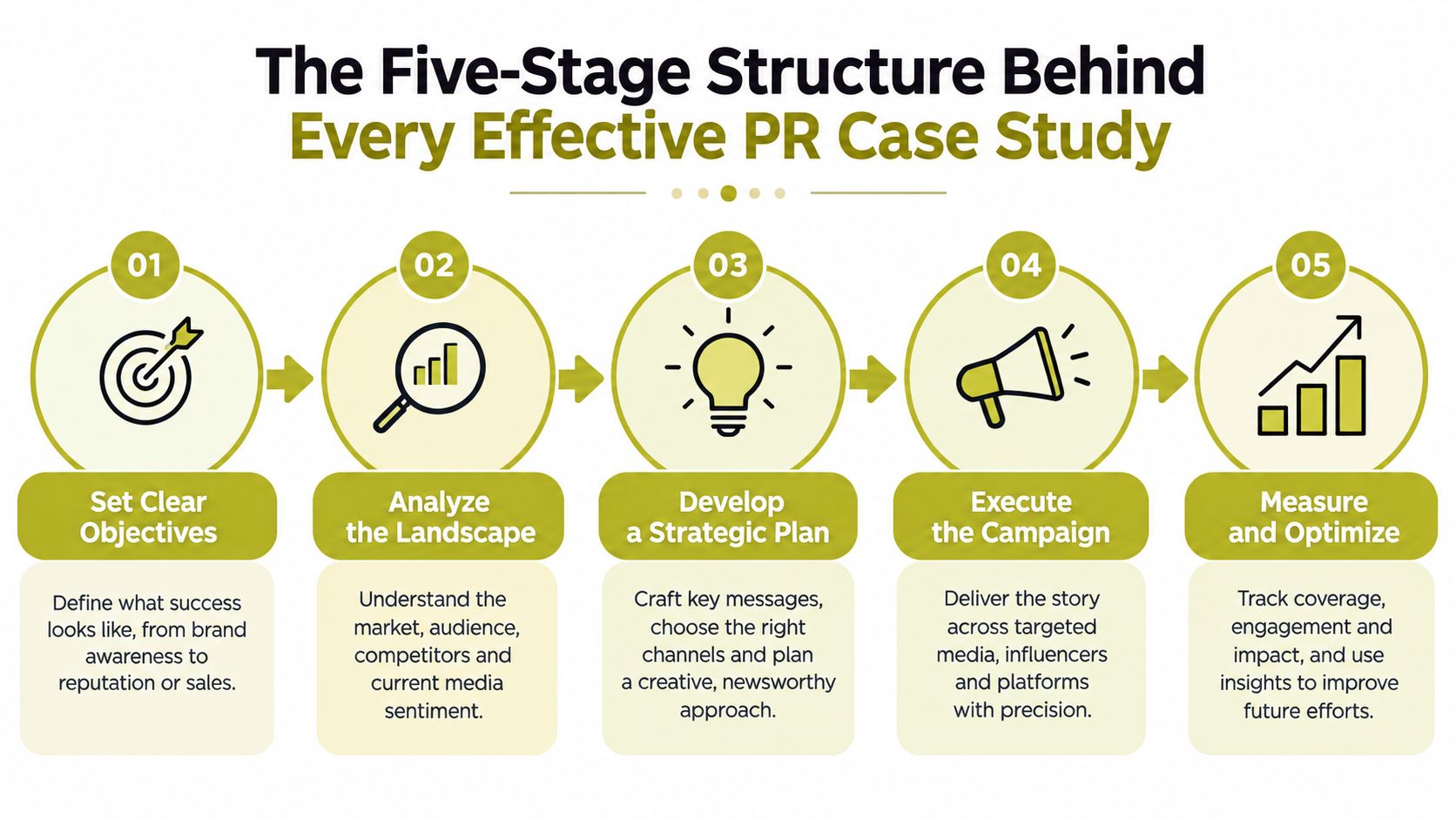
To audit an old case study quickly, write the five labels on a page and look for one paragraph or data point under each. Missing Objective means the campaign lacks purpose. Missing Scale means the distribution can't be judged. Missing Impact means the piece is probably reporting activity rather than value. Missing Story usually means the copy will read like a sales sheet.
The UK Government Communication Service OASIS guidance supports this disciplined sequence and distinguishes outputs, outtakes and outcomes. It also recommends allocating approximately 5 to 10% of paid-campaign resources to evaluation, with objectives that are numerical, outcome-focused and time-bound.
From Coverage Counts to Commercial Outcomes
Finance teams don't sign off a press clipping. They sign off a credible explanation of how an investment may have contributed to a business result.
The cleanest way to build that explanation is to separate four layers. Coverage records what appeared. Attention records whether the intended audience consumed or interacted with it. Intent records a meaningful signal such as a branded search, content download or sales conversation. Revenue records the commercial result, while recognising that PR may be one influence among several.
Build the evidence chain
Suppose a regional broadcast segment features a local software firm and a customer explaining a costly operational problem. Before publication, the team should record the relevant referral sources, branded search baseline, existing trial volume, sales pipeline and any other campaigns running during the period.
After the segment, the team can compare referral traffic from the broadcaster, direct visits to the campaign page, branded search behaviour and trial registrations with the baseline. Sales should then identify which registrations became sales-qualified opportunities and which eventually closed. The report must preserve the time window and note competing influences, such as a product launch, seasonal demand, paid search or an unrelated news event.
Don't claim that the broadcast caused every later sale. Say that the segment generated identifiable referral activity, that some referred visitors entered the sales process and that the available evidence supports a contribution to the result. That language is more credible because it reflects the limits of attribution.
| Layer | Example metric | Risk if used alone |
|---|---|---|
| Coverage | Relevant article, interview or broadcast segment | Presence doesn't prove that the intended audience noticed |
| Attention | Engaged visits, viewing behaviour or message recall | Attention may not indicate buying intent |
| Intent | Qualified enquiry, registration or sales conversation | Intent can fail to become a commercial result |
| Revenue | Closed business or attributable retained value | Revenue may reflect several channels and external factors |
A useful guide to measuring PR effectiveness can help teams turn these layers into a working reporting sheet. Each placement should have a source tag, audience description, message record, referral path and link to the relevant CRM entry where possible.
Rebuild a weak coverage report by asking:
- Can finance verify the baseline? Record the comparison period and data owner.
- Can sales recognise the lead? Match enquiries to source tags and campaign pages.
- Can a reader see the limitation? List concurrent activity and unresolved attribution.
- Can the team judge quality? Separate relevant editorial attention from inflated impression estimates.
- Can the result guide the next campaign? State which outlet, message or audience produced the strongest signal.
Industry research cited by CIPR found that 97% of nearly 200 UK and Ireland communications professionals struggled to measure PR effectiveness, while less effective measures such as coverage volume, traffic and engagement were often used more frequently than lead generation, behavioural change and return on investment. The same survey estimated approximately £80,000 of annual waste per organisation, although that estimate comes from an industry survey rather than official UK statistics. The lesson is straightforward: a case study should make uncertainty visible instead of hiding it behind a large reach number.
Why Trusted UK Media Outlets Beat Bigger Reach
Reach answers how many people might have encountered a message. It doesn't answer whether the audience trusted the source, understood the claim or considered acting.
For a UK SME, outlet choice should follow the commercial task. Broadcast can help a consumer brand demonstrate a product or humanise a local issue. A national business title may support investor, partner or recruitment credibility. A specialist trade publication can reach the people who understand the problem and influence a purchase. A regional paper may outperform a national outlet when the business depends on local customers, staff or public support.
The relevant comparison isn't BBC versus a social platform, or The Times versus a trade title. It is which environment gives the intended audience enough confidence to take the next step. The BBC, The Times, City AM, Retail Week and the Manchester Evening News each carry different editorial expectations, audience relationships and commercial implications.
| Outlet tier | Example titles | Trust signal | Audience fit for SMEs | Typical commercial impact |
|---|---|---|---|---|
| Broadcast | BBC, ITV News, Channel 4 | Editorial scrutiny, recognisable presenters and public accountability | Consumer, public-interest and reputation-led stories | Awareness, trust, stakeholder confidence and direct response |
| National press | The Times and other established national titles | Strong brand recognition and broad authority | Founders, investors, executives and national customers | Credibility, search visibility and market positioning |
| Business press | City AM and comparable business publications | Commercial relevance and financial readership | Finance, investment, entrepreneurship and B2B propositions | Investor attention, partnerships and executive visibility |
| Sector trade | Retail Week and relevant specialist titles | Subject expertise and concentrated professional readership | Niche B2B products, services and regulated sectors | Qualified conversations, referrals and category authority |
| Regional press | Manchester Evening News and comparable local titles | Local knowledge and community relevance | Place-based brands, employers and regional services | Local demand, recruitment and stakeholder support |
Ofcom's 2025 research on news consumption in the UK found that around seven in ten regular users of broadcast television, print newspapers and radio rated those sources highly for accuracy and trust. It also found that online sites and apps had become as important as television as a main news source for UK adults. That doesn't make every online impression equal to a broadcast appearance. It means channel selection needs to account for audience behaviour, trust and the action required.
Before pitching, score an outlet against five questions:
- Does its audience include the people who can buy, recommend or regulate the proposition?
- Does its editorial style suit the evidence and spokesperson available?
- Will the coverage offer durable search or referral value?
- Can the organisation answer scrutiny about claims, risk and customer outcomes?
- What action should follow, and can the team measure it?
The OECD's UK public-communication scan recorded media trust at 38.8% in the cited 2022 OECD Trust Survey, which reinforces the need to prioritise credible context over raw exposure. Trusted media isn't a shortcut to sales. It is an environment in which well-supported claims have a better chance of being believed.
SEO, Schema and Distribution That Make a Case Study Travel
A case study shouldn't disappear after the launch email. Treat it as a durable search asset with a clear subject, a useful URL, internal routes and evidence that can be understood by both people and search systems.
Start with the page itself. Use case study PR naturally in the title, introduction, one relevant subheading and the metadata, but don't repeat it mechanically. Give the page a specific descriptive title that includes the client problem or sector. A heading such as “How a regulated fintech rebuilt stakeholder confidence” is more useful than “Our latest success story”.
Make the page useful to searchers
Build the content around the questions a prospect would ask:
- What problem existed before the work?
- Why was the audience difficult to reach or persuade?
- Which PR activity changed the situation?
- What evidence supports the result?
- What constraints, risks or trade-offs affected the campaign?
- What should a similar organisation do next?
Link from the case study to the relevant service, product, sector and contact pages. Use descriptive anchor text rather than forcing every internal link to use the same phrase. Add Article or CreativeWork schema when the page clearly represents one of those content types, and keep the visible author, publication information and dates consistent with the structured data.
Distribution should follow the audience and the likely shelf life:
- Owned first: Publish the complete case study on the organisation's site, then give sales and client teams a concise version with approved proof points.
- Earned next: Offer an angle built for journalists whose beats match the customer problem, not a generic announcement about the campaign.
- Paid last: Amplify the strongest evidence to a defined audience only after the organic page and tracking are working.
LinkedIn suits founder commentary, customer evidence and professional discussion. Email works when a known audience needs a practical lesson. Trade forums can provide specialist context, but only when participation is useful. Press syndication may increase distribution, yet duplicated copies should not be counted as separate audiences or treated as independent editorial validation.
For outreach research, a practical directory of backlink building sites can help identify relevant opportunities, but relevance and editorial quality should determine whether a site belongs in the plan. Search Console should be monitored for impressions, clicks, queries, average position, indexed status and referring-page behaviour during the early life of the asset. Look for changes in the queries that bring people to the page, not just a headline traffic total.
Technical detail won't rescue thin proof. The page still needs a real customer voice, a clear commercial question and claims that legal, sales and editorial stakeholders can verify. Guidance on SEO for press releases is useful when a case study is connected to a wider announcement, but the case study itself should remain readable without promotional padding.
Real Case Study Breakdowns Across Different Sectors
Different sectors expose different weaknesses in case study PR. A start-up needs proof that reduces perceived risk. A manufacturer needs to connect reputation to a considered buying journey. A regulated business must often earn confidence before it can ask for action.
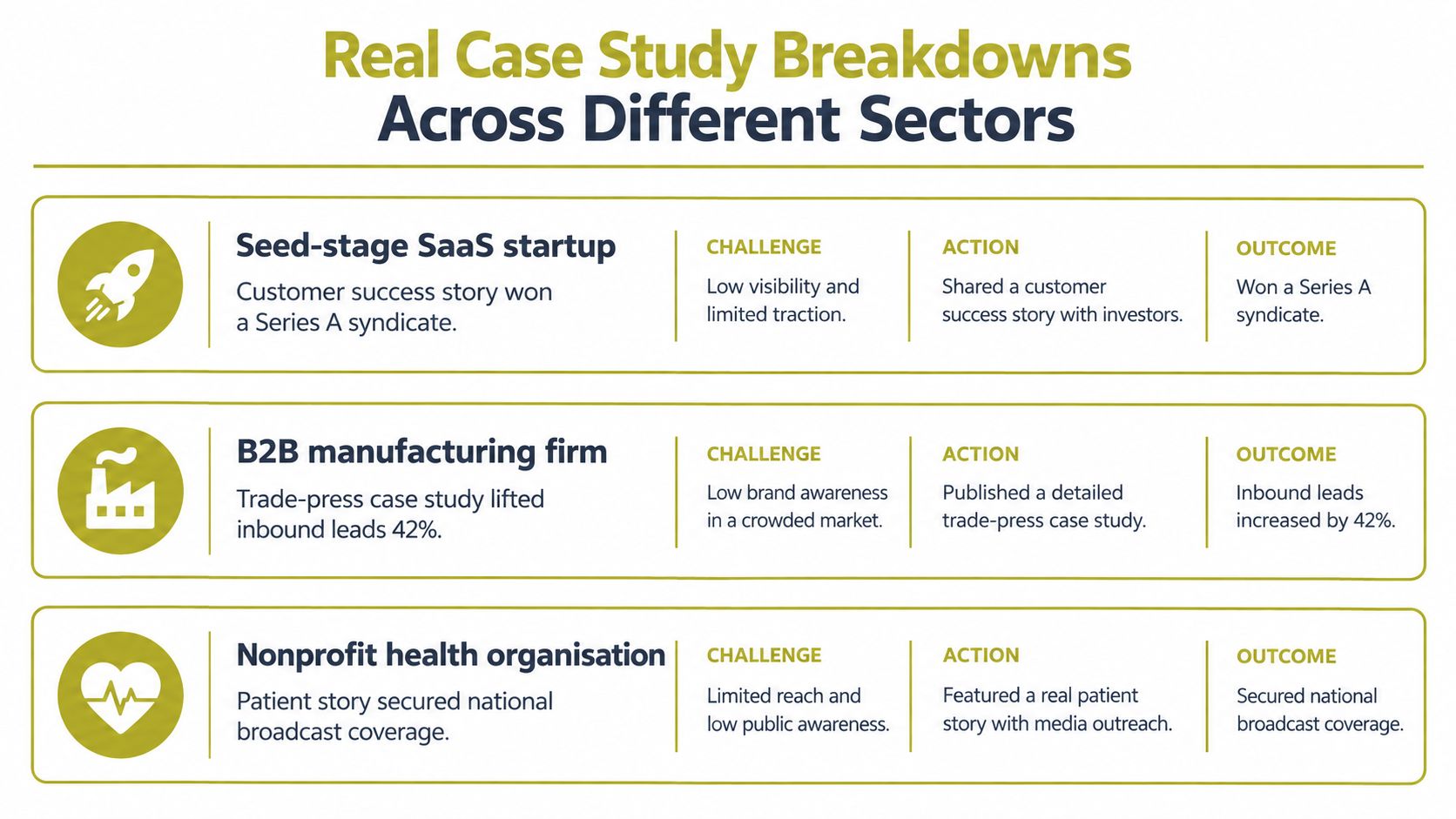
A seed-stage SaaS company
The objective was to use a customer success story to establish credibility with enterprise prospects. The hook wasn't the software's feature list. It was the customer's operational problem, the decision to change and the evidence that the new process made work more manageable.
The team prepared a customer interview, a founder briefing and a concise proof pack for specialist technology journalists. Trade coverage then supported targeted sales conversations, with the commercial measure focused on enterprise pilots rather than audience size. The lesson is that a recognisable customer problem can do more persuasive work than a company announcement, provided the customer can explain the change in their own terms.
A Midlands manufacturing SME
The business had a sustainability achievement but didn't want a purely celebratory story. The objective was to make the achievement relevant to buyers, employees and the regional community.
The hook combined a practical change in production with the people responsible for delivering it. Regional media established local relevance, while national and trade outreach connected the story to procurement and industry discussion. Sales tracked responses linked to the coverage and compared them with the existing enquiry pattern. The lesson is to translate a values claim into operational proof. “We care about sustainability” is weak. A documented change, a credible spokesperson and a buyer-relevant consequence are stronger.
An FCA-regulated fintech
The objective wasn't immediate lead generation. The organisation needed to rebuild confidence after a difficult period while remaining within compliance boundaries.
Every claim and customer reference went through the appropriate review. The media mix favoured explanatory, evidence-led material over aggressive promotional placement, and the measurement plan focused on message understanding, sentiment and stakeholder response. A slow reputation rebuild can be commercially valuable even when it doesn't produce an instant sales spike, but the case study must show the sequence of evidence rather than imply a dramatic turnaround.
The distinction between output and outcome is illustrated well by Anyvan's bulk content example, which demonstrates how a scalable content asset can be discussed through its practical purpose rather than treated as a collection of isolated pages.
For each sector, the useful case study asks the same underlying question: what changed in the audience's behaviour, and what evidence supports that conclusion? The answer may be a pilot, a qualified conversation, a sales response or improved understanding. It won't always be a headline revenue figure, and pretending otherwise weakens trust.
A Pitch Template That Proves Outcome, Not Just Output
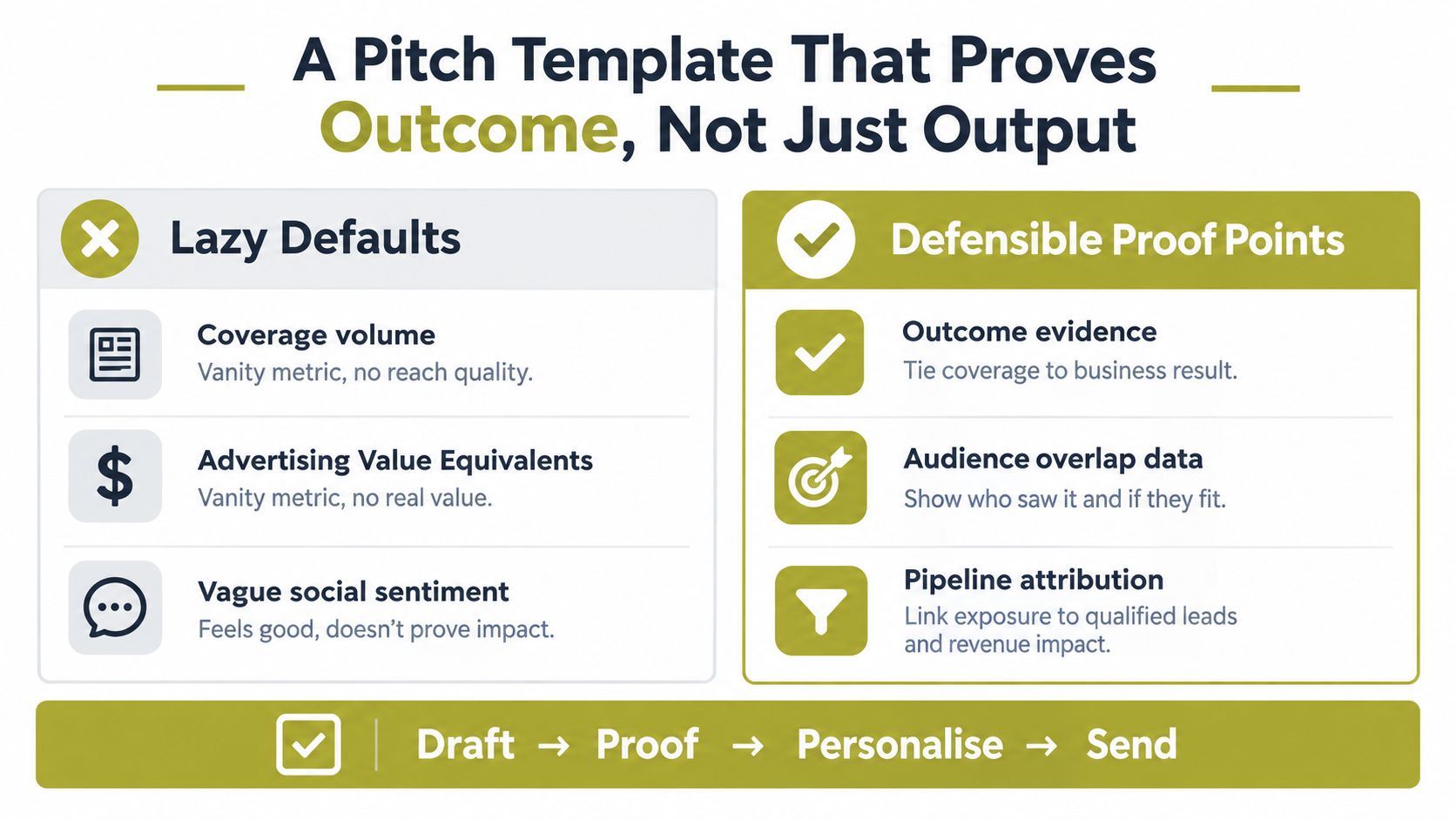
Three lazy defaults still weaken many PR pitches:
- Coverage volume: A stack of mentions says little about audience relevance or response.
- Advertising Value Equivalents: A hypothetical advertising comparison doesn't establish editorial influence or commercial return.
- Vague social sentiment: Likes, shares and positive comments can show reaction without showing a business decision.
Replace each with a proof point tied to one commercial question. For example, ask: Did this campaign help the sales team create qualified conversations with the audience that matters?
A concise pitch can then follow this sequence:
- Baseline: Before the campaign, what behaviour or perception needed to change?
- Mechanic: What did the PR team do that could plausibly influence it?
- Audience: Which people encountered the message, and why were they relevant?
- Measured shift: What changed in enquiries, branded search, registrations, conversations or perception?
- Attribution: Which part can be linked to PR, and which part remains uncertain?
- Cost: What resources were required to produce and evaluate the activity?
- Risk-adjusted view: What could be repeated, and what depended on unusual timing or a single news event?
- Why now: Why does this evidence fit the journalist's beat today?
A 200-word email can be more effective than a 1,200-word traditional pitch when it gives the journalist a clear result, credible evidence and a relevant human angle. The shorter format forces the sender to remove background that doesn't support the news value. It shouldn't remove the source of the claim, the customer context or the limitation.
Use the press kit templates to organise approved biographies, images, customer evidence and supporting facts, then complete a final quality check:
- Legal approval: Confirm that every commercial and regulated claim is cleared.
- Named source: Identify who owns each number, quote, customer statement and outcome.
- Evidence trail: Keep the source tag, baseline and relevant CRM or analytics record.
- Editorial relevance: Explain why the subject matters to this reporter's audience.
- No overclaiming: State contribution where causation can't be proved.
- Clear next step: Offer an interview, customer voice, data point or document that helps the journalist report the story.
The strongest pitch makes the outcome the unit of persuasion. Coverage is the vehicle. The reason to care is the verified change behind it.
Carlos Alba Media provides senior-level PR and digital marketing support across broadcast, online, print and social, with a specialist team in which every professional is a former national news journalist or has agency experience working with international brands. Visit Carlos Alba Media to discuss a case study PR programme built around credible stories, measurable commercial outcomes and media scrutiny.