
The nearest market isn't automatically the right first market. Nor is the largest one. For a UK SME, the better opening question is whether the business can deliver, comply, localise and support customers there without exhausting its cash and management capacity.
That changes the purpose of a market entry strategy. It isn't a growth slogan or a list of promising countries. It's a sequence of tests that ranks regulatory friction, delivery economics and execution capability before marketing spend begins. PR, SEO and digital acquisition then have a job to do, each tied to evidence that the market can produce commercially viable demand.
Why Most Market Entry Strategy Advice Fails UK Firms
Market-entry advice often starts with market size, GDP, population or geographic proximity. Those measures can identify opportunity, but they don't tell you whether your business can operate profitably once customs, tax, payments, local standards, fulfilment and customer support enter the calculation.
UK exporters face practical barriers before a single campaign goes live. In a Department for Business and Trade survey, 55% of registered businesses that export or could export said cost was a moderate or strong barrier. Transportation from the UK to the destination was cited by 58%, exchange-rate fluctuations by 47%, and the cost of scaling the business by 45%. 52% also described their capacity to export or deliver international contracts as a moderate or strong barrier, according to the Department for Business and Trade evidence on exporting barriers.
A business can therefore choose a large, nearby market and still create a shallow pipeline. The team may generate attention before it knows whether it can quote accurately, meet delivery expectations, answer compliance questions or support customers in the right time zone. PR then produces awareness without a credible next step, while SEO attracts visitors to an offer that isn't operationally ready.
Rank friction before audience
Government data recorded 394 reported market access barriers in financial year 2024 to 2025, across 90 trading partners, with 79 barriers in Europe alone. The UK market access barrier statistics show why geographic closeness doesn't remove entry risk. Customs procedures, non-tariff barriers, local regulation and trade finance can still determine whether a launch works.
A sharper ranking system asks three questions:
- Can we operate there? Assess licences, standards, data rules, customs and consumer obligations.
- Can we deliver at an acceptable cost? Model freight, returns, payment costs, currency exposure and partner margins.
- Can our team execute? Test local expertise, sales capacity, customer service and the ability to adapt messaging.
Practical rule: Don't approve a market because the headline opportunity is attractive. Approve a test because the business can define what success, failure and exit will look like.
Every pound should connect to a commercial threshold, such as qualified enquiries, partner-sourced opportunities, conversion from a localised landing page or a viable payback period. If the team can't state the threshold, it isn't ready to scale the channel.
What a Market Entry Strategy Actually Is
A market entry strategy is the operating plan for beginning to sell or work in a new market. It defines where to start, which route to use, what the organisation must adapt, how much commitment is acceptable and what evidence will justify the next investment.
The choice of entry mode matters because it changes the balance between speed, control and exposure. Direct exporting may let a firm test demand from the UK, while a local entity provides more control but creates earlier legal, tax, banking and employment obligations. A distributor can supply relationships and local reach, although the manufacturer gives up margin and some control over customer information.
Choose the route against five tests
Use these criteria before selecting a channel:
- Capital exposure: How much cash must be committed before revenue is proven?
- Speed to revenue: How quickly can the organisation reach real customers?
- Control: Who owns pricing, data, brand presentation and customer experience?
- Regulatory burden: Which approvals, filings and local responsibilities arrive with the route?
- Reversibility: Can the business pause without an expensive lease, entity, acquisition or long-term contract?
| Entry Mode | Capital Exposure | Speed to Revenue | Control | Reversibility |
|---|---|---|---|---|
| Direct exporting | Low to moderate | Fast for an initial test | Moderate | High |
| Licensing or franchising | Low to moderate | Moderate | Lower | Moderate |
| Joint venture or strategic partnership | Moderate | Moderate | Shared | Moderate |
| Distributor or agent network | Low to moderate | Moderate | Lower | High |
| Local entity set-up | High | Slower | High | Low |
| Acquisition | Very high | Potentially fast | High, subject to integration | Low |
A startup may begin with direct sales and a partner, then consider an entity only after demand and service requirements justify the commitment. A regulated business may have to reverse that logic, completing authorisation and approved messaging before promotion. A company assessing how to launch across 27 EU markets should also distinguish a broad legal or structural opportunity from the practical work required to sell and support customers in each market.
No mode is a default answer. Treat these routes as building blocks. The right combination depends on the market assessment, the firm's capabilities and the cost of being wrong.
A Practical Market Assessment Framework
A useful assessment should prevent a team from confusing an attractive market with an executable one. Score candidate markets across four dimensions, then add delivery economics and internal capability as explicit decision factors rather than burying them in a narrative recommendation.
Four dimensions to score
Demand quality comes first, but avoid vanity totals. Estimate the addressable segment for the actual product, buyer and price point. Use search behaviour, customer interviews, category activity, relevant procurement data and competitor visibility as proxies. A large general market is less useful than a smaller segment where the buying problem is clear.
Competitive density includes direct rivals, substitutes, local specialists and incumbent relationships. Review their pricing, distribution, proof points, customer complaints and search visibility. The question isn't whether competitors exist. It's whether the business has a credible position that gives buyers a reason to change.
Channel fit tests how customers discover, evaluate and purchase. A tourism brand may need destination partners and review platforms. A B2B technology company may need industry events, specialist media and local implementation partners. A consumer service may require local payment options, customer support and marketplace access.
Regulatory friction covers product standards, licensing, data protection, employment, tax, customs, advertising and consumer rules. The score should reflect both complexity and the organisation's ability to manage it.
Score the shortlist
Use a five-point score for each dimension, where a higher score means a more favourable entry condition. For regulatory friction, score low complexity highly. Give friction and delivery economics enough weight to stop an apparently attractive market winning on size alone.
| Dimension | Weight | Score (1-5) | Weighted Score | Notes |
|---|---|---|---|---|
| Addressable demand | 20 | Buyer need, reachable segment and purchase intent | ||
| Competitive position | 15 | Direct rivals, substitutes and differentiation | ||
| Channel fit | 15 | Suitable routes to discovery, trust and purchase | ||
| Regulatory friction | 25 | Rules, approvals, documentation and local obligations | ||
| Delivery economics | 15 | Freight, returns, payments, currency and partner margin | ||
| Execution capability | 10 | People, service capacity, local knowledge and management time |
Multiply each score by its weight, total the result and document the assumptions behind every mark. A score isn't a substitute for due diligence. It is a way to expose disagreement early, before a senior team treats instinct as consensus.
Use the same framework for the EU, the US, the Gulf or another UK region. The inputs change, but the discipline remains. A competitive intelligence service can support the competitor and positioning work, but the final ranking should still connect to operational evidence.
A short demonstration can help teams apply the model consistently:
Don't hide uncertainty. Mark assumptions as untested, assign an owner and turn the most consequential unknown into the first pilot question.
PR, SEO and Digital Go-to-Market Tactics
Marketing should follow the evidence sequence, not run ahead of it. PR creates recognition and third-party validation, SEO captures active research, UX removes conversion friction and partnerships borrow trust or distribution. Each channel should produce a defined signal before the next layer receives more budget.
Awareness creates language and recognition
Start with a focused landing page, a clear proposition and a small set of buyer questions. Paid social can test audience language, while trade media and founder-led PR can establish why the organisation belongs in the category. Owned content should target the terms buyers use when comparing providers, checking compliance or looking for a local solution.
At this stage, judge the work by message response and audience quality, not volume alone. Look for relevant engagement, enquiries from the intended segment, media interest and evidence that prospects understand the offer. A campaign that generates attention but no useful conversations has probably found an audience, not a market.
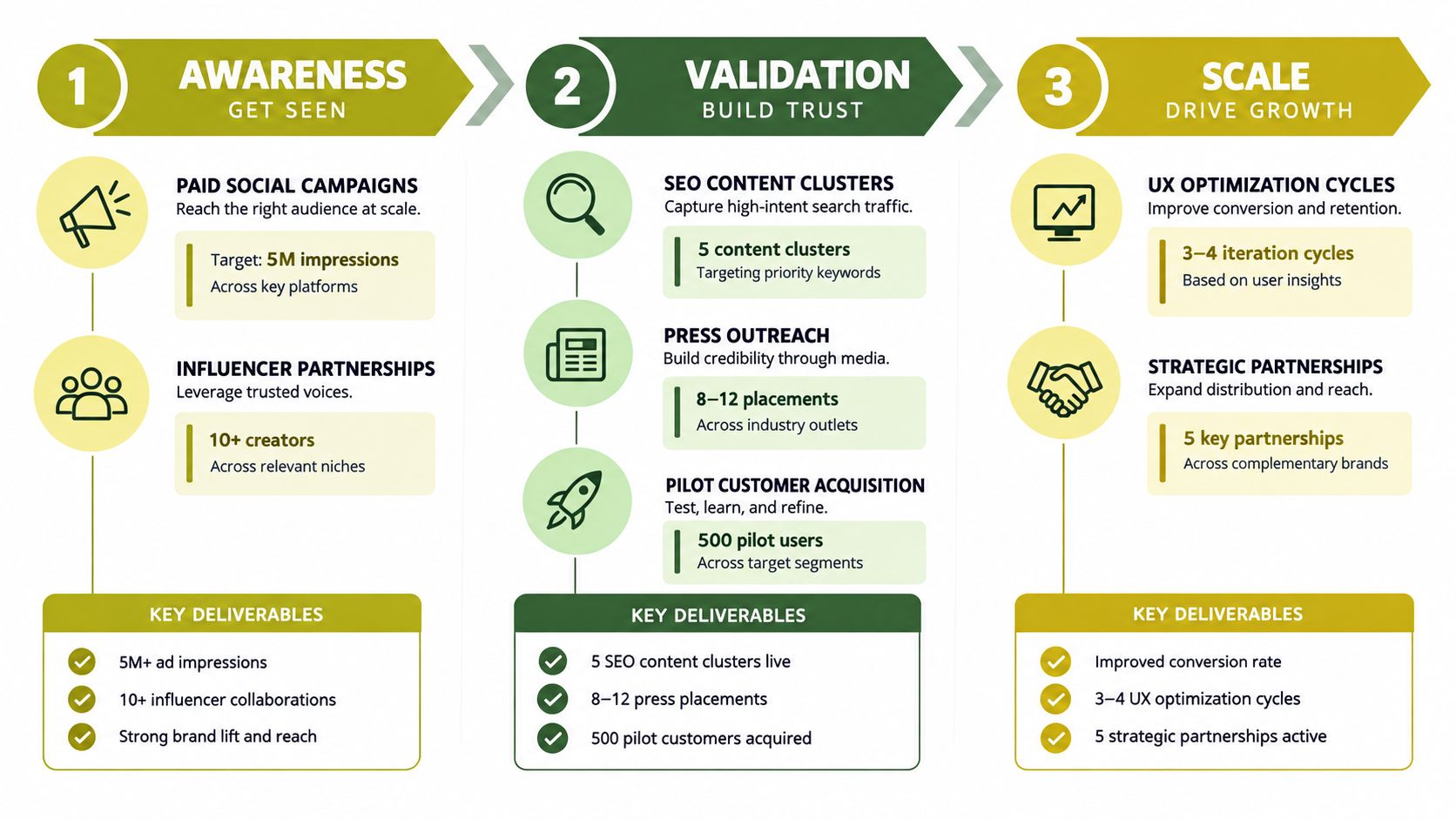
Validation tests the commercial message
Use lifecycle email, retargeting and partner placements to test whether interest becomes action. Build content clusters around the questions that appeared in sales calls and search research. Localise currency, contact routes, terminology, proof points and compliance explanations before blaming acquisition for weak conversion.
UX work should remove uncertainty at the point of decision. Show delivery conditions, payment options, service coverage, returns, customer support and relevant credentials in plain language. For an ecommerce use case, the same principle applies to product information, checkout clarity and post-purchase communication.
A practical validation threshold might require a defined volume of qualified enquiries, a credible trial-to-meeting conversion or a repeatable partner referral route. The exact threshold belongs in the commercial model. What matters is that the team agrees it before interpreting early results.
Scale only after the system works
Once the proposition converts, digital PR can earn authoritative links and coverage, programmatic SEO can expand proven topic patterns and channel partnerships can reduce reliance on paid acquisition. The owned, earned and paid media approach keeps those channels connected rather than treating them as separate campaigns.
The specialist Scottish-led PR and digital agency behind this advice works with teams in London and Glasgow, combining senior counsel with a leaner agency structure. Everyone working there is either a former national news journalist or has agency experience working with international brands, which gives clients access to newsroom judgement alongside digital execution.
Evidence before expansion: Increase spend when the market responds to the offer, not simply because the campaign has reached its launch date.
Entry Playbooks for Startups, Tourism and Regulated Sectors
The framework changes shape depending on what the organisation sells and what can go wrong. A software startup can often learn through a landing page and partner conversation. A tourism brand must connect digital discovery to a physical experience. A regulated firm may be unable to promote an offer until legal permissions and approved claims are in place.
Three operating patterns
A startup should protect speed and optionality. Test a sharply defined use case, recruit a small group of credible design partners and use a UK entity wrapper where appropriate. Partner-led distribution can reveal local buying practices without forcing the company to hire a full market team immediately. Its go-or-no-go evidence should include sales-cycle quality, activation, retention signals and the cost of supporting the customer.
Tourism and hospitality businesses need to treat distribution and reputation as part of the product. Online travel agencies, destination organisations, travel media, review platforms and local partnerships can generate demand, but the guest experience determines whether that demand becomes advocacy. SEO should cover practical trip-planning questions, while PR should sell a distinctive reason to visit rather than repeat generic destination language.
A fintech, health or legal firm has a different sequence. FCA or CQC scrutiny, mandatory compliance filings, sector permissions and consumer duty obligations can determine whether a campaign is lawful and credible. Approved messaging, complaints handling, data processes and trained staff need to exist before media activity creates public demand.
| Dimension | Startup | Tourism / Hospitality | Regulated Sector |
|---|---|---|---|
| First test | Landing page, interviews and partner conversations | Distribution partner and bookable experience | Regulatory feasibility and approved proposition |
| Primary risk | Building before finding repeatable demand | Promising an experience the operation can't deliver | Breaching rules through product or promotion |
| Strongest channel | Founder outreach, specialist content and partnerships | Travel PR, destination search and review platforms | Trusted expertise, professional referrals and compliant content |
| Evidence quality | Real usage and qualified pipeline | Bookings, partner referrals and guest feedback | Permission, documented controls and compliant customer outcomes |
| Go decision | Repeatable acquisition and support model | Profitable demand with reliable capacity | Legal clearance, operational controls and sustainable economics |
The acceptable evidence differs too. A startup can learn from a controlled conversation. A regulated firm needs documented advice, formal sign-off and an audit trail. Treating both organisations as if they need the same launch plan is how teams either move too slowly or take unacceptable risk.
Risk and Compliance Considerations UK Firms Cannot Ignore
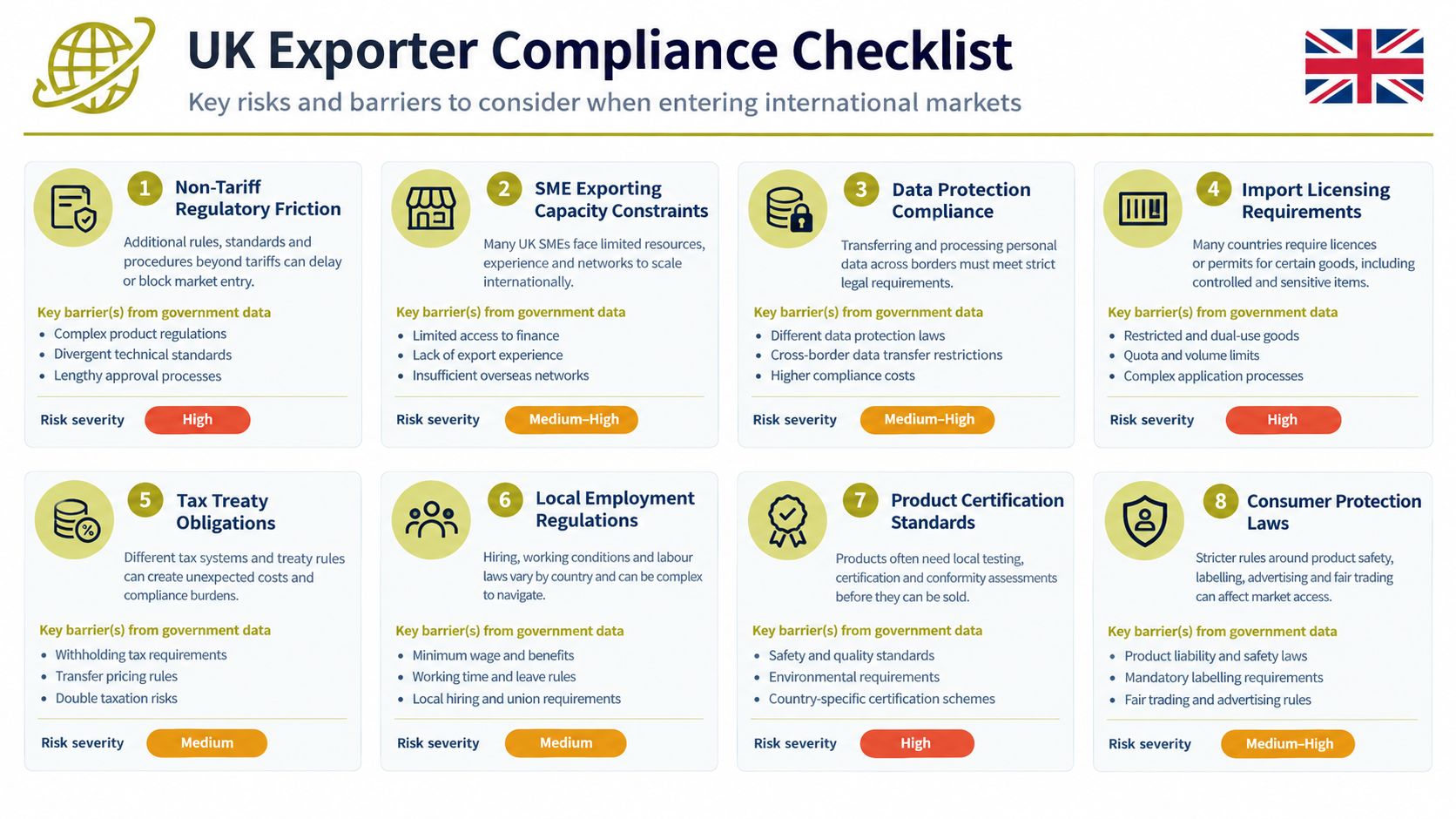
Regulatory friction isn't an administrative footnote. It can determine the sequence, cost and credibility of entry. UK firms must consider product compliance, data protection, import licensing, tax, employment rules, consumer protection and sector-specific permissions before public demand exposes weaknesses.
The scale of the challenge is visible in the UK market access barrier statistics for 2025 to 2026. The data records 394 barriers in FYE 2025 and 323 in FYE 2026, while the UK Trade Strategy says 98 barriers were resolved between July 2024 and March 2025. For smaller exporters, local knowledge is also material. FSB-linked research found 49% of current and would-be exporters regarded knowledge of local regulations as key to competitiveness, while 42% cited low delivery costs, as summarised in the government barrier evidence.
Execution capacity creates another constraint. Santander's Autumn 2025 barometer found 53% of UK firms said lack of talent held back expansion, while 48% of non-international firms cited economic and political uncertainty and 47% cited unfamiliar or divergent regulation, according to the Santander Trade Barometer.
Build a compliance pre-flight
Before the pilot, assign owners for:
- Product standards: Confirm certification, labelling and technical documentation requirements.
- Data protection: Map personal data, lawful bases, processors, transfers and local obligations.
- Import and tax: Check customs declarations, VAT treatment, duties, invoicing and payment flows.
- Employment: Clarify whether staff, contractors or partners create local employment responsibilities.
- Consumer rules: Review cancellation, warranties, complaints, advertising and accessibility expectations.
- Operational safety: Document risk assessments, incident procedures and any specialist support. An SME may consider outsourced health and safety where internal capability is limited.
- Reputation: Prepare approved claims, spokesperson guidance and a response route before launch. Legal crisis management can sit alongside the operational plan where public scrutiny is material.
A pilot should have a compliance owner, evidence folder, escalation route and stop condition. Marketing can't compensate for a missing licence, an unclear returns policy or a delivery promise the operations team can't keep.
Budget, Timeline and Go or No-Go Decision Points
A market entry budget should make failure affordable. Separate one-off work, such as legal set-up and localisation, from recurring commitments, such as media relations, paid acquisition, partner fees and customer support. Don't spend the whole pot on launch activity before the organisation has tested demand and delivery economics.
The table below is a planning template rather than a claim about what every business should spend. Use the tier that matches the approved entry pot, then replace each cell with supplier quotes, internal staff cost and a documented contingency.
| Workstream | £200k tier | £500k tier | £1m tier |
|---|---|---|---|
| Market research | Focused segment, buyer and competitor validation | Multi-market research with customer and partner work | Extensive research, fieldwork and specialist analysis |
| Regulatory setup | Priority legal and compliance checks | Broader registrations, advice and process design | Full market operating model, specialist counsel and assurance |
| PR and content | Core messaging, media relations and localised assets | Ongoing content programme and sector campaigns | Multi-market newsroom, thought leadership and digital PR |
| Paid digital | Controlled tests with strict stop rules | Validated acquisition across priority audiences | Scaled acquisition with continuous experimentation |
| Local partnerships | A small number of carefully screened partners | Structured partner development and enablement | Wider network, co-marketing and channel management |
Use four decision gates
Weeks 1 to 4, scoping: Confirm the addressable segment, friction score, delivery model, compliance questions and first hypothesis. Stop if the team can't identify a buyer, route to market or responsible owner.
Weeks 5 to 12, validation: Run the localised landing page, buyer conversations, partner outreach and limited PR or paid tests. Continue only when the evidence shows qualified demand and an operationally credible route to fulfilment.
Months 4 to 8, controlled launch: Expand the offer carefully, monitor acquisition cost, conversion, payback, delivery margin, complaints and partner-sourced pipeline. A weak signal in one channel should trigger a message or route-to-market test, not automatic budget growth.
Months 9 to 12, scale or pause: Scale when the commercial model is repeatable and the team can support additional demand. Pivot when the market responds but the channel or proposition is wrong. Pause when demand, economics or compliance remain unresolved.
Keep the gates reversible. A calendar milestone is not evidence. Qualified leads, organic sessions from the right audience, relevant press mentions, partner-sourced opportunities and conversion quality are evidence.
Pulling the Strategy Together
A market entry strategy is an operating decision, not a growth slogan. Rank candidate markets by regulatory friction, delivery economics and execution capability before letting size or proximity influence the shortlist.
Sequence PR, SEO, UX and partnerships according to the evidence each stage should produce. Awareness should clarify the proposition, validation should prove commercial response and scale should improve the economics of a system that already works.
This week, list the three markets under consideration. Score each for friction, delivery economics and team capability, then choose the market with the lowest weighted friction where the business can credibly operate in month one. Build the channel plan around that ranking, not the other way around.
Carlos Alba Media provides senior-level PR, digital marketing, SEO, UX and media strategy for SMEs, tourism brands and regulated organisations entering new markets. If you need to turn market evidence into positioning, coverage and measurable digital activity, visit Carlos Alba Media to discuss the next practical test.