
You know the moment. A competitor puts out a polished announcement, a journalist runs with it, and by the time your team notices, the story's already being quoted in the trade press, discussed on LinkedIn, and folded into buyer conversations. For a Scottish SME, that can feel less like a marketing miss and more like being locked out of your own market.
Competitive intelligence is the habit that stops that happening so often. It gives a founder, a marketing lead, or a PR manager a repeatable way to spot moves early, read the room properly, and react while the window is still open. For a useful primer on the marketing side of the discipline, intelligence gathering for marketing teams is a helpful starting point because it treats monitoring as an ongoing business habit, not a one-off research task.
The Moment a Smaller Competitor Beat You to the Story
A rival launches first. A reporter takes their call. Your team sees the coverage in the afternoon and suddenly the sales call that was meant to belong to you becomes a comparison exercise. That's the practical pain point that pushes most founders toward competitive intelligence, even if they've never used the term before.
For small firms, the problem isn't lack of effort. It's that the market moves faster than the internal rhythm of many teams. Campaigns, pricing changes, press releases, product tweaks, and social posts can all land in the same week, and if nobody is watching the right signals, the competitor defines the conversation first.
That's why the smartest SMEs treat competitive intelligence like a newsroom treats rival publications. The question isn't, “What did they publish?” It's, “What does it mean, what comes next, and how do we respond before the cycle closes?”
Practical rule: if the competitor story reaches customers before your response does, you've already lost the first round.
The point of this guide is simple. It shows how a smaller business can build a lightweight, repeatable intelligence habit without hiring a research department. It's written for founders, marketers, and agency-side teams who need a weekly system that helps them protect reputation, spot coverage opportunities, and avoid being surprised by the market.
What Competitive Intelligence Actually Means for an SME
Industry guidance describes CI as the collection and analysis of openly available information on competitors, customers, industry trends, and market dynamics, using methods such as market research, competitor analysis, industry analysis, web monitoring, and primary research. That matters because the ethical boundary is clear from the start. Competitive intelligence is not covert collection, it's disciplined use of public evidence. The LexisNexis glossary frames it exactly that way in its definition of competitive intelligence.
For a small business, the easiest way to understand it is to think of a news desk tracking rival outlets. Editors don't sit around collecting everything. They watch specific beats, verify what changed, and decide whether the change is worth a headline, a follow-up, or no action at all. CI works the same way. You are not building an archive for its own sake, you're building a decision system.
Why it isn't just competitor research
A one-off spreadsheet of rival prices or messaging can be useful, but it goes stale quickly. Continuous monitoring is different because it catches the movement, not just the snapshot. That's especially important in the UK, where regulatory updates, local coverage, and regional competition can change fast enough to make annual reviews feel out of date before they're finished.
The practical distinction is this. Research tells you what a competitor looked like last month. Intelligence tells you what they're becoming, and what that means for your next move. The idea of updating CI regularly is consistent with established guidance that recommends treating it as a recurring process rather than a one-off report, with weekly refreshes helping teams track change over time.
Intelligence is only useful when it changes a decision.
For the rest of this article, competitive intelligence means an ongoing, ethical process of gathering public evidence, comparing it across sources, and turning it into a practical action, whether that action is a pitch, a press response, a product tweak, or a warning for leadership.
Why Competitive Intelligence Has Become a Strategic Necessity
A Scottish founder can feel this shift in one very ordinary week. A rival announces a partnership before your team has finished drafting its own release, a trade title quotes their director before yours gets a callback, and by Friday your sales calls are already being shaped by language you never saw coming. That is why competitive intelligence has moved from a specialist corporate function into a mainstream business habit, because decision-making now depends on externally sourced market signals as much as internal instinct.
The scale of that change is easy to miss if you only look at your own inbox. A widely cited industry estimate says 9 out of 10 Fortune 500 companies use competitive intelligence, and the same source projects the global CI market will exceed $35 billion by 2026. Those figures are not UK-only, but they still matter to Scottish SMEs because they show the standard set by the firms you compete with in broader markets, and Ranktracker's 2024 competitive intelligence overview captures that shift clearly.
For a five to twenty-person team, the trade-off is plain. Larger peers are watching the market continuously, so if you go quiet for weeks at a time you end up reacting with less context and more guesswork. That affects pricing, media readiness, sales confidence, and the speed at which leadership spots risk. It also affects reputation, because the first competitor story that lands in a journalist's inbox often shapes the frame everyone else has to work against.
The real pressure points for SMEs
CI matters more now because competitor publishing cycles are faster, and the signals travel further. A routine update on social media can become visible within hours, and AI-assisted workflows make it easier for competitors to produce more content, test more positioning, and change more often. The hidden factor in AI competition is not just technology, it is risk tolerance. Some firms are willing to try more, fail in public, and move faster than the businesses trying to perfect every message before they release it.
That creates a real practical problem for SMEs. A tourism brand needs to know who is winning the story before the booking window closes. A professional services firm needs to spot narrative shifts before clients start treating them as expertise gaps. A tech company needs to catch product and positioning changes before prospects start repeating a rival's language in demos, procurement calls, or board discussions. These are not abstract monitoring exercises. They are the moments where one missed signal can change the tone of a sales conversation or a journalist's angle.
There is also a difference between copying competitors and studying them properly. A useful framework should not just log what rivals say, it should show what that means for your own positioning, which is why a structured approach such as intelligence gathering for marketing teams helps small businesses decide which signals deserve attention and which can be ignored.
That is why the old model, a quarterly competitor review buried in a slide deck, falls short. Smaller firms do not need enterprise bureaucracy, but they do need a regular habit of watching the signals that matter and deciding what each change means for pricing, messaging, media, and sales. In practice, that means a lightweight system that keeps pace with the market without requiring a full-time analyst.
A Five-Step Workflow Any SME Can Run in a Few Hours a Week
A workable CI system starts narrow. The biggest mistake small teams make is trying to monitor everything, which creates noise, not intelligence. The better move is to define one question, choose the few sources that answer it, and review them on a fixed rhythm.
Step 1 Define one decision question
Start with the business choice you need to make. That could be, “Which rival is most likely to win the next trade feature?” or “Who's changing pricing in a way that could affect our sales calls?” The point is to give your monitoring a job.
Step 2 List the direct competitors only
Keep the first pass tight. Three to five rivals is enough for most SMEs. If the business is tourism, look at the operators fighting for the same regional coverage. If it's tech, focus on the products your prospects mention in demos and discovery calls.
Step 3 Pick the signal categories
Monitor the things that tend to move first, not the things that look impressive in a dashboard. That usually means:
- Press releases and website updates, because they often show launches, hires, and partnerships early.
- Job posts and hiring pages, because they can hint at expansion, product focus, or new markets.
- Reviews, complaints, and support pages, because they reveal customer friction before a brand admits it publicly.
- Social and newsroom coverage, because they show which messages are spreading and which are being ignored.
Step 4 Set alerts, then triage them
Use lightweight alerts on competitor names, product names, and key spokespersons. The Carlos Alba Media competitor analysis framework is a useful reminder that monitoring only becomes useful when it's tied to a decision structure, not when the inbox fills up.
Step 5 Hold a weekly thirty-minute review
A weekly review beats a quarterly deep dive for small teams because change compounds quickly. One person can scan, sort, and flag the meaningful shifts, then share a short summary with leadership or sales. That rhythm fits the newsroom model: assignment, sources, filing, review, publish.
Collecting data is not the same as understanding a move. The first gives you inputs, the second gives you an answer your team can use.
Putting CI to Work in Real PR and Media Scenarios
A good CI habit shows up in the moments when timing matters. The value isn't abstract, it's in the pitch that lands, the story angle that beats a rival, or the warning that lets leadership prepare before a change becomes public.
Tourism and broadcast coverage
A tourism brand spots a competitor landing a partnership with a national broadcaster. The clue isn't just the press release, it's the combination of the announcement, the journalist involved, and the language used in the coverage. The team responds within forty-eight hours with a sharper local angle, a stronger spokesperson, and a pitch that gives the same journalist a different story worth running. The result is not guaranteed coverage, but the brand is no longer waiting to be invited into the conversation. The practical playbook for getting that pitch ready is closely aligned with how to get press coverage.
Tech and launch timing
A tech SME monitors competitor reviews and customer comments, then notices repeated complaints about onboarding and support. That matters because it reveals where the rival is vulnerable and where buyers are already primed to pay attention. Instead of launching into a crowded message stream, the team times its announcement to answer the exact friction prospects are talking about.
Regulated sectors and early warning
A regulated brand keeps an eye on competitor filings, press cycles, and public statements. A small change in wording can point to a coming regulatory adjustment, or at least to how the market is preparing for one. That gives leadership time to brief spokespeople, update internal messaging, and avoid being caught flat-footed when the issue reaches the news.
The value in each case comes from editorial judgement. You're not just counting mentions. You're connecting the signal to the story buyers, journalists, and stakeholders are about to hear.
The Highest-Value Public Sources for UK-Facing CI
A smaller competitor can look quiet right up until the week it takes the press, the search terms, or the customer conversation away from you. That is why SMEs should rank public sources by cost, effort, and signal quality, then spend their time where change shows up first. The job is to triangulate, not to sit under a pile of tabs and hope a pattern appears.
Public source categories ranked for SME competitive intelligence
| Source category | Cost | Effort | Signal quality | Best for |
|---|---|---|---|---|
| Competitor-owned channels | Low | Low to medium | High | Product launches, messaging shifts, pricing cues |
| Third-party media | Low | Medium | High | Reputation moves, partnerships, market positioning |
| Regulator and government data | Low | Medium | High | Compliance shifts, filings, sector change |
| Customer voice | Low | Medium | Very high | Pain points, service gaps, sentiment trends |
| Recruitment signals | Low | Low | Medium to high | Expansion, capability changes, market intent |
Competitor websites, news releases, and social posts are the obvious first stop, but they are not always the best early signal on their own. Job ads can show strategic intent before a launch is public. Customer complaints can expose weaknesses before a polished campaign papers over them. That is why newsroom sourcing discipline matters. Corroborate, triangulate, and verify before you act.
For a useful SEO-adjacent angle on how rivals signal intent in their content, SemDash's competitive keyword guide is worth reading alongside your own search monitoring. It helps connect search behaviour to positioning shifts, which is especially useful when competitors start chasing the same terms.
The practical rule for smaller teams is simple. Start with four buckets, competitor channels, third-party media, customer voice, and recruitment signals. Add filings, patents, or industry reports only when the first layer is already producing enough signal to justify the extra work. If your team is also comparing monitoring software, a page like 10 reputation monitoring tools for SMEs in 2026 is a sensible next stop, because the right source mix depends on whether you need fast alerts, deeper analysis, or both.
The best public sources are usually the ones that look ordinary. A support complaint, a job ad, or a quiet wording change on a homepage can tell you more than a glossy campaign, because those signals are less rehearsed and often closer to what a competitor is doing.
KPIs and Reporting Rhythm That Prove CI Is Working
If competitive intelligence isn't changing decisions, it's just monitoring. That's why the reporting layer has to stay simple enough for a founder to read quickly and act on.
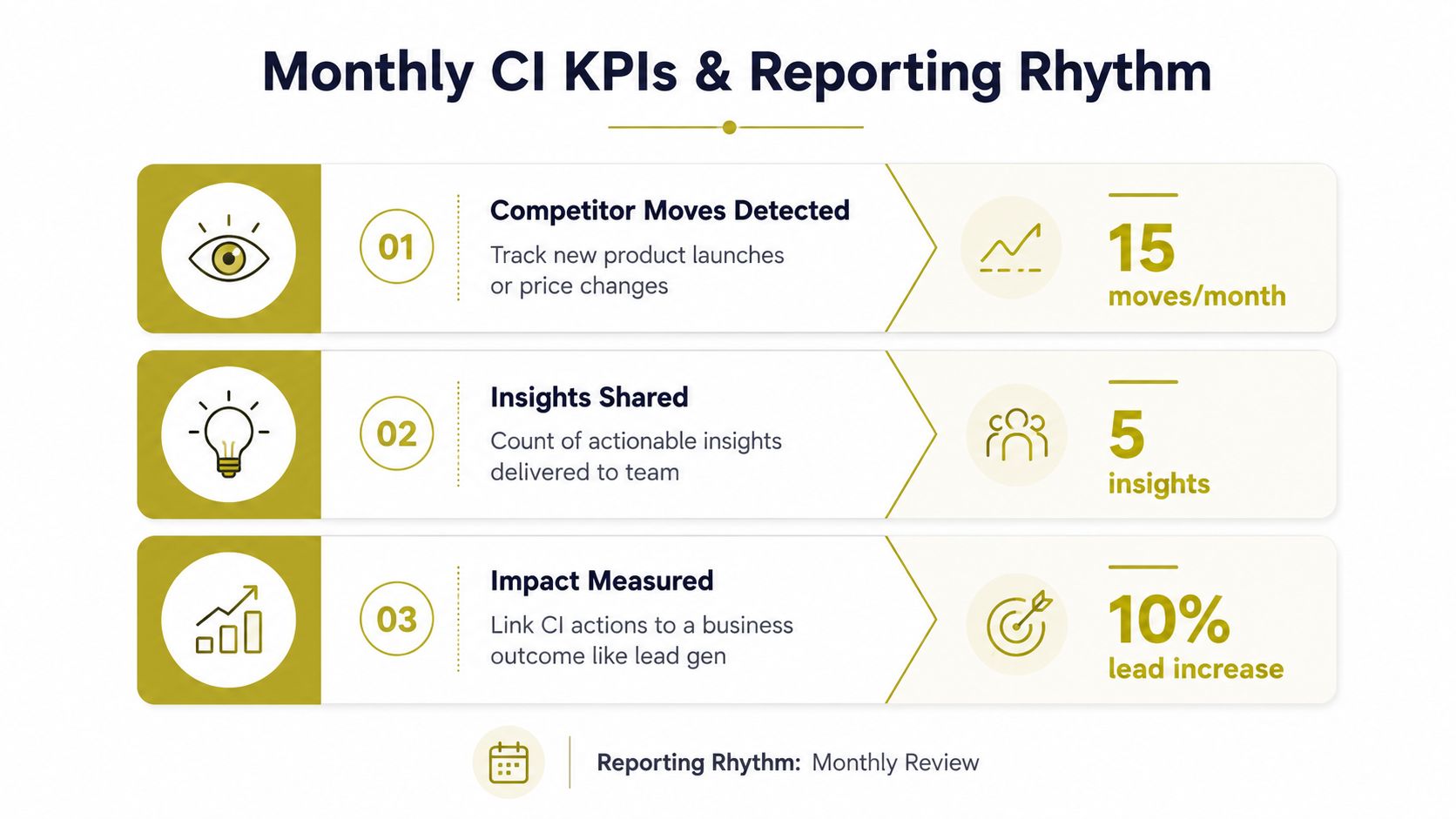
A tight KPI set for SMEs
Use a one-page monthly report and keep the measures tied to action. The most useful starting points are:
- Competitor moves detected, which shows whether the system is catching change.
- Insights shared, which tracks whether monitoring is being turned into something the team can use.
- Response time to competitor campaigns, which tells you whether your team is moving while the issue is still live.
- Win rate on contested pitches, which helps connect intelligence to commercial outcomes.
- Early-warning detections, which shows how often CI prevented a reactive scramble.
The report itself should be short. Put the new competitor moves at the top, note what changed, say why it matters, and record the action taken. If leadership can't see a decision attached to the insight, the metric is too vague.
How to run the rhythm
Review weekly, report monthly, and keep the language plain. A sales lead needs to know what changed in the market, a founder needs to know what demands attention, and a marketer needs to know which message to sharpen next.
If the insight doesn't change a pitch, a price, or a priority, it doesn't belong in the report.
As the programme matures, the KPI set can become more selective and more strategic. Early on, the goal is visibility. Later, the goal is anticipation.
Your First Thirty Days and Why a Newsroom Background Changes Everything
The first month should feel controlled, not ambitious. Pick three competitors, choose one decision question, and set up alerts on their websites, news releases, job posts, and social channels. Then run a weekly thirty-minute review and write one monthly summary that says what changed, why it matters, and what you'll do next.
The reason a newsroom-trained team changes the work is simple. Editorial discipline forces better sourcing, cleaner triage, and faster judgement. A journalist's instinct is to ask what's confirmed, what's noise, what's missing, and who needs to know before the next cycle turns.
That same discipline is what makes competitive intelligence useful for SMEs. It stops the process becoming a pile of screenshots and turns it into a habit that helps you win coverage, reduce reputational surprises, and brief leadership with confidence.

Start small, stay consistent, and treat every signal like a lead worth verifying.
If you want senior-level support turning market signals into sharper PR, stronger coverage, and a practical weekly intelligence rhythm, Carlos Alba Media can help. Visit Carlos Alba Media to see how a newsroom-trained Scottish team approaches strategy, reputation, and competitive insight with the speed SMEs need.